Feeds:
Posts
Comments

Archive for the ‘neuroscience’ Category

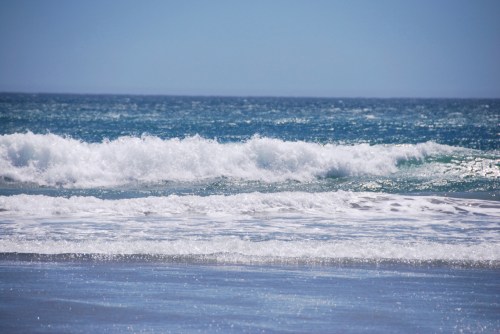
I can remember science lessons in High School where we studied waves. I thought they were fascinating. I still do. All kinds of waves. Waves in the sea

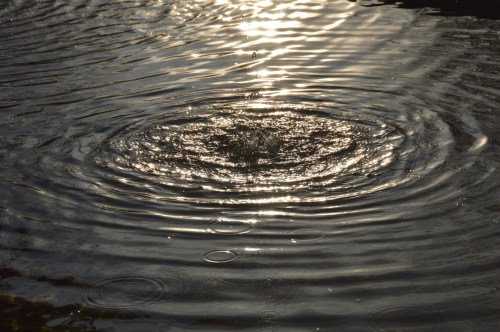
waves in a pond
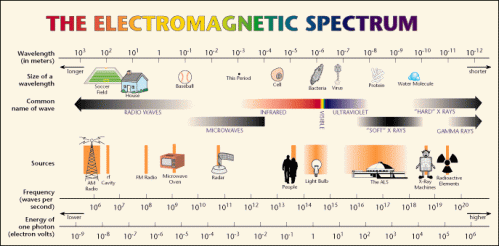
the electromagnetic spectrum which includes the light and colours we can see, the radio waves we can tune into and many other varieties of invisible waves which affect us.
the waves produced by our hearts and brains which we can’t see, but we can measure and represent on charts (did you know that when your heart rhythm emits a wave pattern which can influence the heart rhythms of people who are physically close to you? 

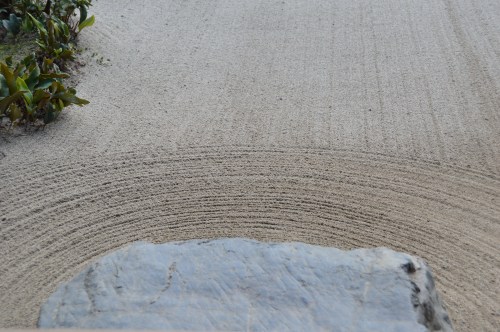
Even the representation of waves drawn in the stones in a temple or shrine (like the one at the start of this post).

Waves change us.

Waves carry energy and information.

As energy and information reaches into our bodies and minds it changes us.

I read the other day that “influencers” are having a hard time. Bear with me, I’m 66 next month, and “social media influencers” are not my specialist subject, but as best I can tell people who make a living from advertising and marketing revenues from companies by sharing pictures and videos of themselves wearing or using those companies’ products have seen a sharp decline in their income.

Seems one of the things during this pandemic is that people are consuming less “stuff”. Well, given that around the world millions of shops are closed and production lines are at a standstill, maybe this is no surprise. But there’s another element to this story which seems to be a sort of re-evaluation that’s going on. Less people seem interested in the lives of “celebrities” (ie people who are famous for being famous) just now. Priorities and values are changing.

However you want to look at this, the underlying reality is that we are all influencers. There is nothing I do, from the breaths I take, to the beating of my heart, to the communications I make and the behaviours I show, which doesn’t change the world. OK, yes, of course, not the whole world! Well, probably a very small part of the world actually. But collectively we are all influencers.

We send out materials, energy and information into the world constantly. Unceasingly.

What materials do you send out? What “waste” do you produce and what do you do with it?

What energy do you send out? How does that energy affect your relationships?

What information do you send out? What are your messages? How do you say them? Are they based on kindness or hate? Hope or fear? Anger or Joy?

You cannot escape being an influencer.

The question is – what waves are we making? You and I.
Read Full Post »

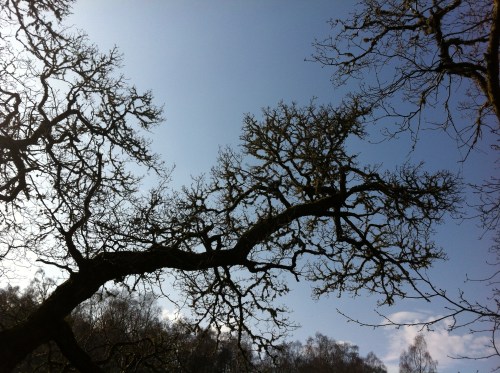
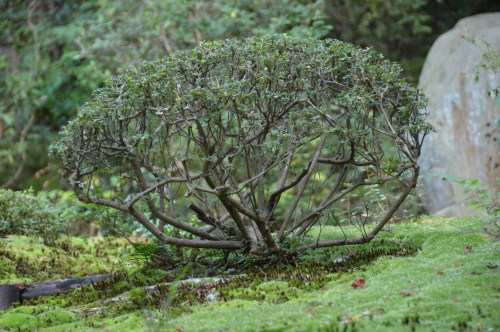
There’s something of this shrub that makes me think about the human brain. The leafy cortex forming a curved border and the mesh of branches, twigs and stems which look a bit like a neural net.

Deleuze and Maturna wrote about two common models we use to organise our world view – the arboreal and the rhizomal. They described how we use the former to create tree structures everywhere…..those hierarchical constantly branching sets of binary choices. Think of a genealogy chart, and how we refer to it as a “family tree”. But think also of “organisation charts” which lay out the positions within a company, and show the power flows, with the “Chief Executive Officer” at the top. We see it in protocols, guidelines and algorithms, which proscribe the actions to take at every point to get from a starting position to an “outcome” or “goal”.

I love trees, but “arboreal” models of thought and world view make me uneasy. They are too binary for me. At every stage you can go this way or that way, and there is often an implication that there is only one way which is the right way. It assumes that the starting conditions are exactly as the author expects them to be, and the goals or outcomes which the model maker identifies are the best, or most relevant, or most “efficient” ones, so everyone should share them. Like all models the people who make them have certain values, beliefs and world views, but, rarely are those things made explicit. They are also too hierarchical for me. I’m not a fan of strongly hierarchical, centralised power structures.

On the other hand, there is something very appealing about these tree-like diagrams. I probably drew little family trees every working day. I found it helpful to chart a patient’s relationships, siblings, parents, grandparents, partners and children. They often revealed patterns which shone a light on this patient’s illness. And there is no denying the tree-like branching structures within the body – particularly in the lungs and the circulatory system, but not only there.

In Jacques Tassin’s “Pour un Ecologie du Sensible”, he uses a variety of metaphors to show how interconnected all of life is. One of his metaphors is the tree. He says all life is like an invisible tree rooted in the Earth, each branch, each leaf a living being, a part of the same tree. I like that. If each of us is a single leaf, then, obviously we are connected to every other leaf through the over all structure of the tree. I also like his reference to the roots, which we usually don’t see, because it seems very true that we are vastly interconnected in invisible ways.

The rhizome model is more like grass. There isn’t a single trunk, or root. It’s massively interconnected. It’s a “distributed network” as opposed to a “hierarchical structure”. The brain is probably more like that. Every one of our millions and millions of neurones makes up to 50,000 connections with other neurones. Trees don’t do that. I find the network model very appealing. I love the way it reveals a multiplicity of equally “good” pathways. I love how it doesn’t pre-determine either the starting points or the end points. In fact, it’s kind of impossible to see where a brain begins and ends. It’s not even fenced off in the skull!

When I look at this shrub, then, I actually see elements of both of these models – the branching tree structure, and the presence of multiple, connected pathways.

OK, maybe only up to a point, but, hey, at the end of the day, it’s a pretty appealing and inspirational shrub!

Read Full Post »

One day you finally knew

what you had to do, and began


One day I was walking in a forest and I came across this signpost. Clearly, this was the way to go….

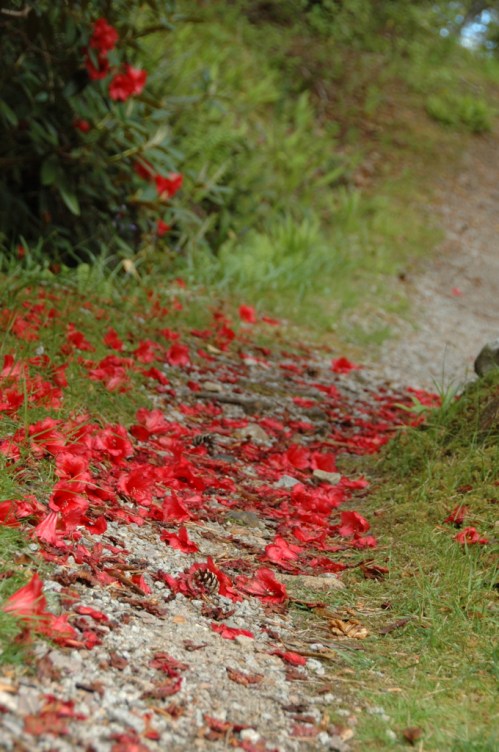
I followed the path strewn with blood red petals, but I didn’t know where it would take me.

Mary Oliver, in The Journey, the beginning of which I quoted above, continued her journey…

It was already late

enough, and a wild night,

and the road full of fallen

branches and stones.

I turned a corner, and there before me I saw…..

…red petals cascading down a slope, and rising high up into the canopy of the trees. Maybe this is what I came to see? But I carried on….

as you strode deeper and deeper

into the world,

determined to do

the only thing you could do –

determined to save

the only life that you could save.


Eventually, I found this….

…the heart of the wood.

So, this is how it is, isn’t it?

We don’t need a “goal”, or an “outcome”. We don’t need to “get” or “consume” anything in particular.

What we need to do, is find our heart.

This is as good a time as any to listen, and find out if you can hear what your heart is telling you.

We have access to more than one kind of intelligence. Not just the rational intelligence of the analytic left cerebral hemisphere in the brain, but the emotional intelligence of the heart.

You think that’s fanciful? Or just a nice metaphor?

I don’t think so.

It turns out we have a network of neurones, yes, neurones, the specialist kind of cell you find in a human brain, around the heart. There is a neural network around the heart. Apparently, the nerve connections between the brain and the heart are not just about the brain regulating the heart, they are two way. Our heart informs our brain.

And emotions? Those deep, intense embodied rivers of information and activity which course through the depths of our very being…..are they something supplementary? Are they something inferior in some way to our thoughts?

I don’t think so.

Our emotions are the organising, adaptive strategies which have evolved to enable us to survive and to thrive.

As the fox said to the Little Prince – “what is essential is invisible to the eye”.

Here’s Mary Oliver’s poem, The Journey, in full –

One day you finally knew
what you had to do, and began,
though the voices around you
kept shouting
their bad advice–
though the whole house
began to tremble
and you felt the old tug
at your ankles.
“Mend my life!”
each voice cried.
But you didn’t stop.
You knew what you had to do,
though the wind pried
with its stiff fingers
at the very foundations,
though their melancholy
was terrible.
It was already late
enough, and a wild night,
and the road full of fallen
branches and stones.
But little by little,
as you left their voices behind,
the stars began to burn
through the sheets of clouds,
and there was a new voice
which you slowly
recognized as your own,
that kept you company
as you strode deeper and deeper
into the world,
determined to do
the only thing you could do–
determined to save
the only life you could save.

Read Full Post »

This is probably one of the most familiar shapes you know. We humans evolved from a life in the trees and both individual trees and whole forests hold a lot of meaning for us. In fact, you could probably argue that these are such familiar forms that we pass them by, almost, or even completely, un-noticed.

Trees are the lungs of the Earth. They capture the carbon dioxide in the air, extract the carbon, and push oxygen out into the atmosphere. See this shape? Inside your lungs you can see pretty much the same pattern. The difference is that trees produce individual leaves along their smaller branches, but our lungs end in what look like little bunches of grapes. Both these structures are designed to present the maximum surface area to the air. This particular form maximises exchange. In the trees it maximises their ability to capture carbon dioxide and sunlight, and to send out oxygen. In humans it maximises our ability to get oxygen out of the air and into our blood, and to get carbon dioxide out of the blood and into the air. Nice symmetry, huh?

We use this same tree-like structure to organise our knowledge too. Think of genealogy, using what we even call a “family tree”. Or of any system of classification, which breaks the whole field down into ever bifurcating, diverging parts. You’ll have used that too when you make an outline to help you plan a document, each chapter divided into sections and each section divided into subsections and so on…

But there is a limitation to this model. It is based on separation. At every stage there are more and more divisions. By the time you get out onto the twig at the end of a branch it seems to be connected only by traveling back along the twig, branch and trunk, retracing the divisions to bring the flow together – just like you see as the many streams and little rivers flow together towards an estuary.

This separation is true. It’s a fundamental characteristic of reality. But there’s another form just as fundamental, which maybe we neglect.

The web of nodes and links.

In networks we see a different way of connecting. The human brain has more specialised cells (neurones) than anyone can count….it’s billions – can you imagine what billions of anything look like? It’s pretty hard. But wait, it gets even more mind boggling than that. Every single one of these neurones establishes direct connections (synapses) with thousands of others. Thousands. That means the total number of connections in the brain is in the trillions…..nope, I can’t imagine what that looks like either!

There are networks everywhere in Nature. From inside our bodies and brains, to local ecosystems, to the entire “biosphere” of planet Earth.

I’m fascinated by networks and I’ve written a few posts which gather together some of the most influential books I’ve read on this subject. Have a look at this, at this, or this.

The thing is the tree-model isn’t the only one which helps us to understand Life, the network model is needed too. I find that a lot. It’s not a matter of “either/or” it’s a matter of “and”.

That’s become my mantra – “And not Or”.

It helps me to focus on the connections, to understand what holds opposites together, and to keep returning to the perspective of the whole…..whether that is a whole, unique patient, or a whole, unique Earth.

Read Full Post »

What colour is the sea?

Blue?

Like the sky?

Green?

Like grass?

White?

Like clouds?

What colour is the sand?

Yellow?

Like lemons?

Grey?

Like stone?

Blue?

Like the sky?

Here’s one thing I’ve found….the more I pay attention to the particular, the more I see (or hear, or smell, or taste, or feel)

We use our left cerebral hemispheres to focus on parts or aspects, label them, categorise them….which is all useful of course, but if we leave it at that we stop seeing reality as it really is.

We need to reintegrate that information into the right cerebral hemisphere to see its contexts, its connections and relationships to everything else. Only then do we experience the particular, the uniqueness of all that is real.

I found that in my work with patients. It was never enough to apply the diagnostic label and think of the patient as just an example of that – whether that be a “diabetic”, an “asthmatic”, or whatever. I had to pay attention to the specifics, to this particular patient’s unique story. Only then could I experience the reality of who they were and understand what they were experiencing.

So, here’s something to try today. Slow down and take your time to pay attention. Explore, as much as possible without labelling. Or, actually, it’s pretty tough not to label, so once you apply the label, just say to yourself, ok, this is an apple (or whatever it is you are exploring), but then, what colours do I see, what textures do I feel, what scents do I smell, what sounds do I hear as I interact with it (turning it over in your hand, running your fingertips over its surface, biting into it…..only if you are exploring something edible of course!)

You get the idea?

Pick anything you like. An object, a song, a view, a flavour, a scent, a sensation. Slow down, pay attention, notice the labels which pop into your head, then continue to explore.

Allow yourself to experience the diversity of the unique.

Read Full Post »

Quite a lot of people, me included, are saying this pandemic is throwing a light on certain things – how fragile our systems of health care and social care, how poor the safety nets are, how interconnected the world is, how the instincts to collaborate and connect are so strong in human beings, how much we humans move around the Earth……[add you own here]

But today I stumbled across some old photos of reflections and I realised that the reflections are a different sort of light.

A direct light brightens and maybe even makes more clear the object it is shining on. That’s useful. Though it immediately brings to my mind that question I have about Scandi-noir crime drama – why does the (usually female) detective always go down into the basement or the abandoned warehouse at night, all alone, with just a torch to light up little bits of the room? Well, I suspect I know the answer to that one already.

Reflections are different.

They turn things upside down.

They give us an unusual and different take on reality, which lets us see beyond what the light is illuminating.

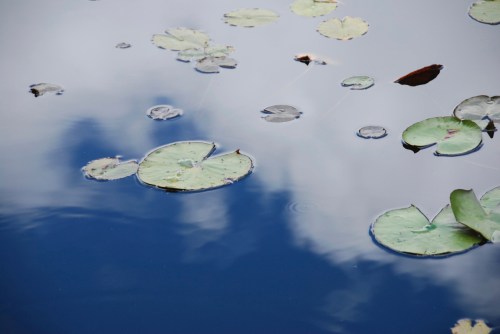
Look at this one, for example –

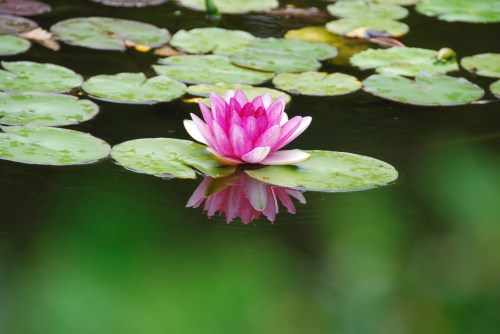
lily leaves on a still pond which is reflecting the blue sky and some clouds.

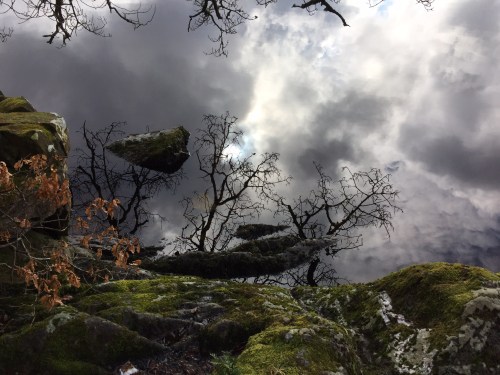
Or this one –

the edge of a Scottish loch where the still water is reflecting the clouds

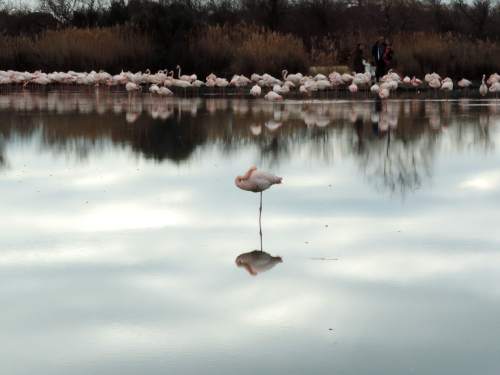
Or, this one –

the solitary flamingo doubled by the water’s surface

In all these cases the reflection does something special I think.

It literally turns something upside down which immediately makes us look more carefully.

It changes our perspective whilst keeping our default one. In other words, it increases our perception and understanding by doubling our perspectives.

It shows us connections we were happy to ignore as long as we focused solely on the central subject. It connects the sky to the water, the water in the clouds to the water in the loch, for example, reminding us of these cycles and links and interconnections which are the most fundamental characteristic of Nature.

It increases our experience of beauty. Each of these photos could have been beautiful without the reflections, but I think that including the reflections make them exponentially more beautiful.

All of which brings me to my main thought today – shining a light on something helps us to understand it, promotes analysis and clarifies what has been obscure or forgotten. Reflecting adds in something completely different – it promotes our perception and understanding by changing our perspective, highlighting the connections, and increasing our senses of wonder and delight.

“And not or” is my moto – analyse and reflect. Actually, as I write that sentence I’m reminded of Iain McGilchrist’s Divided Brain thesis and how the left cerebral hemisphere is great for zooming in, analysing and cataloguing, while the right seeks out the connections, the specific and the unique.


Read Full Post »

The phrase “everything is connected” immediately appeals to me and strikes me as true.

The first thing I think of is the human being.

Although I was taught Medicine in parts, learning about cells, tissues, organs and even systems separately, it was an almost unspoken given that all the parts were connected. In Second Year of Medicine at the University of Edinburgh, one of the main subjects was Anatomy and we were put into groups of six to spend a year dissecting a human body. Our guide was a three volume textbook, “Cunnigham’s Manual of Practical Anatomy”, along with “Gray’s Anatomy” (probably the most beautiful textbook I ever possessed). I was a bit overwhelmed with the sheer number of pages in these texts and asked one of the tutors “Which bits of this book do we need to learn?” He replied, “Which bits of human beings do you think patients will ask you about once you’re qualified?” “Ah, you mean we have to learn it ALL?” He smiled and walked away.

It would be a full two years after that before I met an actual live patient, but, hey, they don’t teach Medicine that way any more do they?

I don’t remember a single lecture about holism, but somehow it was a core value for me right from the start. However it was over a decade after graduation before I came across “Psychoneuroimmunology” and “Psychoneuroendrocrinology” which were fields of study looking at the connections between the Mind, the Nervous System, the Endocrine System and the Immune System. I think that’s where I first encountered a more holistic science, one focused on “systems” not “parts”.

It was much, much later when I encountered “Complex Adaptive Systems” and both “Chaos Theory” and “Complexity Science”. Somehow I think we are still in pretty early days of developing the sciences of the connections. But it sure still excites me!

As a GP I also had to be aware of the individual patient’s connections between themselves and the rest of the world….their relationships, their work, their housing, their family and so on. Those are threads you never quite get to the end of. I think that makes us humble, that knowing that we will never know all there is to know.

Sometimes it seems to me that our minds are like fractals, vast webs of mirrors reflecting similar patterns of reality to each other. Actually, as I write this I remember “Indra’s Net” – where every drop reflects every other drop. I think we humans are great at spotting patterns, and regularities, and that, combined with our ability to use metaphors and symbols enables us to appreciate the incredibly rich, dense nature of reality.

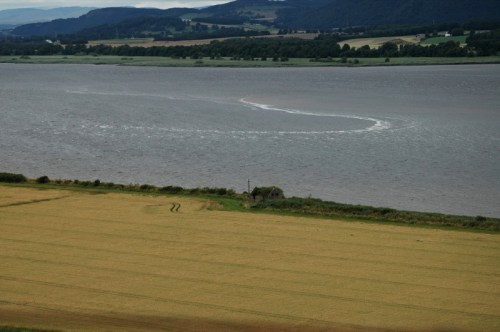
When I saw this shape on the surface of the water I wondered if it had been caused by a boat, or was it something lying on the river bed? But look at the shape drawn by the farmer who has been working this field. What a gorgeous echo of the shape on the river. One of the things that happens when we appreciate these connections is an experience of beauty and wonder intimately entwined.

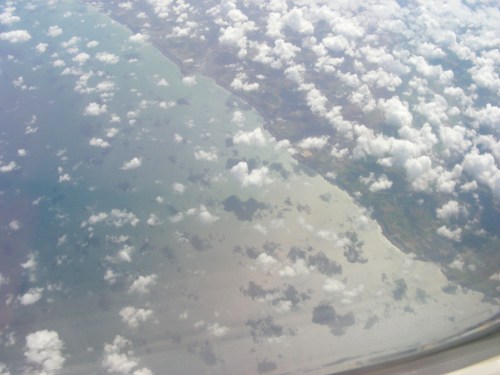
One time when flying over the English Channel, I looked down and saw the shadows of the clouds on the water’s surface just before the coast. Ooh, that still pleases me so much to contemplate this image! I love the fragility and impermanency of the little clouds. I love the even more ephemeral nature of their shadows on the Channel. And I love that transition of density of the clouds from the area above the water to the area above the land, how you can see in that the dynamic, ever moving dance of the land and the water and the air. Magic!

What connections have you spotted today?


Read Full Post »

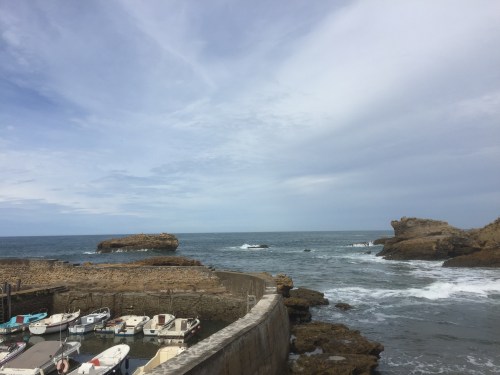
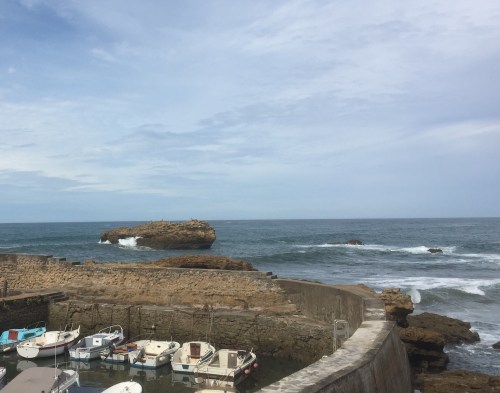
See this large rock just above the harbour in Biarritz? How does the sea make it to the shore when this rock is in the way?

The most obvious way is to go around it.

And that’s what most of the water does. It makes it way towards the shore, and back out to sea again by breaking against the rock and flowing around each side of it.

That’s one way to deal with an obstacle, with something standing in your way…..find a way around it.

But, wait, look at this…..

…the water has found another way as well.

It goes THROUGH the rock!

I suspect this has taken a very, very long time for wave after wave to make its way through a small crack in the rock, widening the gap slightly every time it passes through. But look at it now. Sometimes when a more substantial wave hits the far side of the rock it flows directly through the gap. Doesn’t happen every time. Just when the waves are big enough.

So, there’s the other solution. Keep going. Keep pushing up against the obstacle, looking for a gap, an opportunity, a way through, and once you find it, come back again and again. Each time, it’ll get easier. Each time the gap will get wider, the way will become broader.

Something else…..this is just beautiful to watch. Mesmerising even. Over the course of a few minutes you can see how the rock and the sea sculpt each other. It’s a delightful relationship.

Oh, and something else……Michel Serres, a French philosopher who died recently, used to describe human beings as “anticipation creatures”. I recently listened to an episode of one of my favourite podcasts, Onbeing, where the science journalist, Erik Vance, talked about “the drugs inside our head”. He was discussing the poorly understood but fundamentally important phenomenon known as the “placebo effect”, and one thing he said was that our brains are “prediction machines” (well, I hate the metaphor of “machine” applied to living organisms, but you get the point…).

Both Serres and Vance are talking about our incredible ability to spot patterns, so that we can predict the future. OK, not too far into the future, and not with 100% accuracy, but we don’t just notice the world, we anticipate it.

As I stood watching this phenomenon of the white surf gushing out of the mouth in the rock, I was quickly captured by the experience of anticipation, watching the swells on the surface of sea further out, trying to predict which would turn into waves big enough to pour through the rock.

It was hard to stop.

It was delightful.

Read Full Post »

We humans are pretty good at making maps. We do it all the time. Dr Dan Siegel, a psychiatrist and neuroscientist, describes the three commonest maps we make in the frontal cortex of the brain – a “me” map, a “you” map, and a “we” map. You might wonder about the use of the term “map” there, arguing that we create “images” rather than maps, but let’s not get bogged down on that one. I like both terms (one of my favourite principles in life is “and not or” – 🙂 )

The thing about a map is that it shows contexts and connections. It shows us where we are, where we might want to go, and helps us to imagine how to get there.

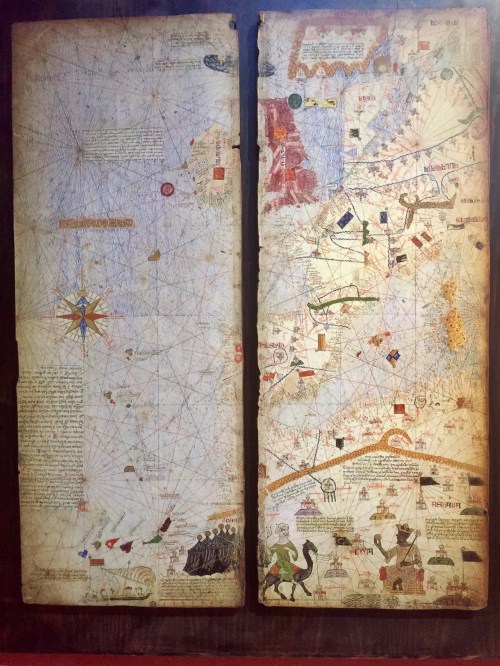
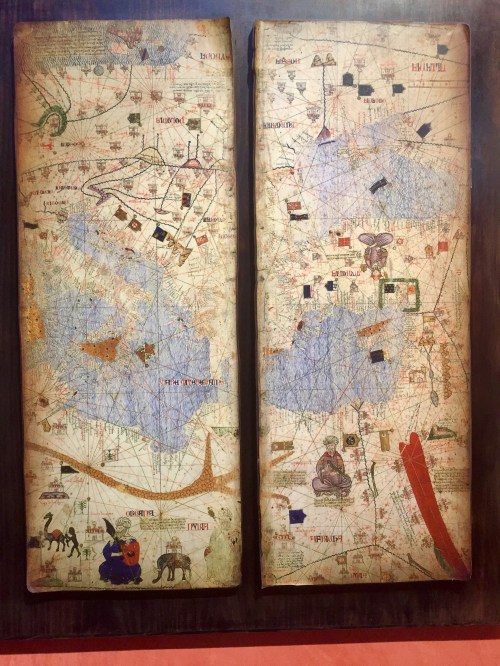
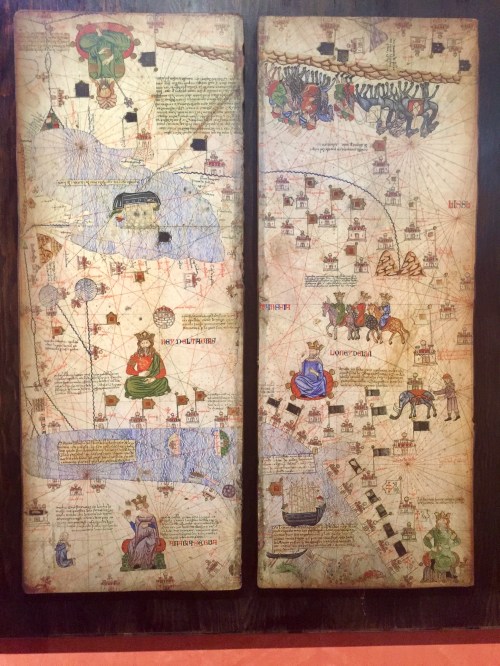
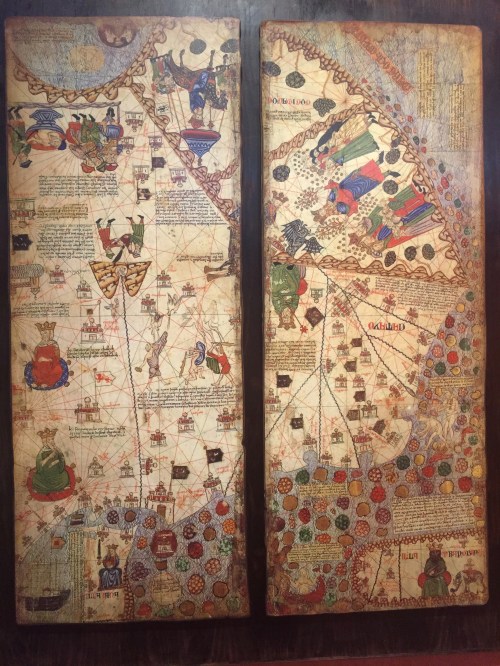
I was in Tordesillas, in Northern Spain, recently and visited the “Treaty House” which displays a number of ancient maps. Here’s one set which particularly grabbed my attention.

It’s a set of panels describing the known world at the time – the world of the “Occident” followed by a set describing the unknown world – the world of the “Orient”. Take a look –

In this first section you can clearly make out Britain (although Scotland hasn’t really become known yet!) and you can see the areas we now call Portugal, Spain, France, Scandinavia and so on.

The next one extends the first one to show Italy, Greece, Turkey, “The Middle East” and also more of the North African coastal countries.

For a medieval map it’s surprisingly accurate. It might even have helped people to find their way from one place to another.

But then check out these two panels of the “unknown”, “Orient” –

At first there are elements we recognise – The Nile, The Caspian Sea, but the further East we go, the more the map becomes an expression of a creative imagination.

Isn’t that fascinating?

I’ve never thought of mapping out what I don’t know before. After all, where would I stop? The older I get, the more I realise how much I don’t know – how much WE (we humans) don’t know. But it might be a fun idea, don’t you think? To sketch out some maps of the unknown…..

The personal maps of “me”, “you” and “we” are constantly being updated, constantly evolving, and we create them from both what we know, and what we don’t know…..from our memories, our present day experiences, and our imaginations.

Map making turns out to be a dynamic and fundamental ability. I wonder how aware we are, on a day to day basis, of the maps we have made, the maps we are making, and the influence they have on our lives.

Read Full Post »

I reckon I come across something amazing every day. Maybe I’m easily amazed! But in French, the phrase, “l’émerveillement du quotidien” (the amazement of the every day), is one which has made its way to the core of my being. I don’t know if you’d call it a value, or a principle, but it shapes my life, moment by moment, day by day.

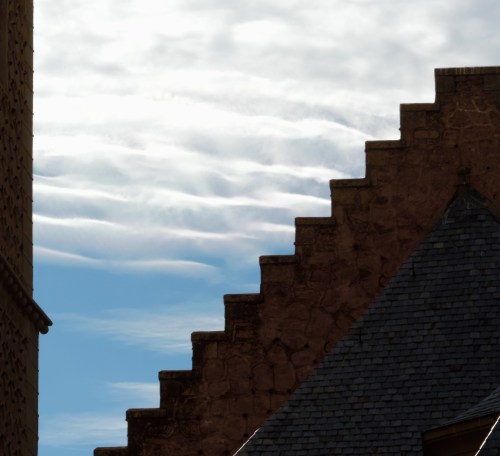
This photo is of something I noticed the other day, something which attracted my attention, then stimulated my thinking. That’s the kind of amazement I like best!

What I saw first was the sky. Just a bit of the sky between two buildings. The clouds looked unusual and pleasing, so I framed the shot, taking in the silhouettes of the buildings on either side of the patch of sky. I liked it the moment I saw it. And I clicked.

When I looked at the shot later it pleased me even more. Not least, I think, because of the contrasts. There’s the contrast between the blue and white of the sky, and the dark browns and grey/blacks of the buildings. But there’s another contrast too.

Look at the shapes.

There’s the shape of the stepwise construction of the building, the bricks laid, one by one, each one separate from the other. It’s like a stair case, isn’t it? A stair case you climb one step at a time. The shape, it seems to me, is typical of what we’d call “discrete”. Each step is distinct from, separate from, the others. And each one adds in a pretty linear, arithmetical way to the others.

But then there is the shape of the clouds. They look like waves. They emerge out of the invisible, out of the blue, each one becoming less distinct, less separate, than the other, till at the top of the image the waves merge into a patch of cloud, almost like waves disappearing into the sea.

I find that pleasing.

I find that appealing, attractive and it make me wonder. Isn’t that the essence of amazement? Of “émerveillement”?

I find that thought-provoking. It seems to me that the left hemisphere of the brain is great at seeing patterns, great at breaking the whole down into individual, discrete parts, great at constructing, building, step by step. Whilst the right hemisphere is busy seeing the whole, seeing the context, seeing the connections, great at finding what’s new, great at engaging with waves which emerge from the whole, (from the sky, from the sea, from the Earth) and dissolve back into it again.

How amazing. To have two brains working away at the same time, enabling us to see and appreciate this universe so uniquely.

Read Full Post »

« Newer Posts - Older Posts »