Feeds:
Posts
Comments

Archive for the ‘perception’ Category

Water fascinates me. Maybe it fascinates you too? Because it’s pretty universal to find that little children love playing with water, isn’t it? They love to play with it in their bath, in a tub, at the beach, in a pool or a pond…..they love to make snowballs and snowmen, to sledge down snowy slopes, to jump in puddles in the rain.

I don’t think that fascination leaves us. It’s a core energy which courses through us for our entire lives. Hey, around 60% of the human body is water. Water, in various forms, flows around us, into us, out of us, circulates within us. We need water much more quickly than we need food.

Maybe one of the most fascinating things about water is how it is present around us in gas, liquid and solid form. We see it in the air when we breathe out on a frosty day, creating little, temporary clouds which vanish, quickly, into the air. We don’t see it in the air as we speak and sing (which is why we’ve ended up wearing masks during this pandemic – that coronavirus rides the water droplets from one person to the next). We see it mostly as liquid….in a glass, in a puddle, in the rain, in the oceans, rivers and lakes.

Sometimes you can see a mist rising from the surface of a loch, float above the surface, and drift across the face of the forested hillsides like ghosts. Other times, like in this photo, you can see the water turn from liquid to solid. Do you remember that lesson from school? How cooling most substances down causes them to shrink, but how freezing water expands it? Weird, huh? Water is weird. We really, really don’t understand it.

In this photo you can see the edge between the solid frozen water, and the still liquid form. You can see the trees reflected in the mirror-like surface of the liquid water, and you can see the white frosted edge of the solid ice. I think, in this image, that gives the lock a nice “yin yang” appearance. Somehow, by doing that, it captures the sense of dynamism, of how the one form exists in the presence of the other, and of how the liquid and solid forms are constantly shape-shifting, from the one into the other.

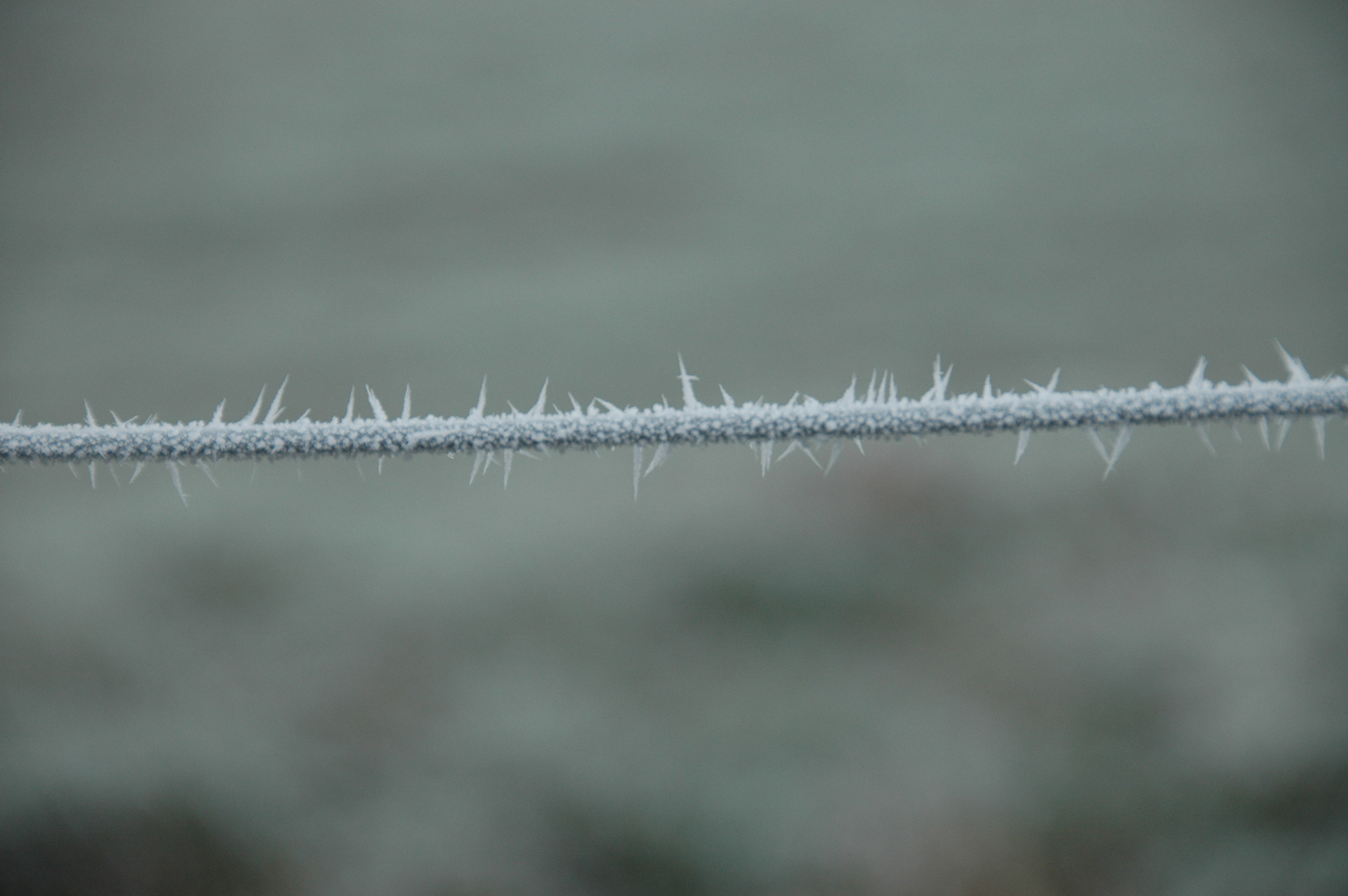
As water freezes it takes on all manner of shapes – you know that no two snowflakes are identical, don’t you? Don’t you think that is astonishing? I do. But when water freezes on the surface of something else it is also able to create the most incredibly beautiful shapes.

Read Full Post »

I reckon one of the most important lessons I’ve learned in life is the importance of context. There’s a huge tendency to “abstract” elements from reality – to take things to pieces and examine the pieces; to reduce the whole to a selection of parts; to consider only a single episode or moment in a life story; to pull a single thread from the entire matrix and try to follow just that; to measure what can be measured and disregard the rest. This tendency to “abstraction” is coupled with a tendency to “generalise”, so all is labelled, categorised and filed away; to give precedence to the “average”, the “norm” and the “typical”, over the “individual”, the “specific” and the “unique”.

Our left hemisphere is the champion of all that. Abstraction, labelling, categorisation and generalisation are at the heart of the way it engages with the world. All that can be useful. It can help us to “get a grip”, to “grasp” things, to make predictions and exert some control over the future (at least in small ways for short periods of time).

But it isn’t enough.

Throughout my decades of work as a doctor I interacted with people one-to-one, one after the other, always encountering a unique human being in a specific situation with a particular life story. I never saw two identical people in two identical situations with two identical life stories.

To make a diagnosis, to achieve a better level of understanding, and to establish a personal bond with each patient demanded that I brought my right hemisphere into play. I had to seek the connections, make connections, discern the meaning from the contexts, the contingencies and the uncover the unique, singular story. Only by doing that could I understand this person, in this situation, at this point in their life.

I got thinking about all that again this morning as a I looked at this photo. I mean, at first glance it’s a photo of someone in traditional Japanese dress. At second glance they are standing in front of a statue of Hume, the Scottish philosopher, dressed as a classical Greek scholar. Well, there’s a combination you don’t see every day! I have seen lots of people in traditional Japanese dress, but mainly when I’ve been visiting Kyoto. Not in Scotland. I’ve walked down the High Street in Edinburgh countless times past this statue of Hume

Only once did I see someone wearing a kimono, standing having their photo taken next to it.

So it’s the context of these two figures which makes this photo what it is. Either character by him or herself might tell a different story. But seeing them together here is a sort of “satori” – a “kick in the eye” – it makes me stop, take note, and reflect.

It inspires me to reflect about the importance of contexts and connections, of juxtapositions and synchronicities. And it inspires me to reflect on the two great traditions of philosophy and thought – the Eastern, Taoist/Confucian/Shinto/Buddhist with the Western, Enlightenment/Rationalist/Greek and Roman.

That’s an incredibly rich source of inspiration!

Follow your own special way through the thought chains and connections which unfurl, unravel, and open up before you when you look at this.

Read Full Post »

This pandemic has been going on for months now, and in many countries office workers have been working from home. I had to deal with a government agency recently and I could tell from the background sounds that the person I was speaking to wasn’t working in an office, so I asked him if he was at home. He replied that he was and he thought it was great. He no longer had to commute for about an hour and half in each direction between home and work every day, and when he wanted a coffee, he said, he could just reach behind him and switch on the coffee machine – no queue to join! He sounded relaxed and happy.

In surveys I’ve read it seems a lot of office workers are hoping they will never have to return to an actual office. Maybe this will be one of the big bonuses to come out of the pandemic……a shift away from commuting, from impersonal workspaces, and an increase in both quality of life, and time spent locally with friends, family and in local businesses and communities.

I took that photo above many years ago, one evening as I walked through Aix-en-Provence. I guess these two folk found a way to access free wifi! But that image comes back to me now as I think about how we are breaking out of the old ways and habits of office working.

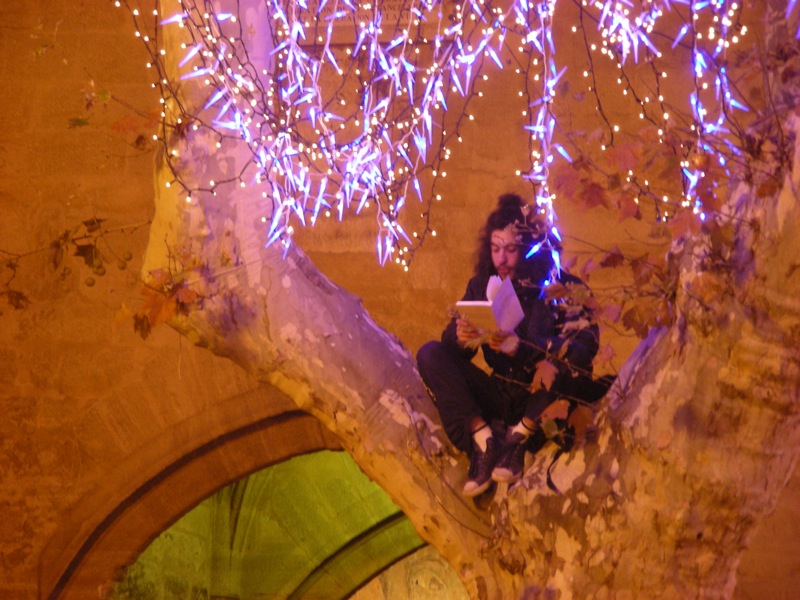
On another evening in Aix I came across this man sitting high up in a tree, reading a book. I don’t know why he picked that particular spot but I remembered him just as I was writing about the unusual places a lot of us now work from, or study in.

I do think one of the main lessons we are going to get from this pandemic is to challenge our orthodoxies, and our habits. You can even make a case for saying that we got to where we are today by doing things the way we’ve been doing them, so if we want to get out of this and not fall back into it, perhaps we are going to have to get creative and come up with new ways of living, new ways of working, studying and sharing our time and space.

Maybe this isn’t the end of the office as we’ve come to know it, but it surely challenges the dominance of the current model. If that leads to more flexibility and more diversity then I think that can contribute to a better, healthier way of living.

Apply this same thinking to education and you can already see that the way we’ve been delivering education to children and young people is also going through a potential revolution. I’m a bit of an optimist at heart, and I can’t help thinking that, although these changes bring lots of challenges and difficulties, they can also bring us the opportunities to learn and to teach differently.

Read Full Post »

Webs fascinate me. They are such beautiful structures woven each by a single spider. How do they do that? Spiders have far more rudimentary neurological structures than mammals, but they certainly have brains which enable them to create these webs. Exactly how they know how to spin a web is a mystery. I also think it’s pretty incredible that the actual material from which the web is made is created in the spider’s body.

I wrote yesterday about the underlying structure of reality which is built upon the concept of a network – nodes with connections. In a spider web, the nodes are where the threads meet and the threads are the connections. The fact that the entire web is inter-connected is what enables the spider to detect the movement of a fly when it is caught on the web, and to know exactly where to find it.

But as that example hints, webs exist, not as separate entities, but in complex dynamic relationship with other creatures and with the environment in which they are created.

This photo is of a complex of wind-borne seeds stretched between several stalks of a plant. I don’t know if there is a spider web hidden in the middle of these seeds. I couldn’t see one. But it is reminiscent of the web I’ve shared at the top of this post. But there needn’t be a web inside this seed group. Perhaps they just all attached onto each other as they were released by the plant, and have formed a structure that looks just like a web, because each seed is connected to several other seeds through those fine filaments which are designed to carry the seed on the wind.

However this structure came about it shows how nothing exists in isolation. Not only are these seeds connected to each other, but they are connected, both physically and historically, to the plants which produced them, and so on back in time to the seeds from which these particular plants grew, connecting back over decades, centuries, aeons. They are also connected to the visible and invisible surrounding environment in which they exist. They interact with the wind, with passing creatures, and with other plants.

When you pause to consider anything from the perspective of its connections, you find yourself following trails which extend both back and forward in time, as well as connections to other objects, creatures, energies, physical and environmental phenomena. Really, if you were to attempt to tell the story of a single seed from the moment you encounter it back beyond its origins, and forward into the rest of its life story, then you’d find yourself lost pretty quickly. There seem to be no limits to the chains of connections and relationships we can uncover for any single object, creature or person.

So, really, nothing is completely knowable. There is always more to discover. There are always paths, connections and relationships which change our understanding of what we see in this present moment.

I think that fact keeps us humble, and stokes the fires of our wonder.

Read Full Post »

Did you ever come across an ancient Chinese philosophical concept, “Li”? I’m no scholar of Chinese philosophy but the sense I make of this idea is that there are invisible patterns, structures and forces throughout the universe which shape the forms that we see. (If you understand this better than me, and you think I’m mis-representing “li” please explain in the comments section)

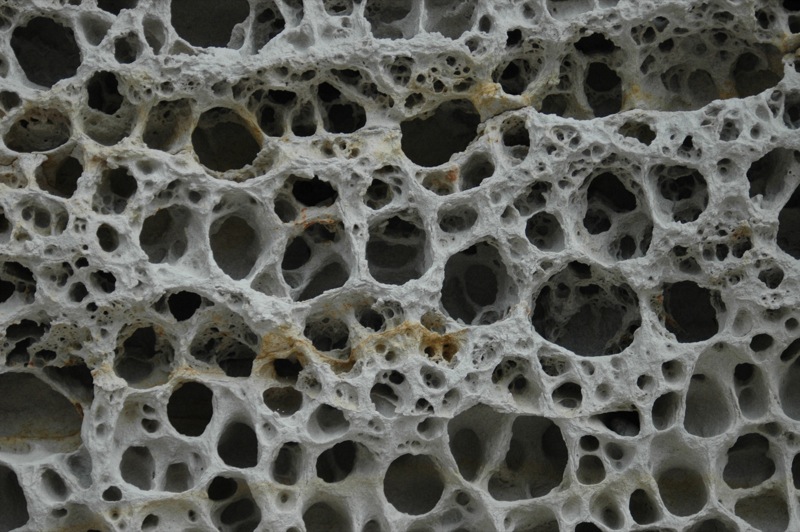
It does seem to me that there are certain patterns in Nature which seem pretty widespread. This one which is a “honeycomb” pattern in rock in the West of Scotland is one of these, and, for me, it’s one of the most fundamental.

It’s a bit like a web, or a net, and really it’s simply connections and points of connections. The connections are the thin almost thread like pieces and the points of connection are where two or more of these pieces meet. This is the basis of all networks – we call the points of connection, “nodes”, and the lines represent the ways in which nodes influence each other.

Simple nodes receive information, energy or materials from other nodes, and pass them on. More complex nodes do some processing, so that the exact information, energy or materials which it receives, leave it in somewhat different form.

One of the places we see this structure is in our brains – we have billions (yes, billions) of special cells in our brain. We call them “neurones” and their main purpose is to transfer information from one place to another. The neurones all meet up with other neurones at specialised junction points called “synapses”. Every single neurone is connected this way to several thousand (yes, several thousand) other neurones. You can imagine pretty easily that the permutations of firing, communicating neurones, neuronal pathways and neural networks in the brain might not be infinite, but it’s so gobsmackingly (is that a word?) large that we literally can’t actually envision it in its totality. I’m sure I once read someone say that the number of whole brain states, determined by which neurones are firing is greater than the number of visible stars in the universe. Well, don’t know if that’s quite right, but it sure gives you a way of imagining the immensity of it.

Another place we see this structure is in the human body. Think of each of your several billion cells as a node, and once you realise that every single one of those cells lives in constant relationship with all the others (either directly or indirectly, cos that’s the way a network works) then you get a good understanding of why we need to think of our health and wellbeing holistically. None of our parts live in isolation. In fact all our cells, all our tissues and all our organs, are continuously, dynamically relating to others by establishing and maintaining “integrative” relationships – that is “Mutually beneficial bonds between well differentiated parts”. There’s a key point to see here – the most fundamental kind of relationship in the universe is collaborative, integrative and co-operative.

Yes, competition exists. Of course it does. But we have been duped into believing that competition is THE key relationship in the universe…….THE driver of evolution. It’s important and it’s real, but by itself competition could not produce evolution, could not produce Life, cannot describe reality. We need relationships which are essentially integrative, fundamentally well-meaning, mutually supportive, collaborative, to do that.

I don’t know about you, but I think we could all benefit from this simple shift of understanding – we need to put “collaborative, integrative, co-operative” relationships at the heart of our decision making.

Read Full Post »

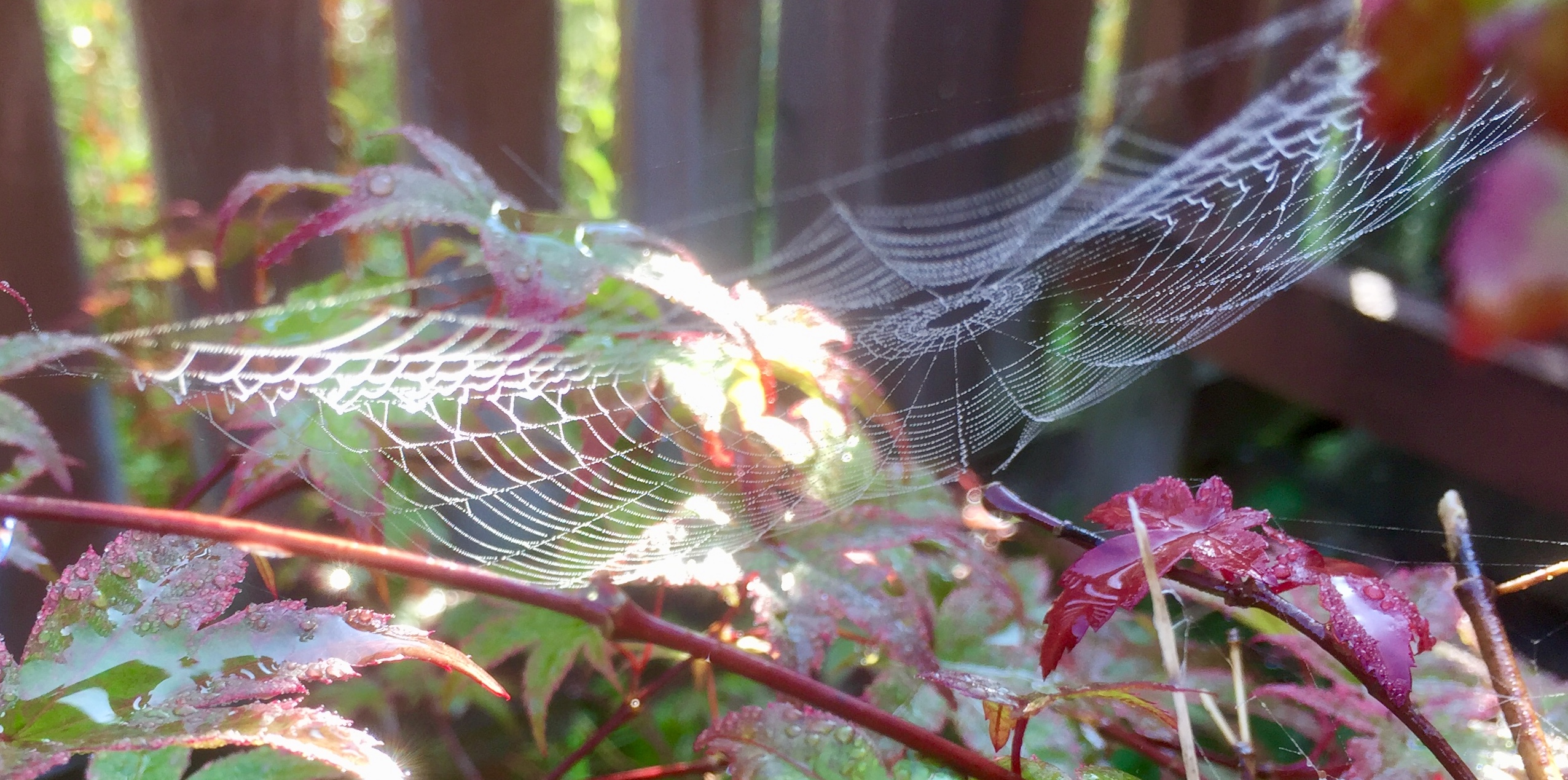
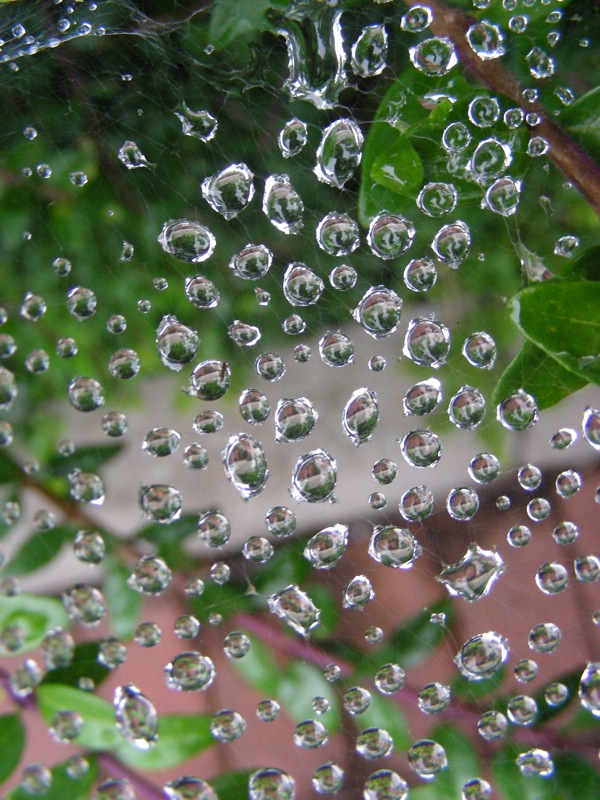
I’m pretty keen on taking photos of webs, especially on a misty morning or after it’s been raining.

This is one of my most favourite photos of a web. Actually you can hardly see the strands of the web itself, which makes it even more interesting……it’s like the underlying structure which gives shape to the whole image is invisible, or almost so. And I think life is like that. There are underlying structures, forms and shaping forces to everything, but mostly that’s all invisible!

What we see most in this photo is a myriad of water droplets – each one of them acting as a prism or a lens. Look closely at any of them and you can see that they are showing you an upside down image of the surrounding world. Isn’t that fascinating as well as beautiful?

Because what that makes me think is how each of us is like one of these droplets. Each of us has our own unique perspective upon the world. Every single one of us sees and experiences the world from our individual and different subjective point of view.

But we are all connected. And we are all living in the same world. So most of what we see in any of these little lenses is the same. We live shared lives. We experience shared phenomena.

That takes me back to my favourite – “and not or” – we are at the one and the same time having unique, individual experiences, AND shared, common, connected ones.

It’s not a matter of choice.

If we forget either one of these apparent polarities then we fail to grasp reality. Reality is a vast, inter-connected, largely invisible web of unique, individual events and experiences, constantly changing, constantly interacting, always astonishing and, utterly beautiful.

Read Full Post »

There’s a tradition around Kyoto of climbing the hill to the Fushimi Inari temple in January. There are the most amazing Tori gates there….thousands of them winding through a forest on top of a hill. It’s one of the most spectacular places I’ve ever visited. The tradition related to the start of the year is about wishing for a “good harvest” or, in more modern times, wishing for good luck and well being I suppose.

The reason I return to these photos and think of Fushimi Inari every January is because of the gates – because January is the month of the threshold, of the gate, of the place where we step forwards into the New Year looking ahead with some hope and good wishes, and looking back at the old year just gone, remembering some of our main experiences. In fact “January” gets its name for the God “Janus”, the one with two faces, one looking forwards and the other looking back.

But there’s an additional reason I return to these particular photos in January – because the Inari shrine with its long winding passageways of Tori gates isn’t just about look forward and back. It is utterly, wonderfully, beautiful just as it is. In other words, as you walk through these gorgeous bright orange tunnels of gates, with glimpses of bamboo and forest all around you, you become completely entranced by the present – by the here and the now.

So there you have it – January – really a wonderful month to take the time to reflect on the year just ended, to look ahead with hope and wonder to the year ahead, and to remind yourself of the “émerveillement du quotidien” – the every day wonder of this one, unique, and special day which is unfurling before you right here, right now.

Read Full Post »

One of my most favourite sculptors is Anthony Gormley. Many years ago he created one of his works in London, placing his distinct iron casts of a man standing on various roof tops around the city. It caused quite a stir as several people thought they could see real men who looked like they were about to jump from the heights. I never saw it that, thinking more of Wim Wenders’ angels in Wings of Desire (or the City of Angels, American remake of that classic) where you could see the angels sitting or standing high up above the city watching down on the people below. At the same time as Gormley placed these figures around London he had an exhibition in the South Bank Gallery and that’s where I took this photo.

One of his works in the exhibit was a large glass box, the size of a whole room. The glass box was filled with mist, so dense that you could hardly see your hand in front of your face. You could walk around inside the box, dimly making out other visitors who appeared and disappeared continuously in the thick mist. As you walked around the box on the outside you could make out the occasional figure temporarily appearing in the midst of the mist as they walked around inside the box. As I passed someone reached their hand up to place it on the glass, and as I snapped the photo, I noticed the glass wall was reflecting one of the figures high up on a roof outside the gallery.

That lucky moment gave me this image which has kind of haunted me ever since. As I look at it again today, in the context of this surging wave of the pandemic and trying to cope with yet another month of sundays in lockdown, this image seems to have a new meaning and a new poignancy.

It makes me think of this world we are all living in now, hidden behind invisible barriers, or, sometimes, all too visible ones! How we are connecting by email, texts, zoom calls and so on, but how we can’t quite reach out and touch anyone else.

I know that this will pass. Everything does. Nothing remains the same. And maybe this experience of “distancing” which we are experiencing is giving us the opportunity to become more aware of what’s really important to us. Maybe, like me, you’re finding that you are deepening relationships with even more communication that you “normally” do. Maybe you’re making new friends, encountering the kindness of strangers in other lands. I guess I’m saying, it’s not all bad. But I don’t mean in a way which would dismiss the challenge and the struggle.

What better can we do today, tomorrow, and the next day, but reach out and tell our loved ones how much we love them, and extend the hand of kindness to strangers?

Read Full Post »

It’s many years since I was walking around Aix en Provence and came across this ball lying against the kerb. I could have just walked by. After all, what’s so remarkable about a ball just lying in the street? But I didn’t. I crouched down at the side of the pavement and took this photo.

The ball is the centre of attention. I know about the “rule of thirds” in relation to picture composition but I decided this time to make the ball sit pretty much in the middle of the shot. But it’s not just a picture of a ball. It’s a ball in a totally empty street……which really gives the impression of an abandoned ball. I don’t know if the ball had been abandoned or if some kid had just left it outside their house while they had their lunch, but in this particular framing this image still captures a real sense of abandoned play for me.

At this point in our pandemic (it’s January 1st 2021 as I write this) a street like this looks like the “new normal”. I’ve been seeing streets like this for about nine months now. So, now that I return to this old photo it has a new, topical relevance.

But I want to return to the ball itself today, because what is the purpose of ball like this, other than to be something to play with?

I know we are going to have to develop new behaviours, make different choices, change our lives in the face of this pandemic, but I’m going to suggest to you today that one of the behaviours we could do with a bit more of is “play”. I don’t mean that in a trivial way. In fact, I think play is greatly under-rated. Babies and children learn and develop most of their key, lifetime skills, through play – they explore, they press what they can press, push what they can push – I saw a little video of my smallest grandchild opening his first ever Xmas present. He’s not a year old yet. But he immediately spun whatever would turn, pushed whatever buttons would go down, popped a ball into a hole……he just constantly tried out everything. It’s this kind of play we need to cultivate I think and that is going to require –

Wonder – if you can keep in touch with a sense of wonder, not only will every day have something in it to delight you, but you’ll remain curious, you’ll keep wanting to explore. We will find new ways of living through our capacity to wonder. Lose the sense of wonder, lose the ability to invent new ways to live, lose the ability to make sense of this world.

Humility – getting down to a child’s level is a way of having a “beginners mind” – a way of countering any arrogance of knowing it all. We never know it all. That’s just not possible. Unless we retain a sense of humility and acknowledge that we can always learn from our experiences then we just aren’t going to progress. One of the things that frustrates me most about this pandemic is what seems like a systemic inability of politicians to admit they didn’t get things right, to acknowledge that they could have made different choices. Without the ability to do that, they can’t make better choices next time around.

Joy – how much do you let joy guide your actions and choices? Researchers into the neuroscience of emotions, and many philosophers over hundreds of years have shown us that joy is one of the most powerful emotions and drivers in the human psyche. You can see that easily in children. If it’s not bringing them joy, they soon let you know! And, yes, I know, joy is not the only emotion, and can’t be your only guide. I’m just suggesting that there’s a benefit in becoming a bit more aware of brings you joy, understanding why that is, and then feeding that into your decision making.

Imagination – I sometimes think this our superpower. We are literally the co-creators of our daily lived experience and there is no way we could do that without excercising our imaginations. We can’t think ahead without it. We can’t experience what anyone else is experiencing without it. We wouldn’t have memories without it. We couldn’t create without it.

I’ll leave this post with those four things. I think these are four things related to “play” and I think we are going to need them all in spades as 2021 unfurls……

  • Wonder
  • Humility
  • Joy
  • Imagination

Read Full Post »

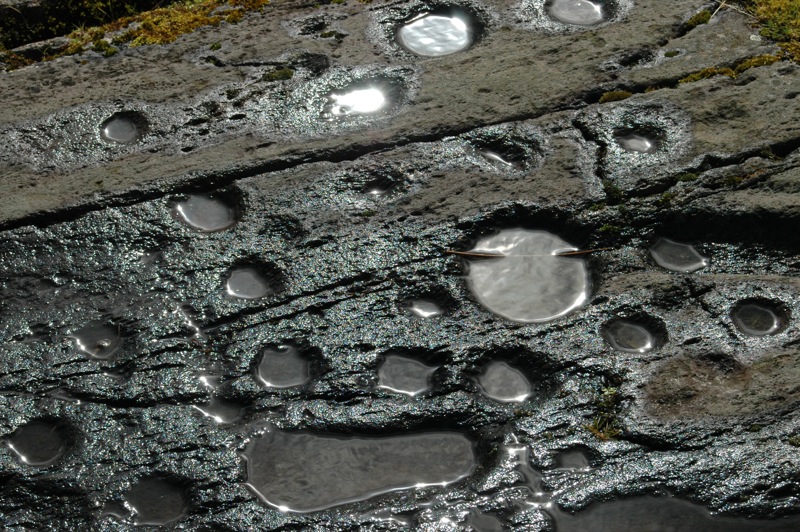
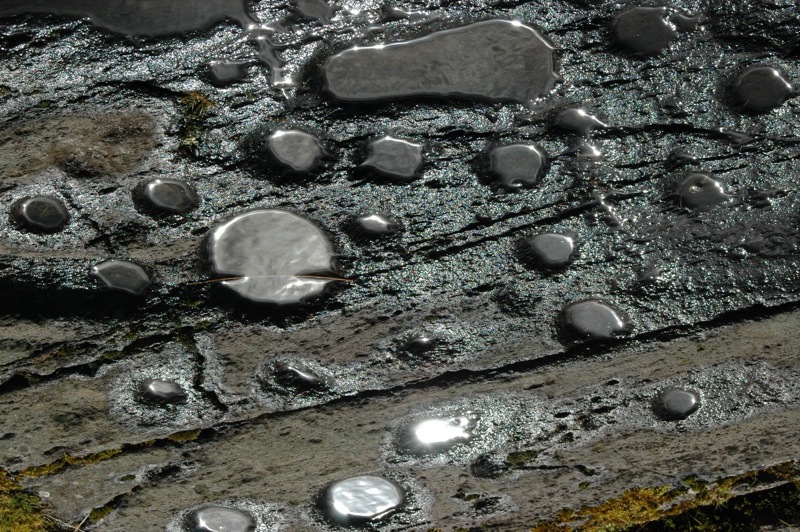
Look at these two images.

I took this photo at Achnabreck in the Kilmartin Glen in the West of Scotland many years ago. The Kilmartin Glen has hundreds of cup and ring marked rocks, standing stones and cairns dating back 5000 years to prehistoric times.

As I wandered around the rocks, taking photos, on a typical showery day in Scotland, I noticed that when I looked at some of the water filled indentations that they looked concave, but when I moved to the other side of the rock the water now seemed to be convex. I’m no expert in optics so I could’t explain the phenomenon but when I got home and uploaded this photo, I noticed that if I flipped it 180 degrees I was able to replicate what I’d seen.

So those two photos above are just one photo – with the one flipped 180 degrees to the other. I find this quite mesmerising…….whatever the, probably simple, optical/physical explanation. Every single time I look at these two images side by side I am inspired to think about how different “the same” world looks when we change our perspective.

Maybe this is a variation on the old “glass half full, glass half empty” idea, but in this case, sunken vs swollen water in indentations.

Actually, just by itself this is one of my favourite photos of all time. First of all, if it hadn’t been raining then the cup markings wouldn’t have filled with water and would have looked very, very different. Something else which highlights the contingent nature of all of our experiences – every event, every experience is unique, because no two sets of time, place, weather, environment, mood, mental state, place in a personal narrative are ever identical. Secondly, how on earth did people with just stones as tools make these marks? And isn’t that one which isn’t a circle, a footprint? A footprint in rock?? Thirdly, why did they make these marks? We don’t know. There are amazing spirals and loops and spirals with tails scattered on rock surfaces throughout this valley – but nobody knows why. Are they maps? Do they tell a story? Are they the marks of particular tribes? Are they symbols of spiritual signficance? Are they art? Are they doodles?? We don’t know. And why here? Why in the Kilmartin Glen (I’ve found that not many people I’ve met know about the Kilmartin Glen but it’s one of my most favourite, most special places in the whole of Scotland)

Here, in the last couple of days of 2020, with yet another wave of the virus on the up, and vaccination programmes just beginning to be rolled out, I’m sure we’ll all be taking some time to reflect on this most unusual year, a year we will never forget.

As I reflect, I’m hoping to do two things – acknowledge the losses and the difficulties of this year, then affirm the gains and opportunities – because this, maybe more obviously than most years, is a year when so much has happened and so much has changed that it feels a year of special significance – perhaps a turning point, perhaps a year of revelation, perhaps a year of re-evaluation, perhaps a year of enlightenment – because this year surely seems a year when we human beings were given the opportunity to change direction.

Read Full Post »

« Newer Posts - Older Posts »