Feeds:
Posts
Comments

Archive for the ‘perception’ Category

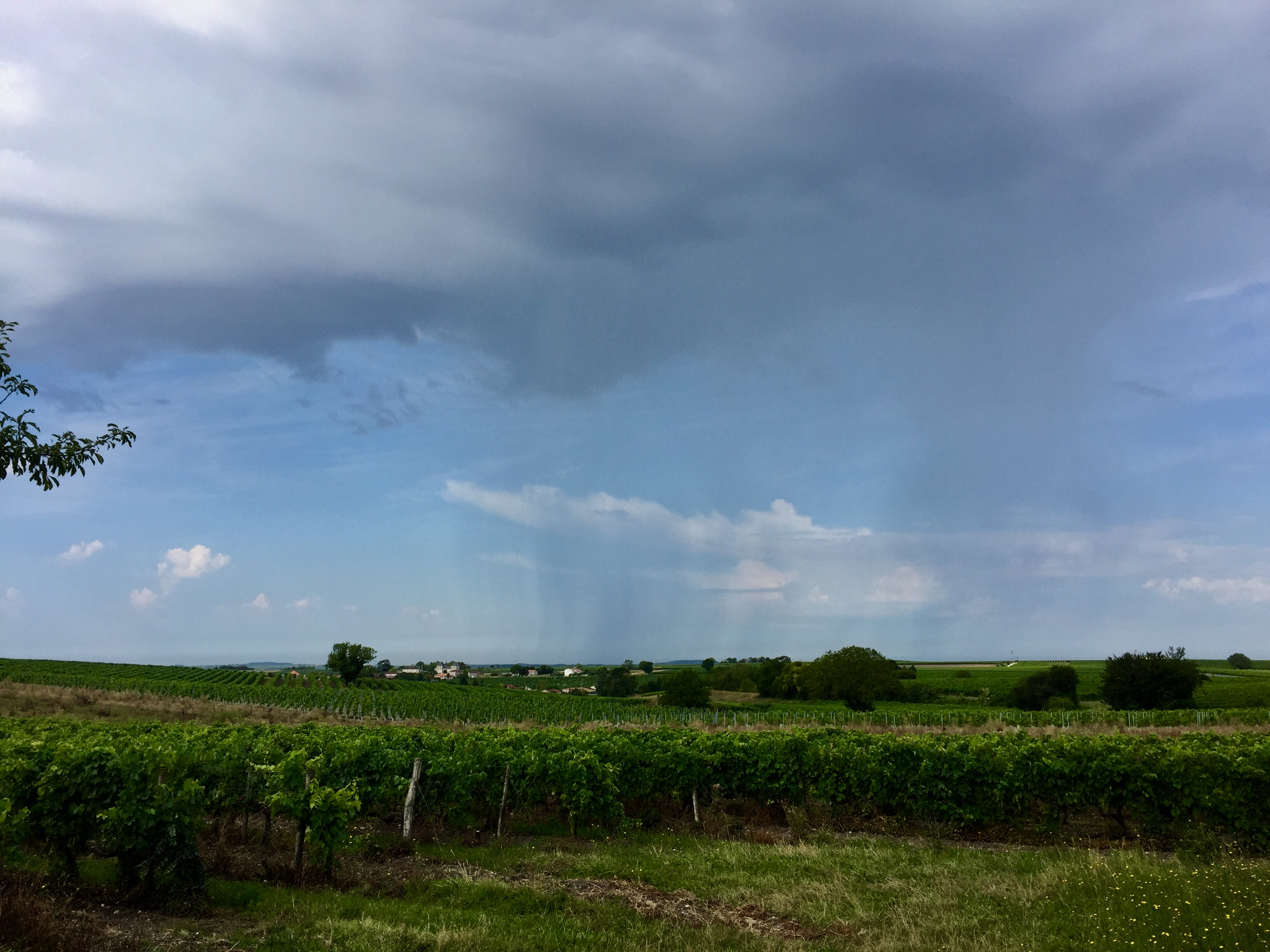
I love to be able to look over the vines and see the rain falling in the distance. Where I’m standing it’s dry. No raindrops keep falling on my head. But across there towards the horizon I can see where the rain is falling….and where it isn’t falling.

It looks like I can see the edges of the rain. The rain is appearing as sheets, veils, or fingers reaching all the way down from the clouds to the ground. You can see it too, can’t you? You can tell that some parts of the land are getting wet, and that some aren’t.

In other words it appears that we can see the boundaries of the rain – it’s reach, not just vertically from cloud to soil, but horizontally, over a certain distance, left to right, or west to east, or whatever. If we see these boundaries so clearly, then surely, we could measure them. I could find out exactly the height, the breadth and the depth of that rain over there.

The thing is, as best I know, I can only do that approximately, and only if I stay at a sufficient distance from the rain. Because the closer I get, the harder it is to see exactly where the rain is falling, and where it isn’t falling. If I did do a measurement then something interesting happens. I have the impression of exactness. I have the impression that I have a more accurate, more complete knowledge.

But that’s a delusion.

We can prove it’s a delusion just by actually standing in the rain. When we are being rained on, it’s pretty impossible to know if we are in the middle of it, at the beginning of it, or nearing its far edge. It’s a lot easier to see a shadow approaching or receding, than it is to see the rain. That’s at least in part due to the fact that the rain has no hard edges. Those clear boundaries we can see in the distant rain, disappear the closer we get. By the time we step into the rain, the boundaries dissolve. We can no longer see where the rain begins and where it ends.

Yes, I know, there are two exceptions to that……if we look far enough away through the rain we can sometimes see outside of it to land where the rain isn’t falling. That can give us an idea of the rain passing through, knowing that in a short time, it will be gone again. And the other exception is sometimes rain falls in intense highly localised bursts. I’ve been able to see the rain pouring down just outside my garden while I stand, perfectly dry, inside the garden. But that’s rare. And even then, the exact boundaries are far from clear as I approach them.

What this image and these thoughts inspire in me is wonder……wondering about how everything is connected, and how it only looks separate if we don’t look closely enough. The closer we look the more the boundaries dissolve, the more connections and gradations we see.

It also inspires me to think about the difference between observing an object and experiencing an event. I can see the rain in the distance as “something”, maybe even something I could measure. Certainly something with particular dimensions. I see it as an object. But when I stand in the rain I experience it as an event. I don’t see it as an object. I can’t measure it. I can just live it.
Read Full Post »

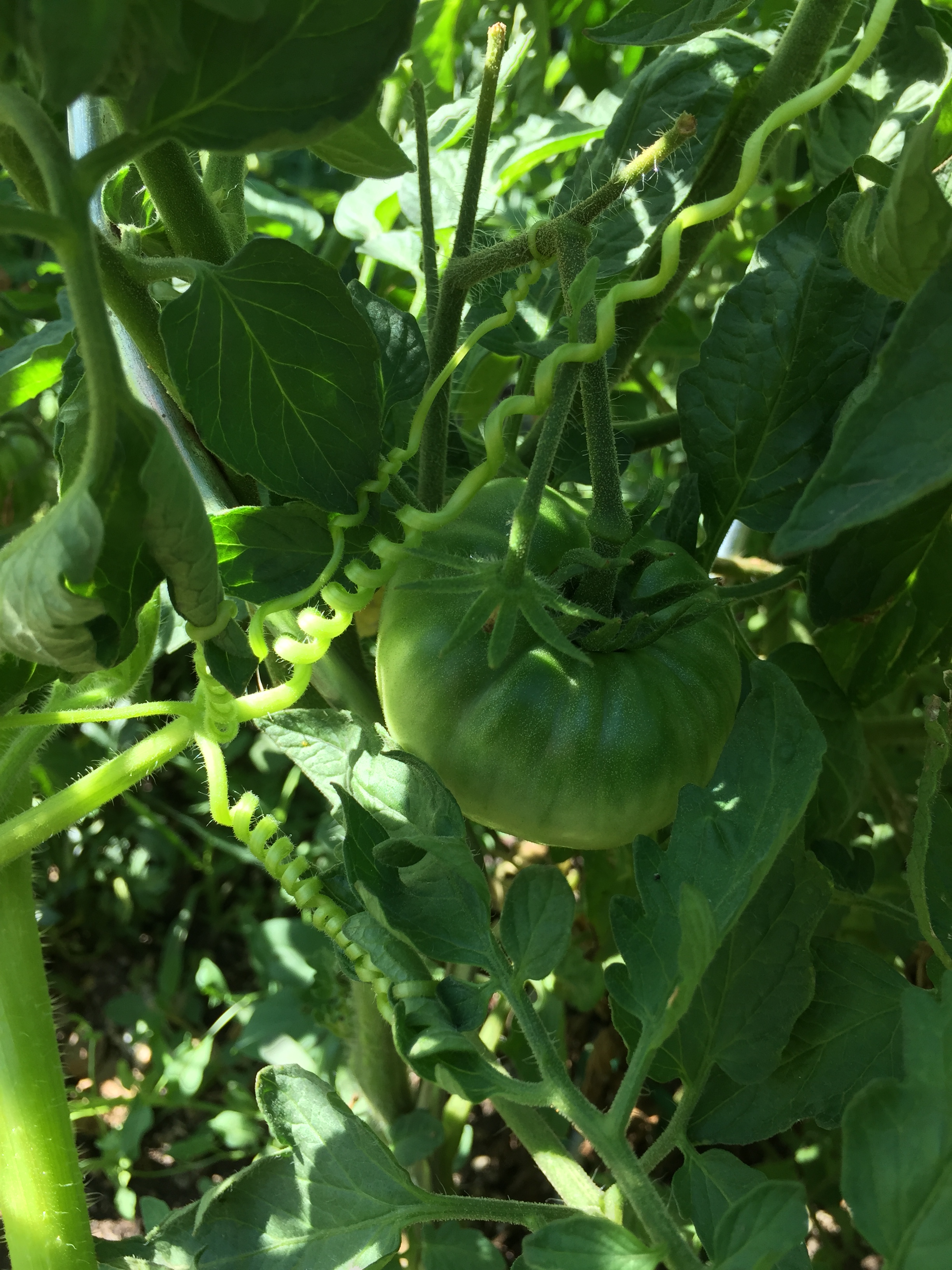
Pumpkins are one of the most prolific and successful plants in my garden. They appear even where I haven’t seeded them (they must be in the soil now after five years of planting) and once they start to grow they spread across the entire vegetable patch reaching out towards every border.

On their way around and over the other plants they send out these tendrils which catch on to whatever they can touch. The tendrils then spiral intensely creating these powerful bonds which the plant uses to anchor itself and pull itself up on the surrounding plants, fences, walls and so on.

I think these bright green coils are astonishing. I’m amazed by them. How does the plant know when it’s touched something else….another plant, a part of the fence, or whatever, and then how does it move its tendrils to wrap around whatever it has connected to, and then how does it “wind itself up” like this?

Plants don’t have brains. We know that. But they sure have the ability to sense – they can sense touch, they can respond to light, to gravity, and as far as I know can seek out the nutrients they need. They can unfold their leaves to gather up the Sun’s energy to transform it into sugars and structures. They can fold their leaves up to protect the plant from too much sun. We tend to think of plants are creatures which stay put, but I can tell you pumpkin plants to anything but stay put!

I think we under-rate the plant world. It is astonishingly diverse, incredibly resilient and is far more sentient than we realise. Plants have the ability to move much more than we realise because we don’t see them walk or run anywhere, and we know they don’t have muscles or limbs. But, goodness, they are not still. They reach out, spread, grow and seek what they need to survive and thrive.

I wonder how they communicate with each other? I wonder if the pumpkin here in this photo communicates with the tomato plant it has found and fastened itself onto? I don’t reckon they “think” or “speak” like we do, but they surely make connections, exchange energy, chemicals and information, and doesn’t that amount to a vast amount of communication?

Seeking, connecting, communicating, pulling together……..I guess we’re at our best when we do that too, aren’t we?

Read Full Post »

I took a photo of this little street in Segovia for one reason – it’s name. I mean, look at the street. I’m standing at one end taking the photo so you can tell it’s a pretty small street. I don’t think the buildings on either side of it would entice you to go and explore it, but the cobblestones are attractive, and, probably more than anything that arch at the end looks very inviting. Which is interesting because seeing the arch, which invites you to pass through it, and seeing the countryside rising up the hillside beyond it is definitely tempting. But the truth is there are wonderful views of the countryside all around Segovia.

Here’s what caught me and convinced me to take this photo.

Now I don’t speak much Spanish but I know that this is the street name – and that the name is “Street of the Moon Gate”.

Street of the gate of the moon!! I mean, how can you read this and not feel your curiosity and your imagination start to stir! That archway at the other end of the street was probably where the original gate into the old town was. But why was it called after the moon? Was it the gate to enter by moonlight when you hoped not to be noticed? (actually you are less likely to be noticed on a moonless night)

I don’t know. Maybe one of you does. If you do, please let me know what you’ve found out. There is a Sun Gate in Segovia, but the other gates are all named after Christian saints.

However, here’s my point. It’s the name which caught my attention. It’s the name which has stimulated my curiosity and fires my imagination. I’m sure there must be stories set in Segovia which mention this gate, but if there aren’t, maybe I’ll try and write one!

Have you come across any places where the name made the location special?

Read Full Post »

What influences how we experience the everyday? What shapes reality?

One of the ways our minds work is by creating frames and schema. We learn from our own experiences, from the stories of others, and from the messages we are given. All of these combine to create frames, or lenses, through which we filter the present moment. They also combine to create schema which are like pre-formed sets of perception, values, attitudes and behaviours.

There are lots of examples from psychology research – although, beware, because a lot of psychology research has been called into question and other researchers have failed to repeat the results of very famous experiments. But here’s an example of a type – volunteers are told they are being tested on a cognitive skill, say, perhaps, the ability to undertake certain mathematical tasks. But before they take the test, some are interviewed by a researcher who asks them to talk about the lives of the most elderly members of their family. Others don’t have that chat. After the test is complete, the researchers measure the time it takes the volunteer to walk to the exit. Those who had spent time talking about elderly family members before the test take longer to walk to the exit after the test. Bizarre, huh? This kind of experiment suggests that we can be “primed”. That pre-fashioned patterns of thought and action can be set in train unconsciously.

There are lots of different experiments which seem to demonstrate the same idea. These “schema” or “pre-fashioned” patterns of thought and action can be activated and influence how we experience and perform in the light of them.

We shouldn’t be too surprised by this. We know we are influenced by the messages which bombard us. Why else would advertisers spend billions to catch our attention? There’s a whole discipline now of “neuro-marketing” where companies can learn how to use how the brain works to catch our attention and to “prime” us to do what they want us to do – click “buy”, or vote “yes”, or whatever…..

This is one of the things underlying my choice of the title “Heroes not zombies” for this blog. I think that it’s easy to spend life on autopilot, allowing others to press our buttons, to convince us of their frames, to implant their schema in our minds. If we want to become the “heroes” of our own narratives, then we need to wake up, become aware of things like this, and then, perhaps, even consciously choose to create our own frames and our own schema.

So here’s my question today – for me, and for you – what are the frames, the schema, and the messages which are creating my experience of today?

Once we become aware of them, then we are able to make some choices – choose to accept them, or choose to make our own ones.

Let me finish with a simple example. If you spend the first part of your day “doom-scrolling” (you know that new term? Where you read story after story on your newsfeed, your twitter feed, your facebook feed, each one horrifying you, irritating you, outraging you, frightening you….but you can’t stop…you keep on scrolling)….so, if you spend the first part of your day doom-scrolling then what kind of day follows? What are you set up, or primed to notice, to pay attention to, to give your energy to? What if you chose to start the day some other way? With affirmations, reflection, gratitude…….you get the idea?

What if we started each day with some “conscious creation“?

Read Full Post »

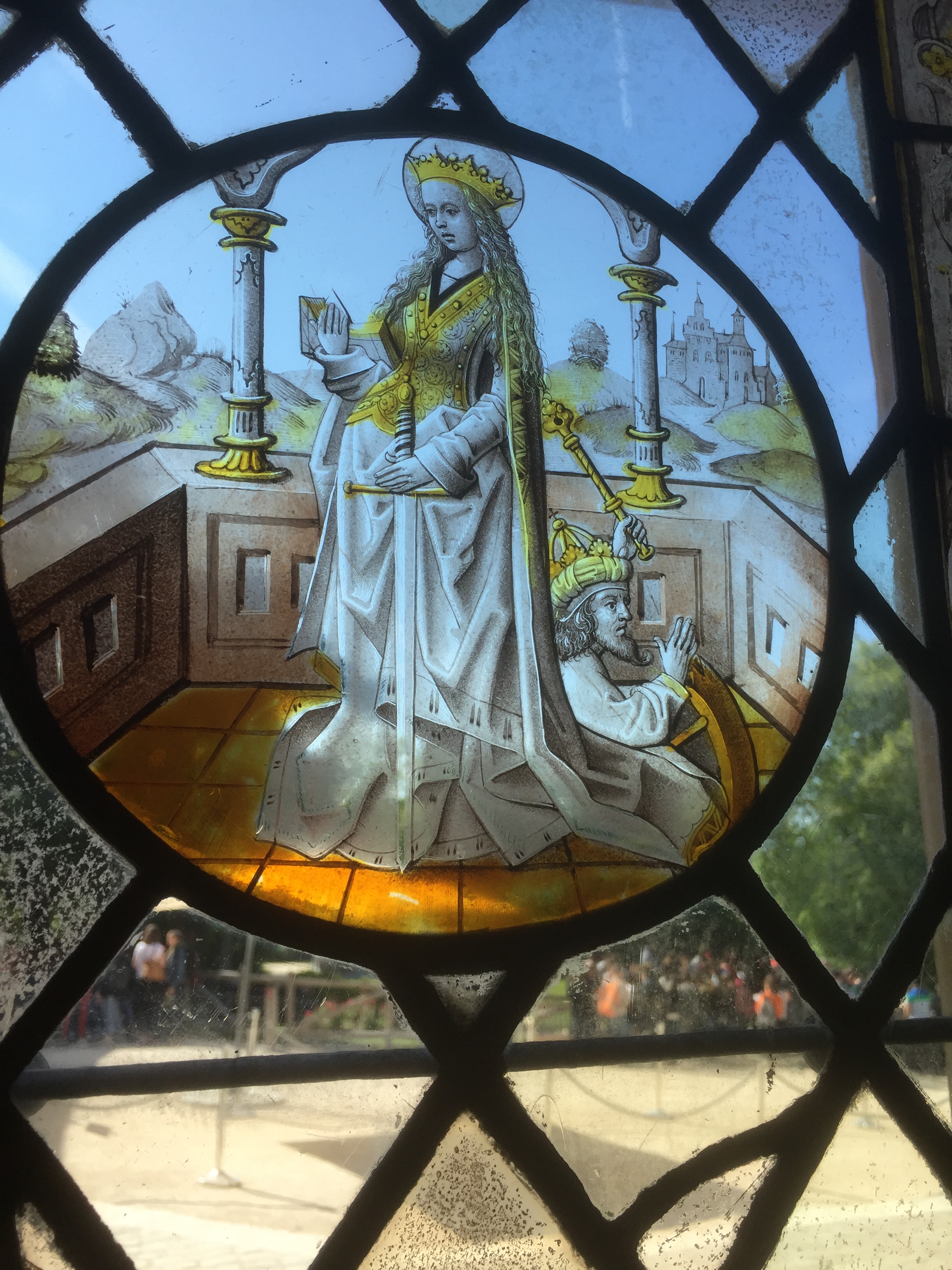
I guess none of us really paint scenes onto our actual windows these days but isn’t this beautiful? It gets me wondering what kind of scene or image would I like if I were to get, or make, a window like this? I wonder if I’d want a natural image of a beautiful tree, flower or bird, perhaps? Or would I want something highly symbolic, something resonant of myth and memory? Or would I want something visionary to inspire my thoughts of the future?

I suppose that in some ways a painted window like this could be a sort of vision board…..one of those walls where you collect images which inspire you in an attempt to inspire and focus your attention, desire and will to achieve what you want in life……or to attract it, “manifest” it…..or, at very least to colour your thoughts and your days.

I’m not a hugely goal-orientated person. I don’t set myself targets and “SMART” goals. But I know those things work for a lot of people. I suppose I prefer to set my values, my attitudes and my intentions, then open myself up to “emergence”…..to the realisation of experiences which I couldn’t have predicted. Maybe I prefer that to any attempt to force the world to deliver what I’ve already decided I want. After all, it turns out this universe has way more potential than any of us humans can imagine. So, I don’t really try to alive by organising my life around pre-determined end points.

What I do like to do is to repeatedly reflect and re-orientate my life around curiosity, wonder, joy, love, kindness and positive intention. So, that’s what I should represent on my painted window (or my “vision board”) – the images, symbols, stories and myths which stimulate and inspire my curiosity, my sense of wonder…..which bring me joy…….which stoke my feelings of love and kindness…..and which strengthen my intention to act, speak and think positively.

All of this constitutes a kind of “conscious creation” I think. A deliberate choosing to make and maintain reinforcing loops of the attitudes, values and behaviours which I want to experience in the world….which I want to manifest in the world.

Ok, folks, here’s my list (for me to return to as I move this idea forward, but also, if you wish, for you, if this inspires you or resonates with you).

Curiosity

Wonder

Joy

Love

Kindness

Positive intention

I’m going to use this list to consciously create the world I want to live in.

Read Full Post »

I saw this door panel in the Chateau Chenonceau. Isn’t it wonderful? What an incredible piece of craftsmanship carving this scene. I love the waves below the characters and the clouds above them, and I especially like how the clouds break out of the frame.

The scene is Poseidon and Amphitrite (I think!), the God of the Sea and his wife. They are being blessed with a wreath and a flower (a lily perhaps?) by two creatures with human bodies, fish tails and wings……nymphs I presume…from Amphitrite’s ancestry.

Apart from the beauty of this image in it’s own right, it is laden with symbolism, as are many of the carvings and tapestries of that period. Exactly what the significance is of each symbol and, indeed, of the myths of which they are integral part can be uncovered to a certain extent with study and research.

I invite you explore this for yourself. What can you find out about the characters represented and what stories are there about them? What can you find out about the nymphs, about the cupid figure, the trident, the bow, the wreath and the flower?

Some historians say that in their time the people who had these works of art created were well versed in the answers to all those questions. They could “read” a scene in the light of the knowledge they’d gained. They had been told these stories, taught these symbols, and they wouldn’t just look at an image like this and think “how beautiful” – the work would evoke whole sets of emotions, memories and fantasies for them. When I think of that I feel we’ve lost something because most of us haven’t had the education which allows us to have a similar experience.

Symbols and myths are an integral part of human life. Creating works of art is fundamental to our nature. I was listening to a BBC podcast the other day about cave art and the experts said the wall drawings of bulls, aurochs, deer and so on date way back to the times of not just the earliest humans, but to neanderthals too. Some of the cave art was created in caves so deep that not only were they in perpetual darkness but there could be no real reason for human beings to go there….other than through sheer curiosity, or to hide and protect their art works.

Who were those images created for, and what part did they play in their lives….of both the artists and the spectators? We don’t really know. But whatever the answers to those questions there is no denying that we are a species which does more than hunt, gather and farm. We create and live with art. It’s in our bones!

Read Full Post »

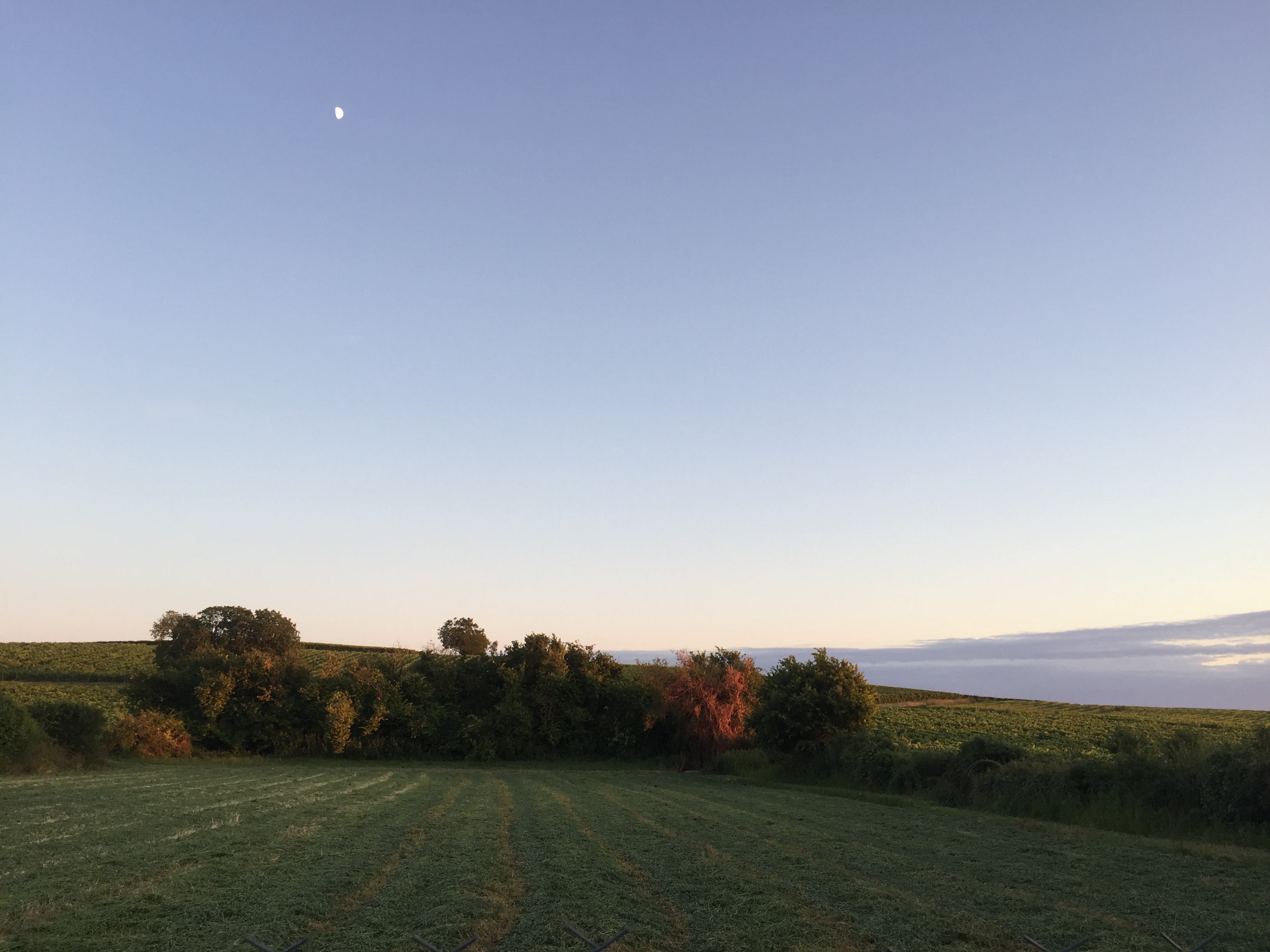
A couple of years ago I took this photo from my house. I suppose it was actually the Moon which caught my eye, but, hey, an iPhone isn’t that great for capturing images of the Moon, is it?

However, as is often the case, once I loaded the photo onto my computer, I noticed something completely different – an orange face at the right hand side of the trees and bushes at the end of the field. Do you see it?

It’s not just an orange face, it looks like something with a wide open mouth, either in amazement, or in fear? By the way, the face is facing West which is where the orange glow comes from, as the Sun was starting to set as I took the photo.

Once I’d seen this face-like image I couldn’t ever un-see it. It’s the first thing I see now every time I look at this photo. Our brains function this way. From our very first days we have the ability to notice faces, and it doesn’t take long for a baby to be able to distinguish mum from other people. But it’s not just that we have a great ability to recognise individual faces, we seem to have the ability to see faces even where none exist. We see them in rocks, in trees, in bushes, in clouds, in the landscape….you name it.

Faces. Don’t you think that’s significant? We see faces way more than we see feet, or hands, or even whole human bodies. We are particularly attuned to seeing faces and face-like patterns. Surely that is linked to the fact that we are such incredibly social creatures. We are able to see a friendly face, or to be wary of an unfriendly one, almost in an instant. We don’t just have the ability to pick a familiar face out of a crowd, but we are able to “read” faces unconsciously. We “read” the emotion on a face, and we respond to faces with emotional reactions. We know there are people we like at first glance and those who we are immediately wary of. In fact, we have a tendency to rush to judgement, and it might take quite an effort to move past a “first impression”.

You know the phrase “if your face fits”, for example. We judge faces pretty much instantly. Again it might take quite an effort to move past that “prejudice”, that “pre-judging”.

Fortunately we do have those skills too. We are able to learn and to adjust. We become familiar with certain people and change our opinions of them as we experience them to be friendlier, or the opposite….un-friendlier, than we found them to be at first. This learning and adjusting is, however, not all about faces. It’s about behaviours, actions, words, conversations and shared experiences. Then we might begin to see someone differently.

It’s Halloween at the end of this week, so that’s partly why I thought I’d share this particular image with you today….it’s kind of a Halloween face, don’t you think? Or am I thinking that just because Halloween is approaching?

Read Full Post »

Every living organism has the capacity to stay healthy and to repair any damage it incurs. In other words, they all share the ability to survive. Plants, micro-organisms, animals, humans…..every creature which lives has the ability to survive. Otherwise it wouldn’t exist.

We’ve discovered a fair number of the processes which enable us to survive and to repair when we are damaged. A whole bunch of these are called “homeostatic” processes – they are complexes of cells, chemicals and feedback loops which maintain a certain stability of the “internal environment”. They keep the working relationships between all the cells, tissues and organs in balance. Things tip too much one way or another, the homeostatic system kicks in and returns the organism to a more balanced state. When we are damaged, for instance, when we break the surface of our skin, or break a bone, then the body mobilises “inflammatory” processes to pour cells and chemicals into the damaged area, seal off any breaches in the defences, and start to lay down repair tissue.

Isn’t it amazing how the body does this?

There’s a huge tree just behind my neighbour’s house. One day about three years ago, in a storm, a large cluster of branches were broken off at the top of the tree, turning it from a pretty symmetrical plant into something that looked like a giant had taken a big bite out of it. Now that gap has gone. The tree has repaired the damage and has, almost, become symmetrical again.

Survival and repair. These are the fundamentals of life aren’t they? But they aren’t enough to fully describe Life. There’s a third element in every living creature – growth.

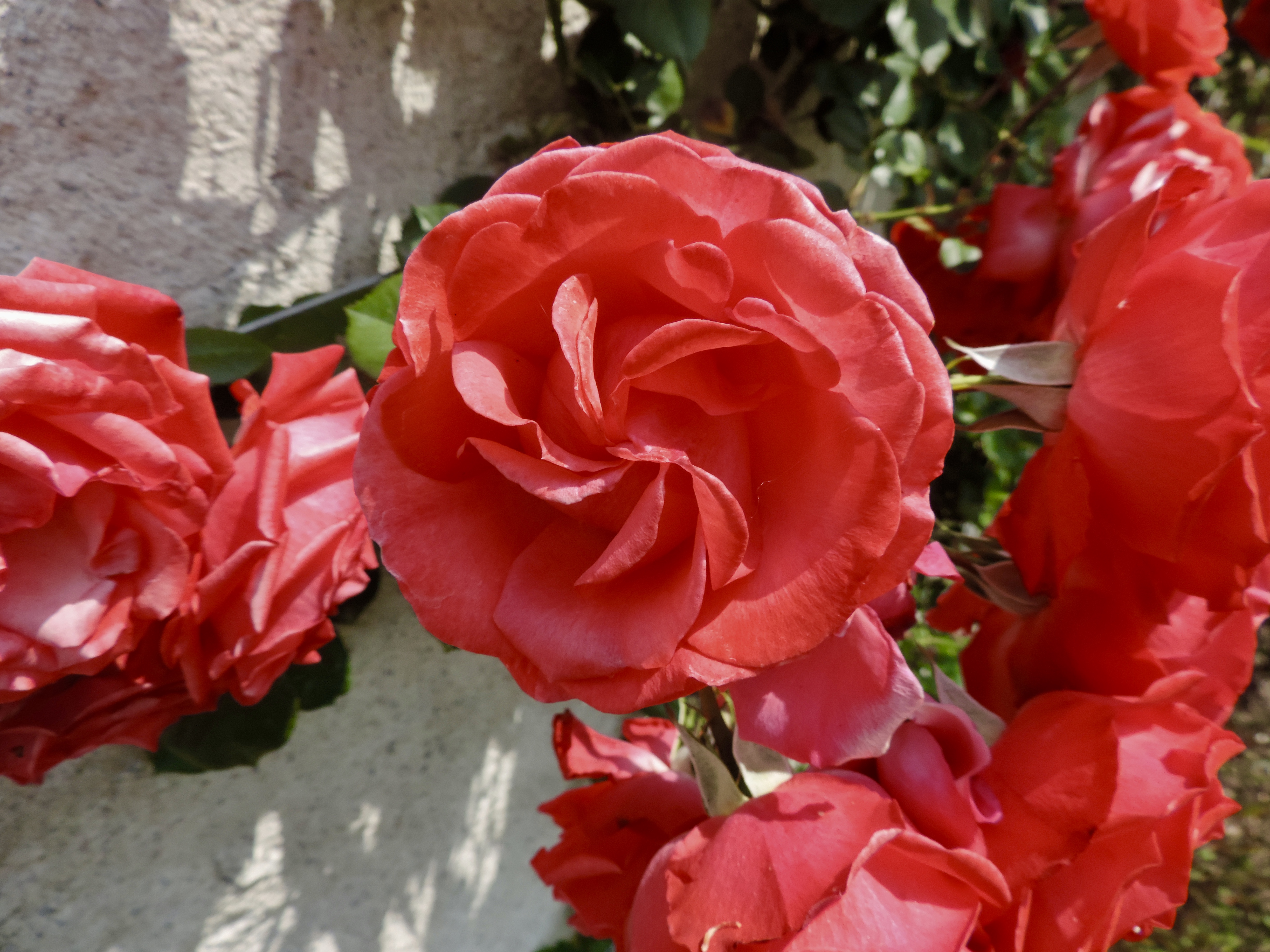
This rose in the image above is unfolding the petals from one of its buds. The unfolding is like a spiral, like one of those paper windmills you used to play with as a child. It’s utterly beautiful. This unfolding is an expansion, an opening up, a revealing and a stretching out to manifest itself. This rose is declaring “Here I am!” This rose is showing the world she exists by performing the third element of Life – growth.

Not just growth which is about becoming bigger, taller, thicker. Not just growth which expands the reach of the plant into the surrounding territory. But growth which reveals a whole new aspect of the rose. Before the flowers open up like this, the rose looks quite different. Green, leafy, thorny. But without flowers.

My littlest grandson is just seven months old now and seeing him start to “flourish”, start to “unfold” and “reveal” himself is like watching a miracle. Those first new behaviours and sounds are such a thrill, that emergence of interaction, of recognition and connection…..it’s breath-taking.

I used to find a similar awe and wonder when witnessing the unfolding and revealing of a patient as they moved beyond survival and repair into the fullness of health……seeing in that process the revelation of their uniqueness.

I think we tend to take these things for granted, because they happen all the time….these processes of survival, of repair and of growth.

But it’s worthwhile pausing from time to time and becoming aware of them….in the flowers, the trees, the birds, the other animals which share your world……in people you meet, people you love and in yourself.

It’s beautiful.

It’s inspiring.

Read Full Post »

Andrea Guenther

Sometimes we just need to pause, slow down, step off the wheel, take a few deep breaths.

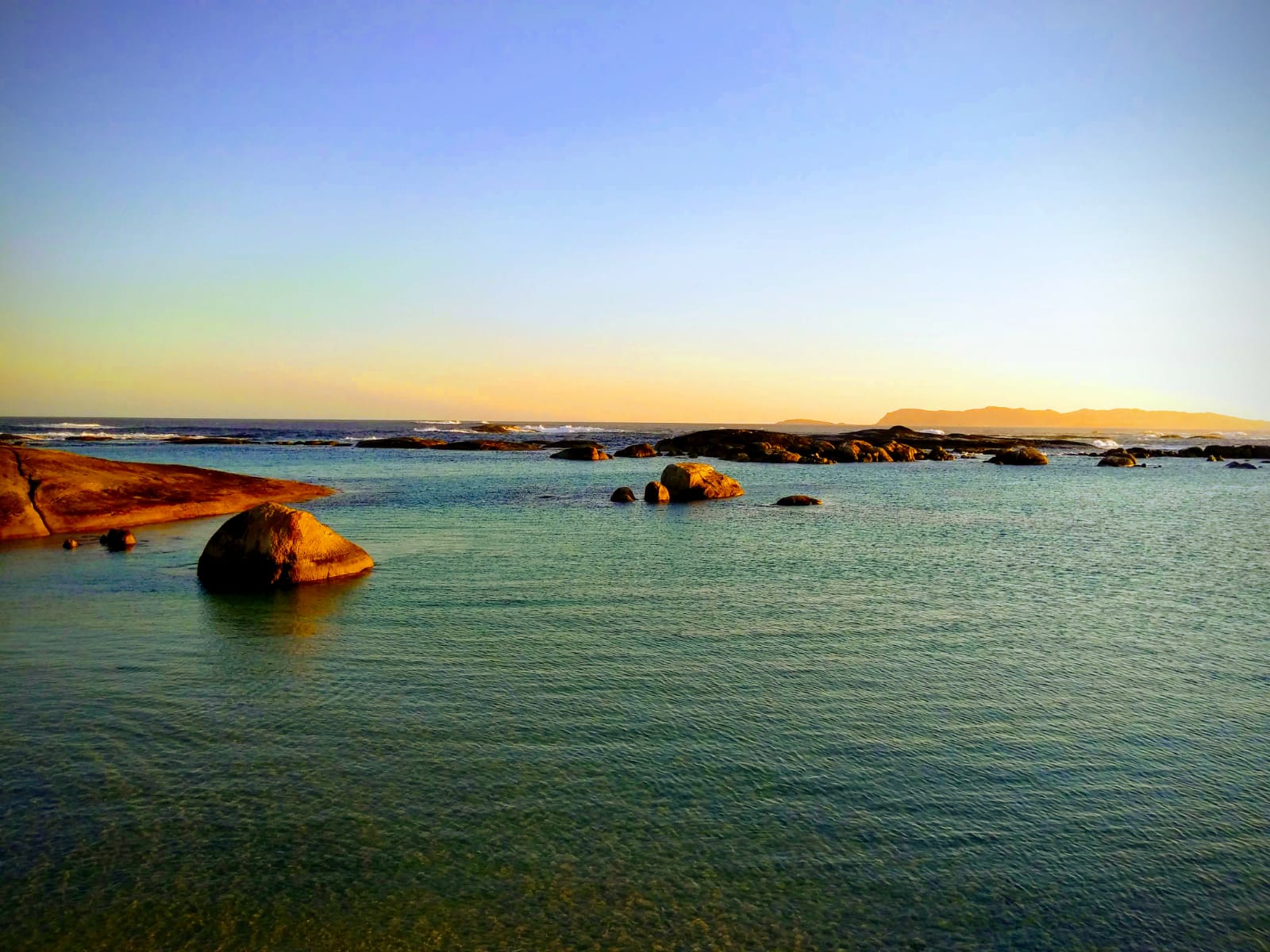
There are many ways to do that, but one I find effective is to contemplate a peaceful scene. Here is one such scene. I love the calmness of the sea, the green of the water, slowing morphing into blue the further we look (the distance is usually blue isn’t it?) then on the horizon I see where the deep blue sea meets a golden bank of air before my eyes ascend towards the deeper and deeper blue of the heavens. I see long, flat, smooth rocks, languishing on the golden horizon and soaking themselves in the peaceful green water in the middle of the scene. I see some breaking waves splashing white where the green water turns blue, and these are pleasing waves, the kind you hear breaking with sighs as the ocean exhales on the beach.

Find your own way around the scene. Take your own route. But just spend a few moments, or even minutes, allowing yourself to take it all in……..

…..there, doesn’t that feel good?

Read Full Post »

I know it’s tempting to think of time as a straight line, running from then, through to now, and onto whenever. But what pleases me so much more is to become aware of phases and cycles……those circling, looping, spiralling movements of Life.

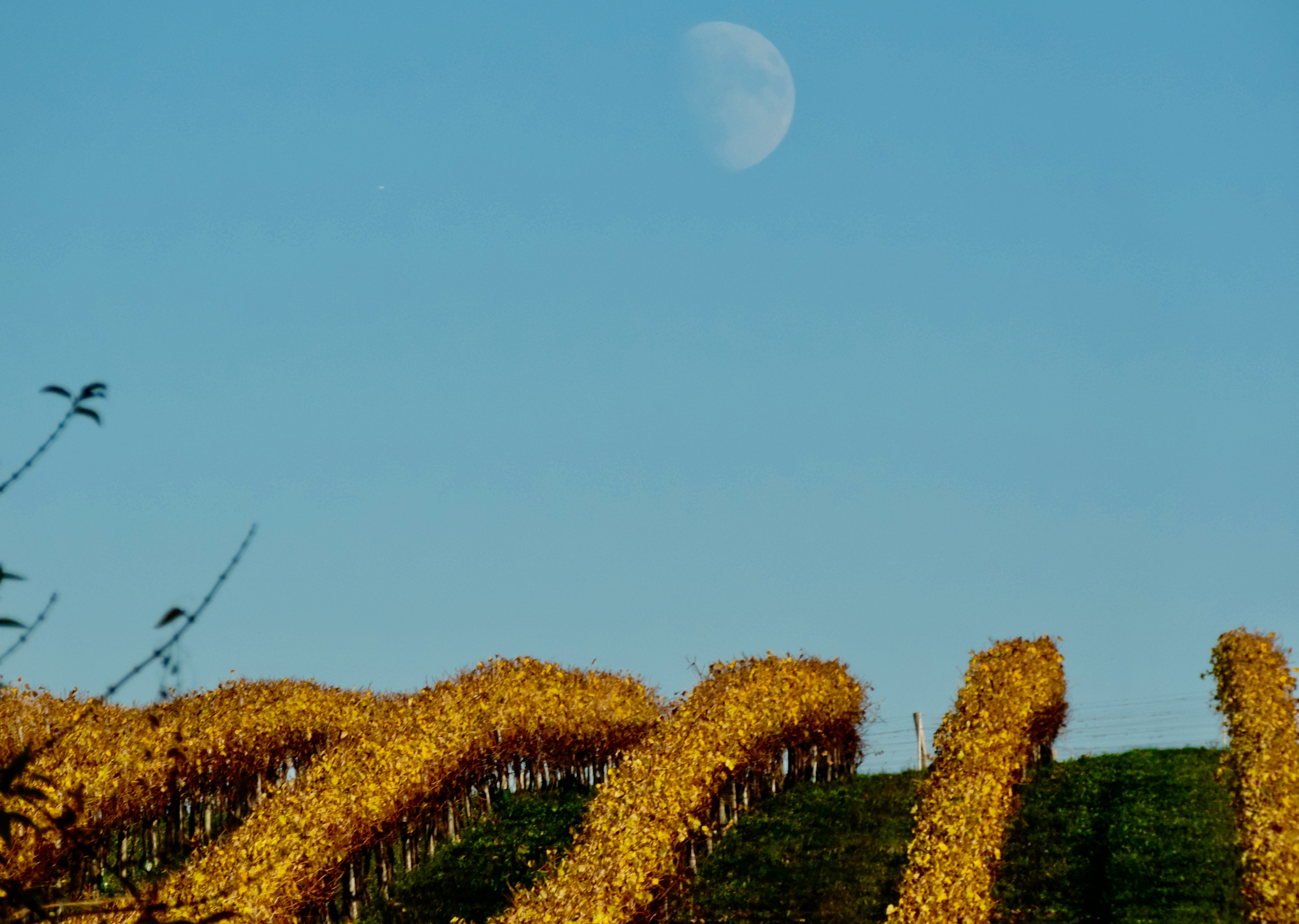
In this photo, the first thing I see is the Moon…..that celestial object which never stays the same. Every single night or day when we look at the Moon we see its shape is a little different from what it was yesterday. Surely this must be one of our most ubiquitous examples of constant change….the phases of the Moon.

We know that a lot changes here on Earth in sync with the Moon phases. We see the effect on the tides as the oceans and seas reach further up the beach, or recede away from the land to a greater distance. We know that there are rhythms of change in incidence of psychological phenomena too…..the old word “lunacy” is not without foundation in reality. We also know from “biodynamics” that seeding, planting and harvesting at different moon phases can produce different results. Yet, somehow, perhaps because night skies above cities are rarely clear, many of us have lost touch with our knowledge of Moon phases.

Do you know what phase the Moon has reached tonight?

Check tonight and see if you are right.

The second thing I see in this photo is the vines. There are vineyards everywhere in this part of France. Each of these lines is called a “wire”, and each vineyard has several “wires”. Here, near the town of Cognac, almost all the grapes go to the production of the drink of that name – “cognac” (but also to another product called “pineau”). The big “cognac houses” have contracts with many local growers, each of whom dedicate the harvest of a certain number of their “wires” each year to the distillery. By selecting particular amounts of the harvest from several, diverse regions within this grape growing area, they get a mix of flavours….some from land which is near the sea, some near forests, some very high in calcium content, and so on.

Watching the phases of the vine growth and grape production over the course of a year brings a certain rhythm to life. A rhythm attached to the seasons. In this photo the vines are all turning gold as they do every autumn. I love this season of the year for its glorious colours.

Attuning ourselves to natural phases and rhythms sets a background sense of time which stretches over longer periods than how long it take the hands of the clock to make their way right round its circular face. And it sets a rhythm completely different from the rigid, relentless movement of our digital devices as they show us what number of hours and minutes, or even seconds, have “passed” since we last looked!

Phases and seasons……cycles and rhythms………which ones do you attune to?

Read Full Post »

« Newer Posts - Older Posts »