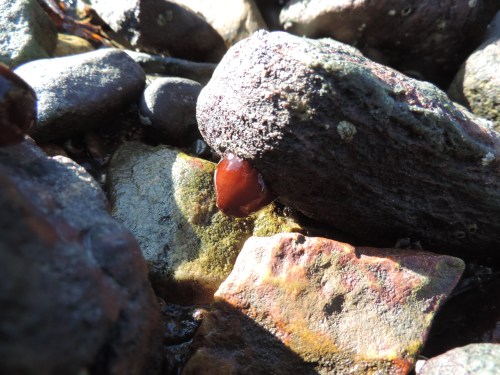
This looks like a bird, don’t you think? That’s interesting because in fact it is a stone on a beach with a little sea creature clinging to its undersurface, looking for all the world like a bright orange beak, and a tiny shell attached to the side just where you might expect to find an eye if this was a bird.
So, my mind has taken a combination of a stone and two completely different sea creatures and created a image for me which makes me think “This looks like a bird”.
We do that all the time. All the time. When we look at clouds we see patterns which make us think they look like faces, creatures, or other familiar shapes. We see people who look like people we know. We see likenesses in babies features which remind us of parents or grandparents.
This “looks like” ability isn’t unique to human beings of course. Flowers, insects and many other creatures are brilliant at developing shapes and forms of other life forms….either to attract what they want to attract, or to repel what they want to repel.
But we humans take this “looks like” ability to a completely different level. We use “representation” to become aware of, or to create, connections between things which we would otherwise miss. We use it to know, quickly, what we are looking at, or at least, to make a preliminary, perhaps “good enough” assessment.
But we also use it to connect to others. We look for similarities, symmetries echoes and reflections, to form bonds, attachments, relationships. We look for some aspect of a person or their life and say “I identify with that”, or “me too”, or “I sympathise with that”, “I understand that”.
Even in the circumstances where we look closer and realise that what we perceived at first wasn’t really what we thought it was…..this is not a bird….that ability of do the “looks like” thing turns something mundane into something just a bit more magical. It’s a way of “re-enchanting” the world.
I think we take this power to a whole new level when we start to employ symbols, art and language. I’ll say more about that tomorrow.
I’ve had a couple of days thinking about beginnings, so it seemed kind of obvious to have one about endings!
This photo shows a number of berries, all part of the same plant, even the same part of the same plant, but each in a different stage of maturation. Some are still green, some have turned yellow, some red, and some are even beginning to get wrinkled (like me, ha! ha!) and so appear the most mature.
When I think about beginnings, I realise that they are all pretty arbitrary – a beginning is where we begin – if you pick a thread or two you’ll always find your way back to an earlier beginning.
I don’t think that means there are no beginnings. I think there are. All the time. Every day. Every moment of every day. There are beginnings. There are phenomena and experiences which have only this moment come into being for the first time ever. It’s pretty great to notice that.
Endings have exactly the same quality. It’s not that there aren’t any. There are endings all the time. Every day. Every moment of every day. There are endings. There are phenomena and experiences which have only this moment slipped into the past. You’ll never have them again. It’s pretty great to notice that.
Outcomes, targets and goals
In Medicine, there is a lot of focus on “outcomes”, sometimes called “clinical outcomes”, which, somehow are a bit different from “patient reported outcomes” (“PROMS”). These are all endings. They are points to be reached. Measurements to be attained, or ratings to be completed. But when your working life is that of a family doctor, (a “GP”), then you’re never done with outcomes. The patients don’t reach the intended outcomes then go away. Life, it turns out, goes on. What was an ending today, turns out to be just another chapter in an ongoing story, just another time and place sensitive reading in the midst of a flow of a whole life.
Oh, yes, you’ll say, but there is one outcome which isn’t like that isn’t there? Death. The final outcome. The ultimate ending. Except it’s not really, is it? Well, it is for the physical body of the person who has died, but we are more than physical bodies aren’t we? We are experiences, stories, events and memories, aren’t we? And those continue long after the physical body has gone. Are the people you loved who are no longer alive completely gone from your life? I don’t think so. Their life continues to influence our lives. The experiences we shared, the memories we made, whatever we created together, the stories told, the photographs taken, the objects held…….
Have you ever seen a BBC TV programme called “The Repair Shop”? I love it. People bring old objects to a workshop of artisans. The old objects are usually in a poor state of repair, but they mean something to the person who has them. Once restored by the craftsmen and women, the person comes back to reclaim the object, and time and time again, it is an immensely emotional experience. They are put in touch, deeply, and significantly with a loved one, long gone. It’s lovely to watch and it shows how a person, an individual, continues to influence others long after they’ve gone. How their “presence” I suppose you could say, is made more real through what they’ve touched, what they’ve handled, what they played with, or made.
Targets are a kind of outcome. They are useful as ways of getting you to somewhere you want to get. For example if you want to save up a certain amount of money then setting a target of that amount is a good aid to getting there. The trouble is that targets are used inappropriately. Whose targets are they? And are they the same, most important targets, which others want to achieve? Because the selection of targets is an individual, value-based, subjective, exercise of choice. But if they are set for others then they direct the efforts and lives of others towards those targets instead of others. I’m not a fan of targets. At least, not ones I don’t have a say in the creation of!
Goals are a bit like targets. I’d say the same about them. They can be helpful to get us to places we want to get to. But they are aspirations, not predictions. And they are not endings. Or at least, they are not final endings. Are they?
I think this unique and unpredicted pandemic is forcing us to face up to the reality of beginnings and endings. It’s making us more aware of connections, of webs of influence, of the non-linear, multifactorial, dynamic, ever flowing, ever changing nature of reality.
This morning I read an article in Le Monde about how management methods are already starting to change in the light of this experience. Here’s the main point I got in that article – management is having to move away from “control” to “coaching”. Three things have come to the fore – the need for individual autonomy, the need for good team working and relationships between workers, and the need for transparency.
Well that all seems pretty good to me! I look forward to seeing the end of de-humanising “Taylorism” and “command and control”, and the beginning of an emphasis of autonomy, relationships and transparency. Imagine if we governed countries according to those principles?!
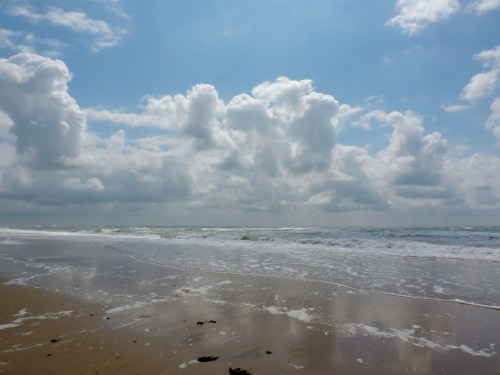
I took this photo the same day as the one of bubbles in the surf which I shared yesterday. I think it is beautiful. It’s one of those images which is lovely to spend some time with. I can lose myself in it.
I love how this shows water in the process of changing into several of its forms. We can see the water which forms clouds, and if you sit or stand and watch clouds for even a few seconds you notice how each cloudy constantly changes. It changes position, it changes shape, and it changes size.
We can also see the water which has reached the beach, turning the sand into a kind of mirror because in this thin surface of water we can see the reflections of the clouds up above. I think that’s quite unusual….. it was the main thing which caught my attention and led me to take this photo. The thin layer of water on the sand has been left by breaking waves which have stretched up to a certain point on the beach, then receded back into the ocean. Some of those waves have turned to bubbles and foam. Waves don’t stand still. They are constantly on the move. They sound like the ocean breathing, breathing the water out onto the sand, and then breathing it back into itself again.
We can see the ocean which is a huge volume and expanse of water constantly changing from flatness to swells, individual waves, and white foam, under the influence of energy waves and tides in the sea interacting with the wind blowing over surface.
The ocean, the waves, the foam, the bubbles, the mirror like surface, the clouds up above……all manifestations of the one phenomenon – water. Water, that ubiquitous, mysterious, substance without which there would be no Life on Earth. A constant source of wonder and amazement.
It’s beautiful to gaze on such ever changing mystery, to remember how essential this is to us, and to feel humble in the face of all we don’t know, and don’t understand about this most important element on Planet Earth.
Yesterday I wrote about new beginnings, about choosing what and when to start, but I’ve been thinking about it since then and I realise beginnings are paradoxical. They are both easy to find and impossible to find. Why do I say that?
Well they are easy to find because every action, every thought, every experience is, in fact, brand new. Life moves and flows continuously. This present moment has never existed before, not for you, not for anyone you know, not for the planet, not for the universe. So every present moment is a beginning (and, yes, it’s an ending too, because no experiences are exactly repeatable)
They are also impossible to find because everything is connected. We human beings are “complex adaptive systems”. That is we are massively interconnected, both in our own being, and in our contexts, relationships and environments. We are “open systems”. That is there are no impermeable barriers between an individual and the rest of the universe. The atoms, molecules and cells which make up our bodies are changing all the time, as we breathe in, ingest and absorb new materials, and breathe out, expel and excrete other ones. Energy and information flow into and through us continuously.
So what? Well, all this means it can be very hard to trace back from now to a “start point”, or a “beginning”. For example, when a patient would come to see me and complain about a particular problem, and I diagnosed a certain disease, where did that disease start? With the first symptom? With the first symptom which was troublesome? With the pre-conditions before the first symptom began? I was taught to explore a patient’s “past history” to see how this illness might fit in the trajectory of their life. I was taught to explore their “family history” to see if there were family patterns or dispositions. I was taught to explore their “social history” to find out what was happening in their work and social life. I could go on……
A beginning is pretty much arbitrary. It’s where we choose to begin. Think how you would tell your life story to another person. What would you say first?
As I progressed in my work experience I changed my introductory question to each patient, from something like “What’s the problem?”, or “How can I help you?” to “Tell me your story”.
Yep, “tell me your story”. Sometimes a patient would be a bit taken aback with that beginning, but I’d just maintain eye contact, show I was listening and wait. Sometimes I’d have to say a little more to get things going, for example to explain that I wanted to understand what they were experiencing and how it might have come about so I’d like them to just tell me about it in their own way, but usually, people would just start to speak.
Where a person chose to start, and how they told their unique story, was always interesting and relevant. As the consultation progressed I’d often ask another question “When did you last feel completely well?” This was a particularly useful question to be followed up with “Tell me about the weeks and months leading up to that time”.
Those were beginnings. Different beginnings. All useful and all relevant.
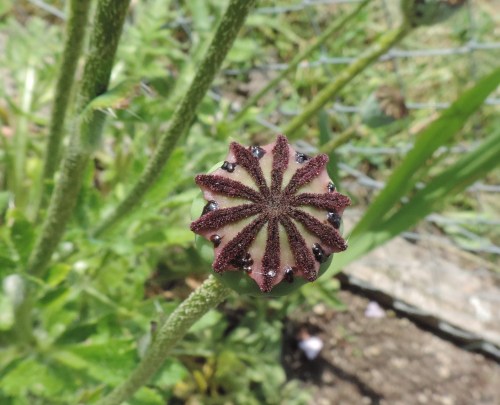
I came across this photo of the seed head of a poppy the other day and it’s so beautiful that I just decided I’d like to share it with you. How does it fit with today’s thoughts about beginnings? Well, all plants live cyclical lives, with phases passing through seed, germination, growth, perhaps blossoming or fruiting, and scattering the new seed before dying back for the next cycle. Does the beginning of that cycle start with the seed in the ground, or the seed in the seed head waiting to be dispersed? Or somewhere else?
So, back to beginnings. Whatever you want to begin, begin today. Even if its a habit, a routine, a task you’ve experienced before and stopped, because even when you stop, you can start again. You can start today. After all, you’ve never lived this day before.
Yesterday I shared a post about two forms of growth….unfurling (unfolding, opening, flourishing or blossoming) and connecting (reaching out to make bonds, relationships and links).
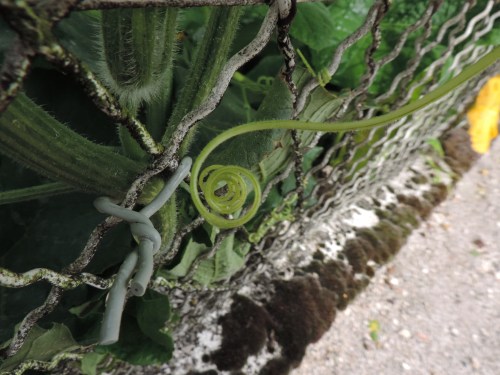
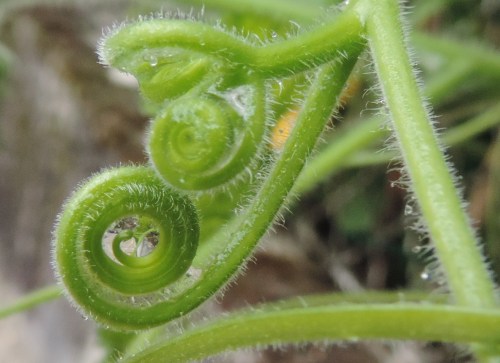
Today I came across a couple of photos from my garden which show both of these processes occurring at the same time. In this first photo you can see how the tendril or creeper which is reaching out is doing so in a kind of spiralling or un-spiralling way. It doesn’t consider that a straight line is the shortest distance between any two points! Perhaps there is something to learn from this – a sort of melange of meandering and spiralling around.
But what really struck me was this photo because I took a close up of these beautiful spirals and because I was focussing on the near distance the background has gone nicely blurred (something photographers call Bokeh I believe!) – but, wait! Look more closely! Look at the centre of the spiral which is in the bottom left corner of this image!
Through that spiral the distance suddenly becomes clear as crystal.
I don’t know what you think, but that reminded me of my favourite “And not or” theme – when you take BOTH of these processes of growth together suddenly you can see the world more clearly!
If you’re interested to read more about “And not or” check out my book.
I’m pretty keen on creativity. I have an eye for what’s new. In fact, I’ve been pretty impressed with the old philosophy which says to treat every day as if it’s the first time you’ll have experienced it. Because it is. Each patient who came into my consulting room was coming in to tell me a new experience, a new story. Even if I already knew them quite well they’ll still come and tell me something I hadn’t heard them say before. Everyone had the capacity to surprise me.
I love the Spring time of the year because I love to see the new seeds pushing up the first green shoots, love to see the buds beginning to form and unfurl, love to see the first sight of the migratory birds returning from their winter travels.
But Autumn is sort of opposite to that. It’s a time of a certain paradox – a time of fruition and therefore harvest, but also a time when the world begins to wind down, go to sleep, or even die off. It’s a time you might call the “down cycle”. I love that too. I love to see the leaves turn yellow, red, brown, golden. I enjoy sweeping up the leaves that fall from the mulberry tree.
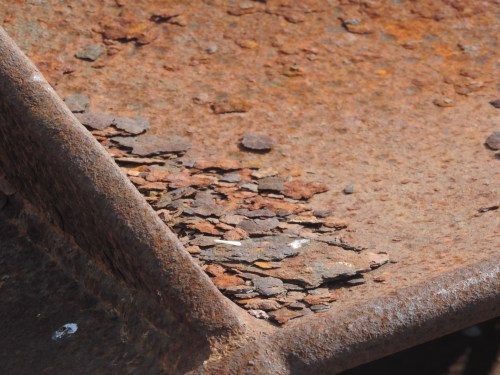
This photo reminds me of the down cycle. Here’s a piece of iron. Some large, once strong panel or plate which someone created. But it’s been cast aside for a long time, and Nature has begun to break it down. The once smooth and shiny surface is breaking up into these little chips and flakes. The chips and flakes will, finally, turn to dust.
Does that seem like a loss?
I suppose viewed from one perspective it is. But Nature has down phases as well as resting phases, waking, growing phases, and maturing phases too. Could anything exist if any of these phases didn’t exist?
I think we need to remember that sometimes, and not get too upset and anxious about change. Nothing stays the same. And because nothing stays the same we are able to start each day as if we had never lived it before….because we haven’t. Imagine! How much there will be to discover today. How many new experiences and sensations you will have. How many new thoughts and feelings you will experience.
Life is dynamic. As Carlo Rovelli, the physicist says
A stone is a prototypical “thing”: we can ask ourselves where it will be tomorrow. Conversely, a kiss is an “event.” It makes no sense to ask where the kiss will be tomorrow. The world is made up of networks of kisses, not of stones.
I think an awareness of the phases and cycles of life reminds us of that. There’s beauty in every phase.
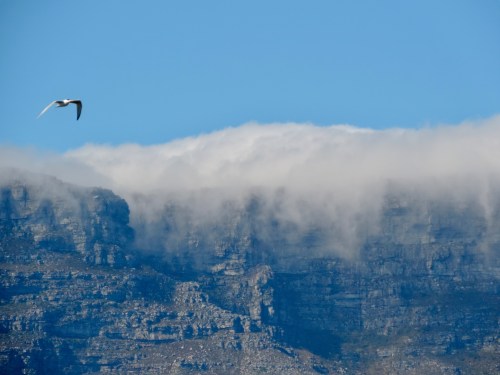
I took this photo in Capetown many years ago. It wasn’t my intention to take a photo of a seagull, but, somehow the bird’s presence adds to the image, rather than taking anything anyway.
What I was wanting to photograph was this very common phenomenon which the locals refer to as “The table cloth”. It’s when white clouds form on top of Table Mountain and steadily spill over the edge to tumble down the cliff face.
They don’t tumble that far before disappearing. It’s mesmerising. I watched it for ages. It seemed like there was an endless supply of white cloud on the mountain top. No matter how much spilled over, there never seemed any less on top. It’s a constantly moving phenomenon. The cloud tumbling over the edge is continuous. At the very top it looks like a waterfall, but, as you can see, it’s a waterfall which completely disappears within the first few metres of its descent.
Where does it go?
As you stand and look at it, you are watching the visible become invisible. Right before your very eyes.
Isn’t it amazing that all that water which creates the white cloud is already present in the air, but invisibly so, and it all just vanishes back into its natural invisibility as you watch it.
I know I often think of the relationship between a wave and the ocean when I think of our individual existences…..how we emerge from the ocean, the way an identifiable wave emerges, without ever leaving the environment in which it exists.
This “table cloth” phenomenon is like another example. The water exists in the air, then it coalesces to from clouds like these, before slipping back into the invisibility of the air.
Each of us, in our short, transient lives, is fashioned out of all that exists, appearing briefly in our distinct, unique form, before slipping back into the continuity of Existence.
As the physicist, Carlo Rovelli, wrote…
A handful of elementary particles which vibrate and fluctuate constantly between existence and non-existence and swarm in space even when it seems that there is nothing there combine together to infinity like the letters of a cosmic alphabet to tell the immense history of galaxies of the innumerable stars of sunlight of mountains woods and fields of grain of the smiling faces of the young at parties and of the night sky studded with stars.
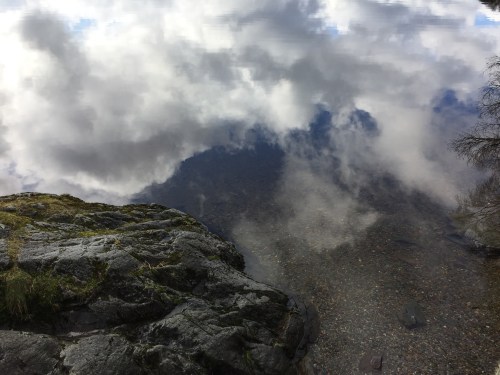
When you look at this photo I think it seems to be a mountain with clouds and sky just above it. But you immediately recognise that’s not quite right.
So then you see this and you think it’s trees with the sky above….maybe one of those forest pictures where the photographer directs the camera straight up to the sky and catches the topmost branches of several trees. But that’s not quite right.
In the first photo, the apparent mountain in the foreground is an odd shape. Mountains just don’t look like that, then, in the second photo, what’s that rock doing balanced on top of the trees?
The thing is, these are both photos of reflections on the still water of a loch. Once you know that, the whole image makes sense.
This inspires a train of thought in my mind…..about how we perceive and make sense of reality. It’s a complicated business but it involves context. It helps to know where you are when you are looking around and what you can see in the immediate environment. There is nobody standing at the edge of this loch wondering what they are looking at. They know where they are and how they got there.
We make sense of reality by spotting patterns, but we need to learn the patterns before we can spot them. A bit chicken and egg-ish isn’t it? In normal life these two aspects of the same thing are iterative…..we are constantly learning and spotting patterns, the more we learn, the more we spot, and the more we spot, the more we learn.
Medical Practice is like that. Doctors learn pathology and the natural history of diseases. In other words, they the patterns of illness. The better a doctor knows the patterns, the more easily they’ll be spotted – or diagnosed. And the more diagnoses a doctor makes, the better the knowledge of patterns. We call it experience. I always felt that a good diagnosis was crucial in good health care. If the diagnosis was wrong, the chances are the treatment would be wrong.
In my first Paediatric job, my mentor told me on the first day that his goal for my six months with him was to teach me how to recognise a sick child. When he said that I thought it was a pretty bizarre thing to say. I mean, wasn’t it obvious when a child was sick? Wasn’t the goal to diagnose ie name the sickness? Well, of course, he was right. I was wrong. What he wanted to teach me was that very first important step…..how to recognise, in an instant, that this child was ill and needed immediate attention. Working out exactly what the disease was and how to treat it came a close second, but if you didn’t recognise that the child was sick, all was lost. It turned out that learning was by experience, encountering sick children and healthy children of all ages, to become familiar with what was normal behaviour and demeanour at different developmental stages. That teaching was crucial for my practice as a GP. It let me walk into someone’s house and know instantly that this child needed close attention and help.
The clues, and the signs, were in the contexts, the environments and the relationships. Yes, some were in bodily or facial “signs”, but mostly they were in behaviours and responses.
I suppose it’s that kind of experience and learning which made me suspicious of reductionism and generalisations. Every individual is unique and can only be understood within their contexts, their environments and their relationships.
Diagnose, like pattern spotting, is like joining up the dots. It’s got a lot to do with connections and behaviours. It’s not all about “data” and “measurements”. Especially when considering the real, actual, unique individual here and now.
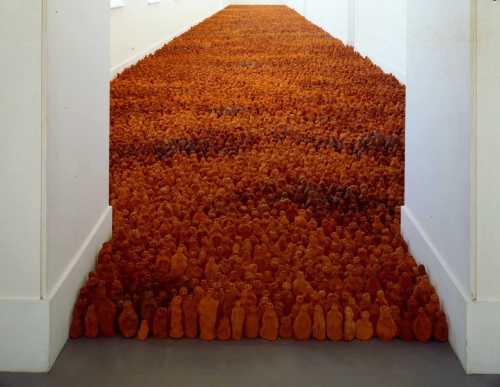
One of my most favourite sculptors is Antony Gormley, he who made “The Angel of the North” which stands beside the M1 in the North of England. His “The Field”, which I saw in Inverleith House in the Edinburgh Botanic Gardens years and years ago left an indelible mark on me. I recalled it in my mind time and time again as I wrestled with the paradox of what makes every patient unique and what they share with others.
But I was thinking again of his work the other day and I remember “Capacitor” which is what you see in this photo at the beginning of this post. This was one of the works he created from an outline shape of his body. In this case he made it with dozens of metal rods.
Maybe this came to mind because for the first time since I moved here almost six years ago I came across a hedgehog in the garden after dark, as I was out closing the shutters for the night.
I have such a clear memory of being in the same room as “Capacitor”….how awkward and dangerous it felt to be anywhere near this work. Like it could take your eye out, or pierce your body if you got too close.
So, you can see why that’s come back to me now. When I’m out and about now I sometimes think everyone has got on a suit that makes them look like “Capacitor”. Except all the spikes are invisible. Has this become the famous “new normal”? All of us increasing our stand-offishness (is that a word?). All of giving each other “a wide berth”. Everyone now regarded as a potential threat.
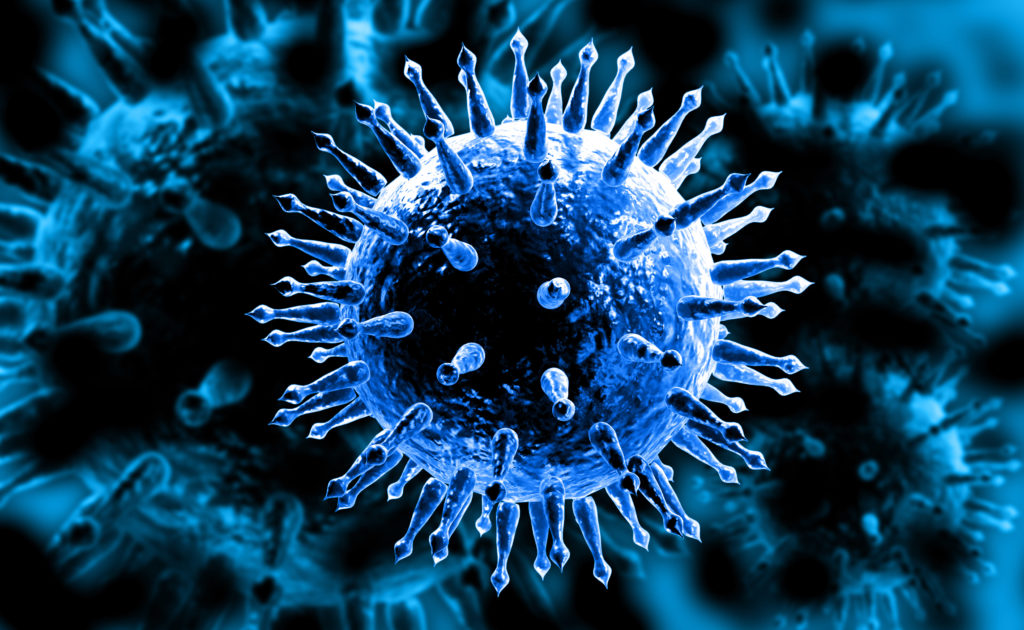
Then it struck me…have you seen the images of the coronavirus?
It’s a ball of spikes!
Yikes! It’s turning us all into images of itself!!
Plants send out creepers and tendrils which twist and turn and spiral on their way are always fascinating. For the last five years I’ve been composting grass cuttings and “garden waste” then spreading it on the veggie patch. It’s turned a stony, hard, bare piece of ground into something of a mini-jungle once each year’s vegetables start to grow. This year there must have been some viable pumpkin seeds in the compost because a couple of pumpkin plants started to grow in places where I definitely hadn’t planted them. Once they started to grow they took off, spreading all around the entire patch, weaving between other plants, sending spiralling tendrils out to grasp onto to anything it could touch, reaching each of the two boundary walls (the veggie patch is in a corner), climbing those walls, the fences above them and by now developing over half a dozen huge pumpkins. Every morning you could see how much further the plant had managed to grow since the previous morning. It’s astonishing.
This photo isn’t of a pumpkin plant. There are many, many varieties of plant which have this ability to send out these incredible tendrils. They reach out, touch and catch on. They connect, they bind, they tie together. Look at the size of these ones! You can sense how strong they are.
I was thinking this morning about how pretty much every single atom on the Earth has been here since the planet was formed. They arrived here from distant stars. I was contemplating how the Earth doesn’t make new copper atoms, gold atoms and so on. But what Nature does is create what’s unique and new every single day. She does that by making connections, reaching out, touching, drawing together, blending and binding. In other words, the world is full of newness every day….not new elements but new forms. Nature is like the most inventive creative artist you could imagine, fashioning brand new, individual, unique, forms every single day.
Making connections. Making new connections. That’s the essence of creation.
I welcome constructive criticism and suggestions. I will not, however, tolerate abuse, rudeness or negativity, whether it is directed at me or other people. It has no place here. ANYONE making nasty comments will be banned.