Feeds:
Posts
Comments

Archive for the ‘perception’ Category

I know there’s a colour called “sea green” but I must say that most times I look at the sea, I don’t think “Look how green the sea is!” But on this particular day, I did. In fact, the singular most striking feature of the sea in this photo is how green it is. Growing up in Scotland I’m used to seeing the land as green….the hills, glens, fields and forests. There is a lot of green in Scotland. I associate those greens with Nature, and with Life.

When I think of a calm, soothing landscape, I usually envisage one which is green, but this green seascape isn’t calming at all. The fact that the wind is whipping up the waves and causing them break far from shore tells me this is a day of a more “active” form of weather…..not a day of peace and ease. And there’s something else in this scene which makes it a bit disturbing….the lighthouse.

The lighthouse? Why should that be disturbing? Well, what’s a lighthouse for? For warning people sailing in this area. Why this area? Because there are dangerous rocks, and/or dangerous tides here. If you’re not careful around here then you could run aground, and even lose your life.

Noticing the lighthouse and realising that I was feeling unsettled as I looked at this image reminded me that we are constantly bombarded with warnings these days – “yellow weather warnings” (what is yellow weather by the way?), “red weather warnings”, “danger to life”, “virus warnings”, “health warnings”, “safety warnings”…….there’s no end to it.

What do all these warnings do? Keep us safe? Maybe. But one thing they certainly do is trigger our inner warning systems. There’s a part of the brain which is called the “amygdala” which has a key role in our alert system. It sets off the famous “Fight or flight” response, flooding our bodies with adrenaline, speeding our hearts and our breathing, tensing our muscles, tightening our stomachs, preparing us to take action. What kind of action? Survival actions.

This essential survival system comes with a problem however….when it’s constantly triggered it sets a higher level of body defence…..that’s the inflammatory system…..and a chronically alerted, activated inflammatory system is at the basis of most chronic disease – from heart disease, to any form of “-itis”, to autoimmune diseases and chronic psychological problem states like chronic anxiety, phobias and depression.

So, I think it’s important to be able to do something about that, and here’s a simple, but helpful exercise – take three very deep breaths, slowly one after the other, completely filling your lungs, then gradually letting all the air out bit by bit. Repeating that big, deep breath three times.

That’s it.

Sure, there are loads more things you can do, but, believe me, this is a good start! Firstly by consciously choosing to do these three breaths you’re taking your attention away from the alarm state. Secondly, this form of breathing changes the chemical balance in your body, changing the oxygen/carbon dioxide ratio in a way which triggers cascades of anti-inflammatory change in your whole system. Thirdly, it triggers the vagus nerve, slowing the heart and pretty much literally steadying your nerves. Finally, this all breaks the loops, helping your break out of stuck hyper-activated circuits….a kind of “re-set” if you like.

If you want to extend these benefits and deepen them, the next thing to do is call to mind a calming, safe, relaxing scene…..preferably one you once experienced. Re-create that event, or that circumstance for a few moments and the emotions which arise with it will begin to dilute the alarm state and deepen the benefits of the three breaths.

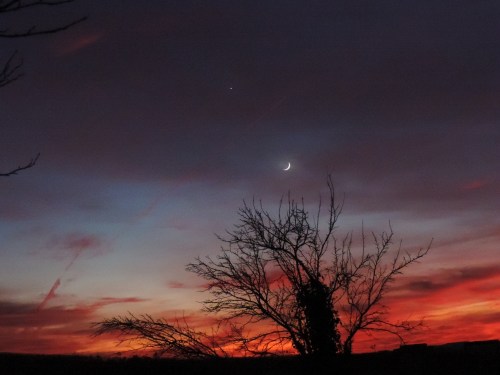
You might want some help with this. I find a sunset helps. Here’s one taken from garden on a night where the crescent moon sat above the plum tree and the planet Venus hung in the depending night sky just above the moon.
You might well have a photo of your own somewhere on your phone…..a peaceful, pleasing, calming scene, which you, yourself witnessed. If you do, mark it as a favourite and keep it handy. It could be just what you need.
Read Full Post »

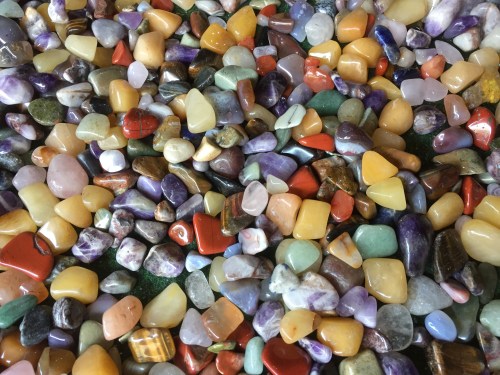
This is a photo of a small part of something called a “Scratch Patch”. It’s an area about the size of a large room. The floor is covered with polished stones. You pay for a container/jar and can then spend as long as you like filling it with the particular stones which attract you most.

I shared a photo of a pumpkin stall at a farmers’ market the other day to demonstrate the beauty of diversity but then I came across this photo which shows exactly the same thing in the mineral world.

We have a bit of an ambivalent attitude towards stones I think. Maybe because they are inanimate we don’t often value them as much as we do plants or animals, but on the other hand, “precious” stones are considered to be amongst the most valuable objects in the world.

At a simple level many of delight in spotting and picking up a few “interesting” stones when we are out walking – whether it’s through the vineyards, or along a beach. You probably have some favourite stones of your own. Maybe in your pocket, at the bottom of a bag, or on a shelf somewhere in your house.

We must know, instinctively, that stones are not all the same. Otherwise how would we notice some but not others? Why would we choose to pick up and keep certain ones?

I think the attraction of uniqueness runs right through everything in this universe. We humans, each of us unique in our own right, are delighted by uniqueness, whether we find it in our gardens, the paths we walk along, the flowers and trees which grow around us…….

I have often said that what I looked forward to most on a Monday morning was the first clinic of the week. Every single week I knew I’d meet unique patients. Every single day I knew I’d hear unique stories which I’d never heard before. Every single consultation was unique, never to be repeated.

For me, good Medicine couldn’t be reduced to protocols, guidelines and algorithms because every single human life is a unique one. Every single human being is “extraordinary”, not reducible to a class, a type, or a disease. Every encounter occurs only once.

Read Full Post »

“Now, Life is living you”

This sign is on the wall of a buddhist temple smack in the middle of Kyoto city.

Just take a moment and contemplate it.

Ever since the moment I saw this phrase and it stopped me on the pavement outside this temple, I often think of it, and the more we learn about Life on Earth, the more true this statement seems to me.

As best we know, planet Earth was formed from atoms which were created in the great furnaces and explosions of distant stars. Every single one of us has been created from those atoms. Nature doesn’t create new atoms, it recycles and rearranges the existing ones. So the atoms which can be found in your body were once found in other bodies, other species, other members of other kingdoms on this Earth.

Our bodies are Star Bodies. We are the children of the Stars.

Emanuele Coccia, the Italian philosopher challenges us to think about the Plant Kingdom differently. He has a new book out, “Métamorphoses” (I’ve got it in French…..you’ll need to wait for an English translation if you don’t speak Italian or French). One of the central themes of this book is that we are One….that there is only One Life which never ceases to change forms whilst never changing its substance. In other words, there are only the atoms which made up the substance of the Earth at its creation, but Life turns these atoms, continuously into new forms – new species, new individuals within each species. The process of evolution is a kind of sculpting, produced by the vast complex web of all that exists, to create ever more adapted forms of Life.

We are each like the individual waves on one great ocean of water, every one of us unique and transitory, emerging for brief periods of time before dissolving back into the vast sea.

It’s Life which fashions each of us, and each of us, in turn, interacts with, metabolises and changes the other forms of Life. So, as Emanuele Coccia says, once we understand the one-ness of everything, all ownership and frontiers lose their significance.

Life is living you.

Read Full Post »

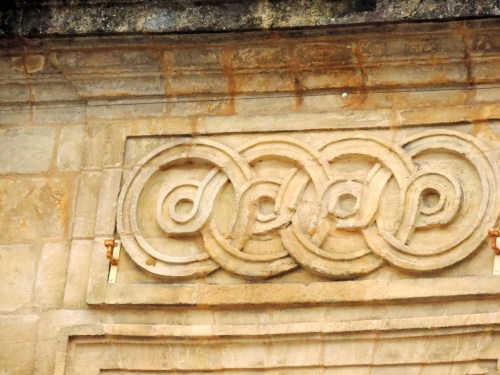
When you look at these two photos, how do you respond?

Do you find you prefer one to the other? Or do you like both, equally?

The design on the left is all straight lines and right angles, whereas the one on the right is of interlocking circles and loops.

Some people find straight lines and right angles somewhat aggressive. I seem to remember reading that the architecture of Waldorf Schools and other Steiner inspired buildings seeks to avoid these “harsher” lines and angles. The hospital where I worked for the last two decades of my career, “The NHS Centre for Integrative Care” (formerly, “Glasgow Homeopathic Hospital”) was designed to have as many curves, and as few right angles, as possible. The main reception desk was curved and open, and even the walls of the inpatient unit were a series of curves which evoked the image of gentle waves. I liked that.

As I was born and grew up in Scotland, the typical Celtic designs of knots and loops were familiar to me from an early age. Although the image on the left is also of intertwining lines, it isn’t typical of the Celtic drawings I know.

But maybe the straight lines and right angles are more appealing to you? If they are, why don’t you tell me about them? I’d be interested to hear what your preference is, and why.

Read Full Post »

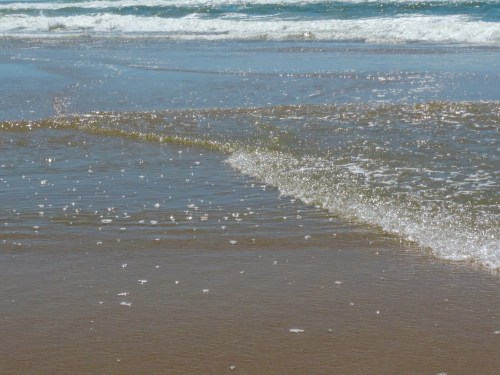
There’s a stretch of coastline about an hour directly west of here. It’s known as “La côte sauvage” – the wild coast. It’s beautiful but a bit dangerous. There are rip tides and ever changing flows within the Atlantic Ocean which can trap and carry off a swimmer.

This photo captures something of that unpredictability. If you look at the lines of the breaking waves you can see the water is arriving from at least three different directions at once, and there are layers of water running in several directions.

Actually, I think life is like this. There are forces, attractions, repulsions, triggers and stimuli influencing us from multiple origins in every waking moment. We are complex creatures, we humans. And the world we live in is complex too. That’s why I doubt simplistic analyses and confident predictions.

Human life cannot be reduced to “cause and effect”, to “rationalism”, to “measurements”, “categories” and “data”. Life is full of surprises and every single experience emerges within multiple contexts with us responding, mostly unconsciously, to an almost infinite number of factors.

Somehow, that makes life all the more beautiful, all the more mysterious, all the more engaging……

Read Full Post »

There’s something which really bothers me about modern management theory and practice – “efficiency”.

“Why should that bother you?” you ask.

Well, because it seems to me that it usually means getting the greatest return from the least input or effort. And I’m not sure that’s always a good idea. I’m coming from the perspective of health care. I despaired of the annual cuts after cuts after cuts in the NHS. Every year I saw colleagues who retired or moved away, not replaced. Every single time someone left the remaining staff were asked to “absorb” the missing colleague’s workload. Every year there were more budget restrictions, more closures of beds and services, all in the name of “efficiency”.

So what has happened now that a pandemic has hit? Not enough beds, not enough equipment, not enough staff. Even now, weeks into the crisis, frontline staff lack adequate amounts of PPE (Personal Protective Equipment). All the pressure to “protect the NHS” was due to the fact it had been pared down to the bone over at least a decade. There was, and there is, no, or little, resiliency in the system. Yes, they redirected staff and reallocated beds to deal with the COVID-19 patients, but did so at the expense of the care and services which those staff and beds were normally employed for.

Is it really a good idea to have “just in time” ordering and delivery systems for something like the NHS? It doesn’t look like it. Is it really a good idea to have as few beds as possible, as few hospitals as possible and as few staff as possible? It doesn’t look like it.

Nature doesn’t do it this way.

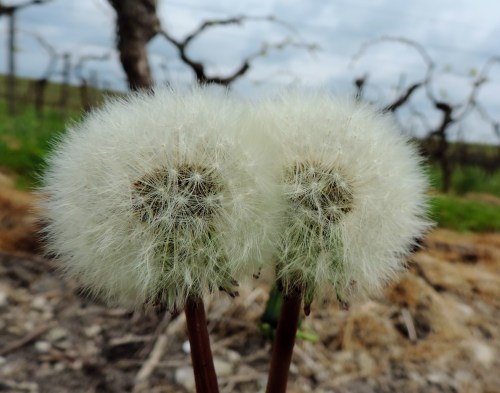
Nature goes for abundance. Look at the seedhead in the photo at the start of this post. How many seeds are there from that single plant? Way more than you’d “need” for reproduction and spread you might think. Would it not be more “efficient” for the plant to produce, say, half that number of seeds? Or maybe only ten percent? It doesn’t look like it.

Complex adaptive systems are Nature’s way of enabling adaptability and resilience. All such systems have what scientists call “redundancy” – by which they mean there are “belt and braces” approaches, there are several pathways to achieve the same thing. It’s by drawing on those “extra” resources and methods that Natural living organisms survive and thrive.

I think we need to learn that from Nature. There’s been way too much paring back, stripping down, and minimising going on. If we want resilient services, and resilient societies we aren’t going to get there by “efficiently” going for the least, the cheapest, the quickest and the meanest.

Here’s what Nature does –

It goes for more……

Read Full Post »

What happens as new technologies, new designs and new fashions appear? Do they replace the existing and past ones? Do we throw away the ones we have and replace them with the new ones we just bought?

Well, I suspect that happens a lot. What do we do with the old “stuff’? Stick it in a drawer, or in the attic? I read that most of us have old phones, old cameras, old laptops etc stuck in the house somewhere….no longer used, out of sight, out of mind, just occupying space (although, to be fair, it’s usually dark space……somewhere hidden where nobody can see it)

Dark space, huh? There’s an interesting idea! Sounds a bit like “dark matter” or “dark energy” which between them are apparently mainly what the universe is “made of”. I wonder how much the “dark space” in our houses affects the way we live? Or do you think all that stuff has no effect because you don’t see it on an everyday basis?

If we don’t stick the old stuff into dark space, then maybe what we do is throw it away, give it away, or sell it. There are increasingly good reasons to do the latter two, rather than the former one.

Nature doesn’t do waste. There is no waste in Nature. So why don’t we try to be more natural?

Be more like Nature!

How are we going to do that? Well, reducing waste would be a good idea. Longevity of products would help that. In other words making things which last. We used to call that quality. Wouldn’t it be good to have better quality in our lives?

But longevity isn’t enough. Our lives change, our needs change, there is just a lot that we don’t need any more, don’t use any more, don’t wear any more. What to do with that?

Share it – “toy banks”, “clothes banks”, “community swaps” etc.

Give it away – donations to charities, to relatives, to friends etc

Sell it – in France there are lots of “vide grenier” – which translates as “attic emptying” – in other countries you might call them “garage sales” or “car boot sales”. There are lots of online options too.

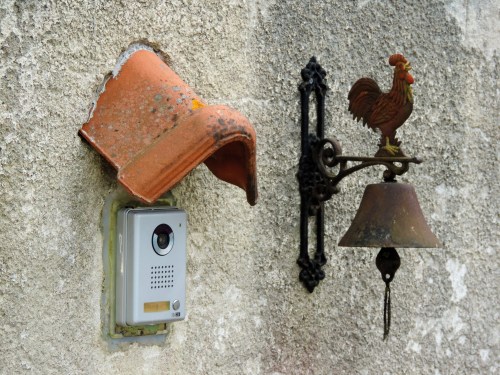
Or, in the case in the photo above, it seems to me, they’ve gone for “and not or”. They had a way of visitors letting them know they were there. It’s pretty attractive actually……a handbell with a cockerel on top. But, maybe because it’s not so easy to get to the door any more, they’ve added a smart video-doorbell, so they can see who is there, and, maybe, I don’t know, press a button to open the door. So why not just take the bell and cockerel down and throw it away, give it away, or sell it? Maybe it means something to this homeowner. Maybe their grandfather made it, or it was a wedding gift, or….well, use your imagination. We humans relate to objects in more than mere utilitarian ways. Sometimes we want to have a particular object because it inspires memories, symbolically conveys meaning to us, or to others…..and that’s absolutely fine.

(Mind you, it’s unlikely all that stuff in your “dark space” has got real, valued meaning for you…..because if it did, why would you keep it where you can’t see it??)

Read Full Post »

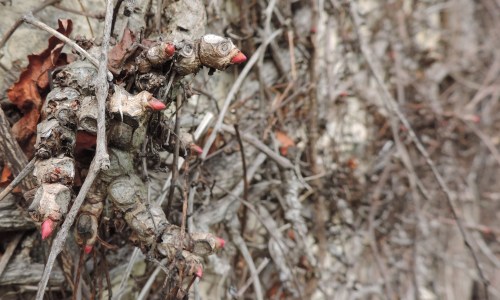
There’s an amazing plant known as “Boston ivy”, or “False Vine”, which grows up the largest, old stone wall on one border of my garden. Actually the wall has fallen down now, but the vine is still growing, and has in fact made the gaping wound of the collapse considerably more beautiful.

I’ve had great pleasure from this vine over the last five and half years. It changes SO much with each season. This particular photo is taken in early Spring when the dormant, rather bare, plant is waking up and emerging from the Winter.

The first sign of its awakening is the appearance of the these bright red buds which look like pen tips, or the beaks of tiny finch-like birds. If you look carefully, maybe especially at the one which is most “top right” of the group, the woody part of the stem even looks like it has created an eye, which with the red bud bursting forth, makes this look even more like the head of a little bird with a bright red beak.

One of the things I find most attractive about a phenomenon like this in Nature is how it demonstrates symmetries and echoes of other parts of the world. As far as I am aware, there are no little finches with bright red beaks in this part of the world, so it’s only my awareness of them from other experiences that allows me to see these buds as suggestive of something else.

I think a lot of symmetries, echoes and resonances are like that. We have to have the other prior experiences and knowledge, we have to have an open mind, really paying attention to the detail of what is right before our eyes, but we also need imagination.

Without imagination could these resonances exist?

That question, suddenly, reminds me of the old “Does a tree falling in a forest make a noise if there is nobody there to hear it?”

Well, does it?

Read Full Post »

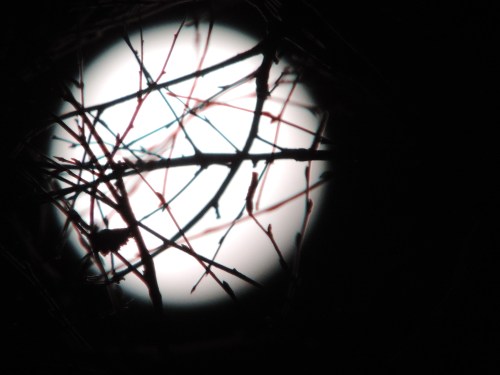
These two images were taken within seconds of each other. Both are a picture of the full moon through the branches of a tree.

But they look very different don’t they?

In the first one, the tree is to the fore. We notice the pattern of twigs, buds and branches, with the full moon as a white, circular background. If you look carefully, you can even see different colours, some reddish, some bluish, in the tree….although I’m still not sure where those colours came from!

In the second one, I’ve allowed the light of the moon to dominate, whiting out the tree in front of it….almost completely, but what this has done is reveal the parts of the tree lit by the moon, but just outside of the intense white light of the moon itself. This does two things…..it creates a sense of a swirling circle of branches around the moon, with an opening in the tree which just happens to be moon-shaped. This is an illusion – there is no moon-shaped gap in the tree.

I love both of these images, and don’t actually have a preference, but I realise that just by altering the exposure setting in the camera, I alter the entire frame of the shot….and that the two different frames give very different experiences of reality.

That’s what frames do. They shape our experience of reality. The frames we use all the time are fashioned out of our beliefs, values, habits of thoughts, and established attitudes. They aren’t easy to change. They aren’t even that easy to see. But I think it’s important to try to become aware of them, given how powerfully they shape our perception of reality.

Read Full Post »

Here is my secret. It is very simple: It is only with the heart that one can see rightly; what is essential is invisible to the eye.

Le Petit Prince. Antoine de Saint-Exupéry

I often notice, and photograph heart shapes, but in this particular photo what I like best is that the heart is in a path.

I like that because I think this is the most fundamental value for me. It’s not a simple value….this heart-focused one….but its complexity adds to it, rather than diluting it.

The heart is a symbol of love for us. If I want to live the best life I can live, I believe it has to be a life of love. Love in all its forms. Love in the form of care and compassion. Love in the form of passion and desire. Love in the form of bonds and relationships. Maybe we don’t speak much about these forms of love these days, but it’s always something I think we can do with more of.

The heart is also a symbol of the soul. “Heart felt”, “heart warming”, “good hearted”, “heart to heart” are all phrases which suggest authenticity and depth. It is the antithesis of the superficial and careless. It nurtures. It supports. It nourishes.

The heart is an important part of the body for processing emotions. We now know there is a neural network, of the kind of cells we used to thought you found only in the brain, around the heart. What does that network do? It seems to be involved in the generation and management of emotions.

The heart also focuses us on qualities rather than quantities. What we see, what we feel, what we know, with the heart can’t be examined under a microscope, weighed, measured or have a monetary value attached to it.

A path of the heart is a path of love, emotion and quality.

What is essential is invisible – and can only be seen with the heart.

Read Full Post »

« Newer Posts - Older Posts »