Feeds:
Posts
Comments

Archive for the ‘perception’ Category

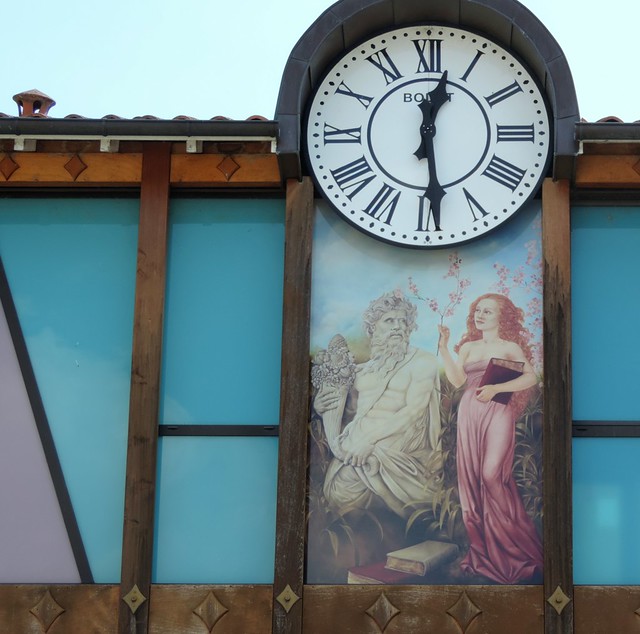
Sundial Saint-Savin

//embedr.flickr.com/assets/client-code.jsI don’t have an Apple watch. In fact, I don’t routinely wear a watch. Years ago, a Dutch friend of mine who I’d invited to Scotland to teach, told me on the train on the way to the venue that he’d taken his watch off several years ago, because he’d realised that the more often he checked his watch, the more anxious he felt. (We were on a delayed train and I was anxious we were going to be late, but he told me why worry, we’re not driving the train, and worrying won’t make it go any faster) However, these days with the smartphones, (I do have an iPhone), it’s never difficult to check the time. But if you are out and about I bet you’ll find some kind of timekeeper isn’t far away – whether it’s a digital clock outside a pharmacy, or a beautiful clock on some building.   Les Macarons de Montmorillon//embedr.flickr.com/assets/client-code.js

So, I’ve been wondering, what do you look at when you want to know the time?

And do you think that where you look influences how you feel about time? Do you like the precision of digital, the analogue of old clocks…..or sundials and calendars?!

Read Full Post »

What’s better?

To look up close……
IMG_2922

Or to look far away……

clouds   

Ok, so it’s a trick question. 

It’s great to look at something like that mulberry leaf really close up – I mean, look at the veins and the structure of the leaf! Look at the stomata! What an incredible pattern! Then look at the colours, the shades of green….

But then, look up at the sky and see the clouds, layer upon layer with such rich shades of grey and blue….

The thing it, its best just to LOOK. 

We spend so much of our lives on autopilot (zombie mode), that the world can literally pass us by, and in so doing we miss all these opportunities to be amazed at just how incredible it is to be alive, here and now, on this Earth.


Read Full Post »

I live in a typical Charnetaise house –

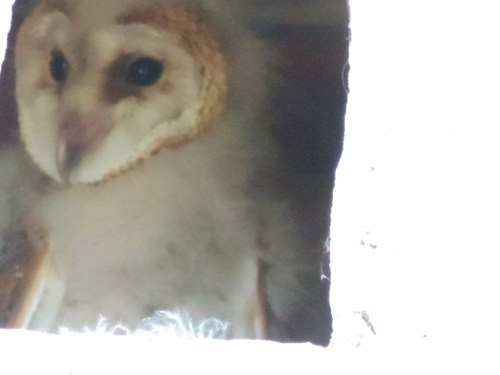
Can you see those two little arch-shaped holes/windows up on the top left? Well, there’s been such a lot of hissing coming from there in recent nights, and a bit of research revealed that the noise is the sound of barn owl chicks (barn owls don’t hoot, they hiss!)

Today I thought I could just make them out when I stood under the mulberry tree, and with a lot of patience, a camera on full zoom maxed up to a 3200 ISO setting, I managed to get these photos –

and

Wow!

I mean – wow!

OK, not exactly nature photographer of the year material but WOW!

This is just the kind of thing which makes an ordinary day an extraordinary day!

Read Full Post »

butterflyLooking up from my book I saw this butterfly and captured a photo of it with my iPhone. The sky looks pretty grey but it was actually just some clouds passing by as I was relaxing with a book out in the garden. Within a few moments there was blue sky again. I’m struck by how the sky changes so quickly. Clouds are a great reminder of the transience of Life with their constant making and unmaking of themselves, their constant appearing from apparently nowhere and disappearing apparently into nothing. The fact the sky looks so grey in this shot also reminded me of how often we take a moment in time and react to it, then the reaction can live for a long time afterwards. There’s no doubt that the ability to expand our focus of attention, stretching it in time and/or in space, can radically change our inner experience and hence our mood. I suspect that the relationship between moods and emotions is a bit like the ripples which spread out over the surface of a pond after a stone lands in the water. The moment the stone lands creates a condition – just like a word, a gesture or an action might trigger an emotional state in us – but that the state spreads out to become our longer lasting state of mind (a mood) – in much the same way that the ripples can be seen long after the stone has disappeared, or the wake can wash onto the shore long after the boat which caused it has sailed by.

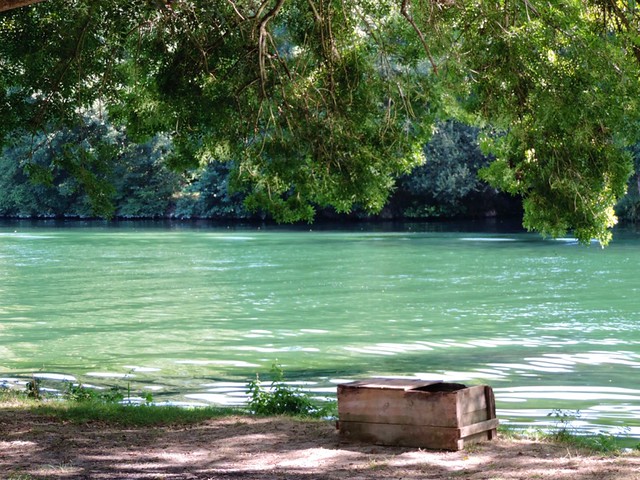
the Charente

Butterflies can be a trigger for us to think of transience (but also of metamorphosis – I think I’ll return to that in another post) so, the butterfly against the changing sky worked as a strong prompt for me.

Sometimes we just need to place events into their larger contexts in order to alter the impact they can have on us. It’s great to be focused on the present moment, but it’s also important to be able to set the present moment into our larger story.

Read Full Post »

The Mission

I recently received my first “Discover Weekly Playlist” from Spotify and so far, I’ve really enjoyed every single track. So, does Spotify “know” me?

We have more and more services like this around us – Amazon telling us what other people who bought “this” also bought (or even looked at!), Apple telling us what other apps other people bought who bought this particular one….and so on. This is something which Maria Popova has written about in her excellent Brain Pickings

I recently found myself in an intense conversation with a friend about privacy — why it matters; how much of it we’re relinquishing and what for; whether it is even possible to maintain even a modicum of control over our own privacy at this point…….It suddenly struck me that our cultural narrative about privacy is completely backward: What we really fear is not that the internet — or a prospective employer, or a nosy lover, or Big Brother — knows too much about us, but that it knows too little; that it fails to encompass Whitman’s multitudes which each of contains; that it reduces the larger, complex truth of who we are to a few fragmented facts about what we do; that it hijacks our rich, ever-evolving personal stories and replaces them with disjointed anecdotal data.

I hadn’t thought of it that way around when it comes to the internet, but she is definitely onto something. The underlying truth of what she is referring to is similar to what I read years ago in Mary Midgley’s “Wisdom, Information and Wonder” where she wrote –

One cannot claim to know somebody merely because one has collected a pile of printed information about them

That observation seemed absolutely true to me in the domain of health care where sadly, far, far too often, “data” or “information” is ALL that is known about a particular patient as individual narratives are dismissed as “anecdotes” or “unscientific subjectivity”. That dominant way of practising Medicine always seemed to me to be just the opposite of how it should be done. Information, or data, can tell you something about some aspect of a person’s disease but it’s a long way from the person’s own narrative.

One of the dangers of substituting data for narrative is the presumption of knowing – I used to say to patients that each of us spends a lifetime trying to really know ourselves (and I’m not sure any of ever complete that task!) so how can I presume to know them from hearing just a little of their story over the course of an hour or so? Frankly, reducing their stories to a few data points just takes doctors and nurses even further away from knowing their patients.

Maria Popova’s recommendation to counter this is to “master the art of personal narrative” –

Perhaps the most potent antidote to this increasingly disempowering cultural shift is to grow ever more thoughtful and deliberate about how we tell our own stories

Thought provoking, huh?

Even when someone uses the personal data we’ve shared to offer us more music, books, restaurants etc, that we may like, I think its best to keep these things as hints. That’s why “discover weekly” works for me – it doesn’t assume the impossible – they don’t know me – but I’m happy to have them help me discover new music. And I’ll use some of their suggestions to continue to make my own playlists.

Where are you with this issue of information, privacy and how we make ourselves known to the world?


Read Full Post »

What’s this flower doing?

No, it’s not a trick question. It’s pretty simple actually – it’s flowering. Because that’s what flowers do.

Isn’t it interesting that we have a verb for that?

What would be the equivalent verb to describe what YOU are doing?

Would you look for a “category” word – like human – and say you are humaning?

Would you look for a more specific category and say you are manning, or womanning?

Would you choose a role and say you are mothering, or fathering?

Or something related to your employment? Doctoring? Nursing? Teaching?

What if you went for something really specific? Something that only YOU in the whole universe is doing, has ever done, and ever will do? (That’s being the unique you that you are) What verb would you choose for that?

Would you turn your name into a verb? But that would only work if you don’t share your name with any other person, living or dead.

I don’t think there is a single verb to describe what you, uniquely, are doing – the closest I’d get would be to say I’m becoming me. (Because that’s a constant work in progress)

Let me return to the flower at the start of this post – it’s a “hollyhock”, or “rose trémière” as it’s called around here where I live. But it’s not just any rose, it’s the rose which lives here and which I see, and notice, every day. (A bit like the little prince’s rose)

“People where you live,” the little prince said, “grow five thousand roses in one garden… yet they don’t find what they’re looking for…

They don’t find it,” I answered.

And yet what they’re looking for could be found in a single rose, or a little water…”

Of course,” I answered.

And the little prince added, “But eyes are blind. You have to look with the heart.”

Read Full Post »

Convolvulus

I took this photo this morning of a convolvulus which has just flowered – don’t you think this looks like one of the images which astronomers take using the Hubble telescope?

A Universe within……

Read Full Post »

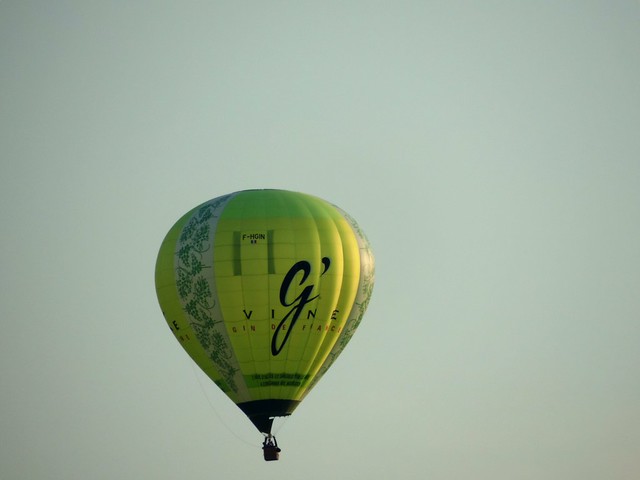
Montgolfière over Salles d'Angles

One of my favourite philosophical practices is the “view from on high” – or the French version of a “view from Sirius” (which isn’t just about seeing from above, but about encountering things as if for the first time).

Conceptually, its about taking an overview, seeing everything within its contexts. It’s about approaching something as a whole, rather than analysing its parts. (This latter is the distinct difference between the two sides of your brain, according to Iain McGilchrist – the right hemisphere allows an “analogical”, holistic approach to be taken, whilst the left facilitates a more “digital”, analytic and reductionist one)

We can do this literally, when we climb up to a vantage point, (or take a flight in a hot-air balloon or a plane), or we can do it cognitively, by reflecting at the end of a day, or by taking a pause, taking a few deep breaths, or slowing down to be able to actually perceive properly (instead of the world and our thoughts whooshing past at a hundred miles an hour!)
Hot air balloon

By the way, if you do get the chance to actually go up in a hot air balloon, I can recommend it. I’ve only done it once (for my 50th birthday) but it was one of the most amazing and special experiences of my life.

Read Full Post »

paeony

If you look at the header of this blog page, you’ll see the byline “becoming not being”.

I was inspired by the writings of the French philosopher, Giles Deleuze, when I began this blog. He emphasised the difference between “être” and “devenir”. Here’s why –

Really everything in this universe constantly changes. It’s just that some things change more slowly than others. All living creatures, however, change quickly and unceasingly. Maybe you realise that none of the billions of cells which make up your body live as long as you do? Some of your cells only live a few days, whilst others have a life expectancy of a few years. The biological truth is that your body now contains very few cells which were there ten years ago.

We are more than our physical bodies. Our thoughts, feelings and sensations are in constant motion and we process all that information unceasingly. Hopefully, we mature, develop and grow through our lives. Discovering more talents, learning more skills, developing our behaviour and maturing our personalities.

We are more than single beings in isolation as well. We are incredibly social creatures. We live our days in constant exchange with other humans, with other animals and with the wider natural environment in which we live. It’s difficult, indeed I’d say impossible, to understand a person in isolation. We have to see each individual in the contexts within which they live.

How do we hold all these changes together and have some sense of stability? How do I still recognise myself in the flux of all these changes?

Well, partly, we do that by telling stories. Each of us is a narrative self. When you meet someone, you introduce yourself by telling where you came from, where you are now, and maybe also, where you hope to go. In other words, you tell a simple story with a beginning, a middle, and, if not an end, then at least a potential plot direction!

All living organisms are like this. It’s just that we have evolved to a greater level of complexity than other creatures and we, we humans, are the storytelling species.

So, if we focus on “to be” (on “être”) then we reduce the subject to an object. We pin down just part of a person to a particular place and time and we then try to label and categorise them on the basis of a small set of features or characteristics.

I find it so much more satisfying to focus on “becoming” (on “devenir”). It’s slippier, it’s more complex, but it’s more alive. And, fundamentally, it’s a much better reflection of reality.

Try it for yourself – try focusing on becoming instead of being…..

Read Full Post »

one petal left

Starting from here, this photo above, we can move to either here –
poppy seeds

or here –
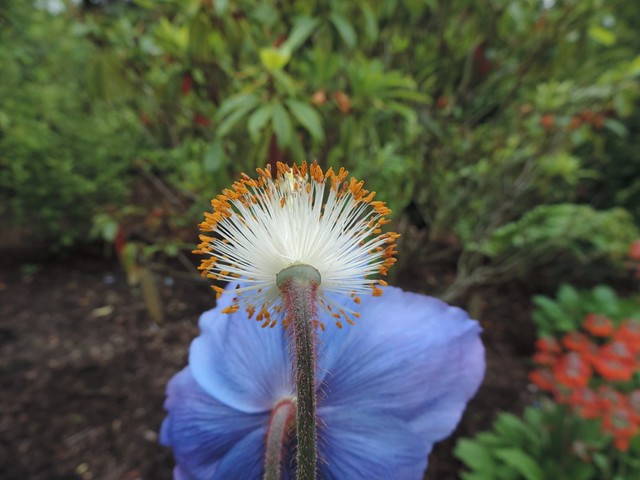
meconopsis

What comes first?

The seed or the flower?

What comes last?

The seed or the flower?

Looked at one way, the seed comes first, grows into the plant which unfurls its petals and reveals its new seeds, attracts the pollinators, then drops the petals, then disperses the seeds to start new plants. Looked at another way, we can start with the flower…..

So, what’s the plant doing? Seeding? Or flowering?

We know, of course, that the plant would not be the plant at all unless it was seeding AND flowering.

Gandhi was once asked “What’s your message?” and he replied

My life is my message

That’s true of all lives isn’t it? Every plant, every animal, every person…..

Read Full Post »

« Newer Posts - Older Posts »