Feeds:
Posts
Comments

Archive for the ‘perception’ Category

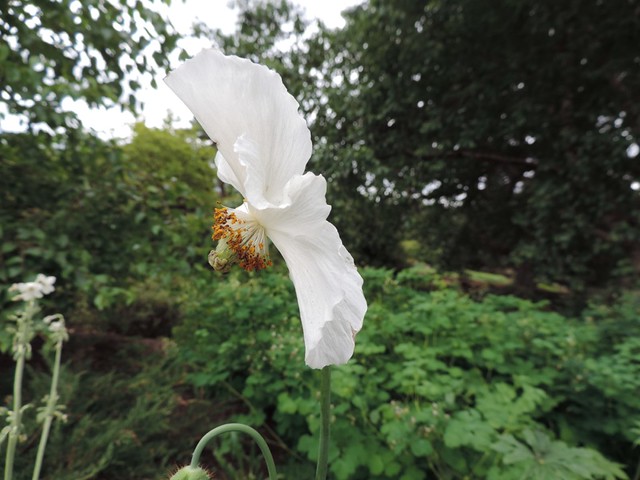
angel flower

Doesn’t this flower look a bit like an angel?

Or a butterfly if you can’t imagine what an angel might look like!

I read recently that our retinas only register colour in the central 30 degrees of visual field ….the fact that we see a full panorama in colour (even out the edges of our vision) is due to our ability to make up what we are seeing.

Really?

I know that seems a bit incredible, but when you stop to think about it, our eyes convert light energy into electro-chemical signals which are then processed by the neurones in our brains for us to “see” anything, so maybe it’s not such a surprise that we are responsible for “colouring in” most of what we see!

We are incredibly creative organisms with fabulous bodies and powerful imaginations.

Mark Twain said

a person cannot depend on the eyes when imagination is out of focus

Read Full Post »

I have a fascination for water.

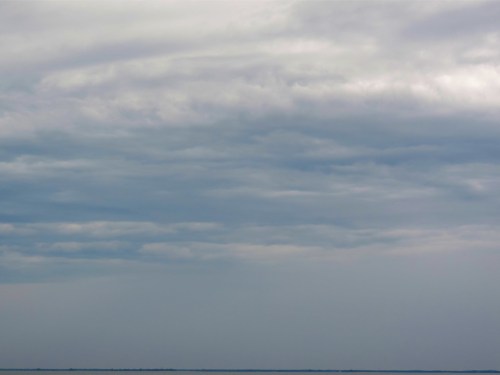
When I look up I see clouds – which seem so solid but are really so transient. On this particular day (the photograph above) there was a storm coming, and I think you can see the seeds of it in these clouds.

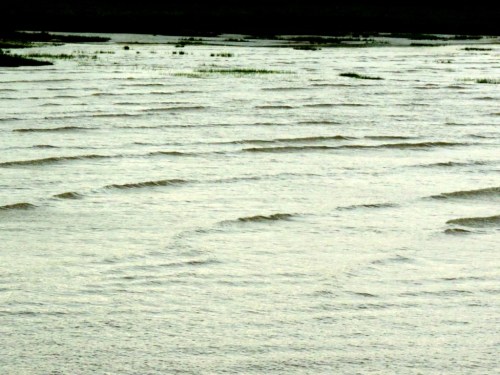
But waves are also fascinating.

Again, they look so solid, but for such brief periods of time. You can follow a wave with your gaze and without doubt it looks as if an coherent body of molecules is traveling together over the surface of the sea. But it isn’t! The wave is an energy pattern and as it passes through the water it moves the molecules up and down in a kind of circular motion. The wave which arrives on the shore is not “made of” the same water molecules which it seemed to be made of when you first spotted it heading towards the land.

Clouds and waves.

Such brilliant demonstrations of the most essential characteristics of our lives.

Both are transient but while they exist they seem quite solid.

Both are created by energy patterns which we can’t see, although we clearly see the effects these creative “forces” have.

Both are made of patterns of molecules which hang together for a period of time but are in fact being replaced constantly.

It might seem a stretch to think of our bodies this way, but we too are “made of” constantly changing patterns of molecules. We too are the brief manifestation of underlying invisible forces and energies.

We, too, are beautiful and fascinating. (And, yes, that includes YOU)

Read Full Post »

There’s an excellent collection of articles about health in this month’s “Philosophie” magazine in France.

The cover instantly reminded me of the great quote by the American physician, Oliver Wendell Holmes –

Throw out opium, which the Creator himself seems to prescribe, for we often see the scarlet poppy growing in the cornfields, as if it were foreseen that wherever there is hunger to be fed there must also be a pain to be soothed; throw out a few specifics which our art did not discover, and it is hardly needed to apply; throw out wine, which is a food, and the vapors which produce the miracle of anaesthesia, and I firmly believe that if the whole materia medica [medical drugs], as now used, could be sunk to the bottom of the sea, it would be all the better for mankind,—and all the worse for the fishes

Health is a much more complex and nuanced phenomenon than the simplistic ideas we are offered by the current dominant model of health care – that of Big Pharma and statistical medicine (drugs for every problem, protocols for every health care professional).

One of the central themes explored in this issue is summarised by the lead title of “Health, is it in your head?” There are those who promote the idea that all illness begins in the psyche and expresses itself in the body (Freud?), and others who promote the idea that all illness is physical, material change in the body whilst the psyche remains separate (Descartes?). There is a third option discussed, whose roots are traced to the philosophy of Spinoza – that the psyche and the body just express the same underlying disturbance, but each in their own language.

I like that third idea – it seems totally congruent with the core value of my lifetime of medical practice. I refused to divide a person into two parts – a mind and a body, and I used the philosophy that there is a system or a force within all life forms which produces growth, maintains health and repairs the organism when it is damaged. It’s interesting to see how the more recent discoveries of neurobiology are showing us more and more interconnectedness within a person – with amazing multitudes of connections and pathways between the different organs and tissues. It’s becoming increasingly untenable to hold one of the divided views.

One of the articles mentions an old essay by Kant, written in 1798 “Du pouvoir du mental d’être maître de ses sentimentsmaladifs par sa seule résolution”. In that essay he distinguishes between “la sensation” and “le savoir” of health – in English, perhaps, something like the difference between what health feels like and the knowledge of health. This strikes me as close to the nub of the issue.

We experience health. It’s something we can all assess and comment on. We can say when we feel well and when we feel ill. But we have also developed ways of knowing about organ or cellular functions, so we can discover what our blood pressure is, or what level of haemoglobin exists in our red blood cells (two things we could not know by “sensation”). The point is, both of these perspectives are real. We do not have the kind of nervous system which can make us aware of the moment to moment functions of the organs of our bodies at a conscious level. Indeed, how could any of us live that way? But the connections exist. A certain level of heart cell dysfunction may be experienced as palpitations, pain or breathlessness. However, the heart can malfunction without us being aware of it at all – the investigation known as an “ECG” (a cardiogram) can reveal a “silent infarct” – damage which occurred to the heart from a clot without the person having experienced any pain or breathlessness.

The connections which exist between “sensation” and “consciousness” are complex but clearly non-linear – in other words, a small change in one area can have either a large, or a negligible, effect on another.

Isn’t this why we can encounter a person who feels very ill, but whose investigations are all “normal”, and why we find people who have “abnormal” results in investigations, but who feel completely well?

Where modern medical practice goes wrong, I believe, is by attributing truth to “knowledge” whilst dismissing “experience” as unreliable and so, not useful. This has come about from our obsession with measurement. We can measure physical changes, but we can’t measure pain, breathless, dizziness, nausea, or any of the other “sensations” of illness.

But to attribute symptoms (sensations) to mental disorders when physical test results are all within the normal range is neither rational, nor clever.

I think we need, in every case, a person-specific synthesis of what the tests tell us and what the person is experiencing. A person’s experience can be communicated to us by their telling of their story – which has the additional benefit of allowing us, together, to make sense of what is happening – by which I mean to explore the meaning of the illness.

Keeping focused on the narrative which includes this synthesis also enables us to explore the individual’s values, hopes and fears, allowing us to make more relevant, more holistic, diagnoses and so, hopefully, to offer more appropriate choices for each patient.

Read Full Post »
blue

Sometimes its contrasts which catch my eye, but other times it’s the luxuriant shades within one area of the colour spectrum, whether that’s blue (like above), or green (like below)
DSCN3655

…or even the shades within one flower
petal

Read Full Post »

Sometimes my attention is caught by a single flower

A single flower is stunning in its uniqueness…its “singularity”.

But then sometimes what catches my attention is a whole of lot flowers of the “same kind” –

And in fact, its the uniqueness of their gathering together, of their coming together, or growing together, which is so stunning.

Indeed, sometimes its their presence as a group in a particular context –

– which is just so gorgeous and beautiful and wonderful.

I think there is something here which is worth remembering about Life, especially about the lives of human beings.

We are each wonderful in our uniqueness, in our “singularity”, but we can be something else again when we live together in harmony – in our “plurality”.

Read Full Post »

The other evening as I was shutting the shutters, a little later than usual, it was already dark.

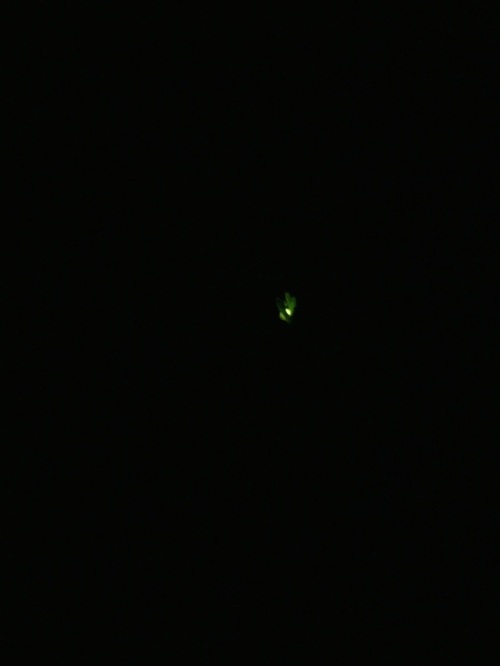
Suddenly a little light in the grass at the far end of the garden caught my eye. You know how a cat, or dog, or other little creature can look like it’s got a light in its eye when a headlight shines on it? Well I thought this must be something like that. Probably a wee creature like a mouse or something.

I started to walk towards it and the first thing which struck me was that the light didn’t flicker, and it didn’t disappear. Now, in my mind, if a light in a creature’s eye is just a reflection from another light then as the animal moves its head the light will “go out”. This wasn’t happening so I began to doubt that it was a mouse or whatever after all.

When I got up really close I saw where the light was coming from – an insect in the grass. It’s body had two bars shining as bright green as any LED light.

I tried to get a photo.

OK, I admit, this is hardly a convincing photograph, but until I learn how to do macro photography in the pitch dark with an iPhone this is as good as it gets!

I quite like that the photograph actually captures the mystery of what I saw, rather than the more distinct appearance of the actual insect (which I saw once I turned on the torch feature on my phone)

A bit of research later revealed that what was in the grass was a glow-worm.

Well, that’s another first for me. I’ve never seen one of them in real life till now.

Something new to see every day?

Read Full Post »

bejewelled

I can’t resist it.

These sparkling jewels of dew in the morning, shining in the morning sun…..

This is the month of light, and seeing light making the world sparkle is such a treat.

Seen any sparkles near you recently?

Read Full Post »

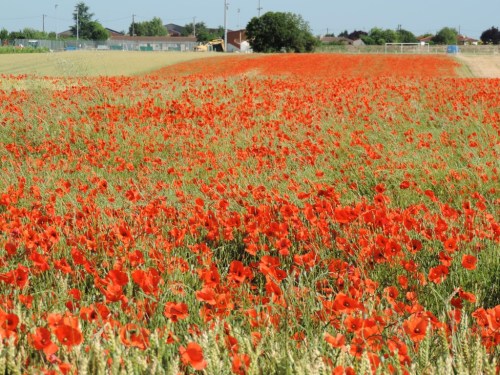
poppies south of cognac

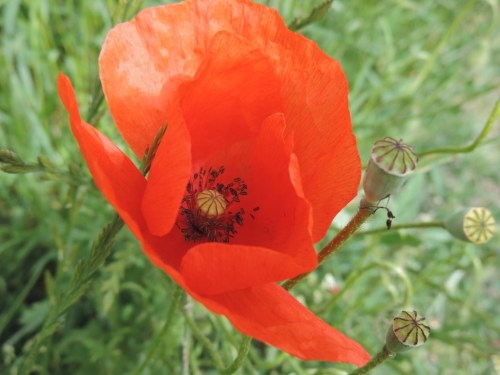
poppy


According to Iain McGilchrist, who has explained the way we use the two different cerebral hemispheres, first of all the signals and sensations which we pick up are passed to the right hemisphere which we use to get an overall, holistic, “analogue” understanding of the world. Then we pass some of the information to the left hemisphere which is terrific at homing in on just some aspects of what we’ve picked up. We use the left hemisphere to “abstract”, analyse and categorise what we have received. If the right hemisphere view is analogue and holistic, then the left is digital and reductionist.

What should happen next is that the left passes back to the right what it has processed so the right can deepen its understanding – now understanding both the overall and the particular.

The overview, the “view from on high”, and the extracted, abstracted, reduced view, seem like opposites, and in many ways they are, but we have this incredible brain which lets us process in both of these opposite ways at one and the same time. We are capable of holding the general and the particular in our minds at the same time.

Iain says we have developed a tendency to think that the view from the left is the “correct” view, and “enough” and is so doing we failing to use our whole brains….we are failing to see the whole picture.

Interesting, huh?

Read Full Post »

light at the end of the tunnel

Some years ago I realised that the names of the days of the week relate to the same planets in many languages and that got me wondering about the names of the months – which aren’t!

It struck me that relating the name of a day to a planet opened up a whole rich level of symbolism and meaning and I thought it was a shame we couldn’t do the same for months. So, I decided to come up with a keyword/theme/symbol for each month that made sense to me. I’ve been following that since, and in that scheme, June is the month of light. I chose that because, in the northern hemisphere, where I live, its the month with the most light (including the longest day). I know for some of you it’s the month with the least light, so I encourage you to come up with your own themes, which make most sense to you, or that you stick with June being the month of light and see what you can discover about winter light.

It’s hard to actually see light, but the way light plays with us, and with the rest of the world, is beautiful to explore.

I’m aware that, in choosing this particular image, which I only took yesterday, it immediately speaks to me of “light at the end of the tunnel” – so if you’re looking for some light at the end of a tunnel, here’s an image just for you!

Read Full Post »

the geometry of flowers

Isn’t this beautiful?

How could you fail to be seduced by the astonishing geometry of this flower?

We see this everywhere in the world – how patterns seem to display an remarkable mathematical order.

Interestingly, the same day I took this photograph (which I immediately titled “the geometry of flowers”) I read a fascinating article about mathematics teaching, entitled “The limits of a rational mind in an irrational world – the language of mathematics as a potentially destructive discourse in sustainable ecology.” by Steve Arnold of Auckland University of Technology. Here are a couple of paragraphs which caught my eye –

Galileo famously said, “The laws of Nature are written in the language of mathematics.” However we realise that this profound statement was while very true, it is not strictly true. There are times when the mathematical understanding of the world breaks down. Now in a time of ecological distress, we need technologies and tools that can match more perfectly our world. In reality, Mathematics is a highly nuanced poetry that describes the human condition, it mirrors the workings of the human brain (as mathematics is exclusively a product of human thought). Mathematics tells us our own story, it tells us how the human brain works, and as we strive to make meaning of the world, we do so using the tools available to us; number is one of the ways that we language our experience.

Within mathematics there continues to this day an expectation that the simple relationships described in mathematics should be able to neatly describe our complex world. However the real world is not simple, tidy and neat. The real world is full of messiness, unpredictability, human emotion and error. Mathematics describes a predictable world, where error can be eliminated, and it is desirable to simplify and exterminate unwanted complications. Where the two differ, surprisingly it is the human experience in the real world that defers to the all-powerful notions of mathematics.

And, in conclusion, he makes the excellent point that mathematics is just one way to make sense of the world, and it’s a way that we ourselves have made up.

We put so much faith in numbers, that sometimes we place the power of the digit over the judgement of our experience. This idea of positivism has found a secure home in the teaching of mathematics in schools. We are controlled by numbers, from the early stages of test results, to class position and IQ, to more recently BMI scores, glasses prescriptions, salaries and postcodes. We sometimes forget that numbers are a way to tell the human story. We forget we make them up, not the other way round.

So, yes, this is a beautiful geometric flower and how often can we use mathematics to model the beauty of the natural world? But, surely, we need to always remember that the mathematical story of the world is not a perfect explanation. And that we should not allow anyone to reduce Life to numbers.

Read Full Post »

« Newer Posts - Older Posts »