Feeds:
Posts
Comments

Archive for the ‘perception’ Category

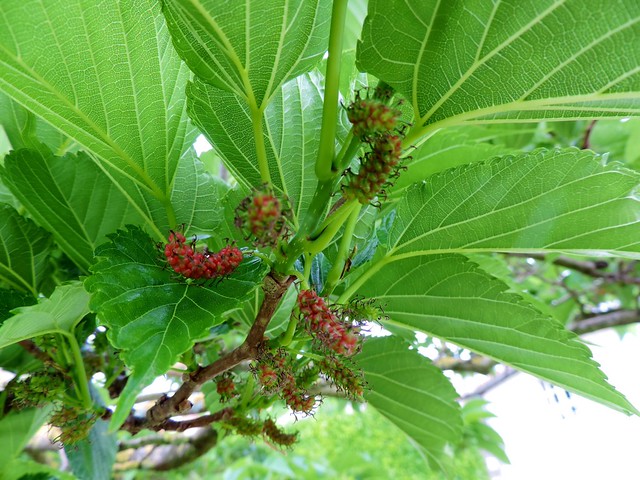
Mulberries

Mulberries.

Have you ever seen them before?

This is a first for me. We’ve a mulberry tree in our garden in France and as this is our first year here, we’re watching it change through the seasons. And here comes the fruit.

Don’t they look like little creatures?

How often do we see that in Nature, where some kind of organism develops the characteristics, or features of another?

I love how we can see such inventiveness and rich variety in Nature.

Read Full Post »

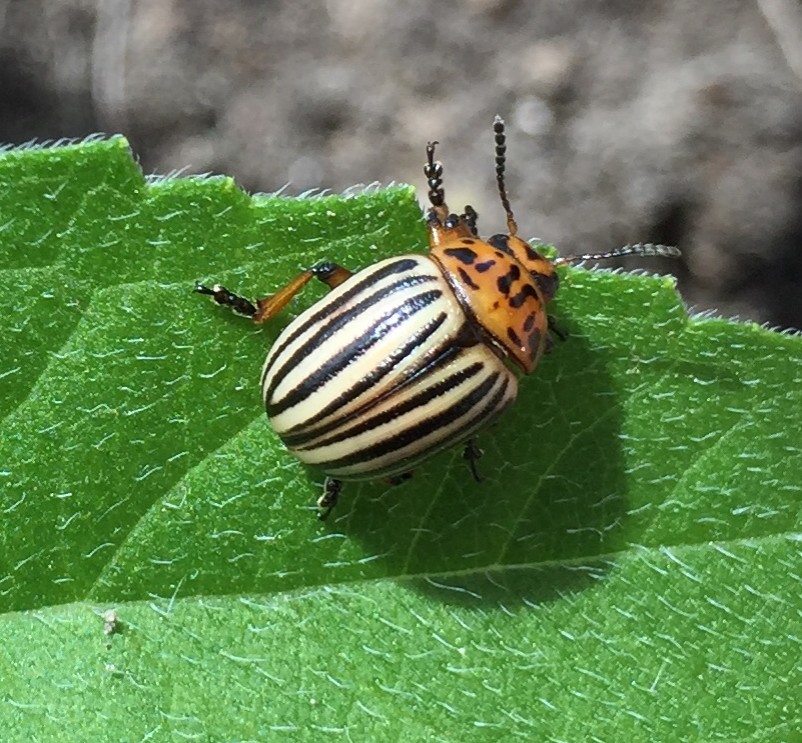
Beetle

Even when kneeling down pulling out weeds, turning over the soil, you can encounter something for the first time.

Look at this little beetle! What astonishing markings!

For me, it’s these little first time, unexpected, brief encounters which can really make a good day great.

I have no desire to catch, kill, or collect creatures like these, but to see them, be amazed by them, and to take a photograph – I like all that.

What little, unexpected but amazing encounter did you have today?

Read Full Post »

sky writing

Last night I saw these clouds up in the sky just before sunset.

Never seen clouds quite like these before and they didn’t hang around for long.

Don’t they look like symbols? A number two perhaps, followed by some question marks?

Or, what do you see?

We do that, we humans, don’t we? We look for patterns. We try to interpret patterns, to name them, recognise them, make sense of them.

And the other interesting thing is….all of that is personal. Yes, maybe you agree that these clouds look like something, some writing, or numbers or whatever, but maybe you don’t. And even if you do, you’ll maybe “recognise” something in them that I don’t.

When that happens, it’s good to share. To just say, “This is what I see”, “This is what I experience”, “This is what sense I make of it”.

Read Full Post »

strawberry

With the current dominant world view, there is an enormous tendency to focus on “mass” – mass production, mass consumption – and to focus on quantities – GDP, profit, numbers “in work” etc. This all seems to drive core values of conformity and uniformity. We have ever more protocols and algorithms which are supposed to deliver “evidence based outcomes”. We find one-size-fits-all policies in health care, education, economics and politics. Difference is described as “variation” to be eliminated and “integration” is about forcing people with different values and beliefs to conform.

What values and what kind of world view might develop from a positive prioritisation of difference?

A shift from the general to the particular. 

Human beings are brilliant at spotting patterns, classifying them and naming them. We categorise by moving quickly from specific instances to general characteristics. We do that by stripping away the context and homing in on one or a few characteristics. By doing so we quickly lose sight of the individual, of the reality of the uniqueness of every person, every experience, every organism. And we quickly lose sight of the whole.

If we keep our eyes and ears open for the differences, then we take these generalised patterns which we spot and then consider how this particular instance fits, or doesn’t fit into those generalities. In other words we do what Iain McGilchrist describes in his “Divided Brain” – we perceive with the right cerebral hemisphere, analyse and classify a part of that with the left, then hand that analysis back to the right for further integration.

A shift from quantities to qualities.

“Lies, damned lies, and statistics”? Does the total number of people with jobs mean very much? Or is the nature and content of those jobs important? Does it matter if the jobs are zero-hour contracts, or full-time, more than minimum wage contracts? Does it matter if the jobs are to manufacture chemical weapons, or chemotherapy?

In health care, in education, in politics or society, because these are human institutions, its the quality which matters, not just the numbers.

A shift from seeing the world as composed of fixed objects, to seeing the world as a complex system which is continuously growing and evolving.

A shift from conformity to diversity.

Should we all have the same beliefs, the same values and make the same choices? If I choose one modality of health care when I am ill, and you choose another, is that a good thing? Or is it better that we both receive the authorised treatment which the protocol demands? Nature thrives on diversity. Monocultures are not natural.

A shift from a focus on parts to a focus on connections.

When we focus on parts, we tend to reduce what we are considering to objects. But no object exists in isolation. Everybody, every creature and every “thing” on our planet has a history. We all emerge out of what already exists. In the here and now we are inextricably linked to who and what is around us. Our left cerebral hemisphere is great at focusing on the parts. Our right is fabulous at focusing on the connections – the “between-ness” (to use Iain McGilchrist’s term)

A shift to integration.

Integration is the creation of mutually beneficial relationships between well-differentiated parts.

Think of the human body. A heart is distinctly different from a liver. To be healthy we need both, and we need both to be working in ways which maximise the health of the other. Our heart and liver are not in competition. They are not fighting it out to see who survives – only the strongest? Instead, they function best by integrating. I think we can see the same principle at work everywhere – or at least in all complex systems, from living organisms, to families, societies, cultures and environments.

A shift to seeing the flow of change

Nothing stays the same. We have cycles of growth and cycles of destruction. We see change which describe as growth and maturation, from (in the case of human beings) single cells, a spermatozoon and an ovum, to a fertilised egg, which grows into a foetus, a child, and then a fully grown adult. to And from the first moments of the Universe until now we see not just change in terms of growth and maturation, but a direction of change which we call evolution – we see an increase in complexity from the first hydrogen based stars to human beings with consciousness.

Whether in terms of maturation, or evolution, what we see is flourishing – the coming to fullness of all a being can be.

So, here’s my starting list of values

  1. Uniqueness
  2. Diversity
  3. Tolerance
  4. Integration
  5. Flourishing

What might the world become if we prioritised these values?

Read Full Post »
face

No two faces are identical.

Ever.

No two sets of fingerprints are identical.

Ever.

No two pairs of eyes are identical.

Ever.

Have you ever wondered about that? Maybe when you are at a Border Control in an airport, or maybe when you are looking for someone you know in a crowd?

Not only is every single one of us in the world unique, but we are unique in the time dimension too. There has never, ever, been someone with an identical face, identical eyes, and identical fingerprints to you. And there never, ever, will be in the future either.

Human beings are not clones. We are not units of production. Not physically, and certainly not narratively (is there such a word? We each have a unique story to tell….the story which says who we are, what we experience and what sense we make of it all)

Difference is one of our essential characteristics.

Might that be important?

Read Full Post »

acer

What caught my eye here?

Sure it was the redness of the leaves of the acer, but, what made them even more eye-catching was where the tree was growing, in the midst of luxuriant greenery.

The red contrasts with the green strikingly, so the acer does not just stand out because of its redness, but because of the environment in which it is growing. Had this acer been growing in a forest of acers, it would still have been striking, but this particular one, this individual tree growing in the village of Aubterre-sur-Drone, really captured my attention because it was growing amongst such green plants.

This highlights two important principles related to a focus on difference – contrast and context.

When we focus on difference we become more aware of both contrast (just how different this particular whatever is) and context (exactly where we are seeing the existence of whatever it is).

In other words, to really focus on the difference is not to see something in isolation, but in its relatedness. Contrast is a comparison between something and something else. Context is the place and the time where the something is being observed.

I think this is a point we often miss when we think of difference because there is a tendency to think that if we concentrate on individual uniqueness, we are isolating something, or somebody. I don’t think that is true, or at least, not necessarily true. To really see the uniqueness of anything we have to see it in its connectedness – in its situation, in its particular time and place, in its relationships to “other”.

To see you in your uniqueness, in your difference, I have to hear your story. I have to explore some of the myriad of links and connections you have in the world.

If I try to see you in isolation, I won’t fully see you.

Read Full Post »

hoopoe

If we are to prioritise difference, we have to start noticing it more.

One way to notice difference is to spot the unusual. This is one of the easiest ways because its the very fact that what we are seeing is SO different which catches our attention.

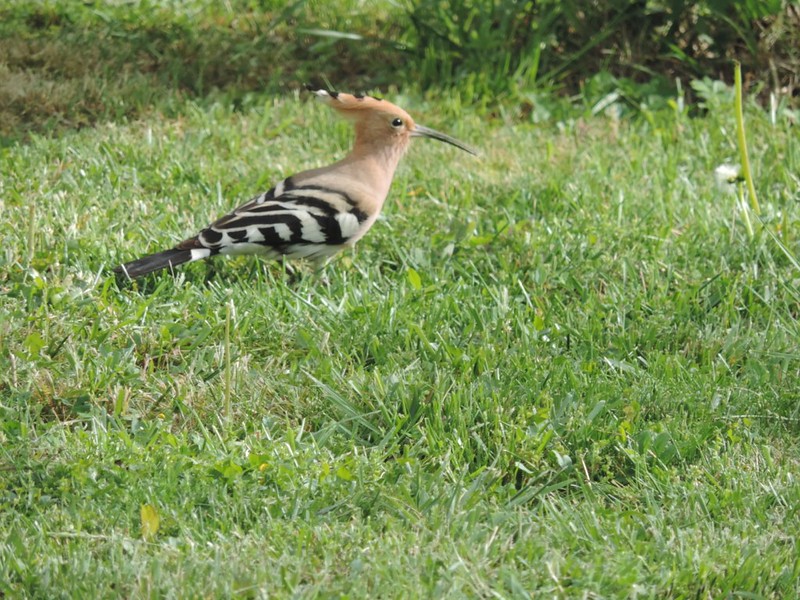
I’ve seen some interesting and different species of birds in my garden here in the Charente, but yesterday look what appeared!

I have never, ever seen a bird like this!

It seems it is a “hoopoe” – nope, I hadn’t heard of it either. But isn’t he spectacular?

Only the one, not a pair, and certainly not a flock. He pecked around and had a bit of supper then flew off. Maybe I’ll never see a hoopoe again, but it was a sheer delight to see one this time!

What is unusual is often striking. And what is striking catches our attention easily. The pleasure and delight can be maximised by allowing your attention to be caught and then lingering awhile – spending a few minutes just watching, noticing, enjoying.

Has anything unusual caught your attention recently?

Read Full Post »

Cockerel

This is the bird which lives a couple of houses away from me. I hear him every day but now I have seen him!

And it sure looks like he has seen me too!

In my A to Z of Becoming, O can stand for Observe. So that’s my theme for this week.

I’m sure you will have had the experience of traveling a familiar route and when you arrive you realise you have been so lost in thought that you haven’t noticed anything en route. This can even happen when you a driving car. It’s not that you aren’t seeing anything but I think these experiences say something interesting about how we observe. In other words, observing is not just about what our eyes “see”, it’s about how we process that flow of information and energy within us.

One way to change what you observe is to set an intention to observe. Before you head off on your usual journey you can ask yourself “what am I going to notice today?”. Then while you are out, you are more likely to notice what is around you and so observe.

I find an easy way to increase your awareness and so your observation is to set the intention to photograph what you notice. These days with smartphones, we all have a camera in our pockets or bags, but the way to make sure you take more photographs is to actually have the device in your hand. I do that with my camera. When I set off out to observe and to photograph I set off with my camera in my hand – not in my bag or my pocket – in my hand.

Happy observing!

Read Full Post »

The living world is a realm of dynamic processes. A flower is not a thing, but an event, like a butterfly emerging from a chrysalis. But with the word, we take a living event and freeze it forever into a useful but stable category. As Goethe wrote, “How difficult it is, though, to refrain from replacing the thing with its sign, to keep the object alive before us instead of killing it with a word.”

  • David Fideler, in “Restoring the Soul of the World”

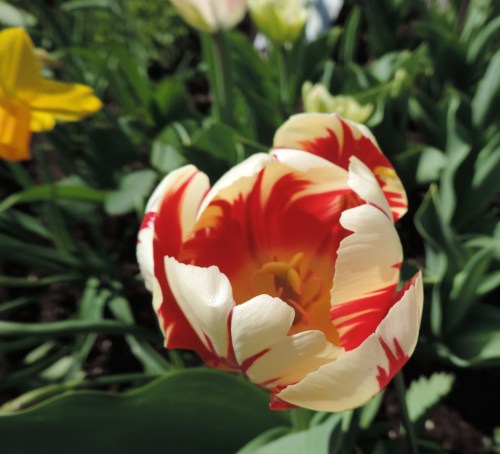
When you see a tulip opening in the warmth and light of the sun, you know in your heart this is not a thing, but an event.

Iain McGilchrist says, in “The Master and His Emissary”, that we use our left hemisphere to label and categorise. In so doing, we take the actions, the verbs of the real world and re-present them to ourselves as nouns, or as objects. If we stop there, we mis-understand the world. But if we re-present them to our other hemisphere then we can see the links, the connections, the what he calls “the between-ness” of the re-contextualised representations.

How much more wonderful the world seems to me when I see dynamic processes and connections all around me, rather than a collection of separate and separated “objects”.

Read Full Post »

Shiny new leaves

Oh, wow! Look at the new leaves coming out on the vine at the end of my garden!

Look how shiny they are! Brand new and glistening!

I love to stumble across these moments of emergence, seeing the Life Force surging through the bare stalks and bursting into colour and shape like this.

It reminded me – there is no such thing as a fixed object in this universe. You can see that easily when you encounter the leading edge of life, but if you think anything you see is a fixed object, then you are either just not paying close enough attention, or you aren’t looking for long enough.

Becoming not being, that’s the way of the universe.

Read Full Post »

« Newer Posts - Older Posts »