Feeds:
Posts
Comments

Archive for the ‘perception’ Category

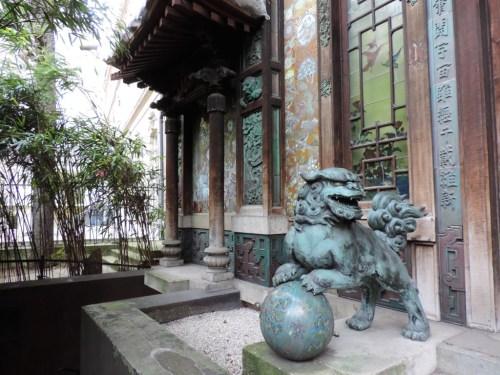
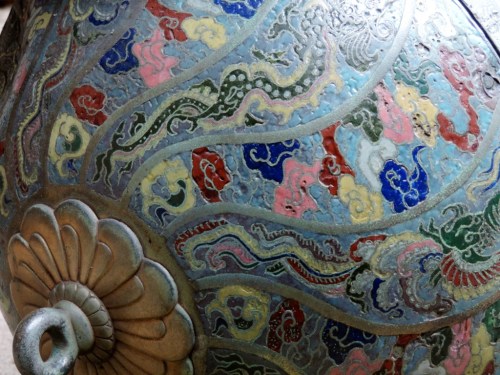
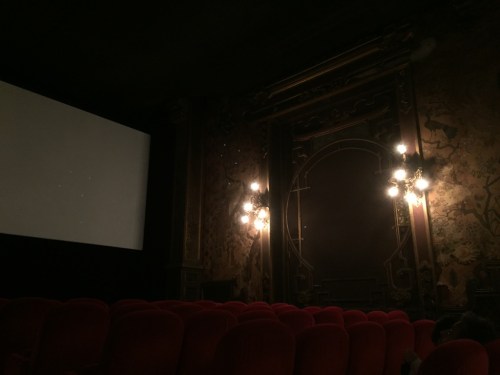
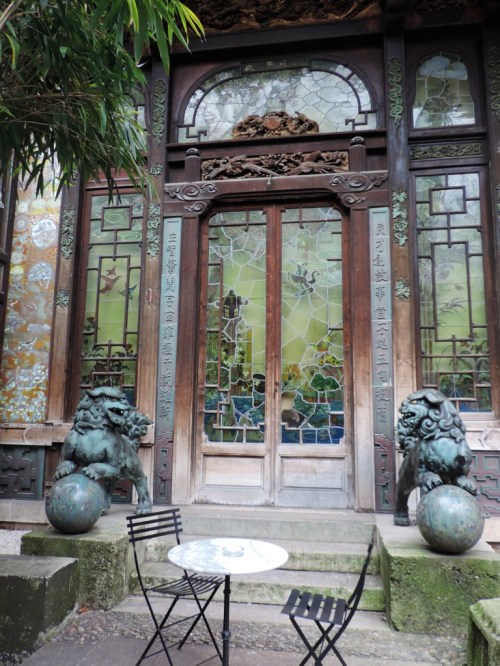
Recently when I went to Paris I discovered a magical cinema – La Pagode

You can see some of the photos above.

I went to see a movie in the main auditorium which is called the “Salle Japonaise”.

There is often something magical and enchanting about going to the movies, but it seems to me that most multiplexes take some of that magic away.

The physical spaces where we have our experiences definitely colour, or even determine, the quality of the what we do there.

How I wish I could find more truly magical cinemas like the Pagode! 

Read Full Post »

Cou cou

Sometimes, rather than the big, in your face, can’t miss it experiences grabbing your attention, it’s the little, subtle ones which are really the best.

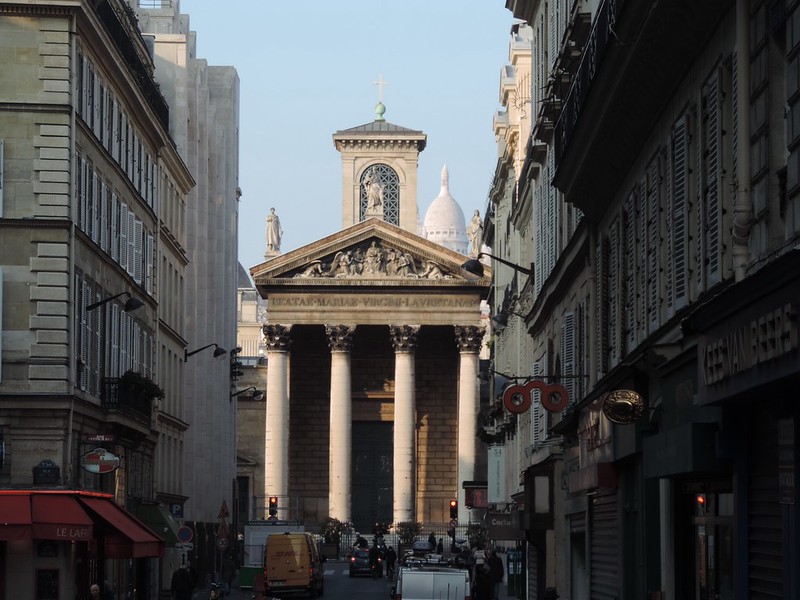
Sacre Coeur from afar

See Sacre Coeur peeking over the end of the street?

Read Full Post »

Lens

In my A to Z of Becoming, J can stand for the verb “join”.

When we think of “joins” we might think of connections, or of interfaces. We can think of bonds and relationships. We can think of the quality of a connection.

Iain McGilchrist, in his Master and His Emissary, shows clearly how the two halves of our brain are well designed to approach the world in two distinct ways – the left hemisphere tends to approach the world by drilling right down, by isolating parts and examining them. It’s great for focus and for labelling or categorising. It is largely responsible for how we see the world as full of “things” – objects which are separate from each other.

The right hemisphere, on the other hand is great at putting things together, seeing the patterns of connections, focusing on the relatedness rather than on the things. This approach to the world doesn’t see anything as isolated and unconnected. It’s great for seeing the contexts, for appreciating the whole without breaking it into parts.

He makes the point that our societies have developed in a strongly “left hemisphere way” and suggests it would be better if we got our right hemispheres working more effectively, and, especially it would be better if we used our whole brains instead of only half of them.

So, here’s something to explore this week. Instead of using the lens of objects and parts, how about looking for the joins? How about seeing the connections, reflecting on the relationships in your life? I don’t just mean the relationships you have with other people. I mean the relationships between you and the world….the world of objects, as well as the world of other subjects!

Whatever you turn your attention to next, see if you can put it in its context, see if you can see it as a transient, emergent part of the whole, see it as inextricably part of the flow.

Here’s a passage from the teaching of Thich Nhat Hahn where he uses a piece of paper to illustrate this idea beautifully –

If you are a poet, you will see clearly that there is a cloud floating in this sheet of paper. Without a cloud, there will be no rain; without rain, the trees cannot grow; and without trees, we cannot make paper. The cloud is essential for the paper to exist. If the cloud is not here, the sheet of paper cannot be here either. So we can say that the cloud and the paper inter-are. “Interbeing” is a word that is not in the dictionary yet, but if we combine the prefix “inter-” with the verb “to be,” we ha vea new verb, inter-be. Without a cloud and the sheet of paper inter-are.

If we look into this sheet of paper even more deeply, we can see the sunshine in it. If the sunshine is not there, the forest cannot grow. In fact, nothing can grow. Even we cannot grow without sunshine. And so, we know that the sunshine is also in this sheet of paper. The paper and the sunshine inter-are. And if we continue to look, we can see the logger who cut the tree and brought it to the mill to be transformed into paper. And wesee the wheat. We now the logger cannot exist without his daily bread, and therefore the wheat that became his bread is also in this sheet of paper. And the logger’s father and mother are in it too. When we look in this way, we see that without all of these things, this sheet of paper cannot exist.

Looking even more deeply, we can see we are in it too. This is not difficult to see, because when we look at a sheet of paper, the sheet of paper is part of our perception. Your mind is in here and mine is also. So we can say that everything is in here with this sheet of paper. You cannot point out one thing that is not here-time, space, the earth, the rain, the minerals in the soil, the sunshine, the cloud, the river, the heat. Everything co-exists with this sheet of paper. That is why I think the word inter-be should be in the dictionary. “To be” is to inter-be. You cannot just be by yourself alone. You have to inter-be with every other thing. This sheet of paper is, because everything else is.

Suppose we try to return one of the elements to its source. Suppose we return the sunshine to the sun. Do you think that this sheet of paper will be possible? No, without sunshine nothing can be. And if we return the logger to his mother, then we have no sheet of paper either. The fact is that this sheet of paper is made up only of “non-paper elements.” And if we return these non-paper elements to their sources, then there can be no paper at all. Without “non-paper elements,” like mind, logger, sunshine and so on, there will be no paper. As thin as this sheet of paper is, it contains everything in the universe in it.

Read Full Post »
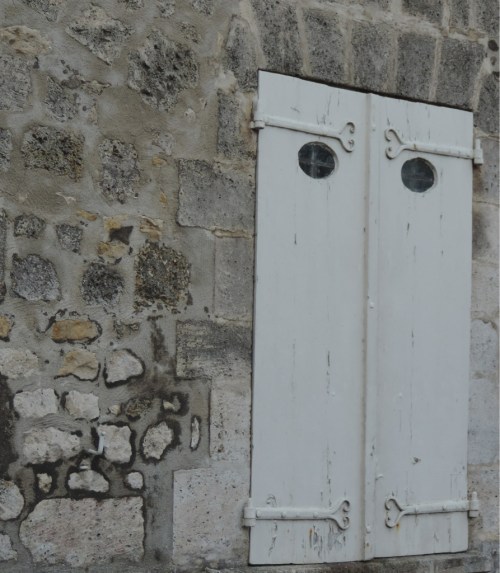
This is a very unusual set of shutters because shutters in this part of France virtually never have any openings in them. When they are closed they are closed, and when they are open they are open. But these ones have little oval windows in them. What do you think they are there for? To let some light in? And/or so the residents can peek through to see out into the street? I think it’s to let some light in actually, because they are very high up, but, then, who knows, the residents might be very tall!

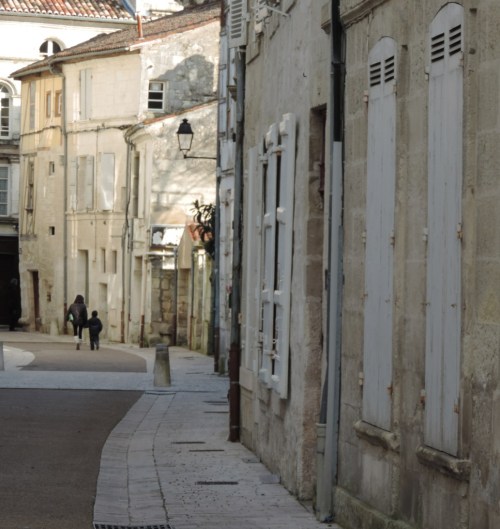
There’s a saying here which goes something like “Pour vivre bien, vivre caché” – “To live well, live hidden”. A common style of property in the Charente includes a high wall around the courtyard or garden and a big arched entrance filled with a solid wooden door. When most of the houses in a street have their shutters closed, a town can seem almost uninhabited.

What fascinates me about this idea of shutters, and high walls, and huge gates, is that the people in this part of the world seem to be amongst the friendliest, most welcoming and sociable people I’ve ever met.

Richard Sennett, who talks about the idea of “open cities”, argues that “integration” is about trying to make everyone the same. In that sense, integration promotes homogeneity, and so reduces us all. He suggests it’s better to learn how to live well together respecting our differences. Living together then becomes a matter of choosing how to relate, how to interact when we meet in our shared spaces, whilst respecting the uniqueness, the values and the choices, which privacy protects in our own homes.

I don’t think any of this is easy, but I’m intrigued by this apparent paradox of separateness and belonging which lies at the heart of all our lives.

I think it also emphasises the contact points we have – the interfaces, or edges where we connect. Look at this door buzzer for example –

What does this contact point say about the person who lives here?

What about your own contact points? Your edges? How do you use art, colour, design or symbols at your boundaries between self and other? Consciously, or otherwise!?

Read Full Post »

Front door. Angouleme

What does your front door look like?

As I wandered through the streets of Angoulême the other day, I came across this front door.

The house seemed just an ordinary house in an ordinary street, but look what they’ve painted on the door!

This makes me wonder – who painted this? Does the person who painted this live here? Or did they commission this? And, what effect does it have on the people who use this door?

It certainly made me smile. In fact, I’d say it “delighted” me, which made me think having a door like this might just contribute to lightening the state of mind of the person who uses this door.

Isn’t this so uniquely human?

If a door was simply something to secure an entrance way, or something to fill the space of the doorway, then what would be the point of painting this on it? Isn’t this such a human thing to do? To create. To make art. To change the experience of the everyday environment by engaging with it using imagination, using a sense of beauty, of fun and of delight.

We are the co-creators of our lives, not least by the way we use images, symbols, and art.

Read Full Post »

In my A to Z of Becoming, one of the verbs beginning with “I” is “imagine”.

As it happens, I’ve chose “imagination” as my keyword for this year. Do you do that? Do you choose a “word for the year”? 

I think I have a very active, very well developed imagination. My feeling is that I used my ability to imagine every day at work as a doctor to help me understand my patients. For me, good medical practice is dependant on the ability to empathise. Without empathy there is a diminished level of understanding. In fact, the complete lack of empathy, resulting from a failure of imagination, as a cause of cruelty, was highlighted by the author Ian McEwan, and others, after 9/11.

Since retiring and moving to France, I’ve begun to experiment with writing fiction as another way to use my imagination. What startles me, and repeatedly surprises me, when I write fiction is how my imagination comes up with things I hadn’t expected. 

Maybe that shouldn’t surprise me because every night when we dream our imaginations are producing the unexpected, aren’t they?

That got me thinking…..is there an off switch for imagination?

Are we ever not using our imagination?

When we fear something, we are imagining whatever it is we fear. When we worry about something, we imagine whatever it is we are worrying about. When we experience something we bring our imaginations into the experience as we create the subjective experience for ourselves. When we remember something we re-create the memories using our imaginations. When we plan to make something happen, we use our imaginations to create the plan.

Actually, I think, there is no off switch for the imagination.

However, when we are on auto-pilot, when we are in zombie mode rather than in hero mode, we are not aware of the activity of our imagination, and we are not making conscious choices.

Those are the two key elements to moving from zombie to hero mode, I reckon –

First, become aware.

Second, choose what to do.

So, here’s two things about imagining to explore this week.

What are you currently using your imagination for? And, what are you going to choose to use your imagination for?

Read Full Post »

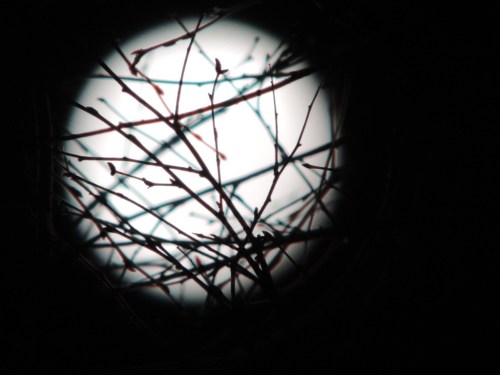
Last night with the moon just a night away from being full, it shone so very brightly in a clear sky.

Instead of taking a photo of the moon this time, I decided to take a photo of the silver birch tree in the garden which, just at that moment, had the moon shining through its branches.

But what I didn’t expect was the colour.

Look at it! Look at the colours produced by the moonlight!

I’ve never seen that before – it’s a magical, beautiful creative act by the moon and the silver birch tree (and me!) 

Read Full Post »

Seb

How do we perceive the world?

Do you think we are the passive observers of reality?

Or do we bring our prior values, beliefs and habits to the every day co-creation of reality?

I think it’s the latter.

I think we make our world, but we don’t make it from nothing. We co-create our world.

What I create changes the world you experience. What you create changes the world I experience.

Every day your experiences are unique.

Whatever you experience today, remember this will be the very first time you experience exactly this. And, remember too, that this will be the very last time you will experience exactly this. Today will not come back again.

Can you be aware of that?

As you live today can you notice, sometimes, what kind of world you are creating? Can you notice what kind of world we are creating?

Read Full Post »

Cognac

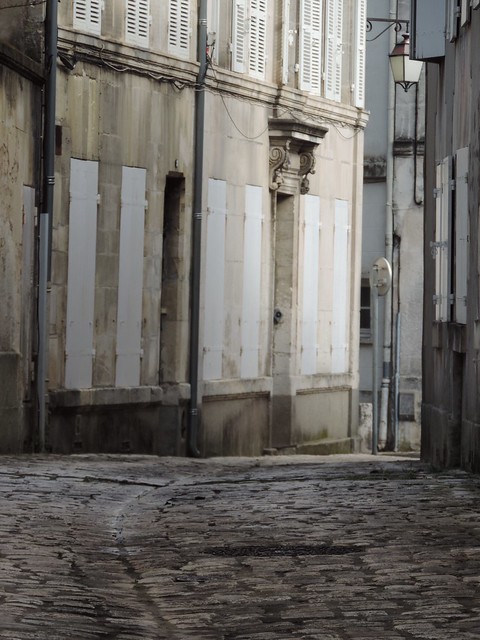
This image is one of the ones which makes me very aware of the quality of light. It’s a simple shot of a street in Cognac around mid-day, but I find the light quite magical.

Isn’t it interesting how different the light appears depending on the time and place? I’m a great fan of diversity, so here are some very different examples, all taken in early afternoon light, but all on different days and in different places.

First up, here’s the Saint-Eutrope crypt in the town of Saintes.

The crypt


Then, the Charente river as it flows through Saintes.

The Charente in Saintes


The bridge to Île-de-Ré, with the oyster beds in the foreground.


From the Ile-de-Re

Read Full Post »

The dark observer

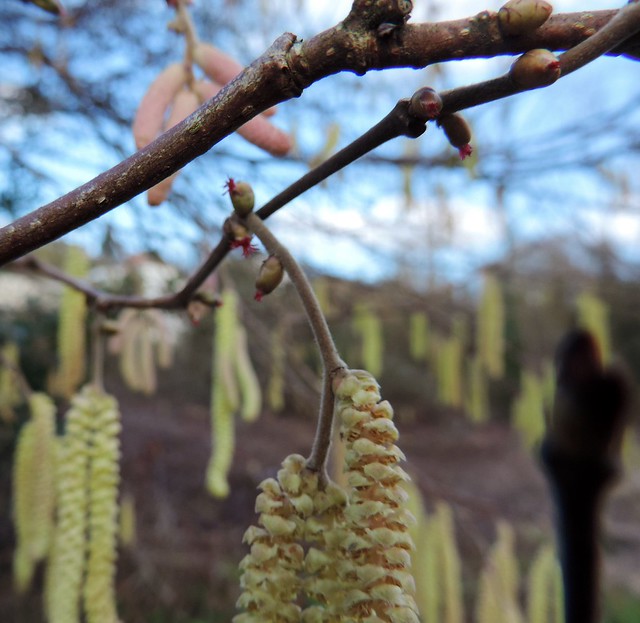
When I loaded this image up onto my Mac, and looked at it, I jumped.

I was taking a photo of the seeds hanging from the tree, but when I looked at it now I could see a skinny dark figure watching me.

The figure looked cloaked and hooded to me and had seemed to step right into my field of vision, even though I had not seen him when I was taking the photograph.

What was this?

Was it a spirit or ghost of some kind? Out in broad daylight? What was it doing there watching me? Was it watching with good will, or evil intent?

I shuddered.

Then I looked again and saw the out of focus foreground twig which must have been sticking up in front of my lens.

But when I look again, the first thing I see, every time, is the dark, shadowy figure.

We bring our active imaginations into our every day perceptions. It happens automatically. Then, when we pause, stand back, and look again, everything changes.

Doesn’t it?

Read Full Post »

« Newer Posts - Older Posts »