Feeds:
Posts
Comments

Archive for the ‘perception’ Category

yellow and blue

I think it is often difference which catches my eye.

i think difference is beautiful.

Sameness quickly becomes, well, sameness.

This simple photo is beautiful, not just because the blue sky is beautiful, and the yellow lichen on the tree is beautiful, but also because of the contrast between the blue and the yellow, and the contrast between the smoothness of the sky and the roughness of the branches.

Mass production and mass control seems to have a different ethic from this – uniformity and the “elimination of variation”.

Here’s to a celebration of difference, of uniqueness and of diversity.

Read Full Post »

There is no more difficult art to acquire than the art of observation, and for some it is quite as difficult to record an observation in brief and plain language (William Osler)

The “art of observation” – interesting phrase. It’s not just a matter of looking then? Or of gazing whilst your mind is elsewhere? I think we often forget that observation is both an active and a creative process. It’s not the same as measuring. But it always involves some level of “abstraction” ie we focus on certain elements or characteristics. We simply can’t “take in” all the sensory stimuli and information which is streaming our way at any particular moment. We sift, we categorise, we discard, we focus.

Telling someone else what we observe often reveals these processes which alter what there is to be observed. Recording too little, hides too much. Recording too much, overwhelms with detail and we run the risk of not being able to see the wood for the trees.

A want of the habit of observing conditions and an inveterate habit of taking averages are each of them often equally misleading (Florence Nightingale)

Florence Nightingale adds another two aspects to the issue of observation – two common faults she said – one of failing to “observe conditions” which I take to be either a failure to observe the context, or a failure to observe the phenomena of the illness. And secondly, the “inveterate habit of taking averages”. When it comes to the individual, averages are of little use. They can blind the observer to the unique present situation.

Read Full Post »

When I started the A to Z of Becoming, the first verb beginning with an A was Attend. (Click through on that link to read the original post)

This week I want to explore the difference between passive and active attention. What I really mean can most easily be understood from that common expression – “that caught my attention”. We experience our attention being “caught” all the time. Whether it’s caught by a loud bang, a bright light, a word or a phrase we hear or read, what we experience is suddenly noticing.

What caught my attention and led me to take the above photograph was the colour of sky at sunset. I noticed the red sky, picked up my camera and went out into the garden to take the photograph.

What caught my attention next was the bright spot of light you can see shining up there in the top left of the image. 

What is that?

So, then I took out my iphone, opened up the Star Walk app, and held the screen towards that part of the sky I had photographed.

Venus. That bright light is Venus. I then noticed (on the app) that several other planets were in the same vicinity, some of them having already disappeared below the horizon with the setting sun, and some of them not shining brightly enough yet to be visible in the red light.

What happened there was that my attention was caught, first by the red sky, then by the shining “star” (which turned out to be a planet). The whole experience was extended by following the curiosity which my attention had provoked. And I extend the experience further again now, as I write this.

We’re often not that aware of what is catching our attention because we don’t linger with it. We become aware of something, then we quickly start to think about something else. So, how can you become an more active player and influence what your mind is paying attention to?

Here’s an exercise you can do to find out what keeps catching your attention.

Take a notebook and write continuously without stopping to think what to write for either a period of time, or until you’ve filled a number of pages. I’ve seen several variations of this exercise and suggest you choose the one that best fits for you. Either fill three, or more, pages of A4 size, or write continuously for 30 minutes, or a period time you can fit into your schedule (I’d suggest it needs to be at least 15 minutes)

The rules are, do it every day, don’t stop for a second as you write, and don’t read what you’ve written. Do this for 30 days, then read the whole lot. You’ll be surprised when you find some of the things that keep coming up. Some will be obvious to you, but I bet there will be others which really surprise you. These repeated phrases, topics or whatever, are what has been catching your attention this last month. (If 30 days is too much for you, try it for 7, or for 10 days. Set your target in advance and don’t read anything until that target has been reached)

As you reflect on what you’ve written, you can make some choices. You can choose to stop paying attention to something, or you can choose to actively look out for something else. In other words you can engage actively with your attention, setting yourself up to have your attention caught more frequently by whatever it is you’d like it to be caught by.

We are never fully aware or completely present for long, but the act of choosing to attend to something in particular, again and again, begins to influence our passive, less conscious reactions too.

We can gradually begin to experience more of what we choose to experience.

Read Full Post »

air and water

water and fire

air water and fire

air water fire earth and Life

Read Full Post »

It’s often said that every action you take, every word you utter, maybe even every thought you have, ripples out into the Universe like the spreading waves on the surface of the water after you throw a stone into a pond.

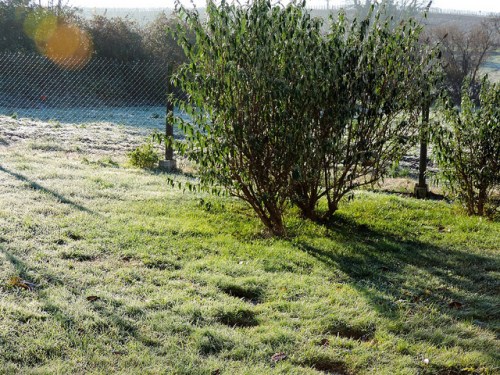
Take a look at this photo. I took it the other morning when I saw the grass was covered in frost and the sun was coming up.

You can see the sunlight is coming from the top left of the image and that the bush is casting a shadow towards the bottom right. You might think (rightly) that the land covered by the shadow will not be warming up as quickly as that which is in direct sunlight, so the frost will stay there longer. 

But look more closely. there is a whole circle of ground around the bush where the frost has gone. And that circle is on both sides of the bush – the sunlit side, and the shadow side.

More than the metaphor of the ripples on the water, I think this image reminds us how a living organism impacts on the world of which it is a part. 

It reminds me that all living organisms are “a part” of the Universe, not “apart” from the Universe.

It reminds me that our every day living influences and effects the place where we live, the environment in which we live, and that we interact in complex and surprising ways with the Universe.

It’s true, isn’t it? Every action we take, every word we utter, every thought we have, cascades “out” into the Universe.

Read Full Post »

UNESCO has declared 2015 as the “Year of Light” (“and light-based technologies”), so I thought I’d share a couple of thoughts about light.

For the last 52 Sundays I’ve published a post about an action to consider in the week ahead. To focus on actions, I’ve been writing about verbs. Verbs are tools for us. We use them to create the lives we experience. Verbs are doing words. They can’t quite be pinned down into one place or time. When we are doing something, we are experiencing continual change. Some even say that the best way to think of the “self” is not to think of self as a noun, but as a verb.

The practice of meditation invites us to investigate the flux of arising and passing events. When we get the hang of it, we can begin to see how each artifact of the mind is raised and lowered to view, like so many flashcards. But we can also glimpse, once in a while, the sleight-of-hand shuffling the cards and pulling them off the deck. Behind the objects lies a process. Self is a process. Self is a verb.

Verbs are our tools of becoming. Because we can choose our verbs and practice them, we can become active creators of our own experience.

I’m thinking of doing two things with the A to Z of Becoming series – develop them into a book which I hope to publish this year, and continue the Sunday series of posts about verbs.

This Sunday, I’m going to pick up on the UNESCO theme and think of verbs related to light. A long time back I figured that being a good doctor included practising three verbs related to light – lighten, brighten and enlighten. But now I think they are good value-grounded verbs which can add to anyone’s life.

So, this week you have three verbs to explore.

What or who lightens up your life? Can you find time to spend doing what it is that lightens up your life this week?

And what light do you shine in the lives of others? In your day to day interactions with others do you make their lives lighter, or darker (lighter or heavier maybe)?

What about brightening? To me, if you lighten someone’s life, you do something which eases any suffering they are experiencing. You help them to relax, feel less anxious, or down. To brighten someone’s life is to turn the light up in their lives. Think of sunshine, or of sparkling. Sparkling eyes brighten a day. Smiles brighten an exchange. Sharing a passion or an enthusiasm makes an experience more vivid. I’m thinking of brightening in those ways.

What can you do to brighten someone else’s life up this week?

And, how do you brighten your life? How do you add colour to it, richness or, variety? How can you increase the intensity of your experiences…..turn up the brightness…..hear, see, smell, taste, feel more vividly?

Finally, what about the idea of enlightening?

To enlighten is to understand better, to see something more clearly, to know what something means. How can you increase your understanding of another this week? How can you see something more clearly? We humans crave a sense of meaning and purpose. How do you make sense of what you experience this week?

There are lots of questions in this post, and I don’t expect you’ll explore them all in just a week, but maybe that’s why I’ve been thinking about them today. If this is to be a year of light, I can explore light in many ways over the coming days and weeks. I’ll do that with my camera, and I’ll do it with my journal. But mainly I’ll do it by coming back again and again to these three verbs – lighten, brighten and enlighten.

Here’s some amazing sunlight

sun

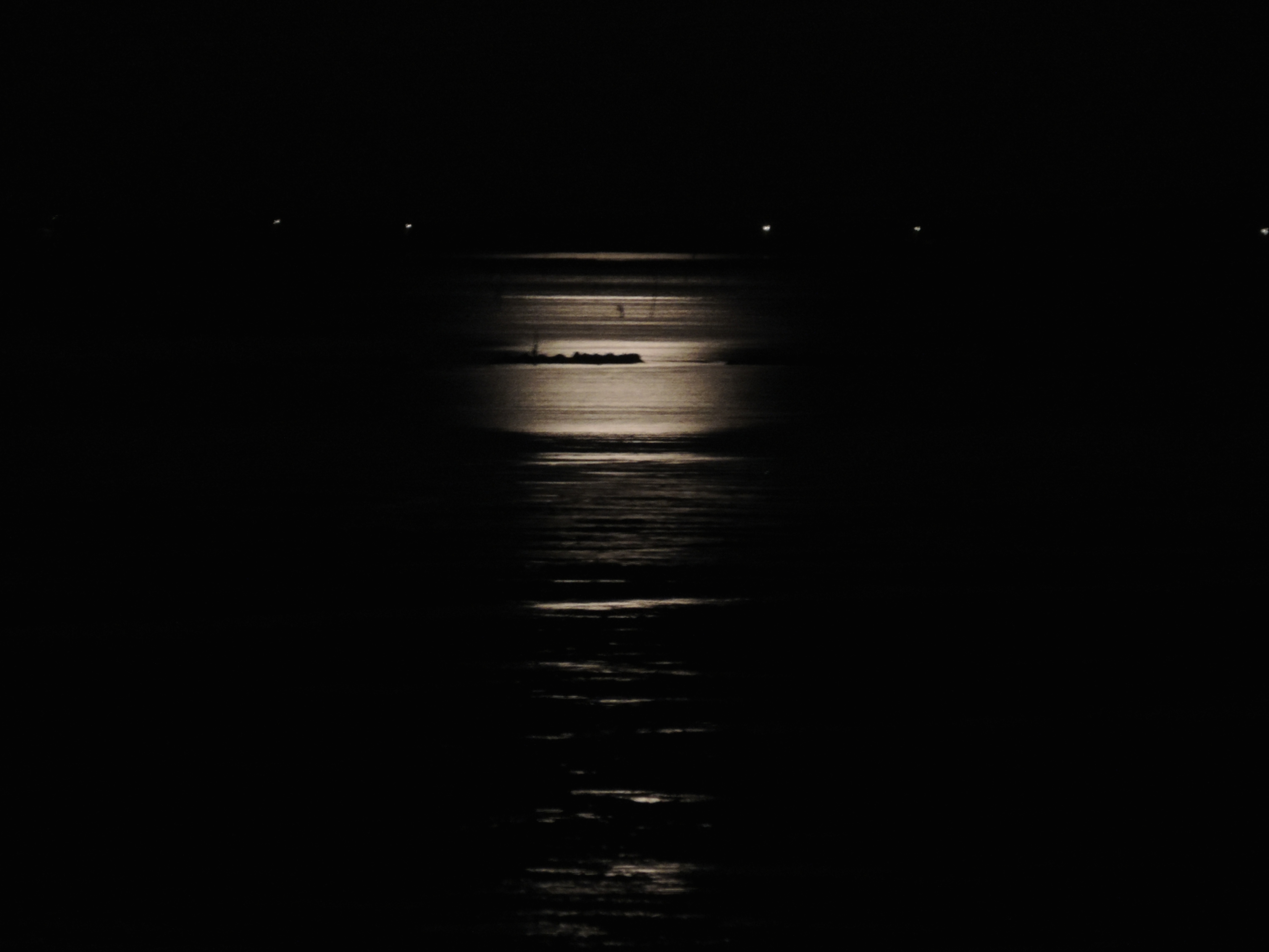
Some moonlight…..

moon

And some sparkles….

sparkles

Read Full Post »

Moon

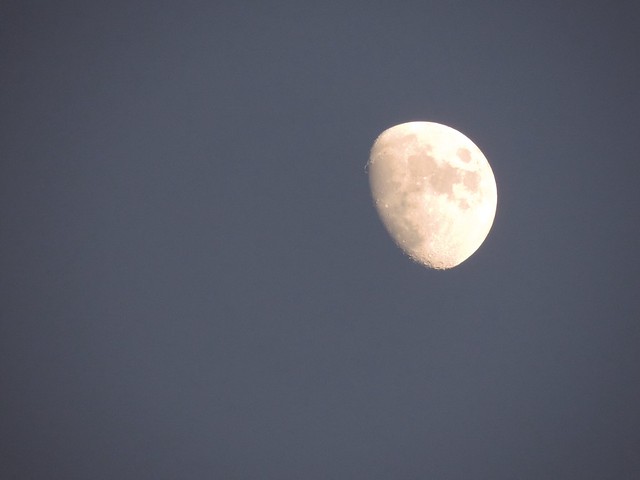
The moon has been very bright recently, so I thought, I wonder if I can get a decent photo of it? Not bad, huh?Isn’t it wonderful, and beautiful, and amazing?

This is how I take photos.

I thought I’d just share, at the start of the year, the foundation principles of my photography.

  1. First, never, ever go anywhere without a camera. That’s pretty easy nowadays when our smartphones have such great cameras in them, but I still prefer to take an actual camera with me too.
  2. Second, be prepared to be amazed. L’émerveillement du quotidien is the French phrase for it.
  3. Thirdly, photograph what catches your attention, or your wonder. That’s it I think. Oh, no, wait, there’s a fourth one!
  4. Take your time. You can just point and shoot, but you’ll get way more interesting and pleasing photos if you take your time. Change your position, your point of view, move the frame, zoom in or zoom out. If you are using autofocus, give the camera time to focus and make sure you’re focusing on the part of the view you want to be most sharp…….just take your time and press the shutter release only once you’re happy with what you are looking at.


Read Full Post »

In the London Review of Books, Hilary Mantel has written an extremely thought provoking review of Brian Dillon’s “Tormented Hope: Nine Hypochondriac Lives”.

For some of us, the question ‘Am I ill or well?’ is not at all straightforward, but contentious and guilt-ridden. I feel ill, but have I any right to the feeling? I feel ill, but has my feeling any organic basis? I feel ill, but who am I to say so? Someone else must decide (my doctor, my mother) whether the illness is real by other people’s standards, or only by mine. Is it a respectable illness? Does it stand up to scientific scrutiny? Or is it just one of my body’s weasel stratagems, to get attention, to get a rest, to avoid doing something it doesn’t want to do? Some of us perceive our body as fundamentally dishonest, and illness as a scam it has thought up.


We understand, almost instinctively, the nuanced difference between disease and illness. As Eric Cassell put it so clearly – “illness is what a man has, and disease is what an organ has”. Or “illness is what you go to the doctor with, and disease is what you come home with”. However, both doctors and patients are caught up in the blurred boundary between these two concepts. For doctors, once a sensation is classified as a symptom, it becomes a signpost to a pathology (or it is dismissed as “psychological”). For all of us, though, we live with the possibility that any sensation might be a symptom. For the hypochondriac, every sensation might be a symptom. As Hilary Mantel says – 


In hypochondria, the whole imagination is medicalised; on the one hand, the state is sordid and comic, on the other hand, perfectly comprehensible. It is the dismaying opaqueness of human flesh that drives us to anxiety and despair. What in God’s name is going on in there? Why are our bodies not made with hinged flaps or transparent panels, so that we can have a look? Why must we exist in perpetual uncertainty (only ended by death) as to whether we are well or ill?

Am I well, or am I ill? Who decides?

Brian Dillon consoles us that ‘hypochondriacs are almost always other people.’ The condition exists on a continuum, with fraud at one end, delusion in the middle and medical incompetence at the other end; he is a benefits cheat, you are a hypochondriac, I am as yet undiagnosed.

One issue is symptoms, which are a particular way of classifying sensations. Are some more real, somehow, than others? Do they need accompanying physical changes in the body to be real?  

Many people are simply hyper-aware of bodily sensations, and so are driven continually to check in with themselves, examining visceral events as a man about to confess to a priest examines his conscience; like the believer scrutinising himself for sin, they expect to find something bad, perhaps something mortal. Forgiveness, and cure, are only ever partial and temporary; there will always be another lapse, some internal quaking or queasiness, some torsion or stricture, some lightness in the head or hammering of the pulse, some stiffness in the joint or trembling of the limb, or perhaps even an absence of sensation, a numbness, a deficit, a failure of the appetite.

A researcher called Kurt Kroenke has published many studies where he shows, time and again, that not only is the percentage of people listing symptoms which they have equal whether they are attending medical clinics, or are simply stopped in the street and asked, but the actual symptoms people complain of are the largely the same whether they are attending for health care, or just going about their normal lives. Clearly, not only are sensations not usually symptoms but symptoms do not equal disease.

Bodily, and psychic sensations are part of being alive. But we humans are compelled somehow to try to find the underlying meaning of everything..including sensations. Isn’t this the crux of the issue? Who gives meaning to your daily life, your lived experience, your sensations, thoughts, and feelings?

In the days before internet information and misinformation became available, patients often came away from a consultation with the feeling that they did not own their own bodies, that they were in some way owned by the doctor or the NHS. Now perhaps Google owns our bodies; it is possible to have access, at a keystroke, to a dazing plurality of opinion. There is an illness out there for every need, a disease to fit any symptom. And it is not just individuals who manufacture disease. As drug patents expire, the pharmacological companies invent new illnesses, such as social anxiety disorder, for which an otherwise obsolete formulation can be prescribed. For this ruse to work, the patient must accept a description of himself as sick, not just odd; so shyness, for example, becomes a pathology, not just an inconvenient character trait. We need not be in pain, or produce florid symptoms, to benefit from the new, enveloping, knowledge-based hypochondria. We are all subtly wrong in some way, most of the time: ill at ease in the world. We can stand a bit of readjustment, physical or mental, a bit of fine-tuning. Our lifelong itch for self-improvement can be scratched by a cosmetic surgeon with his scalpel or needle, our feelings of loss assuaged by a pill that will return us to a state of self-possession. For hypochondria, the future is golden.

It’s not just doctors who interpret your sensations now, there are interpretations everywhere, and some of them are deliberately invented for marketing purposes. 

Living involves experiencing sensations, and being human involves sense-making. Trying to understand what is happening now may be an inescapable part of Life. Deciding what meaning fits best is, ultimately, down to the individual – either by simply accepting the interpretation of an other, or by consciously, rationally, working it out in our own terms.

Entangled as they might be, the untangling of sensations is up to us.

Read Full Post »

In the second part of the A to Z of Becoming, Z stands for the verb, zoom.

What I suggest you do with this verb, is think of a camera lens – the kind that zooms – it can zoom in, and it can zoom out.

A few years back I climbed the hill to the Inari Shrine just outside of Kyoto. I took photos (of course) and what follows here is the sequence, starting at the entrance gate, then looking back towards the gate, and beyond to Kyoto, as I climb the hill. See if you can pick out the entrance gate in all the photos.

inari

inari and kyoto

inari and kyoto

inari and kyoto

Imagine now, that you are standing on top of this hill, and you zoom in on the gate you passed through at the start of the climb. You can either do that using a camera lens, or you can do it using your memory or imagination.

As you zoom in, and zoom back out, the context changes. You see what you saw before but in a different, broader, or narrower, setting.

That’s what zooming does for us. It allows us not to get stuck on one single viewpoint, but to see whatever we are looking at in a number of different contexts.

You can do the same with time.

You can stand here, at this point in the year, today, this very day, and zoom out to remember or imagine this day in the context of this week, of this month, of this year, of this life even. Then zoom back in again, to focus on the present.

Can you do that to see forward as well as back?

Fushimi Inari Shrine

You can, if you use your imagination…..

By the way, the shrine has many passageways like this one –Fushimi Inari Shrine Torii Gates

and this one –

Fushimi Inari Shrine Torii Gates

– where you can’t zoom very far forwards, or backwards, you can only see as far at the next curve, and as far back as the last one – keeps you focused on the here and now! It’s good to focus on the here and now, but a bit of zooming can broaden or deepen your awareness.

Read Full Post »

silver lining

Have you ever looked up at a cloud and wondered about just where its edges are?

You’ll be familiar with the idea that every cloud has a silver lining….like the one I’ve photographed here. When we talk about that we have this kind of image in our minds, an image of a grey cloud with a bright white silver edge.

But where exactly is the edge of a cloud?

If a cloud is droplets of water, where do those droplets become so numerous that they constitute a cloud? Watch any cloud for a moment and you’ll see the edge slowly, but constantly, changing. The cloud literally changes its shape before your eyes.

I find that fascinating. And it can be a nice contemplation or meditation too.

Either to keep your attention on the cloud, observing the changes at its edges, bringing your mind gently back to the cloud every time it drifts off into some other thoughts.

Or think of a cloud as a model to consider other “objects” in the world – yourself for example. Where are your edges, and how are they changing?

Read Full Post »

« Newer Posts - Older Posts »