Feeds:
Posts
Comments

Archive for the ‘personal growth’ Category

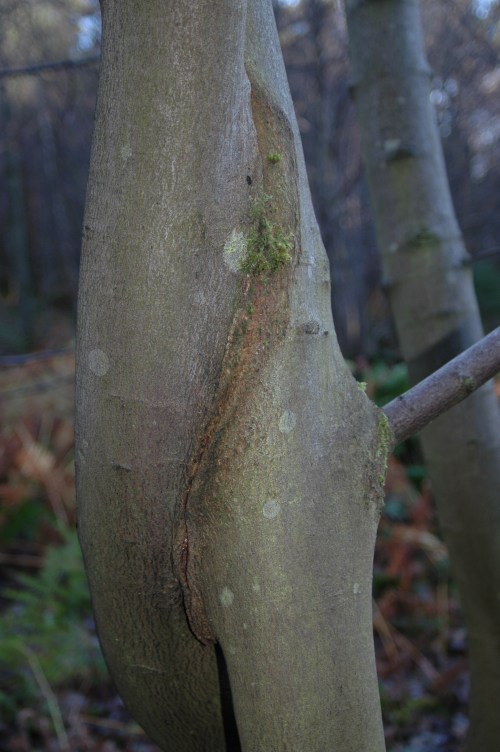
It’s many years since I stumbled across these two trees in a forest, but it’s an image which still captures me every time I see it.

I mean, just look at this….as best I could tell these are two trees growing close to each other in a wild forest. So close that one day they joined together. What began as closeness grew into entanglement. In my photo library I’ve labelled this photo “loving trees”. Of course, I don’t know if trees do love each other or not, but I do know there is a growing body of evidence revealing that trees communicate and co-operate much, much more than we ever thought they did.

I don’t mean to anthropomorphise the trees but I do think this kind of phenomenon reveals something about the underlying life forces which shape our universe. It’s natural for living organisms to connect, to get close to each other, to share and to collaborate. I know the dominant narrative of Nature and Society for many years now has been one of competition with every single plant, insect, animal or whatever fighting for its life and competing with every other creature for the common resources. But competition is just one phenomenon we see in Nature, and it may turn out not even to be the most important one.

I think we haven’t paid enough attention to co-operation and collaboration in our world. Look at human beings for example. Our extraordinarily developed brains absolutely excel at making connections and creating relationships. Human babies wouldn’t survive for long with out these innate skills. We understand the importance of infant-parent attachment much better now. We even know that without healthy, loving attachment in the earliest years a baby’s brain will grow less neurones, and make less connections between them. These early experiences of love, care, attention and belonging set us up for life. Conversely, their lack limits us and makes life a whole lot tougher.

I’m always struck by how you can see in any emergency, whether it be a road accident, someone falling ill in the street, or something even more dramatic like a natural disaster or a terrorist attack, there are always many people rushing to help. It’s a human instinct. Actually I don’t think this is reserved to humans. We can see all kinds of co-operation and collaboration in the other kingdoms of life – other primates, other mammals, birds, insects, flowers and trees. The word “ecosystem” refers to the complex, inter-twined, co-dependent, elaborately connected webs of inter-being, connecting all sorts of living creatures and creating the conditions for life and growth.

I often think we get more of what we pay attention to, so I often think it’s a good idea to pay attention to relationships, to love and to care.

I’d like to see a world where we recognise that co-operation, collaboration and sharing is the natural counter to competition, grabbing and hoarding.
 

Read Full Post »


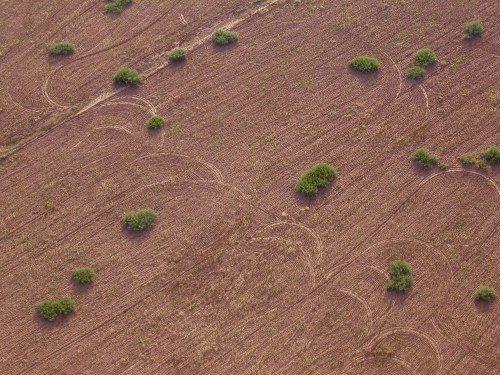
I am sorting through old photographs just now and came across this one which I took fifteen years ago from a hot air balloon near the Atlas Mountains in Morocco.

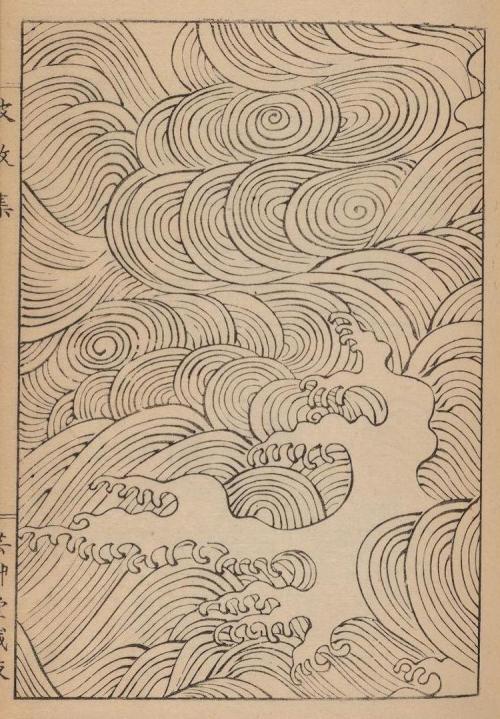
I suspect I took the photo because I spotted this strange patterning of the ground but I don’t really remember. Looking at it again now I am really struck by a combination of beauty and strangeness. There is undoubtedly something pleasing about these multiple semicircles on the red soil. They are almost like one of those wave paintings you see in traditional Japanese art.

Sure, it provokes my curiosity. I can’t help wondering who made these marks, how they made them, and why? But I only visited Morocco for a few days and I was never closer to these markings than I was in this photo. I’ll never know. But that takes nothing away from them, because I find I’m content to enjoy them. In fact, I find they draw me to them and I time can stand still for a little while as I contemplate them.

There is evidence of human mark making all around us of course. I look out onto this –

Of course, I do know how these patterns are produced and why. But they certainly create a distinctive landscape don’t they?

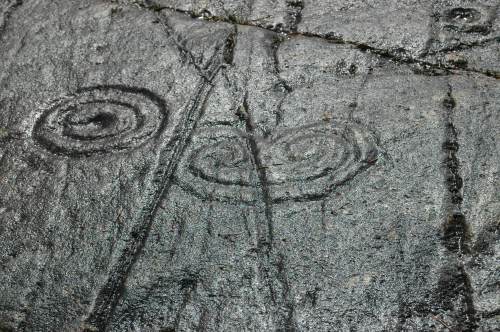
Another place where I came across strangely beautiful marks is the Kilmartin Valley in Scotland. There are several large stones covered with markings from pre-history in that valley.

Who made these marks? How did they make these marks, and why?

More questions we don’t have answers to, but, again, aren’t they just beautiful in themselves?

But more than that, I realise as I look at these images again, their beauty is enhanced by mystery.

I like to explain things. I like to understand.

But I don’t deny that part of the enchantment of life is just how much mystery there is.

“And not or” – our lives are rich because explanation and mystery are so entwined.

Read Full Post »

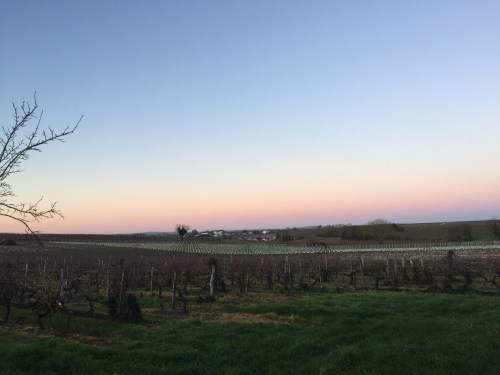
Yesterday I wrote about sunsets. This morning when I opened the shutters I saw the most gorgeous example of “The Belt of Venus”.

It was every bit as compelling as the sunset I had just described…..and it was in the exact same direction…..looking West.

If the Sun was the greatest magnet we’d be drawn to watch it rise at dawn (if only we were awake and up early enough!), and it’s true that the rising of the Sun can be every bit as impressive as its setting. In fact, that phenomenon often makes me think of the scenes from “City of Angels” where the angels stand on the beach to watch the dawn. But the dawns are not usually as colourful as the sunsets, are they? When they are, when they fill the sky with rosy pink clouds, then what pops into my head is “Red sky at night, shepherds delight. Red sky in the morning, shepherds warning.” I know there are other variations of that saying in different parts of the world, but it does somewhat detract from the delight and attraction of the dawn sky versus the one at dusk, doesn’t it?

Most mornings, however, the sky isn’t pink and I’m not that aware of the Sun rising above the Eastern horizon. After moving here to the Charente I began to notice that the Western horizon was definitely pink some mornings and that spiked my curiosity. It turns out to be a phenomenon called “The Belt of Venus” and it comes about just as the Sun rises in the East but casts a shadow of the Earth just above the Western horizon. Well, both the phenomenon itself, and it’s rather romantic and glorious name, really engaged me, and now I’m much more likely to spot it. (That makes me wonder just what else we miss every day because we don’t recognise it. How much is invisible to us, passes us by, because we don’t pay sufficient attention, and we don’t know what we are looking at?)

Well, this is February now, and according to my monthly themes, February is the month of Love. So, how appropriate that Venus should make herself known so clearly this morning. Actually, we’ve had really clear skies these last few nights and one of the brightest objects in the night sky here is currently the planet Venus, so she’s around at night, as well as leaving her mark on the dawn.

So, I’m just reminding myself of all this today…..that February is a month to practice love, and loving kindness. That fits in with one of my two words of the year as well…..”bienveillance” – which is about “meaning well”, or acting with good intentions.

I like it when things come together like this….a phenomenon, how we name that phenomenon, and all that we attach to that name, the stories which spin off in all directions along a common theme, and the influence all that has on our daily behaviour.

Read Full Post »

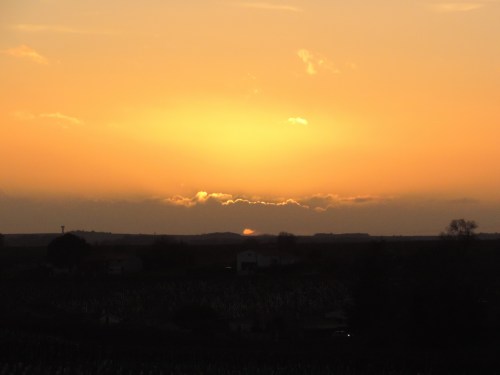
I don’t know about you but I find that sunsets exert a strong magnetic pull on me. I just can’t resist them.

They capture my attention, draw me outside, inspire me to grab my camera and take a few shots. Or I just walk to the corner of the garden, look west, and bask in their beauty for a while.

I haven’t counted how many spectacular sunsets I’ve seen since moving to the Charente (and I was also SO lucky to be able to see an incredible number of fabulous sunsets around Ben Led in my years of living in a top floor flat near Stirling, Scotland). The number isn’t important. Quantity is irrelevant. It’s the quality of them – the colours, the spread, the depth, the way they change the colour of the entire landscape, and, yes, even the speed with which they change.

Have you ever tried to watch the minute hand on a clock move? It’s not easy! Sure, if there is a second hand, you are immediately aware of its constant motion, but the minute hand? Not so easy! Try watching it for five minutes. Chances are you’ll be well aware that the five minutes have passed but your mind probably went off on a wee jaunt somewhere while waiting for that time to pass, and it really won’t be easy to actually see the minute hand moving.

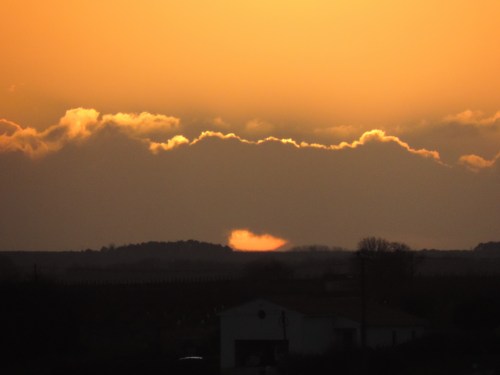
But stand outside as the sun just touches the western horizon and I bet you’ll find it hard to look away. I don’t find my mind drifting off anywhere as I watch these sunsets. I’m entranced by them. Of course, if its a cloudless sky I can’t (and shouldn’t) look directly at the sun. Even at that time of day it’s too bright. But when there is a little cloud there it’s easy to follow the changing patterns of light as the Sun sinks below the horizon. In fact, it’s often in those first few moments after the entire sun has disappeared below the horizon that the real beauty commences, painting the sky every shade from tobacco to crimson.

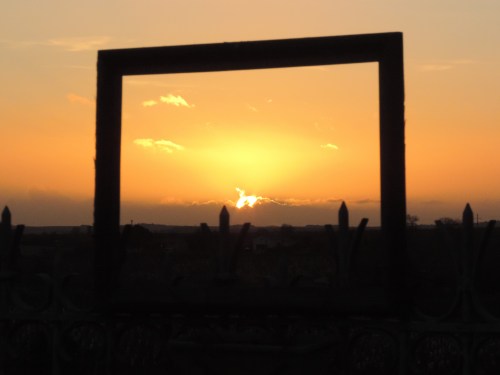
Sometimes it looks like it did last night. Just as the Sun is about to disappear it sends an astonishing flare of bright yellow light high up into the sky. It looks like the very air has caught fire! In this particular sunset that flare was concentrated so it looks for a few moments as if there is a secondary source of light in the sky. It looks as if there is a centre to the brightness which is completely detached from the actual Sun. Almost the visual equivalent of ventriloquy…..

In between the Sun itself and this secondary light cast, the edges of the clouds shone brightly. You couldn’t call this a silver lining. It’s a platinum lining.

It is just fabulous.

When I talk about “émerveillement” this is just the kind of thing I mean.

How great to end the day with wonder, delight and amazement.

How great to feel the effects of beauty and joy wash through my being.

How about you? Do sunsets have this effect on you as well? If not, what does?

Read Full Post »

TS Eliot wrote, in “The Rock”

What life have you if you have not life together?
…………
When the Stranger says: “What is the meaning of this City?
Do you huddle close together because you love each other?
What will you answer? ‘We all dwell together
To make money from each other?’ or ‘This is a community?’”
Take a look down your street. Down any street. Imagine all the people who live there. Some of them you might know, others, not so much. Or maybe you don’t know any of them at all. But, here’s my question.
Why shouldn’t all the people living in the same street have the same rights?
The same rights to live, love, learn, work, to garden, to shop, to go out for something to eat, out for a drink…..take part in the same concerts, enjoy the same museums and galleries, see the same movies…..same rights in law, same rights to health care, education, same freedoms to move, to speak, to write, to vote?
In other words, why separate people who live in the same street?
Why separate them according to the place of their birth, or the place of their parents’ birth?
Who benefits from doing that?
Is that any way to create a community? A town? A city? A country? A world?
What do you think? Is it better to set limits on some of the people who live in this street? To say some can stay but some can’t? To say some can vote but some can’t? Some can have access to health, education and social support, but some can’t? And if you think that’s better, how do you think we choose? Who should we include, and who should we exclude?
Because I really don’t see the point of all that separation, and categorisation, and exclusion.

Read Full Post »

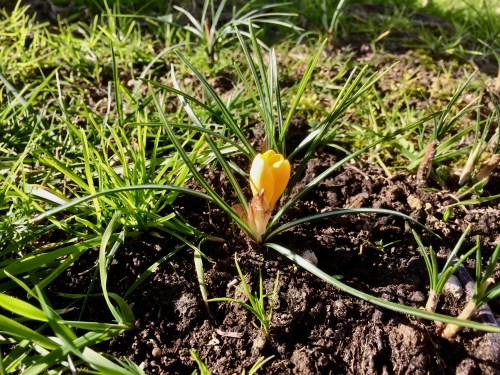
Here they come! The first little crocus flowers.

It’s the middle of January, and here in the Charente we have blue skies and a bitingly cold wind blowing from the North East (the literal opposite direction from the prevailing winds which come from the South West).

Every year in late autumn I poke some more holes in the grass around the mulberry tree and plant some crocus bulbs. Last time I planted about fifty of them. I’ve lost count of how many I’ve planted in the last five years. We have an image in mind of a carpet of yellow, purple and white crocus flowers covering the ground at the foot of the tree, but, so far, it’s never looked remotely like that, so I just keep adding a few more every year.

Did you know that there is no scientific way to tell if a seed is dead or alive? No way to know which have the potential to burst out of their shells and make their way through the soil towards the Sun. Any botanists out there can correct me, but I suspect the same applies to bulbs. There’s no way of knowing which will produce full-blown flowers, and there certainly is no way of knowing which of them will appear first.

That means that every single year the sight of the first crocus is a surprise and a delight. It’s like making a discovery. Even if I know it’s me who planted the bulbs there. That delight doesn’t go away with the appearance of the first flower either. Every single new plant brings an equal measure of delight. It’s the gift that goes on giving!

This is one of the occasions where I am struck by how we humans can welcome and embrace uncertainty. We’d like to think we can control things. We’d like to think we can predict things. And there are certainly cases where we can, but more often than not, we can’t. I worked as a General Practitioner for four decades of my life, and the core skill of a GP is to be able to handle uncertainty.

In the Primary Care setting, a GP (Family Doctor), tends to be one of the first to be consulted when a patient becomes unwell and can’t manage their illness by themselves. In my training I was taught this meant I’d see a lot of patients with “undifferentiated illness” – because in the earliest stages of illness things can be pretty vague. There might be a bit of a fever, or just a symptom or two….feeling tired, or achey, of slightly nauseous. In these early hours or days there might not be much to find amiss on a physical exam, or at least, not much to find which is distinctive of any specific disease. A few days, or even hours, later, it can be glaringly obvious! Which is why GPs learn to assess the severity of a patient’s symptoms, the over all level of their health, and the need for any urgency. We learn to review the situation as quickly and frequently as appropriate. We also learn that the future is not predictable at the level of the individual patient. We can have a good knowledge of the likely progress of certain pathologies, but we can’t predict the future path of an individual’s illness. Same thing goes for any treatment. Whether or not a certain treatment is so-called “evidence based”, only the unfolding story of this particular patient in the days and weeks ahead will reveal the course of the illness and the appropriateness of the treatment.

I can see that you might read that and despair, thinking, surely the doctor can do better than that? Surely they can predict the future with certainty. Well, nope, they can’t. What that means is that the uniqueness of the individual can never be set aside. The particularity of the person can never be replaced by the categorisation of their illness by diagnosis, or by the likely effectiveness of any treatment. At all the times, the GP has to make a judgement, based on knowledge and experience, use that judgement to decide what to do, then, crucially, follow up.

That’s why I don’t think it’s a good idea to chop the delivery of health care into little pieces. Dealing with the whole person has got a time dimension to it. We need to know how things are progressing, and make another judgement, another decision, in the light of the changes.

So, I might have started writing this thinking about a little yellow crocus popping up, by I find my train of thought exploring uncertainty, unpredictably and the Practice of Medicine, (who saw that coming?!)

Where that takes me to is – I think there are at least three crucial elements to good Medical Practice –

  1. Time – sufficient time for the patient and the doctor to get a good understanding of what’s going on
  2. Continuity of care – follow through of every event into an emerging story over hours, days or weeks
  3. Open minds – never closing down the thought processes by ticking a box, or issuing a prescription, knowing that the future, in all individual circumstances is uncertain.

I’ll leave you with one of the “new”, newly emergent, crocus flowers, by which I mean one of the new variety I planted last year which has just popped up to say hello!

Read Full Post »

Do you do that “word of the year” thing? Where you choose a word at the beginning of each year, a word which will be some kind of touchstone, theme or “north star” for you?

This year, I’ve decided to choose two…….because I received two books as presents for Christmas and it immediately struck me that between them they lay a foundation for a way of living I highly value.

These are French books, so here’s another innovation for me…..up until now my Word of the Year has been an English word, but, hey, I’ve been living in France for the last five years and I’ve read a LOT of French, so, I reckon it’s high time I choose a couple of French words.

Here’s where things start to get interesting, because I can’t find direct, single word translations of these two words into English. Perhaps, more accurately, I should say I can’t find any direct translations into English which I find satisfying. I think that’s a great example of how learning a second language can both widen and deepen your world.

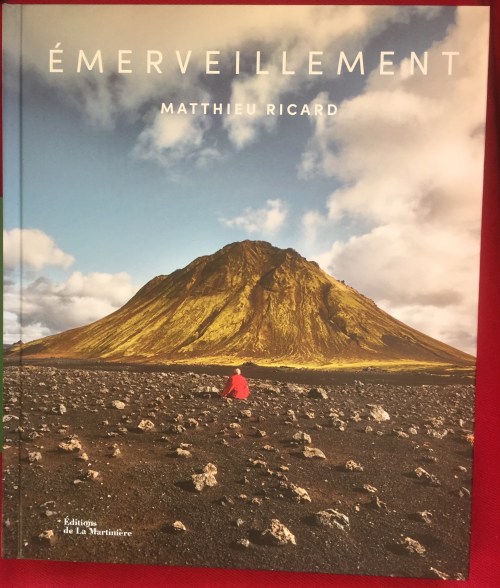
If you’ve read other posts on my site here you’ll have come across my use of the term “émerveillement” already. The first time I read the phrase “l’émerveillement du quotidien” I was entranced by it. It sort of means “the wonder of the every day”. The word “émerveillement” captures my core value of curiosity, of amazement, of awe and of wonder. I adore those moments when you notice something and it stops you in your tracks, where you pause, savour, and reflect. The more that happens in my life, the better my life seems to me. To really experience “émerveillement” you have to be open minded. You have to be curious, aware and non-judgemental. So the pursuit of “émerveillement” every day brings along with it a whole set of other attitudes and behaviours which I value.

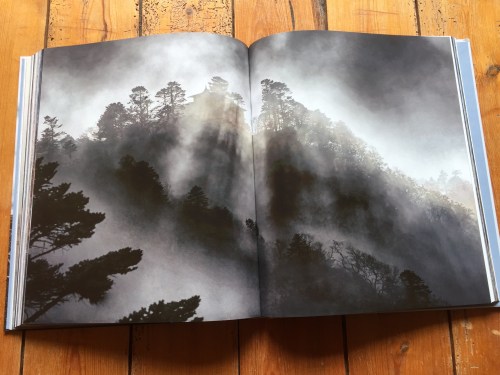
Here are a couple of pages from the book which give you a flavour of why it entrances me –

The second word is “bienveillance” which could be translated as “well-meaning” but again, that direct translation doesn’t quite cut it for me. It is used to cover well-meaning and well-wishing, but also kindness, gentleness and care. So, another set of values and behaviours I really rate and aspire to every day.

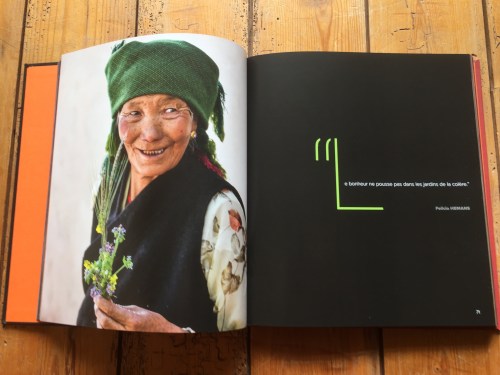
Here a couple of pages from that book which might stir the same feelings in you. If they do, then, yet again, a picture will have proven to be worth a thousand words.

That quote in the middle image is from the poet Felicia Herman and it translates as “Happiness doesn’t grow in the gardens of anger”, which is an interesting line to consider in these days of conflict and polarisation.

Read Full Post »

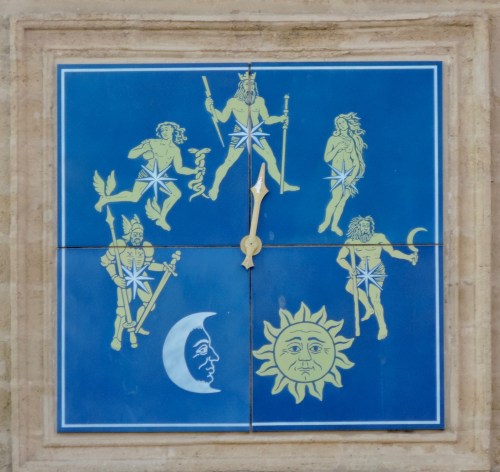
I remember how surprised I was to discover how the days of the week share a naming tradition across many languages. The key to understanding the links is to see how each language attributes the same planets to the same days.

Starting with Sunday, the sequence is the Sun, the Moon, Mars, Mercury, Jupiter, Venus, and Saturn. It’s consistent across many, many languages. Learning a little about the symbolism and mythology of each of the planets allows us to create a rich daily experience with a different theme, or focus, for each day of the week. Try it for yourself. Get yourself a notebook or diary and pick a theme related to each planet and note the themes for each day, then return to that theme throughout that day and see how it colours your experience.

I have since felt quite frustrated that the same principle can’t be applied to the months of the year. Not only are the names of the months not shared through the various languages of the world, but the European model isn’t even based on a consistent naming system. Some of the months are named after Gods, like March, named after Mars, some are named after Roman Caesars, like July and August, and others just get a number, as we see in October through to December. I don’t like it! It feels clumsy and inconsistent. Especially in the light of the names of the days.

I’ve looked around but haven’t found any alternative naming system. What was I looking for? Well, a set of names which had symbolic or mythical meanings, as we have with the days of the week, so that I could play with the themes each month which related to those symbols.

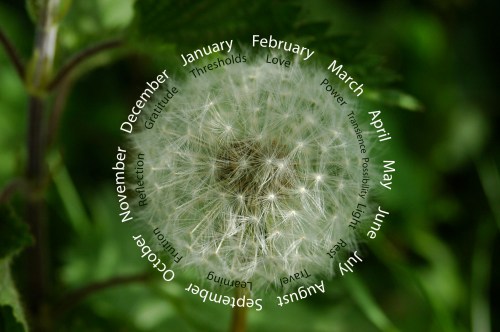
So I came up with my own set of themes, one for each month of the year. Here they are, each one with a sentence or two to explain why I came up the particular theme for the specific month.

January is the start of the new calendar year. It’s named after Janus who faced both forwards and backwards, and can be symbolically represented by a gate. At a gate, we stand on a threshold, about to step from one place to another. January is like this. It’s the time of taking an overview of the year, of starting a new calendar, a new diary, a new journal. It’s a time of reflections and resolutions, looking back at the year just finished and forward to the one beginning.

February has Valentine’s Day right in the middle, but why restrict this loving theme to only one day? How about making February the month of acts of loving kindness?

March is named after Mars, the God of War, or, perhaps more positively, of strength and power. This would be a good month to pay attention to your personal autonomy and your strengths. Maybe a good time to explore the “Signature Strengths” of the Positive Psychologists.

April is the month of the tree blossoms. In Japan, it’s the month of the annual appearance of the Cherry Blossom. This month is a month to celebrate transience. As we celebrate the beauty and uniqueness of transient blossoms, we become aware of the transience of everything in life, not something to fear, but something which enhances our appreciation of every moment. It’s a time to celebrate and enjoy what we have for just a short time.

May is the month of the flowering buds. It’s a time when Nature reveals some of her potential. Make this the month you do that too. Make May the time to wonder about what may come to pass, to imagine how things in your life can flourish.

June is the month of midsummer. The month with the longest day. This can be the month to celebrate the light.

July is the beginning of the second half of the year and for many, is the beginning of the holiday season. This is a month to consider rest. A time to take a break, to pause, relax, and take it easy for a while.

August is “Le Grand Depart” in France, the month when everyone sets off to have a holiday somewhere. To get there, they have to travel. It’s good to enjoy your home, but it’s also good to broaden your outlook by travelling and discovering other places.

September tends to be the start of the academic year. Schools, colleges, universities begin their year here. But you don’t need to be a student to learn. We can all learn throughout our whole lives. What would you like to learn this year? Are there any courses you’d like to take? This is the month to plan and begin new skills and new knowledge.

October is a month of berries. It’s a time of fruition. Maybe this is a good month to celebrate that aspect of life? A time to enjoy what’s come to fruition. A time of congratulation.

November can be a time to reflect as the year draws towards its end. This reflection can be on any, or all, aspects of your life. How is your year going? How are you?

December is the month for gratitude and giving. What are you grateful for, and how could you give to others?

Read Full Post »

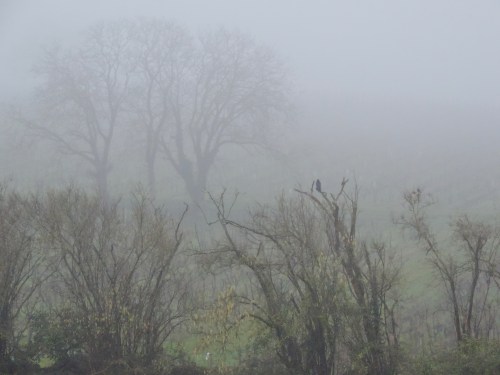
I don’t deny there is a beauty in fog.

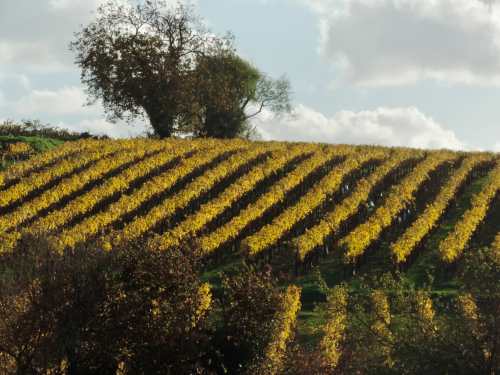
But when I looked out the window this morning and saw that the vineyard covered hillside had disappeared, the word “obscured” popped into my head.

Fog “obscures”. It prevents us from seeing the world so clearly. It draws the horizon closer, sets a nearer limit to our perception.

Well, with that in mind, I spotted an article in Wired magazine……”To fight disinformation we need to weaponise the truth

Through social media, mainstream media and mass media, we are being manipulated on a daily basis. We are bombarded with propaganda and advertising, trying to get us to think what someone else wants us to think, to buy what someone else wants us to buy, to believe what someone else wants us to believe, to vote they way someone else wants us to vote.

When I started this blog over a decade ago I chose the title “Heroes not Zombies” because I had an idea that we tend to drift through life on autopilot, but that if we wake up, become aware, and claim the authorship of our own stories, then we become the heroes of our own stories. But, of course, it’s not just that we drift along on autopilot, it’s that we allow others to sit in the driving seat.

So, here, in that Wired article, is a wake up call, but also a kind of education. The author explains how we are being manipulated.

Cybersecurity researcher Ben Nimmo describes Russia’s approach in terms of the “4Ds”: dismiss critics, distort facts, distract from other issues, dismay the audiences. And indeed Russia has been leading the way in using disinformation-based warfare against other nations. But others are now joining them.

The article is worth reading but I thought I’d summarise the 4 “Ds” here. Just so they are nice and clear. Just so that I don’t forget them.

  • DISMISS critics
  • DISTORT facts
  • DISTRACT from other issues
  • DISMAY audiences

So, as you browse through your timelines on your social media accounts today, or read the headlines on the front pages of the newspapers, or watch the news on TV, why not write these four words down on a post-it and see what the messages you are reading look like in the light of the 4Ds?

Read Full Post »

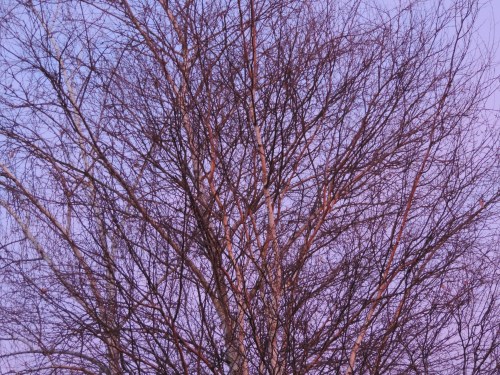
I was out looking at a particularly spectacular sunset the other evening then I turned around to look in the opposite direction and saw the birch tree at the other end of the garden.

Look at the colour of it!

Yes, the colour of the sky is pretty gorgeous too, but look how the normally almost black and white birch tree has turn shades of pink and violet.

If you’ve been reading my posts for a while you’ll know it’s pretty common for me to have two main streams of experience in relation to my photos. The first stream is beauty. I just love this for itself. It’s what someone might describe as “uncommonly beautiful” because it’s beautiful AND it doesn’t look like this on most days. When I see something like this, it stops me in my tracks. I had turned around to head back into the house but I stopped walking when I saw this, took a photo, then stood for a while just admiring what I was looking at. It seemed to me that this part of the world had momentarily been transformed by a Celestial Painter. I think what I’m trying to say here is that sometimes I am entranced by the beauty of the world I live in. Not just that I’m in admiration of it, or even that I’m having one of those moments of “emérveillement” that I keep mentioning here. I am “entranced” by it. It’s beauty like this, moments like these, which re-enchant the world for me, and I think that’s something we could all do with – more experiences of enchantment.

The second stream starts up when I’m at my computer, looking through the photographs I’ve taken. Slowly. When I got to this one I had the following thought-stream start up –

You know that phrase “seeing the world in a new light”? Well, usually it’s used when we have a new insight, a different, deeper, understanding of something or someone. But this literally looks like “the world in a new light”! So what? Well, when we have an insight, or a revelation, a lot changes. Not only does the world seem different now, but we are changed too. We’ve changed our perspective perhaps, or we’ve changed our opinions, our beliefs or even our values? Maybe not changed them from something into something else, but changed them in their intensity, their prominence, their power.

The truth is the world is in a new light every day. There’s been much talk these last few days about this being the beginning of a New Year, 2020, and the beginning of a new decade. I wonder if it feels like that to you? I do have a heightened sense of change underway….change in me as well as change in the world.

Isn’t this reality?

That today is a day which has never occurred before. That today is a day you are going to experience for the very first time. That today is a day which will never be repeated (Groundhog Day being a fiction). I think it’s very, very easy to forget that. When we get caught up in the “stuff” inside our heads, the repeat loops of ruminations and fears, we just don’t see reality any more.

Our internal fantasies mask our lived realities.

So, sometimes we need something remarkable to happen. I like that word, “remarkable” – something which induces comment, inspires us to make a “remark”, to pause, to reflect, and then to share that experience with others. Something which prods us into noticing.

Look! This is new! You haven’t been here before, in this very place at this particular moment. Savour it. Enjoy it. Then reflect.

The world looks different in the light of awareness.

Read Full Post »

« Newer Posts - Older Posts »