Feeds:
Posts
Comments

Archive for the ‘personal growth’ Category

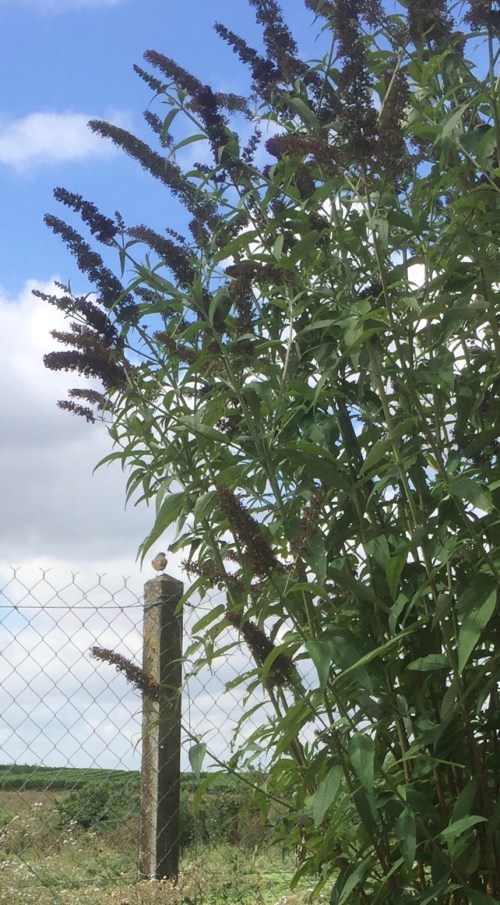
See this little bird? She’s a redstart. There are a pair of them who spend a lot of time in my garden in the summer months. I first spotted a male a few years back and was struck by his distinctive call. I even got to imitating it and “having some conversations with him” – well, I know, that’s pushing it a bit far. I’ve no idea what he was telling me and I suspect he had no idea what I was telling him. After all, I’m not even sure, myself, what I was telling him! He disappeared over the winter and then reappeared the falling Spring. I heard him before I saw him, and I had a hunch he recognised me.

Can wild birds recognise individual human beings? I read a report of a study recently which suggests that they can. I can’t say that surprised me. I have a strong feeling that we have become familiar to each other.

Since then he’s come back every summer and this summer, in particular, his partner has been about a lot too. I find that pretty much any time I go out into the garden to sit and read, that within a few minutes one of the pair, or occasionally, both of them, turn up nearby, watch me for a bit, then hop down onto the grass, getting ever closer, before nabbing a fallen mulberry or something and flying off.

This photo here is a rare success. As I sat with my book I noticed her on the fence post and slid my phone from my pocket to grab a quick shot. Then she flew off.

Now, I have no idea how much of this is my imagination but I do get a good feeling when one of these little birds comes to join me for a few minutes. And that got me thinking about the importance of relationships in life. How important it is for us to form and experience bonds, not just with other people, but with other living creatures, whether they be birds, trees or flowers!

I think these bonds we form have a special quality. They enhance life, they add flavour to the ordinary day, they “enchant” us. Literally. So how do they come about? Well, I’ve got a theory.

They come about through a particular kind of attention – “Positive Intention Attention” (PIA) – I think when we pay attention with positive intent that we create bonds, bonds of mutual benefit, “integrated bonds”, healthy, life-sustaining, life-enhancing bonds. That’s what I mean by “positive intent” – an intention to create bonds of mutual benefit.

So, I’ve decided that’s what I want to do more of, every day – pay Positive Intention Attention to the experiences, events and phenomena of the every day – and, by doing that, I have a hunch, the every day will become just that bit more extra-ordinary…..


Read Full Post »

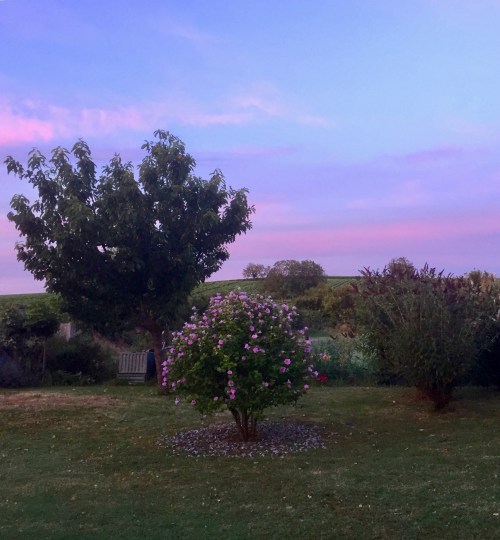
This morning, at dawn, the clouds in the sky turned pink….a pink echoed in the flowers of this bush in the garden.

Pleasing, isn’t it?

It got me thinking about how often we come across this in life…..where there are resonances, where one phenomenon seems so “in tune” with another. When we encounter them I think we stumble across what is Beautiful, Good, and True. It thrills the mind, delights the heart, and enlivens the body.

Think for a moment about how we function, we human beings. There are so many individual cells within our body that nobody can count them. Billions of them. And here’s the amazing thing. They work together all the time. When our body is in a state of good health, all these cells, all our tissues, all our organs and our systems are working in harmony with each other.

Some people say they are “integrated”. What does that mean? I like Dan Siegel‘s definition –

integration is the creation of mutually beneficial bonds between well differentiated parts.

Notice the two elements of that definition.

“Mutually beneficial bonds”. Isn’t this a fundamental fact of life? We exist in relationship. As does every single cell and part of our being. A particular kind of relationship – a mutually beneficial one. We are perhaps the most social of creatures, wired and genetically determined to form bonds with others. If a newborn baby didn’t do that life wouldn’t last very long. We need the loving attention and care of others from the moment of our very first breath.

The second part of the definition is “well differentiated parts”. Uniqueness and diversity are also facts of life. No two cells are fully identical, not when we consider them in their contexts of time and space. We don’t develop healthy hearts and minds by making all the heart cells and brain cells the same. We need them to be different. But we need them to work in harmony with each other. Not in competition with each other.

When we live in harmony with others and with the rest of the planet I suspect we give ourselves the best possible chance of health and thriving. In fact, is this not the origin of “dis-ease”? Where we fall out of harmony with ourselves and our world? Maybe we need more emphasis on resonance and harmony, and less on competition and individualism…..


Read Full Post »

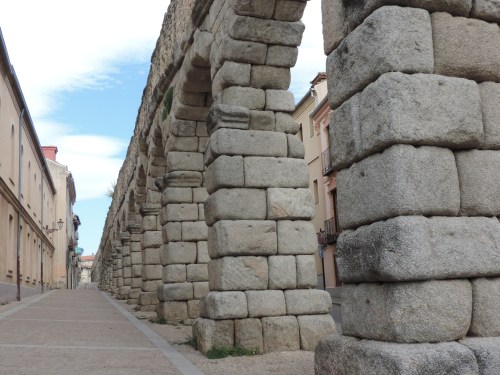
One of my most favourite cities is Segovia, in Spain. Perhaps its most striking feature is the Roman aqueduct. It begins as a pretty average sized wall, then column by column, arch by arch it gets bigger and bigger and bigger, straddling the town below until it reaches the old castle.

In this first part houses have been built on each side of it. I don’t think I’ve ever come across such an astonishing structure running right down the middle a street!
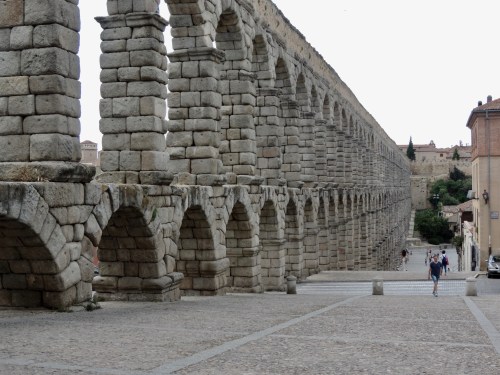
One of the first of the town’s squares lies at the foot of the aqueduct just as it reaches its greatest height.
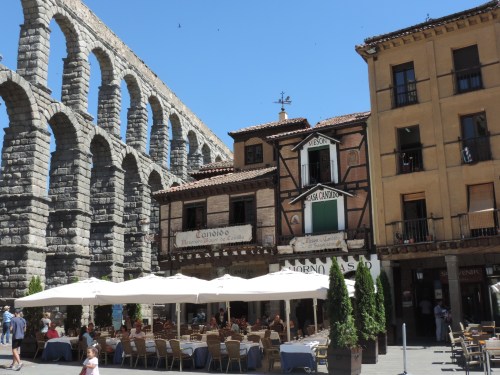
I find this SO inspiring! Here’s what it got me thinking last time I was there…..

Throughout my career as a doctor I saw time as linear. Perhaps because the second half of my working life was in a specialist centre for people with chronic (long term) conditions, I commonly heard patients tell me of the traumas which they had experienced prior to becoming unwell.

I was never someone who bought into a mechanical, linear view of human beings, or of life. Every patient I met convinced me that all these chronic ailments are multi-factorial. You could never say that “this” caused “all that”. But there was one question I frequently found revelatory.

“When were you last completely well?”

Sounds an easy question, huh? But, actually, it was often difficult, and took some time and conversation to find the time, perhaps even several decades ago, when the patient last felt completely well. I’d then ask about the year the patient moved from wellness to illness.

“Tell me about that year”.

It was often a year of significant trauma, or the culmination of many traumas. I don’t think that meant that the patient’s illness could all be attributed to that trauma, but it was a starting point in making sense of their experience and beginning to find the way forward.

Sometimes patients were clearly stuck with these unresolved hurts. Again and again they’d think about those times, feel bad about them all over again. Others were so traumatised that they were living lives of fear, continually looking ahead and wondering “what if….?” “what might happen?” “how will I cope if….?” and things like that.

In both of these scenarios I’d draw a straight line – and say, the left hand point of this line is your date of birth, the right hand, the date of your death. We know the first, and have no way of knowing the second. But right now, today, you are somewhere along that line. Where is your attention? Where is your focus? Because if it’s to the left of today, it’s in the past, and that doesn’t exist any more, except in your memory. If it’s to the right, it’s in the future, and that only exists in your imagination. You can’t have your attention in more than one place at a time, so what if you draw your attention into the present instead? How might that feel? And we’d then explore ways of living more in the present reality, than in the past traumas and future fears.

I think it was often helpful, but now it seems somewhat simplistic to me. Because I now see time is not as linear as I thought. In fact, seeing cycles and seasons of time makes rather more sense to me now. As I experience a place like Segovia I realise that the past doesn’t go away. It doesn’t disappear into memory. (and memory is not an artificial place anyway….it’s no dusty filing cabinet with the drawers all locked)

Rather the past is always present, always here, and always now. It fashions our every day. It colours our every experience. It sets the tone of today. It constantly challenges us to respond to it, to adapt. In fact, that’s how we learn isn’t it? By having an awareness of the past in the present? If we forgot and discarded everything we experienced how could we learn anything? We adapt by carrying with us the past into the present.

And although this is even more challenging, the future is here now too. Not least because the future is, in one sense, a “multiplicity of singularities” – a set of possible paths, which are, at least in part, fashioned by this present moment, and by each and every decision and action.

I don’t think the past goes away. I don’t think the old “time heals” is true in the sense that it makes the past go away. Instead I think we learn to adapt to it. When we become aware of the past in our everyday we have the opportunities to create new responses, new strategies of living under it’s influence.

OK, so, this is not where I thought this post would go when I pasted in those photos of the aqueduct! But here’s a related thought – how does the presence of the past in today, as we see in this colossal aqueduct stretching over Segovia, shape, fashion, influence, inspire, challenge, stimulate the thoughts, feelings and actions of the people living there?

And so, of course, even when the past isn’t as obvious as this aqueduct, how does it’s presence today influence our experience of today?

Here’s the final part of that story – we don’t heal just by shifting our focus, we heal by becoming aware, aware of the past AND the future IN this present day, and realising we can change how we respond to that. Realising our current patterns aren’t fixed. We can alter them.

Read Full Post »
There’s a very human tendency to view ourselves as outside the world. What I mean is that we feel we are IN the world, but we remain APART from it. We are dualists. We think “there’s me” and “there’s the world”.

How did we get here? Just parachuted into it? Dropped down from outer space? We talk about “Nature” or the “the natural world” as if that’s something other than ourselves. As if it’s a place we can visit, and then leave again.

But that’s all a sort of delusion, isn’t it?

There is no “me” separate from “the world” or from “Nature”. We didn’t land on Earth from an alternate universe, we emerged within it, live within it, die within it. There is nowhere else. (Or if there is, we have no way of knowing that)

Yet, this sort of division persists, doesn’t it?

In fact, it seems this is a crucial and necessary part of being human. Our brain has evolved the ability to create what some call, “a necessary distance” between the flows of energy, information and materials pouring through ourselves and the planet we live on.

We are great pattern spotters, we humans. We see patterns, analyse them, name them, categorise and label them, then we can re-cognise them very quickly. We create maps in our minds. We create a “you map”, a “me map” and a “we map”, as Dan Siegel says in “Mindsight”. These maps contribute greatly to our sense of self, as well helping us to recognise others and develop confidence and belief in our relationships.

Our linguistic abilities are used to create the names and labels and to think about whatever we are applying them to, as well as enabling us to communicate about them. We use words, symbols and metaphors to take these processes of analysis and recognition to whole new levels. These are some of our super-powers as humans. They enable us to literally, and metaphorically, grasp the world in which we live.

To do all those things requires us to step back from the flow of experience. We use this “necessary distance” to momentarily step aside, to enable us to see more clearly, understand more deeply. With this comes this sense that we are “apart”. That there is “me” and “The Other”. When, in reality, there is only ONE, and we live inextricably IN the flux and the flow.

I don’t like judgements. They stop thought. But we need them. It’s just we need to be able to let them go more easily than we make them as our understanding deepens, as we see more and more connections, envisage the contexts in which whatever we are examining exists.

So, it’s interesting to me, to take the old school philosophical spiritual practice of “the view from on high”, literally from time to time. To climb up somewhere, to take the time to gaze towards the horizons, to see the landscape unfolding in front of me. To see the “bigger picture”.

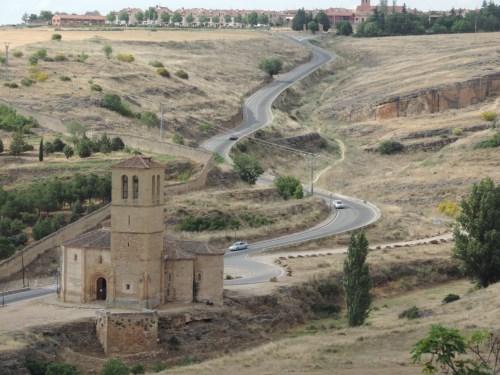
This photo is one I took the other day when standing outside the Alcazar in Segovia. I’m pretty sure that what caught my eye was the church. It seems to stand alone. Almost in the middle of nowhere. But as I framed the shot my eye was led from the church to the winding road which my mind then followed to the top of the hill. Up on the ridge I could see buildings. A lot of buildings. So not a church in the middle of nowhere at all. But still, a church set apart somehow. The curve of the road was immediately appealing and I made sure I included it in the camera frame.

Now that I look at this image I see, yes, the church, that physical symbol of the spiritual connected to the village at the top of the hill by a winding, beautifully curving road. You could argue the road leads to the church. Or you could see the road as leading from the church to the town where people live. In other words, you can see the church, the town AND the connection all at once. I find that immensely pleasing.

I don’t know if that will get you thinking about the place of the spiritual in human life. It might. Or maybe it will get you thinking about connections, contexts and the illusions of separateness?

Ah, before I go, one other thing……see the wall someone has built just to the left of the church and the road? Someone has claimed this piece of the Earth as their own and built a wall around it to strengthen their feeling of separateness. Most people live in the village on the ridge, or so it seems to me. Not many live behind the wall.

Oh yes, walls again. We are hearing a lot about them these days. Both literal walls, to separate Americans from Mexicans, or Palestinians from Israelis, and the toxic and divisive “US AND THEM” walls which divide “natives” from “immigrants”.

But it’s all one world, huh? We share the same planet, the same air, the same water, the same place in the evolutionary path of Life.

It’s a bit of a challenge isn’t it? To see differences and separations but to see them as inextricably connected in a bigger picture.

Read Full Post »

I’ve recently realised I have a dual speed approach to photography.

First of all, something catches my eye and I stop to take a photograph. Normally, I don’t spend long over this part. I see something. I stop in my tracks. I get my camera or phone out of my bag, frame the shot, and click. Photo taken. That’s the fast part.

Secondly, I upload all the photos I’ve taken that day, or that week, onto my computer. Then I make a first pass, deleting the ones which are just awful, and adjusting others, cropping, straightening, lightening, deepening…whatever seems to need done. That takes time. It’s the first phase of the slow part. As I do that, certain images strike me more than others do, and I mark them as “favourites”.

Thirdly, and this might happen, days or even weeks afterwards, I browse through them, or find myself searching out a particular photo because I’ve been thinking about something and that image has come to the front of my mind. I pick out the one I’m looking for, or I pick one that strikes me in that moment, and begin the fourth stage.

Fourthly, I upload the photo to my wordpress account and paste it into a new post. Then I take my time to look at it more closely and write what thoughts arise. This is the final slow part.

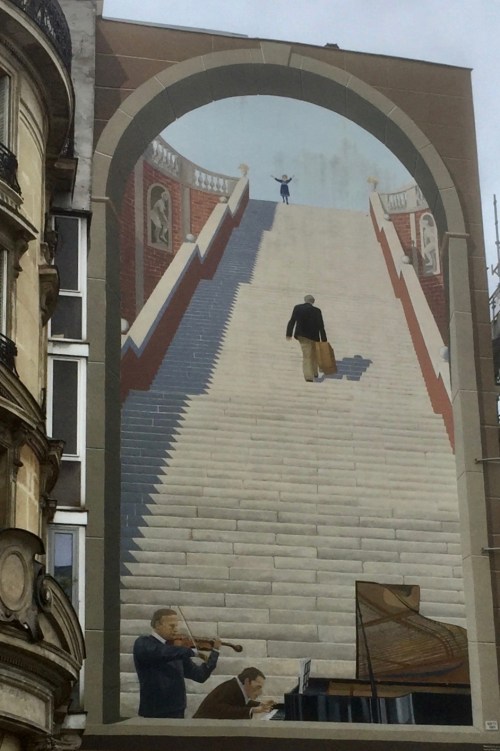
Here’s an example. I was in Paris for a few days a couple of weeks ago and one of the days as I was crossing a road I noticed this huge mural above the shops. I stopped (deciding not to cross with the green man yet!), took out my camera, framed the shot and clicked, then I continued on my way. Once I returned home I uploaded all the photos and when I saw this one I cropped it a bit to focus on the artwork itself. Then I inserted it into this post. The thoughts which have arisen included what I’ve just written about the dual speed nature of my photography, which, strangely, are a set of thoughts about thinking about this photo…..a kind of meta-view……an overview, if you like. Then I returned to the image itself.

This image intrigues me. It’s a huge flight of stairs. I was exploring Paris at the time and that always involves a LOT of walking and a LOT of stairs if you use the metro. I checked my phone and it told me I’d climbed 14 flights of stairs that day! Wow! In that sense, this image was a great motif – this is what a visit to Paris entails – lots of steps! By the way, have you ever climbed the steps up to Sacre Coeur? That’s quite a climb. Or made your way up the crowded Spanish Steps in Rome? Or have you climbed any of the long stairways in Edinburgh up to the Old Town? (You’ll have figured out by now I’m remembering some of the long stairways I’ve climbed. I could add a lot more, but I’ll leave you to add your own).

I’m of a certain age, so a particular piece of music pops into my mind at this point. Yep, Led Zeppelin, ‘Stairway to Heaven’.

And then I return to the image…..

Could the musicians be playing ‘Stairway to Heaven’? If not, what might they be playing?

What other characters are in this mural? There’s a young girl at the top. She’s looking pretty happy and welcoming, and there’s the central character, the man with the suitcase. I realise I’ve immediately identified with the man with the suitcase. Isn’t that something we do quite a lot? Identify with the hero? The central character in the story? Isn’t that how we make sense of our lives actually? Telling ourselves the stories where we are both the author and the main character? Which gets me wondering about the stories we tell. Maybe the man’s suitcase is full of stories? Maybe he’ll be telling some of them to his child (that is his child at the top isn’t it?) once he gets to the top. I suppose there are a lot of life stories about uphill struggles. And lots which are about things “all going downhill” too!

One of my greatest joys throughout my working life was to hear people’s stories, the stories of the patients who came to see me. I never heard too many. Maybe I could even say I never heard enough of them? I loved to sit and listen to them.

Hey, the other night there I watched the movie “Hector and the Search for Happiness“. Seen it? I recommend it. I laughed! And it’s gently thought provoking too. Well, one of the lines in that movie is “Listening is loving”. I liked that line.

I get the feeling that this man is coming home, don’t you? The girl looks like she’s gesturing “welcome back!”

But wait, there are two other characters in the image. Near the top of the stairs there are two statues, both of which seem to have just come to life, and are about to step out from their little platforms. Doesn’t it look like that? I mean, they could just be two statues, each captured in an action pose, but I don’t get that impression. It looks like they are starting to move. Are these two goddesses? If they are, then what are they about to bring into this man’s life, into his story?

What do you think?

……well, this is what I mean by dual speed photography – from noticing to contemplating.

I recommend it.


Read Full Post »

We’ve had a very hot, dry spell recently here in the Charente. Temperatures rising to the mid or high 30s (centigrade) each day which made the leaves of the plants curl up and wilt. Then this last week we’ve had rain, wind and storms. Yikes! What chance have they got?

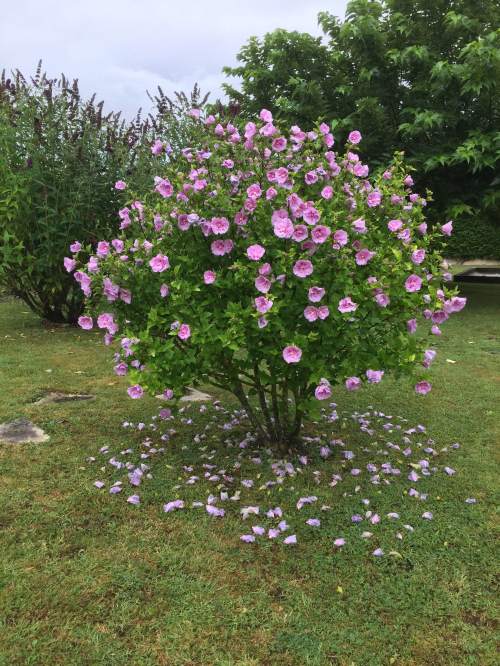
Well, look what all that varied weather has done to this bush in the garden.

First it suddenly bloomed, going from zero flowers to dozens of them over about 48 hours. Then the wind and rain has knocked off more than a few of them.

But when I walked outside yesterday evening and the bush caught my eye I was transfixed.

Just look how beautiful this is! Not just the bush itself but the way the fallen flowers have made a pinkish purple circular rug on the grass around it.

This is the kind of beauty which Nature makes.

In “The Great Work”, Thomas Berry talks about the interplay between discipline and wildness…..between order and chaos (or disorder). This is a great example, I think, of the beauty the wildness and disorder brings…..effortlessly.

Read Full Post »

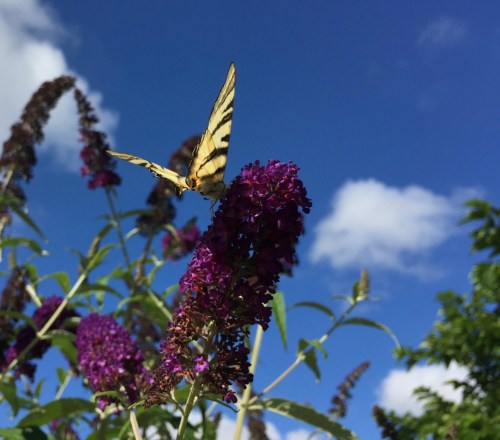
Every year I’m amazed to watch the butterflies appear in the garden the very same day the buddleia bushes flower. I’m convinced they both appear at exactly the same moment. No idea how that happens! Are the butterflies just hanging out around the corner somewhere waiting for the blossoms to appear, then zip round as fast as they can the moment that happens?

However it happens, it’s a delight to see so many varieties of butterfly (and the hummingbird moths, which are incredible creatures!), to watch how they fly in such utterly unpredictable directions, how they spread their wings in the sunlight, or close them up so they look like little leaves.

But here’s one thought which comes up for me time and time again when I see butterflies….they make me more aware of the cyclical nature of life. These little creatures have such different life stages, so different you wouldn’t realise they were stages of the same life. Do we think of them as having a beginning and an end? Starting with an egg, progressing through their caterpillar stages, becoming a chrysalis, then emerging as a butterfly which lays eggs, then dies. Is that the life?

I suppose we do all think of ourselves as having a beginning and an end. But where do we begin, and where do we end?

It depends on whether or not you want to reduce a person to just a physical body. My physical body began with a single fertilised egg and this body will die.

But what about ME?

Do I really think I’m only a physical body? Don’t I have a sense of something immaterial too? A consciousness? A sense of Self? A personality? Characteristics, behaviours, values, beliefs, creative acts, destructive acts? Is there anything I can do which doesn’t ripple out into the world beyond me?

When I look at Rodin’s “The Kiss”, or “The Thinker”, what do I see? The product of the imagination and creative skill of the man called Auguste Rodin. When I listen to music composed and performed by people who are long since dead, isn’t there something I’m sharing there which only they could have created? Aren’t these great works of art the ongoing ripples of unique human beings? Or do you think these are just their footprints? (It doesn’t seem that way to me….these works seem full of life and the potential to continue to create and send out ripples into the universe)

And what about those characteristics, quirks or tendencies that I have which others in my “family tree” also exhibited, even perhaps before I was born? Anyone who explores their genealogy encounters remarkable “coincidences”, talents, life events, behaviours which echo down through the generations. Weren’t those threads present even before the egg which became me even existed?

I think it’s inadequate to narrow a person down to a physical body.

But even if we did, there is still the fact that the body changes continually. It never stops. There is a constant turnover of cells, new beginnings, new endings, every hour of every day. There is a continuous exchange of energy, materials and information between my body and my environment, and we all share the same environment, the same atmosphere, the same air, water…..we are all made from the same molecules, all created from the same “star stuff”.

So it seems to me that beginnings and endings are everywhere……wherever, and whenever, we happen to look.

But it also seems to me that they are nowhere. They just don’t exist. We all emerge from, and dissolve into, the great cycles of the universe.

Beginnings and endings are just where we choose them to be. But we can always make a different choice. We can always take a broader view, a bigger view, a longer view, a more holistic view.

I’m reminded of a song from my school days….it’s by Jeff Beck, and it’s called “Hi Ho Silver Lining” – he sang this truth right there in the opening line of this song…in the first five words……

Read Full Post »

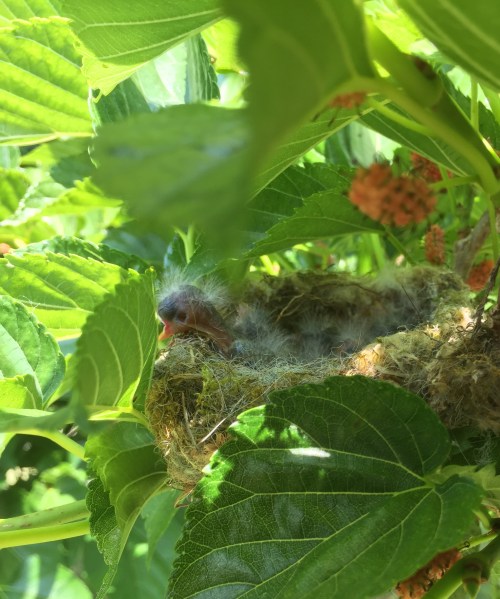
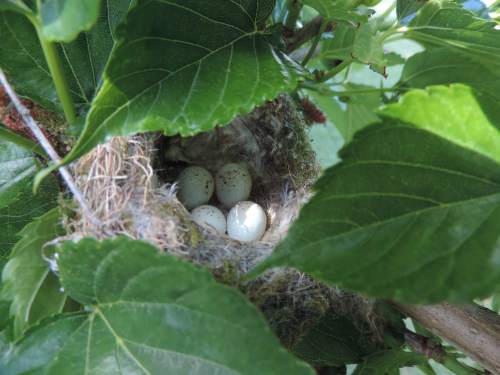
A couple of little finches have built an astonishing little nest almost at the very end of one of the branches of the mulberry tree. The next looks pretty precarious but actually it’s well hidden amongst the leaves and it’s brilliantly woven. Just how do they do that? How do these tiny little birds gather bits and pieces from around the garden and actually weave them into these tight, sturdy nests? I mean how do they manage that with just their beaks? And where do they get their knowledge from? I can’t see that they learn it from any older birds. Is it actually programmed into the DNA sequences of their genes? Really? Isn’t that utterly mind-boggling? I’ve read similar musings about spider webs. Because every single web, and every single nest, is created in a unique circumstance. A new circumstance of time, place, wind, rain, sunshine, heat, cold…..I could go on. So even with a DNA coded programme for web creation, or nest building, each creature has to adapt that knowledge to the present circumstances. Honestly, I’m amazed!

But my amazement doesn’t stop here, because after finding about four little light blue eggs in this nest a wee while back,

Now they’ve all hatched, producing these chicks. What on earth do they look like? This is one of them about a week old. Now, about two weeks old, they are starting to develop feathers. If I understand it correctly, within the next two, or three weeks, they’ll fly. You get that? They will fly! From emergence from the egg to FLYING in about four weeks.

Now, embryology has always fascinated me. Probably my most favourite teacher at Medical School was the professor of anatomy who drew the stages of development of the human embryo on a giant blackboard using a pack of multicoloured chalks. Wow! How impressive was that! Sheer works of art, lecture by lecture. Sadly, we didn’t have mobile phones in those days, so none of us were able to capture those blackboard works. But I do still have them in my memory. Beautiful as they were I still remain utterly astonished that the cells of an embryo can replicate and differentiate and move into entirely the correct places to develop a human being with all the organs, tissues and networks of systems which form the new born child. When I look at this tiny chick I think the same. I think how on earth does the fertilised egg develop this head, this beak, these eyes……and now, the beginning of feathers and wings. And within two weeks from now these chicks will launch out of this nest and fly. How long does it take for a human baby to walk by him or herself? This little bird takes a month from “birth” to flying.

If you don’t find that astonishing and amazing…..well, you do, don’t you?

We take so much of our lives for granted. There’s so much we don’t know and don’t understand. But, can I recommend this?

Take a moment or two to reflect on how one cell (an ovum), joins with one other (a sperm), to become ONE cell which almost immediately becomes two, which become four, then eight, then sixteen……and hour by hour, day by day, a unique creature emerges, with millions and millions of cells, different kinds of cells produced from the original ONE, producing a body, with eyes, a mouth, all the necessary organs……You don’t have to go any further. Just consider any stage along this path and wonder.

Doesn’t it make you feel awe?

Doesn’t it make you feel humble?

Just allow yourself to enjoy that for a moment or two.

It’ll shift your perspective on the world.

Read Full Post »

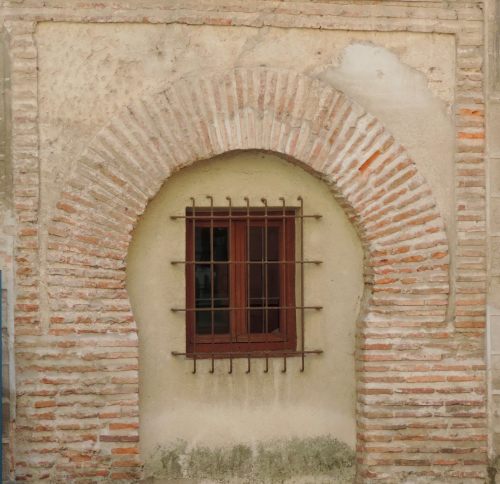
I see this sort of thing a lot when I look at old buildings in either France or Spain. This one is in Segovia.

What’s the first thing you notice?

The window?

Or the window in an arch?

See, when I look at something like this I really get to wondering….how did this come about? Did the original builders build a nice big entrance way, two verticals and a horizontal? Building a frame like a picture frame for an entrance? Maybe not….well, maybe not exactly anyway, because it looks like exactly the same bricks have been used to make the archway and some of the bricks seem to run between the two frames….the square frame and the arched frame. So maybe the original builders built an arched entrance and surrounded the arch with a frame?

But then it looks like somebody decided not to have an entrance there after all and filled in the space.

Then somebody else thought, hey, wait a minute, I’d like a window here and put in the window….but did they fit bars around the window at the same time?

So, has this window, this barred window, emerged over many years from a wall which was built in the space formed by an arched doorway?

And what was the thinking behind each of those steps in the development?

Make an entrance, an attractive, obvious entrance…..then block it up…..then make a window, but not one for letting that much light in, and certainly not one somebody might climb into, or out of…..was that, is that, a problem around here? People climbing in and out of windows?

Bear with me here but because I worked as a doctor for almost forty years this image sparks my thinking about patients and the problems they talked about in the consulting room. They’d bring the equivalent of this window….let’s say they’d talk about a pain (instead of a pane….ha! ha! sorry!)…..and I’d ask about the pain, asking them to describe it….its features, its characteristics, its exact location, what surrounded it, or accompanied it……and then I’d want to know how it arose. Tell me when it wasn’t there. What was there before it? What was happening when it began? And so, gradually, what a first glance might be a simple symptom turned into a unique, never before told, story…..and that’s where I began to understand what the problem might be.

Read Full Post »

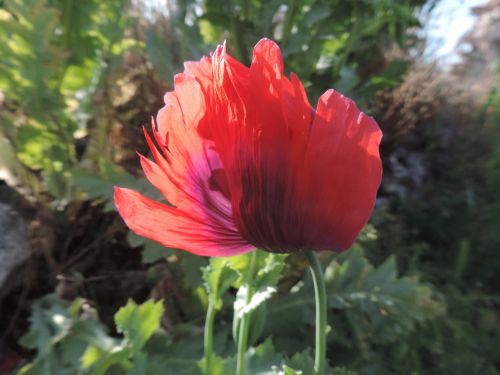
Poppies are such striking flowers. They radiate colour and they pull you towards them to have a closer look, or to take some photos. Their petals are often huge but somehow delicate and fragile, and they don’t last very long.

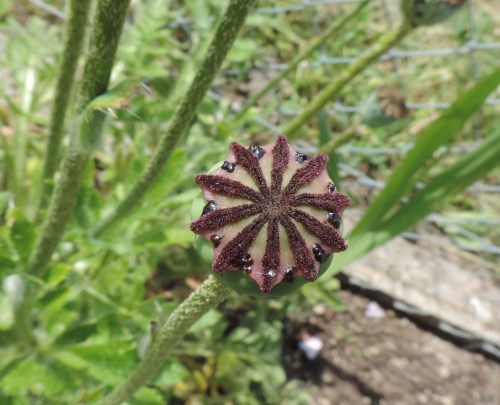
I do adore these flowers, not least because they offer you a second chance to be entranced by them after their petals fall.

Wow! Just look at this! Click on the photo to get a closer look! Isn’t it just a perfect design? A glorious pattern?

It’s like a jewel, isn’t it? Something precious, something valuable, something simply beautiful.

So here’s an impossible question…..what is more beautiful?

The petals of the poppy, or the poppy after they fall?

Read Full Post »

« Newer Posts - Older Posts »