Feeds:
Posts
Comments

Archive for the ‘personal growth’ Category

waterfall

Is time linear? Is it like this waterfall? Does the future rush towards us, the present pour past us in a constant stream, and the past disappear into the far distance carrying the our daily experiences off into the vast oceans of memory?

Or is it more like a tree?

zen garden

Does time accumulate, like the growing sapwood just under the bark, laying down this year’s experiences on top of last years, each and every ring layered over the previous ones?

The forest becoming

Does the present grow out of the past which doesn’t disappear, but which perpetually lies beneath us, our daily experiences emerging from, growing from, all that has occurred before?

Read Full Post »

Mostly we react, but its better when we respond.

What’s the difference?

Reacting is automatic and rapid. Somebody presses one of our buttons and BUZZ out comes the response – anger, indignation, anxiety, hurt, sadness…..you name it. One of the problems with this reaction mode is that we get the feeling other people are constantly pulling all our strings.

It would be great if we felt more in the driving seat, wouldn’t it? To do that, we need to practice responding instead of reacting. What happens in response mode is that somebody presses one of our buttons, we notice it and think, ‘oh, there’s that button getting pressed again’, then in the short pause, we get to choose. What am I going to do about it?

It’s a bit like when the telephone rings. You don’t HAVE to answer it. You have a choice. The experience of exercising that choice, in fact, even the experience of having time to choose, is hugely empowering.

Here’s a simple little technique which lets you begin to change from reactive mode to responsive mode. It’s called “getting neutral” by the “Heartmath” people.

First deliberately move your attention to your heart area. Say, for example, you are speaking to someone on the phone, maybe someone who repeatedly winds you up. They hit one of your buttons but instead of automatically reacting, you say ‘hold on a moment’, put your hand over the receiver, turn your attention to your heart area, and now, take three deep, diaphragmatic breaths. One, two, three. Now return to the conversation.

This is called ‘getting neutral’ because its like when you are driving a car and the brakes fail. You can slip the gear into neutral, breaking the connection between the engine and the car’s wheels, stopping it from speeding out of control.

I’ve taught this method to people who experience panic attacks. Instead of spinning out of control, they turn their attention to their heart area, take three diaphragmatic breaths, and the panic stops.

It might not work every time, but one of the great things about it, apart from its simplicity and easiness, is that it gets more powerful and useful the more it is practised.


Read Full Post »

In the A to Z of Becoming, the second verb is “breathe”.

You might think, ‘well that’s easy, I do that all the time!’ But I don’t mean automatic, unaware breathing. I mean the kind of breathing we choose to do.

Think of these two different kinds of breathing – primarily using the muscles of your chest, or primarily using your diaphragm. It’s this latter form of breathing which I’m going to focus on this week. Diaphragmatic breaths tend to slower, deeper and fuller than the more automatic chest muscle form. These deeper, fuller breaths change the balance of oxygen, and carbon dioxide in our lungs, and so affects the balance of chemicals in the blood. This has far ranging effects on your body, and your mind.

Here are two simple suggestions.

First, awareness of the breath. At any moment, in any place, turn your attention to your breathing. Without trying to change anything, see if you can just notice how you are breathing. How fast is your breathing? How regular? How deep?

Secondly, take three diaphragmatic breaths. Fill your lungs by breathing in as much as you can breathe in. Now breathe out, slowly, evenly, and as completely as you can. Once you have completed this out breath, breathe in again, again completely filling your lungs. Breathe out, slowly, evenly and completely a second time. And now do the same again a third time, once more filling your lungs to the top, and slowly, evenly breathing out to empty them.

Notice how you feel. How does your body feel? How does your mind feel?

Read Full Post »

jupiter over ben ledi


When I looked out of the window this morning I saw a bright star shining over Ben Ledi.

My Starwalk app tells me that what I was looking at was Jupiter, and it was sitting smack in the middle of the constellation Gemini. It was too light to see any of the constellation but you can see how easy it was to see Jupiter.

There’s a saying in French about taking a view from on high (vue d’en haut). The meaning is pretty clear. When you think what it is like to look out over a land or seascape from a cliff or hilltop, you get the idea. In other words, its about taking an overview, seeing the bigger picture, seeing things in their context.

Iain McGilchrist describes how the left and right hemispheres approach the world differently. The left tends to focus in on things. It’s like using a telescope or microscope. It’s great for seeing the details and analysing them. It’s a kind of digital approach. The right however gets first claim on all the information flowing into the brain. It takes the overview, the more holistic, analogue approach. In some ways, you could say our right hemisphere is well designed to allow the view from on high.

The French take a variation of the view from on high, and include the concept in the expanded one of a “view from Sirius”. Sirius is the brightest star in the sky (the planets might look brighter but they aren’t actually stars).In 1752, Voltaire wrote a story entitled “Micromegas” about a giant from Sirius traveling across the universe and coming to Earth to have a look around. Not only does the view from Sirius include the idea of an overview, but it also captures the idea of everything being seen or experienced for the first time. When you travel to a new land, the everyday reality can seem strange and new, and stimulates your curiosity.

So, when I look out and I see the bright shining Jupiter over Ben Ledi, it sets off my thoughts about taking the “view from Sirius” and takes me into the day with a sense of wonder, of open-ness, and of being able to see the bigger pictures.

Taking a look from higher than Ben Ledi, but not as high as Jupiter or Sirius shows us just how thin the biosphere is…..its a pretty thin layer in the scheme of things!

biosphere


Read Full Post »

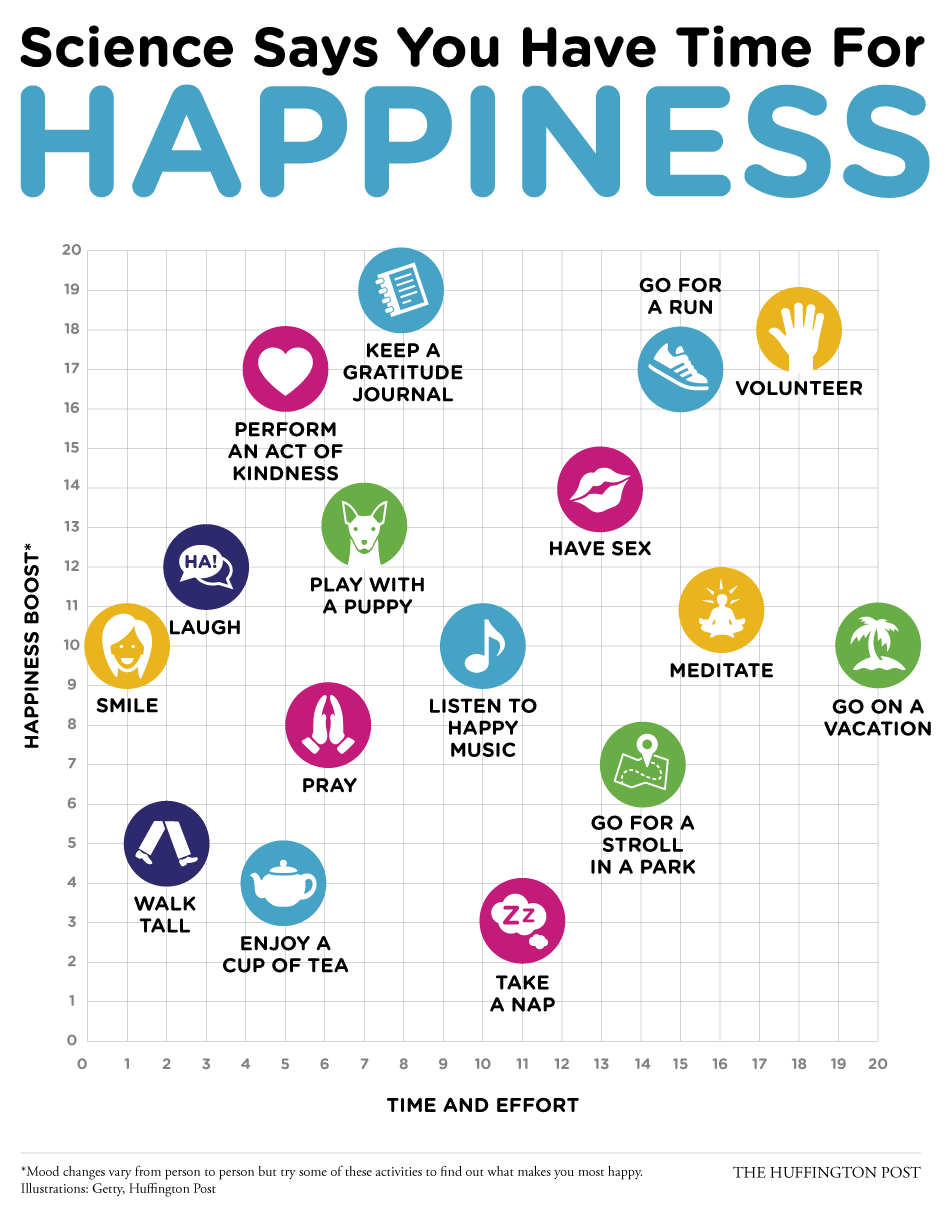
I’ve read a lot of books about happiness, but this little article on the Huffington Post really caught my attention with this simple and useful infographic. Click through on the link to the Huffington Post in that sentence to find the links to the studies backing the creation of this image.

2013_HappinessMatrix

Nice, huh?

Good to see how you can easily boost happiness simply by smiling (warning: the smiles have to be authentic – artificial smiles don’t work!) And I am really struck by the power of gratitude, and by performing acts of kindness.

So, how about just taking those three, and trying them out for the next few days. Start a gratitude journal and write in once a day, maybe preferably at night before bedtime……just list, and write a sentence or two about, whatever you experienced today that you feel grateful for, or write about who you are grateful to, and why. Set out each day to perform at least one act of kindness, or, even better, see if you can speak kindly and act kindly all day long. Finally, play some music which makes you smile, or look at some photos which make you smile, or delve into your memory banks for moments in your life which made you smile.

Read Full Post »

Did you read “Stoner”, by John Williams last year? It’s been quite a phenomenon in the UK, having sold precious few copies in the author’s lifetime, then suddenly becoming a bestseller with rave reviews here this year.

I liked it. A lot. But let me just share with you a couple of wee passages which describe how the main character, Stoner, comes to think of love as he gets older. Firstly,

…he began to know it was neither a state of grace nor an illusion; he saw it as a human act of becoming, a condition that was invented and modified moment by moment and day by day, by the will and the intelligence and the heart

and, also

….that the person one loves at first is not the person one loves at last, and that love is not an end but a process through which one person attempts to know another.

Well, I’m sure if you’re a regular reader here, you’ll know why that first passage grabbed me – “a human act of becoming….” and I especially like the thought that love changes all the time, and that the will, the intelligence and the heart are all involved in creating that change.

Then, well, how wonderful….to describe love as a “process through which one person attempts to know another”. I do think that is so often forgotten….that love isn’t just a feeling or a state, but it is an ongoing act of trying to know another. Funnily enough, that makes me think of my verb of the week – attend, particularly, with regard to the latin origin of ‘attend’ being about a reaching or stretching out towards….

Read Full Post »

Over the course of the next six months, I’m going to share with you some thoughts on 26 verbs….one per week. Each verb is an action. Each of these actions will support your process of becoming as fully YOU as you can be. I believe that’s why we are here – to develop and manifest the uniqueness of who we are. Every single one of us is an utterly unique expression of the universe. There is no other, has been no other, will be no other, expression of the universe with the same uniqueness as YOU.

This is a life process, and its a process of becoming. It’s not a process with a fixed end point, and we never quite know how it’s all going to go but I’m working from the core belief that every day I can contribute to this process of becoming by choosing how to live, by choosing which actions to take.

So, let’s start with A.

My A verb is ATTEND.

Let’s think about some of the meanings of the verb, attend.

  1. to be present at
  2. to go with, or accompany
  3. to take care of
  4. to wait upon
  5. to watch over, or look after
  6. to listen to, or give heed to
  7. to wait for or expect.

The English word, attend, comes from the 14th century French, “attendre”, meaning “to direct one’s mind or energies”, “to wait for, pay attention”, and from the Latin, “attendere” which literally means “to stretch toward” (or “give heed to”)

So, what are you choosing to be present with today? What, or who, are you choosing to be with, to accompany?

What, or who, are you taking care of, looking after, listening to, or giving heed to?

What are you waiting for, or what do you expect of today? What are you “stretching toward”, reaching out to?

Attending to something involves paying it attention, and it seems to be that whatever we pay attention to gets bigger. The more we think about a particular issue, the more that issue looms large in our minds. Attending to, in that sense, is a bit like a magnifying glass.
Attend

Lotus root and yen

So, when we attend to something, or someone, today, whether that be our thoughts or feelings, or objects, people, activities……whatever it is will grow.

What do we want to grow? Which thoughts, which feelings? Who, or what, do we want to nurture?

I’m only going to share one verb a week, and I’m going to explore that verb every day for a week (that doesn’t mean I’ll write about it here every day, mind you!) I invite you to share this with me. I’m inviting you to explore these verbs with me and share as much of your exploration as you want, in whatever way you want…..comments, your own blog, Facebook, tweets, instagrams…..whatever works for you.

This is an invitation to participate in becoming more truly, more fully YOU.


Read Full Post »

Where did 2013 go?
Where does the past go?
Does it go anywhere?
Is time like this long road?

DSC_0167.JPG

Was 2013 like a car, making its way along time’s highway? And disappearing into the far distance as we look?

That’s one way to look at it, but then look at this tree….

DSC_0062

The very shape of the tree tells a story, contains a history, reveals its past. Doesn’t it?

So what if time isn’t like a straight line, with the future speeding towards us, and the past soon behind us and out of sight?

What if time is cumulative? What if the past doesn’t go away anywhere, but instead continues to exist underneath the present?

Doesn’t the present emerge from an ongoing interaction between what’s possible, what’s happened already, and what else is happening now?

Think of 2013 as still here, underneath today, and out of which 2014 will grow. After all, if 2013 wasn’t still here, then what would 2014 emerge from? Nothingness?

Read Full Post »

Japanese Garden

January is named after Janus – who looks both forwards and backwards. Janus is often represented over a gateway or doorway, and it strikes me that January is a kind of doorway. We say goodbye to the previous year, looking back, reflecting, remembering, and using that recall to inform our hopes, ideas, and even plans for the coming year.
I don’t think this is something to do just on the 1st, or even in the first few days (by the way, I read a study today which said 26% of men give up diets after ONE DAY!), but that we could take a theme for this month – make this the theme of gateways, of doorways, a moment to pause, reflect and dream – both of those entwined, letting reflections stimulate dreams, and dreams stimulate reflections.
This is different from making resolutions (even sustainable ones!).
Why not get yourself a notebook, or create a new document on your computer or tablet, and allow yourself to record your daily reflections and dreams for the month? See what emerges…..

Read Full Post »

through the round window

I don’t know if you’ll be making any resolutions in the next few days, but I know a lot of people do.

One of my problems with resolutions is that they are often either so vague that they quickly dissipate, or so reduced (eg to lose x pounds), that once they are achieved, the old patterns and habits and quickly re-emerge (eg regains x pounds!)

What I’ve been thinking about these last few days is “sustainable resolutions”.

I started with thinking that a sustainable resolution is one you keep – and what that really means is creating new habits or patterns of living – but whilst that might be a useful thing to consider, I’ve gone on to thinking about “sustainable resolutions” as ones which contribute to sustainability more broadly.

What I mean is that is seems clear we (the human race) are not on a sustainable path. It’s just not possible to continuously increase the number of people in the world consuming more and more of the finite resources of the planet. It’s just not possible to continuously increase the number of people in the world consuming more and more drugs every year. It’s just not possible to continuously increase the “growth” of the economies of every country in the world every year if “growth” is shorthand for growing consumption or growing material wealth.

Marc Halévy’s writings have made that ever so clear to me over the course of last year. In one of his books, “Prospective 2015 – 2025” he asks us to think about the work we do, or the activities we carry out, and to ask ourselves three questions. I’ve adapted them slightly to produce “sustainable resolutions”

Will this activity/work/habit

  1. be excellent for my personal health – physically, mentally and spiritually?
  2. add to the wellbeing and quality of life of other human beings?
  3. be excellent for Nature, Life and the Earth?

Only if the answer to ALL three of those questions is positive, is the resolution likely to be a “sustainable resolution” – one which contributes to a better quality of daily life for the individual, whilst also contributing to a better daily life now and into the future for Life on Earth.

Read Full Post »

« Newer Posts - Older Posts »