Feeds:
Posts
Comments

Archive for the ‘photography’ Category

In the A to Z of Becoming, U is for “understand”.

morning sun

This is a verb which is close to my heart. At times I think of myself as insatiably curious, but in fact, it’s not mere knowledge I seek, it’s understanding. I don’t want to collect facts, statistics or data, I want to understand. I think that’s why I’m not impressed with the current version of “evidence based” whatever (the kind which applies the term “evidence based” as a kind of quality marker with a claim that if it has this label, then this action, or opinion, or choice, has some kind of superior status).

I often wonder what is a doctor’s job, and, at least one conclusion I reach is that it is to understand. Every patient I meet presents a story to me which I do my best to understand, and in my pursuit of understanding, I think I don’t only make a “diagnosis” or a “formulation” but I enable the person to understand themselves better. It’s a shared venture, the doctor-patient relationship, and it’s founded on the pursuit of understanding.

There is such a difference between understanding and judging. To judge, is to conclude. And that conclusion often involves approval or disapproval. The General Semanticists say “Judgement stops thought“. Also, in making these judgements there is some assumption that the one doing the judging has some superiority. To understand, on the other hand, requires a certain humility. In my opinion anyway, it does not involve leaping to conclusions. Understanding is more a never finished process. It is always possible to understand more, to understand more deeply, more fully, to understand better.

I think that to understand requires an attitude based on love. If you love and care for someone you open up the potential to understand them. If you love Nature, you are more likely to try to understand her. If you love a plant, you are more likely to understand what it needs to thrive, so you become more able to nurture it.

Understanding can create healthy bonds.

february love

Read Full Post »

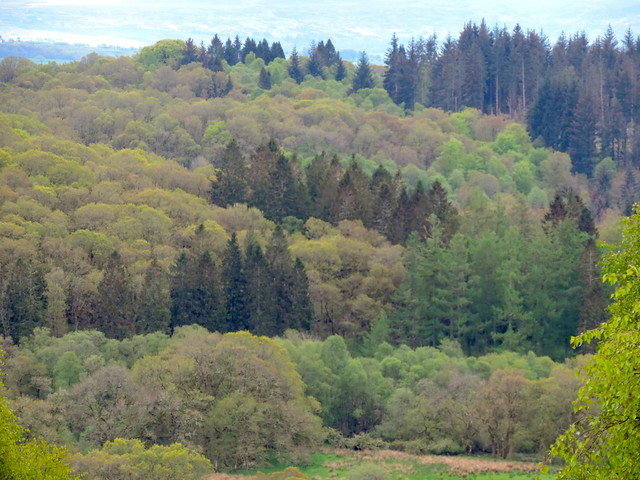
trees

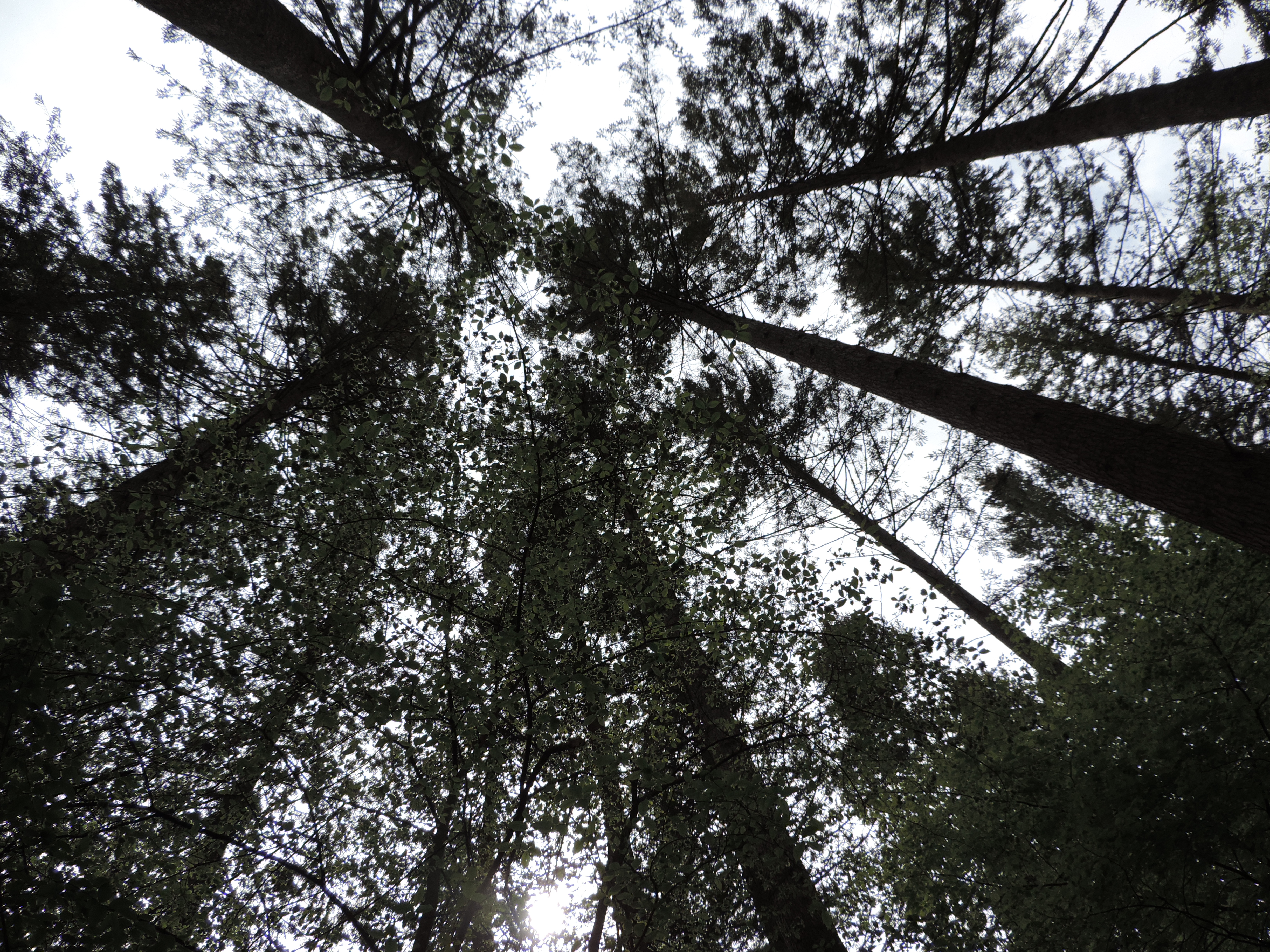
Nature LOVES diversity. Monocultures just don’t occur naturally.
But do you know what I like so much about this kind of image?
It’s not only that every single tree is different and unique.
It’s that together they create the fullness of the beauty.

We are like that. We are all unique. But aren’t we so much more when we live in harmony with all the other unique lives around us?

Read Full Post »


amv

amv2

amv1

rockforest

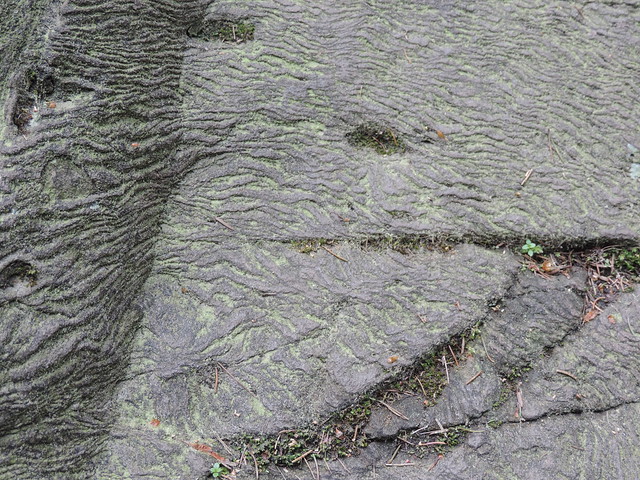
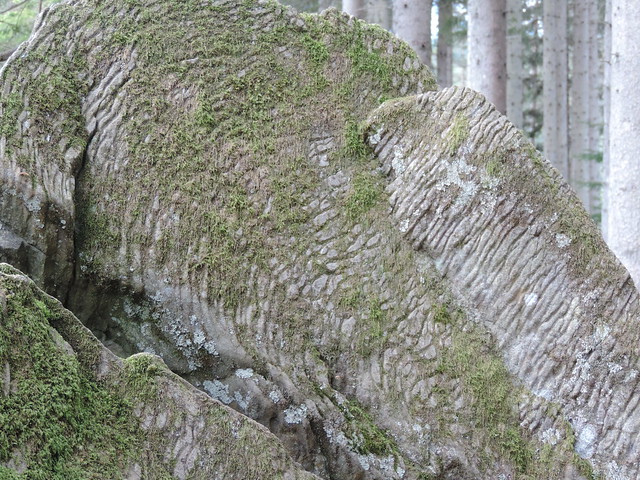
These rocks in the forest bring up two thoughts for me. One is just how much they challenge our preconceptions of form. From the distance they seem to be large boulders, but close up they look like trees. Maybe they are fossil trees? I don’t really know what fossil trees look like, but I’d imagine they look like this. So are they trees becoming rocks? And now I look at that them again in these photos they look like elephants, or some prehistoric dinosaur-like creatures!

The other is about boundaries…..where one object stops and another begins, how every “object” exists in its context and how much the environment, the place where the boulder sits, creates its reality, and then that other boundary of time…..how everything changes, how everything is in a constant state of becoming.

Read Full Post »

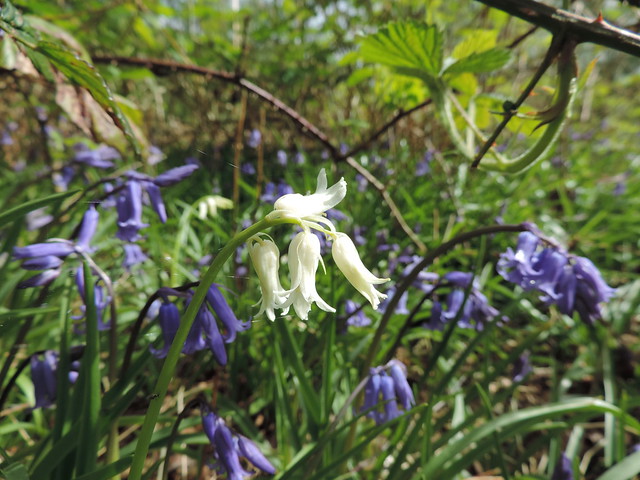
One of the rhythms I enjoy is the Spring season of blooms, and one of the blooms we see in Scotland at this time of year is that of bluebells in the woods.

bluebells

In many of the woods you are surrounded by whole carpets of bluebells.

But I’ve also got an eye for uniqueness, not just the uniqueness of the particular patch of bluebells, but the differences between individual plants.

white blue

Read Full Post »

DSCN1264


Hermitage

Hermitage

DSCN1275

Read Full Post »

IMG_1556

Nature’s abundance never fails to amaze me.

This is the spiral staircase from the upper consulting rooms at the NHS Centre for Integrative Care, down into the garden.

Astonishing

Read Full Post »

fern


“For there is nothing that grows or lives that can approach the feathery grace, the symmetry of form, or the lacy elegance of pattern of the Ferns: and to be blind to all this beauty is nothing less than calamitous” – Herbert Durand, in “The Field Book of Common Ferns”, quoted in Mary Oliver’s poem, “More Evidence”, published in her collection, “Swan”.

Read Full Post »

From Mary Oliver’s “What can I say?”

The leaf has a song in it.
Stone is the face of patience.
Inside the river there is an unfinishable story


leaf

stone

river

Read Full Post »

IMG_1548

We have developed a strange way of thinking about the relationship of human beings and Nature. In fact, that very sentence is an example of how we think. There’s us, human beings. And there’s Nature. They are different. We separate ourselves out from other forms of Life, and from all the other ways Life manifests itself in Nature. We think we are not the same as other creatures. Maybe a bit like apes, maybe a bit like other mammals, but certainly not like flowers or trees. And even if we identify with LIFE in its multitude of forms, we still think of ourselves as separate from the other forms of Nature – earth, rock, water, wind, energy.

But we don’t stop there. We don’t just consider ourselves separate from, and in some way outside of, Nature. We tell ourselves Nature is there for us to exploit, to consume and to control. We think of being in a constant battle with Nature, wrestling with its power and its potential to do us harm. We conceive of the evolution of Life as a perpetual competition, a striving to survive, and only the strongest will win that battle.

But what kind of lives does that kind of thinking create for us? What kind of Nature does that attitude bring into existence? What daily experience do we have when we live from that perspective?

Over the last hundred years, physics has shown us that there are no separate, discreet, irreducible “particles” which are the “building blocks” of reality. We have begun to understand (or maybe rediscover) that any sense of separateness is a creation of the human mind. In particular we use our left cerebral hemisphere to filter and re-present the phenomena of reality to ourselves. This gives us a view which declares boundaries, and which creates the impression of separateness. As we explore the connections, the bonds and the relationships we begin to experience Life quite differently. And as we take on board the phenomenon of integration – of the creation of mutually enhancing bonds between well differentiated parts – we begin to see how co-operation is the basis of evolution, at least as much as, if not more than, competition.

So we can change our focus, taking on board Einstein’s question of whether or not we think of the universe as a friendly place, and then we see in Nature not just the inter-connectedness of everything, but how this Earth is perfectly created to sustain and develop Life itself. How everyday life is only possible because of the innumerable beneficial links between ourselves and others, between ourselves and other species, between ourselves and those who have lived before us, and between ourselves and the rest of the Universe from which we emerge.

The image above is a path. I think it is beautiful and shows an intimate relationship between human beings and trees. Here’s another path, quite different from that one, but which also makes me think about the paths we create as we live in this world.

DSCN1239


Maybe it’s time to create a better path? A more “natural” path?


Read Full Post »

DSCN1247

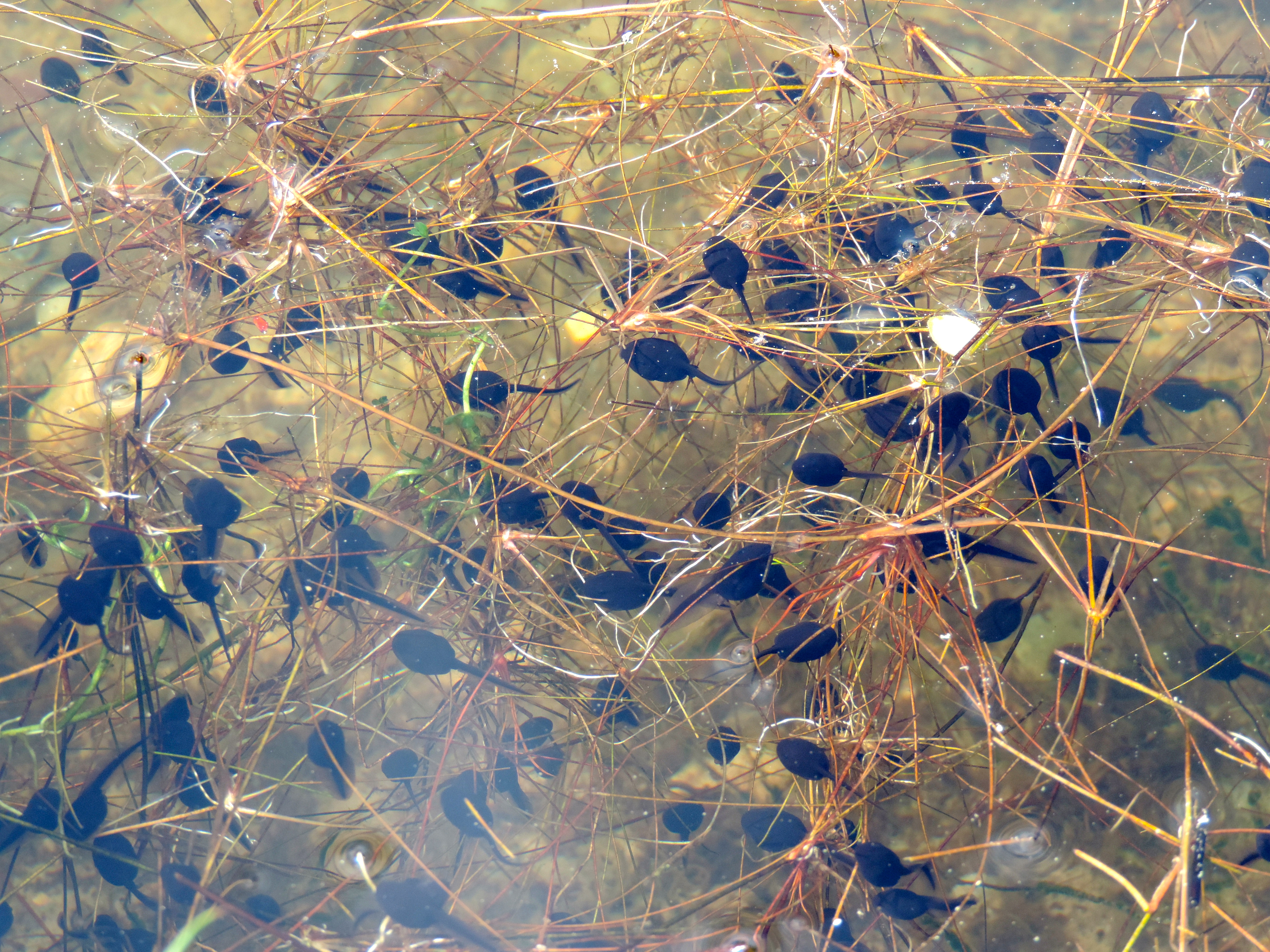
Spotted these tadpoles in a pond up near Aberfeldy yesterday. This shot of them captured only a small portion of the hundreds swimming around the edge of the pond.

What do you think about when you think of tadpoles?

I bet you don’t think what I do.

Here’s what happens when I see tadpoles. I hear a song in my head. “Share it” by Hatfield and the North.

Do you know that song? Do you know why I hear it when I see tadpoles? Well, when I was a teenager, my friends and I were great fans of bands like Soft Machine, Caravan, Camel, and Hatfield and the North. So when Hatfield and the North played the Student Union at Edinburgh University we went along. My friend Ian seemed to know all the words of their songs and sang along. At the end of the concert, Ian made for the front and asked Richard Sinclair, the singer a question. The question?

“I can make out all the words of ‘Share it’ apart from the first one. It’s “something is screaming in my ear” but what’s the something? Richard Sinclair leaned down from the stage and whispered one word into Ian’s ear. What was the word?

Tadpoles.

If you don’t know the song, here it is


Listen carefully to the very first word. You’ll see he wasn’t kidding! 

But do you know what amazes me most about tadpoles? Metamorphosis.

During metamorphosis, a tadpole loses it tail, grow legs, loses its gills and grows lungs, rewiring it’s nervous system and on and on…..the number of changes are astonishing. How does it do that? We know a little bit about some of what’s involved (hormonal changes and different responses in different tissues to the same hormones) but we absolutely don’t know how these these massive changes are co-ordinated. 

Amazing. Completely amazing

Read Full Post »

« Newer Posts - Older Posts »