We’ve had a very hot, dry spell recently here in the Charente. Temperatures rising to the mid or high 30s (centigrade) each day which made the leaves of the plants curl up and wilt. Then this last week we’ve had rain, wind and storms. Yikes! What chance have they got?
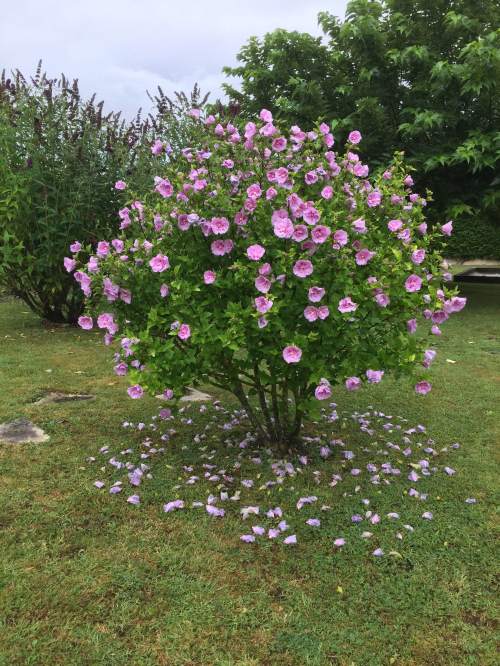
Well, look what all that varied weather has done to this bush in the garden.
First it suddenly bloomed, going from zero flowers to dozens of them over about 48 hours. Then the wind and rain has knocked off more than a few of them.
But when I walked outside yesterday evening and the bush caught my eye I was transfixed.
Just look how beautiful this is! Not just the bush itself but the way the fallen flowers have made a pinkish purple circular rug on the grass around it.
This is the kind of beauty which Nature makes.
In “The Great Work”, Thomas Berry talks about the interplay between discipline and wildness…..between order and chaos (or disorder). This is a great example, I think, of the beauty the wildness and disorder brings…..effortlessly.
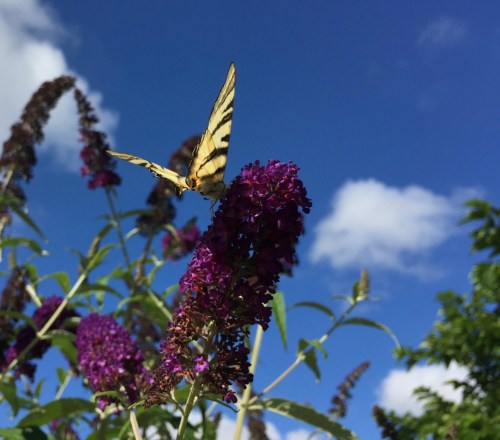
Every year I’m amazed to watch the butterflies appear in the garden the very same day the buddleia bushes flower. I’m convinced they both appear at exactly the same moment. No idea how that happens! Are the butterflies just hanging out around the corner somewhere waiting for the blossoms to appear, then zip round as fast as they can the moment that happens?
However it happens, it’s a delight to see so many varieties of butterfly (and the hummingbird moths, which are incredible creatures!), to watch how they fly in such utterly unpredictable directions, how they spread their wings in the sunlight, or close them up so they look like little leaves.
But here’s one thought which comes up for me time and time again when I see butterflies….they make me more aware of the cyclical nature of life. These little creatures have such different life stages, so different you wouldn’t realise they were stages of the same life. Do we think of them as having a beginning and an end? Starting with an egg, progressing through their caterpillar stages, becoming a chrysalis, then emerging as a butterfly which lays eggs, then dies. Is that the life?
I suppose we do all think of ourselves as having a beginning and an end. But where do we begin, and where do we end?
It depends on whether or not you want to reduce a person to just a physical body. My physical body began with a single fertilised egg and this body will die.
But what about ME?
Do I really think I’m only a physical body? Don’t I have a sense of something immaterial too? A consciousness? A sense of Self? A personality? Characteristics, behaviours, values, beliefs, creative acts, destructive acts? Is there anything I can do which doesn’t ripple out into the world beyond me?
When I look at Rodin’s “The Kiss”, or “The Thinker”, what do I see? The product of the imagination and creative skill of the man called Auguste Rodin. When I listen to music composed and performed by people who are long since dead, isn’t there something I’m sharing there which only they could have created? Aren’t these great works of art the ongoing ripples of unique human beings? Or do you think these are just their footprints? (It doesn’t seem that way to me….these works seem full of life and the potential to continue to create and send out ripples into the universe)
And what about those characteristics, quirks or tendencies that I have which others in my “family tree” also exhibited, even perhaps before I was born? Anyone who explores their genealogy encounters remarkable “coincidences”, talents, life events, behaviours which echo down through the generations. Weren’t those threads present even before the egg which became me even existed?
I think it’s inadequate to narrow a person down to a physical body.
But even if we did, there is still the fact that the body changes continually. It never stops. There is a constant turnover of cells, new beginnings, new endings, every hour of every day. There is a continuous exchange of energy, materials and information between my body and my environment, and we all share the same environment, the same atmosphere, the same air, water…..we are all made from the same molecules, all created from the same “star stuff”.
So it seems to me that beginnings and endings are everywhere……wherever, and whenever, we happen to look.
But it also seems to me that they are nowhere. They just don’t exist. We all emerge from, and dissolve into, the great cycles of the universe.
Beginnings and endings are just where we choose them to be. But we can always make a different choice. We can always take a broader view, a bigger view, a longer view, a more holistic view.
I’m reminded of a song from my school days….it’s by Jeff Beck, and it’s called “Hi Ho Silver Lining” – he sang this truth right there in the opening line of this song…in the first five words……
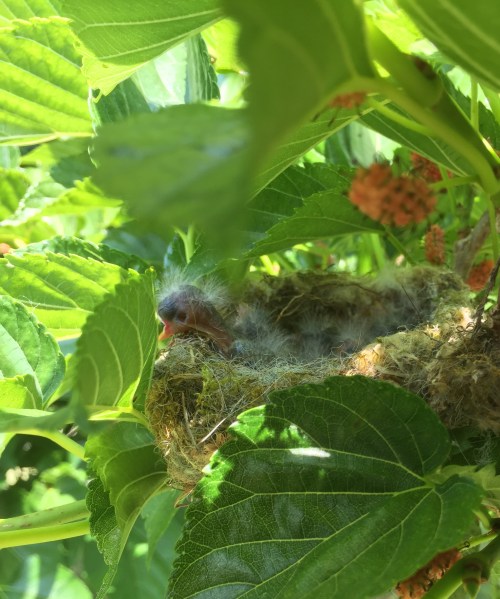
A couple of little finches have built an astonishing little nest almost at the very end of one of the branches of the mulberry tree. The next looks pretty precarious but actually it’s well hidden amongst the leaves and it’s brilliantly woven. Just how do they do that? How do these tiny little birds gather bits and pieces from around the garden and actually weave them into these tight, sturdy nests? I mean how do they manage that with just their beaks? And where do they get their knowledge from? I can’t see that they learn it from any older birds. Is it actually programmed into the DNA sequences of their genes? Really? Isn’t that utterly mind-boggling? I’ve read similar musings about spider webs. Because every single web, and every single nest, is created in a unique circumstance. A new circumstance of time, place, wind, rain, sunshine, heat, cold…..I could go on. So even with a DNA coded programme for web creation, or nest building, each creature has to adapt that knowledge to the present circumstances. Honestly, I’m amazed!
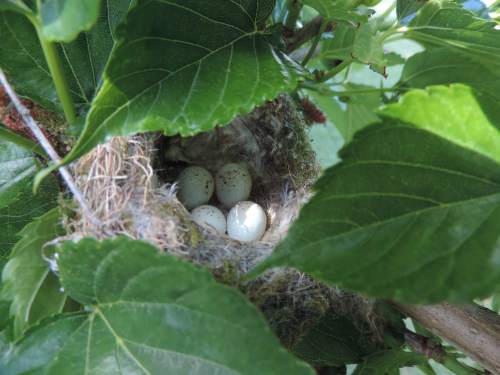
But my amazement doesn’t stop here, because after finding about four little light blue eggs in this nest a wee while back,
Now they’ve all hatched, producing these chicks. What on earth do they look like? This is one of them about a week old. Now, about two weeks old, they are starting to develop feathers. If I understand it correctly, within the next two, or three weeks, they’ll fly. You get that? They will fly! From emergence from the egg to FLYING in about four weeks.
Now, embryology has always fascinated me. Probably my most favourite teacher at Medical School was the professor of anatomy who drew the stages of development of the human embryo on a giant blackboard using a pack of multicoloured chalks. Wow! How impressive was that! Sheer works of art, lecture by lecture. Sadly, we didn’t have mobile phones in those days, so none of us were able to capture those blackboard works. But I do still have them in my memory. Beautiful as they were I still remain utterly astonished that the cells of an embryo can replicate and differentiate and move into entirely the correct places to develop a human being with all the organs, tissues and networks of systems which form the new born child. When I look at this tiny chick I think the same. I think how on earth does the fertilised egg develop this head, this beak, these eyes……and now, the beginning of feathers and wings. And within two weeks from now these chicks will launch out of this nest and fly. How long does it take for a human baby to walk by him or herself? This little bird takes a month from “birth” to flying.
If you don’t find that astonishing and amazing…..well, you do, don’t you?
We take so much of our lives for granted. There’s so much we don’t know and don’t understand. But, can I recommend this?
Take a moment or two to reflect on how one cell (an ovum), joins with one other (a sperm), to become ONE cell which almost immediately becomes two, which become four, then eight, then sixteen……and hour by hour, day by day, a unique creature emerges, with millions and millions of cells, different kinds of cells produced from the original ONE, producing a body, with eyes, a mouth, all the necessary organs……You don’t have to go any further. Just consider any stage along this path and wonder.
Doesn’t it make you feel awe?
Doesn’t it make you feel humble?
Just allow yourself to enjoy that for a moment or two.
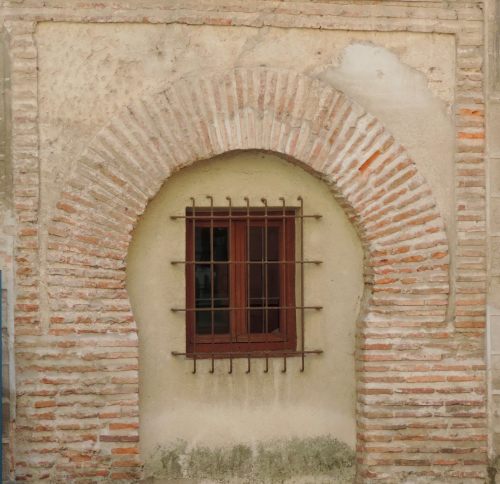
I see this sort of thing a lot when I look at old buildings in either France or Spain. This one is in Segovia.
What’s the first thing you notice?
The window?
Or the window in an arch?
See, when I look at something like this I really get to wondering….how did this come about? Did the original builders build a nice big entrance way, two verticals and a horizontal? Building a frame like a picture frame for an entrance? Maybe not….well, maybe not exactly anyway, because it looks like exactly the same bricks have been used to make the archway and some of the bricks seem to run between the two frames….the square frame and the arched frame. So maybe the original builders built an arched entrance and surrounded the arch with a frame?
But then it looks like somebody decided not to have an entrance there after all and filled in the space.
Then somebody else thought, hey, wait a minute, I’d like a window here and put in the window….but did they fit bars around the window at the same time?
So, has this window, this barred window, emerged over many years from a wall which was built in the space formed by an arched doorway?
And what was the thinking behind each of those steps in the development?
Make an entrance, an attractive, obvious entrance…..then block it up…..then make a window, but not one for letting that much light in, and certainly not one somebody might climb into, or out of…..was that, is that, a problem around here? People climbing in and out of windows?
Bear with me here but because I worked as a doctor for almost forty years this image sparks my thinking about patients and the problems they talked about in the consulting room. They’d bring the equivalent of this window….let’s say they’d talk about a pain (instead of a pane….ha! ha! sorry!)…..and I’d ask about the pain, asking them to describe it….its features, its characteristics, its exact location, what surrounded it, or accompanied it……and then I’d want to know how it arose. Tell me when it wasn’t there. What was there before it? What was happening when it began? And so, gradually, what a first glance might be a simple symptom turned into a unique, never before told, story…..and that’s where I began to understand what the problem might be.
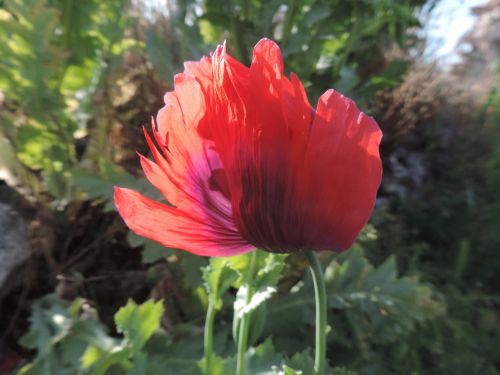
Poppies are such striking flowers. They radiate colour and they pull you towards them to have a closer look, or to take some photos. Their petals are often huge but somehow delicate and fragile, and they don’t last very long.
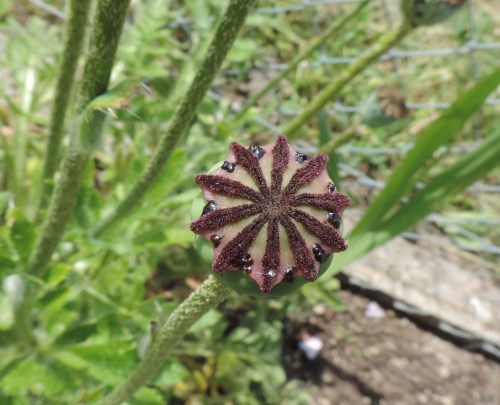
I do adore these flowers, not least because they offer you a second chance to be entranced by them after their petals fall.
Wow! Just look at this! Click on the photo to get a closer look! Isn’t it just a perfect design? A glorious pattern?
It’s like a jewel, isn’t it? Something precious, something valuable, something simply beautiful.
So here’s an impossible question…..what is more beautiful?
The petals of the poppy, or the poppy after they fall?
I was in Saint Jean de Luz last week and the colours of the lichens and mosses on this old bridge caught my eye. Then I noticed the ruler and I wondered if the river had ever reached the “59”, or even higher? And if it had, that would have been written down somewhere and compared to the water levels in previous months and years. Maybe “59” was a record. Maybe it’s only ever reached “49” or even less. Whatever the numbers, people would have their stories to tell. There would be stories of “the great flood”, of rooms, shops, maybe even whole houses submerged under the water. Stories of desperation, of fear, of rescue, of heroism and of hope. Then the waters would have receded again, down to a lower number, and once cleaned up and dried out, the townspeople would “return to normal”. (Whatever a phrase like that can ever mean!)
For me, the beauty in this image lies in the stones, the green and orange life growing on the surface, in the shape of the arch (with most of it left implied), and the dark river running beneath. But it’s the ruler that I return to and I wonder how we choose what to measure and what those measurements mean to us.
In health care we carry out lots of measurements. There is even a movement of people dedicated to recording figures for many of their daily bodily functions. “The Quantified Life”. Does that appeal to you? Can we adequately capture the experience of being healthy with a data set?
All these measurements, these figures, that data…..it gives us the sense of “having a handle on” something….even “having the measure of something”. And we use the numbers to rank experiences and events. The warmest day, the highest river level, the least rainfall. Is that how we remember our past? Is that how we tell our individual stories to others? Recounting the records, telling the numbers, reading out the data? Or by sharing the stories of our experiences?
Thing is, for me, there’s so much more in a life of qualities, than quantities. So much more to tell of beauty, of love, of wonder and amazement. So much to make sense of, to try to understand the meaning of, the purpose of. So much to experience, moment by moment, without a ruler in sight.
But you know, when I return to this image I see again that I have both. The qualities and the means to record the quantities. And isn’t that how to live a full life? To use both halves of the brain? The side which measures, and the side which experiences? The side which concentrates on the parts, and the side which pays attention to the “between-ness”, the connections, the whole?
There’s a climbing plant making its way along the fence and when I stopped to look more closely I was amazed to see the structures it creates to get a grip of the ironwork. There are many tight, strong, spring-like spirals of bright green like this. Mostly the cross a space diagonally, not straight up, or straight down. That surprised me. I was taught that a straight line was the shortest distance between two points. It seems that plants aren’t that interested in shortest distances, and don’t do straight lines.
I read somewhere, long, long ago, that there are no straight lines in Nature. If you see straight lines, you can be pretty sure that humans have had a hand in their creation.
Life doesn’t go in straight lines either does it? I sets off along unpredictable paths, spiralling as it goes……
Despite our constant seeking out the so-called simple insights of “this causes that”, when it comes to living organisms, it’s always a bit more complex, a bit more nuanced, a lot more unpredictable than that.
And here’s something else – isn’t the shape of this just stunningly beautiful?
I mean, its enough you’d think, to be in awe of just how a plant actually creates a structure like this (from sunlight, air and water) and uses what it creates to anchor itself, to get a hold on its environment. I mean, how on earth does it do that? But, that aside, just look at it! Isn’t it gorgeous?
Some of those new things are so startling they make us stop and look more carefully.
Often when I stop and look more carefully I’m filled with wonder, awe and amazement……and loads of questions!
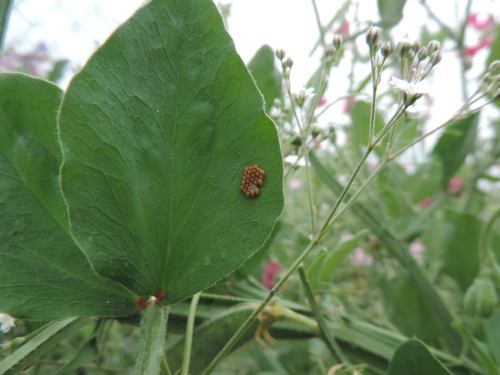
I mean, look at this photo here! What, oh, what, is that??!!
It’s a small collection of eggs on a leaf. But look at the arrangement. Have you ever seen anything like this before? What kind of creature laid its eggs in this tightly fitting symmetrical pattern? A geometry bug? An insect with OCD?
And look again, a little more closely time, because on of the eggs is out of place. It’s either failed, or it’s hatched already leaving just the casing to become a bit unstuck. So the pattern doesn’t look as “perfect” as we might like. There are quite different cultural responses to something like that. Some people find complete symmetry the most pleasing. Others would look at something like this and see the one egg which has “broken” the pattern and see that as “natural”, as “alive”, even as a symbol of transience, of change, and of “becoming not being”. And it will look all the more beautiful for that.
How do you feel when you look at this?
What thoughts, memories, emotions or imaginings does it spark?
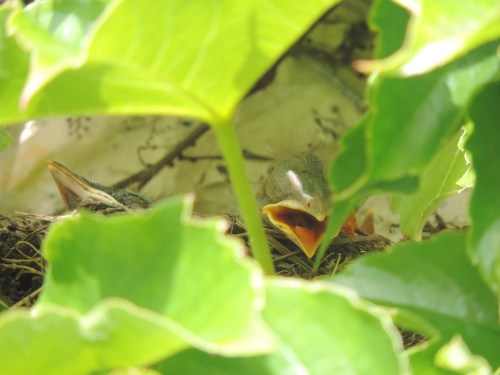
I’ve been watching a pair of blackbirds dash in and out of the ivy for some time now and this morning I thought I heard that tiny squeak of new life so had a peek (from a distance). There they are! Two little blackbird chicks!
This wasn’t an easy photo to take. I used full zoom so I could remain as far away from them as possible and the bright sun behind my back was making the LCD viewfinder pretty hard to see. Also, have you ever tried finding something using the zoom function on a camera? You’d be surprised how hard it can be to train the lens exactly on what you can see with your naked eye. Once I uploaded the images to my Mac I saw this. Wow!
Look at the one on the right, eyes closed, mouth wide open, tuft of little white feathers on its head. And how green this little BLACKbird is!
How do you feel when you look at this image?
There’s something here delights us, thrills us, makes us feel good, isn’t there?
Can we carry that feeling forward as a core value?
To delight in, and to welcome, LIFE, here on this little planet Earth.
I listened to an interview with Yuval Noah Harari recently. I read his “Sapiens” some time ago and mostly enjoyed it, but I haven’t been tempted to read his more recent “Homo Deus”. This latter book looks ahead to consider how things might go as artificial intelligence and robotics develops apace. He argues that our technology could give us incredible powers, so that we may end up more like gods, but he also says things could go the other way and create an increasingly large class of people he labels as “useless”.
That “useless class” terminology is certainly a way of getting attention, but when he specifies what he means by it, there’s a lot in it –
“I choose this very upsetting term, useless, to highlight the fact that we are talking about useless from the viewpoint of the economic and political system, not from a moral viewpoint,” he says. Modern political and economic structures were built on humans being useful to the state: most notably as workers and soldiers, Harari argues. With those roles taken on by machines, our political and economic systems will simply stop attaching much value to humans, he argues.
He goes from there to imagine a future where this class spends its time on drugs and Virtual Reality games machines. Depressing, huh?
So, two things struck me immediately. Firstly, this connects to some of the debate about “Universal Basic Income” – the idea that every citizen should receive a monthly allocation because we are heading towards a system which will be “post-work” – robots and algorithms will take over most of the jobs and the increased automation will increase unemployment. Our current economic system will either be adapted to take account of that, or human beings will have to adapt to the current economic system. Or not. It’s this “or not” that Harari explores by describing the “useless class”. One question then is what do we value in society and how do we allocate resources to what we value? As a society.
The second thought was, what, if people don’t have jobs in factories, shops or offices, the only thing they’ll be able to do is take drugs and play VR games? What popped into my mind straight away were caring and creating.
Human beings are great at caring. Sure, we don’t do nearly enough of it, and we could sure do with developing our capacities to care, but take, as one example, the response to an earthquake, a storm, a flood, a terrorist attack. In all of those situations we hear story after story of human kindness, human sacrifice and human caring. With declining infant mortality and increasing life expectancy more and more people in the world are living longer and in need of more care. We won’t run out of opportunities to care for others.
Human beings are great creators. We are problem solvers, scientists, home makers, gardeners, cooks, and artists of all kinds – writers, sculptors, painters, musicians, dancers. We won’t run out of opportunities to create.
Thirdly, I’d argue, human beings are great learners. We have whole neural circuits primed to seek out what’s new or different. We have whole systems dedicated to learning skills, acquiring knowledge, understanding and making sense of things. We won’t run out of opportunities to learn.
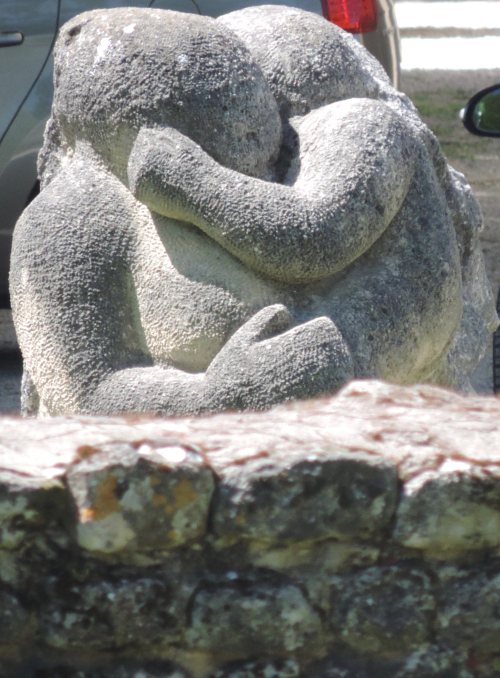
So, when I visited the town of Blaye recently, I saw this artwork in a car park. Isn’t it beautiful? Simple, and beautiful. Doesn’t it capture something about the human ability to care and to create.
Isn’t there an opportunity at this point in civilisation to change our focus away from grabbing and consuming, to caring and creating? And learning!
I welcome constructive criticism and suggestions. I will not, however, tolerate abuse, rudeness or negativity, whether it is directed at me or other people. It has no place here. ANYONE making nasty comments will be banned.



 Heroes Not Zombies