Feeds:
Posts
Comments

Archive for the ‘Uncategorized’ Category

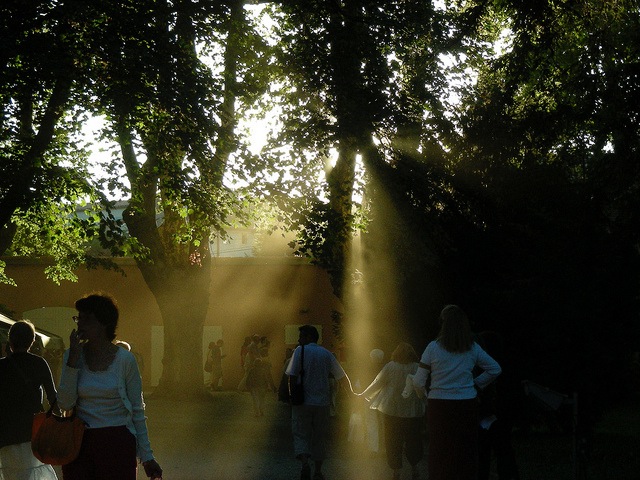
I took this photo because I liked the way the shafts of sunlight were shining between the trees but when I looked at it later I was struck by how the main sunbeam was lighting up a couple holding hands.

I’ve returned to this image many times.

This is what we humans do. We connect to others. We interact. We form bonds and make relationships. Scientists describe us as “social animals”. Over millennia we have evolved complex systems within us to help us to be aware of others, to learn from each other, to care for each other, to love each other.

During this pandemic, just like during other emergencies and crises we see people put themselves out to care for and help others. In fact, it seems like there has been a heightening of our awareness of our need to connect, belong and interact with others.

The development of the dominant social and economic model based on selfishness and competition has made us all vulnerable to this pandemic.

I hope we grasp this opportunity to change direction and work together to build a different society – one based on collaboration, cooperation and care.

If our core evolved way of living is “social”, then let’s create societies which prioritise that. Let’s make our systems, our laws, our politics and economics support and enhance these fundamental human characteristics.

What would the world look like if we did that?

Read Full Post »

How’s your sleep pattern recently? A lot of people are discovering new rhythms or developing new habits since this pandemic began. If you’ve lived through a lockdown in your country then it’s highly likely your work life and social life norms have been enormously disrupted. How has yours changed?

Maybe you’re waking up and/or getting up at a completely different time and, if so, you’re probably finding your bedtime has changed too. What’s interesting about this is that it could well be that your body has eased itself into its natural diurnal rhythm.

So what? you might ask. Well I think we can learn a lot about ourselves by paying attention…..paying attention to our bodies and what they are telling us.

One thing that might have become clear is how much sleep you actually need. That’s something you can take forward because even when life opens up and your need to be out of the house at a particular time returns you now know when you should head to bed each night.

Another thing that might have become clear is when your “best” times are….are you more a “morning person” or a “night owl”? Knowing that helps you to decide when to do certain tasks (up to a point!)

A lot of people are finding that this period of stepping out from their norms and from their externally imposed tasks and schedules is leading them to reconsider a lot of aspects of life. Some people are thinking about moving, hoping never to be trapped in an inner city flat with no outside space again. But that’s tied up in work, income, schools or all sorts of other aspects of life.

How about you? What new life patterns have emerged for you, or old life patterns been rediscovered?

What are you reassessing, and, importantly, what are you going to do about that?

There will be no “return to normal” so what changes would you like to make?

Read Full Post »

Creation

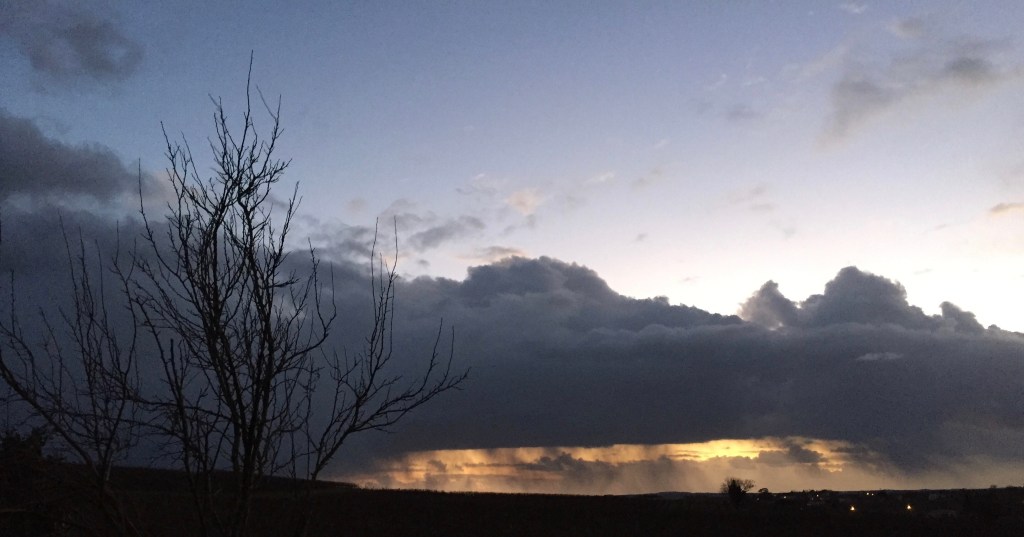
I love a sky like this. It’s so richly textured. The clouds look both solid and insubstantial at the same time covering the entire sky yet somehow hinting that they could disappear in minutes.

I always find that combination of the ephemeral yet solid reality so appealing. It seems to capture the core characteristic of life – brief, fragile and transient AND filling the entire moment with substantial touchable feel-able presence.

I also adore the rich patterning of a sky like this. Not a featureless grey cover stretching from one horizon to another but shaped and varied and changing over every square metre of the sky.

What creates a pattern like this out of water? How do those millions of normally invisible little water molecules link up and shape themselves into those delightful shapes?

I don’t know

Read Full Post »

The essence

Certain images capture something of the essence of a place. Or, maybe better, capture some of the most prominent themes of a place. This is one such image for me.

I took this from the window of my study. It shows an old Citroen 2CV car in the middle of the vineyards. Both the vineyards and this particular model of car are SO French!

I used to have a car very similar to this one. It was my first brand new car and probably one of the most fun cars I ever had. You could roll the roof back on sunny days and you could lift out the back seat to either carry bigger objects or use it to sit on while having a picnic. I transported a far too large Christmas tree in it one year, with most of the tree sticking out through the roof!

As was typical of 2CV owners of the time I had a bright yellow “Nuclear Power? No thanks!” sticker on the back. I guess people probably thought they had a good idea of my values when they saw me in that car. And maybe they were right!

Somehow cars have become way more indistinct these days. Do you agree?

I live in a small village near to the town of Cognac and the entire countryside around here is vineyards. Cognac production is THE major industry in this part of the world with dozens of distilleries, barrel-making and bottle making plants, stores selling tractors and other vineyard machinery, factories which make corks and so on.

Cognac is the essence of Cognac!

Since this pandemic began our horizons seem to have shrunk and expanded all at once. Shrunk because we have been spending our lives within tighter limits, traveling less, visiting less, shopping closer to home. It’s kind of refined our habits I think. You might say it’s “distilled” them!

On the other hand it’s expanded our consciousness making us more aware than ever of how interconnected and interdependent we all are on this one small blue marble of a planet.

What would you photograph to capture an essence of the place where you live?

Read Full Post »

Impossible

Some boats have such great names. This is one of my all time favourites. I can’t see this without thinking someone likes to prove the impossible is, actually, possible after all!

Maybe one of the reasons that I like to claim that the impossible isn’t impossible is that through my working life as a doctor I was frequently surprised by the turn of events.

I know that prognosis is one of the skills doctors are taught. However my experience was that individual patients didn’t conform to the predictions we’d make based on our knowledge of pathology and the natural history of disease.

I learned that the hard way. In my first few days as a junior hospital doctor I admitted a seriously ill elderly lady to a ward. Her two, also elderly, daughters were sitting in the corridor visibly distraught. They asked me if their mum was going to be ok, and wanting to reassure them, I said “Oh yes, of course.” The words were no sooner out of my mouth when one of the nurses called me over to tell me the old lady had just died. I didn’t make that mistake again!

Of course none of us can predict the future. One day one of patients told me her husband had recently been told he had only three months left to live. I asked her how that made her feel. She replied “Really angry”. That wasn’t the answer I was expecting. “Why angry?” I asked. She replied “Well why does he get to know how long he’s got and I don’t know how long I’ve got?”

I guess a lot of impossible things are impossible but it’s just hard to know what the future holds so, sometimes, what seems impossible isn’t impossible after all.

I think of that these days when the world seems so full of crises and difficulties. Can we make a better world? Can we learn from these crises and change direction?

I think we can.

I don’t think it’s impossible.

Read Full Post »

You know I think that, especially in times like this, we think of life as being incredibly fragile. It’s easy to see it as transient and fleeting, subject to being extinguished in the blink of an eye.

All that might be true, but there is an opposite equal truth.

Life is an incredible power.

Maybe life is one of the most, or even, THE most powerful force in the universe.

At one time this planet which we all share had no life on it all. Now you can find it everywhere.

Some of the most successful life forms are micro-organisms. They have spread into pretty much every single ecological niche you can think of. You find them in volcanoes. You find them on the deep sea bed. You find them under metres of ice.

There’s even a theory that single celled creatures like bacteria got together to create multicellular organisms – including, eventually human beings. Did you know that there perhaps ten times as many bacteria in your body than there are “your” own cells? Each of us is actually a symbiotic community of cells.

Astonishing (and a bit creepy too somehow!)

There are regions of the world where there is a huge diversity of plants. The Fynbos in South Africa is one of those. Periodically fire burns through that region destroying all the flowers, but the heat from the fire stimulates the germination of seeds in the soil which then spring up as flowers. Some of the species of flower which appear haven’t been seen for decades. Some were thought to have become extinct. But no, they come back to life (or maybe the were never dead?)

Albizia Julibrissin, the Persian Silk tree, taken to London in 1793 was thought to have disappeared but after the German bombing of London in 1940 its seeds germinated and it began to grow again – 147 years later!

I’m sure we’ve all lots of experiences of flowers popping up in the most unlikely places!

The photo I’ve shared at the beginning of this post, of the little flower appearing in the forest floor, reminded me of all that.

Yes, life is delicate and fragile, but it is also THE most incredible force in the universe. We would do well to remember that.

I think that’s partly why I don’t like all the war language which is being used during this pandemic. We are not at war with corona virus. We are, I hope, learning how to live with it. There are already scientists telling us these pandemics arise because we haven’t learned to live with all the life forms on this Earth, that our destruction of habitats and environments, our pollution and urbanisation, are the root causes of the emergence of this particular pandemic and will remain the cause of the future ones unless we learn to respect Life and to learn to live together, learn to adapt to life together on this little blue planet.

Read Full Post »

It’s fascinating and inspiring to watch a bud mature into a flower.

It’s a process of unfolding and unfurling. The tightly packed young petals expanding and unwinding as they grow opening up to reveal the flower in all its glory.

From a certain perspective the flower is there already in the small green bud, it’s future path laid out before it. It’s fate, it’s destiny, to become a very particular type of flower, even if it’s individual uniqueness will be determined by an innumerable complex of factors…time, place, climate, weather events, insects and chemicals, natural and manmade in the environment, human hands…..

It’s a beautiful phenomenon. This interplay of the past, the present and the future, bringing into reality a specific creation, a unique single “actual” from the “multiplicity of singularities” of possibilities.

It’s just as beautiful in human beings. Watching the newborn child unfold his or her character, unfurl his or her body, as they grow, develop, mature into the fully expressed uniqueness they are in the universe….it’s awe inspiring.

It inspires me to open, to spread my wings, to choose growth and development, to express the uniqueness that is me.

I hope it does exactly the same for you.

Read Full Post »

Burden of proof

One of my favourite French magazines is “Sens et Santé” (that translates as “Sense and Health”). The latest issue has a major section on the effects on human health of exposure to natural environments. They describe several scientific studies showing lowering of inflammatory substances in the body after walking, or contemplating, in a forest, reductions in blood sugar levels, improvements in mood levels, reductions in the need for painkillers, and the famous study showing post surgical patients with a view of a wall required more medication and longer admissions than those who had a view of trees outside.

They even describe the inspiring “nature prescriptions” project in Shetland where GPs are giving patients a calendar of activities in nature to pursue each week. The calendar is a joint project of the local health service and the RSPB (the UK’s bird charity).

I delighted in reading all of this, but then I wondered do we really need research to “prove” or even simply highlight the health benefits of spending time in nature?

Does any of this information change my mind about anything? No. I’ve been convinced that natural environments are “a good thing” for a long time.

Maybe these studies just reinforce my confidence in my views and my beliefs?

Well, I’m not so sure. I think they deepen my understanding.

And that, for me, is science at its best.

I don’t see science as a way to gain control over the world, although that does seem to be the dominant view these days. No, I like science when it provokes my curiosity, stimulates my “émerveillement” (wonder and delight), and deepens my understanding of the world.

The philosopher Deleuze described three ways of thinking. Philosophy, he said, was thinking about concepts, art, thinking about percepts and affects, and science, thinking about function.

In that scheme, science helps me to understand how something comes to be the way it is. It answers “how?” but not necessarily “why?”.

I reckon Deleuze got it right and we need all these ways of thinking to better understand the world.

Since I retired and moved to France I’ve read a lot of philosophy. I’m not trained in philosophy. I just enjoy it. It struck me the other day that philosophy doesn’t really present itself as the ultimate, be all and end all, the way modern science does too often.

Philosophy seems more about opening the doors to understanding and reflection, to thinking, “if I look at the world this way, then…..” and a path of exploration lies ahead.

Science which pursues certainty too often claims “the truth, the only truth” and discards any alternatives. At least, that’s the kind of science I like least. All those headlines that science has proven this or that or disproved that or this. I can’t be doing with them. It seems to me there’s a difference between seeking utility and seeking understanding.

I visited the Chateau de Clos Lucé in the Loire Valley where Leonardo da Vinci spent his last few years. The king, Francois 1st, invited him, gave him board and lodging plus an annual grant and told him he was free to do whatever he wanted. All the king wanted in return was a daily conversation with him. How many scientists would love that kind of arrangement over their current publication driven grant seeking working lives? How different might our world be if we just supported scientific pursuit of understanding, in the realistic knowledge that understanding is never complete, never “the truth, the only truth”? Seems to me that might be better than the agenda of prediction and control funded by those who seek wealth and power.

I didn’t expect this post to go this way but I’ll finish by saying I love the scientific pursuit of understanding but I’ve also come to love the philosophical pursuit of “how might I live”. I think that’s why I like “Sens et Santé”.

Read Full Post »

The Botanic Gardens in Edinburgh has been a place of wonder for me for many, many years. As a student I lived within walking distance of the gardens and would take my Medical textbooks there to study. Throughout my life I’ve returned there, and although many parts are familiar it has constantly changed. I’ve never walked there without stopping several times to gaze in wonder at some astonishing plant.

I’m a great fan of “l’émerveillement du quotidien” – the wonder of the everyday – it’s one of my most favourite strategies for a happy, healthy life, and I know of nothing more likely to astonish me than Nature.

I took this photo the other day and I find it both breath-taking and entrancing, so I thought I’d share it with you.

As I gazed on this scene, this poem, by Yeats, came into my head –

Had I the heavens’ embroidered cloths,   
Enwrought with golden and silver light,   
The blue and the dim and the dark cloths   
Of night and light and the half light,   
I would spread the cloths under your feet:
But I, being poor, have only my dreams;   
I have spread my dreams under your feet;   
Tread softly because you tread on my dreams.


Read Full Post »

Sometimes I find threads which connect various, apparently completely different, books. Here’s one such example.

I’m reading Alain Juppé’s “Dictionnaire amoureux de Bordeaux”, and one of his entries is about Jacques Ellul, who was a Professor of Law and wrote about sociology, philosophy and theology, amongst other topics. One of his major themes was what he termed “Technique”. I won’t go into that in any detail here. I’ll write something else about it some other time. But here’s the phrase of his which hit me between the eyes – “Suppression du sujet” – the suppression of the subject. This is what happens when we turn a blind eye to the uniqueness of each human being, or when we reduce a “subject” to an “object”. This is an issue close to my heart and I’m going to explore it more, but what immediately came to my mind when I read that phrase were a few lines in the opening paragraph of Marguerite Yourcenar’s “Memoirs of Hadrian“. Specifically, this –

It is difficult to remain an emperor in presence of a physician, and difficult even to keep one’s essential quality as a man.

When I read that two thoughts jumped into my mind. One was how I had never experienced intimidation when I consulted with a patient. No matter whether or not the person was a celebrity, a Lord, or a Professor. It wasn’t that I felt better than them, but I saw everyone as unique, wounded and suffering. But I only thought about that because this is an emperor speaking. The other thought, which I reckon is more important, was the second phrase in the sentence – “…..difficult even to keep one’s essential quality as a man” – there is something potentially de-humanising about health care. It happens when doctors and nurses refer to a patient by their diagnosis instead of by their name. Indeed, not only refer to them as “a case of X”, but treat them that way too, considering only the “data”, the “results”, as important and not the lived experience of this unique person.

When visiting my mum in hospital recently, I overheard one nurse in the corridor say to another “Have you taken the blood from Bed 14 yet?” I thought, good luck getting blood out of a bed!

Sadly it’s not uncommon to witness health care based on the “suppression of the subject”. Outcomes, targets, measurements, doses, and all the technical paraphernalia of machines, tubes and flashing lights can obscure the human being completely.

When I read the sentence in The Memoirs of Hadrian, I wrote in the margin, some lines from T S Eliot’s “The Cocktail Party” –

In consultation with the doctor and the surgeon

In going to bed in the nursing home

In talking to the matron, you are still the subject,

the centre of reality. But stretched on the table

you are a piece of furniture in a repair shop….

All there is of you is your body

and the “you” is withdrawn.

The subject as the centre of reality – is that basis of our health care? Is it the basis of our politics, our economics, our schools, our workplaces? Because if it isn’t….it should be!

This “subject” which Ellul says is suppressed, this “essential quality” of Hadrian’s, this “you” which Eliot says is withdrawn. What is it?

That’s my thought for the day – how do we get to know the subject, the “me”, the “you”, the “self”, the “person”? And how do we make that REALITY the core of our societies?

Because when we objectify human beings we lose touch with reality, and we open the door to all kinds of cruelties and suffering.

Read Full Post »

« Newer Posts - Older Posts »