Feeds:
Posts
Comments

Archive for the ‘Uncategorized’ Category

IMG_1130

Let’s talk about death.
Because we don’t.
Somehow it’s not acceptable to talk about death, almost as if it’s bad manners, or maybe just that you’re going to make someone uncomfortable by talking about it because death is something we all hope to avoid. Today, anyway! Maybe we think that if we don’t talk about it, don’t even think about it, then it won’t happen. Which is equivalent to a child covering their eyes to hide and thinking nobody can see them.
Death is certain. It’s inevitable, inescapable, unavoidable.
Yes, yes, I know that, but let’s deal with it when it comes along, and, look, it’s not coming any time soon, right?
I don’t have the impression that death is difficult for the dead, but, then, what do I know? I’ve never talked to a dead person. Or, more accurately, no dead people have ever talked to me.
Dying, on the other hand, can be really difficult. I’ve seen difficult deaths, been present through those final weeks, days, minutes of final struggle. Some of those deaths make the moment of death like a release, a final end to suffering.
And death is difficult for the living. It’s loss, emptiness, sadness, distress, grief….It changes the lives of the living permanently. Life is not the same after death.
But life is never the same anyway. Life is a process of constant change. Even in the midst of our most fixed habits and routines, life changes. Relationships are formed, relationships fall apart, new jobs appear, old jobs go, people enter our lives, and they leave, some temporarily, some permanently. Isn’t death just one of those changes? A kind of ultimate experience of transience?
How many deaths have you witnessed?
I’ll never forget the first time I had to certify someone as dead. As a Junior Doctor working in a hospital, one of my responsibilities was to confirm that a patient had died, and initiate the formal recognition of their death, writing in their case file “Time of death” and entering the time I declared it. The first time for me I was called, as on call doctor, at about 3am, to a ward I’d never visited before. An elderly patient there, whose death was expected, had just died. It was my responsibility to examine him for signs of life. I took my time. I didn’t want to get it wrong! I listened to his chest for a long time, but couldn’t hear any heart beats. I tested for various reflexes and got not response. I stared long and hard into his eyes, using a device called an ophthalmoscope, shining a light onto his retinae to look for the signs of death I’d been trained to see. Finally, I was convinced. Looked at my watch, and retired to the little office at the end of the ward to write the formal statement of my examination and the date and time of his death. As I walked back along the empty main corridor I began to think about what I’d just experienced. I wondered whether or not it was true that we each have a soul, and whether or not that soul hovers around the body for a little time after death, before departing. I wondered if the man’s soul had been hovering around behind me, as I checked his body for signs of life. I wondered if his soul might have started to follow me from the bedside to the office, and maybe, now, as I walked down this empty corridor. I started to walk faster and wondered whether or not a soul could keep pace with a living person. My heart started to beat faster and as I turned into the on call rooms corridor to go to bed I flicked on the light switch in the stair well and “bang!” the light bulb flashed on then immediately went out again. Well, that spooked me! I ran up the dark stairs taking two or three steps at a time, fumbled as I tried to get my key into the on call room door, eventually managing, throwing the door open wide, then slamming it hard behind me. As I stood, breathing heavily, with my back to the door, I suddenly thought. “Hey, surely ghosts can walk through walls!” At that point I realised how absurd it was to be imagining such things. Took me a while to settle though!
I’ve seen many deaths since then. I don’t think it ever became routine. I didn’t imagine souls hovering around me any more, but I always found the experience disturbing. Maybe that’s just normal.
For most of us we won’t have experienced many deaths directly. When they happen, they are significant events. They feel like something has gone wrong. Maybe somebody is to blame. Maybe someone has failed. Maybe we even feel the dead person has failed….failed to rage against the dying of the light.
When you talk to people who have had an encounter with death, a near miss, a sudden, or unexpected one, brought on by an accident or an illness, it’s not uncommon that they will say it’s made them realise how precious life is, how fragile, how maybe until that moment they hadn’t really known that. Well, known it as a sort of fact, but not known it as a person. There’s a difference. Maybe they’ll say they’d have a wake up call. A wake up call to what? To the knowledge of the shortness of life. They might say it’s made them realise that if they want to make the most of life, then it might be a good idea to start now.
Or they might have a heightened sense of reality, of the unpredictability of life, or even of the inevitability of its ending.
Thinking about death because you’ve survived a serious accident, recovered from a serious illness, or have just experienced the death of a loved one, a friend, or a colleague, can make you re-evaluate your life.
Re-value your life.
Feel how precious and fragile it is and decide to make some changes, to stop procrastinating, to stop living this way in the hope that one day, in the distant future, you’ll be able to live a different way.
That’s the gift of death. The gift of life.
Do we have to go through such an experience to get there? Can we only wake up, reassess our choices and values by having personal encounters with death? Or can we make such decisions, initiate such changes, by thinking about death, or talking about it?
If you knew you had one year left to live, what would you do differently?
Stephen Levine, who passed away in January, 2016, wrote a best selling book entitled “A Year to Live” where he describes the process of living as if you have only one year left. Many people have followed his programme since.
But the whole idea of thinking about death as a way to a better, or should I say, more considered, life, goes all the way back to Socrates (there are whole schools of thought on this subject from many other cultures too)

In the Phaedo Plato has Socrates claim that in death the soul is released from the impure and contaminated body, and thus becomes able to attain pure knowledge of Truth. In the dialogue Socrates says: “It really has been shown to us that, if we are ever to have pure knowledge, we must escape from the body and observe things in themselves with the soul by itself. It seems likely that we shall, only then, when we are dead, attain that which we desire and of which we claim to be lovers, namely, wisdom…”
Thus according to Plato upon death the philosopher achieves that which he has been striving for his entire life. Because of this Plato has Socrates claim that the practice of philosophy in life is really a dress rehearsal for what comes in death: “…those who practice philosophy in the right way are in training for dying, and they fear death least of all men.”
Since the time of Socrates and Plato philosophy has assisted countless individuals confront their own mortality, and provided consolation in the face of what many consider the greatest of all evils – death.

A related train of thought is wondering what you would do differently if somebody you knew had only a year left to live. What if that somebody was your mum or dad, a brother or sister, a lover, partner or friend?
And what if it wasn’t a year? What if it was five years, or, ten? Would that change anything? Would either of those scenarios lead to different choices?
So, a little contemplation on death from time to time, might have a serious impact on both the way we live, and the way we are with others.
You know, I think there’s an awful lot more we could consider down this road, but maybe that’s enough for now.
Before I finish, though, when I was researching life expectancy figures for the articles I was writing about health, I discovered that a male Scot aged 65 (that’ll be me in a few months time!) has a life expectancy of a further 19. 7 years. When I read that I had mixed feelings. I mean twenty years seems quite a long time, right? But on the other hand, it feels as almost no time at all! But what I realised I was doing with that figure was considering it as an end point. I thought, well I might just see the start of 2040 then! But then I read what “life expectancy” is. It’s a median. That means that in 19.7 years time, 50% of male Scots, aged 65 today, will be have died. But 50% will live beyond that timescale. It’s not an end point. It’s the 50/50 point!
Hey, how human is it to grasp at offer of hope?! (Well, that’s another subject to consider….the importance of hope)
OK, this is like a PPS but I must tell you about the patient I saw one day. I knew her from previous visits, but this day she seemed particularly out of sorts. I asked her what was bothering her and she said “My husband’s been diagnosed with cancer. He’s been told he’s got six months to live”
I sympathised with her and asked how that news had made her feel. Her reply took me completely by surprise.
“I’m angry. Really angry. I mean how come he gets to know how long he’s got and I don’t get to know how long I’ve got?!”
We had an interesting conversation about uncertainty after that!

Read Full Post »
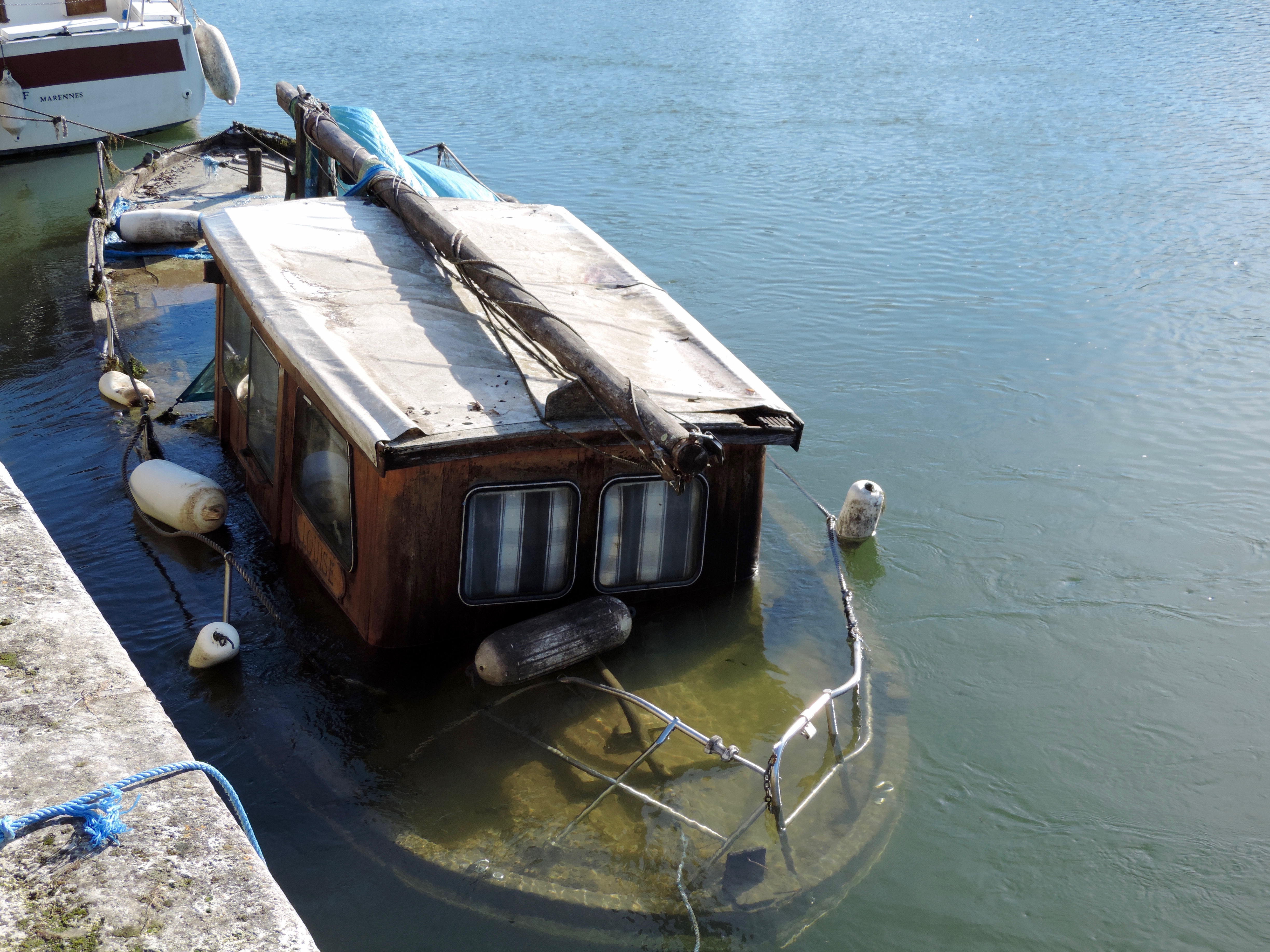
sinking boat

This is my last article in this series about health. I started by addressing the needs of health services, then continued with an exploration of how to move towards healthier communities so that more people might expect more years of healthy life. I began with shelter, exploring housing, then, food, education, and the environment.

Finally, I want to address the issue of inequality.

In Scotland, in 2008, life expectancy figures revealed that men living in one part of Glasgow could expect to live 28 years more than those in another part. This was publicised as the plight of “Shettleston man”, named after the area with the poorest male life expectancy. Twenty eight years of difference in two areas a mere 15 minutes away from each other.
Shocking? Of course. This wasn’t the full story. The number and severity of illnesses suffered by the men in poor Shettleston, were far greater than those living in the more affluent, Lenzie.
Since 2008, that picture has changed somewhat, partly because that dramatic figure was a result of high numbers of drug deaths. Ten years later the figures still show huge differences between the richest and the poorest parts of Glasgow. One area has a male life expectancy of 82, whilst in another it’s 66 – still a difference of 16 years.

This huge inequality in health experience and in life expectancy are closely linked to other inequalities, from income, employment, and housing to education.
For many years Richard Wilkinson and his partner, Kate Pickett have produced research evidence for inequality itself being one of the most significant factor in the production of these shocking statistics. It’s not just poverty, it’s inequality.
They’ve recently published more findings which explore the links between mental health, wellbeing and inequality. What they demonstrate is some of the potential mechanisms of the links between inequality and illness, through the psychological impacts which are part of the daily lives of the poorest communities.
We don’t live in isolation.
We can’t just exhort people to eat more healthily, smoke and drink less, and move more and expect the population to suddenly become healthier. We have to address the conditions in which people live. Unless we tackle inequality it’s going to be hard to bring better health to the majority of the population.
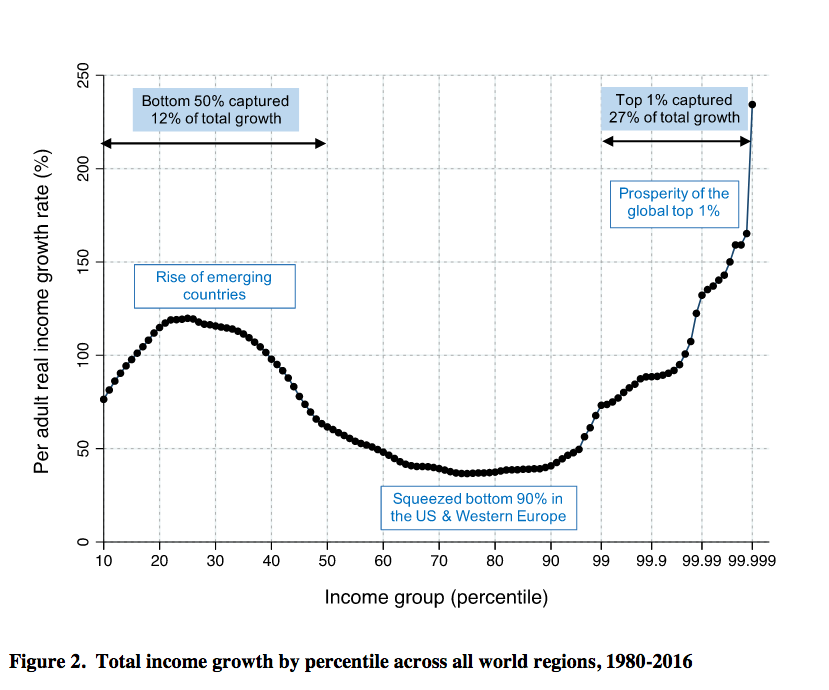
Many reports have shown how inequality around the world is on the increase. This article, in The New Yorker neatly summarises the findings of the French economist Thomas Piketty on this issue.

The famous “elephant graph” (so called because of its shape) shows what’s happened over the last four decades.

elephant graph

Is this inevitable?
Surely not. It wasn’t always the case, and it’s actually changing. If we want to change it in a different direction we’ll need to get to grips with ways in which the richest manage to grab and hoard their wealth.

A recent story reported that, in the US, Amazon, despite making a profit of $11.2 billion, they’ll not only be paying zero Federal tax, but will actually receive a tax rebate of $126 million.

It’s not only the richest corporations who work hardest to pay as little tax as they can. Individuals do too. The CEO of Ineos, the UK’s richest man, is moving to Monaco to save £4 billion in tax. His two wealthiest executives are following suit.

The “Panama Papers”, leaked from the offshore law firm, Mossad Fonesca, revealed, amongst other things

“the myriad ways in which the rich can exploit secretive offshore tax regimes. Twelve national leaders are among 143 politicians, their families and close associates from around the world known to have been using offshore tax havens. A $2bn trail leads all the way to Vladimir Putin. The Russian president’s best friend – a cellist called Sergei Roldugin – is at the centre of a scheme in which money from Russian state banks is hidden offshore. Some of it ends up in a ski resort where in 2013 Putin’s daughter Katerina got married. Among national leaders with offshore wealth are Nawaz Sharif, Pakistan’s prime minister; Ayad Allawi, ex-interim prime minister and former vice-president of Iraq; Petro Poroshenko, president of Ukraine; Alaa Mubarak, son of Egypt’s former president; and the prime minister of Iceland, Sigmundur Davíð Gunnlaugsson.”


The “Paradise Papers” are another big data leak related to a separate company showed many, many, similar examples

“Key revelations include:
Millions of pounds from the Queen’s private estate has been invested in a Cayman Islands fund – and some of her money went to a retailer accused of exploiting poor families and vulnerable people.
Prince Charles’s estate made a big profit on a stake in his friend’s offshore firm.
Extensive offshore dealings by Donald Trump’s cabinet members, advisers and donors, including substantial payments from a firm co-owned by Vladimir Putin’s son-in-law to the shipping group of the US commerce secretary, Wilbur Ross.
Twitter and Facebook received hundreds of millions of dollars in investments that can be traced back to Russian state financial institutions.
The tax-avoiding Cayman Islands trust managed by the Canadian prime minister Justin Trudeau’s chief moneyman.
The Formula One champion Lewis Hamilton avoided taxes on a £17m jet using an Isle of Man scheme.
Oxford and Cambridge and top US universities invested offshore, with some of the money going into fossil fuel industries.
A previously unknown $450m offshore trust that has sheltered the wealth of Lord Ashcroft.
The man managing Angola’s sovereign wealth fund invested it in projects he stood to profit from.
Apple secretly moved parts of its empire to Jersey after a row over its tax affairs.
How the sportswear giant Nike stays one step ahead of the taxman.
The huge tax refunds given by the Isle of Man to the owners of private jets.
Offshore cash helped fund Steve Bannon’s attacks on Hillary Clinton.
The secret loan and alliance used by the London-listed multinational Glencore in its efforts to secure lucrative mining rights in the Democratic Republic of the Congo.
A former UK minister who defended tax avoidance has a Bahamas trust fund.
The complex offshore webs used by two Russian billionaires to buy stakes in Arsenal and Everton football clubs.
Stars of the BBC hit sitcom Mrs Brown’s Boys used a web of offshore companies to avoid tax.
British celebrities including Gary Lineker used an arrangement that let them avoid tax when selling homes in Barbados.
Prominent Brexit campaigners have put money offshore.
The Dukes of Westminster pumped millions into secretive offshore firms.
A tax haven lobby group boasted of “superb penetration” at the top of the UK government before a G8 summit that was expected to bring in greater offshore transparency.
The law firm at the centre of the Paradise Papers leak was criticised for “persistent failures” on terrorist financing and money laundering rules.
Seven Republican super-donors keep money in tax havens.
A top Democratic donor built up a vast $8bn private wealth fund in Bermuda.
The schemes used to avoid tax on UK property deals.
The celebrities, from Harvey Weinstein to Shakira, with offshore interests.
How a private equity firm tried to extract £890m from a struggling care home operator by making it take out a costly loan.
Trump’s close ally Robert Kraft, the New England Patriots owner, is the longtime owner of an offshore firm.
One of the world’s biggest touts used an offshore firm to avoid tax on profits from reselling Adele and Ed Sheeran tickets.”

It’s only the wealthiest individuals and companies which go to such lengths to contribute less of their wealth to the societies in which they made their gains.
Meanwhile, at the other end of the scale, there is a growing evidence that increasing minimum wages is a great way to make positive impacts on populations.

A 2011 national study showed that low-skilled workers reported fewer unmet medical needs in states with higher minimum-wage rates. In high-wage states, workers were better able to pay for the care they needed. In low-wage states, workers skipped medical appointments

“Studies have linked higher minimum wages to decreases in low birth-weight babies, lower rates of teen alcohol consumption and declines in teen births. A 2016 study published in the American Journal of Public Health found that between roughly 2,800 and 5,500 premature deaths that occurred in New York City from 2008 to 2012 could have been prevented if the city’s minimum wage had been $15 an hour during that time, instead of a little over $7 an hour.”

None of these issues can be tackled in isolation. They need co-operation and collaboration. That should encourage us, because these are two of the greatest strengths of the human species.


Read Full Post »

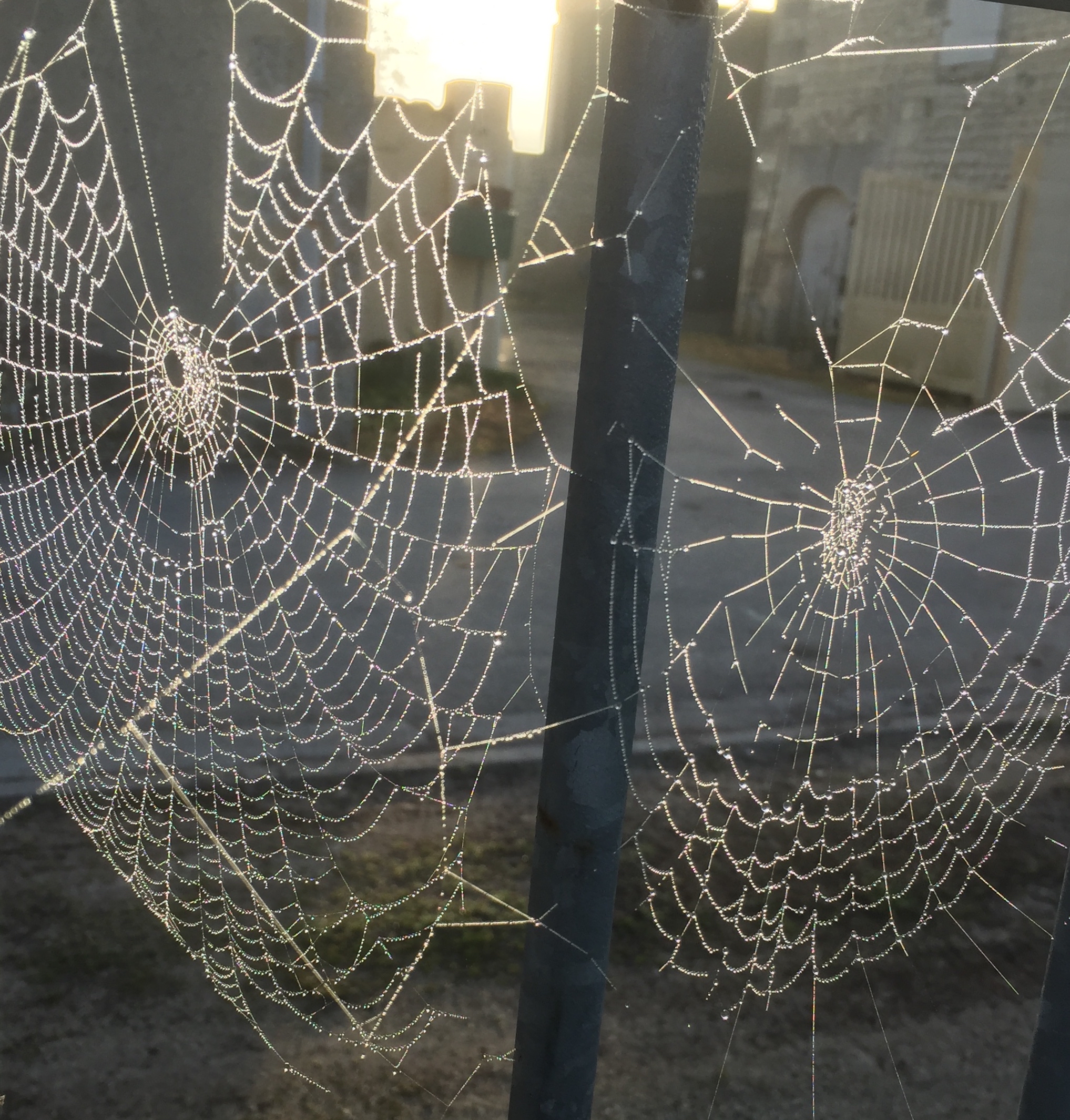
two webs

How do you have a healthy population of human beings without a healthy environment? Isn’t it pretty obvious the two issues are linked? Because there are no human beings who live outside of the environment. You could even say that it’s a false distinction. There is no “us” here, and an “environment” over there. It’s not like the environment is a foreign country you can visit with a tourist visa.
But what do I mean by environment? I often find I’m tempted to write environment in the plural, to talk about “environments” rather than a singular object called “THE environment. Because the environment is just the circumstances in which we live. It’s that vast web of connections which weaves every single individual into the whole.
There’s a physical environment of earth, air, water and fire. There are the cyclical environments of energy, of heat, cold, wind and rain.
There are the geographic environments of place. There’s a long running French TV series called “Rendez vous au terre inconnu” (Meeting in unknown places), where someone spends two weeks with a remote tribe and a camera crew capture the experience. I love it. It’s done with great sensitivity and compassion. Every episode opens your eyes to other ways of living and it is frequently surprisingly moving. It’s very human. In one episode they did return visits to three places and showed each group the original films of both their own place and the places of the other two. One group lived high in the mountains, one in a region of permanent snow and ice, and a third on houses built on poles in the sea. It was startling to see such diversity and to see each group express their astonishment that other people could choose to live so differently. There’s no doubt that the physical places where we live influence our daily habits, our diets, our whole outlook and our patterns of disease and health.
City dwellers face different challenges from rural ones. Coastal communities different ones from desert dwellers. And so on.
But there are other, less visible, environments. Our social environment of family, friends, colleagues and neighbours. Our cultural environment of values, practices and beliefs. Our political environment of laws, limits and agreements. And so on.
We live embedded in all of these and more. We are influenced by them, and we influence them.

 
In the books as “Linked”, by Barabasi, “Connected”, by Christakis, “The Bond”, by Lynne McTaggart, and “The God Problem”, by Bloom, we can see how we live in networks of relationships which influence everything from or chances of becoming obese, or catching certain infections, to the daily choices we make. We are not as “individual” and separate as we think we are.
Look how “memes” spread, how videos become “viral”, how quickly behaviours and attitudes spread across cultural and physical borders through social media.
If we want to create healthier populations we have to address these environments.
I was going to write about things like the number of industrial chemicals which can be detected in the blood of new born babies in Paris, or the insecticides, fertilisers, herbicides present in everyone’s urine, or the number of prescription drugs which are present in our drinking water, or the amount of plastic washing up on remote islands, or even the estimated 400,000+ people who die every year in Europe from disease caused by air pollution.
But I’m not going to.

You can read any of these kinds of details any time. If those sorts of stories don’t appear in your newsfeeds, you can search for them online. They really are not hard to find.
No, the only point I want to make here is that we do not live separate lives, so if we want to create healthier societies we need to pay attention to our multiple environments. We need to understand them better, then make some different choices. Together.

Read Full Post »

bouqin

This is one in a series of articles about health. There’s an almost unspoken belief that the way to make people healthier is through Medicine, and the Health Services through which Medicine is delivered. I’m not sure that’s true. Some of the most striking improvements in population health throughout history have come through the provision of clean water, effective sewage systems, and making such changes as housing the population in better houses, reducing malnutrition, and tackling poverty.
I think it’s important to deliver good health care, and, for me, that means both adequately resourced health care, and, perhaps more importantly, human-scale health care.
What do I mean by that?
Health care where the day to day, hour by hour, minute by minute focus is what human beings do together. It’s caring, compassionate, staff who are well educated in engaged and committed relationships with those who are suffering.
But one thing is clear. The demand for health care is increasing, and shows no sign of tailing off. The higher demands rushing fast down the pipeline come from demographic change with many more people reaching old age, and, consequently, many more with chronic illnesses, complex needs and, ultimately a requirement for good, end of life care before they die.
If we want to tackle the rising demand, we have to deal with the causes of ill health, and if we restrict our focus to individual behaviours, we’re going to fail. We have to deal with the economic, social, and environmental causes of ill health if we want people to live more of their lives in good health.
I’ve written about housing and food so far, and here I’d like to explore education.
Some people claim that education is THE most powerful way to make an impact on population health and it’s a hard claim to refute. Education can improve health in many, many ways, some more obvious than others.
For example, education can reduce poverty and improve incomes, enabling people to find more adequate shelter and to eat more nourishing diets. Education is particularly effective when focused on women and girls. Educated girls and women tend to be healthier, have fewer children, earn more income and provide better health care for themselves and their future children. It reduces maternal deaths and helps to combat infectious diseases, including HIV and AIDS.
Did you know that a child whose mother can read is 50% more likely to live past the age of five?

education and health

Don’t you think that’s stunning?
If you want to explore this further have a look at the United Nations 17 Sustainable Development Goals.
But there is another aspect to education I’d also like to consider. It’s the education embedded in the ordinary doctor-patient consultation. Or at least, it could be. One of the first tasks of a doctor is to make a diagnosis, which is a way of saying to arrive at an understanding. The doctor tries to make sense of the patient’s story, of their symptoms and of the signs of disease in their bodies. A diagnosis unlocks the door to effective treatment, and by effective treatment I mean whatever encourages a restoration of health (though, sadly, many treatments don’t do that, they just either maintain the status quo, or slow the progression of the illness, but with less suffering).
Why shouldn’t diagnosis be a shared experience? Not just a label applied by the professional. One of my favourite diagnoses to illustrate this labelling behaviour is “Idiopathic Urticarial Syndrome”. A patient goes to the skin specialist with an itchy rash. They don’t know why they’ve got it. They don’t know what it is. But the skin specialist does. It’s “Idiopathic Urticarial Syndrome”. Well, here’s a secret. “Urticarial” means an itchy rash (OK, it’s a particular kind of itchy rash, one with “weals”, which is another word for “urticaria”). “Idiopathic” means in this particular case we don’t know what is causing it. If we knew what was causing it, it wouldn’t be idiopathic. It’d be an allergy to washing powder or whatever. “Syndrome” is a trick word. It’s sounds like the name of a disease but actually it’s a collective word for a group of symptoms (and maybe some signs). So, having sought help with an itchy, urticarial, rash whose origin is unknown to you and which you don’t understand, you now know you have an itchy, urticarial rash, whose origin nobody knows, and which nobody actually understands.

There is a different way.

Rather than seeing a diagnosis as an end point, it I can be thought of as a level of understanding. Then the doctor can take it as a step forwards, not a job done. A step towards a better, deeper, broader understanding of the patient. They can explore some of the mystery, the when, where and even the why of the illness. I think this is a form of education. It’s the doctor educating themselves about this particular patient.
An exploration of the circumstances of an illness, probing the when, the where and the possible why questions, is an opportunity for education for the patient too.
If somebody understands better what is going on, and what the initiating and maintaining factors might be, they can make other choices. Choices which might well lead to restoration of health.
One of my most favourite questions in a consultation was to ask the patient when they last felt completely well. It might take a bit of encouragement to get there, but most people can identify the period of their lives before this illness began. Having identified the time around the change from health to illness, I’d then explore what was happening in the patient’s life around that time.
I can’t tell you how many times that was like a light bulb going on. “Do you think my mother’s death might have had something to do with getting ill?” “Do you think losing my job, getting divorced and the death of my brother all in the same month might have had something to do with this?”
Of course, I could never answer a simple yes. It was just a helpful way to begin to explore the potential factors, their impacts, and what someone could do to tackle the ongoing effects.
I’m sure this isn’t possible in every single encounter, but it’s something to bear in mind. Ideally, all doctor-patient consultations can be therapeutic ones, and perhaps the best way for them to be therapeutic is when both the doctor and the patient learns something from the experience.
Learning from experience is definitely a powerful education.

One of my friends says “If everything that goes wrong is a learning experience I’d have a bloody PhD by now!”

Read Full Post »

spanish oranges

How do we reduce demand on over-stretched health services? Well, it might help to work towards a healthier society. Whilst it’s important to give health services enough resources to look after the sick, it’s not Medicine, not drugs, nor vaccines, nor “gene therapies” which have ever made the greatest contributions to population health. And it never will be.
As best I can see there are a number of issues to consider and all of them involve we human beings working together to create healthier societies. It’s what we can achieve when we work together that really impresses me. Sure, individual choices, personal behaviours and so on can result in valuable improvements for each of us in our own lives, but we don’t live in isolation. We are embedded in complex webs of environments and societies. If we don’t pay attention to those environments, our personal choices run the risk of being overwhelmed by the noxious factors outwith our individual control.
The first issue I explored was housing. After all, without adequate shelter, human beings perish. And with over-crowding, poor sanitation, inadequate supplies of clean water and power millions suffer from poor lives and are vulnerable to the ravages of acute infections, trauma and a growing number of chronic inflammatory conditions.
The second issue I’d like to explore is food.
Patients often asked me if I had a “diet sheet”. I didn’t. Maybe that was naive of me, but I don’t believe that one “diet” fits all. We are all different. Not only in our tastes, but in our tolerances, and even our needs. I think healthy diets can be as varied as human beings are. Yeah, sure, too much this, and too much that, is rarely healthy, but trying to single out a particular food or food group as “good” or “bad” always struck me as foolish. No single food is a miracle cure for anything, and no natural foodstuff is just downright bad.
I’ve always admired the work of Michael Pollan. Two things he has said are especially helpful. The first is “Eat food. Mainly plants. Not too much.” That seven word dietary advice seems very wise to me. Starting at the end, the “not too much” captures the need for both moderation and variety in a healthy diet. “Mainly plants” points to the fact that too much meat can be a problem. And “eat food”, although that sounds strange advice, actually captures one of the most important points. Why should we eat anything that isn’t food? Isn’t everything that we eat food?
Well, what he means by this is that the less processed a foodstuff is, the more likely it is to be nutritious. That connects well to the second point he makes, which is captured by asking yourself, “who made this food?” Because if it was made by human beings it’s more likely to be nutritious than if it was made by machines in a factory.
The more a foodstuff is processed, the more chemicals which are added to make it last longer, look a different colour, artificially change its flavour, the chances are, the less nutritious it’s likely to be.
This simple advice to “eat food” pushes us towards eating what is produced locally and seasonally. It’s one of the things I enjoy most about life here in the Charente since I moved here from Scotland. There is a local market every day except a Monday in Cognac, and within a short distance from here there are a large number of other interesting weekly markets. The markets regularly have stalls of locally produced, seasonal foods. The “locally” bit doesn’t mean only whatever is produced within the surrounding countryside. But it’s a sort of tendency. Yes, you can get what local farmers produce, but you can also get what’s grown in France, rather than what’s arrived from boats and planes over thousands of kilometres. And if you don’t see what you fancy from the local farms, or from France, then you can go a little further, and buy fresh produce from Spain or Portugal. Everything is labelled clearly. You can see how far it’s come.
I look forward every year to the Corsican clementines, the white and the green asparagus, the locally grown strawberries and raspberries, the various types of French apples and pears, the season of the walnuts, chestnuts, truffle. I swear that eating whatever is “in season” just tastes better. Is it healthier? I don’t know, but I want to eat food which is more than just “healthy food”, I want to eat food that is delicious.
The photo I’ve used at the start of this post is an example.
There is a network throughout southern France of Spanish orange growers and traders. They claim the time from tree to the stall in a local town car park is a matter of days. I have no way of verifying that but I can tell you I’ve never tasted orange juice quite this delicious.
Well, that’s me, and my personal circumstances. Yours will be different. But here’s my point.
The more we industrialise food production, the more we reduce its potential nutritious value, and the more we run the risk of non-food consumption of a mind-boggling list of man-made chemicals. This goes all the way back to the farming methods. Factory farming of cattle, pigs, chickens, and of plant crops, demands huge inputs of energy and chemicals, from antibiotics, to growth hormones, pesticides, fungicides, insecticides and so on. All these additives in the food chain aren’t food.
Even without considering the ethics of rearing animals in these conditions of mass overcrowding, one of the biggest problems is that these factory farms mainly feed other factories…..the ones which “process” the original plants and animals so much that you often can’t be sure what you are eating by the time it arrives on your plate. Is that beef, or horse? What part of the animal is used to make those nuggets? The label shows a list of substances you struggle to pronounce, and you sure don’t know what they are doing there, and whether or not they are at least not harmful, or, at best, good for you.
So can we apply these principles to food? The basis of all health? Good, nutritious, delicious food?
What if we prioritised, favoured, both personally, but also at the level of society through economic and political policies and controls, the following qualities –

  1. Less added chemicals – at all stages – from the farm to the shop
  2. Less processing and more transparency – so we can know what we are eating
  3. Less transporting – which will favour more local, more seasonal, fresher food
  4. More variety – every study I’ve ever read shows that populations which have more variety in their diets, often because they eat more seasonally, have longer, healthier lives.

The food economy of a society impacts the planet and its climate, the soil and the oceans, all forms of life, and, in particular, the health of whole populations.

Read Full Post »

cordes sur ciel

There’s a lot of talk about the increasing strain on health services, something I’ve addressed here.

One of things that bothers me about these discussions is the assumption that increasing funding and resources to the health care system will result in a healthier population, which will, in turn, reduce the demand on the health services. This has never happened. And it’s not likely to happen.
The health of a population mainly comes down to how we live, not to the medicines we swallow or how quickly we can get an operation. Let me just clarify that I’m not arguing against more resources and funds for the health service, we need that to improve them. It’s just that this isn’t a way to create a healthier population and so reduce demand.
To create a healthier population we need to invest in what creates better lives. Better lives for as many people as we can.
There are many ways to do this. But let’s start with housing. Because decent housing, warm, weather-proof, houses with enough living space, clean, running water, an efficient sanitation system, and affordable, reliable power, is a foundation for healthier lives.
Would anyone argue otherwise?
If people are homeless, or living in insanitary, unsafe, overcrowded conditions, then they are more likely to get sick – both in the short term, with infections, and in the longer terms, with chronic, inflammatory conditions. I’m not going to list references here. Google these issues for yourself. But I am going to claim that adequate shelter is a necessary first step to better health for a population.

There are many factors and problems to consider here, but I just want to focus on one – waste – the number of abandoned and/or unused dwellings in every town and city.
When I think about this I can’t help also becoming aware of “high streets” full of empty, abandoned shops and offices. So, let’s take that into consideration too. Because when the town centres empty of commerce they aren’t only dying, depressing and, possibly, dangerous, but they represent a huge waste of opportunity for people to work and live together. We need shops, offices, workshops, cafés, restaurants, exhibition and performance venues, to have a healthy community. It’s no good just building lots of apartments in streets which are devoid of the possibilities for people to meet, share, and work together.

Take a walk around the streets where you live, both the residential streets where you dwell, and the town streets you visit most often for shops, offices, cafés, restaurants, and so on.
How many properties are sitting closed up and seemingly abandoned?
At the same time, are there homeless people in your locality? The homeless might be obvious sitting or lying on the pavements, in the doorways of closed shops, or they might be invisible to you, struggling to get by in bedsits, guest houses or hostels. What about decent housing? Is there anyone living in sub-standard, even unsafe properties? Is there anyone housed in overcrowded conditions with landlords maximising their income by minimising the personal living space of their tenants? Are the streets of your town vibrant, filled with people socialising and satisfying their daily needs and desires, for material , social and cultural goods?

I’m asking because it seems to me that it’s very common to find so many shops, offices and houses that look abandoned that a whole area feels either unsafe or unhealthy. The French have a word for it – désertification…..where a once vibrant locality becomes a desert. What could we do to turn this around? Here’s one idea.

A policy of compulsory purchase and leasing.

What if the local authority, the Council, or the Commune, had the right to compulsorily purchase, in its area of jurisdiction, any property which was uninhabited or unused for at least five years? What if all such properties could be compulsorily purchased for the current independent valuation price, then leased out to new tenants?
Residential properties could be rented out to those on housing benefit, paid for directly from the tenants’ housing benefit, instead of the current situation where these benefits go straight into the pockets of private landlords. Some properties could also be rented at commercial rates to either individuals or groups of individuals, encouraging a healthy social mix in the community.
Additionally some could be offered for sale, either directly at market rates, or using co-ownership schemes, where part of each month’s rent is allocated towards the final purchase of the property by the tenants. In a co-ownership scheme, an additional idea could be to agree a contract of improvement and renovations of the properties which would be paid for by the initial rental payments. For example, a property requiring £50,000 of work, and valued at a monthly rental of £1000, could have the works paid for by the first 50 rental payments.
Commercial properties, shops, workshops and offices could be offered rent-free for new tenant businesses. Instead of paying rent, the Council or Commune could be empowered to collect the VAT generated by these businesses, keeping that element of taxation for local use, instead of it disappearing into national funds.
The income streams to the councils from the housing benefits, domestic rents, co-ownership contracts, sales and locally ring-fenced VAT could then be used to make more compulsory purchases.
I’m sure somebody else will be able to take this idea and refine it considerably, but the basic idea is to favour circulation of property and wealth in the local economy and environment, instead of the current picture of stasis and decline.
Community associations, and co-operatives could be included in such schemes. In other words, it’s not just something for independent businesses and entrepreneurs, but something which could also encourage community led activities. Workshops, recycling services, training and education courses, as well as libraries, galleries, theatres and music venues.

Bringing life back to our existing communities by prioritising decent housing for everyone and supporting the daily opportunities for people to live, work and play together, would be a good beginning, if we want healthier populations who have less need of health services.

I’ll explore some other factors in later articles, including food, education and inequality. But maybe you’d like to share your own ideas? If you do, on your blog, your youtube channel, your instagram feed, or wherever you express yourself, please let me know. I’ll include links to your ideas in my posts.

Read Full Post »

petite philo des oiseaux

I’ve just finished reading Philippe Dubois and Élise Rousseau’s “Petite Philosophie des Oiseaux”. It reminds me a book I read last year – Emanuele Coccia’s “La vie des plantes”. Both books look at a non-human realm of life and use reflections on the lifestyles and life strategies of, in the first case, birds, and in the latter, plants, to stimulate the reader into reflecting on aspects of what it is to be human.
I’ve never read any books like these in English, so they are a validation of one of my main reasons to retire to France from Scotland – to learn another language and explore a whole other way of thinking and living.

Migration

There are lots of fascinating, even astonishing stories about birds in the “Petite Philo…” book. For example, the “bar tailed godwit” (which has a much nicer French name – “La barge rousse” – which migrates back and forward between the Alaska and New Zealand. It flies non-stop 11,000 km (that’s over 6000 miles) in about a week, meaning it flies at 70 km/hr! All that in a bird which weighs only about 300 grams. Can you imagine? How does it fly all that way without stopping even once? Apparently, when it sleeps, only half of its brain sleeps, the other half staying awake. How would you fancy developing that skill? (Mind you only using half your brain isn’t that uncommon – ha! ha!)
Lots of birds migrate of course, and nobody knows how they find their way so precisely that they return to the exact same nesting sites every year. Think of the cuckoo whose parents abandon it into another bird’s nest when it is just an egg, but when ready, the chick flies off and travels to Africa from Europe! How does it know how to do precisely that?
The Artic Tern is the most traveled of all the migrators. Here’s what wikipedia has to say about it –

A 2010 study using tracking devices attached to the birds showed that the above examples are not unusual for the species. In fact, it turned out, previous research had seriously underestimated the annual distances travelled by the Arctic tern. Eleven birds that bred in Greenland or Iceland covered 70,900 km (44,100 mi) on average in a year, with a maximum of 81,600 km (50,700 mi). The difference from previous estimates is due to the birds’ taking meandering courses rather than following a straight route as was previously assumed. The birds follow a somewhat convoluted course in order to take advantage of prevailing winds. The average Arctic tern lives about thirty years, and will, based on the above research, travel some 2.4 million km (1.5 million mi) during its lifetime, the equivalent of a roundtrip from Earth to the Moon over 3 times

When you read something like that it’s kind of hard to hang onto a belief that human beings are the most superior of all the animals. We need our rather flawed GPS systems to navigate. They just do it.

Living in the moment

I think that’s one of the main themes of the book, actually. In one passage they say (and this is my translation, so sorry if it’s not perfect! The Aegithalidae are what we call, in English, “tits”. In French, they are “mésanges”).

mesange


But the little tit, does she have any need of the idea of death? No, certainly not. Because making the most of every moment, appreciating every seed she gleans, every ray of sunshine, she does all that already. She doesn’t need someone to teach this truth, she doesn’t need to philosophise: she is already wholly immersed in her life.
The tit doesn’t look forward, doesn’t make plans, doesn’t put things off until tomorrow, doesn’t imagine that things were better in the old days. She lives.


Intelligence

One of my favourite chapters in the one about intelligence, subtitled with a phrase, which, in English, would be “Bird brain!”
When we call somebody bird brained we’re insulting them. But is it true that birds are not intelligent creatures? No!
Just because they have relatively small brains, doesn’t mean they must be relatively stupid. The authors point out that some men have even tried to claim that they are intellectually superior to women because men have bigger brains the women! That hasn’t worked out so well either, has it guys? In fact, birds’ brains have twice as many synapses (connections) in them than the brains of elephants, chimps, or other mammals.
After musing a bit about just what is intelligence anyway? After considering the issue of different kinds of intelligence, including musical and emotional, they describe a number of quite amazing bird behaviours.
Did you know that Blue Jay looks ahead to winter by collecting nuts and seeds and burying them for colder months to come, but if they see another Blue Jay, or other bird, watching them, they’ll pretend to be burying food when they aren’t really?
Some crows have been observed places nuts on the road at traffic lights, when the lights are at red, then when they turn green, the cars run over the nuts to crack them open. The crows wait till the traffic light turns red again, then swoop down to get the nuts.
An experiment done on magpies involved putting a red mark on their brow. When the magpie saw itself in a mirror, it tried to scratch off the red mark.
There are many other examples.

The question the authors ask is shouldn’t we consider that adaptive intelligence, learning how to change your behaviour according to the conditions and environment, actually one of the best kinds of intelligence to have?
As we heat our planet up, fill our oceans with plastic, and our soil with toxic chemicals, it’s tempting to think we’ve got a bit of catching up to do when it comes to adaptive intelligence!

Read Full Post »

Usefulness of the Useless

Nuccio Ordine argues that “usefulness”, when thought of as that which has utility, which can make money, or which can be practically applied to solve a problem, limits our capacity to be fully human. His thesis is that utility has its limits, but in recent times, I think particularly during industrialisation and the spread of capitalism, utility has acquired a dominant position. He argues that this dominance impedes our ability to become fully human and live satisfying lives.
His own idea of “usefulness” is “everything that helps us become better” – by which he means anything which helps us grow, anything which helps us to develop and, to live more meaningful, richer lives.
He is concerned about “the logic of profit” and how political leaders nowadays are always talking only about money. He claims that leaders in the past, for example spiritual leaders, would teach about value, honor, and purpose…..qualities and values in life which couldn’t be purchased. What’s worse he says, is that this overwhelming emphasis on money isn’t making life better for most people. He gives the examples of the 2008 financial crash and the use of austerity measures by Western governments since, and he also cites the huge growth in inequality especially over the last few decades.
All of that is maybe not so earth-shattering. I’m sure we’ve all thought about those things before, and we probably find ourselves in conversations about that a lot. But then things start to get really interesting when he says

“In the universe of utilitarianism, a hammer is worth more than a symphony, a knife more than a poem, and a monkey wrench more than a painting: because it is easy to understand the efficacy of a tool while it is ever more difficult to understand the utility of music, literature, or art.”

That’s a beautifully written passage and at that point I begin to think, hey, yes, isn’t that true? How much does music, art and literature mean to me? A lot! But I couldn’t for the life of me tell you why that’s “useful”.
I don’t listen to music, look at art, read or write to some “end”, to “achieve some goal”. And I think there’s something in there for me to remember, because I think when I write non-fiction, like these blog posts, maybe I’m consciously, or at least sub-consciously, writing to make things better. In other words, writing for a purpose. Yet, I often find it annoying when I read texts written by others who have that same goal! Elisabeth Gilbert says in her “Big Magic” book…“please don’t write a self-help book”?

Big Magic

Then he says

“Now it is important for me to underline the vital importance of those values that we cannot weigh and measure with instruments calibrated to assess quantitas and not qualitas. And, at the same time, I wish to make a claim for the fundamental nature of those investments that do not produce immediate returns and cannot be turned into cash.”

People not data

Well, that’s right up my street again, because I have felt for a long time that the most important aspects of medical practice are NOT what can be measured with the machines, but rather the qualities which individuals experience.
I’ve never really been satisfied by visual analogue score systems that try to reduce human experiences and stories to numbers in a range. I remember once having dinner with some dentists after having delivered an address to their annual meeting. The subject was symptoms, such as pain….what they meant. One of them told me about a chronic facial pain clinic which they’d taken over from their predecessor. They were a bit taken aback when they asked the first patient, “How are you doing?” and they replied “9”, then the next patient did the same thing. “How are you?” “7”. The whole clinic proceeded that way. Puzzled, he asked one of the clinic nurses what was going on, why were people responding to his questions with numbers? “Oh, Dr. X, your predecessor devised a scoring system for pain and he trained the patients to tell him what number on the scale represented their pain level. If someone began by telling him a story about what had happened since their last visit, he’d say “Stop. I want the next thing that comes out of your mouth to be a number. Nothing else!” He was pretty scary.”
Numbers aren’t a good way to understand human beings.
However, the author says more than that….he says he wants to make the case for investing in what does not produce immediate returns or money. He wants to make the case for curiosity, from the satisfaction that arises from understanding something better, for the joy of wonder, and for all those apparently “useless” activities that make us human – singing, dancing, drawing, painting, and the pursuit of knowledge.

Effort and passion

“True, everything can be bought. From legislators to judges, from power to success: everything has its price. But not knowledge: the price to be paid for knowing is of a completely different kind. Not even a blank check would allow us to acquire mechanically what is the exclusive fruit of an individual effort and an inexhaustible passion. No one, in short, can tread the laborious path to learning in our stead.”

Learning takes effort. It’s a personal pursuit. Nobody can learn for you. The key there for me is “the exclusive fruit of an individual effort and an inexhaustible passion” – effort and passion – a great combination!
Nobody can learn something for us. Knowledge doesn’t just appear. You can’t just buy it from a shop. It takes time and it takes effort. And there is the key – it’s in the living – it’s in the personal “journey” (oops, don’t like that word very much), it’s in the everyday experiences which gradually make us who we are. He quotes from Dickens’ “Hard Times” on this subject, describing his character, the teacher, Thomas Gradgrind’s approach to education –

“In this life, we want nothing but Facts, sir; nothing but Facts!” The enemy of teaching open to imagination, sentiments, and affection, Gradgrind is introduced “with a rule and a pair of scales, and the multiplication table always in his pocket … ready to weigh and measure any parcel of human nature, and tell you exactly what it comes to.” For him, education and life are reduced to a “mere question of figures,” to a “case of simple arithmetic.” Just as the young pupils are considered to be “little pitchers before him, who were to be filled so full of facts.”

He also quotes Socrates –

“It would be really fine, Agathon, if knowledge were able to flow from the fullest to the emptiest among us and all we had to do was to be in contact one with the other, like the water that flows along a woollen thread from the fuller goblet to the emptier one.”

That reminded me of when I was a teenager. My best friend and I were insatiably curious kids, always finding things out together and conducting our own experiments. We came across the notion of sleep learning. So my friend hooked up a cassette player to two long wires attached to an old loudspeaker we’d salvaged from an old valve radio, and placed the speaker under his pillow. He got me to recite his French vocabulary for the week onto the cassette tape and set the recorder up with a timer so it would come on during the night and play him the words in his sleep…….didn’t work! He didn’t remember a single one of them!!
So learning doesn’t come without effort!
Mutual benefits of sharing

The next point Nuccio Ordine makes is that knowledge challenges the laws of the market place because we can share our knowledge with others without making ourselves one bit poorer. In fact, it’s the opposite – when we share our learning we both gain – both teacher and learner.

“I can teach a student the theory of relativity or read together with her a page of Montaigne thereby giving rise to a miraculous virtuous circle in which both the giver and the receiver are enriched at the same time.”

My experience of teaching, especially in Japan, was that every single time I learned something. I never came away thinking I’d been giving something away in the sense of losing something, or that I was making myself poorer. I felt that I, too, had gained. I learned a new way of explaining something, or I saw a new connection, or I learned a different way of looking at something. I always came away feeling enriched.

Then read this –

“The gaze fixed on the objective to be attained makes it impossible to grasp the joy of little everyday gestures and to discover the beauty that pulses through our lives: in a sunset, in a starry sky, in the tenderness of a kiss, in a flower that blooms, in the flight of a butterfly, and in a child’s smile. Because, often, greatness is perceived better in the simplest things.”

Oh, isn’t that beautiful?? I love, love, love that! And there it is – “l’émerveillement du quotidien” – the wonder of the everyday….my favourite! If we fill our lives with the busy pursuit of short term goals, the days slip by, literally, without us noticing.

He says –

“Kakuzo Okakura, in describing the tea ritual, identified the pleasure of picking a flower to give to a lady friend as the precise moment in which the human species rose above the animals.”

Here’s the value of not only noticing, but choosing to share. Isn’t that where art, music and knowledge excel? I thought of the cave art I’ve seen in France. All those animals painted in the depths of the caves, something which took so much effort, but why? Nobody knows. Maybe that’s because we are so busy trying to figure out what use the art was, that we miss, not only the sheer pleasure of creation and the satisfaction of creation, but also how art adds meaning and purpose to life.

lascaux wall art

That got me thinking too about the cup and ring markings on the stones in Kilmartin valley. How nobody can explain them either. But maybe they are art not utility?

kilmartin cup and ring and bean

Seeing beauty and choosing to share it with another – that is a characteristic which makes us uniquely human.

“Being an artist,” says Rainer Maria Rilke in a passage from Letters to a Young Poet, “means, not reckoning and counting, but ripening like the tree which does not force its sap and stands confident in the storms of spring without fear that after them may come no summer.”
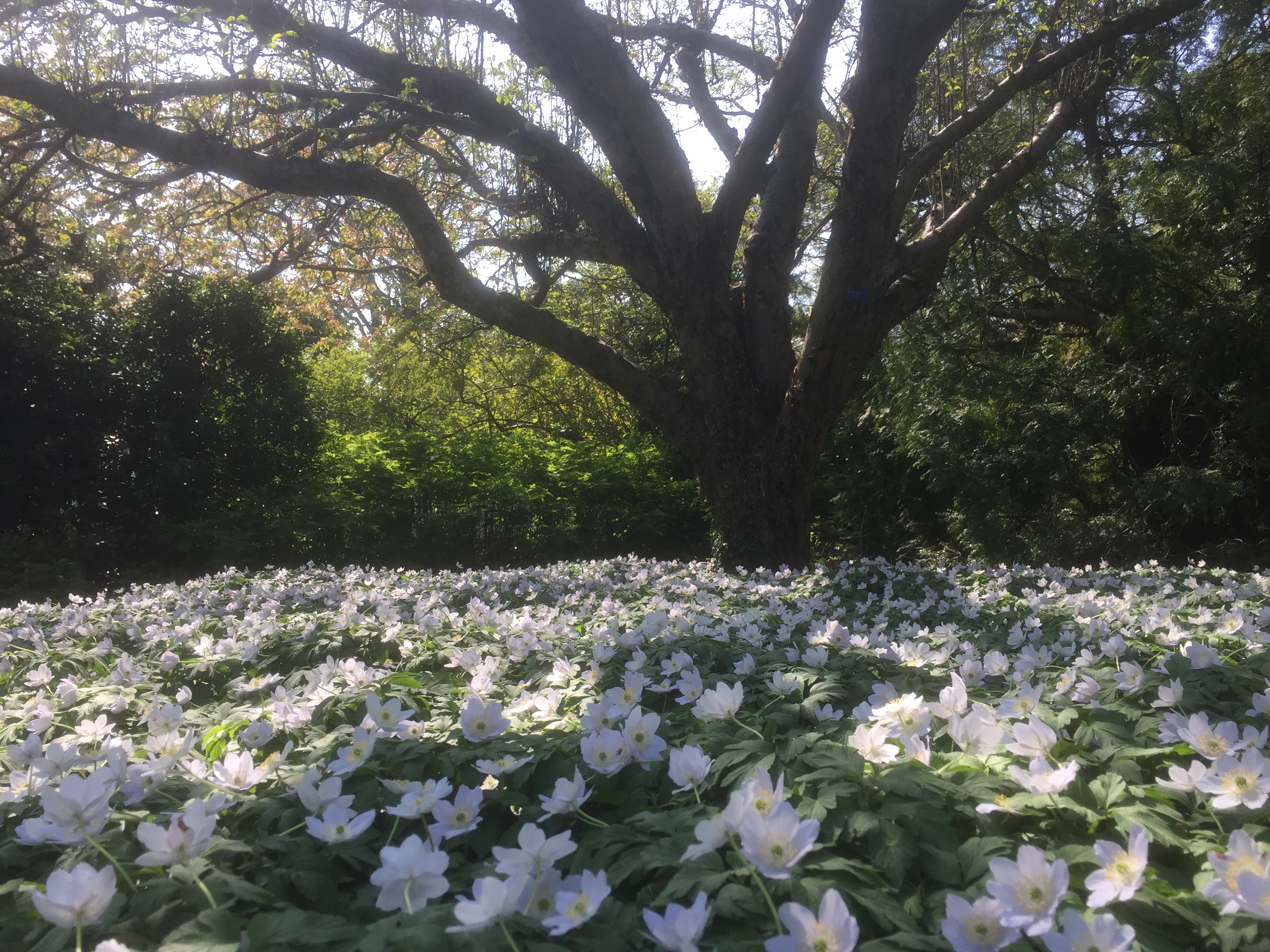
Not “reckoning and counting” but “ripening” – ooh, lovely. I love to watch the new buds appearing on the trees in the Spring, the opening of the bright green new leaves from the buds and the sudden appearance of the blossom.

budding cherry tree

Nuccio mentions Ionesco in the book,

“the need to imagine and create, is as fundamental as the need to breathe”

which is a slight twist on my previously understood “stories are as fundamental as breathing” But I agree, where would we be without our imagination and our creativity?

“Especially when there is an economic crisis, when the temptations of utilitarianism and the wickedest egoism seem to be the only star and the only lifeline, we need to understand that it is precisely those activities deemed useless that could help us escape from prison, save us from asphyxia, transform a dull life, a non-life, into a fluid and dynamic one, oriented toward a curiositas for the spirit and human affairs.”

Curiosity

That made me think of the whole purpose of my “heroes not zombies” blog. It touches on my core value of “curiosity” – curiosity and wonder as drivers in life, as opposed to the desire to possess and consume…..

Here’s another passage explaining his theme –

“While the biophysicist and philosopher Pierre Lecomte du Noüy invited us to reflect on the fact that “in the scale of beings, only man performs useless acts,” two psychotherapists (Miguel Benasayag and Gérard Schmit) suggest that “the usefulness of the useless is the usefulness of life, of creation, of love and desire,” because “the useless produces that which is most useful to us, which is created without shortcuts, without saving time, over and above the mirage created by society.”

Empathy and connection

Time for another insight which is shifting my thinking – this time he quotes the author, Mario Vargas Llosa –

“Mario Vargas Llosa, on receiving the Nobel Prize in 2010, rightly pointed out that “a world without literature would be a world without desires or ideals or irreverence, a world of automatons deprived of what makes the human being really human: the capacity to move out of oneself and into another, into others, modeled with the clay of our dreams.”

There’s the bit that struck me – “the capacity to move out of oneself and into another…” It’s not just that these “useless” activities are for fun, pleasure, or to satisfy curiosity. It’s that they move use out of ourselves and into another – stories do that for sure. Paintings do it. Music does it. I think of concerts I’ve been to where I feel moved to tears from the sheer power of the SHARED experience of the music with the other fans.

A work of art doesn’t ask to be born

“If we think about it, though, a work of art does not ask to come into the world. Or to borrow another splendid observation by Ionesco, the work of art “asks to be born” in the same way “as a child asks to be born”: “A child is not born for society’s sake,” the dramatist explains, “although society claims him. He is born for the sake of being born. A work of art too is born for the sake of being born, it imposes itself on its author, it demands existence without asking or considering whether society has called for it or not.”

I like this too. Another “satori” moment – all this creation, all this art, does not “ask to be born” – just like how we do not ask to be born – we are not born for the sake of society – or even to promulgate a few strands of DNA as Dawkins would have us believe! Can you think of art this way? Again I thought of Elisabeth Gilbert and how she talks about the muse – how if we don’t grasp it, it’ll travel off to find someone else who will!

Freedom

This book really resonated with me. It affirms the value of things like “blue sky thinking” instead of goal-orientated or problem-solving activities. It affirms the value of quality over quantity. But it also sings about FREEDOM – the freedom to BE, to BECOME, to explore, to follow your curiosity and your creativity – not to get to a particular place but JUST COS! Just cos its fun, it’s wonderful, it’s satisfying.

“Free men” have no problems with time and have to account to no one, whereas “servants” are ruled by the clock and by a master who decides”


I have no special talents. I am only passionately curious. ALBERT EINSTEIN,


It is pleasure, not possession, which makes us happy. MICHEL DE MONTAIGNE, Essays

Flexner

The book finishes with an essay from Abraham Flexner who created the Flexner Institute at Princeton University – an institute which offers academics of many disciplines some time there where the only thing they have to do is turn up and take part – nobody tells them what they should or shouldn’t research or teach. They are encouraged to dream, to imagine, to follow their curiosity and to inspire each other – and it goes on and on that way – the academics don’t work there for life – they go for a few months or years and then return to their other universities, jobs etc – then maybe years later will go again for another spell. Wow! I’ve never heard of such a thing! I’ve often heard university academics talk about how they were fed up chasing funding – that every single grant had to be applied for, fought for, and it had to be shown how the research would be USEFUL!
In this final essay, Flexner gives many examples of how scientists who were simply pursuing their curiosity, following a sense of wonder and a desire to simply understand more, often made discoveries which later led to world changing inventions. Others saw something practical or applicable in their discoveries and turned them into useful technologies, but they were building on the those very “blue sky”, free, thoughts and activities of their “less practical” predecessors.

I thoroughly enjoyed this book, as I’m sure you can tell. It’s a healthy riposte to the bean counters!

Read Full Post »

buddha kyoto

Mindfulness has become very popular, especially in America, where it has been pioneered by Jon Kabat-Zinn and others, but also in Europe. The French term for mindfulness is “en pleine conscience” – which more literally translates as “in full consciousness”.
I think it’s become so popular because it’s so helpful, particularly in the field of mental health where it has been developed through “Mindfulness Based Cognitive Therapy” (MBCT) to treat depression, and through “Mindfulness Based Stress Reduction” (MBSR), which does what it says on the tin.
But it’s more than a psychological tool for easing mental disturbances. It’s been found to influence the patterns of neurones and their connections (synapses) in the brain. Yes, it seems to actually have an influence on not just the function, but the shape, of the brain. This takes it into a realm beyond that of a therapy for diseases. As it develops the brain, so it can expand the mind. In other words it seems to have the potential to aid creativity, the growth of emotional intelligence and to increase resilience.

Freedom vs control
All through my working life as a doctor I was keen on therapies which did more than merely reduce suffering. A treatment which simply suppressed symptoms or kept a disease process under control, while potentially valuable (because who wants more symptoms and more disease?) was never that satisfying to me. I was always way more impressed with a therapy which enabled people to deepen their understanding of themselves and their lives, and free them up to grow and develop, to make life changing decisions, and, in so doing, to transform at least some of the underlying factors which caused their illnesses.
Mindfulness meditation is one such therapy. But then so are the exercises which enhance cardiac coherence, like “Heartmath”. And so are other meditation practices, whether they be “Vipassana meditation”, “transcendental meditation”, guided visualisation or “compassion meditation”.

Paying attention and non-judgement
As best I understand it, there are two fundamental tenets of mindfulness –

  • Paying attention
  • Non-judging

I would claim that these were the key tools of successful medical practice long before “mindfulness” became so popular in the West.
The absolute best I could ever do for any patient required that I paid attention to them, giving them my full focus, living together in the present time and place of the consultation. And that I listened with a determination to do two things – to understand them (through empathy), and to help them. I often thought that these were exactly the reasons why people came to consult me – to be understood, so that they could understand what was happening in their lives, and their bodies; and, to be helped, because they’d reached a place where they couldn’t solve their difficulties alone.
The non-judging part was equally crucial, because it’s one thing to pay attention, but if you judge what you hear it’s very hard to hear clearly. Judgement stops thought, as Hayakawa, the “general semanticist”, wrote in “Language in Thought and Action”

“A judgement is a conclusion……The premature judgement…often prevents us from seeing what is directly in front of us”

Diagnosis
Of course a diagnosis is a kind of judgement. It’s a summing up of the patient’s story, their symptoms and their signs. Diagnosis surely is the key to successful treatment. If you don’t know what you are treating, how can you offer the best treatment? So, I wasn’t against judgement as such, just “premature judgement”. In other words, trying to avoid reaching a diagnosis before I’ve paid sufficient attention.

Always more to discover
Ah, yes, I’m sure you’re thinking….so what is “premature” and what is “sufficient”?
And those are great questions. The answers to which are always “time will tell”. You can never be 100% in any particular moment that you’ve grasped the full story, that you’ve completely understood. In fact, it was quite common that patients would tell me towards the end of the consultation that they’d never told anyone the things they had just told me. But I’d respond to that by saying I don’t think anyone can be fully understood. In fact I think we each spend a lifetime trying to better understand ourselves and I’m not sure any of us reach a final, full point of understanding. There will always be more to discover.

“There will always be more to discover”

would be one of my mottos.

The ongoing relationship
Even when I’d made a diagnosis and initiated a treatment, it was important to follow through and follow up. To meet the patient again after an interval and to begin the loop of the spiral – to pay attention and to listen without judging. Failure to do that meant I’d potentially mis-judge how helpful the treatment was for this individual, and would deny me the opportunities to understand them even better.
It wasn’t unusual to hear a story from a patient which transformed my understanding of them, a story told by them several years into our therapeutic relationship. People who had told me several times things they said they’d never revealed to anyone else, could, after many, many consultations, tell me something of fundamental significance which they’d never even hinted at before. That kept me humble and reminded me of my motto “There’s always more to discover”.
I should just add here that my experience of sharing work with colleagues showed me time and time again that I could never say I was always the best person for the patient to work with. Other colleagues would discover things I’d never discovered, just as I’d discover things they’d never discovered. “There will always be more to discover” reminded me to be humble. I should never claim that I was “The One” who “knew best”.

Personalised Medicine
I think it’s those last two points which are forgotten about by some of the adherents of “Evidence Based Medicine”. The only way to know if a treatment is effective for this individual is to continue to pay attention, non-judgementally, to them. The Randomised Controlled Trials, and met-analyses, might help you to select a treatment but the proof is always in the experiencing, the personal experiencing. Only this patient can tell you whether or not their pain is improved, they are sleeping better, they feel less depressed, they can move more easily, or whatever. Only the changes in your measurements of this individual’s body can reveal the success or otherwise of this treatment. The truth is revealed in the follow up.

Personal benefits of medical practice
Finally, I think the work of a GP is a kind of mindfulness training in itself. When consulting at a rate of about ten or fifteen minute intervals you encounter a lot of different people in one day. For each and every one of them you have to be fully present and give them your complete attention. The moment they walk out of the door, and the next patient walks in, you have to stop thinking about them and switch your attention to the person right here, right now. It’s a continuous practice of attending, letting go, and attending again. It’s also a great non-judgement training. Again and again you seek to avoid rushing to conclusions, and again and again, you have to be prepared to drop your diagnosis because now you see there is a better one.
I felt blessed in many ways working as a doctor. Paying attention and listening without judging allowed me to reach levels of understanding with others which felt like a privilege. And, maybe it helped my brain while I was at it! I’d like to think so.

Read Full Post »

floating bridge

This is another of Hokusai’s prints, this time it’s a floating bridge.
When I looked at this first I thought why doesn’t the bridge go straight across the river? Why is it on a curve like that? Then I read that it is a floating bridge. Floating bridges are made from small boats or “pontoons” tied together. It moves with the flow of the water.
Have you ever seen such a bridge? Ever walked over such a bridge?
I haven’t.
I don’t know about you, but I don’t look at it and feel very confident. But this is a winter scene and it’s clear that the bridge, like everything else in the scene, is covered with snow. Well, snow and ice I suspect! With that realisation my already low confidence level plummets. Cripes! Really? Walk across a floating bridge that’s covered with ice and snow?
You’d have to be desperate, wouldn’t you?
Or maybe not. Maybe it’s a journey you’ve made many, many times, without any difficulties or disasters. So your confidence is actually high.
I often wonder about the phenomenon of confidence. How we get on a plane, or a train, or get into a bus or a car, and don’t really consider for a moment that we might not get to our destination, or even that we might not get there in one piece. But how many people are injured or killed traveling in cars, buses, trains or planes, or boats for that matter, every year? None of their journeys worked out for them.
But we can’t live like that, can we? We can’t live with the constant fear that the journeys we’ve made time and time again without any problems might turn out to be our last this time?
So we gain our confidence from our experience and we set off, probably not even giving it a second thought.
I suppose that’s the alternative to being paralyzed by fear – to cope with things as they happen – or, to put it another way, to cross the bridge when we come to it!

Read Full Post »

« Newer Posts - Older Posts »