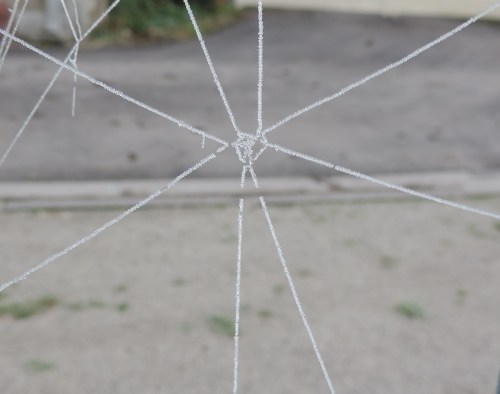
I’ve seen some amazingly complex and elaborate spider webs in my time, but look at this one I stumbled across early one morning recently.
I reckon this has been spun by a truly Charentaise spider. One of the commonest phrases people use in the neck of the woods is “soyons zen” (“let’s stay zen” – meaning keep calm, take it easy, relax…..you get the drift!). The creature which is one of the emblems of this region is a snail, and a small town near me (Segonzac) is one of the “Citta Slow” network.
People say the River Charente flows slowly and calmly. It’s not in a rush. It doesn’t get all white spray and choppy (at least not as it flows through Cognac), and the way that river lives becomes yet another potent emblem of the Charentaise way of life.
So what struck me about this web was its bare, sparse, simplicity. And it’s that simplicity which appeals to me so much. I find a real beauty in it. Yes, I admire, and can easily be in awe of, the complex and the elaborate, but simplicity just hits the mark so directly and powerfully, don’t you think?
I know, some of you might be thinking “that spider’s not going to catch many flies with that web!” and I thought that too, but then I got to thinking, who says spiders never make webs just for the sheer fun of it? Who says spiders only have one reason to spin a web? And how does whoever says that, know?
Maybe some webs are spun to catch morning dew.
Maybe some are spun to be beautiful.
Maybe some are just spun because a spider is just being, sorry…… becoming, a spider!
I don’t like putting things into boxes with rigid edges.
I find life is so complex, rich and varied that to default to “two value thinking” (categorising experiences or phenomena as either “this” or “that”) diminishes rather than enhances.
Focusing on the between does at least two things I find. It heightens my awareness of change, because all I see, hear, taste, feel, think about, is constantly becoming. Secondly, it focuses me on relationships and connections. To look for the between involves considering between what, and so, not only what is being connected, but on the very quality and nature of the connections and relationships themselves.
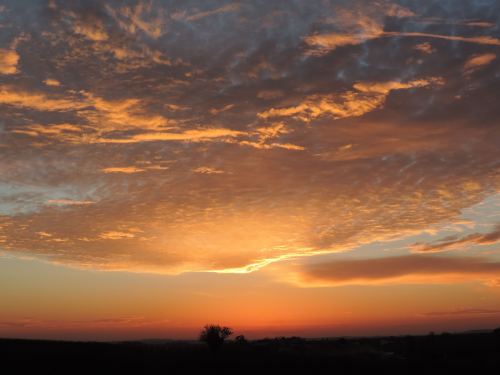
The moments just after the sun sinks below the horizon are a fantastic opportunity to immerse yourself in the between. If day is when the sun is in the sky, and night is when it is below the horizon and the light has gone, then these moments, one of which is in the photo here, are somewhere in between day and night.
Try it for yourself and see what it feels like. Experience the between!
There is nothing that should be recommended so much to youth as activity and vigilance. Our life is nothing but movement…
When I read this I automatically reframed it into a more modern language and something which fitted better with the themes which are important to me – actions and awareness.
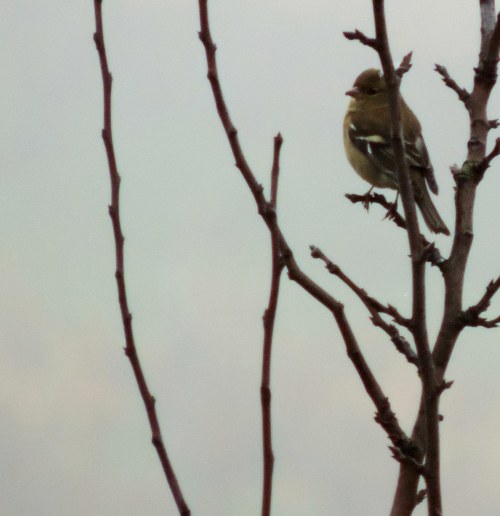
I also thought immediately of the birds in the garden. How they seem to be busy all the time and also, continuously “vigilant” or aware.
If I was to single out two characteristics which make the difference between zombie mode and hero mode in our lives it would be these two –
Activity
In some ways you could argue that we are what we do. When writing stories we create and reveal character by describing the choices they make. William Glasser developed a whole therapeutic approach based on making people more aware of the choices they are making all the time – because we do choose all the time. It’s just that for a lot of the time the choices happen automatically as part of habits, routines or manipulation. That’s the zombie way in my view.
The auto-pilot way. We’re not experiencing our human-ness to the full when we live that way. But we are active all the time. Even if that activity is simply sitting and breathing.
If you’d like to explore this in more depth, then search for my posts in the “a to z of becoming” series on this site where I reflect on 52 different verbs, each of which is an action we can take to further our “becoming”.
If life is significantly about the activities we are undertaking, then might it not be better to be aware? To reflect and consider so that we can choose? Even if we choose to continue doing what we were doing anyway?
That leads to the second characteristic –
Awareness
People talk a lot about mindfulness these days, but that word is really just another word for awareness. To be “mindful” is to be aware.
Awareness is partly about paying attention. It’s about focus. Where are we directing our attention? What is catching our attention?
And it’s partly about reflection, because as we reflect on what has just occurred or what we have experienced we heighten our awareness and deepen our understanding of ourselves and our lives.
As Ellen Langer says, mindfulness is the opposite of mindlessness. Why would you choose the latter?
So, maybe there’s something to learn from the birds – and from Montaigne – that “activity and vigilance” are to be recommended!
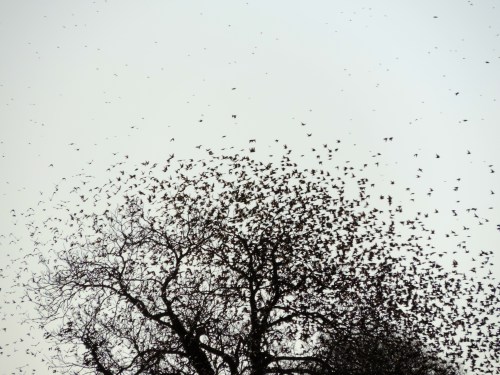
Look at this tree. Those aren’t leaves, they’re birds! Hundreds of them, thousands maybe.
I’ve never seen such a large flock of birds near me before. Maybe you haven’t either. What do you think your response would be? Would you think of Alfred Hitchcock?
Not me!
I didn’t think of that for a moment.
I was fascinated, entranced, drawn outside with phone and camera to do my best to record something of this phenomenon.
Here’s what I put together from my short video clips and some photos.
Later, while reading Montaigne, I read
He who fears he will suffer, already suffers from his fear.
It got me thinking about the stance we take towards the world, about our default attitude. Because isn’t there so much fear around? In fact, it seems to me that fear is often used deliberately as a weapon of control.
What’s the greatest fear?
Some say it’s the fear of death. That this “existential fear” is the foundation of all other fears. For example, as a comedian I heard once said “I don’t have a fear of flying. I have a fear of crashing!” People who fear the dark, fear what dangers might be hidden in the darkness. People who fear dogs, fear that the dogs will attack them. People who fear illnesses, fear suffering and death.
Montaigne says if you spend your life fearing suffering, you’ll be suffering throughout your life. Yet so much of the health advice offered to people is based on trying to avoid death (the greatest fear).
If fear is our default, we don’t just suffer, we live in a shrinking world, fearing difference, the “other” and change.
What’s the alternative?
Dread one day at a time??!!
Nope.
The great thing about alternatives to fear is that there are so many of them.
There’s courage. Courage is the determination to go ahead even when you are feeling fear. That’s something I’ve been practising since coming to live in France. When you start to live in another country with a different language, not only are customs and habits different but at first you’ve no idea how to ask the simplest things. So a trip to a post office, or the local Mairie, or the garage can be quite intimidating. Until you summon up your courage, and just go. And, in my experience here, each and every time I discover there has been absolutely nothing to be afraid of. People are friendly and they want to help. (Then next time you go the fear has diminished, or even gone away entirely)
There’s wonder. Wonder and curiosity. That’s the response I had when I saw all the birds. That’s the attitude I hope to take into every day – l’émerveillement du quotidien.
There’s love. Love comes with a desire to make connections and with an intention to care, or at very least, not to harm – and that applies in relation to plants and animals as much as to other human beings. How often does it seem to be that when your intention is a loving one, that you meet the same response? When I was a GP, my partners and I built a new clinic and the reception was an open one – no glass or metal barriers between the patients and the staff. We were warned that we’d be vulnerable to being attacked. It never happened. Not even remotely.
Fear closes.
It closes us off from the world and from life.
The opposite is whatever opens – courage, wonder, curiosity, love…..add your own favourites at the end of this sentence!
I prefer the opposites for what they bring in themselves, but I resist fear for another reason. I don’t want to be controlled. Heroes not zombies anyone?
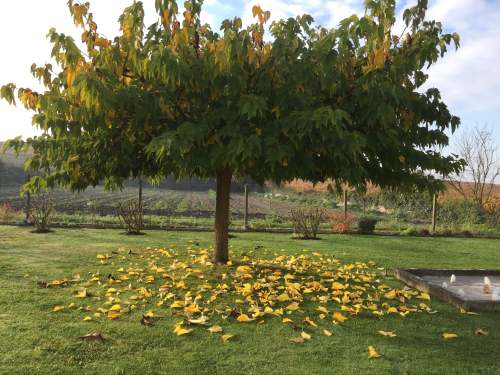
The other morning I was thinking how lovely the mulberry tree leaves are as they fall onto the ground forming such a beautiful circle. It reminded me of Andy Goldsworthy’s art.
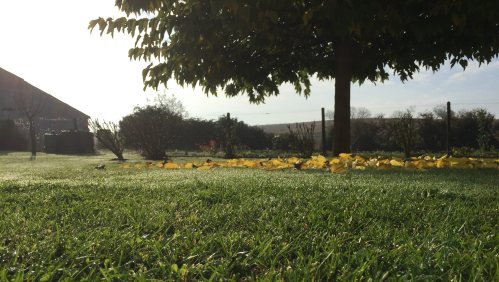
Then I got down on the ground to photograph the morning sunlight on the dew-bejewelled grass…
…and the circle turned into a line!
Interesting that, huh? And it worked the other way too – turning back into a circle when I stood up 😉
How different the world looks when you change your perspective!
What do you call this plant? Japanese lantern? Chinese lantern? Physalis? Whatever name you know it by, isn’t it extraordinary?
I mean, what is this? Is it a fruit? Are these petals? Or leaves? Or what?
Well, turns out these are sepals forming a calyx – the sepals of a flower are a form of protection, but whilst they are usually green, and you probably don’t normally really notice them, in this particular flower they form this papery orange lantern.
Sometimes protection is just so beautiful!
By the way, I’m no botanist, so in Montaigne’s famous words “Que sais-je?” (“What do I know?”) – if you know more about this please share in the comments…..
Osho, when talking about relationships, makes the point that “relationship” is a noun, whereas “relating” is a verb.
I understand the importance of our doing words, our actions and choices as represented by the verbs we use. Have a look on this blog for the “A to Z of Becoming”, or read about William Glasser’s “Choice theory” to explore more about the verbs in your life.
Osho adds another interesting element to the importance of understanding the difference between verbs and nouns. He says verbs are uncertain and nouns are an attempt to be certain.
That made me think of the Creation myth where God told Man to name the other creatures and so have “dominion over them”. This element of control is typical of the left hemisphere approach to the world, as described by Iain McGilchrist – it’s a process of “grasping”, getting a handle on, or getting a hold of something.
Nouns describe objects. They turn activities and experiences into things. Things which can be measured, known and controlled.
But Life is a process, not a thing, and living, loving or relating can never be fully known, grasped or controlled.
It can be exciting to let go of the delusions of certainty and to relish with heightened pleasure the living fully in this present moment.
I took this photo some years ago in the Ginza district of Tokyo. I think it captures two ideas about dreaming.
The first is that when we think of dreaming, partly what we think of is what we do when we are asleep. What did you dream last night? Can you remember? Nobody understands what night time dreaming is about, but for many years psychoanalysts and others have found that dreams can be a rich source of insights into the unconscious mind. If you want to explore what lies within your own dreams, you’re going to have to start improving your ability to remember them. The best way I know of doing that is to keep a notepad beside your bed with a pencil or pen beside it and when you wake up, immediately write down what you can remember from the dreams you’ve been having that night. I’m sure you’ll have had the experience of waking up in the midst of some vivid or powerful dream, only to find all trace of it disappears when you have your first thought about the day you’ve woken up into. I think there is also some mileage in setting your intention. Before you go to sleep, your last thought can be “let me dream tonight, and let me remember tonight’s dreams when I wake tomorrow”. Many people say setting such an intention, coupled with having the notebook ready for when you wake, gives you an increased chance of capturing those dreams. As with so many other thoughts and behaviours, the more you do it, the more easily you’ll do it, so even if the first few mornings you find you still can’t remember anything, persist. Once it becomes established, it becomes more useful.
The second is the kind of dreaming we do when awake, and I don’t particularly mean free-floating day dreaming, I mean consciously dreaming. The fact this construction company in Tokyo chose to print an image of a sleeping baby, cleverly hints at that other kind of dreaming….the kind which is part of the creative process. Dreams which become plans, blueprints, goals, projects…..dreams which become paintings, poems, stories and songs. Dreams of where we want to go, what we want to see and do.
Allow yourself this week to become aware of both these kinds of dreams. Maybe you can note some of them down in your notebook….in your dream journal? Maybe you’d like to have two dream journals, one for the dreams of sleep, and one for you conscious dreams, or maybe, and I prefer this option, the one journal for ALL your dreams……after all, you might find that the one kind of dream becomes entangled in the other kind, and something quite surprising might emerge.
Remember the big swine flu scare? Where governments threw around Tamiflu by the bucket load? This antiviral which had never been shown to successfully treat or prevent swine flu was stockpiled by the government (apparently at cost of about one pound for EVERY 200 pounds spent on the entire NHS in England and Wales in 2009!) and “prescribed” in the UK after telephone tick box consultations.
I was astonished at the time that so many millions and millions of pounds were spent on this drug. I don’t remember such mass, thoughtless prescribing before the Tamiflu debacle. It struck me as horrendously irresponsible of the authorities. Most of it, I thought would just be pee’d down the toilet without doing any good.
Well it’s an even more disturbing story than I knew at the time. A new piece of research reveals that the amount of Tamiflu in the toilet water which was flushed into the rivers has now caused resistance to this drug in the viruses.
If it was ever going to do any good, and that is seriously in doubt because after determined campaigning by researchers, scientists and journalists, it turns out that the evidence Roche didn’t publish shows that Tamiflu doesn’t even do what they claimed it did , that good is sure reduced now.
But then the drug company got its billions didn’t it?
And isn’t that the point of a drug company? To make billions?
Many have believed in an animated, inhabited, sacred world surrounding them, the natural world that constitutes reality. These beliefs restore our sense of belonging, of being-with, which is threatened by our dividing, conquering brain;
Oh, this connects with so many other things I’ve read these last few months. That last phrase taking me back to ‘The Master and His Emissary‘ – “our dividing, conquering brain” – what a brilliant description of what our left hemisphere does! But it’s this sense of Life everywhere which really captures my imagination. Marc Halévy in ‘Ni hasard, ni nécessité’ writes about the concept of hylozoism….a term I had never encountered before. Look it up. I thought Halévy had invented it as a neologism – but he hadn’t. It’s a very, very old idea which, suddenly becomes very, very new and relevant now. It’s the idea that everything has life in it. He juxtaposes hylozoism to materialism and says
It reveals to us that all matter is alive, that all matter is an expression of life, that all matter is living. (my translation)
Without looking it up right now, I seem to recall Howard Bloom argues something similar in ‘The God Problem‘ too, where he makes the case that even neutrons demonstrate free will.
It seems that Life is everywhere, and that the Cosmos is where we belong, what we are part of, not apart from. Does it make you feel differently about our planet once you realise it isn’t a resource but a manifestation of a living universe
I welcome constructive criticism and suggestions. I will not, however, tolerate abuse, rudeness or negativity, whether it is directed at me or other people. It has no place here. ANYONE making nasty comments will be banned.