Feeds:
Posts
Comments

Reaching for the moon

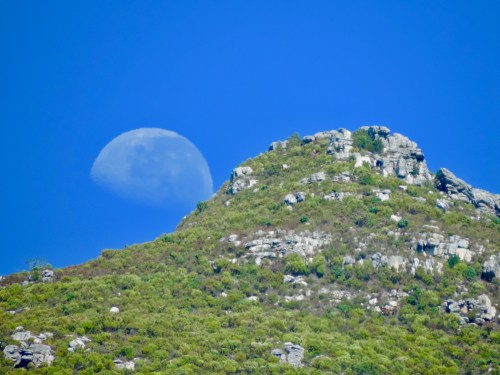
I’d noticed it earlier on my walk. The moon was hanging in the blue sky of the morning. But a little further on and around the corner I looked up and saw this. Wow! I can’t remember ever seeing the moon looking as big as this. Usually when I see the moon it’s pretty small, and if I take a photograph of it, somehow it appears even smaller, so when I pointed my camera towards it this time I was surprised to see it didn’t shrink. It sat there, almost kissing the Earth, holding its own, not diminished in the slightest by the size of the mountain beside it.

Sure, the moon wasn’t shining nearly as brightly as it does when it’s full and high in the night sky, but it was still impressive enough to stop me in my tracks.

There’s something magical about the moon for we humans, or maybe it’s better to say, there’s something magical about the relationship we humans have with the moon. It’s more than just a delight in beauty. It’s more than fascination and wonder.

She inspires us, stimulates our imagination, encourages us to dream, nurtures our feelings of love and romance.

The pull of the moon draws us up and out of our limits, or our habits, as we “reach for the moon”, aspiring to grow, develop, achieve, to become the best we can become.

I delight in my relationship with the moon.

Moments of bliss

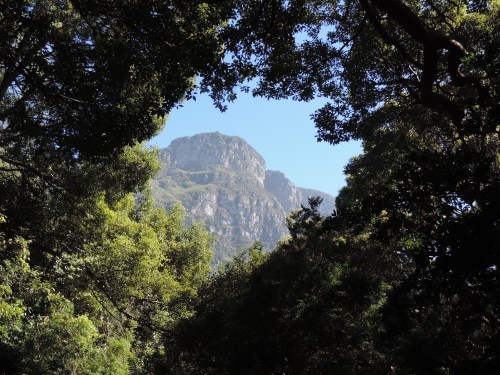
There are places in the world where I feel more whole, places where I am suddenly deeply aware of the strong flow of life, of energy, of spirit around and through me. Pausing for a moment under the canopy of ancient camphor trees in Kirstenboch gardens to gaze up and far to the surrounding mountains which draw my imagination to their summits and beyond, I feel at peace and enlivened at exactly the same moment.

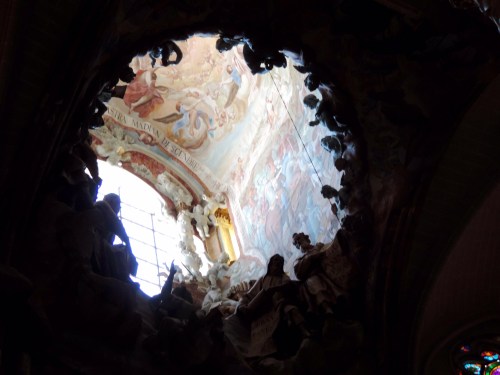
A day later, browsing through my photographs, I stop again at this view and am surprised to discover my memory presents me with an image I captured in the colossal cathedral of Toledo last summer.

The window to heaven in the highest point of the cathedral’s roof.

What’s the connection?

Why are these two images linked in my mind?

There’s the resonance of the imagery, each with its dark, ragged frame around a bright, distant light. But there’s something else too….something of a feeling, that feeling of smallness, enfolded in a greater something, whilst drawn up beyond my self to the universal.

In the cathedral, I didn’t feel at peace. I encountered image after image of suffering, torture and death represented in the lives of the saints. The immensity of the stone structure of the building with its enormous, ornate golden sculptures weighed heavily on me. So, when I stumbled on the window to heaven it seemed to provide some release, some lightening of the spirit and the heart. A few moments later I caught sight of sunlight and trees through an open door and delighted in the cloistered garden it led to.

Under the camphor trees I had none of that heaviness. I felt more cocooned, welcomed by Nature. But then suddenly, here again was an opening which lifted me up and out of my self.

Moments of bliss.

Precious.

Patterns of three

We humans are very good at spotting patterns. Finding patterns is such an interesting two way process. They are there in the world around us but we also develop a sort of sensitivity to particular ones. It’s like having a heightened awareness to certain patterns so we focus on them over other potential ones. Maybe one of the main things the right hemisphere of the cerebral cortex does is create patterns. After all, its predilection is for the betweenness of things, the connections. But our left hemisphere plays an important role here too. We use it to separate things out. I’m not sure we could see any patterns if our left hemisphere didn’t do its work of separating, abstracting, recognising and categorising.

I find patterns of three very appealing.

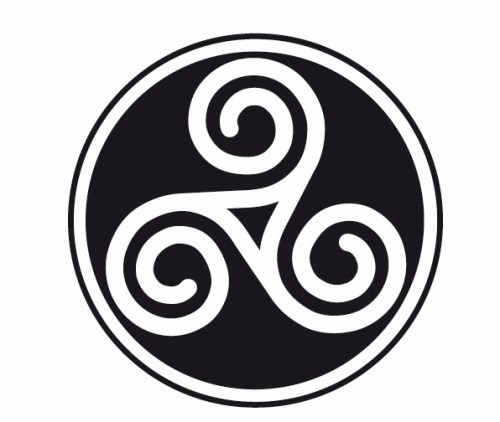
I particularly like triskeles, those simple Celtic knots created by intertwining three circles, or by spiralling out three arms from a central point.

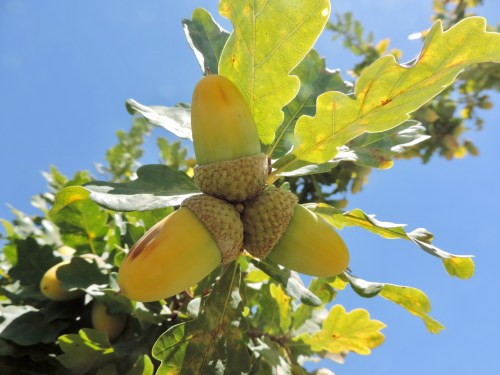
But here’s something I’ve never seen before – three acorns growing in a beautiful pattern of three. Isn’t it wonderful?

A moment of “émerveillement” for me.

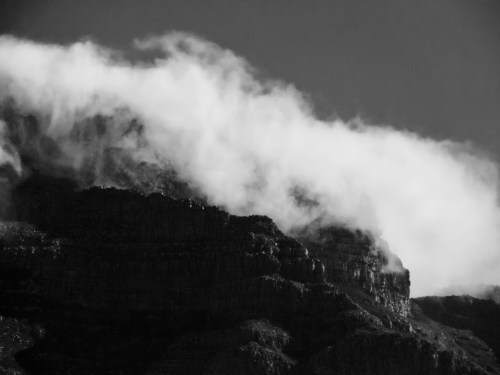
I don’t edit my photos very much at all but this one of the cloudy mists pouring over the top of the mountains seemed to cry out for the monochrome treatment.

I took the photo because I find this phenomenon utterly entrancing.

The clouds appear over the top of the ridge and spill over, speeding down the cliff face for only a few metres before they disappear into thin air. The process is continuous. It has all the appearance of perpetual motion.

I love watching the cloud appear from over the mountain top, from somewhere I can’t see, and following its journey into wispy nothingness in such a short space of time.

From somewhere I can’t see to complete disappearance right before my eyes.

A metaphor for an individual life, delicate, beautiful, transient, and mainly made of water…..

I also like the contrasts in this image. Not only the blackness of the rock and the whiteness of the mist, but of their polar opposite textures. The rock, solid, suggesting a permanence because it changes so much more slowly than we humans can perceive in a single lifetime, and the mist, so insubstantial you can barely discern its edges.

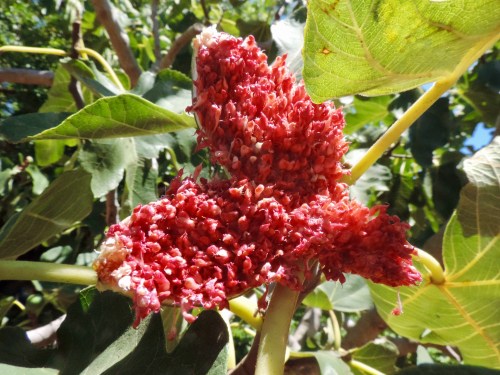
I’ve never seen a fig on the tree like this before. The fruit has burst open to reveal all the wonderful juicy flesh. I’ve picked figs straight from the tree many times, and opened them up with a knife, or just my fingers, but I’ve never seen one open itself up like this.

It’s like an exuberance, as if the tree couldn’t hold itself back. It poured its energies and its life force into producing these succulent, delicious fruits and couldn’t wait another second to show them to the world.

Look! See what I’ve made!

And there’s something else I see here beside this enthusiasm to be the best fig tree it can be….there’s a generosity of spirit.

The tree doesn’t hide its fruit. It declares it, and says, come, taste, share my delight.

It’s inspiring don’t you think….it inspires us to flourish and to give, to create and to share.

Serendipity

Mini

Mini

This is what happened.

I was looking across the road from outside “Bardough” in Capetown and spotted this classic red mini.

I decided to take a photo and when I looked through the viewfinder I realised how good the mini looked in front of the red building. What a perfect backdrop!

Then just as I squeezed the shutter release these two people walked into the shot from offstage right……

And wow! Just look! How fantastic! It took the photo to an entirely new level. How does that happen? A combination of noticing, choosing to take a photo, taking the time to frame a nice shot, then sheer luck……Isn’t it just great when the universe conspires to make your life more beautiful?

dscn8059

Here’s an example of the type of photograph I enjoy so much. At first glance it’s pleasing. It delights me. I can sit and gaze at it for ages, enjoying its beauty. But it stimulates my thoughts too.

I see this and I think about ways of engaging with the world. Iain McGilchrist shows us in his Master and His Emissary that our two cerebral hemispheres allow us to simultaneously use two different types of focus….narrow and broad.

The left hemisphere separates out whatever we are looking at from the contexts in which it exists. It allows us to set a kind of frame around what we are looking at, to distinguish it from the whole. That lets us label it, put it into a category, and so grasp it. Literally. Get a handle on it so we can manipulate it. It’s a narrow focus, one which drills down to separate out and analyse aspects or components.

The right hemisphere focuses on the connections rather than the parts. It lets us see the broad view, the over view. It helps us to see whatever we are looking at in the fullness of its context. We don’t see the separate parts, we see the connectedness of everything. In the terms of classical philosophy, it helps us to take the “view from on high”.

The view from on high lets us do something else too….it allows us to stand apart from whatever we are looking at. It lets us put a little distance there…a distance in space, and/or a distance in time…a pause, or a moment to reflect and consider.

Some people argue this is one of the most distinguishing characteristics of human beings, this ability to create a distance which allows us to choose responses rather than simply react in programmed or patterned automatic ways. But I think it is equally characteristic of human beings that we have this huge cerebral cortex divided into two distinctly different hemispheres allowing us to focus on the world in two such distinctly different ways.

How big is your box?

person-in-box

It strikes me that one of the biggest questions facing us now is “how are we going to live together?”, and the answer to that depends on the extent of our consciousness and awareness.

How big is the box you are living in?

Is it only big enough for you? Do all other human beings exist outside of your conscious limits? I bet they don’t. For some people their box isn’t much bigger than their own family, or the village, street or town in which they live. For others its the size of their network of like-minded souls – the ones who agree with them, who share the same values, behave the same way, speak the same language. For yet others the box is a whole country. They want to put their own country first, and others can just get on and do the same. If there’s to be competition over space or resources, they’ll fight the others for it, hoping for one winner, and for the rest to be losers.

Maybe the box is the size of our species, though. Maybe it contains every living human being. After all, in this increasingly networked world of relationships, travel, agreements, and exchanges, artificially created boxes the size of a single country are increasingly hard to maintain.

Some people call this bigger box, globalisation, and kick against it. What they experience is personal loss, due, they believe, to others’ gain. But the current model of globalisation is just a way of us living together. We all live in the same world. It’s increasingly impossible to live as if others in other parts of this planet either don’t exist, or don’t matter. When people kick against globalisation, I think they are kicking against a way of us all living together. The answers will lie in finding a better way, not in pretending we all live in disconnected, entirely separate boxes.

Let me just stretch this out a wee bit further. Because I think the reality is not that we humans live together in a separate box on this earth. We are part of Nature. We live in constant interaction with the air, the soil, the water and the energy from the Sun. We are an integral part of the biosphere – living in an intricate web with the entirety of Life on Earth.

How often are we conscious of that? How often do we take that awareness and apply it to come up with good ways to live together….not just all we humans, but with the entire biosphere on the finite planet which we share.


tree-vine-fog

As I was opening the shutters yesterday morning I caught sight of some swirls of mist lying amongst the vines towards the next village. I took a few photos. Here’s one of my favourite ones. It pleases me. Enormously. There’s an entrancing beauty to it. And it’s one of those photos which stimulates all kinds of thoughts for me.

I look at this and I think of two of the fundamental forces of the universe – the ones which Thomas Berry called “wildness” and “discipline”. The large tree in the centre of the image grows wild. It grows naturally and it spreads out above and below ground creating this ever branching structure which looks like its reaching out to the world. It looks like it’s stretching upwards and outwards to feel the sky and the moist air. In front of it are rows and rows of vines, trained and pruned by human hand, disciplined to grow along the wires. The vines form a complex web of life. As I look at them now it’s hard to discern where one plant stops and the next one begins.

When I think of these two forces, I think of the two hemispheres of the brain, each with its distinctive style of engaging with the world. The right hemisphere exploring, seeking the new, making connections. The left hemisphere exploiting, grasping, structuring. Iain McGilchrist writes in “The Divided Brain“, that the right hemisphere characteristically seeks to care, it seeks to engage with “the other” empathically. The left hemisphere seeks to control, seeking to deal with “the other” by categorising, labelling and separating.

How we see these forces at work in the world today!


The other day I read an article posted in the Science section of Forbes.com. The title was “Earth’s skies are violet, we just see them as blue“. It explained how the different colours of light scatter differently in the Earth’s atmosphere according to their wavelength, with shorter blue light scattering most which is why the skies seem blue, but then goes on to point out that violet light has an even shorter wavelength than blue so our skies should look violet. Why don’t they? Well, it’s because our eyeballs have three kinds of colour light detector in them. We call these detectors “cones” and each is most sensitive to either blue, red or green (most sensitive to, not only sensitive too) – the blue stimulates most so the skies look blue….

But, wait! Look at this from the other day here (no “post-processing” going on – just as I actually saw it)

violet

Skies look blue, except when they don’t…….(thank you, clouds)