Feeds:
Posts
Comments

Nature’s allegories

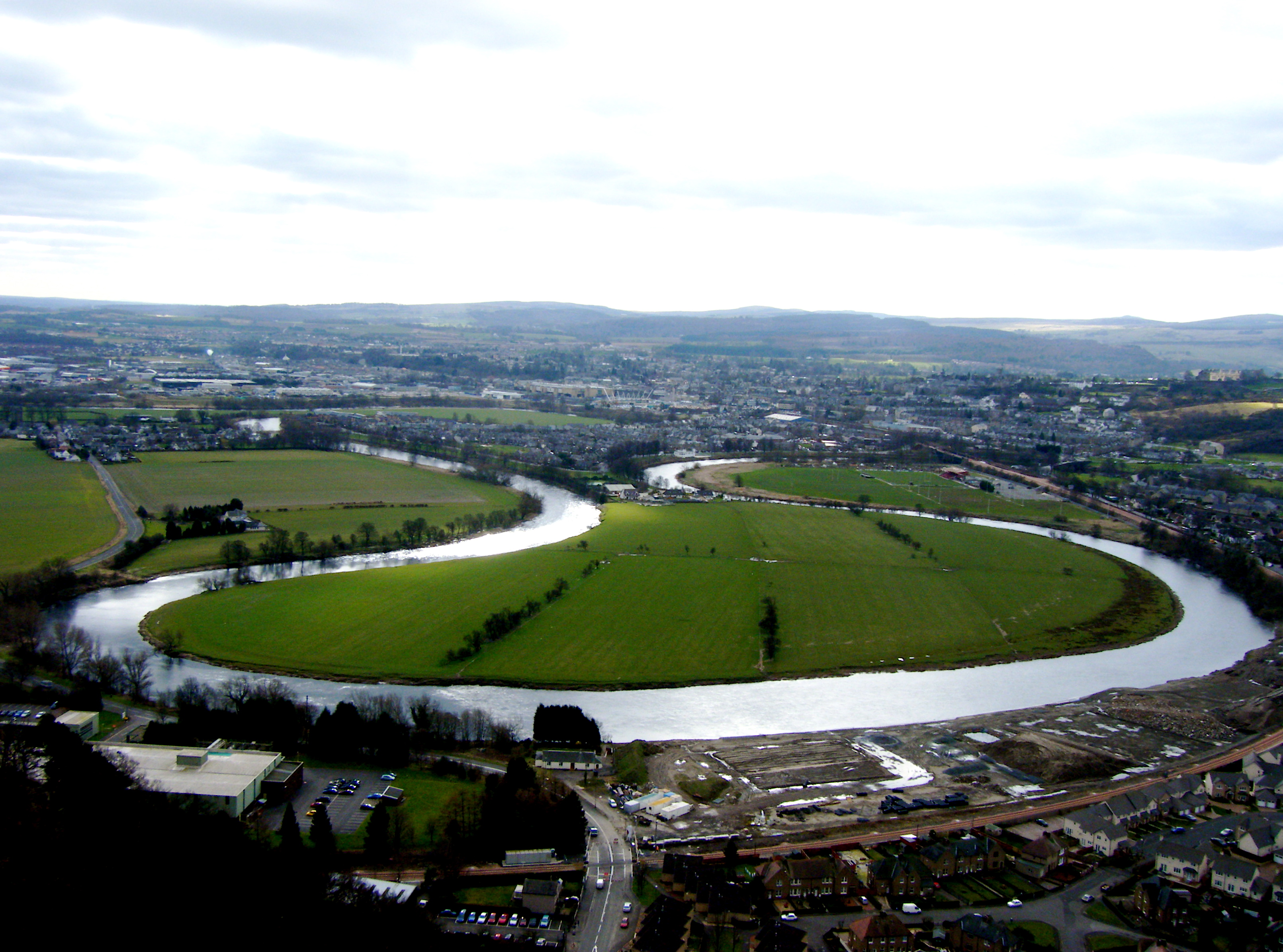
I was looking for exactly this photo the other day, and was delighted when I found it in my library – but I didn’t take it. My daughter, Amy, did. I’m pretty sure I’ve taken photos exactly like this in the past but it must be back to the days of 35mm film because I can’t find any in my digital library. This is a view of part of the River Forth, at Stirling, and it shows beautifully how the river twists, turns and curves around so much at this point in its journey.

I picked up a couple of little books by a French author, Olivier Clerc, when I was in Biarritz fairly recently. One is called “La Grenouille qui ne savait pas qu’elle etait cuite….” (which is about the frog who didn’t know she was being boiled) and the other is “Rien ne peut empecher la riviere de couler…..” (nothing can prevent the river from flowing. In both books, this Swiss author, writes about life lessons he’s learned by taking an analogical perspective on natural phenomena. He argues that as well as thinking analytically, which we are encouraged to do all the time, we should also develop the skills of thinking analogically. That in doing so we will find life itself becomes richer, deeper and more meaningful. I think he’s absolutely right.

The first essay in the second of those books is about how a river can be viewed two ways – first of all, you can see that it twists this way and that (just like the River Forth in this photo), and that if you trace the course of a river from where it starts in the mountains, you find that there seems no logic to its path – it heads west, perhaps, then south, then east perhaps and so on. It disappears at times, flowing into a lake, only to reappear out the opposite side, or into a marsh, or even below ground, before re-emerging perhaps many miles further on. And yet, we call the river by the same name along this twisting, turning, ever changing path. But there’s a second way to look at the river, and that’s to take a lateral slice through the landscape and see that, at every single point, the water is flowing downhill. At no point does it ever, ever turn around and start to flow uphill. It just doesn’t. It continues from Spring to Ocean, in a constantly downhill direction. He points out that these two views of the river show both continuity (as it flows through the landscape) and coherence, as it heads constantly downhill to achieve its goal of reaching the ocean).

He draws several lessons from this, not least being that behaviour is often hard to understand because we see it superficially, and that, we need to look beneath to see the underlying motivations, values and goals, in order to understand why someone is acting the way they do. He says this teaches us to be humble, to accept uncertainty, and to inspire us to look below the surface, to better understand others. What are the coherent threads that run through an individual story, be that of a person, a group within society, a culture, or even a nation? What lies beneath the apparent randomness, the veering this way and that, over years, and decades, that actually reveals the core beliefs, values and purposes?

I like anything which inspires me to pause and reflect. And I think learning to look at the natural world analogically can really deepen the joy of everyday life.

Oh, and just before I leave……I’m suddenly remembering a line from John O’Donohue –

“I would love to live like a river flows,
carried by the surprise of its own unfolding.”

There are some words which are used a lot these days, which make me uncomfortable. Every time I hear them used I find my mind filling with questions and doubts.

The first of these is “Growth”. The Labour government in the UK has come to power from a campaign fixed firmly on the concept of growth. It’s a word used by politicians and economists all the time. But growth of what? If I understand them, they are typically referring to something called “economic activity”, by which they mean the production of more goods, the delivery of more services, and the greater consumption of both by the populace. But is this not a bit lacking in nuance? Does a better, more sustainable future for us, for our children and their grandchildren, lie down the path of ever greater consumption? All this in a finite planet? I read the Club of Rome report, “Limits to Growth”, back when it came out, I think, in the 70s, and whilst much of the projected data in that report didn’t pan out, the underlying principle was that we can’t keep depleting limited natural resources, destroying ecosystems, and producing every more pollution. That seems right to me. There are natural limits to growth, just as there are natural limits to healing and to Life. But, more than that, just chasing growth without specifying growth of what, and for what purpose, lacks all value. Producing and consuming more highly processed food is causing an epidemic of obesity and chronic disease. Producing and consuming more oil and gas is heating up the planet, and polluting the oceans with plastics which will never disappear. If we want to pursue growth, shouldn’t we at least be clear about exactly what it is we want to grow, while remaining mindful of the damaging effects of too much production and consumption. There is also the issue of distribution of the fruits of any growth. The economies of the world have been growing – they’ve been shovelling more and more wealth into the hands of a tiny handful of people, whilst populations everywhere creak under the strain of a “cost of living crisis”. The pursuit of growth for growth’s sake, makes me uncomfortable.

The second word which bothers me is “‘utility”. I read a great quote the other day – “those who believe in utility have to answer the question – utility for what? if the answer is just more utility you have a problem”. It’s the same issue as the growth question I suppose. When utility become the exclusive goal, again we lose all contact with quality and values. Something which is “utilitarian” just lacks something, doesn’t it? It’s limited, superficial, thin. It leads to the charge about “knowing the cost of everything and the value of nothing”. Yes, we want our goods and services to be useful, and in that respect, we have to pay attention to their utility, but we’ve got to ask – utility for what? Is it to further our pursuits of Beauty, Truth and Goodness? Is it to further our wellbeing? To increase justice and fairness? Is it to facilitate the flow of love and kindness? Or what?

The third word which troubles me is “efficiency”. Especially, “cost efficiency”. The extreme pursuit of “the greatest bang for the buck”, of “paying attention to the bottom line” is replacing value in Life, with profit in corporate pockets. Our Public services, of health care, education, social care, and so on, are in crisis. We’ve closed hospital beds, failed to invest in training and employment of highly skilled professionals, and we find ourselves with increasing, unmet demand, and an annual cycle of “how are we going to cope” every single winter. Living organisms are complex adaptive systems and our services should be modelled on them, because they are there to improve the quality of Life, not to increase profits for a small group of “investors”. One of the characteristics of complex systems is “redundancy” – they have more adaptive strategies, systems and resources in place than they “need” at any particular moment, so that when a new, large challenge comes along, they can respond. They can deal with it. We’ve trimmed everything back to the bone. Didn’t the Covid pandemic show us that? Clear as day? Didn’t it expose our vulnerabilities, our inequalities, our impoverished resources? The efficiency of a machine, of the production of machines, is not the same as the efficiency of living, natural organisms. We are not machines. We are not machine like. And we need the services which are designed with Life in mind, with humans in mind, not those with the goals of profit making industrial production.

What are your bug bear words? These are my top three. I don’t think I’ve articulated them here before, so I thought I’d take today to do so. I hope that next time you hear someone talk about growth, utility, or efficiency, you’ll stop to reflect and ask what they actually mean by those words, and whether or not you think they are contributing to a more healthy, more flourishing society.

The English philosopher, Mary Midgley, in her response to those who said the Self was an illusion, said “If the Self is an illusion, who is it who is having this illusion?”

Philosophers, psychologists, psychiatrists and neuroscientists, continue to debate exactly what the Self is. I’m taking a pragmatic, maybe simplistic approach. For me, the Self is what does the experiencing. Me, myself and I, as the song goes…….All the sensations I experience, are experienced by my Self. Yes, I know there are complex sensory cells and networks throughout the body which enable me to pick and process various signals, energies and waves which flow around and through my body. But, ultimately, the experiencing of the light, of colour, of sound, touch, temperature, taste….that’s all done by my Self. Similarly, it’s my Self which experiences my thoughts and feelings. Again, maybe thoughts and feelings involve a huge network of cells and chemicals in my body, but it’s my Self which experiences them.

I know that not everyone will agree with that conception of the Self, and I’m neither a philosopher, nor a neuroscientist, but I just want to describe, as clearly as possible, how I envisage the Self.

From that standpoint, I explore the world in which I find myself alive. I turn to Science to help me grasp and understand what is external to my Self. Primarily, that picks out elements from within the flux of reality, and considers them as objects…objects which can be measured and manipulated. I even turn to Science to discover elements which exist within my body, but which, I argue, are “external” to my “Self”. So developments in anatomy, physiology, pathology and so on, help me to comprehend the tissues, organs, cells and chemicals within my body, and, as a doctor, to understand them within the bodies of others. That helps me to make diagnoses and to suggest treatments when people fall ill.

Secondly, I turn to Art, to understand what is “internal” to my Self, to express what is “internal” to my Self, and to communicate with the “selves” of others. It’s through music, poetry, painting, sculpture, storytelling, novels, dance, and so on, that I attempt to show others what I feel, what I experience, what I think, from this unique perspective on the universe which I call my Self. Through Art I channel, and stimulate my creativity, my imagination and my empathy.

Thirdly, I turn to Spirituality to explore the connections between my Self, and the rest of the Universe. Through experiences of awe and wonder, I dissolve the boundaries of my individuality, and step into the Oneness of Reality.

I know these terms, external, internal, and beyond, are simplifications in their own right, but I reckon if I am to know a person, to really get to know and understand another person, then my best chance will emerge by taking a blend of these three approaches – science, art and spirituality. And, I’ll see more clearly that no single one of them can give me a comprehensive understanding.

Does this make sense to you? I’d love to hear your take on all this.

The concept of “and not or” is very important to me. “And” creates and explores connections. I broadens and deepens our experience. Whereas “Or” divides. It splits reality into pieces and asks us to choose. Iain McGilchrist’s superb explanations of how the left and right hemispheres of the brain enable to focus on the world in very different ways has taught me to try to use my whole brain, not just half of it (we, as a civilisation, and, as individuals, have privileged the left hemisphere approach at the expense of a whole brain one, for far too long now)

But there’s another way in which I apply the “and not or” approach, and that’s through the triad of ways in which we humans view and try to understand the world – science, art and spirituality.

Science provides us with ways of discovering what exists objectively. A core feature of science is measurement. The scientific approach allows us to separate out objects from the ongoing flux of reality, measure them, subject them to experiments and, from there, to make predictions which enable us to exert greater control.

Art, on the other hand, provides us with ways of expressing our inner experience, and of sharing those experiences with others. It’s a range of ways of connecting subject to subject. We use art to express and communicate love, beauty, joy, and unique, individual experience of life. We use music, dance, storytelling, visual arts, poetry etc to develop our creativity and to engage with each other subject to subject. These subjective experiences are not measurable.

Thomas Berry says that the universe is not a collection of objects, it’s a community of subjects.

Thirdly, spirituality, is, for me, that sense of being connected to what is greater than me. I experience it through moments of awe. I experience it everyday through what the French call “l’emerveillement du quotidien” – through wonder, amazement and awe.

I need all of these ways of engaging with the world to lead a deep, whole and meaningful life. Science isn’t enough by itself. It can’t help us to connect, subject to subject. Art isn’t enough by itself, it lacks science’s ability to isolate elements in the objective world to better understand and manipulate them. Spirituality isn’t enough in itself but it stokes our humility and our sense of connection with others and with the rest of the planet, even, the universe.

How about you? Do you enjoy all three? Science, Art and Spirituality?

We are not machines

We are not machines. We are not even “machine like”. Here’s Iain McGilchrist on this –

Machines are not social beings. They don't have Consciousness, feelings, personality, will or individuality. They have no appreciation of music, dance, poetry, art or nature. They do not fall in love and have no sense of humor and they do not have the ability to change their minds and have none of our capacity to sorrow over the past or project a delighted future and that's not even taking into account the far more complex issues entailed in human consciousness including imagination, morality, creativity, the capacity for Spiritual awe and allegiance to Beauty truth and goodness and in case that should sound the slightest bit rarified I'd like to mention that they don't have bodies either and they do not die. It is true of course that you're amazing we're all amazing but it's precisely because we're not just hugely complicated machines. If we carry on talking like this to the aspiring young we will get no better scientists than we deserve. In reality nothing in the entire universe is like a machine except the few lumps of metal we have made in the last few hundred years.

Iain McGilchrist

From health care to our relationship with the rest of the natural world, this machine metaphor is so damaging.

It de-humanises patients and their doctors. It distances us from the world we live in. And it obliterates wonder and enchantment.

Let machines be machines and let’s refocus on what makes Life so astonishingly different from technology and industry.

Machines, including “AI” machines, are tools. They aren’t a replacement for human beings. They aren’t a replacement for Life.

Integration/cooperation

It was pretty late in my career when I came across the concept of “integration” in relation to health, and it took me a wee while to get my head around. It finally clicked when I read Dan Siegel’s “Mindsight” and I read his definition of integration – the creation of mutually beneficial bonds between well-differentiated parts.

Take a moment to let that definition sink in, because it’s pretty beautiful and it captures the key elements of integration – that involves very different entities establishing a relationship which enables each of them to better fulfil their potential.

When I understood this, I immediately thought of the human body. We think of the body as made up of very different parts – highly differentiated cells organised into tissues, organs and systems. We have a heart, a liver, a pair of kidneys, a brain…..and so on, and so on. Are these various organisms in competition with each other? Are they trying to outdo each other and grab most of the nutrition, the oxygen, the energy for themselves, even at the expense of the others? No they are not. They are not in competition. The co-operate. They collaborate. In fact, they are integrated. They are connected and they relate to each other in ways which enable every single organ and tissue in the body to flourish.

If you look at any other living organism you’ll see the same basic strategy – “integration”. If you see a healthy, flourishing ecosystem, you’ll see that it contains a diversity of plants and creatures and they are well “integrated.”

And yet, we have created a global, economic, social system based on competition. A system which creates a handful of winners, and a huge mass of losers. It doesn’t have to be that way. We could, if we wished, create a system where the core value is integration/cooperation instead of competition. Not to say that competition has no place. I think we understand that it does. But we’ve got the emphasis wrong. We need to shift our attention, our imagination, our energy towards integration.

What kind of world could we create if we worked to create human relationships based on integration, care and love, human to non-human creature relationships based on integration rather than dominance, human to planet relationships based on integration instead of exploitation?

A natural world – the way it evolved to be what the universe intended.

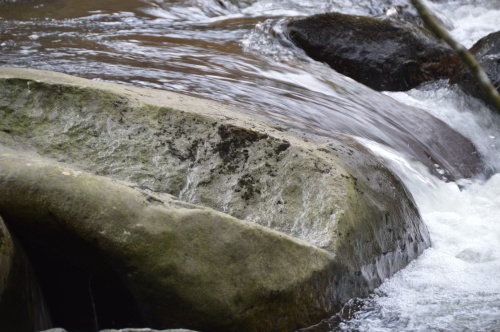
I took this photo many years ago and I’ve shown it to many patients. I call it “the wounded rock”. Something struck this rock, probably a long, long time ago. It almost split it in two. Clearly, it was a heavy blow. It has left a clear wound.

Life is often like this. Something happens, something traumatic, which inflicts a wound on us, a wound which never completely heals. Powerful events change us. They might be violent events, either accidental, or malicious. They might be physical, or emotional. They might be serious illnesses. Or they might be big changes in life – loss of a loved one, loss of a job, moving house….

Life goes on, like the water continuing to flow around and over this rock. But the wound leaves us changed.

But, actually, this tree in my garden, is a better metaphor, or, should I say, a better example. It would seem that one day, long, long ago, a storm blew through and felled this tree. It uprooted it. Its roots have been torn out of the ground, and we found them, standing upright, embedded with stones, and covered in ivy.

You’d expect that would be the end of the tree, but, no. It continued to grow, now turning its branches at ninety degrees to the fallen trunk. It started to reach for the sunlight again.

It’s a better example, because the rock is not a living organism. Having been struck, it can’t adapt. It can’t change. The tree, on the other hand, is more like us. Having been struck, it adapts.

Self-healing is an adaptive phenomenon. It is the basis of all cures, and, even, of all recovery. There is no healing without it. And yet, it has its limits. In both the case of the rock and the tree, there can be no going back. There can be no restoration to a “time before”, much as we might wish there was. In both cases, the flow of life carries on, shaping, and adapting, in surprising, fundamentally unpredictable, ways.

You know if you cut yourself that, in the vast majority of cases, the cut will heal itself just if you keep the area clean. You know how, if you break a bone, that the fracture never heals without the body using its ability to knit back together the broken edges of the bone (sometimes you need something to hold the edges together – a plaster, nails or a plate – but the actual healing of the bone is done by the body). Well, in fact this is what all living organisms do – they self-heal, self-repair, and self-organise.

One model for living organisms is a “complex adaptive system” (search that term on this site and you’ll find several articles I’ve written about it). Complex adaptive systems have a key, core characteristic – they adapt. Self healing is an aspect of adaptation.

Yet, in Medicine we rather take self-healing for granted. We know that nobody recovers from anything without self-healing. We need the body’s abilities to repair, and to adapt and grow, in order to heal. Every single time. But how many treatments, specifically, how many drugs do we use which are developed to target the capacity to self-heal? How many drugs directly stimulate or support the natural processes of self-healing? I don’t know any. Instead we direct our treatments “against” – we use lots of “anti”s – antidepressants, anti-inflammatories, anti-hypertensives, antibiotics etc etc – you get the idea – and hope that in the background the body will self heal. I don’t mean these anti drugs are useless. Clearly they are not. In many cases they can rescue someone suffering from a life threatening episode of illness. But they aren’t enough. We also need to stimulate and support the natural systems of self healing and repair.

What are they?

Well, largely, they are environmental, psychological and social. We need light, clean air, clean water, nutritious food, shelter. We need hope and encouragement. We need to feel cared for and loved. We know that forests can help us heal. We know that time spent in natural environments can help us heal. We know that music, and art, and stories can help us heal.

So do we need drugs? Well, we do. The thing about self-healing is that it is limited by natural biological limits. We are mortal beings. None of us will live forever, and none of us will go through life without experiences diseases and illnesses. Drugs can help us by easing symptoms, addressing imbalances, and countering pathologies. But Medicine is, and always has been, more than just drugs.

But there is something else about self-healing that we should pay attention to and that is…..in common with all forms of adaptation, it is unpredictable at the level of the individual. Sometimes we pretend that all we need to go is a give an “evidence based” treatment and the outcome can be assured. That’s not the case. There is no treatment which produces the same outcome time and time again, in patient after patient. Adaptation teaches us to accept uncertainty. It teaches us to stick with a patient, to follow through and follow up, because only time will tell whether or not the treatment is proving to be useful or not for this person.

And there’s the other key lesson for Medicine from the science of adaptation and self-healing – patients do better when they experience continuity of care.

Over time, we have to adapt our treatments and our care, as the individual patient adapts to the changes brought about by the disease or injury which has made them ill.

It’s good to learn how to deal with uncertainty, because life isn’t predictable.

Focus on uniqueness

Throughout my career as a doctor I always looked forward to meeting new patients, every one of whom would tell me a brand new story. By taking a focus on uniqueness I’d be unceasingly curious. Who is this person? What, exactly, are they experiencing? How did it come about? What are the circumstances of their life now, and what were they when their illness began? And so on and so on. You get the idea. When you focus on uniqueness, it opens your mind to find out more. Making a diagnosis, naming the disease, is no longer an endpoint of the consultation. Finding out just how different this patient is from the others you’ve met becomes an ongoing quest.

But a focus on uniqueness brings value to anyone’s everyday, not just to doctors and patients. The ancients taught us to begin each day with the knowledge that every upcoming experience would occur for the first time in our lives. We have never lived the day ahead before. And they taught us to begin each day with the knowledge that every upcoming experience would occur this time only. Today is our last chance to experience today.

A focus on uniqueness makes you aware of the here now, knowing, as Heraclitus taught, that we can never step into the same river twice.

A focus on uniqueness encourages a sense of wonder – l’émerveillement du quotidien.

A focus on uniqueness makes us more aware of transience and change. Transience is beautiful, and precious, teaching us to savour and relish every single moment.

And it does something else, too. It opens our minds to appreciate diversity.

Try it for yourself. Set out today with a focus on uniqueness.

You are not alone

Sally Rooney, talking about her new novel, discussed the word “mutual”

mutual is a word and idea that repeats throughout Intermezzo. Henry James often uses that term to indicate the moment when subjectivity transforms into intersubjectivity, consciousness into shared consciousness—or, as you put it in Intermezzo, when two people’s “thoughts interpenetrate”

I love that phrase “the moment when subjectivity transforms into intersubjectivty”. That’s what I sought in every consultation in my clinic…that phenomenon where “two people’s thoughts interpenetrate”.

We live in a society, a world even, which is increasingly divided and people are alienated from each other and from the planet. Or in the terms explored here yesterday, increasingly we are “uncoupled”.

But the truth is we are not alone. The human being, with their long period of infancy, has evolved to be highly social, highly interdependent. As Thomas Berry said, we are not a collection of objects, but a community of subjects.

Our lives are inextricably entangled. Beautifully, wonderfully, amazingly entangled. Coupled, linked.

You are not alone.