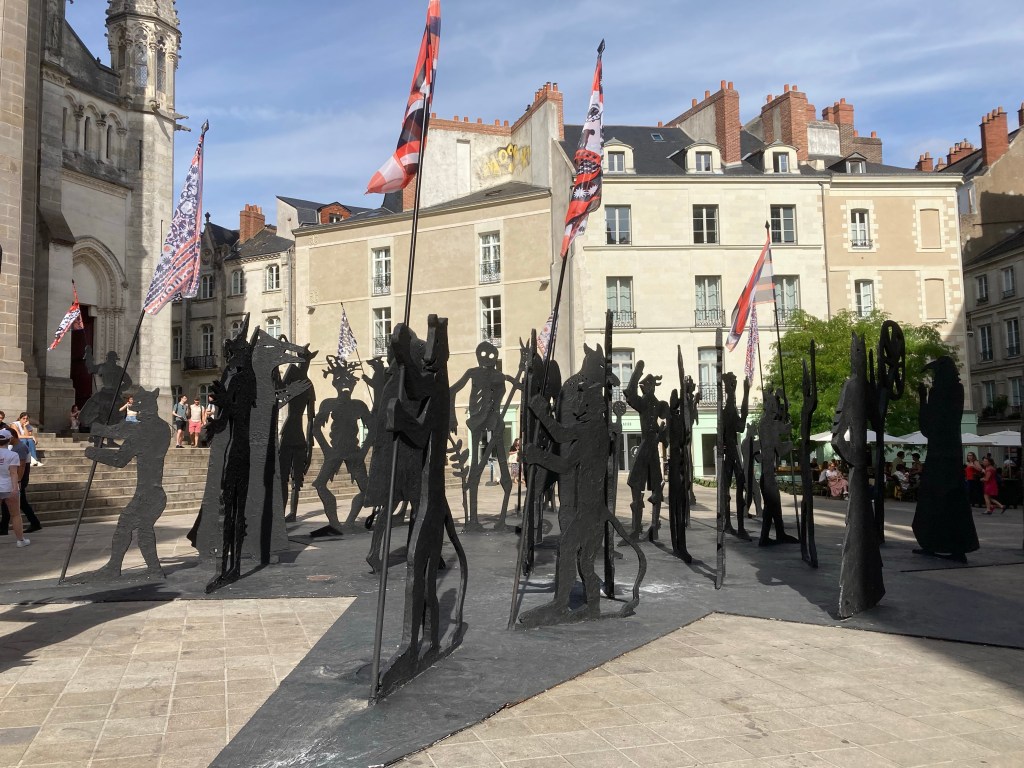
There are three elements, or relations, which lie at the heart of both our sense of belonging and our experience of wellbeing.
They are our relationship to others, our relationship to the living world and our relationship to the Divine.
Others. We are intensely social creatures. Our babies are born unable to survive alone and the early relationships they form determine the number of connections made by the neurones in the brain, the patterns of those connections, our ability to form healthy relationships in the future and even our susceptibility to a number of illnesses throughout our lives. We thrive when we establish mutually beneficial relationships with others. We realise our potentials when we love, and are loved. Loneliness, alienation and trauma are major factors involved in illness and early death.
The living world. When we treat other creatures and organisms as resources or things we impoverish our lived environment. When we pollute the seas, the rivers and the air we impair our ability to live long healthy lives. Climate change is one manifestation of this destructive attitude to the world. We need to reset our perspective and see the living world as crucial to our own wellbeing. Wonder and respect will support us better than exploitation, consumption and the production of waste.
The Divine. However you think of the divine, let’s consider our relationship to the “whole” and to whatever is more than, and greater than us. The Enlightenment thinkers were wrong in declaring we could understand everything. We can’t. And we never will. Knowing that allows us to become more humble. Beauty, Truth and Goodness all reveal the divine to us. We need a sense of purpose in our lives. We can gain that by connecting to what is greater than us. We can gain it through soulful experiences – of music, of food, of places and people – we feel it in our hearts. We feel it when we are touched in our soul.
….nature, whose meaning is that-which-is-about-to-be-born, and is feminine – and what’s more a goddess.
The Matter with Things
Nature, that, like Kali, is wild and gives life and destroys – or rather does not destroy, but transforms one being into another.
The Matter with Things
Nature, that is our mother and our healer and our home, as well as our ultimate fate;
The Matter with Things
Nature, that we are reviling and doing our best to devastate – is the great whole to which we belong.
The Matter with Things
Nature is a term which we humans have, for many years, used to describe what is not us, somewhere “out there”, in the countryside or in “the wilds”. We’ve adopted a view that nature is a resource to be exploited and a force to be controlled. We seem to have an idea that we are separate from Nature, that we appeared on this Earth alongside “it”, and that we can live and survive in the future without “it”.
How wrong are all those beliefs and attitudes.
At the beginning of this post I’ve divided up a single paragraph in Iain McGilchrist’s magnificent “The Matter with Things”. That one paragraph captures a much healthier and much more realistic perspective on Nature than the dominant, materialistic, mechanistic, capitalist one.
I think we’d all be much better off if we reconnected to Nature as a feminine goddess. If we saw her as “becoming not being” (always about to be born).
I think we’d live differently if we understood that Nature never produces waste, that instead of being seen as a potential destructive force we saw her as a great alchemist, transforming one being into another.
What choices would we make if we saw Nature as our mother and healer? As our home and our fate? Have we really forgotten that bodies are self healing and that the best we humans can do is to assist and support those processes?
We need to reconnect to a sense of the divine, to understand that we are an integral part of the greater whole, to know that we are indivisibly bound to each other, and, to what is greater than us.
Nature, our home, our fate, our Mother, our Healer, the vast potential within which we can co-create a healthier, more abundant way of living.
I love to see a flower bud opening up, unfurling to reveal their beautiful petals. At first the tight little bud gives only a hint of the colours which will be revealed, then as the petals begin to unfold the potential becomes the actual.
Every single creature on Earth goes through these stages, becoming, and revealing, their uniqueness as they open up, as they flourish.
In French the word is épanouissement. Such a beautiful word. The blossoming, the flourishing, the maturing, the becoming what was always possible.
Isn’t this a core feature of Life? That we each change continuously but not randomly throughout our entire lives, revealing every year another previously hidden potential?
Every day you and I become the unique individuals that only you and I can be. We are born with tightly wrapped potentials folded deep inside and live the rest of our lives opening them up and revealing them.
At least that’s how it’s supposed to be. Any gardener will tell you that to enable a plant to truly flourish takes care, attention and nurture. It’s the same for we humans. Every little baby needs care and attention. Every little child has to be nurtured.
So there’s a lesson there, isn’t there? The more we care for, the more we attend to, and nurture Life, the more we are rewarded with the beauty and wonder of living.
Wow, there’s an awful lot of judgement swirling around the world at this time. It’s probably worse online than in the physical world which makes you wonder if it’s the anonymity and distancing of social media which is feeding it. Surely a lot of things people say to others online, they wouldn’t dream of saying face to face…or maybe they would, maybe, increasingly they do.
Why do people feel it’s ok to judge others’ appearance, race, sexuality, ethnicity so much? I’m pretty sure it’s not done as “constructive criticism” or to help someone else to be more themselves. It’s certainly not done to support, encourage or help others.
I find it sad.
Mostly these harsh judgements say more about the speaker than the person they are attacking. It reveals a hatred, an anger or a fear.
Would it be so difficult to put kindness at the heart of our communications? To make, at the very least, “unconditional positive regard” the basis of our interaction? Shouldn’t we aim higher, and make love the keystone of every bridge we create between ourselves and others?
Because that’s what relationships are. They are the bridges we build between ourselves and others. Bridges which allow us to step forward and connect. Bridges which give us the opportunity to create mutually beneficial bonds.
Such a shame to waste those opportunities to make the world a better place and burn the bridges between us with hatred, anger, fear and judgement instead.
It’s not hard to be kind. It’s a human instinct. We only need to open our hearts to allow it to flow.
Yesterday I wrote about how we have an imbalance between our left and right cerebral hemispheres. This domination of the left creates the kind of society we live in, and, in turn that society favours the dominant position of the left hemisphere.
It seems crucial that we get off the current track if we are to have better lives, better for ourselves, for others and for future generations. How do we do that? One way is to use our whole brain, to put the left hemisphere back into its natural role as the aid to the right….the servant, the “emissary”.
Mostly that requires a new insight and awareness, and for that I encourage you to read Iain McGilchrist’s books, or, watch some of his talks on YouTube. However, I think that in nature whatever we attend to, whatever we invest our attention and effort in, grows and develops. So I propose we do what we can to activate and use the right hemisphere as much as possible, in order to change the balance….something which has the potential to be transformational.
Spending time in natural surroundings, playing and listening to music, and reading and writing poetry are three daily “practices” which we can all do. That’s what I described in the previous post.
Today I’d like to mention two other behaviours we can practice to support and promote the right hemisphere.
Wonder. If you search my blog you’ll find a number of references to the French term “l’émerveillement du quotidien”. It means, roughly, the wonder of the everyday. It’s a great concept and has become a kind of guiding principle for me. I’m always alert to this potential….ready to be amazed, to be delighted, to be in awe of everyday experiences…whether that’s noticing the colours in the sky, as I saw in this photo above….or it’s in the appearance of flowers on my rose….or….well, the list is endless. Stimulating wonder activates the right hemisphere, and vice versa….the more you experience wonder, the more the universe presents you with more opportunities to wonder.
Empathy. Another major function of the right hemisphere is the important role it plays in empathy. Empathy takes imagination, we have to imagine what it would be like to have the experience of an other. Empathy requires genuine interest in the other, and a desire to be non-judgemental. The more you judge, the harder it is to be empathic, and the less you are empathic, the harder it is to understand the other, and to form a mutually beneficial bond with them – to integrate.
Both wonder and empathy grow with practice and both move us towards a more balanced approach to reality. We need this if we are to find a different path forwards, and, goodness, doesn’t this world need a different path forwards?
I’m convinced about the hemisphere hypothesis as described in Iain McGilchrist’s two great works, The Master and His Emissary, and, The Matter with Things. Both of these books are huge, erudite and comprehensive. They’ve given me a new way of seeing the world and a perspective which enables me to make a lot more sense of life and society.
If you use the search box at the top of my blog and put in “hemisphere”, “McGilchrist”, or “brain”, you’ll find a number of posts which describe how this hypothesis has affected my thinking.
But the essence is this – the human brain has two large cerebral hemispheres. They are not the same. Each enables a different kind of focus, a different way of paying attention. A broad, holistic, attention to relationships, contexts and connections, and a narrow, focused, analytical attention to details. We use both all the time, but over the years, we humans have come to use the left hemisphere much more than the right. The left enables us to “grasp” things. It priorities utility and drives our mechanistic, reductionist view of the universe. All of that has brought us great power and control but by itself this half brain approach has created a delusional view of reality which is now causing great harm – to ourselves, to our societies, to the natural world.
When we use both halves of the brain, the focused analyses of the left hemisphere are handed back to the right hemisphere to be integrated into the broader picture, to be contextualised and synthesised. The right side should be the dominant side, the “master”, benefiting from the work of the left, the “emissary” but the left has convinced itself it doesn’t need the right side. The result is where we are now – valuing utility and control over beauty, truth and goodness, experiencing alienation and illness, and destroying the planet whose health is necessary for our survival.
I’ve written many times about how we exist in a vast web of flow and connections. When we live in harmony with the rest of existence we benefit, and the world benefits. We flourish, and we create the conditions which enable flourishing.
So, the way forward is to develop a whole brain approach to reality and reset the relationship between the master and the emissary.
How can we do that? How am I going to do that in my own life? Partly through awareness, partly through slowing down to experience each day more deeply, partly by seeking to be amazed, to wonder…..to delight in the “émerveillement du quotidien”. But also by deliberately using my right hemisphere more.
I figure that if I use my right hemisphere more I’ll strengthen it and in so doing, I’ll reset the balance between the left and right. One way to do that is to include activities which activate the right hemisphere into my daily life. Here are three of them.
Nature. Spending time in the natural environment, whether gardening, walking in the forest, or taking walks with my camera. There is an increasingly large amount of evidence that engaging with the natural environment is good for us. Part of that is down to how it activates the right hemisphere.
Music. Music primarily activates the right hemisphere. I’m sure you are very familiar with the experience of how music can touch your soul, can move you in such deep ways you can’t even express it in words. That’s got a lot to do with the right hemisphere. Listening to and playing music every day. Another of my core activities.
Poetry. Whilst the left hemisphere is hugely important in language development and in communication, it’s the right which handles metaphor. Reading and writing poetry. My third activity.
Maybe you’d like to try some of this? Maybe you’d like to try including these three activities into your daily life? Nature, music and poetry. Why not? See what changes for you, and for those you live with.
We don’t exist in isolation. We emerge within a vast, infinite web of the universe. It’s our particular set of connections and relationships within that web which makes each of us unique.
We are “open complex systems”, embedded in local flows of material, energy and information, which swirl around us, course through us, are changed within us, and continue their path, now transformed, beyond us.
All our thoughts, feelings, and actions send out ripples of influence into the wider world. The more we live in harmony with the cosmos, the better for us, and the better for the cosmos.
When we destroy, the destruction spreads. When we hate, the hate spreads. When we divide, the divisions cut ever deeper.
But so too, when we create, creation spreads. When we love, love spreads. When we connect, the connections multiply.
We can choose our actions. We can choose how to express our feelings. We can choose which thoughts to magnify.
My blog is called “heroes not zombies” because I think the path of development, of health and flourishing, begins with awareness. When we step out of autopilot we seize the opportunity to become more conscious, more self aware, and so to become the authors and heroes of a personal, unique story. We seize the opportunity to realise more of our infinite potential.
I am not an economist but probably like you I’ve been hearing a lot of talk about how we need to “grow the economy”. In fact, that seems to be the new PM in the U.K.’s main idea for dealing with the cost of living crisis.
So I got wondering “how do you grow an economy!”, and “how do you even measure the size of an economy?”
Well, guess what? There are no clear answers and lots of disagreement amongst both politicians and economists. However it seems that the concept of the size of the economy is about “activity” and/or “production”….the more goods produced, the more services rendered, the greater the size of the economy.
That’s a kinda bizarre concept isn’t it? Recently in the U.K. the economy grew because more people were getting GP appointments. Really? The economy grew because more sick people were turning up asking for, and receiving, help from their GP?
The size of the economy doesn’t take any account of what is actually being produced or provider. It might be more opiates. It might be more weapons to fight wars with. It’s a pretty blunt, value-less concept. The commonest figure used in economy measurement is GDP (Gross Domestic Product) but most economists, it seems, don’t find GDP is useful so are trying a variety of other measures.
I read the Club of Rome’s “Limits to Growth” when it was published in the early 70s and it’s basic thesis still applies….in a finite world you can’t keep consuming limited resources. Stuff will run out.
Is it not kinda mad to promote ever increasing consumption and to never bother about increasing pollution and destruction of habitats?
We seem trapped in a crazy system which needs more and more consumption to be considered healthy. I mean, look around, does the planet seem healthy to you?
Consumption, profit…more, more, more.
But if we cut back, don’t we all end up with less of everything? Do we want to make everyone less well off?
We need to change the system.
What if we based our societies on nurture instead of consumption? We don’t have to make consumption our god. We could value nurture, care, and so on instead, couldn’t we?
Think of how we nurture babies. For the first couple of decades they grow physically. They get bigger. (Although parents would rarely claim to be consciously trying to grow a bigger child!) But then we stop growing taller and we grow mentality, emotionally and spiritually instead. In other words we keep growing but in the sense of realising our potentials, not in consuming more and getting bigger (well if we keep getting fatter, we don’t keep getting healthier!)
So what if what we tried to grow was the realisation of potential, of what the French call “épanouissement” (flourishing, blossoming) instead of consumption?
There is plenty to be done, plenty of potential economic activity after all, if we want to nurture both our populations and our planet.
So what do you think? Could we shift the balance away from consumption to nurture?
The core of health care is the relationship. Every patient is unique. Their differences matter. But every doctor, nurse or therapist is also unique. Don’t their differences matter too?
We’d expect any doctor to have good skills and knowledge. In fact we can expect all doctors to have good skills and knowledge. But every doctor is a person with unique characteristics, values, beliefs, attitudes, ways of being. They bring all of themselves into their doctor patient relationships. How could they not?
Yet in clinical trial reports (research studies), the person who is carrying out the treatment is never mentioned. Clinical trials are group studies and the patients aren’t identified or described, except in their possession of a limited number of characteristics. But the therapists, the prescribers, aren’t even mentioned. How many were there? What do we know of their characteristics? It’s as if it doesn’t matter at all who they are. They don’t count.
In industrialised health care managers describe jobs, with required knowledge skills and attitudes. But as long as the employee ticks the relevant boxes any of them can do the exact same job. It’s as if it doesn’t matter at all who they are. They don’t count.
I think this dehumanises doctors, nurses and therapists, and in the process dehumanises the whole health care system.
When I worked in General Practice each of the four partners had their distinct patient cohorts. Certain patients would routinely seek the care of specific doctors. If, say, Dr A was on holiday you could often tell that a particular patient was only consulting you because Dr A was absent. It wasn’t that only certain doctors were popular, it was the fact that, in Medicine, the relationship is important and no doctor would be the “right” or “preferred” one for every single patient.
That fact is in danger of being lost in the deliberate dis-integration that comes with mechanistic reductionist health care. Patients are not machines to be fixed by mechanics. They are unique human beings, and their carers are too.
Co-evolution is a term coined to describe how an organism and its environment change and grow together. Because all that exists does so in a vast interconnected web, nothing changes all by itself.
I think we sometimes forget that there are ongoing streams of influence flowing into, through and around us.
This photo is of the “Jardin Extraordinaire” in Nantes. It was created in a disused quarry site on the banks of the Loire near the old dock and shipbuilding area. Amazingly it was created only in 2016 but just look at it already!
The site benefits from a special microclimate partly created by the result of quarrying out the stone many years ago. And now somebody clever has picked up on that and planted a number of pretty exotic tropical or subtropical plants, as well as creating waterfalls, pools and streams. The effect is magical. You can see how people are drawn to it.
I was really struck by how I felt different in that garden from how I did in any other part of Nantes. I experienced wonder, delight, joy, contentment. I could imagine my heart rate variability settling into one of those zones of healing frequencies which spreads through the whole body and out a few metres to touch and influence others.
There’s a lot of evidence that engagement with natural surroundings has profound and significant effects on immunity, inflammation and well being, but I think the fact this garden clearly showed to effects of human activity added something extra.
I’ve long since been convinced of the benefits of spending time in natural surroundings, such as lochs, forests and hills, but, actually during my student years I lived near the Botanic Gardens in Edinburgh and went there at least once a week, sometimes taking a book to study, other times simply exploring to incredible plants.
Gardens are a fabulous, common example of how we change our environment, and how, in turn, that environment changes us.
There are precious few examples of one way flow in this world. We all share the same little planet. How I live, changes that planet, how you live changes that planet, and in the process that planet changes you and I.
We co-evolve.
I think a core feature of human life is individuation. We grow, develop and mature. The French word “épanouissement” captures it best for me. It means, blossoming, unfurling, unfolding, flourishing.
And here’s the thing….my “épanouissement” co-evolves with the “épanouissement” of the entire living world, the whole planet.
Or it doesn’t.
So we can’t just follow our paths to individual well being and thriving (although we should always be guided by what our body and intuition tells us is nourishing or noxious for us). We have to work together for world well being and thriving too. Because without that we just aren’t going to live well.
I welcome constructive criticism and suggestions. I will not, however, tolerate abuse, rudeness or negativity, whether it is directed at me or other people. It has no place here. ANYONE making nasty comments will be banned.