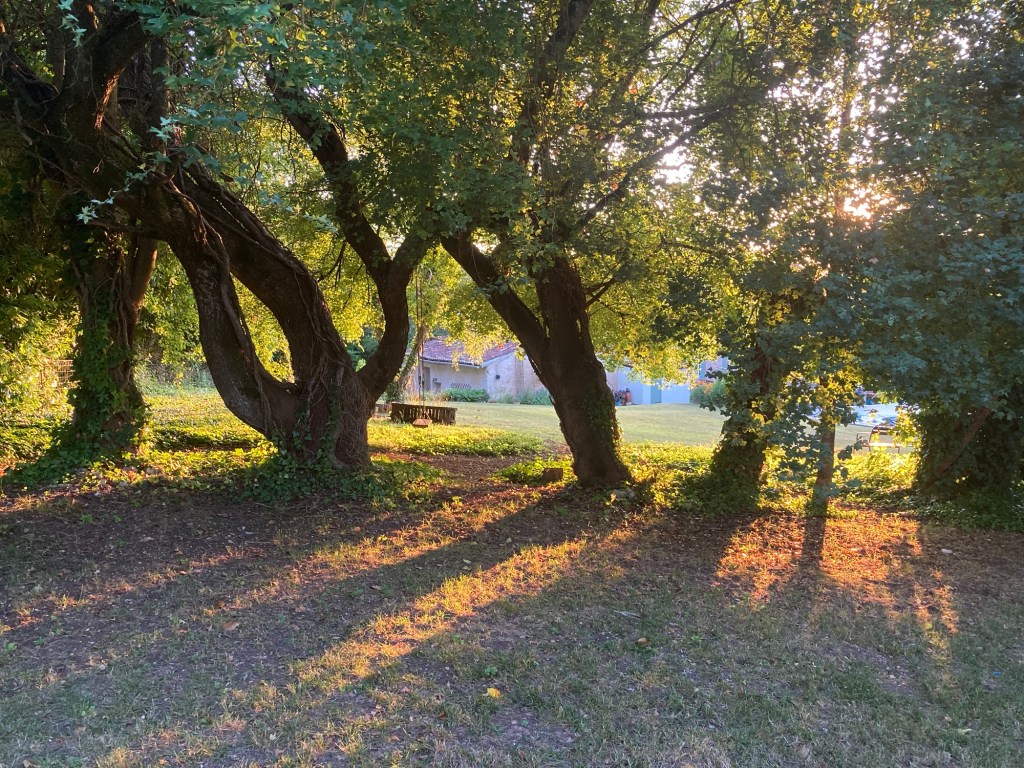
When we bought our house here in the Charente Maritime about four years ago the garden had been pretty much neglected for a long, long time. The house had previously been someone’s holiday house and, as if often the case, when you come on your holiday you don’t want to spend the time doing house and garden maintenance.
One result of that is that pretty much everything growing in the garden had arrived here by itself.
We spend a lot of time in the garden and have reclaimed the impenetrable area we call our forest (honestly, it’s way too small to be a forest but it has the feel of one)
I love the discoveries we make. We’ve found many plants and trees which have been thriving here for years, but it’s still an actively serendipitous garden. New plants appear every year. Here are a couple of the more recent ones…
This is Russian Sage (thank goodness for smartphone abilities to recognise plants), which has popped up in a gravel area.
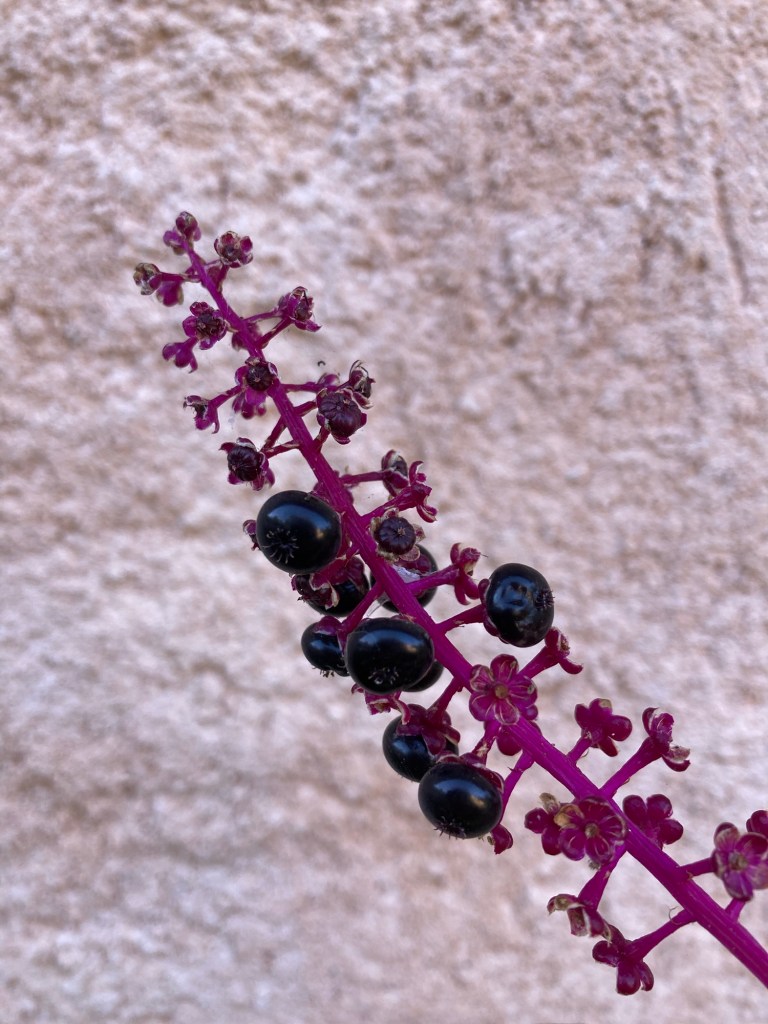
And this Pokeweed, a plant I know from homeopathy, but which I’d never seen in real life until it started growing in front of the wall. It grows really tall and has spectacular leaves, flowers, stems and berries!
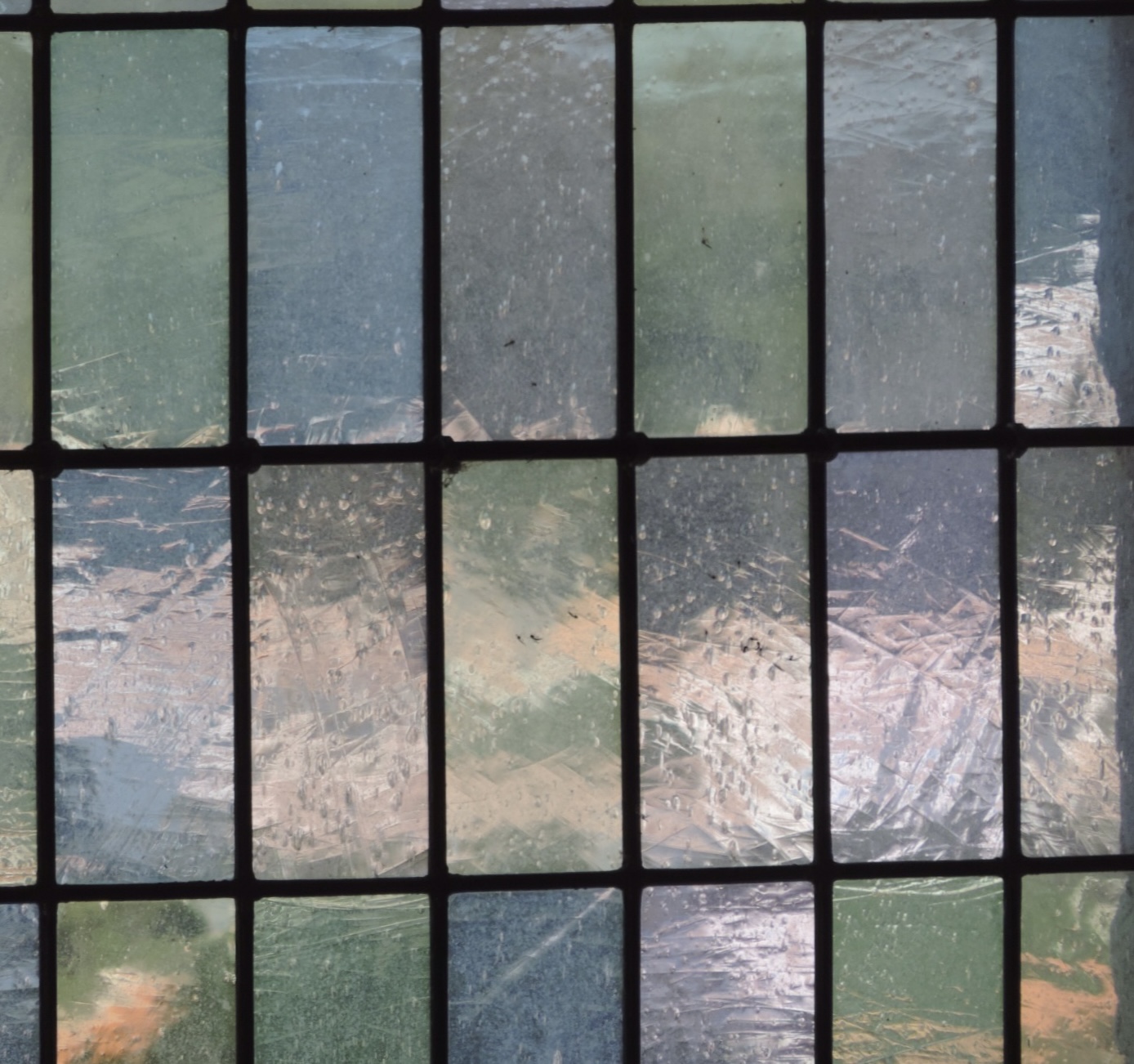
When I saw this window, the first thing I thought was, how beautiful. Look at the colours, the textures, the range and diversity. You can tell this is very old, and, most probably fashioned by hand. It is SO interesting. It caught my attention, stopped me, and drew me in to contemplate it for several minutes.
It doesn’t just let the light into the room, it filters and shades the light, creating what is nothing short of a dynamic artwork, changing minute by minute as the sun moves across the sky.
What it doesn’t do is let you see what is outside.
So, if you think the point of a window is to let you see what is outside, then you wouldn’t see the point of this window.
The creator of this window probably thought letting light into the room, and creating an object of true beauty while it did that, was sufficient. After all, if the main purpose was to let you see what was outside, you’d have selected plain, transparent, colourless glass, wouldn’t you?
I can’t help think, when I walk around any old town in France, that we’ve moved way, way too far down the path of mere utility. I can’t remember the last time I saw a mid 20th century tower block being blown up, and thinking, oh what a shame, what a loss…… Who mourns the passing of concrete (or, worse, “RAC”?)
There are still brilliant designers, artists and craftsmen and women. I just wish we directed more resources towards them, and less towards the get rich quick, throw up a cheap, poor quality building and pocket the profits types.
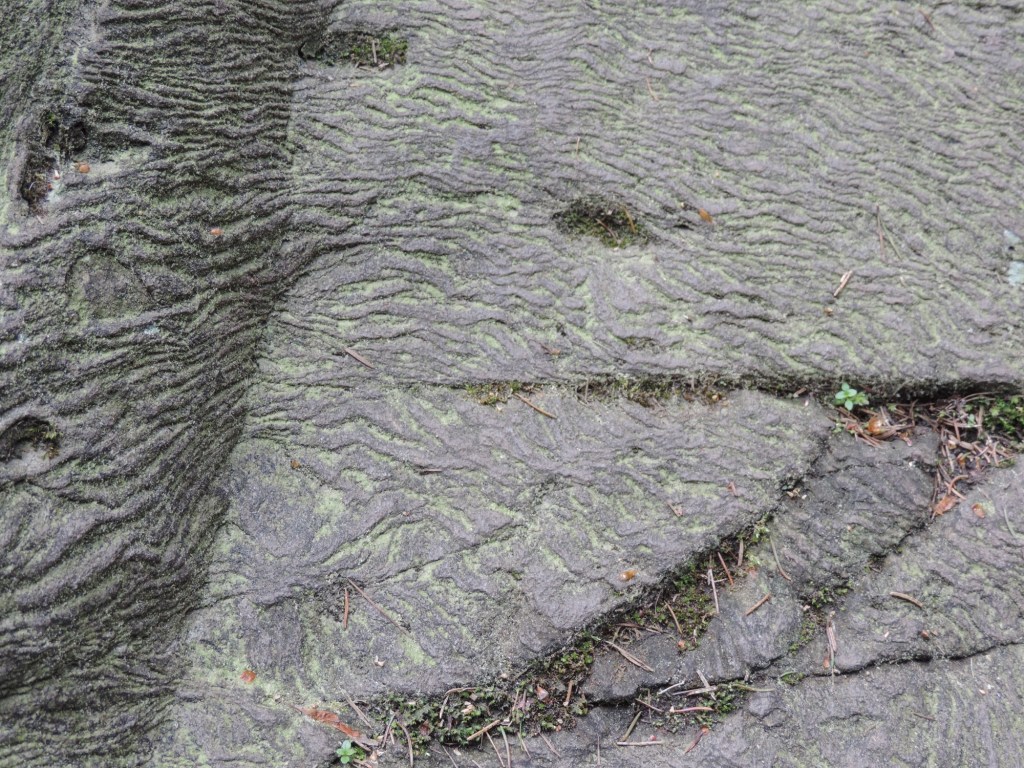
One day I was walking in a forest and I came across these rocks. At least I thought they were rocks. They look more like tree trunks than rocks. They look more like water flowing in the river. They look like an elephant.
There are patterns that appear in a huge variety of forms and materials in the world. The Chinese use a concept of “Li” to describe these underlying patterns which manifest through whatever appears to our eyes.
I think when you see something like this you are instantly aware of the interconnectedness of everything. The sense of a world made up of separate objects disappears.
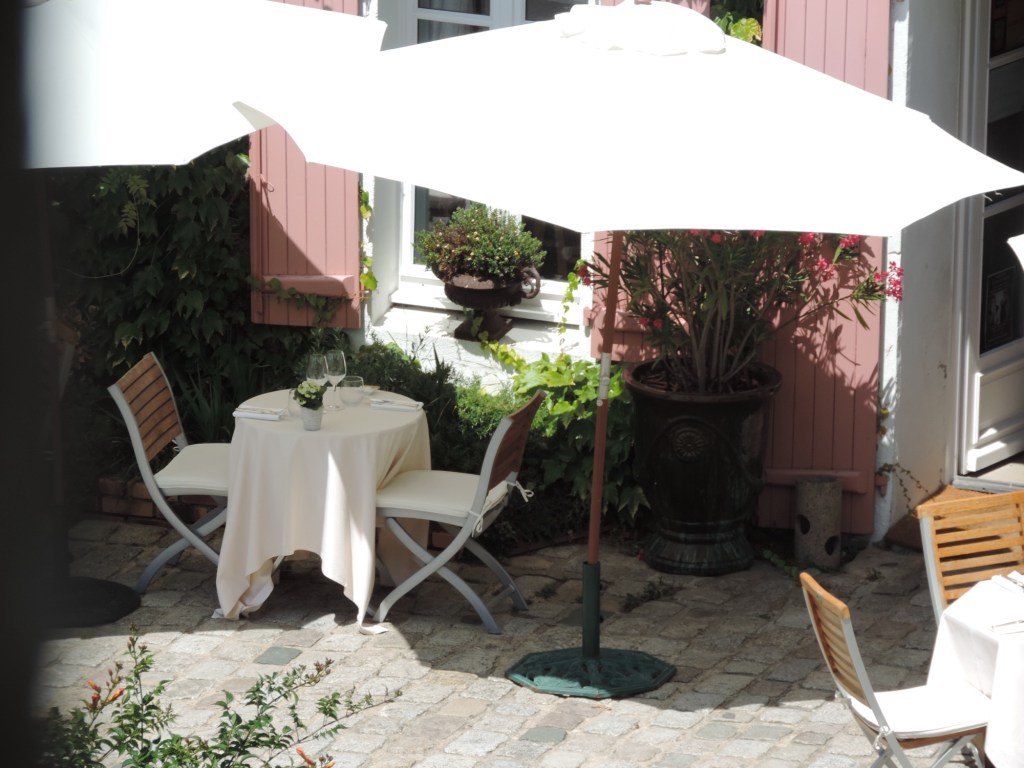
Since emigrating to France from Scotland I have the opportunity to eat outside A LOT more often.
Whether it’s having breakfast, a coffee, lunch, or “apero”, in my garden, or having a meal, or a drink at a cafe, bistro or restaurant « en terrasse » , the climate here just allows that to happen through most of the year.
There’s loads of advice about what constitutes “a good diet”, or “a healthy diet”, but until I came across some articles in French, I didn’t think much about the importance of the non-food aspects of “healthy eating”.
Where you eat influences your experience of eating. There’s something “extra” about being able to eat outside, whether that’s in natural surroundings, like the garden, or gazing out over the ocean or a lake, or in town, “people watching”. It adds to your enjoyment, so influences your emotions, the healthy chemicals in your blood, your heart rate, and even your immune system.
Who you share your food and drink with is important too. The « apero » is an especially social activity, often sharing a board or two of cheeses and charcuterie, accompanied by a beer or a glass of wine. It’s a family event, an event shared with neighbours and/or friends, and it’s more about the people than the food and drink.
The social aspect of eating and drinking is hugely important and takes food well beyond mere “nutrients” or “fuel”.
I love this more holistic way to think about “healthy eating”. It’s not that the food isn’t important. It is. But it’s “and not or”…..the environment and the relationships around the table are also important.
There’s something else which contributes to healthy, enjoyable eating, and that’s the power of food to evoke memories. Whether it’s Proust with his Madeleines, or the dish your mum used to make, or the meal you shared with a loved one, the particular dish can help you relive great moments, and strengthen your relationships.
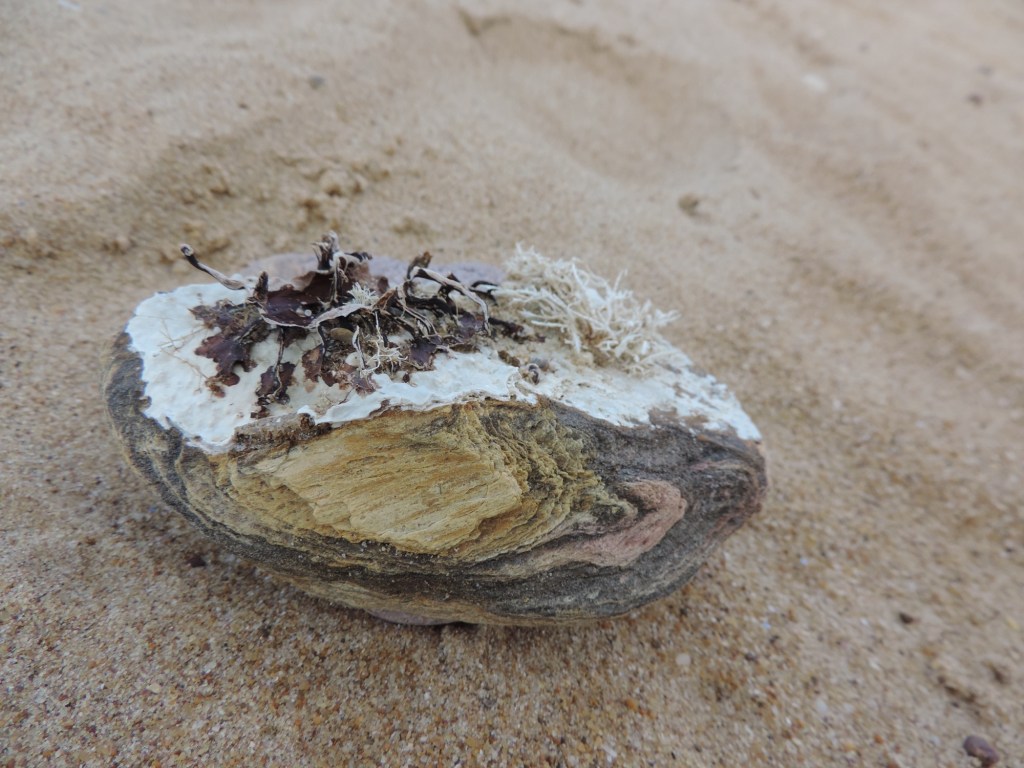
William Blake said we can see a world in a grain of sand, so how much world could we see in this one stone?
It was lying on a beach and from the lichen and/or seaweed growing on its surface, it’s clearly been there a long time.
And look at the layers within in the stone. Almost like the rings of a tree…laid down, accumulated, accreted, over decades, centuries even.
What’s the origin story of this one stone? How far has it traveled? How long has it lain on this particular beach?
I’m pretty sure there will be other life within the plant life there…maybe insects, bacteria, viruses….a whole ecosystem of Life.
And without trying to anthropomorphise too much, what stories could this stone tell us, if only it could? What has experienced? How has it changed in response to the events which have occurred around it within the timescale of its own existence?
And what about us?
How have events changed and shaped us? How have we cocreated our unique reality? What stories do we have to tell?
I spent my working life, one to one, with patient after patient, helping them to tell their stories, so that, together we could make sense of their experience. Time and again, they amazed me, they moved me, they intrigued me.
You can indeed see a world in a grain of sand, a whole world in one stone on the beach, a universe in the heart and mind of another.
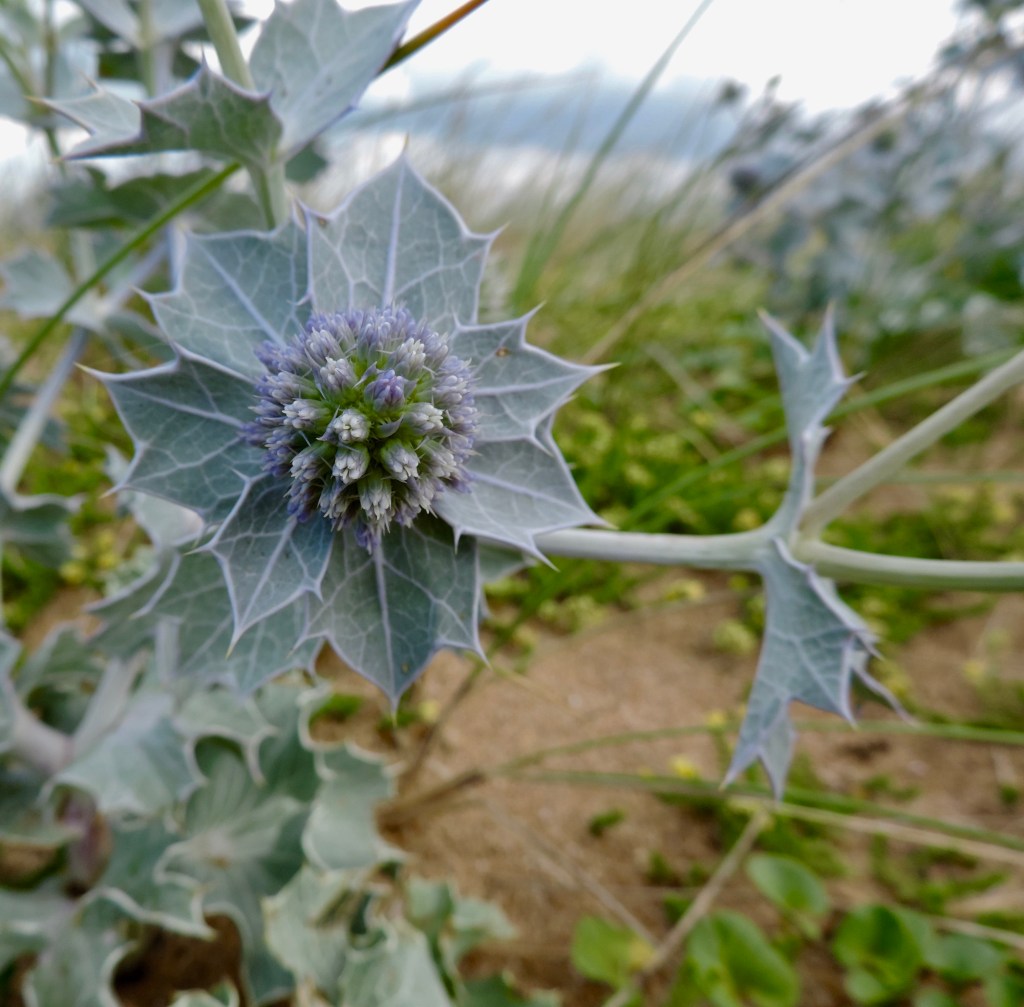
This sea holly caught my eye. Not only is it beautiful, and isn’t beauty one of the most fundamental and important creative attractors in our lives? But it also got me reflecting on the apparent paradox of attraction and repulsion.
The beauty of the plant, its colour and its form, attracts. It draws us to it. It draws pollinators to it too! But the pointed leaves act like thorns and if you get too close they’ll prick your skin. They keep predators at bay too!
We, and by “we”, I mean we living organisms, need both. We need good defences to protect us from harm, to keep others at a distance. But we also need to connect, to call to others, to attract attention and bring others closer.
Around the world we are seeing a rise in Right Wing politicians with a specific focus on the issue of immigration. Country after country is either reinforcing its borders, or planning to do so. The criteria for authorised immigration are getting tighter and more expensive and the rhetoric against those escaping war, torture, poverty or hunger is becoming more severe. Underpinning all this is a negative stance towards “foreigners” who are blamed for housing shortages, low wages, difficult access to health care, pressures on schools and crime. The answers to these supposed effects include closing borders to new migrants, rounding up unauthorised migrants and deporting them, and even “re-migration” (expelling those with a legitimate right to remain in the country).
We could look at the facts and try to discover if any or all of these negative effects can indeed be laid at the doors of immigrants, but, frankly, many have already done so, and none of these claims stand up to scrutiny.
But, let’s take another approach. Let’s think about where we place borders and how we control them.
In the Middle Ages many cities in Europe built fortified walls around themselves. The gates into the cities were guarded by armed men and nobody could move freely into and out of the city.
Then as nation states arose those walls came down, either literally, or functionally. The borders were re-drawn around the new nations.
If you are at all interested in old maps, it’s easy to see that the current “national” borders, have, in many cases, been in existence for only a few decades, and that many have been drawn and re-drawn repeatedly.
But let’s do a thought exercise. What if we were to recreate, if not the actual walls, the borders around cities? What if, for example, we stopped people moving from one part of a country to another part? After all, the arguments against migration from one country to another are mainly down to strains placed on existing services, such as housing, health care and education, on the places to which the migrants move. So, if the problem is people moving into a particular city, or, even area of a city, and the answer is to stop them, why prevent only those coming from other countries? Why not stop those people coming from other cities in the same country?
China does this. There was a recent report about taxi drivers in Shanghai, many of whom are “migrant workers” whose homes and families are hundreds of miles away (but still in China). These workers have a right to work in Shanghai, live in dormitories together, but have no right to bring their families with them, and no right to health care within Shanghai.
How does that sound?
Would you like your country to function like that, controlling the movement of people within the country to stop “locals” in one city from being “invaded” by “hordes” from other cities, or from the countryside?
The rising tide of anti-foreigner speech, and actions, in populations and amongst politicians, is a return to the Middle Ages. Haven’t we developed since then? Haven’t we learned, since then, to identify with other humans who happen to live further away from us?
Xenophobia is a political weapon. Migration is not a “legitimate concern”. The issue is how a country uses and directs its resources. If there is a deficit somewhere, then the answer is to address that deficit, not take away freedoms, or stoke fear and hatred of “the other”.
It makes no more sense to try to control movement over national borders than it does to control movement within them. Setting one part of the population against another is a device to keep the privileged, privileged, to keep the elite, elite, to keep the wealthy, wealthy.
We have greater wealth in our countries now than we ever have, but we’ve developed an economic/political system which funnels most of it into the hands of a tiny minority. It’s only the richest who are substantially increasing their wealth over the last fifty years. That’s untenable. But it’s not an issue caused by migration, or insufficient control of borders.
And, for those who say that free movement over borders would be a nightmare, why isn’t it a nightmare to allow free movement within them?
In some ways, I can’t believe I’m actually writing this, but there are so many stories around just now of children being killed. Almost every day we hear of children being blown to pieces in Gaza, of children being deliberately starved to death. We hear of children killed in wars and conflicts around the world, and, the truth is, we always have.
Recently the case of 800 bodies and children thrown into an unmarked “grave” in Ireland has come to the fore….a story of nuns who discarded the ones who died in their care. How many stories are there of children abused, beaten, humiliated or sexually exploited in so-called “childrens’ homes”? Many of those stories are historic, but, surely, it’s unlikely all that abuse and killing has stopped?
I’ve also read a few articles recently about how “we” have lost our moral compass. With politicians, and those in positions of power, deliberately lying, never held to account, with their corruption and money-grabbing exploitation of their positions, and with all the dreadful violence perpetrated on children (and adults, of course) in Gaza, with voices of dissent shut down. There’s apparently an epidemic of shoplifting but there aren’t enough police to even bother to attend the shops, or pursue the criminals, despite the fact there seem to be plenty of police available to arrest people for standing quietly on the street holding placards. Moral compass?
Sure, there’s never been a time in history where children haven’t been abused and killed. Sure, there’s never been warfare that didn’t destroy the lives of innocent men, women and children. But it never was OK, and it sure isn’t OK now.
Can we agree? Can we agree that it is NEVER OK to kill children?
And if we can agree that, can we condemn those who do it?
Can we agree that it is NEVER OK to abuse children or to make them suffer?
And if we can agree that, can we condemn those who do it?
That would be a good first step on the path to discovering a moral compass. Maybe if we could do that, we could then start to apply the same standards to all other human beings. Now that would be something!
Rebecca Solnit, in her “No straight road takes you there”, quotes the environmental writer, Chip Ward, as referring to “the tyranny of the quantifiable”.
There’s an obsession with numbers in our world. From measurements to statistics, there is a determination to quantify every aspect of life. Yet, Life, itself, is not quantifiable. Neither is Love, Beauty, Goodness, Happiness, Self esteem or self worth, despite the attempts by psychologists to attribute numbers and scales to any invisible phenomena.
This is an issue I had to deal with every day of my working life, because neither “health”, nor the most troublesome of symptoms such as pain, nausea, dizziness, fatigue, itch or breathlessness, can be observed objectively and be measured. Many people used proxies to measure the invisible – scales, such as “from 0 to 10, where 0 is the least troublesome and 10 the most, what number would apply to your “X” today”?
I remember the story of a dentist who ran a facial pain clinic. He insisted that every patient begin the consultation by telling him a figure from 0 to 10 related to how much pain they were experiencing. If they started to describe their symptoms, he’d interrupt, and insist “The next thing to come out of your mouth should be a number”. His successor in the clinic was baffled when the first patients would sit down and rather than say “hello” or start to describe their symptoms, they would say “7”, or “5”, or whatever. The old chief had trained them so well! “The tyranny of the quantifiable” indeed!
But let me return to health, because we all seek that, and doctors, surely, would hope to improve the health of their patients. But health, as Gadamer describes so vividly, in his “Enigma of Health” essays, is not visible, and not quantifiable. Rather, it’s pathology which makes an appearance….in the form of a rash, a swelling, an irregular heart beat, or a restriction of function. When the pathology recedes, health reappears….the painful hand becomes unnoticeable again.
The experiences which make every day seem worthwhile are equally, not quantifiable. Wonder, awe, joy, love, happiness, a sense of connection, of being understood, a feeling of belonging. We can’t measure those with a smart watch, a smart phone, or a fancy scanner.
That’s why our individual stories are so important. Only you can describe what you are experiencing, and only your story helps you make sense of your life. The counter-balance to the tyranny of the quantifiable is appreciation of, and the telling of, our encounters with wonder, joy, love and connection with others.
Your story is unique, and, together, we create a world worth living in by sharing our stories and co-creating the ones which we value the most.
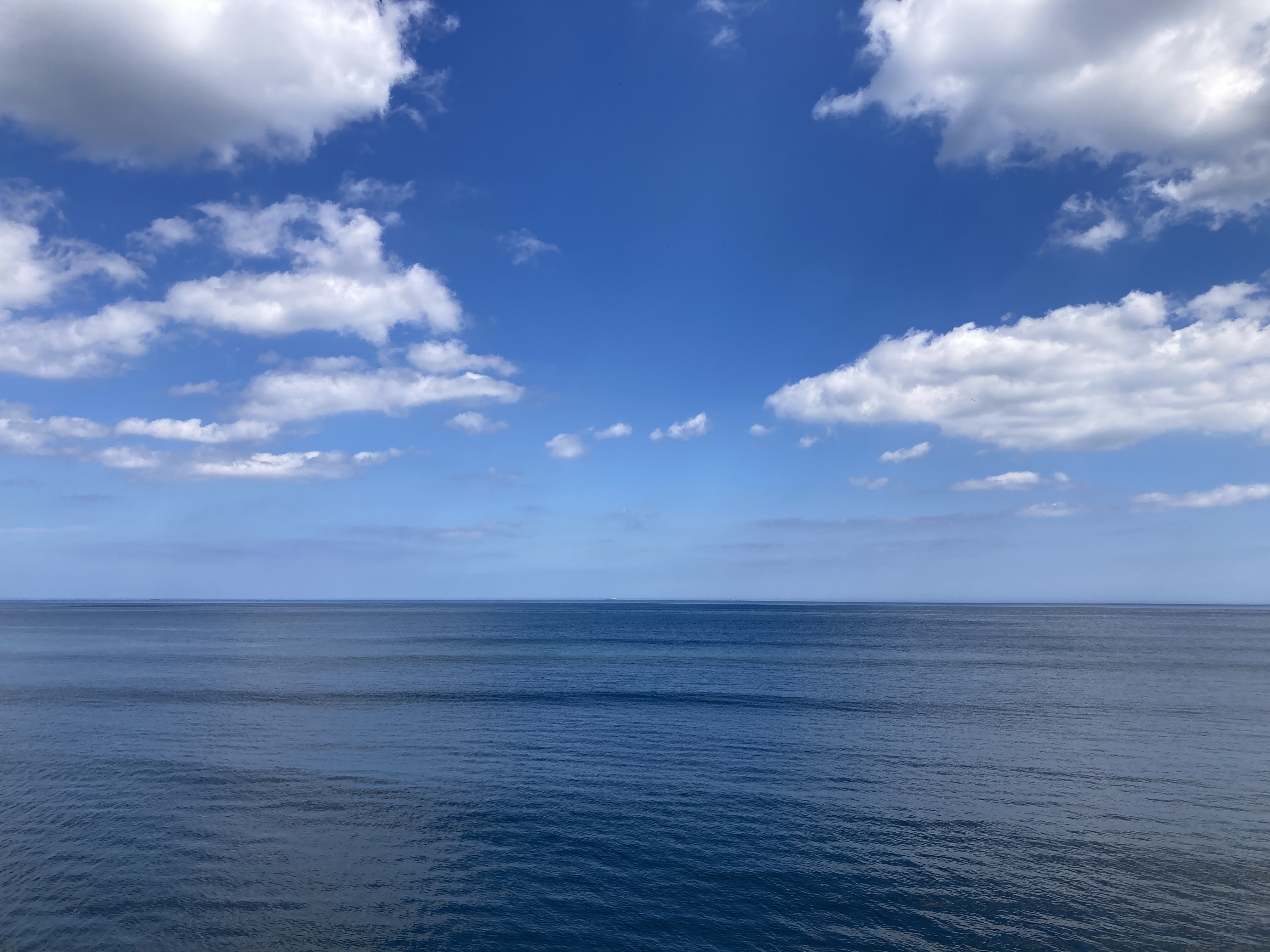
As you stand, alone, gazing out to the vast expanse of the sea, it’s easy to think you are separate. Separate from everyone else, separate from other creatures, standing on the outside, looking in, at this world you find yourself in.
But, that’s an illusion.
We are not separate. We don’t exist apart from Nature. We don’t survive all by ourselves. We are not disconnected.
Yet, this sense of being separate lies at the heart of so much dysfunction and trouble in this world. We have created a system of society, of politics and economics, on the foundations of this delusion. The idea that by encouraging selfishness, actions and choices which put our own interests, not just above those of all others, but with no thought whatsoever to consequences, we can create a healthy, thriving life, is just crazy.
So, why do we live this way? Why do we support the idea that we can consume more and more of the Earth (what we call “resources”) forever and forever? We live in a finite planet. What we burn and destroy won’t come back. The species we eliminate won’t come back. We can argue about timescales, but the Club of Rome’s “Limits to Growth” report, published decades ago, was, essentially, correct. Unlimited growth in a finite world is going to hit the buffers one day, maybe not in our lifetime, but in the lifetime of our grandchildren, or our grandchildren’s grandchildren.
Should we care about our grandchildren’s grandchildren?
I think we should.
Why do we support the idea that a tiny minority of the people in the world should be allowed to grab as much of it as they can? Why do we have billionaires? Does it matter what they do? Does inequality matter? A question which won’t even occur to the narcissist.
Iain McGilchrist’s thesis about our brain asymmetry helps me understand. It rings true and it helps me to see that if we use our left hemisphere excessively, and, as if it is disconnected from our right hemisphere, then we are going to experience the world as if everything is disconnected. Our reductionism and selfishness will narrow our view so much that we’ll fail to see that we, and everything else on this planet, are intimately, inevitably, interconnected.
We are embedded in this world. We exist, for a brief time, in a vast web of relationships. We are the individual waves which appear on the surface of the sea, then dissolve, back into it.
Can we learn to take a longer view? Can we begin to act as if our grandchildren, and their grandchildren matter? Can we make choices which take into account the ripples and effects of those choices, and the effects they have on others, on our environment, on the world in which we belong?
What do you think? Can we develop and share a different vision for our lives and our world? A vision more consistent with the use of both our cerebral hemispheres, a connected world of embedded lives, where everything we do has consequences, for ourselves, for our loved ones, for others? Can we learn to see the bigger picture, the longer timescale, a better way to live?
I welcome constructive criticism and suggestions. I will not, however, tolerate abuse, rudeness or negativity, whether it is directed at me or other people. It has no place here. ANYONE making nasty comments will be banned.