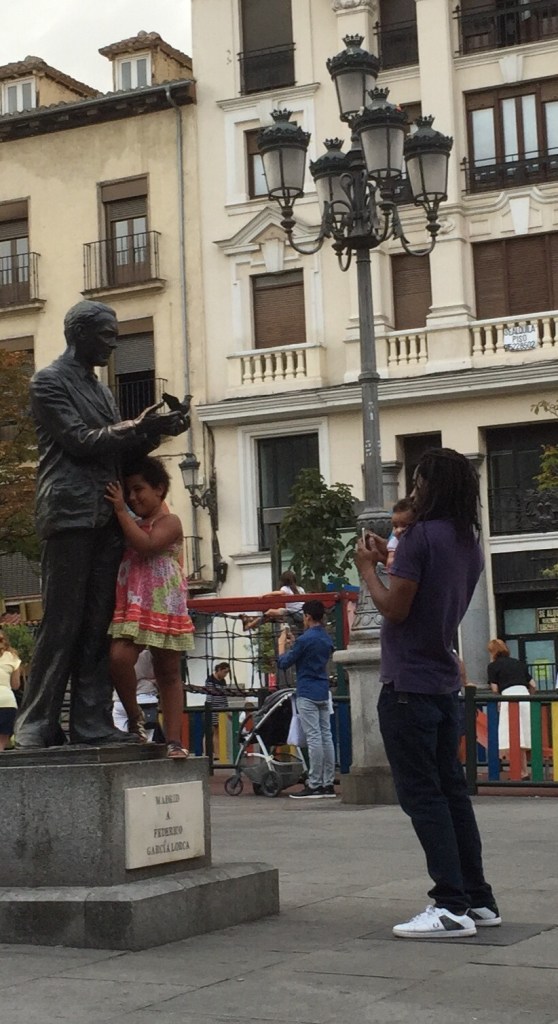
Five years ago I was in Madrid, sitting in one of the many plazas enjoying a glass of wine and I noticed a statue getting a lot of attention. It’s a statue of the poet, Lorca, where he is setting free a bird. You know how certain statues have highly polished parts because so many people have felt compelled to touch them over many years? There are just some statues which call out, silently, to be touched. The ones which touch the people who come near, I suspect. Like « Greyfriars Bobby » in Edinburgh. Well, Lorca’s statue seems to be one of those.
I was particularly struck by this little girl’s response to the statue. Look how she is cuddling Lorca? She’s the very picture of affection.
I’ve looked at this photo many times and every time it touches my heart. It puts me in touch with those flows of kindness, tenderness and affection which run through us all.
I know we are surrounded by stories of cruelty and violence. I know human beings can be capable of the most despicable acts. But there’s something else which runs through us all. You could call it love. You could call it socialisation. You could call it empathy. You could call it the desire to care and be cared for.
It’s present from the moment of birth. No baby would survive without it. No child would thrive without it.
We humans are no solitary creatures. We have achieved what we have achieved as a species. We learn from each other, teach other, support each other, work with and care for each other. If we didn’t, we’d all perish.
I don’t know, I just think it’s worth remembering that from time to time. After all maybe the future depends on our strengthening that connection with our « better angels »
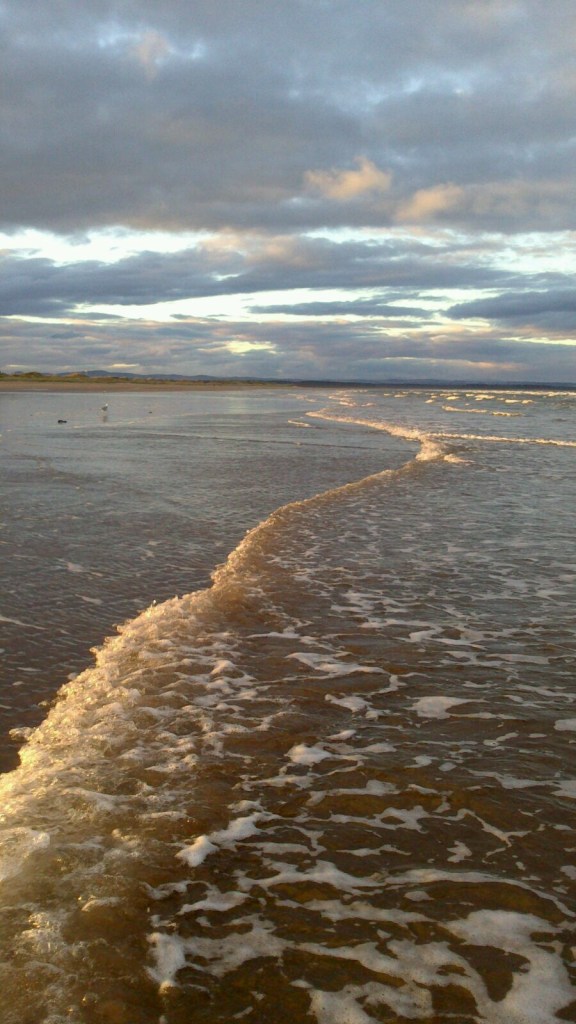
I love this photo. The way the sunlight catches the breaking edge of the waves turning the foam several shades of white, cream and gold delights me. It draws your eye right there – to the leading edge.
I don’t think of the world in terms of separate objects any more. Instead I see flows, intersections, meetings and connections. I see relationships and experiences. I see becoming, not being.
All that exists is impermanent. It’s not just that we humans are mortal, it’s that the whole of Nature is in a constant process of cycles of birth, growth, maturity and death. Transience makes every moment special.
Shifting my gaze from apparently separate objects to change and interaction enables me to see the contexts in which all exists. It focuses me on inter-dependence, on connections and collaborations.
I was thinking of this as I watched David Attenborough’s superb A Life on our Planet on Netflix. Have you seen it? I highly, highly recommend. One of the best things he’s ever done. I found it moving, thought provoking and optimistic. If you don’t have Netflix you can listen to the audiobook version on Audible, or, you can read the book.
Perhaps his key point is the importance of biodiversity which our current societies and economies are in the process of destroying. Because all of Nature is interconnected and interdependent we need biodiversity for the health of the entire planet. In fact we humans won’t survive without it.
It’s that combination of diversity and connections which is, I think, the key, and I reckon he is right when he tells us that the solutions are all there right in front of us. If we want to discover how to thrive, not just survive, then we should learn from Nature, and a great place to start on the path to sustainability is to support and develop both diversity and integration – by which I mean « the creation of mutually beneficial bonds »
When we do that we’ll be living on the golden edge.
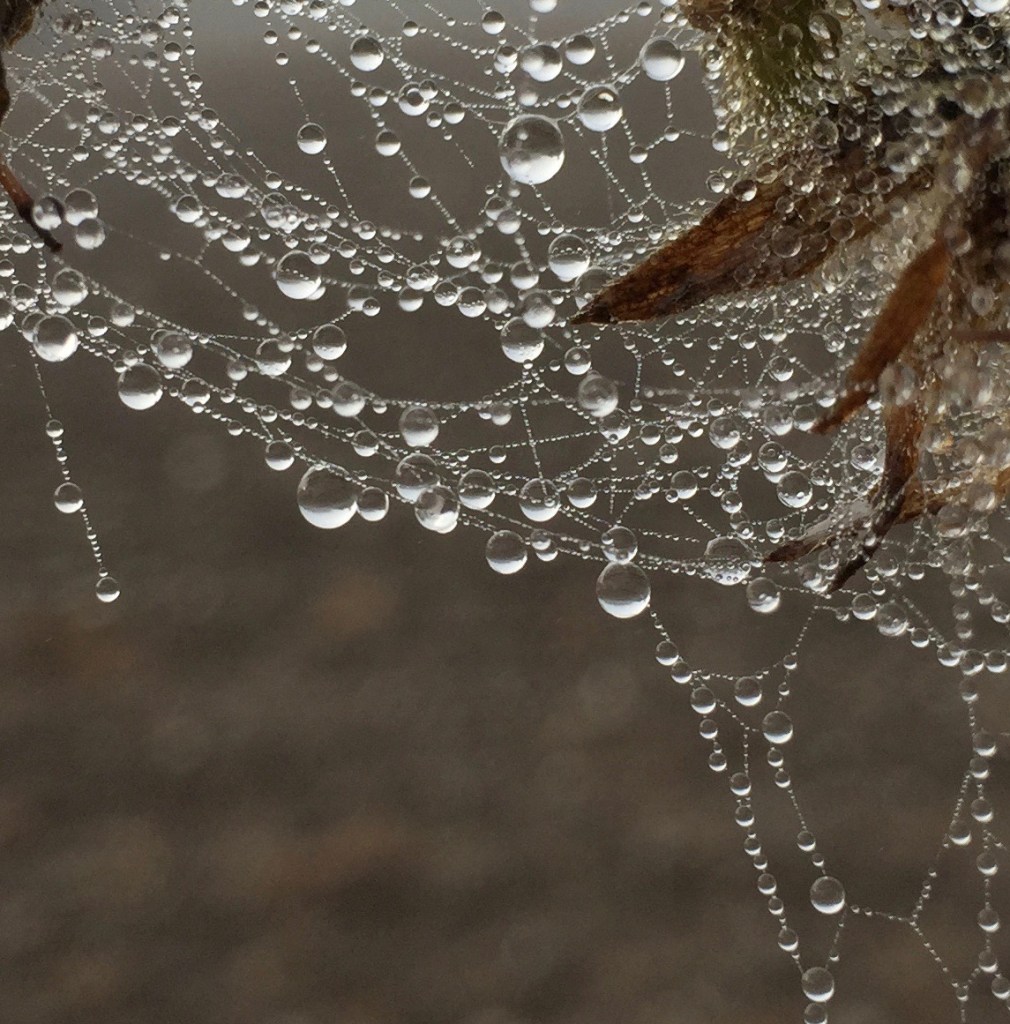
When I see a spider web heavily laden with dew in the morning, or after the rain, it’s the sparkling jewel like quality which catches my attention. But when I look more closely I’m transfixed by how every single water droplet acts as a tiny lens.
Whichever lens you look through you see pretty much the same scene. But if I was considering this more carefully I’d realise that each lens is in fact unique. There might only be tiny differences but they are measurable.
However the fact is that the differences are tiny. No matter which little lens you are looking through you are seeing pretty much the same scene.
So this reminds me about three important truths. First, we all perceive and experience the world from our own unique individual subjective perspective. Second, we are all sharing the same world. We don’t live in, or experience, totally separate ones. Third, we are all connected.
Ever since I read about Indra’s web I think of that when I see a be-jewelled web like this, so it’s easy to slip from the pure beauty of the particular web into a universal experience of dissolution into a sense of One-ness.
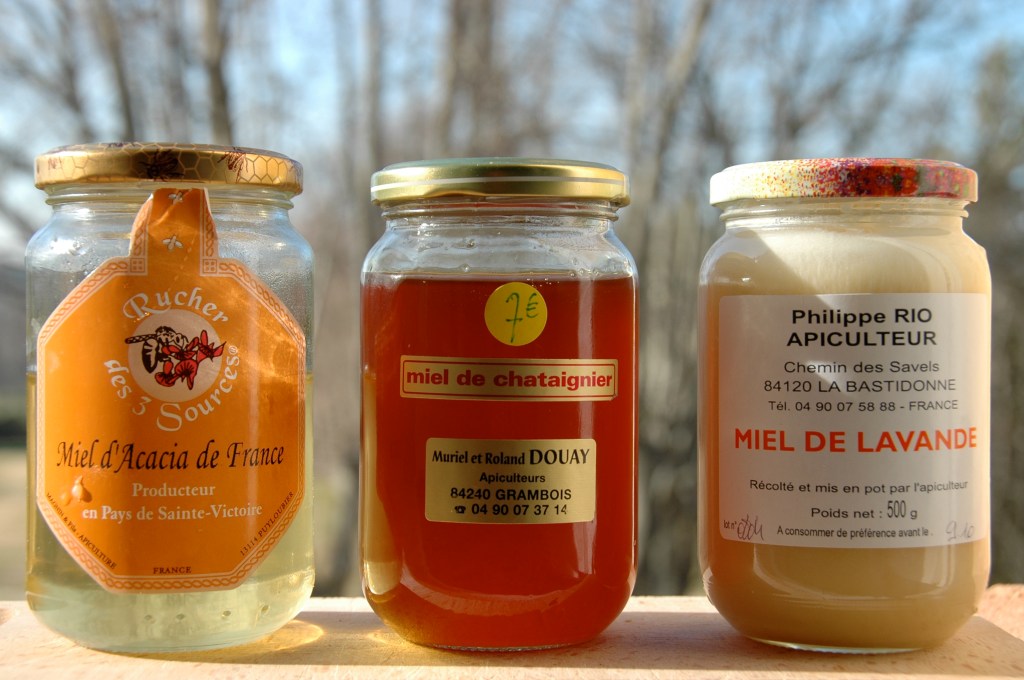
Here are three jars of honey that I bought at a market stall here in France.
From left to right they are acacia, chestnut and lavender.
What’s the first thing you notice?
They are SO different, huh? Just looking at these jars should make you pause and think about this issue which I reckon we encounter multiple times every day – how uniqueness is always present even when we obscure it by abstraction and categorisation.
What?
Well you see I understand why we call the contents of all three of these jars by the same name – honey – because it’s true. They are all honey. But I’ve heard some people say they love honey and others say they hate honey. And here’s where the problem starts. Believe me acacia, chestnut and lavender honey taste incredibly different. They don’t have the same consistency and they don’t even smell the same.
I adore the chestnut honey but I’m the only one in my house who does. Others can’t even stand the smell. I find the acacia kind of bland but it’s probably one of the most popular ones in the shop. And the lavender honey spreads utterly differently from the other two. You can pour the others, but you’ll wait a long time to see the lavender one pour!
I know this skill of analysis and categorisation which is carried out by the left hemisphere is a kind of super power that allows us to think quickly but abstracting just a small number of features or characteristics and classifying the entire “object” according to only those features distances us from reality.
Reality, it turns out is a vast interconnected web of uniqueness with every element, encounter and relationship constantly influencing and being influenced by the others.
Generalising, labelling, runs the risk of blinding us to uniqueness which doesn’t only mean we separate ourselves from reality but it threatens our humanity.
Just last year when visiting my mum in hospital I overheard one nurse say to another “Have you taken blood from bed 16 yet?”
Yeah, right, try getting blood out of a bed!
That’s a common way of thinking and speaking in Medicine. I can remember the excitement of our group in Medical School when we heard “there’s a really unusual heart murmur in ward 6”! Well, we were just learning how to use that iconic instrument, the stethoscope and there’s only one way to detect unusual sounds in someone’s heart – to listen to them and learn each distinct pattern.
Thing is it’s too easy for the actual people whose blood needs to be examined or whose heart is making an unusual sound to just disappear.
Are we going the right way with this issue?
I don’t think so.
By shifting our attention from stories to data we are de-humanising not just our health care but our societies.
Is it any wonder that public and political discourse has become so polarised? If we see someone as “one of them” and “not one of us” it’s going to be pretty difficult to build a mutually beneficial relationship with them.
How do we counter that? Well I guess it’s takes curiosity and a desire to discover what makes someone unique. Because here’s the interesting thing I’ve found in life – when you discover someone’s uniqueness you find what you share with them and at exactly the same time you find you appreciate them as whole people.
It turns out that what we all share is the fact that we are all different.
And seeing both differences and similarities in uniqueness enables us to humanise our daily encounters, to build bridges and to care for each other.
Turns out that makes for a tastier, richer, more delightful life.
This is one of the many stone circles I’ve visited in Scotland over my lifetime. This one is at Lundin, and it’s a pretty small one, but rather uniquely, has a tree growing in the middle of it. That’s pretty unusual. Mostly these circles have just grass or a covering of small stones in them.
I suppose you could look at this and say it’s just a few stones, placed on their ends in approximately the same part of a field. So what’s the big deal? But wouldn’t that be a terribly reductionist, thin, and poor way to encounter something like this.
The truth is I don’t think anyone seriously looks at this and thinks, so what, just some stones in a field!
There’s something about the arrangement of stones into rough circles which resonates deeply with us. They catch our attention, provoke our curiosity and stimulate our imagination. They may even invoke memories for some of us, remind us of stories, create a sense of deep time connection to ancestors.
There is something else they can do too – they can move us. I’m sure I’m not the only person to feel a thrill approaching a circle like this, to experience a quickening of my heart and my breathing. Not with all of them, but with many of them, I have a distinct feeling when I step inside the circle. I can’t quite pin it down. It’s partly a feeling of joy, partly a feeling of wonder, and partly a feeling of expectation. Of what? I don’t know. About the best I can say is that the feeling inside some of these circles is special. It’s unique.
Is this why they were built in the first place? We don’t know. Are they works of art, places of ritual, scenes of celebration or enquiry? We don’t know.
But here’s what I do know. They aren’t just a few stones in a field.
They are opportunities to be enchanted. To be re-enchanted. Because, hey, let’s face it, it’s pretty easy to feel dis-enchanted these days!
There are many kinds of special places for human beings of course. They aren’t limited to stone circles. I wonder which special places you’ve found in your own life?
These special places make us more aware that life can be deep, rich and meaningful if we look behind the superficially disconnected material view of reality.
I took this photo in Aix-en-Provence a few years ago and I still like it. These two students (I’m presuming they are students) are sitting close together in this empty square late one evening. They are both lit up by the light of their laptop screens and I’m guessing they’re sitting there cos the found a wifi they could connect to.
I like that they are together but separate. Each on their own laptop but sitting so close together and sharing a reason to be there.
This image sets off a few trains of thought for me.
First and foremost it reminds me of the deep need we have to be connected. We humans have evolved as the most highly social creatures on the planet. Our brains, our senses, our bodies don’t exist in isolation. They exist in constant flows of materials, energies and information. We couldn’t survive without making connections. If you’ve had a child you’ll know the intensity of connection which overwhelms you within minutes, perhaps seconds, of their birth. No infant would make it to adulthood without powerful ways to connect with others and secure the care they need.
It also reminds me of that rather paradoxical opposite phenomenon – our need to be separate, to know that we are individuals. Each person here on their own screen, making their personal connections with a unique social web of others.
In the light of the pandemic this image takes on a new significance. We have been distanced from each other and confined to our separate spaces to communicate through technology – screens and phones – and that’s produced a mixed bag of experiences. Many of us have reconnected with others who had faded into the backgrounds of our lives. Many of us have spent a lot more time connecting with others on Zoom, FaceTime, messaging services, Facebook, etc. And a lot of those connections have been good. But people are also talking about screen fatigue and recognising that “virtual” connections are not a substitute for “real” ones. We long for the physical, for the gentle touch, for the hug, for the greeting kiss, the firmness of a hearty handshake.
Maybe it’s good to become more aware of all that and to know that, as we go forward, the most important aspect of life is our relationships. We might feel like separate individuals but we live only in connection with others.
I know that colour choices are very personal and subjective. We each have various colour palettes which we prefer, and I suspect there are certain palettes we prefer in particular circumstances.
I don’t really have a lot of bright primary colours around me. The colours I wear in summer are similar to the colours you’d see as you walk around certain Italian streets…..Bologna, for example. But in the winter I generally wear black or dark colours.
Now that I stop to think about it, I’m not really sure why I make these particular choices. It seems to happen mostly subconsciously, but maybe it’s a better idea to become more aware and make more conscious choices?
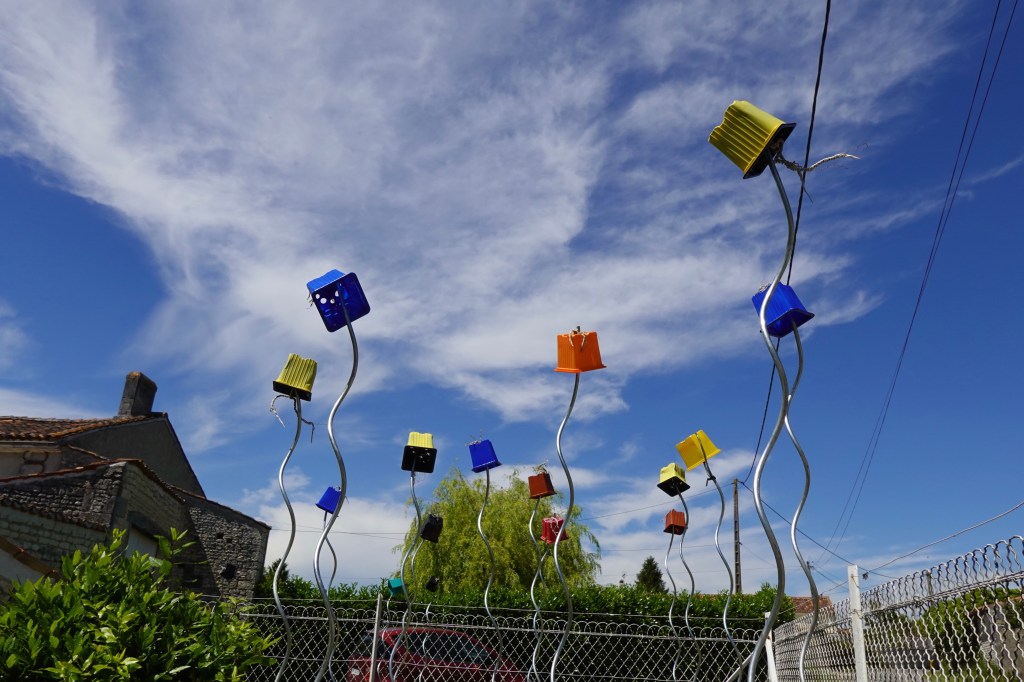
As I walked around the garden this morning the potager caught my eye. We’ve put in these twirly steel rods for the little tomato plants to grow up, and to stop us from poking our eyes out on the pointy ends we’ve attached these brightly coloured little plant pots.
Against a blue sky they are particularly delightful and they’ve got me wondering if bright colours are more likely to evoke the emotions of joy.
What do you think? How to colours influence your emotions and moods?
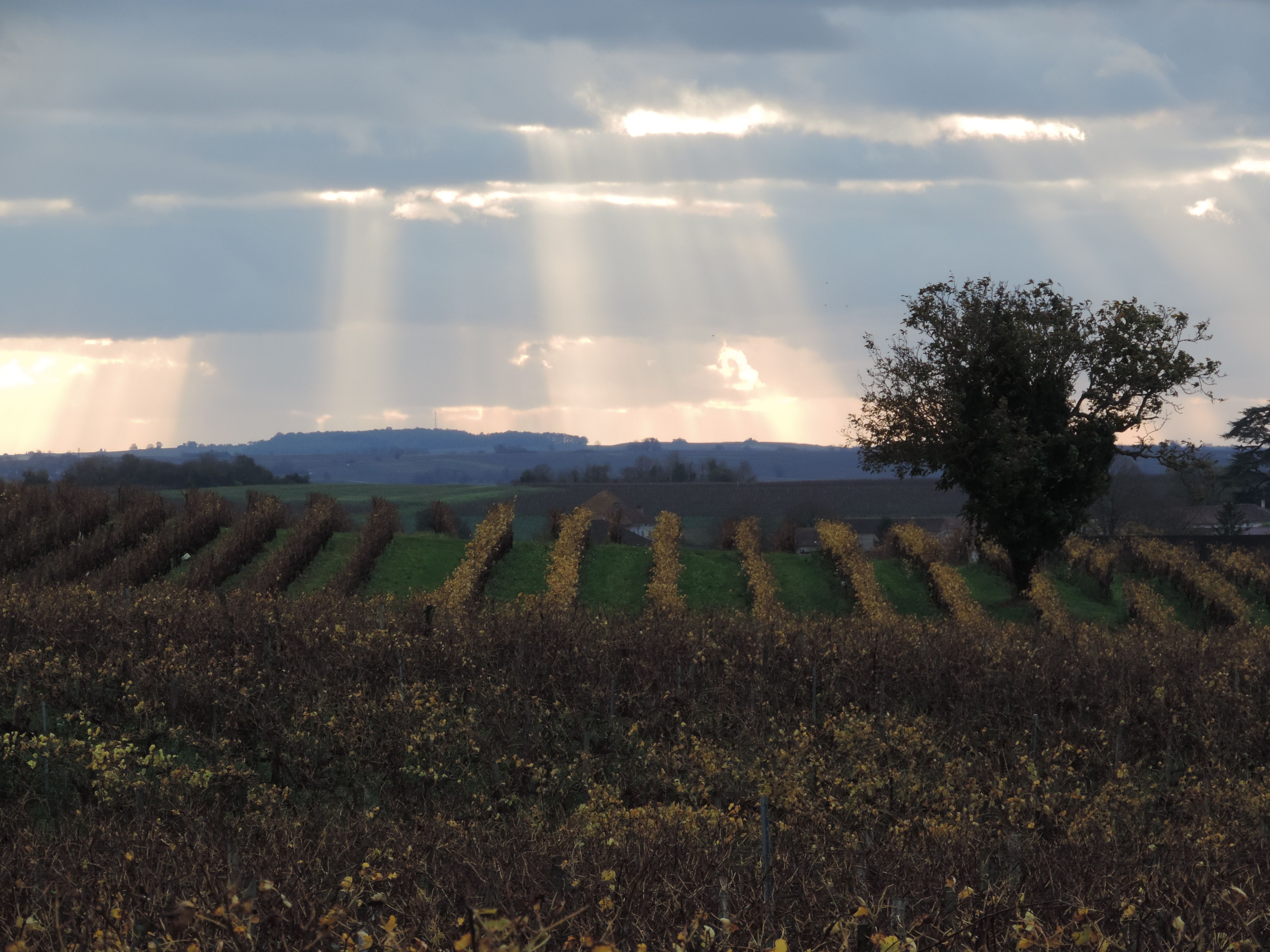
For me, it’s the sort of symmetry you can see here between the rows of vines covering the hillside and the rays of sunlight shining down through the gaps in the cloud.
There’s a resonance there. A sort of harmony which catches my attention. I think “as above, so below”, which is an old esoteric teaching about the way in which this physical world and the spiritual world are connected….or, if you prefer, how the Earth is connected to the Sky or Heavens.
Our brains are brilliant at spotting patterns. In fact, we don’t just spot patterns in the way that a mirror might reflect what stands in front of it, we create patterns. We learn patterns. We remember patterns. Think of the night sky, for example. Once you’ve been taught to see the invisible lines between some of the stars you call them constellations. And then you can find them again much more easily in the millions and millions of stars shining down on a clear night. But someone imagined those lines. They aren’t the same as the threads which make up a spider’s web, or the lines of minerals running through stones you find when you are out for a walk. Our ancestors created those patterns, and told stories so that others would be able to see them and share them.
So we are brilliant at spotting “similars” – we see patterns and attempt to match them to ones we know already, or others we can see, or create in the same moment. When we spot a similar it’s exciting. It’s “remarkable” – it’s attention grabbing and potentially meaning-creating – because that’s something else we are great at – making experiences and perceptions meaning-full. We constant attempt to make sense of the world we are living in, and to connect our experiences to a sense of purpose.
Some of these matches, these “similars” are like resonances – and this is one of those. Resonances are like harmonies. They delight. They spark a little joy, set off some feelings of awe or wonder. They are special.
This is one of the ways in which we can live a more “enchanted” life. A more “meaningful”, “rich”, “deep”, life. A life of soul. A life of spirit. A connected, “integrated” life. A healthy life. A life of flow and movement.
What patterns do you notice today? And what resonances, or similarities, do you see between those patterns, both between them and ones you already know, and between them and the others around you today?
This photo gets me thinking about three dimensions of context…..horizontal, temporal and depth.
The horizontal dimension contains what’s around us here and now. All of our experiences occur within the context of a place. We live, moment by moment, in a web of physical connections which extend in every direction we can see. It includes the natural environment of all the elements and all the other living organisms which share this space with us. It also includes the social environment of all the other people around us (and now with phones, video and messaging services that social environment can stretch out over thousands of miles. It’s not limited to the physical horizon any more). It also includes the cultural environment of habits, behaviours, values and rules with which we co-construct our lives together.
The temporal dimension includes the past….the trails and tracks we can see behind us, the memories we have and the roots which lead from our beginnings to where we are now. It also includes the future, or rather all the possible futures we and others can imagine….that multiplicity of possibilities which collapse into a single reality as each moment emerges from the next one.
The depth dimension lies within us. It’s often unspoken, largely unconscious and unknown but it creates the foundations and defaults of our daily lives. Some of it emerges in our dreams, some is revealed in our language and words, some erupts through in the strength of feelings.
I think if I want to understand someone, whether that someone be me or an other, I need to see them, hear them, discover them in all three of these dimensions.
That’s why a holistic approach in Medicine always seemed necessary to me and why a rigidly reductionist one was often just too narrow to be of more than just a little help.
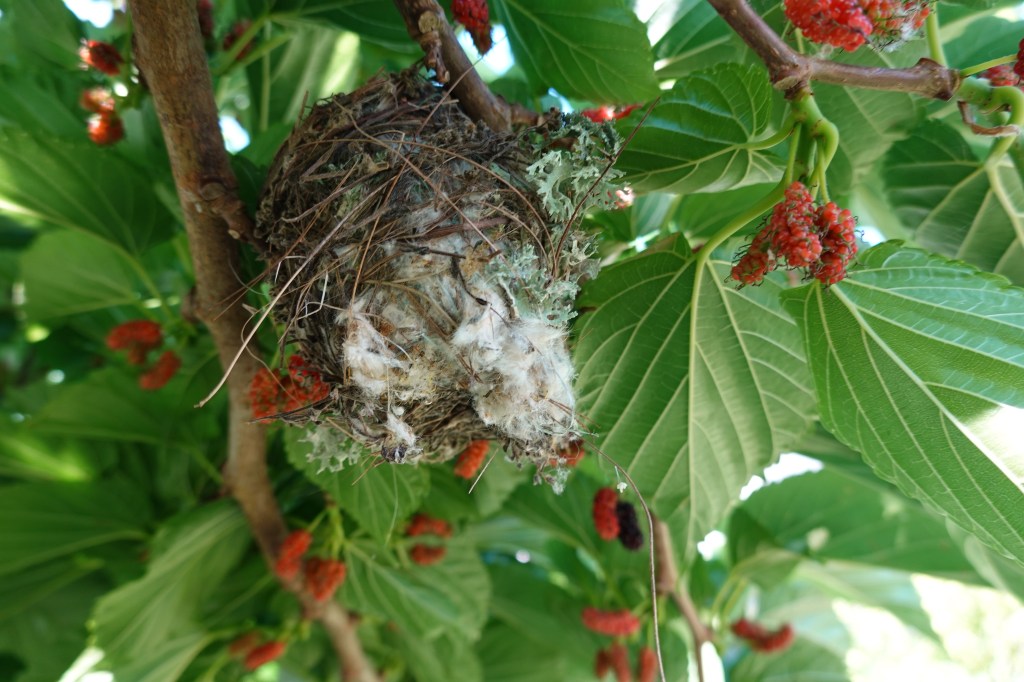
There’s a tiny little bird makes a tiny little nest, every year, usually in what seems to me to be a precarious part of one of the trees or bushes in the garden.
I don’t know where she goes and lives in the other seasons but she sure likes to come here in the summer, lay a few eggs, hatch a few offspring, then she’s gone again.
Take a close look at this nest. It’s not neat, it’s not even especially beautiful and there is actually a hole in the bottom – look next to the eggs –
However, what I got thinking about when I saw her nest this year was this……
“Free as a bird”. This wee creature does what almost all other creatures do – makes a home where and whenever it chooses to.
We humans have made things way more complicated. We’ve created a whole class of people called citizens who have certain rights and can make certain choices that their neighbours who aren’t classes as citizens don’t have and can’t make.
It doesn’t make sense to me to class neighbours differently. Why shouldn’t the people in no. 16 for example be treated the same as those next door in no. 18?
Why have some who have, say “temporary settled status” (in the U.K.), or who are given some kind of visa with limited rights and responsibilities?
Here’s my preference. Treat everyone who lives in the same street, the same neighbourhood or community the same.
They are all inhabitants after all. All living together, all sharing the same spaces, the same facilities.
I don’t get the added value of these various limited rights classifications. Anyone able to make a case for me? Maybe I’m missing something but this little bird building this little nest just where she wants to every year seems to have freedoms we’ve taken away from some of our neighbours. Who gains from that?
I welcome constructive criticism and suggestions. I will not, however, tolerate abuse, rudeness or negativity, whether it is directed at me or other people. It has no place here. ANYONE making nasty comments will be banned.





 Heroes Not Zombies