Feeds:
Posts
Comments

Posts Tagged ‘climate-change’

We hear a lot about growth these days. The Labour government in the UK seems to think achieving economic growth is the answer to all our problems, and, frankly, every other capitalist country agrees. Perhaps that’s because capitalism as a system requires continuous growth to exist.

But the thing is, when I was a teenager I read the Club of Rome’s “Limits to Growth”. That scientific report caused quite a stir since it came out but then the usual suspects mounted their attacks and derided it, so, not much has happened since then. Well, I say not much, but we do have Kate Raworth’s Doughnut Economics, and also the de-growth movement. What I mean is the world has failed to respond remotely adequately to climate change, several governments are rowing back their “green” targets, and Trump and co are all in for “drill, baby, drill” and abandoning environmental protections. So, it doesn’t look good.

However, I come back to a point I’ve made elsewhere – growth of what, and for whom? Because the logic on which “Limits to Growth” was based is still sound. We live on a finite planet, so even if we use technologies to make “better” or “more efficient” use of physical “resources” (by which they mean the natural world), at some point, if every country “grows” every year ad infinitum, at some point, there is going to be nothing left to extract. We just can’t keep grabbing more and more and from the planet, creating more and more pollution, killing off species after species, and expect to have a planet our grandchildren’s grandchildren can thrive on. It just doesn’t make sense.

What is growing? Well, CO2 in the atmosphere. That’s growing. Microplastics in our brains. That’s growing. Insecticides, herbicides, fungicides, I-don’t-know-what-icides, in our water, our food, our bodies, even in our babies before they are born. And the wealth of the wealthiest people on the planet. That’s growing. Maybe we haven’t reached peak inequality yet, but we sure aren’t going to reach the point where really rich people think “OK, I’ve got enough. I don’t need any more than this”.

The planet, Nature, Gaia, grows. But she grows without creating waste or pollution. We see her growth in evolution, and in the history or evolution we see a growth in diversity of species. We see a growth in the interconnectedness of environments, biospheres and individual living creatures. Nature doesn’t grow exponentially in a straight line. It grows in a vast interconnected web of feedback systems, in competition and collaboration with all the other parts of that web. It grows in cycles. Cycles of seasons. Cycles of birth, development, reproduction, maturity and death.

What does healthy growth look like in a human being? Development, maturation, increased skills, abilities, knowledge and intelligence (not artificial intelligence, but the real intelligences of the mental, emotional and social kind). Are our societies doing well at fostering that in their populations? I mean, for ALL the people in their countries? Not so much, huh?

We’re going to have to take on board the basic insights of the “Limits to Growth” scientists, and to create a better system that makes better choices about what it wants to grow. Aren’t we?
Read Full Post »

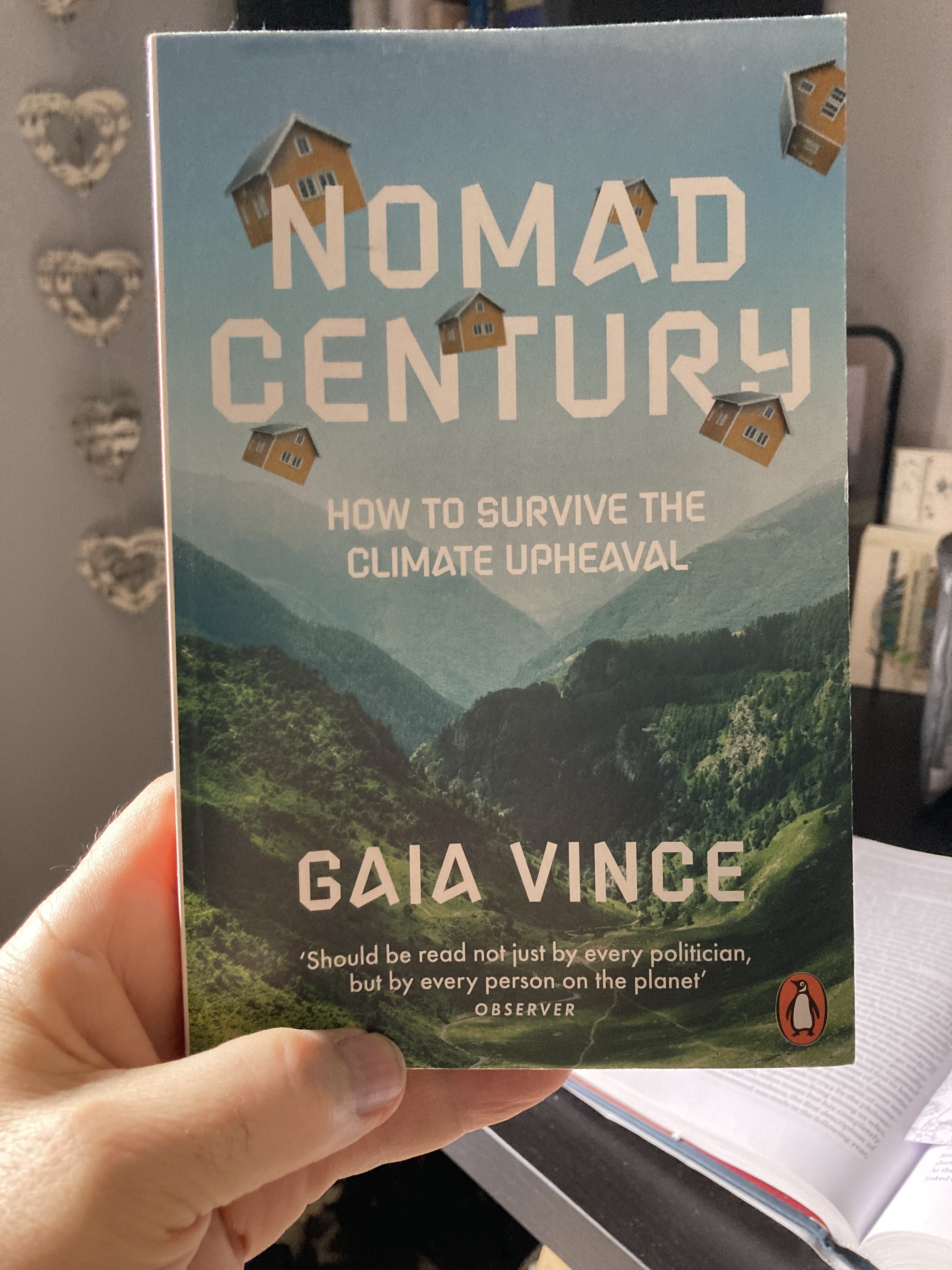
Here’s a book I’d recommend to anyone.

There are loads of books about climate change but science writer, Gaia Vince’s, book is probably the one I’ve enjoyed most. It is beautifully written, and easy read, and isn’t brimming over with despair about our changing climate. She doesn’t play down the significance, or magnitude, of the changes, but, in this book, she takes a focus on an aspect which I haven’t seen others do (or, at least, not so well) – migration.

“Migration is a survival strategy used widely in nature”

There’s a statement which resonates strongly with me. Whenever I try to explain reality, to demonstrate what “integration” actually means, and to highlight how important “cooperation” is, I focus on the human body. In the body are various organs…..heart, liver, kidneys, brain etc…..and in order for us to be healthy all of these organs have to relate to each other. They have to work with each other. They are not part of a competitive market fighting each other for nutrition and resources. Rather, they form “mutually beneficial bonds” – in other words, they create relationships which work both ways in the best interests of each part. This is integration – “the creation of mutually beneficial bonds between well differentiated parts”. Having explained that in relation to body organs, I go on to show how the same rule applies to all the cells and tissues of the human body, all of the billions and billions of cells which each of us has. And from there, it’s easy to see how the same principle applies throughout nature, across the globe, with complex webs of relationships forming between people, animals, plants, and the rest of the environment. Gaia Vance doesn’t use the word “integration” but what she focuses on is migration and cooperation.

For humans, migration is deeply interwoven with cooperation – it is only through our extensive collaboration that we are able to migrate, and it’s our migrations that forged today’s collaborative global society.

and

Studies across nature show that global dispersal is the most effective strategy for any species to prevent extinction.

and

…human brains are highly adaptive and we are hypersocial, able to cooperate with large numbers of unrelated people, supporting each other and sharing resources, ideas and knowledge

What she does so well in this book is to show just how natural it is to migrate. She describes the history of migration, in humans as well as in other species, and the history of borders and nation states (a surprisingly recent development in human civilisation). This reminds me of the writing of Rutger Bregman who challenges the whole issue of nation states and borders in his excellent “Utopia for Realists”.

This is a hopeful book which highlights how we need to think about migration differently – to move away from the toxic, xenophobic and racist narrative which seems to dominate in the world today.

We live in an inextricably interconnected interdependent world. None of us can live by ourselves. Our human super power is collaboration, and combing that with migration, learning how to plan for it, and manage it well, to ensure good integration, is our best hope in the face of a rapidly changing world.

Buy this book. Read it. Talk about it. Share it with your friends.

Read Full Post »

I like this kind of fountain where the water pools in a bowl, or on a table, and flows gently, but constantly over the edge. It’s common to see this type of structure in Japan, but I’ve seen them in many other countries too.

One of the things I like about this particular photo is how the water in the bowl is blue, green, purple and black, but as it flows over the edge it appears golden, silver and clear. I know that has a lot to do with the colour and structure of the container but that’s the thing with water….it adapts, morphs, according to where it finds itself.

Water is such a strong metaphor for change. It loves to flow. It hates to be stagnant. It loves to change from liquid to gas, sending up into the air both millions of invisible water molecules, and visible mists. It loves to firm up in the deep cold of winter, to become hard and to create spectacular structures from icicles, to snow crystals, to icebergs. Those hard, solid looking structures don’t appear to be flowing, but they don’t remain in any one particular form for long. They too give off molecules into the air, at the same time as they turn to liquid on their surfaces.

Without water there would be no life on Earth. We only have the one water cycle on this planet. We might artificially divide up areas of the world’s oceans and seas and give them names. We might try to claim ownership or rights over patches of water, or the seabed below them. But water knows no boundaries, and water continuously cycles into the air, onto the soil, and runs back down into the oceans again. You can’t keep any of the water separate from all the rest.

We try to keep the water out of our houses, but water goes where it wants to go, and no amount of concrete or sandbags can contain it for long. Are there more floods these last few years? It seems so. At least, here in France, it does. Do we understand that? Do we understand how the water cycle works and why rainfall is increasing? Do we understand how rivers are formed and how they flow? Because if we don’t understand these phenomena well enough, how are we going to live with them?

Coastlines don’t stay the same forever. River banks don’t stay the same for ever. We need to adapt to the changes. King Canute didn’t have the right idea.

Read Full Post »

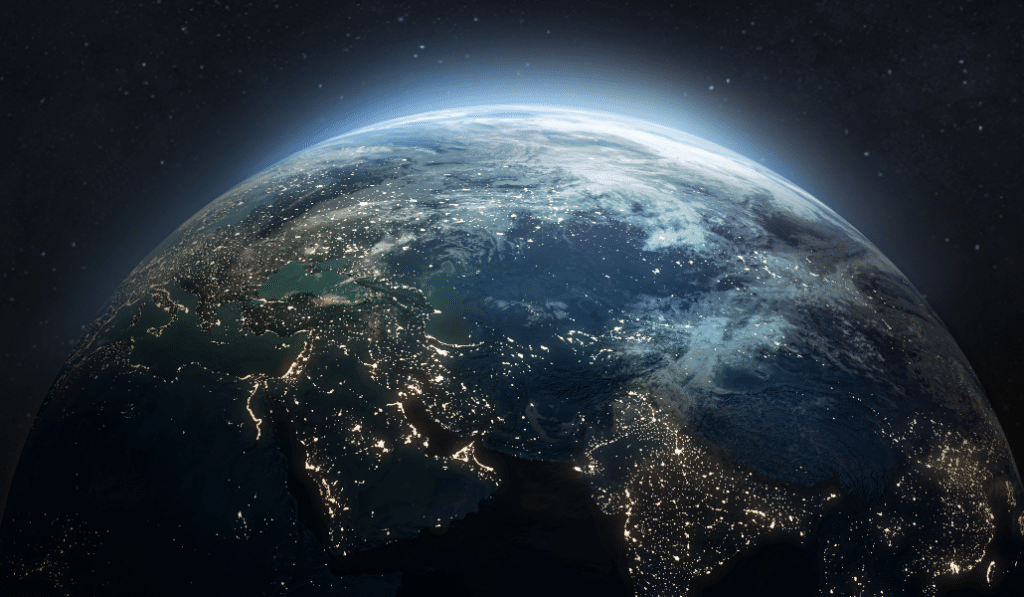
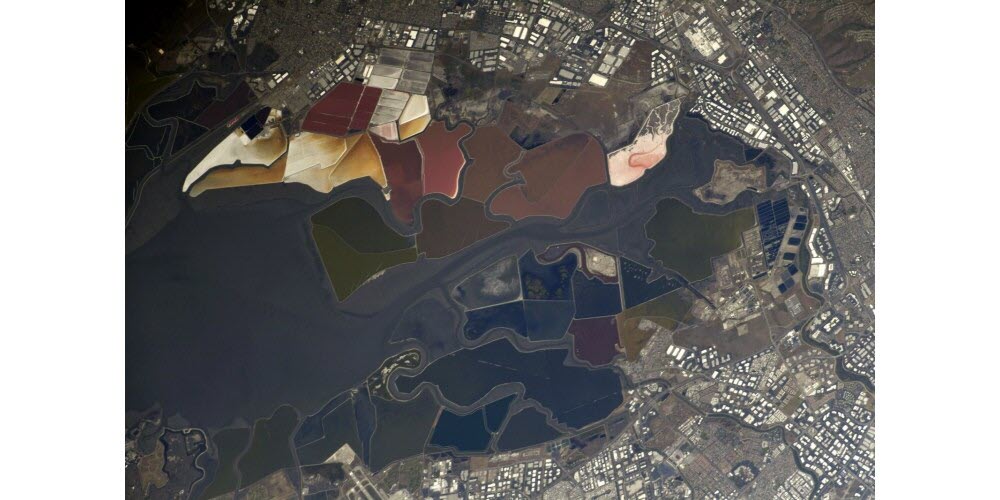
In “Orbital”, by Samantha Harvey, she describes how the astronauts aboard the International Space Station are first entranced by the Earth at night. It’s when night falls over the surface of the planet that the presence of human beings becomes most obvious….the networks of streets, buildings, roads sparkling and shining so brightly you can easily see them from Space. Then as daylight comes they see the Earth as a planet where humans beings are invisible, see it as a living, whole organism with its oceans, clouds, weather systems, forests and deserts. But then they come to realise just how much of the Earth is the way it is exactly because of human choices and actions.

We change the planet just by living here. How it changes comes down to our collective choices and those of the corporations and individuals with the greatest power and wealth.

Normally I use my own photos to illustrate my posts but, having never been to the International Space Station, this time, I’m borrowing a couple of photos from the French astronaut and photographer, Thomas Pesquet. Look him up. Check out his photos. They are simply astonishing.

“They come to see the politics of want. The politics of growing and getting, a billion extrapolations of the urge for more……The planet is shaped by the sheer amazing force of human want, which has changed everything, the forests, the poles, the reservoirs, the glaciers, the rivers, the seas, the mountains, the coastlines, the skies, a planet contoured and landscaped by want.” – from “Orbital” by Samantha Harvey.

This is the modern version of a very old philosophical exercise – taking the view from on high – to stand apart, above, and look out over the greater whole.

Read Full Post »