Feeds:
Posts
Comments

Posts Tagged ‘consciousness’

Rick Rubin writes –

Turning something from an idea
into a reality
can make it seem smaller.

This immediately stimulated my memories of reading the philosophy of Gilles Deleuze. It’s a few years since I did that, and I’m no philosopher, so I can only share with you, what I, personally, got out of reading some of his work. One concept he described, the one which came to me when I read these lines by Rick Rubin, was that of the “virtual”. I think his idea of the virtual was pretty complex and nuanced, but as I read it, the virtual contained what he called “a multiplicity of singularities”.

A “singularity” is a specific. I think of it this way. Today, as I wake up, stretching before me are a pretty much infinite number of possibilities. The day lies there full of potential conversations, encounters and experiences. There are sights and sounds and smells and tastes and textures which I could pick up on and enjoy. As the day unrolls, I make certain decisions, choices. I have certain encounters, certain experiences. Moment by moment they are the specifics of my day. All the other possibilities that were there at the start disappear. It’s a bit like the collapse of the wave. Like how Schrodinger’s cat can be both alive and dead until we open the box, then it’s the one or the other.

It’s even more complex than that, of course, because, moment by moment new “multiplicities of singularities” emerge….ones which only come into existence because of the actual moments which have led to this particular moment.

OK, that’s spiralling a bit out of control, and I’m sure some professional philosopher will be able to point out how much I’ve got wrong about the idea, but my point is, as inspired by Rick’s words, the actual, the specific, the singular, feels like a reduction. It’s the same with every choice we make. Once we make a choice, we choose one thing, one action, and in doing so, don’t choose the others. That’s why making decisions can be difficult. We can’t help imagining all the other possibilities we are about to turn away from. We feel, perhaps, that we are making the world smaller.

But there’s no alternative here. It’s not possible to live without singularities, without specifics, without actuals. If we don’t engage, if we aren’t aware, if we don’t reflect and consider, then the choices are made for us. Because this moment does actually exist. And the other moments which could have been disappear, or morph into some potential future set of possibilities.

So, I don’t fear this phenomenon of making anything “smaller”. Instead, I choose to be aware, to be engaged, and to co-create this actual moment of my unique existence in this vast universe.

Awareness and engagement open up the universe to us. They open the doors to co-creation of this moment, at this time, in this place. Embracing that is a joy, a celebration, which stirs wonder, awe and gratitude.

What not to like?

Read Full Post »

“There’s a time for certain ideas to arrive,
and they find a way
to express themselves through us.”

There’s a theory about where ideas come from, and where memories reside. I’ve read this theory, or some version of it, in several places over the years. Most recently I read it in Rick Rubin’s “The Creative Act”. He suggests that sometimes great ideas come to us but we don’t act on them, then some time later we see them expressed by someone else. It isn’t that other people have stolen our ideas, it’s that the idea’s time has come, and if we don’t act on it, then someone else may.

I read a very similar view a few years ago in Elizabeth Gilbert’s excellent, “Big Magic”, where she said if we don’t write when inspiration comes our way, then, maybe somebody else will. Maybe the idea or inspiration will flow on to someone else because it needs to be expressed. Maybe we will miss our opportunity.

Iain McGilchrist, in “The Matter with Things”, explores memory and consciousness, and dismisses the idea that they lie encased in our skulls. Rather, he argues, our brains act as “receivers” which filter out some of the signals being received to present us with our experiences of consciousness and memory.

Others have argued something very similar……from Jung’s “collective unconscious”, to Sheldrake’s “morphic fields’.

So, it’s not a new idea that we have the ability to “tune in” to whatever is flowing through the universe, nor that that includes ideas, inspirations, memories, and so on. This tuning in is a bit like turning on a radio, the old fashioned, analogue kind, turning the dial, and listening as voices and music begin to appear in the white noise, first of all quiet and fuzzy, till we tune in better and it comes through loud and clear. Aren’t you still amazed that you can sit in a room somewhere, hearing only silence, but, in fact you are surrounded by, you are bathing in, a whole world of songs, stories and speech? You just need to switch on the radio, and tune it in for it all to be revealed.

That still amazes me.

But the idea that the universe is full of stories, words, ideas, images, and music, and that all we need to do is to create the space for it to appear, all we need to do is tune in, and listen….then be inspired…… then we can choose to act on these inspirations, these dreams, these ideas…..express them. Well, that amazes me too.

Read Full Post »

Rebecca Solnit wrote, “Categories too often become where thought goes to die. That is, there’s a widespread tendency to act as if once something has been categorised, no further consideration is required. But, often, it is.”

When I read this I thought of some of the writings of the General Semanticists, especially the phrase, “Judgement stops thought”.

We humans have a tendency to privilege the work of our left cerebral hemisphere which is our powerhouse for stripping out details, generalising what it encounters and applying labels, before setting its work into categories…..neat, separate, distinct, categories.

The trouble is, once we’ve done that, and once we start putting whatever we encounter into one of those categories, we stop seeing the uniqueness of “here and now”. We stop seeing the uniqueness of this particular person. We stop seeing a person at all.

There was a strong element of this in my training at Medical School, where they taught us pathologies before they taught us about people. Teachers and students would say things like “Have you seen the hepatomegaly in Ward 2”, or “Have you listened to the heart murmur in bed 14?” I first encountered cirrhosis of the liver in pathology class. It was in a perspex box filled with formalin so the diseased liver inside wouldn’t deteriorate any further. It was a good three years later before I encountered a human being suffering from cirrhosis of the liver (in Ward 2). This kind of thinking is still pretty dominant in Clinical Medicine. When I was a visiting a relative in hospital I overheard a nurse in the corridor say to a colleague “Have you taken blood from bed six yet?” (and I thought, good luck with that, getting blood out of a bed!)

I recently read an interview with a Paris-based oncologist, who was describing how he was using “Integrative Medicine”. He said he realised that all his chemotherapy, his radiotherapy and his surgical procedures were directed at pathology, but nothing he was doing was specifically directed towards patients. So, he began to explore, learn about, and use, a variety of interventions which engaged with the individual, unique patients, to hear their stories, to understand what they were experiencing in their lives, and to support their recovery and healing. This isn’t a new idea, but it still gets reported as if it is new.

The tendency to label and categorise seems to be on the rise. “Asylum seekers” become “illegal immigrants” become “immigrants” who should be denied the rights and privileges of those whose ancestors arrived in the country before them. In the apparently increasingly divided USA, billionaires, politicians, and evangelicals, talk about “Good vs Evil”. The President frequently applies the label “hard Left” to anyone who disagrees with his policies. Derogatory labels like “libtard” are thrown around. People are accused of being “woke”, although it seems nigh impossible to get anyone who uses that term to describe exactly what it means…..and so on. All of these terms, all of this way of thinking, tends to dehumanise….and that makes it easier to hate, easier to be cruel, easier to make life difficult for whoever is being targeted.

What’s the way out of this?

I suspect it will involve using our whole brain instead of only half of it.

The right hemisphere helps us to appreciate the whole, helps us to see connections and contexts. Looking for connections and contexts is a great way to punch holes in the labelled boxes. It’s a great way to make impermeable categories, leaky and permeable.

The reality is we are not all separate, living in entirely different boxes. We are unique, and that uniqueness arises from our individual complex web of connections and relationships. When we start to look for connections, we see the ways out of the separated boxes. We start to see humans again.

But it isn’t just uniqueness which emerges from these connections and relationships, it’s a discovery of what we have in common, of what we share. It’s a realisation that our similarities matter just as much as our differences, and, luckily, our brains have evolved to be able to handle such paradoxes magnificently…if only we would resort to using our whole brains and not stopping thought at labels and categories.

Read Full Post »

I’ve been watching the series, 1883, recently. There’s one scene I found especially thought provoking. The character, Shea, or “Captain”, talking about grief, describes his belief that when you love someone a part of their soul becomes embedded in yours, and a part of yours in theirs. His wife, who died from smallpox, had a dream to see the ocean, so he’s making his trek West across America to get to the ocean, so that he can share that experience with the part of her soul he carries in his forever.

Whatever you believe about souls or spirits, this is either a beautiful fact, or a wonderful metaphor. I am sure that when we love someone, and they love us, then we do become entangled forever. Even if there is physical separation resulting from life paths which diverge and take us to other towns, or other countries, even if there is the physical separation of death, then this entanglement continues.

I often think that a person is more than the physical existence of their body. They are their personality, their stories, and, indeed, their soul. Every single one of us changes this world simply by living in it. It’s inevitable because we are so embedded and interconnected. The changes we make are unique. There was never the distinct you, before you were born, and there will never be an identical copy of your life at any time in the future. We impact on those who encounter us. We are changed by our encounters.

So, as memories and stories continue, so does the entanglement of two souls.

I’ve understood that for a long time, but it hadn’t occurred to me that I might share my wonder of the world, my amazements and delights, with my loved ones, parts of whose souls I carry inside mine.

I like that idea. It’s beautiful.

Read Full Post »

We have two focus modes in our brains, with each of our cerebral hemispheres using one or the other. The left hemisphere engages with the world through a narrow focus. It pays attention to re-cognising what we already know. It tries to help us identify objects, literally grasp them, or understand and manipulate them. The right hemisphere engages with the world through a broad focus, paying attention to the bigger picture. It seeks out patterns, connections and relationships. When the left hemisphere identifies something it should pass that info to the right for it to be contextualised. Sadly, we’ve developed habits of not bothering to do that, sticking with our generalisations and abstractions.

What we pay attention to becomes magnified. It is the means by which we engage with the world. It creates our experience of the world. If we prioritise the left hemisphere focus we engage with a world of objects, of tools and “things”. We engage with a desire to manipulate and control. But if we prioritise the right hemisphere we engage with a world of relationships, of contexts and patterns, with a world of subjects. We engage with a desire to belong, to make connections, and to see the whole picture.

We live in what has been termed “the attention economy” where the big digital companies make their money through advertising, and advertising only works by grabbing your attention. Politicians have become adept at this too, casting out statements designed to shock, enrage or stoke fear….because shock, anger and fear are primary responses to threat.

But as you’re “doomscrolling” or reading social media headlines and posts, which of them command your attention? Are they the ones that make you feel enraged, afraid, insecure, inadequate? If so, those are the feelings which are going to get magnified. Those are the feelings that are going to shape your perception of reality. Or are they the ones which delight you, which stir feels of wonder, curiosity or joy? Do they put you in touch with the three classic values of beauty, truth and goodness? Do they increase your feelings of dignity, decency and compassion? If so, that’s how you are going to perceive reality.

What we focus on, and what’s important here is to be aware of what we are focused on, shapes our world and our day to day experience of life.

Our attention is our super power. We should use it wisely.

Read Full Post »

We don’t live in a world of entirely separate, fixed objects.

We live in a massively interconnected world of flow.

Every living organism is an open system. There is a continuous flow of materials, energy and information into, through, and from every animal, every plant, every ecosystem.

Yet, we continue to swallow the idea of reductionism, which tells us everything is made up of separate, smaller parts, and the way to understand anything is to isolate parts and observe them as if they aren’t connected to anything else. It’s useful to focus closely on something. It’s useful to analyse something and consider it at various different levels, but it’s dangerous and delusional to fail to see that everything is always in a state of flow…..affected by, and affecting, other organisms, by the environment and by the multiple contexts of its existence.

And we continue to be taken in by dualism….the belief that there are objects and subjects….objects which are measurable and “real”, and subjects which are individual and “imaginary”. I’m not going to get into the complexities of the “hard question” here….of how consciousness can emerge from “stuff”….but this dualism leads us to deny or dismiss human experience, when, actually, experience is THE fundamental characteristic of reality.

We are not machines. We are not machine like. We are living creatures, every one of us with a continuous, ever flowing, experience of consciousness. A consciousness which enables us to appreciate beauty, truth and goodness. A consciousness which enables us to be aware and to direct our attention to whatever interests us, whatever moves us, whatever makes us wonder.

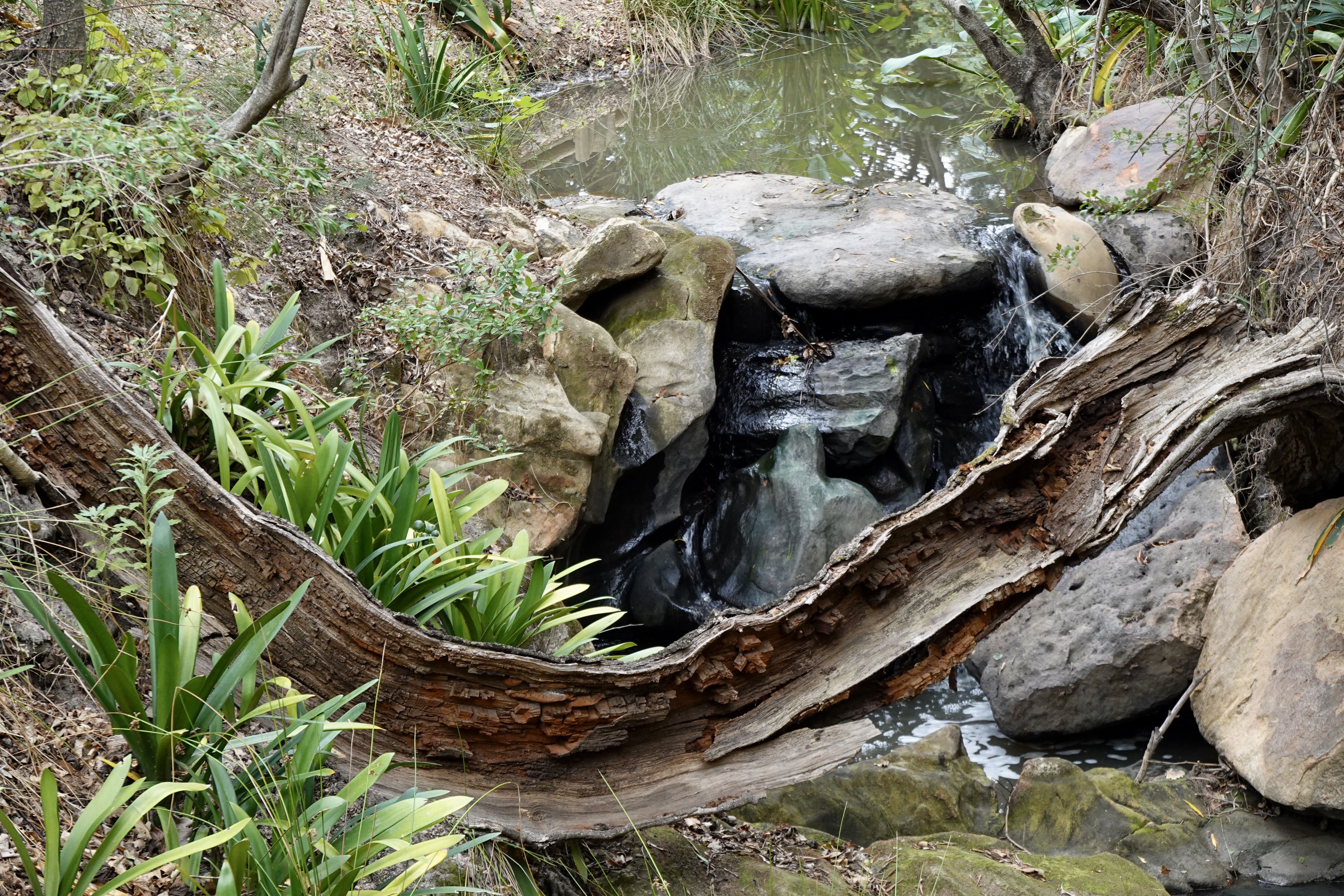
When I look at this photo, I see “flow”. I see it represented in the water. I see it represented in the wood. I see it represented in the green plants. I see it everywhere.

Read Full Post »

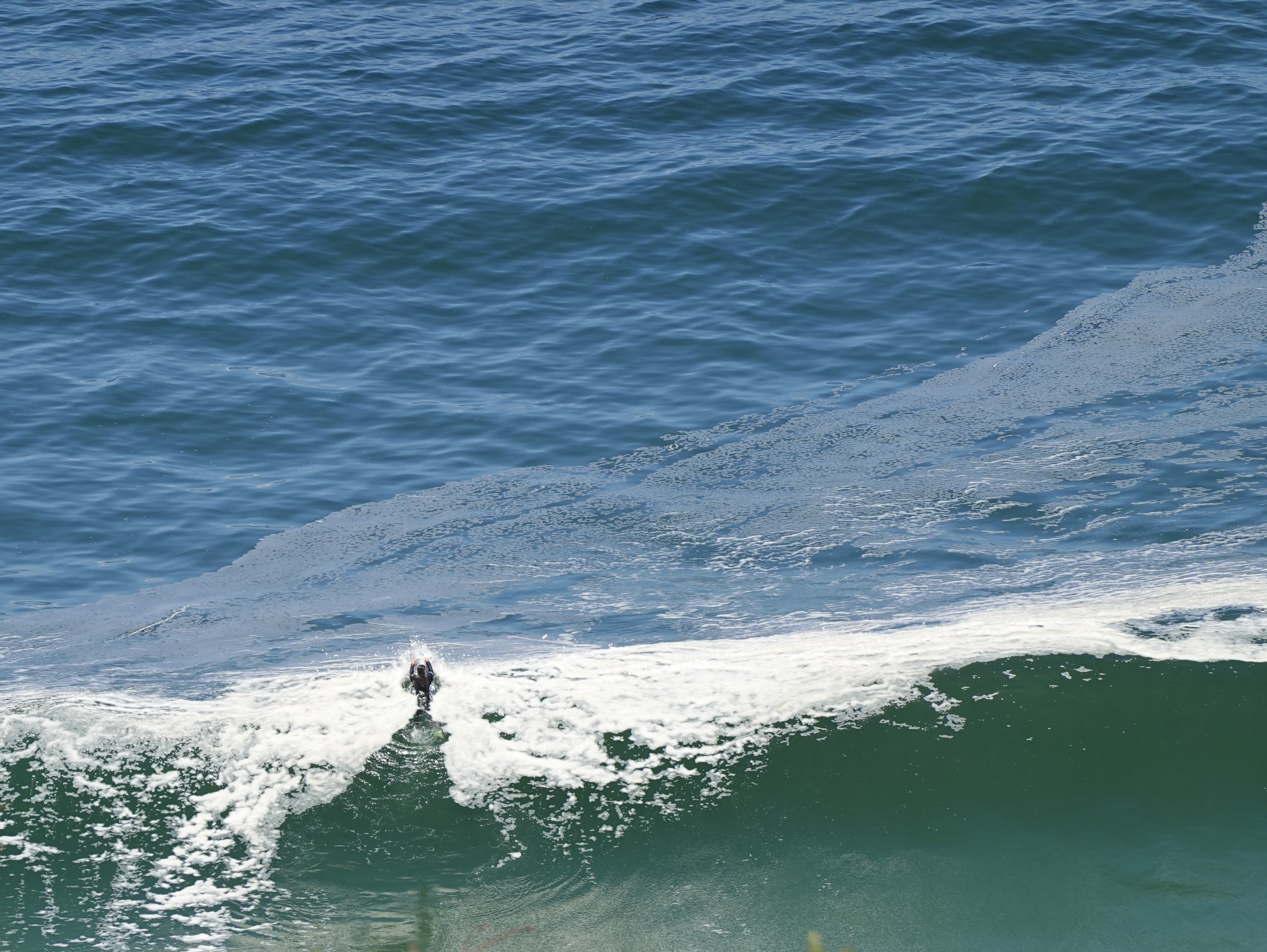
I’m a fan of the idea of “going with the flow”, and I’ve written about it often, but when I was in South Africa last January I saw this person in the sea….not so much going with the flow, as “riding the wave”. This latter phrase isn’t one I use so much, but these feel like turbulent times, and it feels as if the flow is also turbulent….there are great waves, one after another. Waves of significant change, eye catching, attention grabbing waves. It would be easy to feel submerged by waves like these. It would be easy to feel that they are going to wash us all away. So maybe this is a time to learn how to “ride the waves”, to “rise above” them. To tap into their energy and use that to go my own way.

I think it comes down to the attitude we strike – if we approach these waves with fear, then, surely, we’ll drown, or, at best, be driven this way and that, against our will. But if we approach them with confidence, with a sense of wonder and curiosity….then we can play with them, create what we want to create, drawing on the energy and power within the wave, without blindly following its direction.

This does feel a time of great change, but, that can be exciting when we begin to see a potential evolution, a possible phase change, allowing us, as individuals, as communities, and even as a species, to move on to very different world, a very different way of living.

Read Full Post »

There’s what some people call a spiritual practice taught by the Classical Greek philosophers. It’s called “The view from on high”. I thought of that when I looked, again, at this photo which I took from the train crossing the Alps last year.

The idea of the view from on high, is about taking an overview. It’s about seeing the context of something, seeing the “bigger picture”. We can be too close to something, so close in fact that we can’t “see the wood for the trees”. The answer is to go higher for a more comprehensive perspective.

Although the Greeks didn’t know it, this is advice to access your right hemisphere. The left hemisphere of the brain has a very narrow focus. It enables us to zoom in, separate out elements, and grasp what we are looking at. But the right hemisphere takes in the context, sees the connections, enables a more holistic understanding.

Of course, it’s best when we use our whole brain, not just half, but, sadly, we’ve developed the habit in our cultures of thinking the left hemisphere knows best. It doesn’t. It only helps us when we take its “re-presentation” of reality back into the right hemisphere, to situate it in the whole.

Reality is not made up of pieces which are assembled. Reality is a whole, in constant flow and change. Stepping up a level and taking “the view from on high”, can help us to appreciate that.

Read Full Post »

The English philosopher, Mary Midgley, in her response to those who said the Self was an illusion, said “If the Self is an illusion, who is it who is having this illusion?”

Philosophers, psychologists, psychiatrists and neuroscientists, continue to debate exactly what the Self is. I’m taking a pragmatic, maybe simplistic approach. For me, the Self is what does the experiencing. Me, myself and I, as the song goes…….All the sensations I experience, are experienced by my Self. Yes, I know there are complex sensory cells and networks throughout the body which enable me to pick and process various signals, energies and waves which flow around and through my body. But, ultimately, the experiencing of the light, of colour, of sound, touch, temperature, taste….that’s all done by my Self. Similarly, it’s my Self which experiences my thoughts and feelings. Again, maybe thoughts and feelings involve a huge network of cells and chemicals in my body, but it’s my Self which experiences them.

I know that not everyone will agree with that conception of the Self, and I’m neither a philosopher, nor a neuroscientist, but I just want to describe, as clearly as possible, how I envisage the Self.

From that standpoint, I explore the world in which I find myself alive. I turn to Science to help me grasp and understand what is external to my Self. Primarily, that picks out elements from within the flux of reality, and considers them as objects…objects which can be measured and manipulated. I even turn to Science to discover elements which exist within my body, but which, I argue, are “external” to my “Self”. So developments in anatomy, physiology, pathology and so on, help me to comprehend the tissues, organs, cells and chemicals within my body, and, as a doctor, to understand them within the bodies of others. That helps me to make diagnoses and to suggest treatments when people fall ill.

Secondly, I turn to Art, to understand what is “internal” to my Self, to express what is “internal” to my Self, and to communicate with the “selves” of others. It’s through music, poetry, painting, sculpture, storytelling, novels, dance, and so on, that I attempt to show others what I feel, what I experience, what I think, from this unique perspective on the universe which I call my Self. Through Art I channel, and stimulate my creativity, my imagination and my empathy.

Thirdly, I turn to Spirituality to explore the connections between my Self, and the rest of the Universe. Through experiences of awe and wonder, I dissolve the boundaries of my individuality, and step into the Oneness of Reality.

I know these terms, external, internal, and beyond, are simplifications in their own right, but I reckon if I am to know a person, to really get to know and understand another person, then my best chance will emerge by taking a blend of these three approaches – science, art and spirituality. And, I’ll see more clearly that no single one of them can give me a comprehensive understanding.

Does this make sense to you? I’d love to hear your take on all this.

Read Full Post »

The concept of “and not or” is very important to me. “And” creates and explores connections. I broadens and deepens our experience. Whereas “Or” divides. It splits reality into pieces and asks us to choose. Iain McGilchrist’s superb explanations of how the left and right hemispheres of the brain enable to focus on the world in very different ways has taught me to try to use my whole brain, not just half of it (we, as a civilisation, and, as individuals, have privileged the left hemisphere approach at the expense of a whole brain one, for far too long now)

But there’s another way in which I apply the “and not or” approach, and that’s through the triad of ways in which we humans view and try to understand the world – science, art and spirituality.

Science provides us with ways of discovering what exists objectively. A core feature of science is measurement. The scientific approach allows us to separate out objects from the ongoing flux of reality, measure them, subject them to experiments and, from there, to make predictions which enable us to exert greater control.

Art, on the other hand, provides us with ways of expressing our inner experience, and of sharing those experiences with others. It’s a range of ways of connecting subject to subject. We use art to express and communicate love, beauty, joy, and unique, individual experience of life. We use music, dance, storytelling, visual arts, poetry etc to develop our creativity and to engage with each other subject to subject. These subjective experiences are not measurable.

Thomas Berry says that the universe is not a collection of objects, it’s a community of subjects.

Thirdly, spirituality, is, for me, that sense of being connected to what is greater than me. I experience it through moments of awe. I experience it everyday through what the French call “l’emerveillement du quotidien” – through wonder, amazement and awe.

I need all of these ways of engaging with the world to lead a deep, whole and meaningful life. Science isn’t enough by itself. It can’t help us to connect, subject to subject. Art isn’t enough by itself, it lacks science’s ability to isolate elements in the objective world to better understand and manipulate them. Spirituality isn’t enough in itself but it stokes our humility and our sense of connection with others and with the rest of the planet, even, the universe.

How about you? Do you enjoy all three? Science, Art and Spirituality?

Read Full Post »