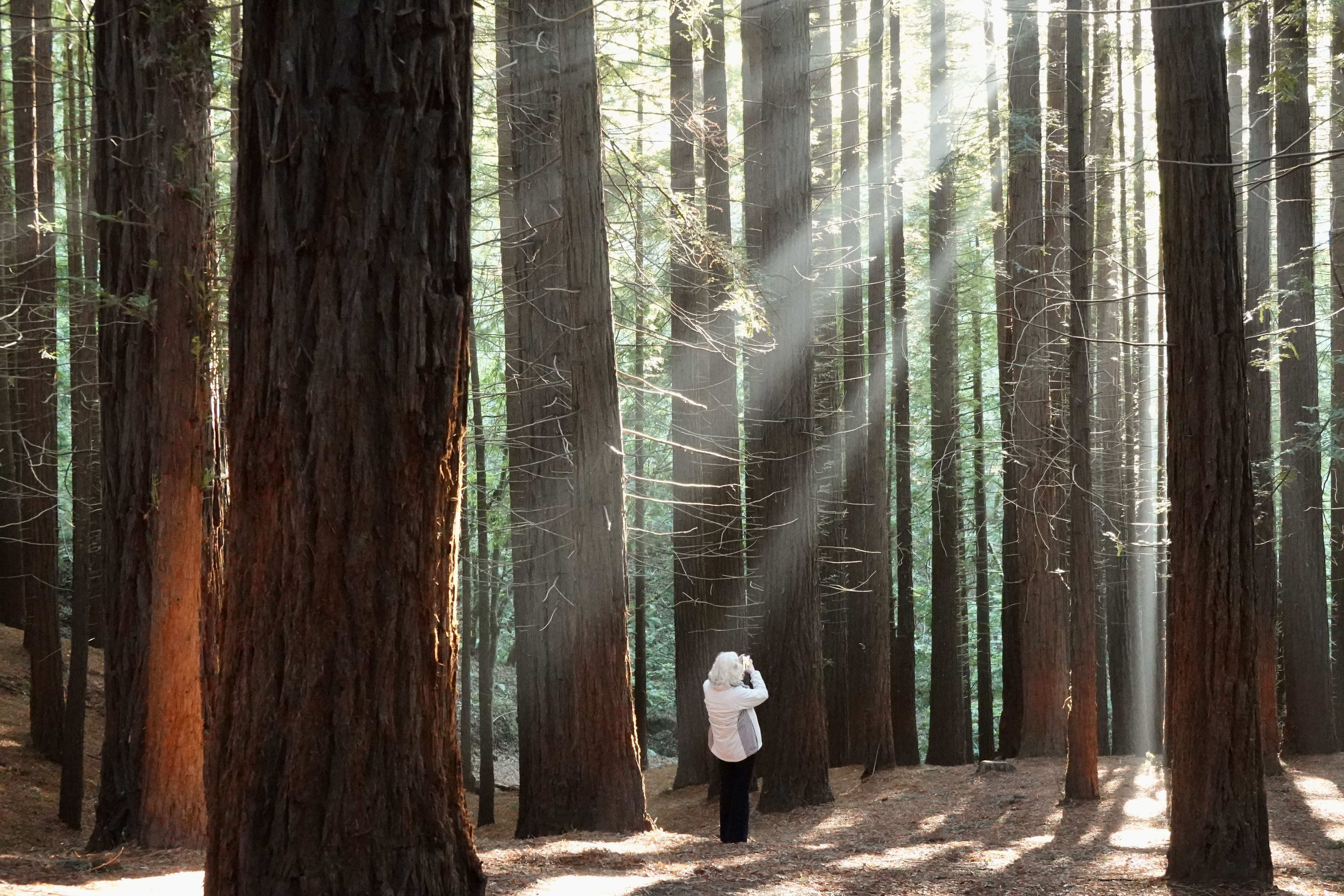
We made a visit to a sequoia forest in Catalonia recently and this is one of the many photographs I took. When I look at it now a passage from C S Lewis comes to mind. It’s many, many years since I read his little essay, “Meditation in a Toolshed”, but I’ve never forgotten it. It’s pretty easy to find online if you search for it. It starts like this –
I was standing today in the dark toolshed. The
sun was shining outside and through the crack at
the top of the door there came a sunbeam. From
where I stood that beam of light, with the specks
of dust floating in it, was the most striking thing in
the place. Everything else was almost pitch-black.
I was seeing the beam, not seeing things by it.
Then I moved, so that the beam fell on my
eyes. Instantly the whole previous picture
vanished. I saw no toolshed, and (above all) no
beam. Instead I saw, framed in the irregular cranny
at the top of the door, green leaves moving on the
branches of a tree outside and beyond that, 90 odd
million miles away, the sun. Looking along the
beam, and looking at the beam are very different
experiences.
He goes on to describe several examples of the difference between “looking at” and “looking along”, where he juxtaposes the “objective” vs the “subjective” (although he doesn’t use those terms), the “quantitative” vs the “qualitative”….and issue which has been at the heart of my career and my life. He summarises his idea with this –
We must, on pain of idiocy, deny from
the very outset the idea that looking at is, by its
own nature, intrinsically truer or better than
looking along. One must look both along and at
everything. In particular cases we shall find reason
for regarding the one or the other vision as inferior.
Most of the essay is about how we seem to have developed a habit of favouring the objective over the subjective to the point where the latter is dismissed as irrelevant, or even, unreal. I’ve heard a junior doctor say that his mentor told him “You can never believe patients. They lie all the time. You can only believe the results (the laboratory findings)”, and time and again, in neuroscience, our inner thoughts, sensations and feelings are reduced to biochemical reactions and neural pathways….as if the MRI scans and biochemistry reveals “the truth”, whereas the patient’s reported experience is dismissed as “anecdote”, or, worse, “illusion”.
As I look at this photo I see my wife, Hilary, standing in a sunbeam in the middle of the forest. I am “looking at” her in the forest. She is “looking along” the sunbeam and photographing the illuminated trees. And I know in that moment that these are two different representations of reality. Both are true. But there’s more – because as I am “looking at” this scene in the forest, I recall, and re-create, the experience I had of standing in the forest surrounded by the massive trees. I feel again the awe which I felt as the sunbeams shone through to the forest floor. I feel again the wonder I had standing amidst this community of trees (which, by the way, were planted only about seven years before I was born!)
We can understand a lot by measuring, by being objective. But we fail to grasp reality if we dismiss both the inner experience of others, and our own subjective one.
That means we need to value personal stories. We need to be curious about them, to respect them and to listen with non-judgemental empathy. Otherwise, we are only scratching a surface. Worse than that, we are in danger of replacing an understanding of what it is to be human, with a distorted and demeaned mechanistic one.

 Heroes Not Zombies