Feeds:
Posts
Comments

Posts Tagged ‘healing’

My area of work was health. I worked as a doctor over four decades and I learned a lot about what made for a healthy environment and what was a more toxic or harmful one. I reckon the characteristics of healthy environments are pretty universal. We all need to breathe clean air, drink clear water, eat nutritious food, have nourishing and caring relationships. There’s a lot of evidence about the positive healing effects of natural environments. I say “natural” but what I mean is, as opposed to built environments. Trees and forests stimulate healthy changes in body and mind, but busy six lane motorways, not so much. But even within these universalities we are all different, so, for some, it’s healing to walk by the shore, or to gaze out at the ocean, breathing in the salt air. For others, the most healing environments are in the mountains and lakes, breathing the clear, fresh air of a little altitude, surrounded by birdsong and wildflowers (“and not or” remember…..both these environments can be good for the same person) 

I read a section of Rick Rubin’s “The Creative Act” this morning (I’m working my way through, reading and meditating on, one section a day just now. It’s such a rich resource)….this morning’s section was “Setting” where he discusses what environments are creative, illustrating how very different ones allow us access to different flows from the universe, each of which can stimulate our intuition. He points out how tranquil natural environments allow us to appreciate the direct information from the universe, whereas, busy peopled places, like cafes, town centres etc, can allow us to tune in to the universe as filtered through human beings. In all situations it’s a question of detached awareness, so that we can notice patterns, but not allow ourselves to be overwhelmed by them. That made me think of the phenomenon we call doomscrolling, where we get caught up in social media feeds. They too can be sources of creative stimulation if we allow ourselves to notice the patterns and themes, and not get caught up in them. In fact, Rick also suggests cultural environments where we focus on reading, music, visual art, etc to pick up the information from the universe filtered through culture. 

The most important point he makes is that we are all different. His conclusion is that we need to “hear the chimes of the cosmic clock ring, reminding [us] it’s time. Your time to participate.”

It is.

It’s your time to participate, to become aware, to trust your intuition and to engage. 

Read Full Post »

How do we improve the quality of our everyday lives?

One way is to do whatever brings us joy, and makes us wonder. And we can do that, either by pursuing an activity which we know brings us joy, for example, listening to our favourite music. Or, and this adds in the element of wonder and discovery, pay attention to the hear and now.

As I wandered through my garden one day, just looking to see what I might notice, I spotted this tiny plant. First of all, I’d never seen a plant like this before, so I didn’t know what it was called. Secondly, I kneeled down, got up close, and just looked. Isn’t it beautiful? Isn’t it amazing? What an incredible structure, and what beautiful colours. I love those tips of purple emerging from the green. Then I got my phone out and took a close up photo….this photo.

I like to take a photo for two reasons. First of all, I can then go back and look more closely over and over again. I can enrich an already rich experience. Second, because my curiosity has been stimulated, I can touch the little “(i)” button on the phone screen when I’m looking at the photo, and it magically tells me the name of the plant.

Apparently, it’s a “self-heal”. Oh, like all plants, it has many other names too, but the name “self-heal” immediately appeals to me. After all, in all my years working as a doctor, that’s exactly what I was trying to do – to stimulate and support a patient’s self healing. I know we live with a kind of medical myth that doctors heal us with their operations and their drugs. But they don’t. Nobody repairs a single wound without the body’s capacity to self heal. Nobody recovers from a virus without the body’s defence and repair system doing its job. Nobody heals without the body’s complex system of self healing doing what it is designed to do. Doctors should remember that. They don’t heal patients. Patients heal patients and the doctor, when working at their best, support, stimulate and work with, the capacity if the patient to self heal.

Once I had spotted this plant, identified it, explored more about it online later, then I suddenly saw it appearing everywhere in the garden. Well, not everywhere, but over a very wide area. Now there’s something else amazing about gardens. I didn’t plant this beautiful plant. I didn’t “propagate” it. But there it is, and it’s thriving. I find that wonder-full!

Read Full Post »

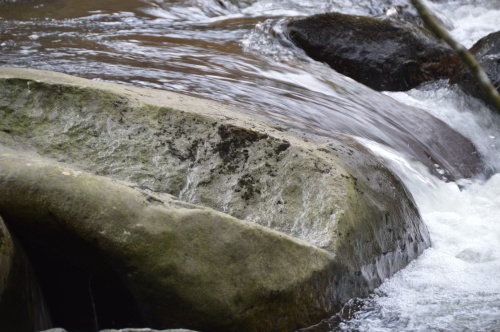
I took this photo many years ago and I’ve shown it to many patients. I call it “the wounded rock”. Something struck this rock, probably a long, long time ago. It almost split it in two. Clearly, it was a heavy blow. It has left a clear wound.

Life is often like this. Something happens, something traumatic, which inflicts a wound on us, a wound which never completely heals. Powerful events change us. They might be violent events, either accidental, or malicious. They might be physical, or emotional. They might be serious illnesses. Or they might be big changes in life – loss of a loved one, loss of a job, moving house….

Life goes on, like the water continuing to flow around and over this rock. But the wound leaves us changed.

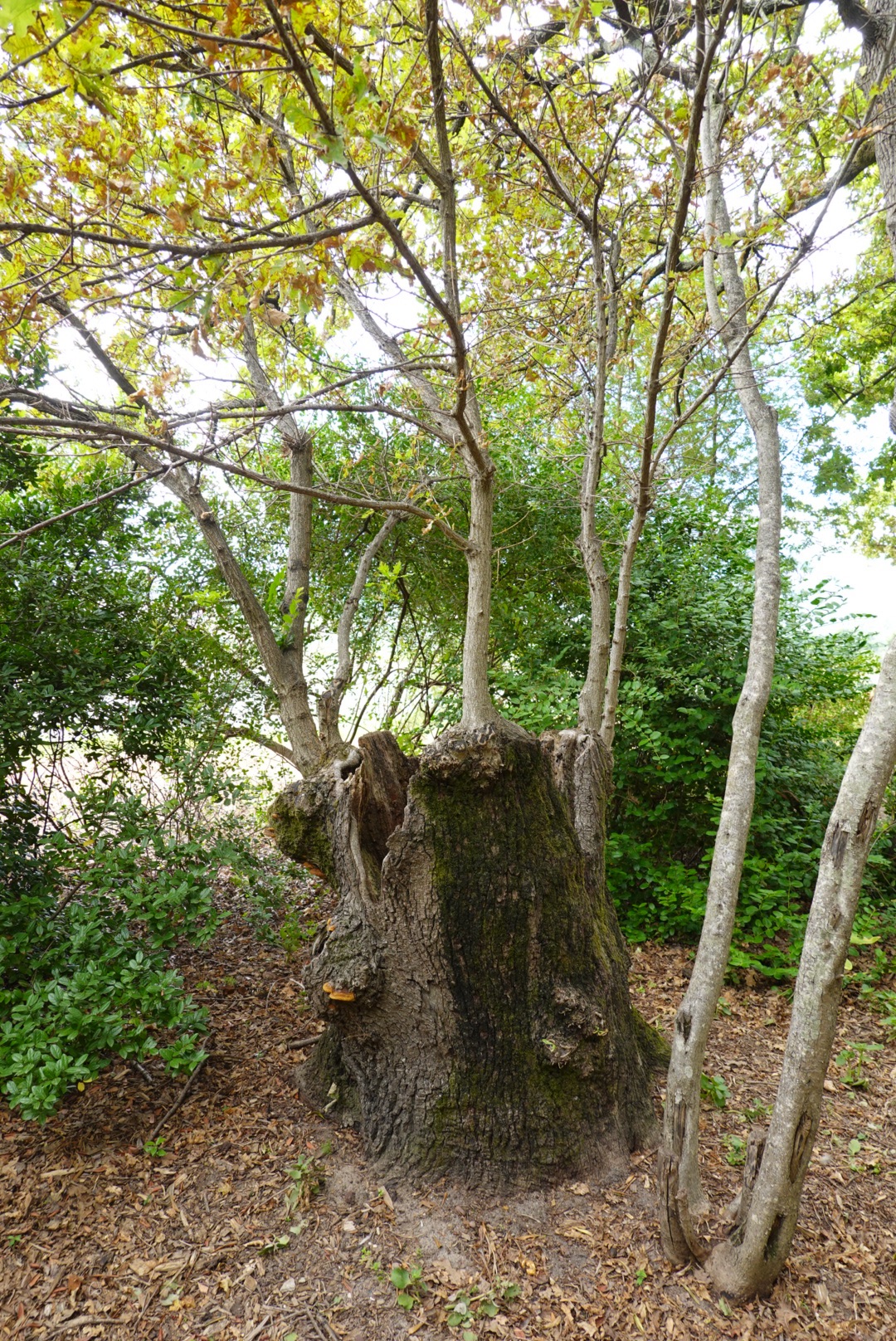
But, actually, this tree in my garden, is a better metaphor, or, should I say, a better example. It would seem that one day, long, long ago, a storm blew through and felled this tree. It uprooted it. Its roots have been torn out of the ground, and we found them, standing upright, embedded with stones, and covered in ivy.

You’d expect that would be the end of the tree, but, no. It continued to grow, now turning its branches at ninety degrees to the fallen trunk. It started to reach for the sunlight again.

It’s a better example, because the rock is not a living organism. Having been struck, it can’t adapt. It can’t change. The tree, on the other hand, is more like us. Having been struck, it adapts.

Self-healing is an adaptive phenomenon. It is the basis of all cures, and, even, of all recovery. There is no healing without it. And yet, it has its limits. In both the case of the rock and the tree, there can be no going back. There can be no restoration to a “time before”, much as we might wish there was. In both cases, the flow of life carries on, shaping, and adapting, in surprising, fundamentally unpredictable, ways.

Read Full Post »

You know if you cut yourself that, in the vast majority of cases, the cut will heal itself just if you keep the area clean. You know how, if you break a bone, that the fracture never heals without the body using its ability to knit back together the broken edges of the bone (sometimes you need something to hold the edges together – a plaster, nails or a plate – but the actual healing of the bone is done by the body). Well, in fact this is what all living organisms do – they self-heal, self-repair, and self-organise.

One model for living organisms is a “complex adaptive system” (search that term on this site and you’ll find several articles I’ve written about it). Complex adaptive systems have a key, core characteristic – they adapt. Self healing is an aspect of adaptation.

Yet, in Medicine we rather take self-healing for granted. We know that nobody recovers from anything without self-healing. We need the body’s abilities to repair, and to adapt and grow, in order to heal. Every single time. But how many treatments, specifically, how many drugs do we use which are developed to target the capacity to self-heal? How many drugs directly stimulate or support the natural processes of self-healing? I don’t know any. Instead we direct our treatments “against” – we use lots of “anti”s – antidepressants, anti-inflammatories, anti-hypertensives, antibiotics etc etc – you get the idea – and hope that in the background the body will self heal. I don’t mean these anti drugs are useless. Clearly they are not. In many cases they can rescue someone suffering from a life threatening episode of illness. But they aren’t enough. We also need to stimulate and support the natural systems of self healing and repair.

What are they?

Well, largely, they are environmental, psychological and social. We need light, clean air, clean water, nutritious food, shelter. We need hope and encouragement. We need to feel cared for and loved. We know that forests can help us heal. We know that time spent in natural environments can help us heal. We know that music, and art, and stories can help us heal.

So do we need drugs? Well, we do. The thing about self-healing is that it is limited by natural biological limits. We are mortal beings. None of us will live forever, and none of us will go through life without experiences diseases and illnesses. Drugs can help us by easing symptoms, addressing imbalances, and countering pathologies. But Medicine is, and always has been, more than just drugs.

But there is something else about self-healing that we should pay attention to and that is…..in common with all forms of adaptation, it is unpredictable at the level of the individual. Sometimes we pretend that all we need to go is a give an “evidence based” treatment and the outcome can be assured. That’s not the case. There is no treatment which produces the same outcome time and time again, in patient after patient. Adaptation teaches us to accept uncertainty. It teaches us to stick with a patient, to follow through and follow up, because only time will tell whether or not the treatment is proving to be useful or not for this person.

And there’s the other key lesson for Medicine from the science of adaptation and self-healing – patients do better when they experience continuity of care.

Over time, we have to adapt our treatments and our care, as the individual patient adapts to the changes brought about by the disease or injury which has made them ill.

It’s good to learn how to deal with uncertainty, because life isn’t predictable.

Read Full Post »

We humans, like all other living organisms, are “complex adaptive systems”, and as such, we share a fundamental capacity to self-organise, self-defend, and self-heal. We know that, don’t we? Whenever you’ve had a cut, within a few days, the wound has been repaired, and often, without even leaving a scar. Whenever you’ve broken a bone, whether or not you’ve needed surgery or the help of a temporary plaster, your body repairs the damage. Whenever we’ve caught a virus, usually within a few days, our body has got rid of it, and repaired any damage done.

But in Modern Medicine, we don’t pay much attention to any of that. We are sold the idea that drugs “cure” or “heal”, when, actually, what they do is modify disease activity within the body.

There isn’t a single drug on the market which has been designed to stimulate and/or directly support self-healing.

And I’m not aware that any drug companies or research groups are even working on trying to do that.

Yet, nobody, but nobody, will recover from any illness without the natural self-healing functions doing what they are designed to do. There is no “artificial healing” (just as you could argue there is no “artificial intelligence”) – there is only natural healing. Natural healing is limited, of course. We are mortal creatures. Every single one of us will die, one day, from something….trauma, infection, or disease. Despite claims that some drugs are “life saving”, the marketers don’t actually mean they can stop you from ever dying! Similarly, natural healing can only achieve what is possible within the biological limits of a living creature.

I’ve no doubt many drugs can make life more comfortable, and many can modify the life history of a chronic pathology. But is that enough? Shouldn’t we, routinely, be exploring, with our patients, what we can do to promote and sustain self healing?

Take the example of post-surgical recovery. When we create the conditions which support self-repair and healing, then patients require less painkillers, develop less complications and make a longer lasting, quicker recovery.

If we don’t use the methodologies which are directly intended to stimulate and sustain self-healing and/or we don’t help patients to access the care and environments which are conducive to self-healing, we aren’t really doing a complete job. Are we?

So, here’s my challenge. See if you can find out what we know supports self-healing….then look to draw upon some of that any time you, or your patient, is ill.

Read Full Post »

I’ve long held that a way of thinking about health is to use the concept of flow. When the various different aspects of our selves and our lives integrate in a coherent way we experience flow – good energy, good vitality, strength, the feeling of being alive (there are many ways to describe it)

waterfall

I recently came across an interesting expansion of this idea when I read “Mindsight” by Dan Siegel (ISBN 978-0553804706).
He describes health as being like a flowing river and he says the river has two banks, either of which we tend to drift towards as we become unwell.
One bank is rigidity, and the other is chaos.

It’s true. We can see that in some illnesses we are stuck, caught in loops, trapped in ever decreasing circles which shrink our world. What should be flowing has become solidified, sluggish, frozen, or blocked.
In complexity terms, this kind of pattern exists around “point attractors”. You’ll be familiar with point attractors in the universe; they are the black holes which suck everything into them. Nothing escapes.
In other illnesses everything seems to fall to pieces, life itself falls apart and we find ourselves lost, or overwhelmed with confusion. We don’t know who we are, or where we are, and we don’t know how to find a way out.
In complexity terms, this kind of patterns exists as a “chaos attractor”, a zone of chaos where there are no clear patterns but which somehow maintains itself.

Which of the patterns are most familiar to you?

Rigidity?

icicles

or Chaos?

sea path

Healing involves a release from these states – from rigidity, or chaos, to flow.

Read Full Post »