Feeds:
Posts
Comments

Posts Tagged ‘health’

There’s an ancient spring opposite my house. It was there in the times of the Celts and the Gauls, then the Romans came and built a small viaduct and channel to harness it. The pool at the spring’s origin flows over a small wall into a narrow channel, and out into a stream which runs for kilometres through the countryside. Several of the villages near me have the word “moulin” in their name. It means a “mill”. The water flowing along this stream powered the millstones which ground the wheat. There’s little left of actual mills, but there are some with remnants of great stone wheels in their gardens, or at the sides of a house. The road follows the route of the stream. It follows it so closely you’d think they had both been created at the same time, but I think the water probably found its own way, and the people followed.

From time to time, I’ll spend a while across at the spring, gazing at the water flowing past the ancient Roman walls, and listening to it gurgling its way to the stream. It’s such a delightful experience. A few moments under the trees, standing on the grassy slope, paying attention to the flowing water.

There are many aspects of Nature which enhance our lives. The Japanese practice “forest bathing”, benefiting from time spent amongst trees, an experience I highly recommend. Researchers have discovered benefits to hospital patients in terms of speed of healing and reduction in pain and complications if they have a view of nature through the window from their beds.

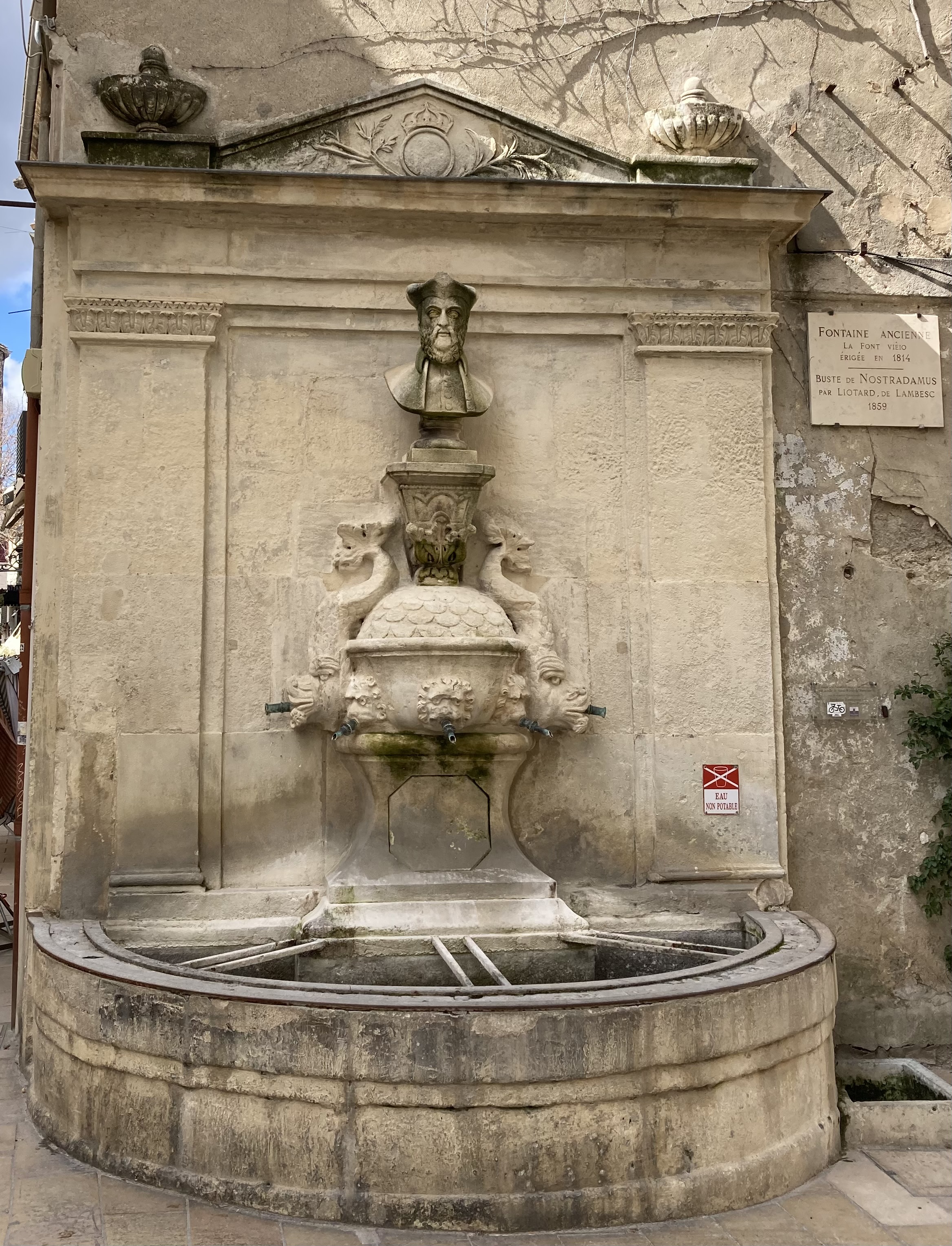
Experiences of flowing water, for me, is one of these many circumstances which enhance an ordinary day. Fountains can have a similar effect. We don’t have any near us, but many French towns have a number of fountains in their central squares, and they always draw me to them.

Do you have anywhere nearby where you can spend a few moments next to flowing water? A stream, a fountain, a waterfall? If so, all you need to do is to pay a little attention to it. Focusing on some flowing water for a few minutes often seems to make a day a better day.

Read Full Post »

How do we improve the quality of our everyday lives?

One way is to do whatever brings us joy, and makes us wonder. And we can do that, either by pursuing an activity which we know brings us joy, for example, listening to our favourite music. Or, and this adds in the element of wonder and discovery, pay attention to the hear and now.

As I wandered through my garden one day, just looking to see what I might notice, I spotted this tiny plant. First of all, I’d never seen a plant like this before, so I didn’t know what it was called. Secondly, I kneeled down, got up close, and just looked. Isn’t it beautiful? Isn’t it amazing? What an incredible structure, and what beautiful colours. I love those tips of purple emerging from the green. Then I got my phone out and took a close up photo….this photo.

I like to take a photo for two reasons. First of all, I can then go back and look more closely over and over again. I can enrich an already rich experience. Second, because my curiosity has been stimulated, I can touch the little “(i)” button on the phone screen when I’m looking at the photo, and it magically tells me the name of the plant.

Apparently, it’s a “self-heal”. Oh, like all plants, it has many other names too, but the name “self-heal” immediately appeals to me. After all, in all my years working as a doctor, that’s exactly what I was trying to do – to stimulate and support a patient’s self healing. I know we live with a kind of medical myth that doctors heal us with their operations and their drugs. But they don’t. Nobody repairs a single wound without the body’s capacity to self heal. Nobody recovers from a virus without the body’s defence and repair system doing its job. Nobody heals without the body’s complex system of self healing doing what it is designed to do. Doctors should remember that. They don’t heal patients. Patients heal patients and the doctor, when working at their best, support, stimulate and work with, the capacity if the patient to self heal.

Once I had spotted this plant, identified it, explored more about it online later, then I suddenly saw it appearing everywhere in the garden. Well, not everywhere, but over a very wide area. Now there’s something else amazing about gardens. I didn’t plant this beautiful plant. I didn’t “propagate” it. But there it is, and it’s thriving. I find that wonder-full!

Read Full Post »

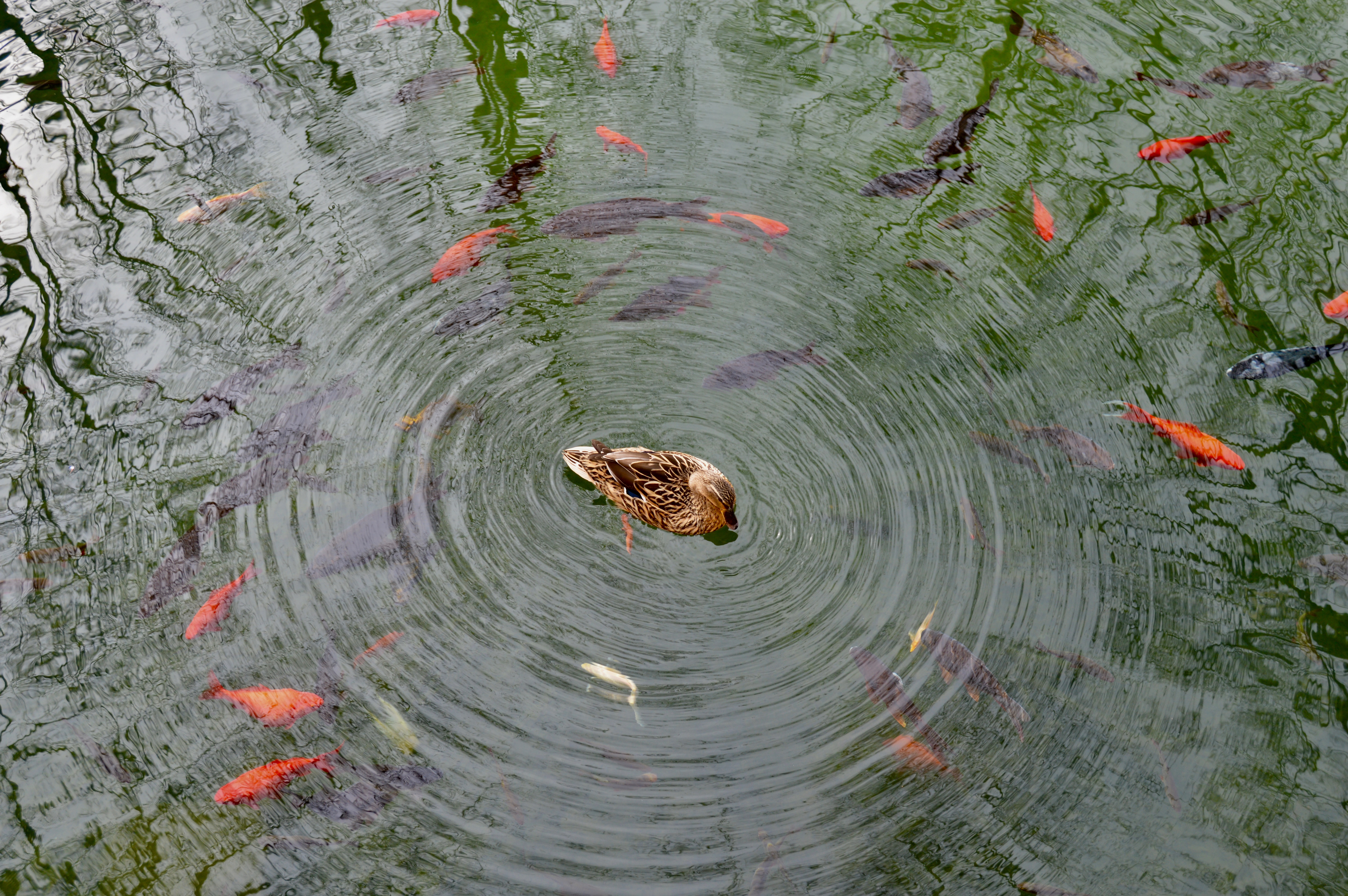
This is one of my favourite photos. It shows two things which always fascinate me. Firstly, the duck, which is apparently just sitting on the water is sending out ripples across the surface in the most beautiful pattern of concentric circles. Secondly, the fish appear to swimming around the duck, some even following the actual ripples.

This is a great example of how just by living we change the world around us and influence the lives of others.

D H Lawrence said –

As we live, we are transmitters of life.

When I’ve looked at this photo in the past, I’ve been struck by how we “influencers”, but, after reading this sentence by Lawrence, I think “transmitters” is a better word to use. Besides, “influencers” has become synonymous with marketers, and, in so doing, has lost some of its beauty for me.

We transmit life just by living. As I breathe, as I consume food and drink, as I digest, as move around this little planet, I change the air, the water, the soil, as I go. As I think, and feel, and imagine, and communicate, I change the lives of others. This blog, which really started just as a personal space to gather things that interest me, has, over the years, become a transmitter. I know that from the feedback I receive from people all over the world. That’s become an explicit part of my writing here. I want to share my life experiences. I want to share my photos, my words, in the hope that you, and maybe others you know, will be touched by them, inspired by them. I hope what I create here brings you some joy, evokes some wonder and reflection, and brightens your everyday. Because, creating these posts, does that for me!

We are transmitters of life, and each of us leads a unique, special, life. We are transmitters of life through our personal stories, none of us telling an identical story to another person. We are transmitters of life through our actions and our thoughts. Collectively, we humans shape and sculpt the Earth. We should stay conscious of that. It’ll help us make better choices.

Read Full Post »

I read an article in the Guardian today entitled “Consuming arts and culture is good for health and wellbeing, research finds” It caught my eye – first because I thought consuming arts and culture ??!! I hate that. I don’t consume arts, I experience/enjoy/participate in…..not consume…. and what is culture anyway? Well, let’s leave that issue for another day. The next thought I had was “I don’t enjoy arts in order to improve my health or wellbeing, and this headline leads me to think these folk are about to try and justify arts on the basis of their utility. But, in fact, the article is even worse than the headline suggests. Here’s how it begins –

Most people are familiar with the buzz that attending a memorable play, film, concert or art exhibition can trigger. But now it is official: consuming culture is good for your health and wellbeing – and generates £8bn a year worth of improvements in people’s quality of life and higher productivity.

Seriously? I might have felt a “buzz” but, “now it is official” – “it generates £8bn a year of improvements in people’s quality of life and higher productivity”. Oh, thank goodness they’ve quantified that. Otherwise I’d have been stuck with my personal delusion that I was just enjoying something, or that it was adding meaning to my life!

Look, I understand what these people are doing, and, at one level, I commend them for it. They are trying to make an economic case for what isn’t measurable. We can’t measure paintings, poems or music. We can’t even really measure “health and wellbeing” (instead we invent questionnaires, the answers to which we allocate scores, then we say we are measuring the invisible – ok, another controversial view I can return to another day) They are claiming that, for example, going to a weekly drawing class at a museum is worth £1310 to each person from “going to see their GP less and feeling better about their lives”. Really? £1310? Not £1315? These apparently definite figures remind me of the old joke that 86.57% of statistics are made up……but, good on them for trying to make the case for arts funding to governments and policy makers who seem to understand only sums and measurements.

But, fundamentally, this makes me hugely uncomfortable. Can’t we make a case for the place of arts “and culture” in our lives without reducing them to arbitrary financial “values”, or so-called “measurements”. I don’t need any of those justifications to play music every day, to write, to read novels, to visit galleries and delight in their works, to feel the connections to their creators……

However, I read, just the other day, that more and more universities in the UK are closing down their Humanities courses, claiming that students don’t want them because they don’t see how they can lead to remunerative employment. Oh goodness, what has happened to our idea of education? What have we reduced that to? Is education only valuable if it lets you get a job managing a McDonalds outlet, or selling people “stuff”?

I hope reports like this one do stimulate debate about the Humanities. I hope they stimulate debate about what makes our lives valuable and meaningful. Meanwhile…..I’m going to continue taking photos, writing, sharing my creativity. I’m going to continue listening to music, reading novels, visiting museums and galleries – because those are some of the activities that bring me joy, that amaze me, that make me think, that help create meaning in my life. If all that contributes positively to my “health and wellbeing”, then so be it. But that’s not the reason I’ll keep filling my daily life with “arts and culture”.

Read Full Post »

You know if you cut yourself that, in the vast majority of cases, the cut will heal itself just if you keep the area clean. You know how, if you break a bone, that the fracture never heals without the body using its ability to knit back together the broken edges of the bone (sometimes you need something to hold the edges together – a plaster, nails or a plate – but the actual healing of the bone is done by the body). Well, in fact this is what all living organisms do – they self-heal, self-repair, and self-organise.

One model for living organisms is a “complex adaptive system” (search that term on this site and you’ll find several articles I’ve written about it). Complex adaptive systems have a key, core characteristic – they adapt. Self healing is an aspect of adaptation.

Yet, in Medicine we rather take self-healing for granted. We know that nobody recovers from anything without self-healing. We need the body’s abilities to repair, and to adapt and grow, in order to heal. Every single time. But how many treatments, specifically, how many drugs do we use which are developed to target the capacity to self-heal? How many drugs directly stimulate or support the natural processes of self-healing? I don’t know any. Instead we direct our treatments “against” – we use lots of “anti”s – antidepressants, anti-inflammatories, anti-hypertensives, antibiotics etc etc – you get the idea – and hope that in the background the body will self heal. I don’t mean these anti drugs are useless. Clearly they are not. In many cases they can rescue someone suffering from a life threatening episode of illness. But they aren’t enough. We also need to stimulate and support the natural systems of self healing and repair.

What are they?

Well, largely, they are environmental, psychological and social. We need light, clean air, clean water, nutritious food, shelter. We need hope and encouragement. We need to feel cared for and loved. We know that forests can help us heal. We know that time spent in natural environments can help us heal. We know that music, and art, and stories can help us heal.

So do we need drugs? Well, we do. The thing about self-healing is that it is limited by natural biological limits. We are mortal beings. None of us will live forever, and none of us will go through life without experiences diseases and illnesses. Drugs can help us by easing symptoms, addressing imbalances, and countering pathologies. But Medicine is, and always has been, more than just drugs.

But there is something else about self-healing that we should pay attention to and that is…..in common with all forms of adaptation, it is unpredictable at the level of the individual. Sometimes we pretend that all we need to go is a give an “evidence based” treatment and the outcome can be assured. That’s not the case. There is no treatment which produces the same outcome time and time again, in patient after patient. Adaptation teaches us to accept uncertainty. It teaches us to stick with a patient, to follow through and follow up, because only time will tell whether or not the treatment is proving to be useful or not for this person.

And there’s the other key lesson for Medicine from the science of adaptation and self-healing – patients do better when they experience continuity of care.

Over time, we have to adapt our treatments and our care, as the individual patient adapts to the changes brought about by the disease or injury which has made them ill.

It’s good to learn how to deal with uncertainty, because life isn’t predictable.

Read Full Post »

We humans, like all other living organisms, are “complex adaptive systems”, and as such, we share a fundamental capacity to self-organise, self-defend, and self-heal. We know that, don’t we? Whenever you’ve had a cut, within a few days, the wound has been repaired, and often, without even leaving a scar. Whenever you’ve broken a bone, whether or not you’ve needed surgery or the help of a temporary plaster, your body repairs the damage. Whenever we’ve caught a virus, usually within a few days, our body has got rid of it, and repaired any damage done.

But in Modern Medicine, we don’t pay much attention to any of that. We are sold the idea that drugs “cure” or “heal”, when, actually, what they do is modify disease activity within the body.

There isn’t a single drug on the market which has been designed to stimulate and/or directly support self-healing.

And I’m not aware that any drug companies or research groups are even working on trying to do that.

Yet, nobody, but nobody, will recover from any illness without the natural self-healing functions doing what they are designed to do. There is no “artificial healing” (just as you could argue there is no “artificial intelligence”) – there is only natural healing. Natural healing is limited, of course. We are mortal creatures. Every single one of us will die, one day, from something….trauma, infection, or disease. Despite claims that some drugs are “life saving”, the marketers don’t actually mean they can stop you from ever dying! Similarly, natural healing can only achieve what is possible within the biological limits of a living creature.

I’ve no doubt many drugs can make life more comfortable, and many can modify the life history of a chronic pathology. But is that enough? Shouldn’t we, routinely, be exploring, with our patients, what we can do to promote and sustain self healing?

Take the example of post-surgical recovery. When we create the conditions which support self-repair and healing, then patients require less painkillers, develop less complications and make a longer lasting, quicker recovery.

If we don’t use the methodologies which are directly intended to stimulate and sustain self-healing and/or we don’t help patients to access the care and environments which are conducive to self-healing, we aren’t really doing a complete job. Are we?

So, here’s my challenge. See if you can find out what we know supports self-healing….then look to draw upon some of that any time you, or your patient, is ill.

Read Full Post »

A wide ranging review of General Practice in the UK has just been published in the British Journal of General Practice. It makes for disturbing reading. Here’s one of their conclusions –

Overall, these findings reveal a system that is approaching — or, in some cases, beyond — breaking point. Staff members are stressed, demoralised, and leaving; clinical care appears to be compromised; and many patients are dissatisfied, frustrated, and unable or less willing to seek care. We believe there are significant risks to patient safety and to the future survival of traditional general practice in UK.

Here’s another –

Quality efforts in UK general practice occur in the context of cumulative impacts of financial austerity, loss of resilience, increasingly complex patterns of illness and need, a diverse and fragmented workforce, material and digital infrastructure that is unfit for purpose, and physically distant and asynchronous ways of working. Providing the human elements of traditional general practice (such as relationship-based care, compassion, and support) is difficult and sometimes even impossible. Systems designed to increase efficiency have introduced new forms of inefficiency and have compromised other quality domains such as accessibility, patient-centredness, and equity. Long-term condition management varies in quality. Measures to mitigate digital exclusion (such as digital navigators) are welcome but do not compensate for extremes of structural disadvantage. Many staff are stressed and demoralised.

I first expressed the desire to be a doctor when I was three years old. The role model I had was the family doctor who attended the home birth of my younger sister. I was trained according to the dominant values of the time (which are referred to within this study) – “relationship-based, holistic, compassionate care, and ongoing support to patients and families”. The authors of this study find that it is increasingly difficult, and in many cases, impossible, to practice according to these values, even though, GPs still hold them. This results in stress, frustration, and burn-out which impacts adversely on both recruitment and retention of doctors in Primary Care.

So, what’s going on? How did we get here? This paper outlines several factors, not least financial austerity, underfunding, increasing inequality, increasing complexity of illness and an ageing population. But it also highlights a problems which arise from a particular management philosophy – the authors don’t actually use that term – where on the grounds of so-called greater efficiency, health care teams have become more diverse, digital and both algorithmic and protocol-driven services delivered by less qualified staff have increased, and the whole service is disintegrating. The efficiency actually goes down, the dangers increase, and dissatisfaction mounts (in both patients and staff).

The authors don’t give any quick and easy solutions but they shine a bright clear light on the problems, and put their finger on at least one issue at the heart of the problem – the loss of continuity of relationship-focused care delivered by holistically and compassionately.

They do use the word “dehumanised”, and that’s long been my experience. We need to get back to those traditional values and stop doing what impairs them. We need to get back to a health service which puts patients and their GPs at the heart of the system, and stop thinking we can use new technologies and industrial management practices to make things better.

Read Full Post »

One of the things which frustrates me most about Medicine is this question – “Is it physical?”, which may be asked in a slightly other form – “Is it organic?”, (or, the apparent opposite – “Is it functional?”), “Is it a problem of the body or the mind?”. This way of thinking which divides illnesses into two categories, separating out the mind from the body, is still way too common. It’s common in patients who refuse to accept their illness could have anything to do with their mind – “it’s a virus”, “it’s a hormone problem”, “it’s my genes” – usually because they have been led to believe that a problem involving the mind is a “mental problem”, which strangely continues to carry a stigma that an infection, or a broken leg don’t carry. Separating out the mind from the body is a common misunderstanding not least because it is promoted by doctors who should really know better by now.

The human being is a living, multicellular organism. Starting from a single, fertilised egg cell, the foetus doubles and doubles and doubles the number of cells, until the fully formed human being is born with trillions of cells on board. Trillions. It’s too big a number to visualise. In fact, the number of cells in a human body are estimated, not accurately counted, partly because cells die and are replaced constantly. None of these cells exist in isolation. They are all in constant communication with, and respond to, other cells within the organism, so that although we each have a heart, two lungs, a stomach, a liver, a brain etc, none of these organs exist by themselves. Every single one of them is “integrated” with all the others – that means each is in an active two-way relationship with other organs, tissues and cells. The cells of your body don’t compete with each other. They collaborate. They work together to make the whole organism healthy, so that it can adapt and to grow.

The mind, as best we understand it so far, is more than a function of the brain. It’s embodied. There are extensive neural and endocrine networks throughout the body which work together to produce what we call the mind. This understanding of mind is sometimes referred to as “embodied mind”. Search for that term online to learn more if you like. It’s a useful concept which allows us to see that the mind is not confined to the skull.

It turns out that terms like “heart felt”, and “gut feeling”, are not mere metaphors, but reflect biochemical activities and phenomena which involve, not only the heart and the digestive system, but the whole organism.

I used to say to patients and medical students, I only ever saw a body without a mind in the mortuary, and I never met a mind without a body.

It makes no sense to me to separate out the mind from the body, because when illness occurs, it might arise in a specific tissue, or organ (or it might not), but the response to the disorder is a whole being response – we use the powers of every system within the body, and our abilities to think and to feel (I mean emotional feeling), to defend and repair.

The big problem with separating off the mind from the body and looking for “physical” or “organic” problems is that if all the lab tests and imaging comes back within normal limits, an illness ends up being classed as “mental” – and treatments for mental disorders are then offered. Or worse, it is dismissed as “not real”.

But there is another way to look at all of this – a holistic way – where we don’t separate out the mind from the body and whatever the disease, we seek to address the person, not simply some of their cells or organs. Yes, maybe there are cellular pathologies which can be, and should be addressed, but healing and repair always involves a whole person.

Wouldn’t it be better if we never limited ourselves to addressing “pathologies” in cells and systems, but, rather, in addition (and not or, remember), we engaged with the whole person through their story, their actions, their thoughts and feelings? Shouldn’t we address the circumstances of their lives, because nobody lives in isolation from environmental influences?

It makes no sense to me to address only a pathology found in a particular tissue or organ. Medicine isn’t a kind of mechanics. It’s an art, and science, of understanding and relating.

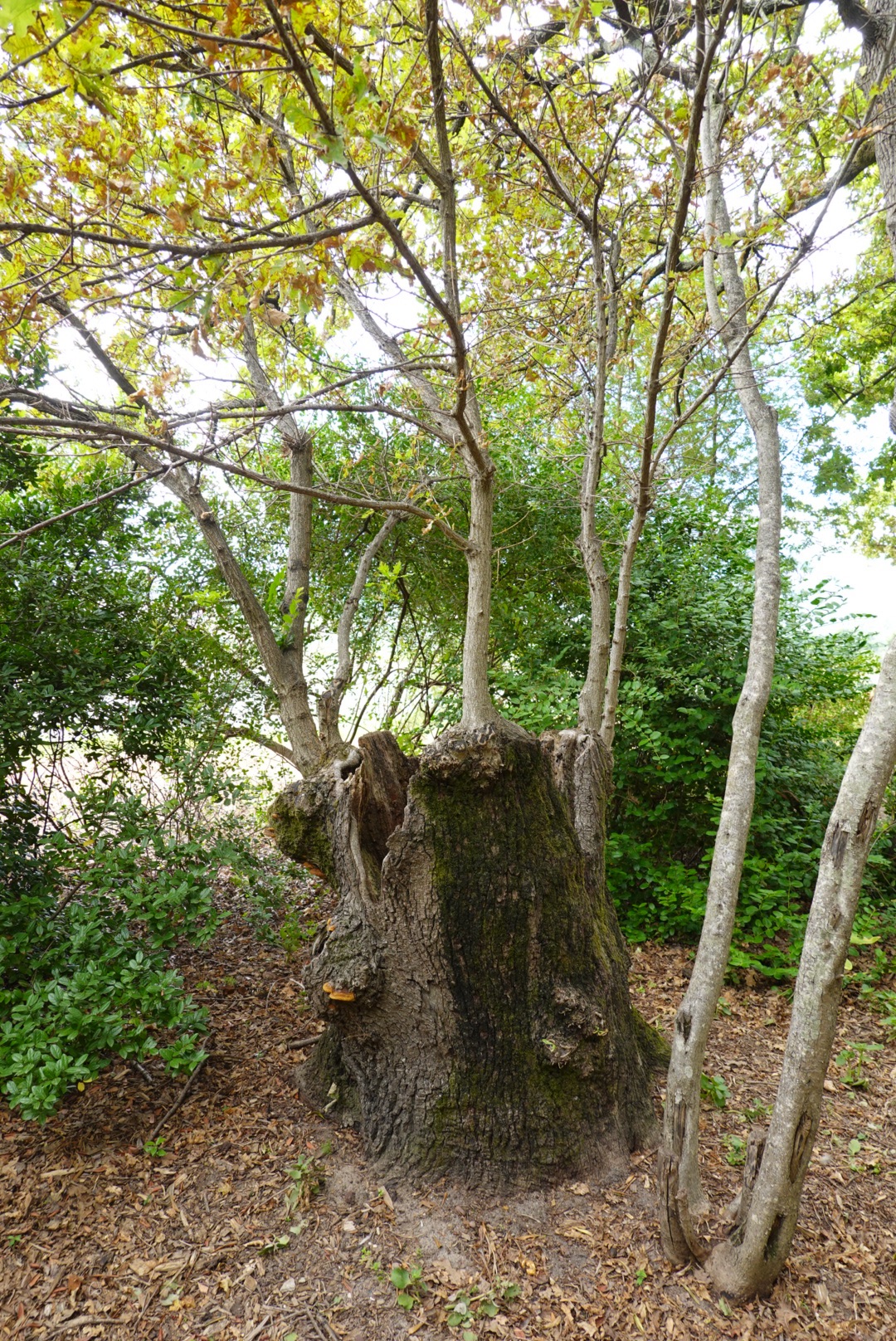
By the way, do you think you can see the suggestion of a heart on the bark of that sequoia in the photo I’ve posted above?

Read Full Post »

All my working life I practised Medicine as holistically as I could. I never made sense to me to split a human being into parts, particularly into a “mental” part and a “body” part. I was trained to practice holistically, even if my teachers rarely used that word. They taught me to listen to a person’s story, to listen with empathy and without judgement, in order to understand their illness, to make a good diagnosis and to plan what investigations and treatments should be considered. We started with the person, and drilled down to clarify what was happening in certain systems or parts, with the help of investigations.

This way of working emphasised that every single human being was unique, and that there were no one size fits all treatments. It taught us to remain ever alert, to follow up patients ourselves and to adjust our diagnoses, treatments and prognoses, as life continued to flow.

But was it holistic enough?

My chronic doubt, which, I confess, has grown over the years, was that it wasn’t. The reason for saying that is that whilst I knew everyone lived within a complex, layered web of relationships and environments, my interventions were almost exclusively individualistic.

But I know that our health is affected by traumas, by relationships, by work, by poverty, by housing, by pollution.

The Covid pandemic made all that clearer than ever, but still, we went for an individualised approach, focusing on vaccinations and personal hygiene. But we saw that the vulnerabilities and problems lay in insecure employment, poverty, racism, overcrowded and inadequate housing etc.

Sometimes I buy the idea that we can all be healthier if we exercise enough, eat a balanced nutritious diet, and manage our emotions, but then I see children in Gaza, people picking through the rubble of their houses in Ukraine, whole towns swept away in historic floods, and I realise, this individualistic holism just isn’t enough.

Let me clarify – I’m not knocking holistic medical practice – it’s far superior to reductionist, materialist, industrialised models. But we need to be much more aware of the circumstances of our lives, and, in particular, of the shared circumstances of our lives. If we can’t do anything about climate change, plastic pollution of the oceans, chemical pollution of the soil, the waterways and air; if we can’d do anything about poverty, social exclusion, hatred and prejudice; then we’re going to be fire fighting, and applying bandaids, when we could be creating a better world for all of us to live in.

How do we do that?

Ah, that’s the big question, and it’s not an easy one to answer. But we have to start somewhere, and awareness might be a good place to start. We need to talk to each other, to express our desire for more justice, more care, more understanding of how we all share this one, massively connected world.

Read Full Post »

“Informed consent” is a fundamental principle of good, ethical, medical practice. In the UK, the General Medical Council has specific guidance about informed consent in its guide to shared decision making, which begins –

This guidance explains that the exchange of information between doctor and patient is essential to good decision making. Serious harm can result if patients are not listened to, or if they are not given the information they need – and time and support to understand it – so they can make informed decisions about their care.

They specify what information should be shared –

You must give patients the information they want or need to make a decision.

This will usually include:

  1. diagnosis and prognosis
  2. uncertainties about the diagnosis or prognosis, including options for further investigation*
  3. options for treating or managing the condition, including the option to take no action
  4. the nature of each option, what would be involved, and the desired outcome
  5. the potential benefits, risks of harm, uncertainties about and likelihood of success for each option, including the option to take no action.
    By ‘harm’ we mean any potential negative outcome, including a side effect or complication.*

When did you last receive a treatment from a doctor? Before you received it, did they gain your “informed consent”?

In my personal experience, informed consent before surgery has always been present, but over the years the information given has improved considerably. When I saw a urologist last year he offered me different options for treatment, discussed the potential benefits and harms, and included a discussion about the option of doing nothing. He then gave me a pack of literature to read and insisted I didn’t decide which treatment to take until I’d read the information and reflected on it before my next appointment with him.

That’s not my experience when it comes to drugs. I have never been given options, nor had the potential benefits and harms discussed, before receiving a prescription, and, in fact, I’m not sure I’ve ever heard of any patient who hasn’t shared exactly that same experience. It’s far more likely that a doctor will write a prescription, and say, take this and come back and see me in x days/weeks. Once the patient picks up the drug from the Pharmacy, inside the pack is an information sheet, which is usually a longer piece of paper than you’d find anywhere else, but where there is a lot of information about what the drug is, the precautions you should take, potential side effects and harms, and exactly how to take it. I’ve never seen any “other options” described on such an information sheet (unlike the information pack I was given before surgery).

I just don’t think this is good enough.

It’s not good practice, as defined by the GMC, and it doesn’t fit with the “Evidence Based Medicine” approach, and it certainly doesn’t meet with the constantly repeated claim to provide “person centred” or “patient centred” Medicine.

If you are a prescriber, maybe you will say, but this just isn’t feasible. There isn’t sufficient time available in each consultation to obtain “informed consent”. I think there are ways to address that. Firstly, there should be enough time, and if there isn’t, then the system is not working. Consultations which are routinely too brief to make a good diagnosis and obtain informed consent are inadequate, and fail to meet the standards of good practice. Secondly, if surgeons can produce comprehensive information about their procedures and the potential benefits and harms, then so can physicians and generalists. Thirdly, as the GMC points out, informed consent is a dialogue and not a single event. Continuity of care has a wealth of benefits, and one of them is enabling an ongoing dialogue between doctor and patient. Many clinics are not designed to facilitate continuity of care, but they could be if we all agreed it was important.

I just don’t think it’s good enough in this day and age to have a doctor write a prescription and say “take this”, without giving any information about potential benefits, harms or other treatment options. And without facilitating a discussion/dialogue with the patient to obtain truly “informed consent”.

Read Full Post »

« Newer Posts - Older Posts »