Feeds:
Posts
Comments

Posts Tagged ‘life’

Not simple

Living organisms are not simple (no, not even the simplest of them!). Look at this tree. How could you begin to trace its beginning and its end? Where do its roots begin and end? Where does the trunk begin and end? What makes the branches emerge exactly where they do, and what determines the direction they will grow and distance they will stretch?

And, to think, this tree began as a single seed. How absolutely impossible to predict the exact shape and size of this tree from an examination of that seed.

We like to chop reality into pieces, calling this a part, and that, another part, as if there are clear divisions between what we are calling “parts”. But that’s just what our brains do. Specifically, that’s how we engage with the world from the perspective of our left cerebral hemisphere. That hemisphere was never intended to function alone, and all its hyper-focus, all its re-presentation, all its re-cognising, labelling and categorising, was always meant to be passed back to the right hemisphere for re-contextualisation, for re-absorption into the whole, so we could see the connections, the relationships, the ever changing, developing flow of the world.

I’m convinced that the world is a more satisfying place, that life is better, when I open my mind to awe, to wonder. I’m convinced that the world becomes meaner and more shallow when I reduce it to “things”, “objects” and utility.

How amazing it is to really stand and see a tree, a single tree, to gaze, and to wonder at its origins, its history, its connections and its here and now reality. How amazing.
Read Full Post »

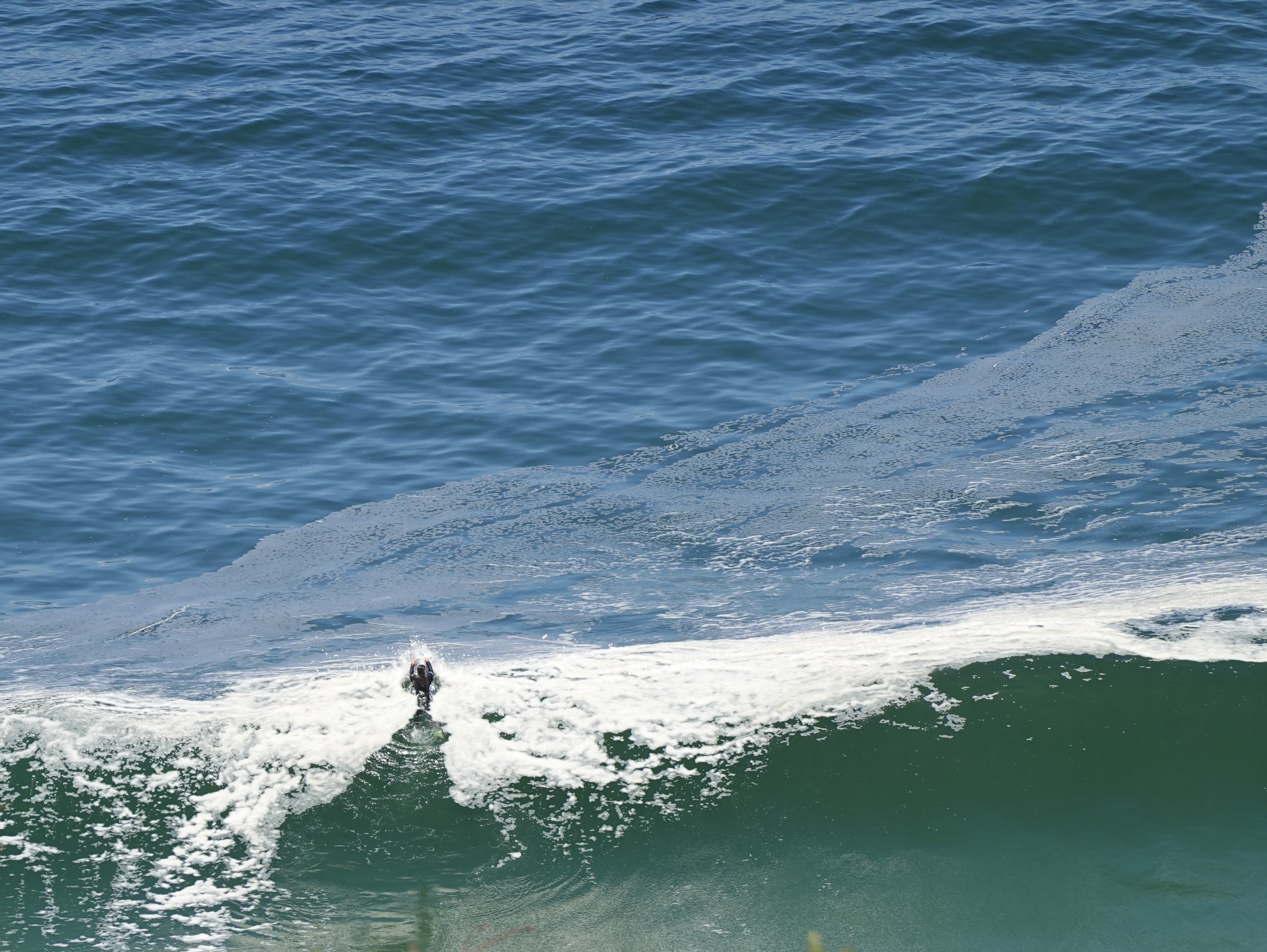
I’m a fan of the idea of “going with the flow”, and I’ve written about it often, but when I was in South Africa last January I saw this person in the sea….not so much going with the flow, as “riding the wave”. This latter phrase isn’t one I use so much, but these feel like turbulent times, and it feels as if the flow is also turbulent….there are great waves, one after another. Waves of significant change, eye catching, attention grabbing waves. It would be easy to feel submerged by waves like these. It would be easy to feel that they are going to wash us all away. So maybe this is a time to learn how to “ride the waves”, to “rise above” them. To tap into their energy and use that to go my own way.

I think it comes down to the attitude we strike – if we approach these waves with fear, then, surely, we’ll drown, or, at best, be driven this way and that, against our will. But if we approach them with confidence, with a sense of wonder and curiosity….then we can play with them, create what we want to create, drawing on the energy and power within the wave, without blindly following its direction.

This does feel a time of great change, but, that can be exciting when we begin to see a potential evolution, a possible phase change, allowing us, as individuals, as communities, and even as a species, to move on to very different world, a very different way of living.

Read Full Post »

Living on the edge

I imagine that the first thing you notice when you look at this image is the sea. In fact, it was the sea which caught my attention, and triggered my camera release. But when I review it now, my eye is drawn from the water, to the rocks, and then to the houses perched on the top of the cliff. Strangely, I didn’t notice them when I was taking the photo.

How would you like to live there? Right on the edge?

You’d certainly have a fabulous view of the sea every day, for as long as you wanted to. As best I know house prices on the coast, with a sea view, are pretty much higher than house prices inland, so, perhaps most people are keen to live on the edge.

Others find it a bit scary. They’re not so secure perched on the top of a cliff, and open to the winds and storms which sweep in from the sea from time to time.

We’re all different.

The philosopher, Gilles Deleuze, writes about the “far from equilibrium” zone. It’s where change occurs. It’s the closest area to chaos, to phase changes, to producing emergent phenomena which we couldn’t predict. He says that when we follow a “line of flight” towards the edge, things can become clearer. In the middle, in a balanced, and relatively static place, the mix of streams of information and energies can make it hard to distinguish characteristics and themes, but as you stretch out towards the edge, it’s a bit like unravelling a ball of threads, each colour becomes easier to see.

But there’s something else about living on the edge which occurs to me. I’ve noticed the word “extreme” is used a lot these days, especially in politics, and always with an intention of shutting people down. Some views are described as “extreme right”, others “extreme left” (sometimes the word “extreme” is replaced with the word “hard”) but what does it tell us about the person to whom we are attaching this label? It’s a judgement, not an observation. The label is applied differently in different contexts of course. As I understand it, something like “universal health care” is described as an “extreme” view by some (much more so in the USA than in Europe). Here in France, that’s definitely not labelled “extreme”.

I’m wary of labels at all times, but I’m especially wary of this “extreme” label. It doesn’t tell me anything. I want to hear what the person has to say. I want to understand their world view and their beliefs. I want to explore their values. Labelling them doesn’t let me do that.

By the way, understanding a point a view, doesn’t mean you have to adopt it. It can, however, open up some points of common ground, and shift the discourse away from the harmful polarised quality which seems dominant at this time.

Read Full Post »

When I look at a mountain, my first thought, my first impression, is how unchanging it is. You can’t imagine a mountain changing. Can you? I used to look out across to Ben Ledi in Central Scotland, and what I saw every day was different. It was different because the light and the weather were different. So sometimes it would glow red with a setting sun, sometimes seem painted white with snow, other times hidden by low clouds and mists, but the mountain, itself, looked the same size and the same shape every single day. I couldn’t imagine a time when it wasn’t there, or when it was just created.

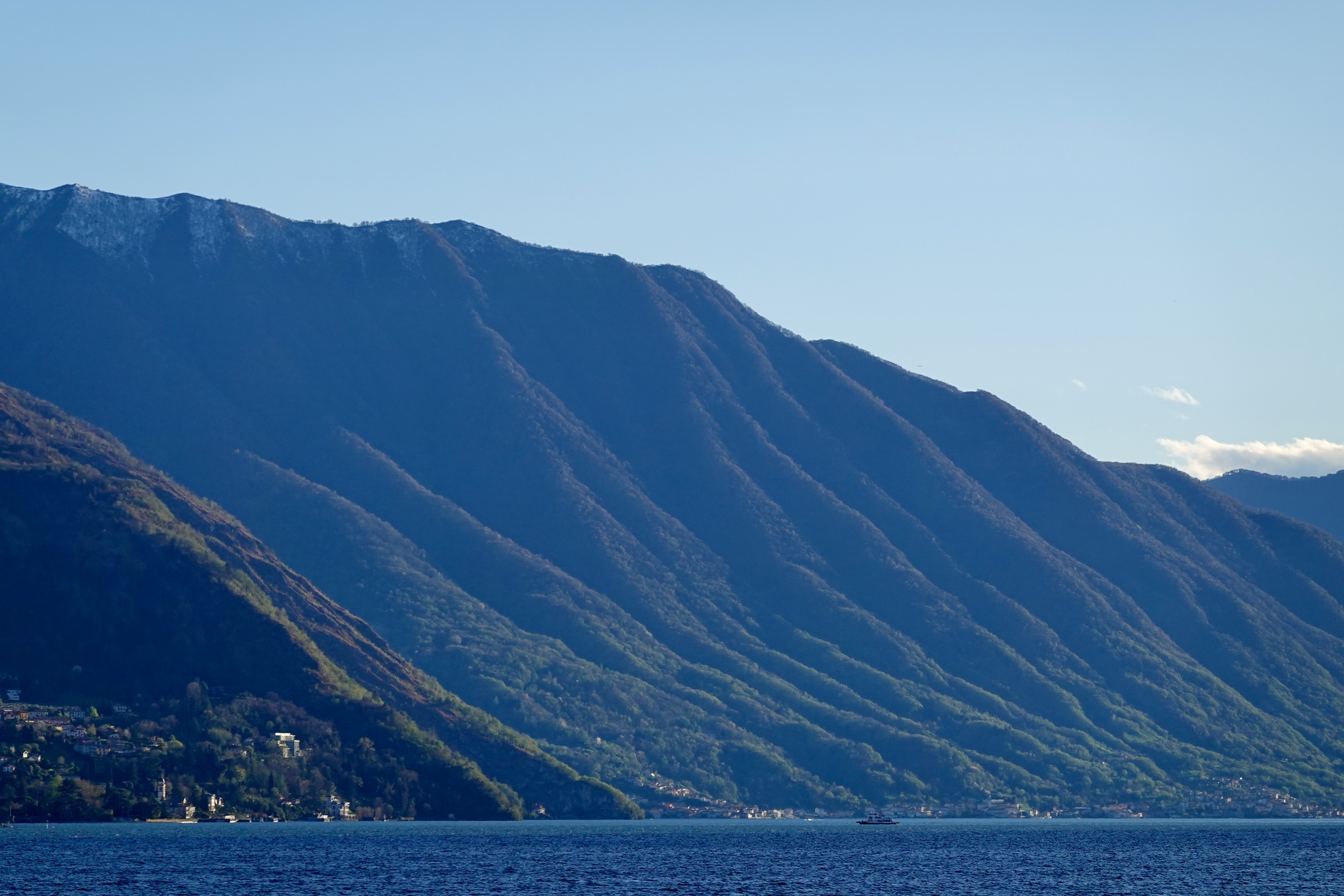
But look at this mountain beside Lake Annecy. It looks pleated. It has so many folds that it looks as if it is draped in a giant cloth. And when I look at that I can easily imagine that this mountain emerged…that it was created by massive forces, stronger than I’ve ever seen.

I can imagine a time when this mountain didn’t exist, and so I can imagine a time when it might disappear.

And I know, that if I was a scientist studying mountains, I’d be aware of just how the mountain changes, little by little, every single day.

Nothing is fixed in this universe. There are no fundamental, unchanging particles, the “building blocks” of all that exists.

The Universe is flow. Reality is always in the process of creation. Every changing.

Read Full Post »

One of the commonest forms you’ll see in the plant world is the spiral. Pretty much any plant which sends out creepers to latch onto something so the plant can grow higher towards the sunlight, uses this form. It doesn’t go for a straight line….what we were taught is the shortest distance between two parts. Why not? There just aren’t that many really straight lines in Nature. It seems there’s a great preference for meandering, changing direction, spiralling around…..not what a machine would do.

Machines, and the industrialised types of management which dominate our lives now, are said to be best when they are most “efficient”. But Nature has a different idea. “Efficiency” seems, these days, to be about expending the least possible amount of effort and money to achieve a standardised outcome. It’s not natural, and it squeezing out beauty and life.

Complex, natural, living forms are not like machines. A plant doesn’t produce the least number of seeds required to produce a second plant. It produces thousands and thousands of them, using a huge number of different methods to have those seeds carried far and wide, relying on the weather and other creatures to do the scattering. Have you ever watched a bee or a butterfly collect pollen? They don’t start top left and work their way “methodically” flower by flower until they’ve harvested the most possible. There’s an inherent, apparent randomness to their flight. You just can’t predict which flower they are going to explore next.

The spiral is a favourite form of exploration in many plants. It’s a way of discovering.

It’s also extremely beautiful. One that artists replicate again and again. Here’s an example from the sculpture park near where I live……

Beautiful, dynamic, attractive, pleasing, and even in a stone carving, bursting with “life”.

I reckon we’ve taken a life destroying path through industrialisation, and I’d love to see us grow whatever we find life enhancing instead. We can do that by paying attention to, and learning from, plants and other creatures. We can privilege beauty, joy and Life instead of consumption, “efficiency” and “profit”. That would lead us to a very different kind of “growth”, and a very different society.

Read Full Post »

On reflection

One of the things I enjoy most about photography is taking the time to really look at the photos I’ve taken. I see things on review that I swear I didn’t see when I was actually there taking the photo. Or I see better something I had noticed, but didn’t take the time to look more closely while I was actually there. When either of those things happen it reminds me to slow down and pay attention in everyday life. I know some people feel that taking photos separates you from the moment, and maybe, in some ways, it does, but actually I find taking some photos, AND taking time to pay attention in the moment, AND reviewing the photos at home, (repeatedly), enhances the joy and pleasure I get out of life, and allows me to make more sense of the everyday.

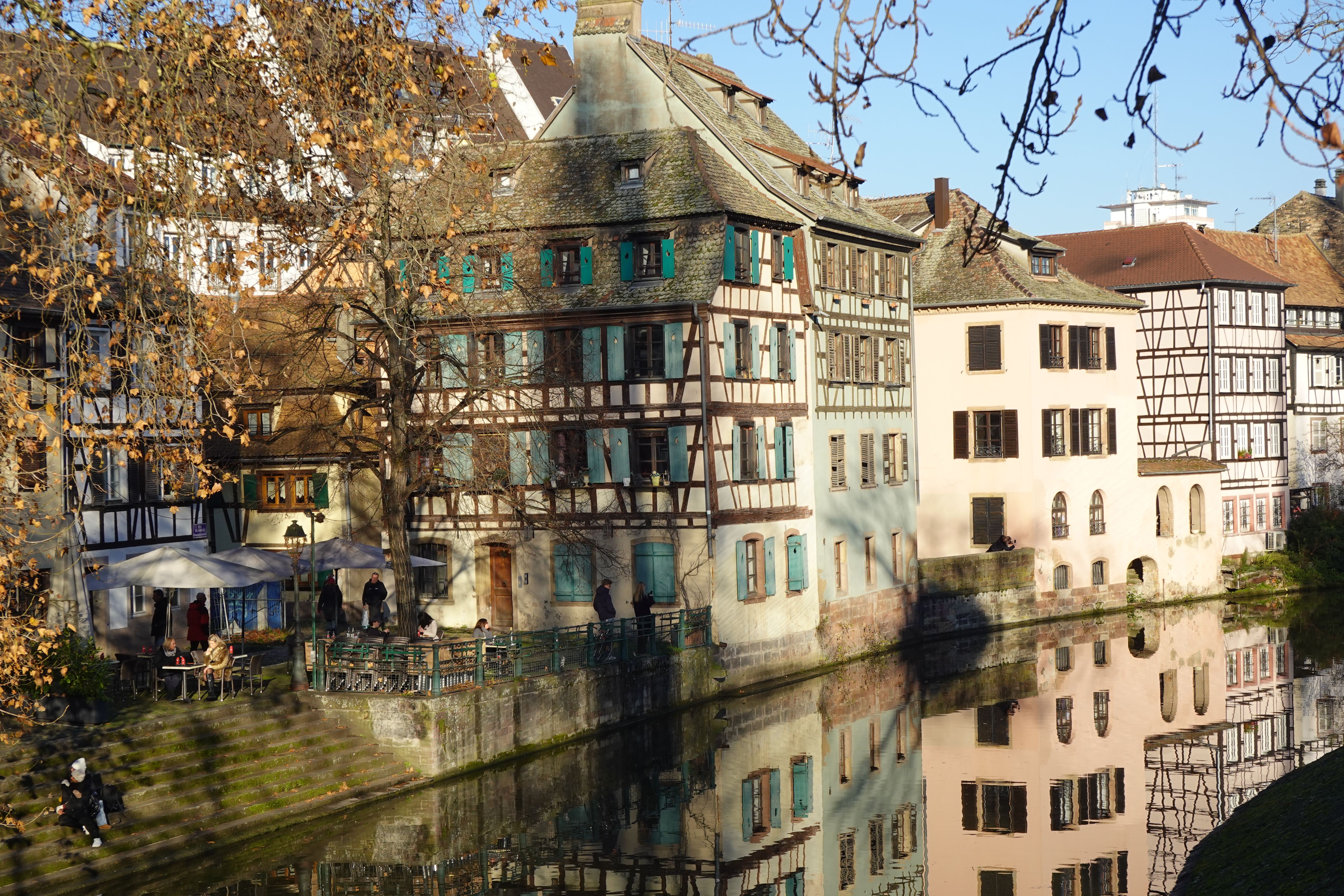
Here’s an example. I was in Strasbourg and noticed the beautiful reflections of the old buildings. Probably thousands of people have taken a photo like this, standing at the exact same spot as I was standing on this bridge. You can see that happening more and more as particular views and locations become “instagrammable”. However, just as in life, every photo is unique. I framed this particular shot, not just to capture the buildings and their reflections in the water but to include the couple sitting on the steps (bottom left of the image) – because I thought that made a more appealing composition.

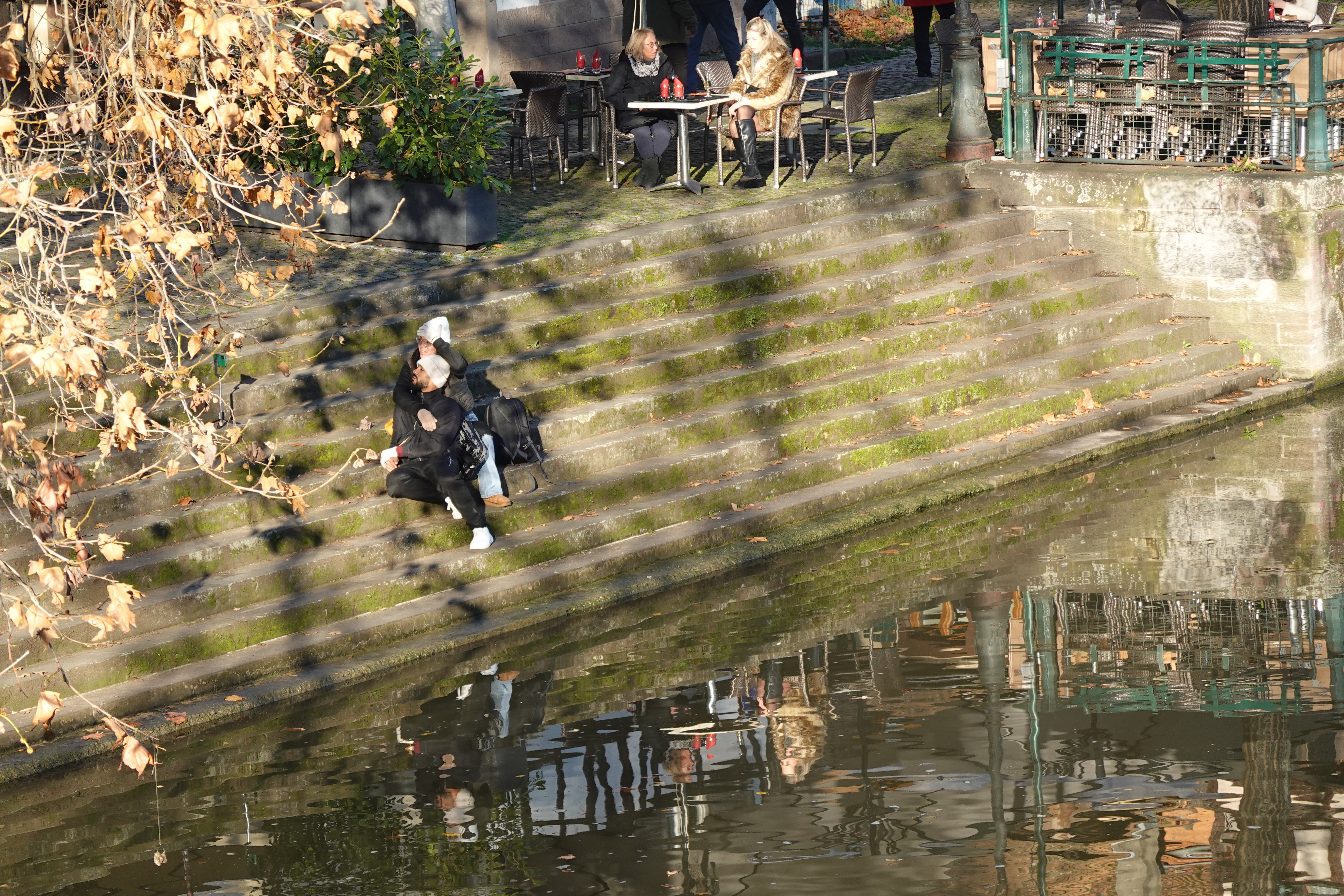
Having noticed them in the viewfinder, and taken the shot, I zoomed in to take a second photo, where the couple and their reflection in the water became the main subject. Here’s that second photo –

I think, at the time, my thought was, what a nice image of “reflection” this would be…..a reflection in the water, and a couple of people, well, reflecting (taking a moment).

But now that I’m revisiting these photos I’ve just seen something else. These people aren’t looking at the water, or the reflections. They are looking at something off screen to the left (there was a beautiful and very ancient tree growing at the end of the bridge. I think that’s maybe what they were looking at). Then I noticed something else. At first, I thought, oh, they’re sharing a pair of white gloves. Because it looks like they both have one gloved hand, and one ungloved hand. Now, sharing a pair of gloves is an interesting thing to do. I think I might have done that while we walked on a cold wintry day, with one hand gloved, and the other thrust deep into a jacket pocket….but, looking closer, I see that for each of them, the gloved hand is the left one. They are both wearing a left hand glove. Well, I’ve never seen anyone do that before. That sure makes me curious and stimulates my wonder and my imagination. What’s that about?

I do love it when a photo I’ve taken leads me off down very different paths of wonder the more closely I look at them.

I am convinced that taking photos, and reviewing them repeatedly, encourages me to reflect more….on the world, on other people, on my life, and on my every day experiences.

Read Full Post »

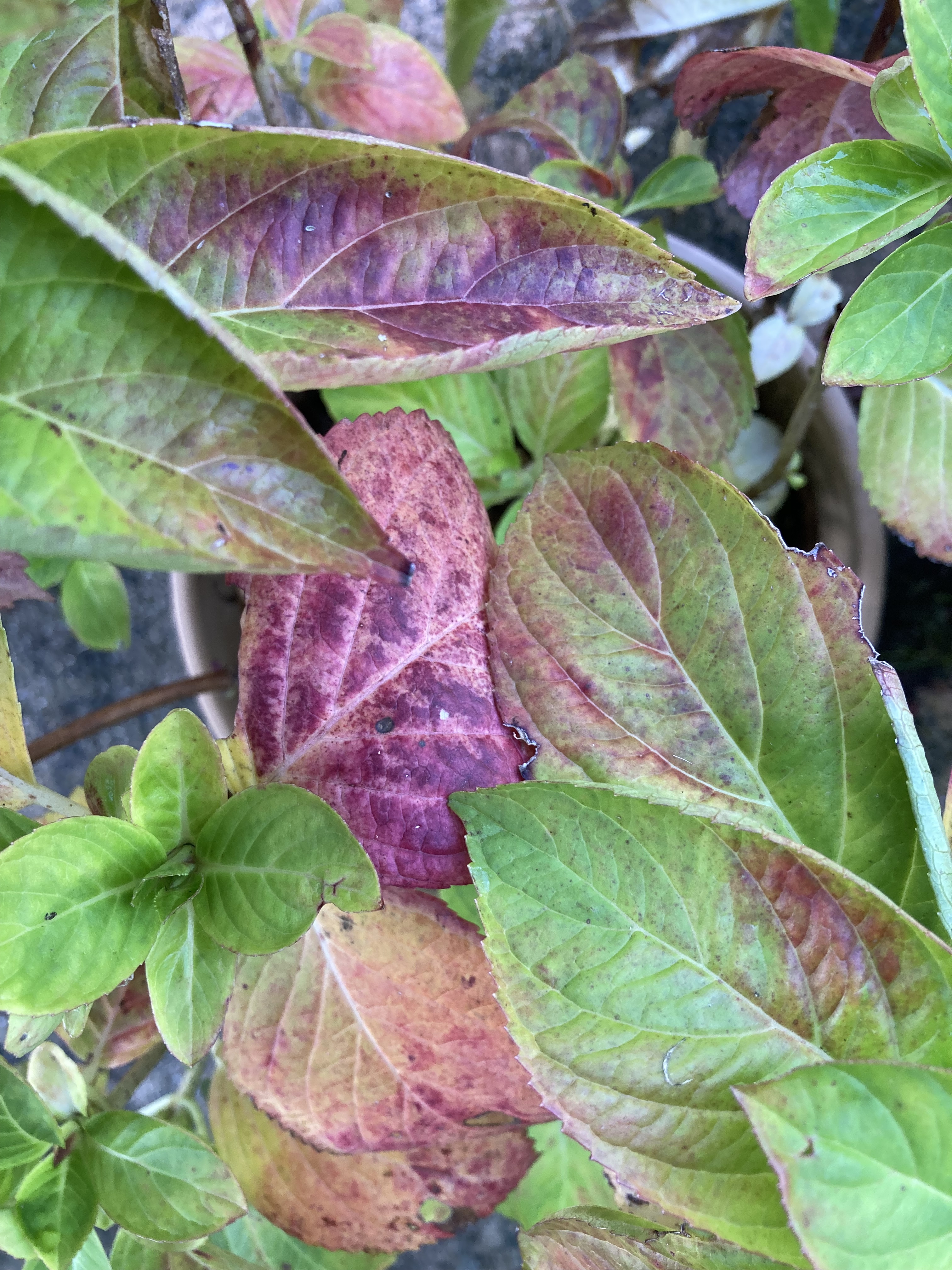
Spring and autumn are the two seasons where I notice change happening right before my eyes. Right now, in October, here in France, we are beginning to see leaves change colour. I love to gaze for a few moments at a plant like this, where some of the leaves are still bright green, some have patches of red or brown appearing, and some have gone fully deep red or even purple.

This reminds me of two things – the first is that change never stops. Everything in the world is constantly undergoing change. We are not the same today as we were a few weeks ago, and we are very different from what we were a few years ago (just browse through your photo albums to see how you’ve changed since you were a baby). The reality is that we change moment by moment. That’s why the advice to “be present”, or to “be here now”, is so relevant. Every single moment is unique, and if we breeze past it without noticing, it will be gone forever (except, of course, in the background of our subconscious the changes never cease to play their part).

The second is that change is so variable. It is heterogenous, not homogenous. You and I are unique. Our daily lives are unique. Our moment to moment experiences are unique and become even more unique over time, as nobody shares with us an exact personal history, an identical string of experiences. Just looking at this one plant and seeing the huge variation in colour as the leaves begin to change makes me even more aware of this uniqueness, of diversity.

So awareness of change slows me down, inspiring me to savour this moment, to live today as fully as I can. It inspires me to pay attention to the flow of Nature, to be aware of the fact that there are no fixed objects in this world, only different rates of change.

And awareness of change does something else for me – heightens my appreciation of uniqueness, of difference, and of diversity. Reducing life to abstractions, selecting single characteristics and bundling everyone who shares them into a single category is such a deluded way of living. We need to stop putting people into little boxes, labelling them and judging them, because when we do that, we just stop seeing them as they really are.

Read Full Post »

I’ve read that we live in an attention economy. Marketers, producers, companies and individuals are all competing for our attention. They pay the social media companies to promote themselves to us using attention grabbing, and attention holding tools and techniques. “Influencers” can only influence if they attract attention, so they do whatever they need to do in order to achieve that goal.

I was pretty shocked on a recent trip to Milan to discover how “instagrammable” has become a major force. Certain buildings, certain viewpoints, or “attractions” were surrounded by dozens of, mostly young female, photographers, either taking pictures of themselves in front of whatever it was that had become “instagrammable”, or having someone else take their portraits there. Some even used portable reflectors, to “get the light right”, and had changes of clothing to model. I joked that my wife and I, standing in front of the Duomo, were the only people in the crowd actually facing the building. Most were trying to make it more beautiful, or more interesting, by putting it in the background, and themselves in the foreground.

That’s not a new phenomenon. A few years ago on a visit to the Alhambra in Grenada, I was surprised to find that most people who were taking photos of the amazing art and architecture, were only doings so by putting themselves into the foreground of each frame.

But attention is important. It’s how we see and experience the world we live in, and it influences our moment to moment moods, thoughts, and actions.

Ellen Langer, who studies “mindfulness”, describes it, simply as, “actively noticing things”.

I love that.

This “heroes not zombies” blog is all about living a more mindful life, and, I believe, that requires two things, both created out of attention. The first is, “noticing”, or as Ellen Langer says, “actively noticing”. When we pay attention, when we set out with an intention to notice – to notice the world around us, to notice others, to notice our thoughts and feelings – then we move into a more active, more conscious mode of existence. We reduce the chances of blindly following the influences and powers of others who try to shape our lives. The second is, to pay “loving attention”. I think whatever we pay attention gets magnified. If we focus on problems, we fill our lives with problems. If we focus on joys, of moments of awe and wonder, then we fill our lives with amazement and delight. But when we pay attention from a loving position – from a position of care, of empathy, of genuine interest, and love – then our attention changes, not only our own lives for the better, that of others…..whether they be other people, animals, plants, the environment, or the planet.

So, I’m all for paying attention – do it actively and do it lovingly – not mindlessly.

Read Full Post »

« Newer Posts