Feeds:
Posts
Comments

Posts Tagged ‘philosophy’

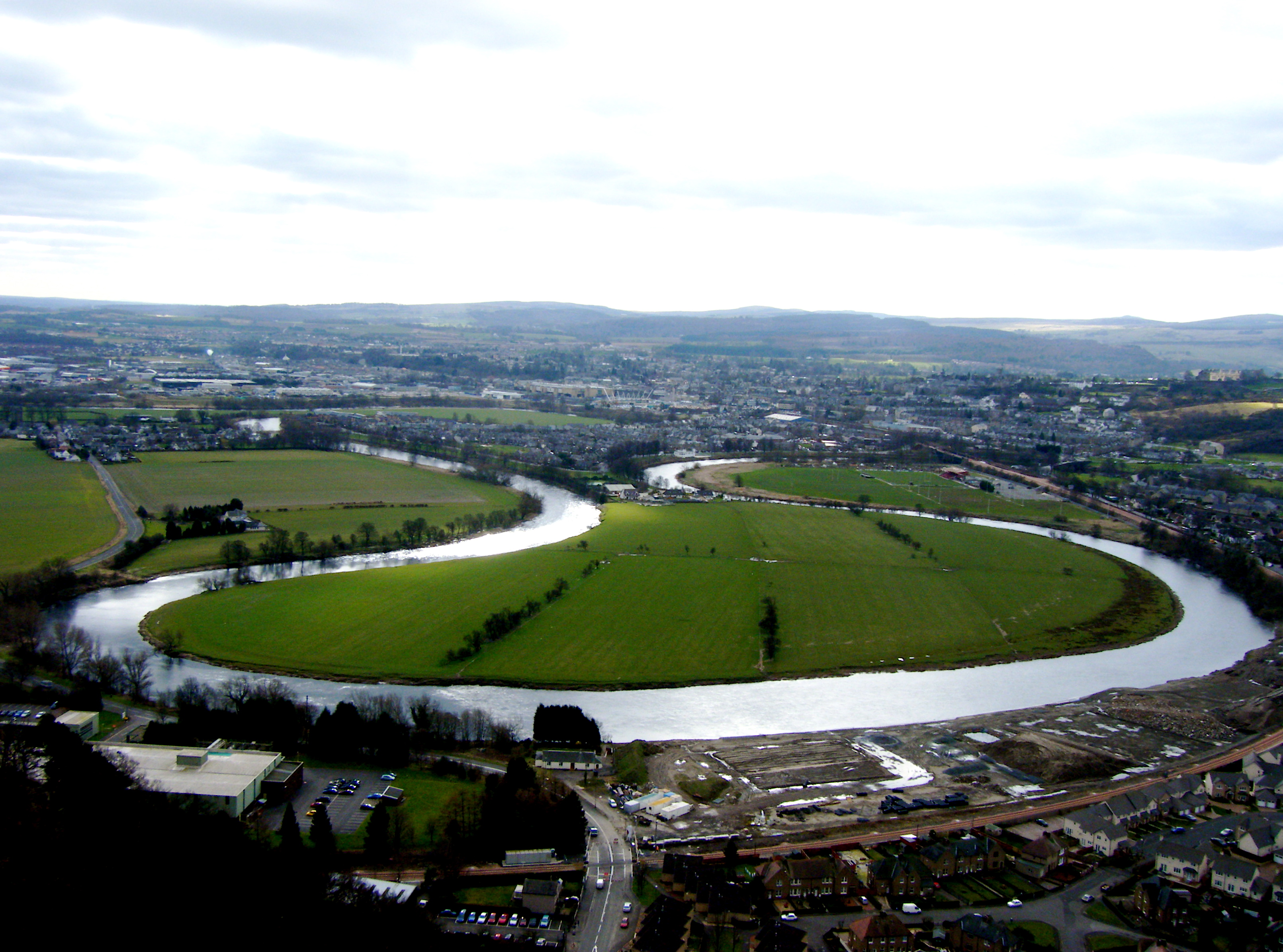
I was looking for exactly this photo the other day, and was delighted when I found it in my library – but I didn’t take it. My daughter, Amy, did. I’m pretty sure I’ve taken photos exactly like this in the past but it must be back to the days of 35mm film because I can’t find any in my digital library. This is a view of part of the River Forth, at Stirling, and it shows beautifully how the river twists, turns and curves around so much at this point in its journey.

I picked up a couple of little books by a French author, Olivier Clerc, when I was in Biarritz fairly recently. One is called “La Grenouille qui ne savait pas qu’elle etait cuite….” (which is about the frog who didn’t know she was being boiled) and the other is “Rien ne peut empecher la riviere de couler…..” (nothing can prevent the river from flowing. In both books, this Swiss author, writes about life lessons he’s learned by taking an analogical perspective on natural phenomena. He argues that as well as thinking analytically, which we are encouraged to do all the time, we should also develop the skills of thinking analogically. That in doing so we will find life itself becomes richer, deeper and more meaningful. I think he’s absolutely right.

The first essay in the second of those books is about how a river can be viewed two ways – first of all, you can see that it twists this way and that (just like the River Forth in this photo), and that if you trace the course of a river from where it starts in the mountains, you find that there seems no logic to its path – it heads west, perhaps, then south, then east perhaps and so on. It disappears at times, flowing into a lake, only to reappear out the opposite side, or into a marsh, or even below ground, before re-emerging perhaps many miles further on. And yet, we call the river by the same name along this twisting, turning, ever changing path. But there’s a second way to look at the river, and that’s to take a lateral slice through the landscape and see that, at every single point, the water is flowing downhill. At no point does it ever, ever turn around and start to flow uphill. It just doesn’t. It continues from Spring to Ocean, in a constantly downhill direction. He points out that these two views of the river show both continuity (as it flows through the landscape) and coherence, as it heads constantly downhill to achieve its goal of reaching the ocean).

He draws several lessons from this, not least being that behaviour is often hard to understand because we see it superficially, and that, we need to look beneath to see the underlying motivations, values and goals, in order to understand why someone is acting the way they do. He says this teaches us to be humble, to accept uncertainty, and to inspire us to look below the surface, to better understand others. What are the coherent threads that run through an individual story, be that of a person, a group within society, a culture, or even a nation? What lies beneath the apparent randomness, the veering this way and that, over years, and decades, that actually reveals the core beliefs, values and purposes?

I like anything which inspires me to pause and reflect. And I think learning to look at the natural world analogically can really deepen the joy of everyday life.

Oh, and just before I leave……I’m suddenly remembering a line from John O’Donohue –

“I would love to live like a river flows,
carried by the surprise of its own unfolding.”

Read Full Post »

The English philosopher, Mary Midgley, in her response to those who said the Self was an illusion, said “If the Self is an illusion, who is it who is having this illusion?”

Philosophers, psychologists, psychiatrists and neuroscientists, continue to debate exactly what the Self is. I’m taking a pragmatic, maybe simplistic approach. For me, the Self is what does the experiencing. Me, myself and I, as the song goes…….All the sensations I experience, are experienced by my Self. Yes, I know there are complex sensory cells and networks throughout the body which enable me to pick and process various signals, energies and waves which flow around and through my body. But, ultimately, the experiencing of the light, of colour, of sound, touch, temperature, taste….that’s all done by my Self. Similarly, it’s my Self which experiences my thoughts and feelings. Again, maybe thoughts and feelings involve a huge network of cells and chemicals in my body, but it’s my Self which experiences them.

I know that not everyone will agree with that conception of the Self, and I’m neither a philosopher, nor a neuroscientist, but I just want to describe, as clearly as possible, how I envisage the Self.

From that standpoint, I explore the world in which I find myself alive. I turn to Science to help me grasp and understand what is external to my Self. Primarily, that picks out elements from within the flux of reality, and considers them as objects…objects which can be measured and manipulated. I even turn to Science to discover elements which exist within my body, but which, I argue, are “external” to my “Self”. So developments in anatomy, physiology, pathology and so on, help me to comprehend the tissues, organs, cells and chemicals within my body, and, as a doctor, to understand them within the bodies of others. That helps me to make diagnoses and to suggest treatments when people fall ill.

Secondly, I turn to Art, to understand what is “internal” to my Self, to express what is “internal” to my Self, and to communicate with the “selves” of others. It’s through music, poetry, painting, sculpture, storytelling, novels, dance, and so on, that I attempt to show others what I feel, what I experience, what I think, from this unique perspective on the universe which I call my Self. Through Art I channel, and stimulate my creativity, my imagination and my empathy.

Thirdly, I turn to Spirituality to explore the connections between my Self, and the rest of the Universe. Through experiences of awe and wonder, I dissolve the boundaries of my individuality, and step into the Oneness of Reality.

I know these terms, external, internal, and beyond, are simplifications in their own right, but I reckon if I am to know a person, to really get to know and understand another person, then my best chance will emerge by taking a blend of these three approaches – science, art and spirituality. And, I’ll see more clearly that no single one of them can give me a comprehensive understanding.

Does this make sense to you? I’d love to hear your take on all this.

Read Full Post »

The concept of “and not or” is very important to me. “And” creates and explores connections. I broadens and deepens our experience. Whereas “Or” divides. It splits reality into pieces and asks us to choose. Iain McGilchrist’s superb explanations of how the left and right hemispheres of the brain enable to focus on the world in very different ways has taught me to try to use my whole brain, not just half of it (we, as a civilisation, and, as individuals, have privileged the left hemisphere approach at the expense of a whole brain one, for far too long now)

But there’s another way in which I apply the “and not or” approach, and that’s through the triad of ways in which we humans view and try to understand the world – science, art and spirituality.

Science provides us with ways of discovering what exists objectively. A core feature of science is measurement. The scientific approach allows us to separate out objects from the ongoing flux of reality, measure them, subject them to experiments and, from there, to make predictions which enable us to exert greater control.

Art, on the other hand, provides us with ways of expressing our inner experience, and of sharing those experiences with others. It’s a range of ways of connecting subject to subject. We use art to express and communicate love, beauty, joy, and unique, individual experience of life. We use music, dance, storytelling, visual arts, poetry etc to develop our creativity and to engage with each other subject to subject. These subjective experiences are not measurable.

Thomas Berry says that the universe is not a collection of objects, it’s a community of subjects.

Thirdly, spirituality, is, for me, that sense of being connected to what is greater than me. I experience it through moments of awe. I experience it everyday through what the French call “l’emerveillement du quotidien” – through wonder, amazement and awe.

I need all of these ways of engaging with the world to lead a deep, whole and meaningful life. Science isn’t enough by itself. It can’t help us to connect, subject to subject. Art isn’t enough by itself, it lacks science’s ability to isolate elements in the objective world to better understand and manipulate them. Spirituality isn’t enough in itself but it stokes our humility and our sense of connection with others and with the rest of the planet, even, the universe.

How about you? Do you enjoy all three? Science, Art and Spirituality?

Read Full Post »

I have long been a critic of reductionism. I mean, I get how it brings something to the table. Our ability to isolate a certain element from within the flux of phenomena and experience, to focus on that element closely, allows us to further our understanding of the world. I suspect it also does, what Iain McGilchrist describes as a left hemisphere trait….it allows us to grasp, to manipulate and control. Therein lies its power.

But it all goes wrong when we fail to integrate our new understanding of a part back into the reality of the whole.

In her novel, Elixir, Kapka Kassabova, writes –

Medicine emerged from alchemy’s noble attempt to marry the subjective and the objective, matter and mind, inner and outer, and in this way, to lift humanity out of superstition and senseless pain. 

But like magic, the bias of modern medicine went too far in the opposite direction. Like magic, it assumes too much and has many blind spots. 

These blind spots come from its many uncouplings, one of which is the uncoupling of psyche from soma, the soul-spirit from the body. Another is the uncoupling of one organ system from another, and another is the uncoupling of the human being from her environment. 

Both Folk Medicine and Western Medicine discourage you from taking ownership of your well-being through knowledge. Both of them keep you dumb and dependent. 

In this passage she critiques both Modern and Folk Medicine for taking power away from individuals. Too often Medicine, in all its forms, comes across as a body of secret knowledge, with an expectation that patients will have faith, and hand themselves over to the practitioner with the superior knowledge.

Personally, I think this is a terrible way to practice Medicine. Diagnosis, prognosis and potential treatment should be a joint process emerging out of a caring, open relationship between a practitioner and a patient. Ultimately, the goal should be to increase an understanding of the self, and to empower individuals towards greater knowledge and autonomy.

I love how Kapka describes Medicine as emerging “from alchemy’s noble attempt to marry the subjective and the objective, matter and mind, inner and outer, and in this way, to lift humanity out of superstition and senseless pain.” That’s exactly how it felt to me. Medicine, at its best improves the lives of others by “marrying the subjective and the objective, matter and mind, inner and outer.”

But in fact what really strikes me most in this passage is “These blind spots come from its many uncouplings, one of which is the uncoupling of psyche from soma, the soul-spirit from the body. Another is the uncoupling of one organ system from another, and another is the uncoupling of the human being from her environment. ” It’s that use of the word “uncoupling”.

I’ve never used “uncoupling” in this context before. But it resonates with me much more deeply than “reductionist”. This, surely, is the heart of the problem – when we “uncouple” one organ system from another, “uncouple” the mind from the body, “uncouple” ourselves from each other, and from the rest of the lived world with whom we share this one, finite, interconnected, little planet.

Here’s to undoing as much “uncoupling” as we can.

Isn’t that something to aspire to?

Read Full Post »

The economist, Thomas Picketty, recently wrote this on his blog – “In France, the combined wealth of the 500 largest fortunes has grown by €1 trillion since 2010, rising from €200 billion to €1.2 trillion.”

What he’s highlighted here is the massive increase in the wealth of the already wealthiest in the world over the last decade or so. There are lots and lots of other figures you can find if you go searching for them, but they are all examples of exactly this phenomenon – while there is great child poverty, millions of people suffering from a “cost of living crisis” and a decline in Public Services in European countries, some people……those who already hoard the most…..have been absolutely coining it in. This is despite such “crises” as the pandemic and the war between Russia and the Ukraine.

At the same time, politician after politician complains about “the National Debt” and how “we can’t afford” to give people decent lives, decent houses and decent jobs.

There have also been a number of articles in recent times about what has been coined the rise of the “inheritocracy” – increasingly, this large shift in wealth away from the general public into to hands of a tiny minority, is leading to more and more younger adults becoming wealthy because they happened to choose the right parents. This isn’t a meritocracy. And it isn’t about rewarding those who work the hardest and contribute the most. There’s a trend underway, and Picketty highlighted that trend in his best seller, “Capital” – that capital is growing faster than the economy, so inequality will continue to increase.

It strikes me there’s something seriously wrong with this system. But let me just pull another issue into this, because these are the things rattling around my brain this morning – the other thing we hear politician after politician go on about is “growth”. “Growth” – the answer the Life, the Universe and Everything! In the UK Labour have built an entire set of policies on this premise – get “growth” and all the good things will follow – better family incomes, better Public Services, less hardship. But, don’t you ever stop to wonder – “growth of what?” I do. Not least because it’s clearer than it’s ever been that we live together on one, finite, massively interconnected planet. We cannot keep growing the global temperature. We cannot keep growing the oceans of plastic waste. We cannot keep consuming more (just consuming more, it apparently doesn’t matter what) every single year. At some point, we’re going to hit the buffers. Aren’t we?

Look, I don’t have all the answers. It’s just that these are a couple of the issues which trouble me these days – both issues, which, along with Climate Change, pollution and species loss – lead me to conclude – there is something deeply wrong with this current world economic/political system.

What do you think?

Read Full Post »

There’s a tiny, beautiful little village on the coast about an hour’s drive west from here. One day while wandering down its medieval streets I saw this sign on a door.

It says, (in my translation), restaurant recommended by the Club of those who life a good life. Actually in French it’s much more elegant than that, but I had trouble translating “vivants” – “livers” would seem the obvious word but that looks like an organ in the body! “lifers” on the other hand makes you think of prisoners! “living beings” is closer, but doesn’t feel quite right, so I’ve opted for “those who live a good life”.

I immediately wondered about this “club” and looked it up online later. It seems to be a restaurant recommendation website in France. Perhaps not terribly exciting!

But I loved the name, and it stimulated my imagination.

Philosophers have wrangled with the question “what is a good life?” for hundreds of years, and it’s something which feels simple and obvious, but when you stop to consider it, it seems impossible to pin down.

I also suspect that we might all give different answers to the question. So, I thought I’d pose it for you today –

How would you describe “a good life”?

I was going to add something myself here, but I’ve decided to just leave this as a prompt for now…….for two reasons. Firstly, I think we can all benefit from taking a little time now and again to contemplate this question. It gets us thinking about our values, our beliefs and our desires, and it also challenges us to consider to what extent we are already living a good life, or whether we think that one day we will. If you think you’re already living it, how would you describe it? What makes your life a good one? And if living a good life is something you hope for one day, what do you imagine it will look like? Because if you don’t know what it will look like, you might not recognise it when it arrives!

Just answer this for yourself after reading this, or discuss it with friends or family. Or, if you like you can tell me – either by leaving a Public comment here, or, privately, by emailing me at bobleckridge@gmail.com

Read Full Post »

“Metaphors we live by” written by Lakoff and Johnson. (ISBN 0-226-46801-1) ……..
I often muse about what makes a human being, human? Or what makes a human being fully human? Consciousness is clearly one of the characteristics. Language is another. And imagination is a third. Perhaps it’s because I’m interested in these phenomena that some time back I bought “Metaphors we live by”. Our ability to handle metaphors and symbols intrigues me, and I wanted to understand better how we use metaphors so the title caught my eye. However, when I flicked through it, it struck me as a bit technical and even dry. I thought it was a book about linguistics, an area of study which does interest me, but one which I find can be difficult to grasp. So I put the book aside in my giant collection of “interesting books to get round to reading one day”. I’m not quite sure I pulled it off the shelf recently. Oh, yes, actually I do remember why, but the explanation is going to have to wait till another post. (cryptic, huh?) I guess that old adage of there being a right time for everything must apply to books, because this time, I started into it and couldn’t stop. I’ve marked it up. I read and re-read chapters. I’ve skipped to the back, delved into the middle, read it from cover to cover. I find it compelling and convincing. And I can’t figure out why I didn’t take to it first time round.
It’s actually an incredibly difficult book to summarise. Usually when I write a review like this I paste in a few passages from the book to illustrate what it’s like. But I’ve collected so many passages I find it hard to pick only a few!
Here’s the gist of their argument. By studying human communication they claim to have discovered that metaphors are not simply a word or language game, but much more fundamentally, they are conceptual. By that they mean we think in metaphors, we understand using metaphors, and, indeed we understand the world and our place in it through metaphors. I didn’t need convinced about that. I already thought that metaphors were the basis of thought. However, they take the whole project to an entirely different level by studying the types of metaphors which are most prevalent in our thinking and communicating. With way too many examples to share here, they illustrate clearly and convincingly that the basic, fundamental metaphors we use haven’t appeared randomly, but are developed out of our interactions with the physical and the cultural worlds in which we exist. In other words, they are develop from our interactions with time and space, and our interactions with other people and creatures. This, I think, is the key. It allows them to develop an argument they call “the experientialist myth”, proposing it as a better way to understand life than the opposing myths of “objectivism” and “subjectivism”. (Time for a quote or two from the book)

The myth of objectivism reflects the human need to understand the external world in order to be able to function successfully in it. The myth of subjectivism is focused on internal aspects of understanding – what the individual finds meaningful and what makes his life worth living. The experientialist myth suggests that these are not opposing concerns.

Within the myth of objectivism, the concern for truth grows out of a concern for successful functioning. Given a view of man as separate from his environment, successful functioning is conceived of as mastery over the environment. Hence the objectivist metaphors KNOWLEDGE IS POWER and SCIENCE PROVIDES CONTROL OVER NATURE.

The principal theme of the myth of subjectivism is the attempt to overcome the alienation that results from viewing man as separate from his environment and from other men. This involves an embracing of the self – of individuality and reliance upon personal feelings, intuition, and values. The Romanticist version involves reveling in the senses and feelings and attempting to gain union with nature through passive appreciation of it.

The old myths share a common perspective: man as separate from his environment.

The experientialist myth takes the perspective of man as part of his environment, not as separate from it. It focuses on constant interaction with the physical environment and with other people. It views this interaction with the environment as involving mutual change. You cannot function within the environment without changing it or being changed by it.

Do you get the idea? It’s a kind of division between the rationalists and the Romantics, with the claim that metaphor builds a bridge between reason and the imagination and gives us a third way. One which neither denies objective reality, not gets lost in subjective relativism. In the process, this “experientialist” way, shows how there are no Absolute truths out there discoverable without an understanding based on cultural systems, but keeps the project of the imagination and feelings grounded in our interactions with the world.

Objectivism takes as its allies scientific truth, rationality, precision, fairness, and impartiality. Subjectivism takes as its allies the emotions, intuitive insight, imagination, humaneness, art, and a “higher” truth.
The proportions of our lives governed by objectivism and subjectivism vary greatly from person to person and culture and culture. Some of us even attempt to live our entire lives totally by one myth of the other.

How do you think it is for you? Are you more drawn to objectivism’s allies, or subjectivism’s?

I find both main strands of their case very convincing. The more you look for it, the more you become aware of the pervasiveness of metaphor, and the more you study it, the clearer it becomes that conceptual metaphors are grounded in our experiences and interactions. Their experientialist myth appeals to me much more than either of the other two older myths. It strikes me as more true. I also think it allows a much more robust defence against scientism than romanticism ever did.

Read Full Post »

Human beings are sensing, feeling, thinking, meaning-seeking creatures. We are probably the only species of life on Earth to function this way. Consciousness is that strange phenomenon which allows us to be aware of all these functions, and it’s consciousness which has enabled us to develop language which allows us to communicate the inner experiences of our lives.

How do you know what another person senses, feels or thinks? Through the sharing of stories. Our key tool in organising all these elements and conveying these experiences to others is narrative. We put things together in our heads in the form of stories. Remember, a story is created by telling of the present as it is emerging from the past in the light of future possibilities. Stories are dynamic. They move, they grow, they develop. And every story is unique, because every human being is unique. We feel less alone when we find connections with others through the stories we share. We use the imaginative facility of empathy to try to understand what another person is experiencing.

These experiences of our lives are made up of the sensations we become aware of, the feelings which develop inside us, and the thoughts which allow us to put it all together. All of this is framed inside what sense we make of it all. Two people can have very similar experiences but understand those experiences differently because sense each one makes of it is different.

Owen Flanagan, the philosopher, describes this very well in his book, “The Really Hard Problem”. He points out that there are many different ways of making sense of experience and these different ways lead to very different perceptions and understandings of the world. He describes the idea of “spaces of meaning”. A “space of meaning” is what a person lives in and through which he or she experiences the world. A “space of meaning” is publically available.

He describes six such spaces – art, science, technology, ethics, politics and spirituality.

Each of these six spaces of meaning names, or gestures in the direction of, a large domain of life. Art includes painting, poetry, literature, music and popular culture. Science includes all the sciences, as well as whatever synthetic philosophical picture of persons (or reality) is thought to emerge from the sciences. Politics includes the relevant local and/or nation-state form of government as wel as the legal and economic structures it rests on and/or engenders. Spirituality includes multifarious religious practices and institutions, theologies, and such non-theistic spiritual conceptions as ethical naturalism, secular humanism, pagan shamanism, Confucianism, Buddhism and Stoicism.

If we want to understand how some person or group self-conceives, and what kind of worldview they have, then we can consider how they make sense of their experience in relation to these “spaces of meaning”. There are as many different “worldviews” as there are people. If we are to understand each other and communicate then we need to grasp something of our own and the other’s worldview. For some people, one of these “spaces of meaning” will be pre-eminent – for example, there are some who think that only the scientific worldview is the “right” view and that all others are flawed. Others think the same of a particular religious or political view of life. We connect with those who inhabit the same spaces as we do. Most people don’t inhabit only one of these spaces. We each have our unique cluster, but some people seem almost incapable of seeing the world in any way other than through one particular space.

One of the points Flanagan is making is that there is no single “right” worldview. Those who cannot see that fail to connect with others who make sense of their lives very differently.

I think we can all learn something from a bit of self-reflection. Which of these “spaces of meaning” resonate most strongly with you? What does that tell you about the way you make sense of the world?

Read Full Post »

« Newer Posts