In the winter time I’d walk to the railway station in the dark in the early morning and by the time I finished work I’d be retracing my steps along the same dark road.
Central and West Scotland is cold in winter. It’s often windy and very often wet. I’d wear a heavy waterproof coat with a hood and walk along with the hood half covering my eyes. All I could see was the road a few metres in front of me.
It would be easy to be uncomfortable and a bit miserable on a day like that but I noticed the colours of the lights reflecting on the wet road and so I stopped to take a photo.
I really like it, even now, years later. It’s like a painting and it takes me back to that moment instantly. I remember how common it was to walk like that in the cold wet winter weather and I remember the route I followed to work every day and suddenly once more it looks beautiful and brings me joy.
You know the old saying about there being no such thing as bad weather, just inappropriate clothing? Well, there’s something in that, but there was always another way to keep my spirits up….notice the world at my feet. It’s often more beautiful than you think.
I’ve developed a habit of watching the lunchtime news on French TV. Mainly because it helps me to “get my ear in” as I try to understand all that’s being said. I’ve gone from understanding very little to understanding most of it now but I must admit it’s a rather disappointingly slow rate of progress.
Anyway, this post isn’t about my journey to become fluent in a second language. It’s been triggered by a piece on yesterday’s news about Scotland. A regular part of the weekend news is a short film about a trip somewhere. It might be somewhere in France, or, more often I think, it’s somewhere abroad. Yesterday it was “The Highlands d’Ecosse”.
They set off from Loch Ness, travelled up the east coast to Dunrobin Castle, right up to John O’Groats then along the north coast to Durness, ending the piece a bit further south in Ullapool.
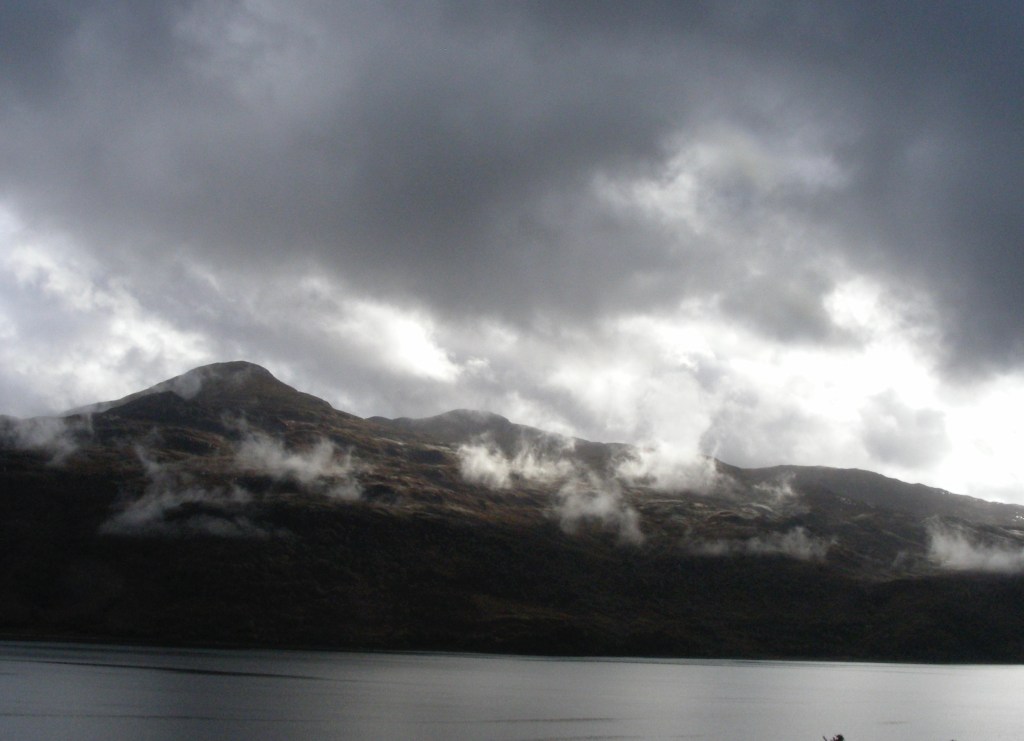
The landscape sent me to my photo collection and I picked this one to share with you today.
French TV presented Scotland as a “land of mists and mystery” and that’s pretty much what all French TV programmes do. I find that if you mention to a French person that you are Scottish they soon talk about the beauty of the mountains, about mystery, castles and ghosts.
I don’t know if this impression is specific to France or if that’s how people in other countries also think of Scotland. But there’s something in that portrayal which resonates with me, a native Scot.
Some of the most beautiful photos I have in my collection are taken amongst lochs and mountains and this one with the brightly lit wispy low clouds/mists running over the side of the hills creates a feeling of mystery I think….maybe even of ghosts or spirits.
Scotland is an ancient land with many stone circles, cairns, burial chambers and standing stones presenting a continuing presence of lives lived tens of thousands of years ago.
I grew up in Stirling, one of several places in Scotland dominated by a castle. One summer night I camped out in our back garden with a friend and we were woken at dawn (about 3am at that time of year) by the sound of footsteps. Someone was walking round outside the tent. We held our breaths and listened carefully. The footsteps stopped and didn’t start again. We unzipped the tent and carefully looked outside. The grass was covered with a heavy dew and there wasn’t a single footprint.
Yep, we were spooked! But also intrigued. So later that day we set off to the Public Library (this is well before the days of the internet!) and began reading about the ghosts of Stirling, one of whom, “The Green Lady” was said to frequent the very area where we lived.
Maybe all teenagers go through a ghosts and spooks phase, but that experience of mine just seemed to fit right in with the sense that we had that we lived in a world of mystery.
I don’t think we either believed or didn’t believe in ghosts actually. I think this was just one of many early experiences which sparked both curiosity and a deep sense of mystery.
Others have written about the disenchantment of life which seems so common now and I’m absolutely sure that the world, that life, that each of us as individuals, could benefit from a bit of re-enchantment.
For me, that happens best in places like the one is this photo. In Nature. In the wild. In beauty, wonder and awe.
It’s not about ghosts after all. It’s about this one small blue planet shared by us all and the sheer gobsmacking wonder of the everyday.
After I enjoyed another sunset and had finished taking some photos I turned around to walk back to the house.
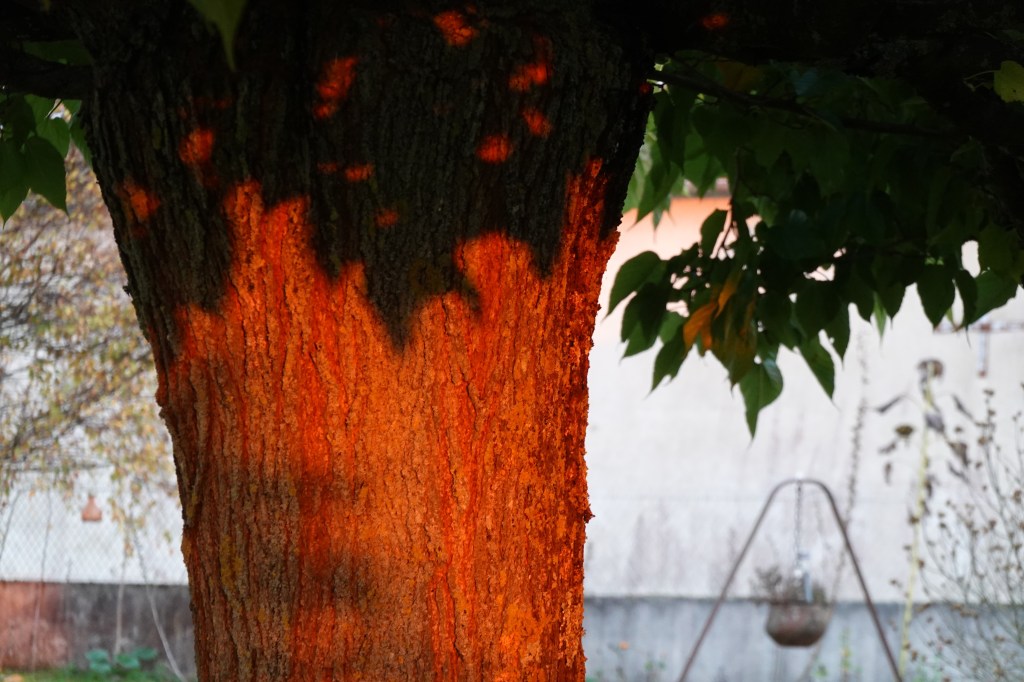
With my back to the setting sun I faced east and right in front of my eyes I saw the mulberry tree bathed in golden light, the shadows of the lowest leaves painted onto the trunk of the tree.
Isn’t this beautiful?
And all because I turned from the main attraction and looked the other way.
The sunset drew me outside into the garden again last night, as it often does. As I framed a couple of shots with my camera I spotted some large seed heads in the far corner. I got closer, changed my position and took this photo.
Oh my, isn’t it beautiful?
I’d be happy to share this with you because I think it will bring you joy and delight.
However, as always, these images set off trains of thought and this morning, as I post this, I find it puts me in touch yet again with the cycles and rhythms of Nature and Life.
Here we have thousands of seeds, each one a potential plant, all waiting for the wind to pick them up and carry them to new lands. A symbol of potential and new beginnings. Those seeds are backlit by the golden light of a setting sun. A symbol of endings, of the close of another day.
Beginnings and endings…..always so deeply intertwined.
We tend to think of the phrase “silver lining” in the context of clouds but I thought of it when I looked at this photo. Although, on closer inspection, this looks more like a “golden lining”. So, hey, that must be a whole level better, don’t you think?
Are you aware of any golden linings in the world just now? In the midst of all the news about the pandemic, a climate crisis, loss of biodiversity, pollution and increasing inequality?
Actually, I do. Maybe I’m a bit strange but in the midst of these challenges I see some glimmering, golden linings.
The first is the number of acts of kindness and care we can see all around us. During lockdowns we saw hundreds of thousands of people helping out their neighbours. In the health and social care sectors we’ve seen the most astonishing levels of dedication and courage. In the midst of hardship we see food banks delivered by volunteers, ordinary unpaid people who just want to help.
Secondly we’ve seen how quickly we can learn in a crisis. The collaboration amongst researchers and clinicians around the world produced new vaccines and new, better ways of caring for the sick.
Thirdly these crises have brought forward new solutions, new ideas and new policies in the domains of science, economics, agriculture and technology.
Sure, it’s easy to be overwhelmed by the extent and severity of the problems we face, and to despair about greed, violence and divisiveness. But we need hope to move forward, as well as having awareness and understanding.
Our golden lining is the profoundly social and creative character of our species. If we align ourselves with these fundamentals, then maybe we will see the golden lining turn into a new dawn, a new era.
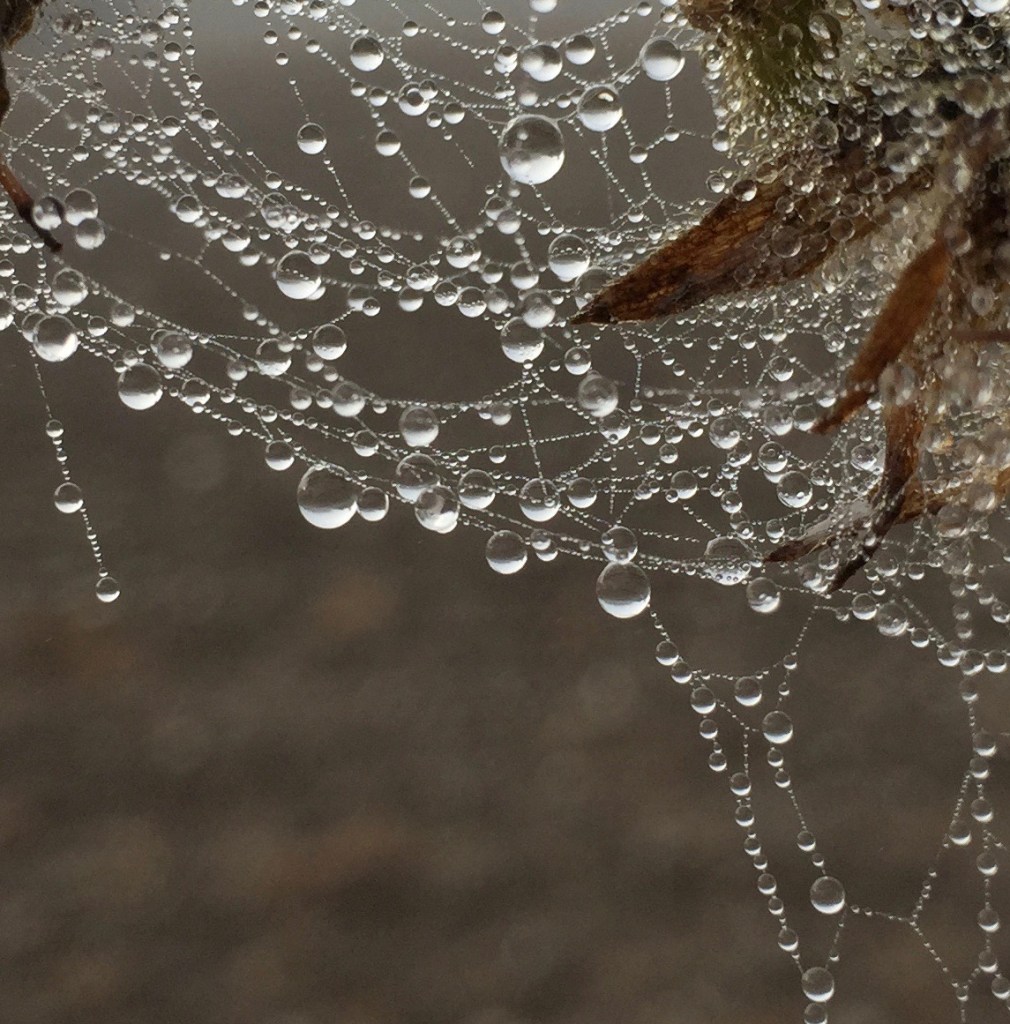
I’m quite fascinated by webs. They always make me think of “complexity” …… which is the basis of reality.
Complex systems are made of nodes and connections. Pretty simple, huh? But really that’s their structure. We see that everywhere. In these webs, in nets, and in networks…..all multiply connected nodes.
When you look in the human brain, that’s what you see. Specialised cells called neurones, each connected to up to 50,000 others. I mean it’s literally mind boggling isn’t it? Hard to imagine billions, yes billions, of cells, every one of which has a node which connects it to up to 50,000 others. Can you imagine how many possible variations there are of actively firing neurones? Each pattern of firing is associated with each thought, feeling, image, perception, memory, action, behaviour…..the scope is infinite.
We can think of the body as a vast complex web too, the trillions, yes trillions (I can’t even envisage what a single trillion looks like!) of individual cells, every one of which is multiply connected to others.
This model scales beautifully. We can see this pattern of nodes and connections within a cell, between cells in a single organ of the body, between organs and tissues, and beyond the body to families, communities, ecosystems.
There’s a special kind of complexity which describes any form of Life in Nature – complex adaptive systems.
Complex adaptive systems (that includes you and me) consist of parts which connect with each other non-linearly. That means the effect of each connection is modified by other connections within the network and changes ripple through the whole system magnifying in intensity, or damping down activity everywhere.
This gives a complex adaptive system certain characteristics. They are all unique, all unpredictable in detail, all self-regulating, and self-repairing. They are “open”, constantly experiencing flows of energy, information and molecules within themselves and within the environments in which they live. This openness and connectedness is the key to their ability to adapt.
Individual healing is a process of adaptation and growth of multiply interconnected nodes, networks and webs.
It’s hard to imagine healthy individuals thriving in unhealthy environments. Which is why it’s so important that we consider the contexts of a person’s life if we want to help them towards health.
Whether we’re thinking about this pandemic or climate change, I think it helps to focus on these images of complexity because they remind us that we are all interconnected, we are all unique, and that we co-create the conditions, and the environments, in which we live. We have to address these problems at both the scale of the individual and the scale of the planet.
Isn’t Life amazing? Isn’t this planet astonishing? Isn’t complexity beautiful?
I took this photo outside the Guggenheim in Bilbao a long time ago. It’s one of my favourite photos and one of my favourite sculptures.
If you look very closely you can see that each sphere reflects several other spheres, and in some of those reflections you can see even more spheres reflected. It’s a bit like one of those halls of mirrors which generate an infinity of images.
If I look very, very closely I can see myself in several of the spheres. And at the same time each sphere contains an image of the immediate surroundings. It’s almost like a hologram where every node shows the whole scene.
But what I always think of when I look at this photo is the concept of the Self as multiple.
We each think of ourselves as a single, unique human being, and we’re right to think that, but in fact that “single” is “multiple”. Every one of us has multiple threads woven together to create a unique tapestry. Every one of us has multiple facets which each glisten when a different light shines on them.
One pretty straight forward way to get a sense of this in yourself is to think of how you are, how you behave, what you think and feel, in different relationships and different situations. Chances are you can see pretty clearly how different you are at work from when you are at home with your family. Or how different you are with different friends.
This only feels odd or false if you try to say that only one of these aspects of your Self is the “true me”. They all are.
Different relationships will bring to life different parts of you, and certain situations will repeatedly bring to the fore particular thoughts, feelings, behaviours and energies.
There are whole therapeutic practices built around the concepts of multiple selves in relation to each other – communities or families of selves.
I’ve always found it helpful to consider each patient as multiple. It helps prevent labelling, categorising and so failing to get to know and understand a whole person. So, I’m always very keen to hear as many stories as possible …. not just the story of the present problem, but family stories, relationship stories, work stories as well as past medical stories.
And here’s the thing which I found hard to grasp at first – not all these selves fit together nicely. We contain multiple and often paradoxical selves. That’s just how things are. We are complex beings with egos, shadows, different drives and desires. It takes a lifetime to get to know them and accept them, but that’s what growth and flourishing are about.
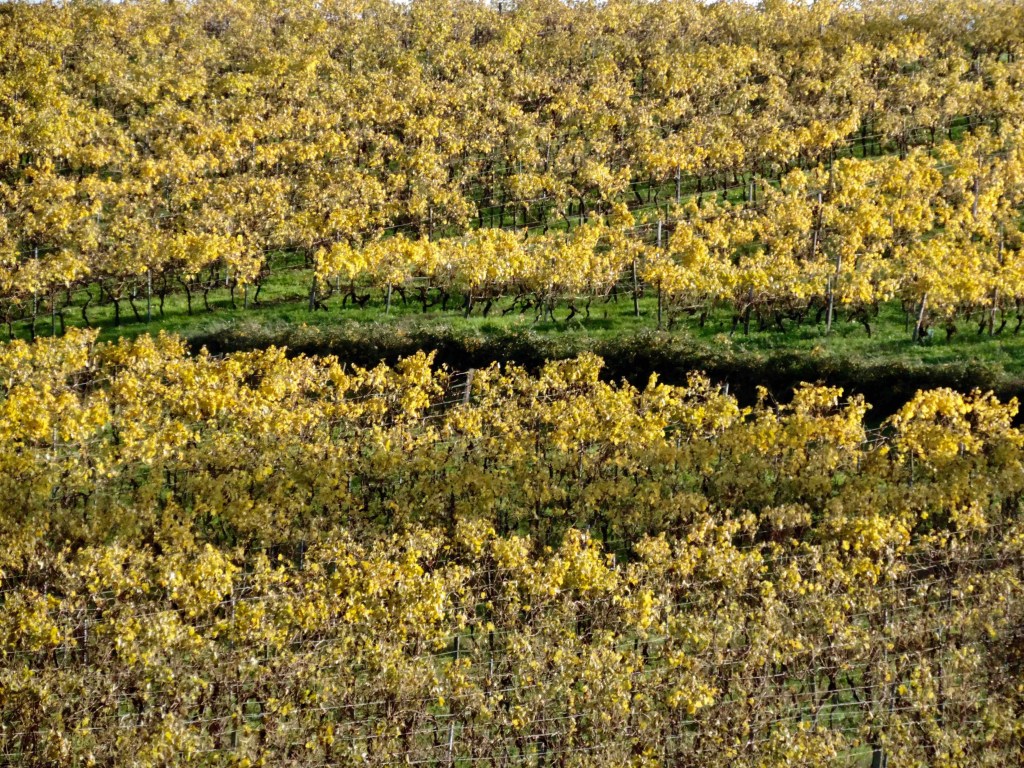
This is what the world looks like around me just now. For the last seven years I’ve lived at the edge of a village just south of the town of Cognac. Cognac isn’t a very big town but it’s name, at least, is known around the world, because all around this region are vineyards dedicated to the work of producing a drink which is also called “cognac”.
Looking out over rows of vines has been a completely new experience for me. I come from Scotland after all! I’ve loved watching the seasons manifest themselves as they sweep through the vineyards and they are probably at their most beautiful at this time of year.
I’ve watched the vine workers go about their daily tasks through seven annual cycles now and two things have really struck me.
There are times when every single plant is tended by human hand. You’ll see the workers move along the lines, pruning and tying up every single plant, one at a time, from dawn to dusk. That’s the phase I witnessed first when I moved here.
How things progressed from there surprised me. For the rest of the year they use machines. Huge machines and tractors spraying chemicals everywhere. Fungicides, insecticides, herbicides….you can see what all these chemicals have in common – “cides” – “killers”.
Then comes the harvest, frenetic activity from well before dawn to well after dusk, driving up and down the vines in vast metal machines which straddle the vines and strip the grapes from the plants, collecting them in huge tractor pulled trailers.
Then the vineyards quietly turn yellow, golden or red. There’s a silence in these days which has become familiar to me.
I’m not an expert in “viniculture”. I don’t know how to rear and tend to vines to produce the best harvests, but I’m sad that the process seems so reliant on machinery and chemicals around here. And I know that an increasing number of vineyards are going “bio”, switching to methods which require a lot less consumption of chemicals and petroleum.
I don’t know if it’s possible for this “new” organic way to completely replace the high carbon footprint, chemically dependent one, but I hope so. And increasingly I express my preference by choosing the “bio” cognac, pineau and wine, which seems increasingly available.
In this week of COP26 in Glasgow we’re all being made more and more aware of our need to act, not just speak. It’s probably a good sign that I find my own awareness of these issues is increasing and that that’s affecting my decisions and choices.
When I took this photo of an Iris flower it was the shape of the water which caught my eye. It looks like a little angel with her arms stretched upwards to the left, and her long dress trailing downwards to the right.
At least, that’s what my imagination creates for me when I look closely.
Isn’t it strange that water can take such a shape? Perhaps not. After water will take the shape of whatever bounds it. Isn’t the shape of a river determined by the rocks and the earth over and around which the water flows? A constant process of co-creation between the flowing water and the solid earth.
That’s enough for me. Water itself, it’s shape shifting and constant flowing, it’s ability to hold a position for a while. All that fills me with wonder and awe.
However, there’s something else comes to mind when I ponder water – emotions.
Emotions are like water. They flow. There’s a clue in the name – e “motions”. It’s easy to forget that because in the midst of an emotional experience it’s easy to lose sight of the fact that, whatever it’s nature and intensity, it is temporary. Emotions don’t stand still. Like water, they arrive, we find ourselves immersed in them, then they move on.
Emotions, like water, can flood us. We can feel like we are drowning in them, overwhelmed with sadness, incandescent with rage, paralysed with fear, ecstatic with joy……
In the midst of the most intense emotions it can be hard to swim. But we can learn and we can practise. We can learn to breathe, to pause, to step back and to notice. We can learn to watch emotions flow past, as the water flows past in the river.
And there’s something else. Emotions can arrive like the rain, or a storm, or the flood waters of a bursting river bank. They can arrive, like water does, from outside us. Learning to see an emotion coming depends on understanding the situations which create them, and we can choose, at least some of the time, to create the situations or to leave them.
When we learn what brings us joy, we can create the situations and habits and experiences which bring us joy.
When we learn what brings us fear, anger, anxiety, we can learn how to be prepared, how to adapt.
We can’t live without water. And we can’t live without emotions either. They are a necessary part of our survival, an essential characteristic of being human.
So it pays off to learn about emotions, to become more aware of them, and to remember that they come and go, as water flows.
I welcome constructive criticism and suggestions. I will not, however, tolerate abuse, rudeness or negativity, whether it is directed at me or other people. It has no place here. ANYONE making nasty comments will be banned.






 Heroes Not Zombies