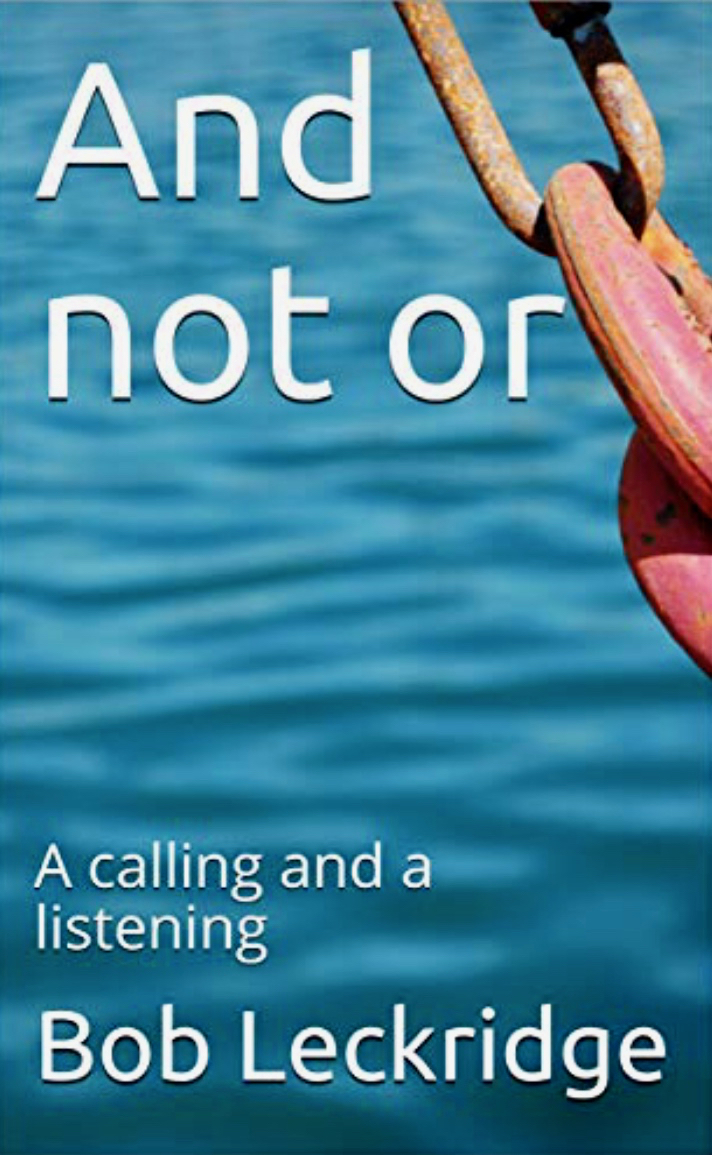
Some time ago I wrote a book called “And not or” – the idea of “and not or” came to me as a good way to approach life, and it’s since become something of a family feature. One of my grand-daughters, mentioning to a friend who queried it, said “What is “and not or” not a thing in your family?”
Essentially, I believe that “or” is divisive. It’s about “this OR that”. It divides the world into pieces, looking through binary lens. “And” on the other hand, builds bridges, forges connections. It is the link between apparently polar opposites. “And” reminds us that no particular experience or view is complete. We never know all that could be known. “Or” is more judgemental. “And” is more humble, more open to learning more.
Here’s the text of the opening chapter of my book, “And not Or” ………..
No man is an island entire of itself; every man
Is a piece of the continent, a part of the main;
If a clod be washed away by the sea, Europe
Is the less, as well as if a promontory were, as
Well as any manner of thy friends or of thine
Own were; any man’s death diminishes me,
Because I am involved in mankind.
And therefore never send to know for whom
The bell tolls: it tolls for thee.
John Donne
Ubuntu – « I am because we are »
None of us are entirely separate, neither from other people, nor from the rest of the natural world in which we live. On the other hand each of us is unique. It seems as if one of the most fundamental paradoxes in human life is a tension between belonging and uniqueness, between connections and separateness. Do we have to choose between these two options? Or is there some way to reconcile them? Many years ago I was wondering how to share my photos with other people. I looked at one option on the internet – a web service called Flickr, dedicated to storing and sharing photos. I also looked at the fairly new idea, at the time, of personal websites, or “blogs”, where I could post photos and write some descriptions of them. I could combine some creative writing with my photos by sharing some of the thoughts inspired by each image as I reflected on them. It didn’t stop there. There was also Facebook, and Twitter, and a kind of mini-blog site called Tumblr. How could I choose? Each of these options offered some features which the others didn’t, and each service seemed to have its own group of users. I knew that if I shared photos on Flickr, certain people would see them, but if I shared them on a blog, on Facebook, Twitter or Tumblr, then different people would see them. As I researched the different options and read reviews, I realised I wasn’t the only one finding it difficult to choose.
Then I came across a phrase taken from the language of logic and computer programming – « and not or » – and a light bulb went on in my head. I could share my photos on more than one of these services. I didn’t have to choose only one. In fact, I discovered that there were many ways to create connections between the different services. I could write a blog post, linking it to a photo hosted on Flickr, whilst automatically sharing it one or more of the other services just by clicking a button named « publish ».
None of us can be reduced to only one part of our character or nature. We are all multiple within ourselves. Have you ever done the thought experiment where you plan a party for everybody you know, and everybody you’ve ever known? You’d hire a large hall and invite absolutely every relative, friend, colleague, client, well, just anybody who has, or has ever had, a personal connection to you. Pretty quickly as you think about all the people who would be there, you realise that almost the only thing they would all have in common is their connection to you. Chances are you quickly realise this isn’t enough to create a cohesive group. The people you know from different contexts in your life may well not share that much in common with each other. The people you’ve known from different times in your life might not share much in common with each other either. Yes, of course, there will be common threads, common interests, values, shared histories, but their individual and even group differences will amount to more than their similarities. You can imagine that several of your guests won’t really click with each other. It turns out that whilst each of us has many different aspects to our character, which particular aspect comes to the fore is highly context sensitive. I could slip easily between my roles of husband, father, son, doctor, colleague, teacher or friend, just to name a few of the more prominent ones. I am not stuck in any single role. I should be able to behave appropriately according to the social context.
And not or.
This is how we live. We constantly change. We flow back and forwards between different aspects of our selves. We don’t choose one role and then attempt to live a whole life within it.
But wait, I hear you say, we have to make choices all the time, don’t we? There are many circumstances where have to make a decision, to commit to one direction rather than another. We can’t have our cake and eat it.
You are right. We often have to choose. In fact, we have created an entire economic system on having to choose. We have even turned choosing into one of our highest virtues. Freedom equals the freedom to choose. Choosing is based on the word « or ». You can choose this political party in the election, or that one. You can apply for this job, or different one. You can spend your money on this, or that. It is the basis of competition and a free market economy. Competition is the basis of both capitalism and our modern interpretation of Darwin’s principle of selection. Different options are set against each other. One wins, the other loses. This is just how things are.
When I say « and not or », I’m not advocating the famous « have your cake and eat it ». Nor am I advocating indecision or indifference. The way of « or » is inextricably bound to the way of « and », just as our need to be unique and separate is bound to our need to belong and to connect. Choosing « and » neither restricts us, nor does it stop us from making decisions.
I’ve come to believe that « or » has become too dominant in our culture and in our everyday lives. I’m anxious that it is separating us from each other, setting us in opposition to each other. We seem to be living through a time when polarities and mutually exclusive identities are proliferating, and on the back of that we are witnessing more strife, more anger, and more division. We hear the rhetoric of « us not them », which stokes prejudice, hatred and suspicion. We have created a civilisation of oppositional camps, each creating their own little worlds, each speaking only to like-minded others in shared echo chambers. We talk of « winners and losers » where the winners take all and the losers are advised to « suck it up » and « move on ». There are more walls going up, more doors being closed, less bridges being built, and less agreements made. Competition and winning are seen as strong and desirable, whilst co-operation and consensus are portrayed as weak.
I want to contribute towards a redressing of the balance. I know we have to make decisions. I know we often have to choose. But when we invest too much in « or » then things start to fall apart. « Or » divides, separates, alienates and creates dis-ease.
It’s my contention that we need more « and » because «and» connects, creates healthy bonds, encourages sharing, and a sense of belonging. We need «and» in order to heal.
« Or » stops thought. We choose, we separate, we finish. Why would I be interested in anything else when I’ve already made my choice?
« And », on the other hand, pushes us towards novelty and connections. It stokes our curiosity, demands our humility, sustains our open-ness to others and to change. It can teach us how to handle uncertainty and unpredictability. It can develop our capacities for awareness, reflection, flexibility and adaptation.
Every living organism survives and grows by making connections, by being open the flows of materials, energies and information in which we all exist. Every living organism survives and grows by responding to, and adapting to, the ever changing environments and contexts in which we all exist.
Maybe the best way for me to explore and share this idea is to tell something of the story of my life. Maybe the best thing I can do is to share some of my experiences and to reflect on how those experiences shaped me, and shaped my life.
This is my story. These are some of my stories. I’m writing this to help me make sense of my life. Maybe reading my story will help you make more sense of yours, too, and I’d be delighted if that were the case, but, ultimately, you will have your own stories to tell. We all do.
You can find a Kindle version of the book here – https://amzn.eu/d/akoOnrz (or search Amazon in your own country)
A paperback version, with colour photos, is available on Blurb – https://www.blurb.co.uk/b/10155078

 Heroes Not Zombies
Leave a comment