Feeds:
Posts
Comments

Archive for the ‘from the living room’ Category

forcalquier

What makes up our sense of a national identity? How about you? Do you have a national identity that means a lot to you? If not, what are the threads of identity which run through you?

And here’s another thing, can you get in touch with the feeling that people from other nations than your own are people you’d like to get to know and build links with? I hope so. I hope differences are exciting and interesting to you. I hope you enjoy feeling changed by your encounters with the Other.

Read Full Post »

Ah, yes, meditation might be thought of as a way of “stilling the mind”, or “calming the crazy mind”, but there’s something totally absorbing, focused and calming in the activity of photographing butterflies. You need patience. Lots of it. And you need to be able to let go of the need to control and predict. You have absolutely no way to know how long a particular butterfly will rest on a particular flower, if or when it will open its wings, and which direction it’s going to fly off in next.

Here’s some I spent a LONG time capturing!

butterfly

butterfly

butterfly

Try it for yourself sometime. It’s very therapeutic. Slows you right down…..

Read Full Post »

different seed

When I saw this seed on the very verge of breaking away from the seed-head the other day I thought it wasn’t only beautiful, it was both wondrous and moving.

Here’s that moment we’ve all experienced where we break away to launch out on our own path. Here’s that moment where we commit to Life, to adventure, to exploration and growth and becoming.

Here’s that moment where Chance takes a hand and who knows where we’ll land next……onto comfortable, nurturing ground, or hard, stony ground?

Here’s where we fly off to embrace opportunities and difference. To find the new. To connect with whatever it is we haven’t connected with until now.

Here’s where we embrace change.

Here’s becoming…..

Read Full Post »

peacock

peacock

I took these two photos 13 seconds apart, standing still. The peacock moved slightly forwards. And look at the difference!
Our world is constantly changing, and what beauty there is to be seen in noticing the changes!

Read Full Post »

We have this idea that time passes in a steady flow in front of our eyes, always at the same steady speed. We chop it into little pieces and call them seconds, minutes, hours…even days, weeks, months and years. But some philosophers show us how to think of time differently. Bergson’s concept of “duration” for example, which Deleuze picked up and developed further (using cinema as a tool to expand our thinking about time and movement).

So, here’s a couple of photos I took the other day ….

rocks and mountains

duration

In the first one, I noticed the stone circle (don’t know the history of it, but I suspect it’s a pretty modern creation actually…) and behind them in the distance, the mountain range. What’s the life of a mountain range? How quickly, or slowly, does it change? What’s the perspective of a mountain? That last thought, brought to mind Herman Hesse’s short story about a boy who wishes he was a mountain (in the Strange News from Another Star collection).
Then, in the second one, I focused on the tombstones instead…..how they too have their own duration, and how they mark the shortness of a life, and the length of a memory.

Read Full Post »

I took a wander around the castle rock in Stirling the other day, following a path called “The Back Walk”. I took my camera of course, and here’s something I saw which captured me.

the liberal man

Why did this capture me? Well, my father’s father was a shoemaker, as was his father before him, and back through the generations. In Stirling, where my ancestors lived and worked, as far back as the 16th century there were “seven incorporated trades” – hammermen, weavers, tailors, shoemakers, skinners, bakers, and fleshers. I’ve heard my dad talk about his father belonging to the “seven incorporated trades”.

This plaque raised many questions for me.

Here’s my first question……what were the incorporated trades? Well, I found this succinct description –

The power to grant incorporated status to trades rested with the magistrates of royal burghs. An incorporated trade was granted the right to monopolise and control their trade within the burgh. Trade incorporations were usually constituted by a seal of cause granted by the magistrates but some were constituted by use and consuetude. A strict monopoly was enforced within the burgh and non-members of an incorporation were not allowed to trade within the bounds of the town. The Incorporation set strict guidelines controlling the quality of workmanship and protected work for the craft within the burghs against outsiders. It prevented apprentices from being drawn away from their masters and controlled standards of craftsmanship amongst its members. An entry fee had to be paid to gain admission. The son of a burgess paid the lowest fee, the son-in-law of a burgess paid more and a stranger paid the highest fee. Trades incorporations were usually governed by a deacon with the aid of a boxmaster and a council of craftsmen who were elected annually. They held a court which could fine craftsmen for contravening the rules and held the ultimate penalty of expulsion. The trades often incorporated with others to form united trades who had a right to representation in the council of the burgh along with representatives from the merchant guild. The representation on the council by trades and merchants was abolished in 1833 by the Royal Burghs (Scotland) Act (3 & 4 Will. IV, c.76) which provided for an elected town council. The exclusive privileges of trade were in decline towards the latter half of the eighteenth century and were finally abolished in 1846 by the Abolition of Exclusive Privilege of Trading in Burghs in Scotland Act (9 & 10 Vict., c.17). Thereafter the functions of the Incorporation were purely charitable: many incorporations were already providing assistance and financial relief to their members

And here’s my second question…..that quotation about liberal men devising liberal things….I find that incredibly appealing, but when I searched for the source, I discovered it was from Isaiah 32:8 and only in the King James translation is it written as “liberal” (which I took to mean “generous“). In other translations it’s “noble” (which actually doesn’t seem so appealing to me!) Can anyone explain this difference? Because, to me, “liberal” and “noble” don’t mean the same thing at all.

I’ve got a third question. Do you know what “Tempori parendum” means? I do. It was sewn into the top pocket of our blazers at Stirling High School. It means “We must move with the times”.

This simple inscription touched me. Here it is, erected by the seven incorporated trades, of which my ancestors were members. It’s placed on the wall of the old High School, which my mother went to (the later one being the school I attended).  It commemorates the building of a hospital to care for the infirm and sick members of the trades, and here I am several generations later, a doctor who cares for the sick and the infirm.

Wow! I stood below this plaque for a while and felt a deep sense of awe at the threads and roots I could feel tugging at me, from the long distant past, connecting me, in so many different ways, through history, geography and blood.

Read Full Post »

As I walked through Ueno Park in Tokyo on sunday morning this shrine caught my eye –

shrine

I went for a closer look once this young woman had moved on.

firebird

Goodness, isn’t this just amazing? I looked more carefully at the flickering flame –

firebird

I had no idea what this was all about but I found it completely captivating. At the base of the shrine was marble onto which the shadows of the overhead leaves played looking for all the world like fleeting reflections of the kanji letters below the dove with the flame.

reflection

Yesterday I asked the students if they knew what this was, and they told me that it was to commemorate those who died in Hiroshima and Nagasaki, and that the flame was a continuous flame which stretched right back to the fires in those cities after the bomb fell.

Then this morning, outside my hotel room door, I find the Daily Yomiuri and look what’s on the front page –

daily yomiuri

Read Full Post »

We live with an illusion of certainty. The volcanic ash cloud over Europe this week is a clear example of real world unpredictability. Alan de Botton writes about this in his usual fluent way here.  He quotes Seneca in saying that we believe two things – that tomorrow will be like today, and that calamity can occur any day. We prefer to ignore the latter and proceed through life as if only the former is true.

We find ourselves divided between a plausible invitation to assume that tomorrow will be much like today, and the possibility that we will meet with an appalling event after which nothing will ever be the same again. It is because we have such powerful incentives to neglect the latter scenario that Seneca asked us to remember that our fate is forever in the hands of the Goddess of Fortune. This Goddess can scatter gifts, then with terrifying speed watch us choke to death on a fishbone or disappear along with our hotel in a tidal wave.

The financial crisis of 2007 onwards has dramatically revealed that the “masters of the universe”  are no such things at all. If you ever did believe what economists or politicians said, are you able to believe them now when they tell you they know for sure what will happen to the economy and how to manage it?
There have been many earthquakes and floods over the last couple of years – none of them predicted, and, probably, none of them avoidable. Yet we live as if earthquakes and floods only happen to other people. Does the Earth “behave” in predictable ways? Can you be certain?
The volcanic ash which has grounded planes throughout Europe for a week wasn’t predicted either. Will it happen again? When will the current problem stop? Day by day, almost hour by hour, thousands of people have had to live with complete uncertainty about  their travel plans.
This is the way the world is. These are “black swan” events as so well described by Nicholas Taleb.

My area of special interest is health care. How certain can we be in this area? Not very, is the true answer. Despite the fact that authorities claim to know for sure which treatments work and which don’t, in real life, they don’t. Nobody can say for sure whether or not a particular treatment will do what it’s intended to do for any individual patient. It’s amazing how often we forget that.

So what’s the opposite of certainty? Uncertainty? Well, yes, to some extent, but then it’s difficult to live with absolute uncertainty isn’t it? No, I think the opposite of certainty is reality. Certainty is an illusion. It only works for us as an illusion when we make our focus very narrow, and very limited. The more we generalise, and the longer the timescale we consider, the less we are able to be sure.

What are we to do? How to live with this? There are a lot of answers to that question. I’ll explore a number of them in future posts, but here’s a few to be going on with – living in the present, living mindfully, developing flexibility, adaptability and diversity, building connections and networks, building resilience and exploring what Taleb calls “the ecology of uncertainty”, resisting generalisations, and doubting those “experts” who claim to know for certain what’s best for you, in your life, based on their statistics.

Read Full Post »

I’ve long held that a way of thinking about health is to use the concept of flow. When the various different aspects of our selves and our lives integrate in a coherent way we experience flow – good energy, good vitality, strength, the feeling of being alive (there are many ways to describe it)

waterfall

I recently came across an interesting expansion of this idea when I read “Mindsight” by Dan Siegel (ISBN 978-0553804706).
He describes health as being like a flowing river and he says the river has two banks, either of which we tend to drift towards as we become unwell.
One bank is rigidity, and the other is chaos.

It’s true. We can see that in some illnesses we are stuck, caught in loops, trapped in ever decreasing circles which shrink our world. What should be flowing has become solidified, sluggish, frozen, or blocked.
In complexity terms, this kind of pattern exists around “point attractors”. You’ll be familiar with point attractors in the universe; they are the black holes which suck everything into them. Nothing escapes.
In other illnesses everything seems to fall to pieces, life itself falls apart and we find ourselves lost, or overwhelmed with confusion. We don’t know who we are, or where we are, and we don’t know how to find a way out.
In complexity terms, this kind of patterns exists as a “chaos attractor”, a zone of chaos where there are no clear patterns but which somehow maintains itself.

Which of the patterns are most familiar to you?

Rigidity?

icicles

or Chaos?

sea path

Healing involves a release from these states – from rigidity, or chaos, to flow.

Read Full Post »

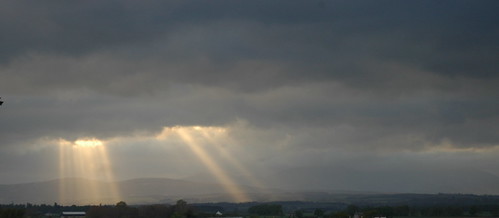
sun's rays

Attention is like the sun’s rays. Whatever we shine it on looks clearer and brighter. Whatever it lands on increases.

Attention is a kind of focus. It’s a way of allocating energy and resources. Whatever we pay attention to receives more of our energy, and as a result, it grows.

Have you ever stopped to wonder what it is you pay most attention to? A lot of people pay attention to the future. Their minds are full of what ifs and if onlys. They experience anxiety and fear of the unknown. If you’ve got a good imagination it’s easy to spend a lot of time thinking about what hasn’t happened yet (and what might never happen!). Other people pay a lot of attention to the past. Their minds are full of memories of the past…..the bad times, the hurts, the wounds…..or the good times (which are now gone). The interesting thing is that you only live in the present. The past is in memory, and the future is in imagination, the present is reality.

If you focus your attention on past bad times, they loom larger in your life. If you focus on future fears, they also loom larger in your life. If you focus on the present, you experience more of the here and now. And whatever you choose to pay attention to in the present is what you’ll experience most strongly.

Meditation practices are ways of training your attention, so that it doesn’t get pulled this way and that by habits or the demands of others.

Morning pages are another interesting way to explore where your attention is hanging out! (that’s a habit I need to re-establish!)

Becoming aware of what we’re focusing on gives us choices – the choices to decide whether or not to focus on that as much as we are doing, or to focus on something else instead.

Whatever it is we pay attention to increases, colours our whole life, becomes our whole world.

Read Full Post »

« Newer Posts - Older Posts »