Feeds:
Posts
Comments

Archive for the ‘from the living room’ Category

September’s issue of Philiosophie magazine has an interview with the Japanese author, Kenzaburô ôe who won the Nobel Prize for literature in 1994.

It’s a fascinating and striking article. He has been a controversial figure in Japan because of the subject matter of his novels, one of which challenges the official version of what happened in Okinawa at the end of the Second World War. Officially, 100,000 Okinawans committed suicide claiming loyalty to the Emperor rather than be over-run by the invading Americans. Kenzaburô says this is a lie. He says the Imperial Army massacred the Okinawans and they died called for their mothers, not swearing loyalty to the Emperor.

He has also shone a clear light on the reality of life for those who survived the blasts in Hiroshima and Nagasaki. Telling their stories shows how these particular bombs didn’t just kill and wound when they were dropped, but continue to damage those who survived right into the present day.

It’s no surprise then to read that since Fukushima he actively campaigns for the abandonment of nuclear power in Japan.

A big part of the story of his life is the birth of his son in 1963. Hikari was born with a severe brain defect and his parents had to decide to either let him die, or have an operation which would likely leave him severely mentally handicapped. They chose the latter. In addition to his severe handicap he has autism and he didn’t speak until he was six.

His first words were actually a sentence. The family was walking in the forest and at the sound of a particular bird call, Hikari said, in exactly the same way a radio presenter of a nature documentary would, “that is the call of the (such an such bird)” – and it was! After that his parents started buying bird song CDs and Hikari learned them all. They moved on to music, playing him Bach and Mozart, and were astonished to find, as he got older, that he could transcribe into musical notation perfectly any piece of music after hearing it just once. More than that, he went on to compose his own music.

Kenzaburô says his son has never expressed any emotion but his music is deeply emotional. His first CD sold 400,000 copies in Japan.

Here’s a video clip of one of his pieces.

Kenzaburô’s daily life is spent in his study reading and writing, while his son sits by him listening to, and writing, music.

A remarkable man.

Right at the end of the interview he says of creative work that it is important to find your own voice, or your own style – to be careful not to “get lost in the universal”.

I like that a lot. Too often we lose our singular uniqueness by trying to be accepted, or to fit in, or to be popular. Isn’t it more important to be the one unique person who only we can be?

Read Full Post »

I was out walking through the vines the other day and I noticed this.

I was immediately attracted to the colours, contrasts and patterns.

I find this image quite absorbing. Almost like a completed jigsaw puzzle or something! It draws my eye in and encourages me to explore the view.

But then I had another thought. I don’t expect vines are supposed to look like this! Maybe this is a sign of disease or disorder of some kind? But then look at the grapes! They are abundant and they look pretty good too. So if the plant isn’t well, it’s still creating and producing well.

I’m not knowledgeable about vine health so I’ll need to let those thoughts rest, and in doing so I’ll return to sheer beauty and compulsive fascination of the image.

Read Full Post »

I moved to France last November, so this has been my first summer in the Charente. Before moving here I lived for many years in a top floor apartment on the edge of Stirling in Scotland. We had fabulous views of the mountains and the volume and light in the flat, created in an 1830s textile mill, was fantastic.

Moving to France gave us the chance to live in a traditional Charentaise “long house” with a garden and a “potager” (a vegetable plot).

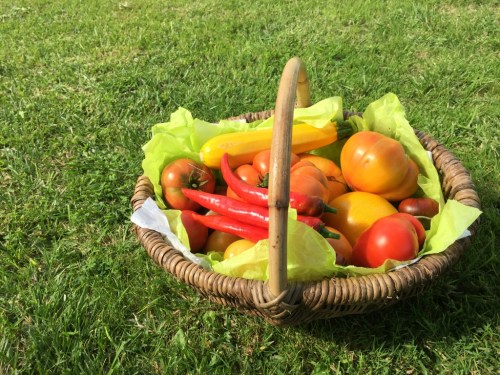
Here’s a photo of yesterday’s harvest. We don’t have a large potager, but look at this!

What a photo can’t convey however is taste. The taste of vegetables straight out of the garden is something else. The yellow courgettes are a relevation to me. I could really take or leave courgettes up till now. These fresh yellow ones are like something I’ve never tasted before.

We’ve tried a range of varieties of tomatoes this year and they sure would all fail the supermarket standards of shape and size but, wow, what the supermarkets are missing out on! Turns out flavour trumps size and shape by a long, long way. I didn’t know tomatoes could taste this good. I didn’t know tomatoes could taste this different!

Finally, look at the huge, red chilli peppers. For some reason, fresh chilli peppers are not easy to find in this part of the world, and we were advised that whilst they might grow outside here, they wouldn’t have much taste. The advice was correct in that they sure do grow outside here. Our chilli pepper pland has produced these beauties in abundance, and there are many, many more just waiting for a bit more sun to turn this glorious red. But the advice was definitely wrong about taste. They could blow your head off! Zinging with spice!

My general theory of a good diet has been pretty similar to Michael Pollan’s food rules – “eat food, mainly plants, not too much”. But one of the things he misses in those rules is flavour. And is there any better reason to eat something than that it delights your palate?

So, what I’d add in is, try to eat food which has traveled as short a distance as possible from where it grew to your plate. When you do that, you get the following –

  • food which is the freshest it can be
  • food which has had the least amount of processing
  • food which has the greatest variety of sizes and shapes
  • food which is most likely to be seasonal

I reckon that, depending where you live, you might not manage this “rule” – let’s call it “advice” – too often, but you know what they say – “every little helps”.

Oh, the other thing I think that Michael Pollan’s food rules miss out on is where you eat and who you eat it with. There’s more to food than “fuel” or measurements of constituents – so much vitamin whatever, such a percentage of protein, fat, carbohydrate, and so on – food’s to be enjoyed, savoured and shared, as well as digested!

Read Full Post »

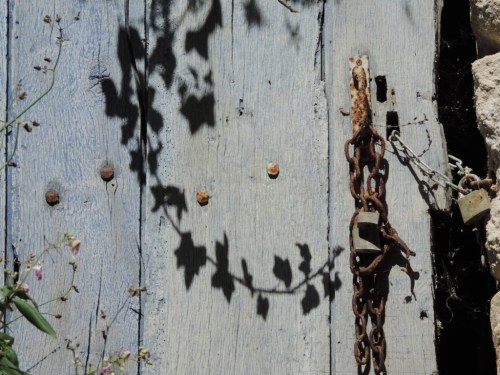
Two of the things which catch my eye when I’m walking in towns and villages are windows and doors. Here’s a very old door I noticed recently.

Look how the sun has faded the blue paint to such a delightful and delicate shade.

Look how the shadow of the plant arches down over the front of the door (but we can’t see the plant itself).

Look at the chains and the locks. The rustiest one has two locks on it and I can’t even see what it’s supposed to be securing any more and the other one looks wholly inadequate to prevent someone from forcing the door open.

But nobody has passed through this door in a long, long, time, have they? Which, somehow, makes it all the more interesting… what lies on the other side?

Read Full Post »

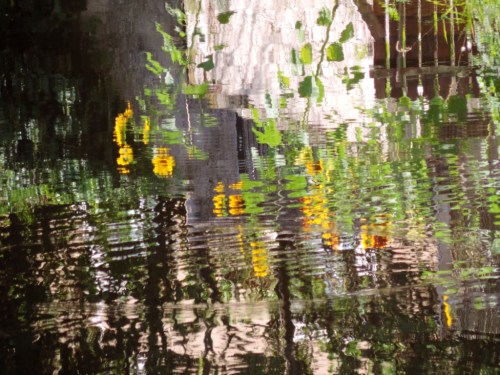
I enjoy taking photos of reflections. There’s something incredibly appealig about the world reflected in water.

This got me thinking though about how we reflect. After all when we are reflecting on something we don’t turn it upside down!

I think reflecting on something is more than just looking again. It’s more than remembering. It does involve looking at whatever it is from a new viewpoint.

That viewpoint either comes from time or distance or both. Or it comes from the way we develop new ways of seeing the world all the time, as we are affected by our every day events.

How often do you take time to reflect? And when you do reflect, are you aware of trying to see from different angles, different viewpoints, or through the new lens of the present?

Read Full Post »

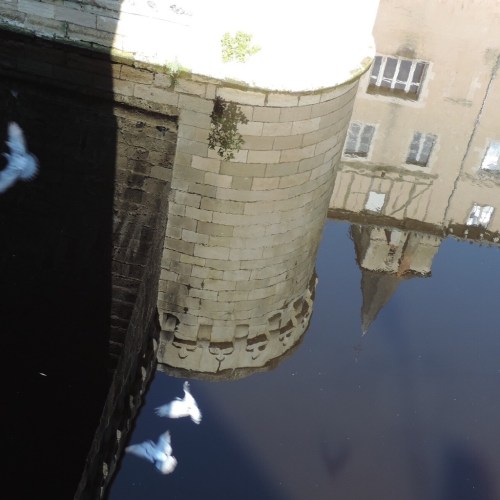
I took this shot leaning over a bridge just as some birds flew over the water.

I love the quite disorientating nature of this image. It takes a moment to figure out what you’re looking at. Which way is up? What is this?

When we drift through life on autopilot (in full zombie not hero mode!) then we stop noticing.

The unfamiliar, the unusual, the unexpected then has great powers to wake us up and see (in full hero not zombie mode!)

Why not set out to encounter something different today?

Read Full Post »

passageway Angles-sur-l'Anglin

There are a lot of medieval villages in France and this passageway in Angles-sur-l’Anglin is typical.

Here’s what appeals to me about this view. I love the archway first of all. There’s something very appealing about the arch of a bridge or a passageway. I love the tunnel-like nature of the passageway too. You know the phrase about “light at the end of the tunnel”? Well, there’s light at the end of that tunnel and draws you towards it. You feel like you want to go that way, to follow the light.

Then there are the plants. Both the flowers up close (down on the bottom left of the photo), and those in front of the houses we can see in the light.

There’s an extra appeal from the easel someone has placed at the entrance. It stimulates my thoughts about creativity and about art, and so tunes me in to the aesthetic qualities of the scene. And it’s facing the other way! So there’s a mystery there. What is on the easel? You have to use your imagination to get the answer.

I also like the cobbles. I know it’s not much fun walking or cycling over cobbles but there’s something very pleasing about them and that got me wondering about the Japanese “wabi sabi” aesthetic which doesn’t try to make something “perfect”….or at least only perfect in the way that Nature is perfect. There’s something of that in the appearance of most of the buildings in these old villages. There’s nothing shiny or sparkly or gleaming about them, and that gives them a greater quality of age and having been lived in.

Finally, I like the contrasts of the light and shade. The one needs the other and together they make something that feels very whole and appealing.

Read Full Post »

Sundial Saint-Savin

//embedr.flickr.com/assets/client-code.jsI don’t have an Apple watch. In fact, I don’t routinely wear a watch. Years ago, a Dutch friend of mine who I’d invited to Scotland to teach, told me on the train on the way to the venue that he’d taken his watch off several years ago, because he’d realised that the more often he checked his watch, the more anxious he felt. (We were on a delayed train and I was anxious we were going to be late, but he told me why worry, we’re not driving the train, and worrying won’t make it go any faster) However, these days with the smartphones, (I do have an iPhone), it’s never difficult to check the time. But if you are out and about I bet you’ll find some kind of timekeeper isn’t far away – whether it’s a digital clock outside a pharmacy, or a beautiful clock on some building.   Les Macarons de Montmorillon//embedr.flickr.com/assets/client-code.js

So, I’ve been wondering, what do you look at when you want to know the time?

And do you think that where you look influences how you feel about time? Do you like the precision of digital, the analogue of old clocks…..or sundials and calendars?!

Read Full Post »

circle of seeds//embedr.flickr.com/assets/client-code.js

There is something very beautiful about seeds, maybe especially the ones which disperse in the wind.

There’s something so delicate, light and insubstantial about them. Maybe that’s why children often think these are fairies when they float past in the wind.

Yet, they are bursting with potential. Full of promise and possibility, just waiting for a helping hand from a passing breeze to leap into the unknown, and hopefully find fertile ground somewhere.

This particular seed head seems even more delicate than most. And doesn’t that delicacy, that fragile impermanence make it all the more beautiful?

It does for me.

Read Full Post »

Creation

I saw this fresco on the ceiling in l’Abbaye de Saint-Savin. This is God creating night and day. What completely fascinates me is the plant – what is it? Do you know? Do tell me if you think you do.

If you look carefully it seems there is the faded remnant of another one just to the left. I’m assuming that the fact there are three heads to the flower is significant, but does this flower usually grow in such a manner?

Can anyone shed any light on this?

Read Full Post »

« Newer Posts - Older Posts »