Feeds:
Posts
Comments

Archive for the ‘health’ Category

I’ve long been impressed by Don Berwick, whose “Crossing the Quality Chasm” introduced me to the concept of the Complex Adaptive System. So I was keen to listen to his keynote presentation at the Institute of Healthcare Improvement at the end of 2013. I urge you to take the time to watch this….ok, it’s 48 minutes long, but it is one of his very best talks.

His main point is that whilst we have improved disease management significantly, if we really want to increase the quality of health care, then it is time to apply attention and energy to “health creation”, and that do so, requires that we ask ourselves just what health is and what examples are there of health creation which might begin to help us build health creation into health care.

I particularly like how Don Berwick refers to the work of Wayne Jonas, Dean Ornish, and the mindfulness movement initiated by Kabat-Zinn. But his reference to “blue zones” was new to me (those communities in the world where people live longer and in better health). What do all of these have in common?

IMG_0551


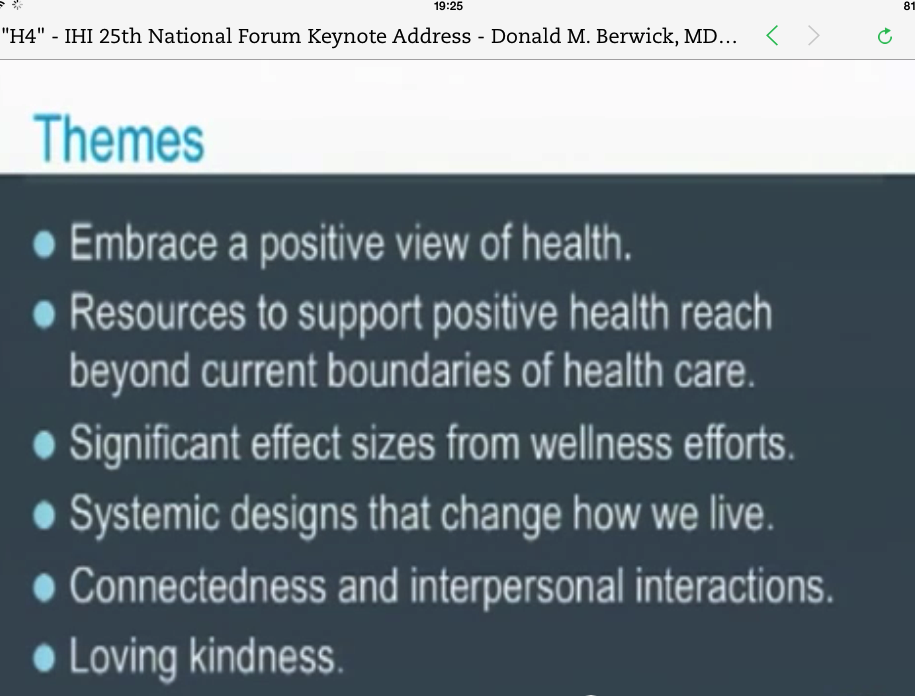
(this is the summary slide from Don Berwick’s keynote)

Health needs to be conceived of as a positive experience in itself – NOT the mere absence of disease. The ways to create health will probably be found outwith the current health care systems. A focus on wellness produces LARGE changes in health – in fact, much larger than the effect sizes of drugs on diseases. We need to use a systems approach to create health – not a focus on parts, but on the whole – body, mind and spirit.

The last two points are crucial –

  • Our connections in the world and our relationships are vitally important to good health.
  • The one key thing you can do to create better health is to practice loving kindness.


Read Full Post »

I’m a bit of sceptic about putting collated data ahead of individual experience when it comes to finding what is best for this patient today.

So, I was very taken by this sentence from a Japanese doctor’s journal. This is a surgeon who has been the only doctor on a small Japanese island since 1978.

Initially, the locals were wary of this strange young doctor coming to their island. How would he win their trust? Show them some graphs of randomised controlled trials and run night classes on calculating odds ratios?

Nope.

I would have no choice but to wait and to rely on the power of positive results to build a relationship of trust here

This is what you call believing reality…..when time and again the lived experience steadily builds your confidence.

Read Full Post »


So, here’s a study which makes you go…..duh!? Is anybody surprised?? The conclusion is this –

When physicians spend too much time looking at the computer screen in the exam room, nonverbal cues may get overlooked and affect doctors’ ability to pay attention and communicate with patients

Using video cameras to follow eye gaze the researchers found that physicians using electronic health records were likely to spend a third of their time in the consultation looking at the computer screen (I’m surprised it was only a third!) and, more surprisingly, that the patient too gazed at the screen, even if they couldn’t see, or read, the details on the screen.

When doctors spend that much time looking at the computer, it can be difficult for patients to get their attention,” said Enid Montague, first author of the study. “It’s likely that the ability to listen, problem-solve and think creatively is not optimal when physicians’ eyes are glued to the screen.”

Can’t disagree with that….it’d be surprising if a doctor could pick up the non-verbal clues when they are looking at a screen.

What do the researchers recommend?

Nope, not putting a bag over the screen the way people used to put a bag over bird cages to get noisy parrots to go to sleep. Instead they say their findings could contribute towards

more effective training guidelines and better-designed technology. Future systems, for example, could include more interactive screen sharing between physicians and patients

Pssst! Researchers! I’m over here! How about getting Humphrey Bogart to teach doctors? If the norm was “here’s looking at you, kid”…..well, what do you think??

Read Full Post »

paris park

Sometimes I think there are two kinds of people (that’s nonsense of course because there are as many “kinds” as there are people!). The two kinds I’d like to consider here are those who value stories, and those who value data.

I am still astonished when I remember the conversation I had with a young junior doctor who told me they were being taught “Don’t listen to the patient, they lie all the time. Only the results tell the truth” That is a data teacher talking, and, frankly, I think it’s scary to think such an attitude exists in doctors, especially doctors who are teaching young doctors. (by the way, do you remember a character called “Data“?)

What I love is the story. Every person I meet tells me a new story. It’s in the narrative that I can make sense of their suffering. It’s in the narrative that I can see the connections between the mind, the body and the spirit.

We all use narrative, not only to understand each other, but to make sense of our own lives.

When I first started to explore the use of narrative in medicine, I think the very first article I read was by Rita Charon. Here’s a passage from her book, Narrative Medicine.

What I am trying to convey is the kind of listening that will not only register facts and information but will, between the lines of listening, recognize what the teller is revealing about the self. Conventional medical care has not considered this kind of listening to be its responsibility. Except for some psychiatrists and psychoanalysts, health care professionals cannot give the time or get the training needed to listen for stories. Without knowing what is salient to an illness and what is not, many doctors and nurses fear that such listening will trap them for hours hearing information that is unrelated to disease. Listening to it, they think, will only distract them from the task at hand— to deal with the insomnia or to treat the abdominal pain. Unfortunately, sickness does not travel in straight lines, and we who care for sick people have to be equipped for circuitous journeys if we want to be of help. Although many health care professionals worry that they do not have the time to listen for stories, many of us who have incorporated listening into practice find that time invested early is recouped quickly. Indeed, the first few visits with a patient may take more time than in conventional practice, but time is saved shortly down the road by having developed a more robust clinical alliance from the start. The serious consequences of not being able to do this kind of narratively sophisticated listening is that patients’ symptoms get dismissed, their non-medical concerns get ignored, and treatable disease gets missed. More compellingly, only this kind of narrative listening will hear the connections among body, mind, and self, and disease recognition and treatment cannot proceed, we are beginning to believe, without simultaneous attention to all three.

I think that’s so right. The shame and weakness of the UK NHS is how it is constructed around routine encounters between doctors and patients which last less than ten minutes. What on earth can you understand about a patient in ten minutes? How do you make a diagnosis? No wonder doctors send patients off for X Rays, scans of this, scans of that, and blood tests so much nowadays. But what worries me most about our current model of care, is how prioritising data, results in just what Rita Charon says “patients’ symptoms get dismissed, their non-medical concerns get ignored, and treatable disease gets missed.”

Jennifer Percy, writing in The Atlantic, says

The language of science was unsatisfying to me. “The most incomprehensible thing about the universe is that it’s comprehensible,” Einstein said. But I don’t think human relationships are ever fully comprehensible. They can clarify for small, beautiful moments, but then they change. Unlike a scientific experiment with rigorous, controlled parameters, our lives are boundless and shifting. And there’s never an end to the story. We need more than science—we need storytelling to capture that kind of complexity, that kind of incomprehensibility.

It’s not just human relationships which are never fully comprehensible, it’s human beings. Can we really apply “rigorous, controlled parameters”, to lives which are “boundless and shifting”?

We do need storytelling to capture the complexity. And we do need to understand that these stories never end.

Read Full Post »
mitsudomo

So, I was told this week I was the most calm person someone had ever met, and asked how did I manage that?

This isn’t the first time. Not by a long way. So the truth is there is something about who I am which allows me to emit a sense of calm. When I was a young hospital doctor (25 years old) and in charge of a Cardiac Arrest Team, the other team members would commonly say that once I arrived on the scene, everyone felt their anxiety level dropped and everyone felt more calm. I never understood how that happened, because my heart would be banging away in my chest and I would feel that bucket loads of adrenaline were storming around my body. But somehow, what I emitted was calm.

However, what occurred to me in response to the question this time was, I’ve learned that calm and ease occur more naturally when we focus on the present. I sometimes say to people that suffering occurs in the gap between fantasy and reality, by which I mean, when we are wishing how things were, instead of experiencing how they are, then we suffer…..regrets, relived hurts, anxieties or fears. The way I practice, and have practiced now for many, many years (this is the year I turn 60), is to fully focus on the person who is consulting me right now. Whether it is for 90 minutes, 20 minutes, or, when I was a GP, only 10 minutes, that piece of time is always fully for this person who is with me. I will listen attentively, engage with them fully, and be completely present. My mind doesn’t wander off to the patient before, or the one about to come next. But whenever that person leaves the room, I let go. And the next patient walks in, and again, I’m fully present with this new person.

What struck me as I thought about that was “what a great meditation practice!” “what great mindfulness practice!” Repeatedly, gently, returning to the present. So maybe that is at least one of the reasons I still absolutely love daily clinical practice. If I’m ever feeling not so great, then a busy clinic gives me a lift. If I’m feeling a bit weary, then the clinic boosts my energy.

I owe a debt of gratitude to my patients over all these years. See what a lot of good they’ve done me!

(And I’m sure it’s a two way benefit. I’m told that all the time.)

Read Full Post »

The Resilience Alliance give this description of resilience, using forests as an example of a complex adaptive system which exhibit resilience.

Natural systems are inherently resilient but just as their capacity to cope with disturbance can be degraded, so can it be enhanced. The key to resilience in social-ecological systems is diversity. Biodiversity plays a crucial role by providing functional redundancy. For example, in a grassland ecosystem, several different species will commonly perform nitrogen fixation, but each species may respond differently to climatic events, thus ensuring that even though some species may be lost, the process of nitrogen fixation within the grassland ecosystem will continue. Similarly, when the management of a resource is shared by a diverse group of stakeholders (e.g., local resource users, research scientists, community members with traditional knowledge, government representatives, etc.), decision-making is better informed and more options exist for testing policies.Active adaptive management whereby management actions are designed as experiments encourages learning and novelty, thus increasing resilience in social-ecological systems.

The main point made here is the importance of diversity. They mention “socio-ecological” systems, but in fact organisations can also be considered as complex systems. This is one of the ways we are going wrong with the way we deliver health are these days. Due to the vast diversity of human beings, and the reality that large organisations behave as complex systems, we need diversity in our organisations and in our practices.

There just is no one size fits all when it comes to health care and a health service managed by protocols, rules and tight controls, will ultimately fail.

Read Full Post »

Take 20 minutes to watch this brilliant TED talk by Iain McGilchrist.


I agree with everything he says in this, but I was especially struck by his mention of the gene which codes for eyes. It’s the same gene which codes for a fly’s eye, a frog’s eye and a human eye. What makes the difference? The context of the other cells in the separate creatures. We are not just our genes, and our genes only express themselves in the contexts of the cells in which they exist.

I also really like what he says towards the end of the talk about protocols and the practice of medicine. How on earth can a protocol devised by a committee somewhere tell a doctor how to treat this particular, unique, individual patient today? It’s nonsense.

Read Full Post »

Rain lenses


Look carefully at these raindrops and see what you can see within them.

There are all kinds of theories about reality and how we experience it, but in this Age of Modernity, the object, what’s “outside”, what can be measured, what is “physical” has gained almost a monopoly over what is accepted as “real”.

What a patient’s tests or scans show are believed to represent what’s really wrong or right. What a patient reports, relates or describes of their experience – their symptoms, their personal narrative, is often dismissed by researchers as anecdote, or by clinicians as unimportant – “I’m happy to tell you your results are all normal” (“now go away and stop bothering me with your complaints!”). Somehow the lived experience of reality has become less relevant than the measurement of reality. The object trumps the subject.

Yet that objective, physical reality can only be experienced by, can only be measured by, the human subject.

So, in this dialectic, is there some way to grasp reality, to know what is REAL?

I’m not about to solve this one here, but one way of approaching this which appeals to me a lot, is to ask the question “what are these the two poles of?” “Inside and outside of what?” Or to put it another way……If the subject and the object are two sides of the coin, what’s the coin?

Is it the continuous process of becoming which we see everywhere in the universe? Is it the vital force, the Life force, the universal spirit from which all form emerges?

Can we take a perspective on reality which sees BOTH the inside and the outside as valid and important?

That’s why I don’t accept the proposed duality of mind and body, and any understanding of a patient is incomplete without exploring both.

Read Full Post »

Steven Charlap tells the story of the failure of his MDPrevent business which he had to close down last month. It’s an honest and thought provoking reflective piece. His idea was to have a medical practice which focused on health instead of disease, which advised patients and supported them in making lifestyle changes instead of prescribing for them. It didn’t work out. For a number of reasons……he didn’t get enough referrals from other health care providers, had many problems with health insurance companies, and, he says, the patients weren’t really up for it.

Based on our review of the credible research, our model mostly excluded dietary supplements and multivitamins because the science mostly did not support their use. When it came to pharmaceuticals, we didn’t rush to prescribe if there were a non-drug alternative. This approach was a turn-off to many patients who expected a prescription or emphatically clung to beliefs in supplements. And the no-cost, no-deductible, no co-payment provisions in Medicare’s preventive benefits may have had an adverse effect on people’s sense of its value. How much would you appreciate something that has no cost to you? For many patients, it seemed easier to take supplements than to be more attentive to food labels and exercise habits.

I have a lot of sympathy for this doctor. I think the present system of health care is not about health, and is not sustainable. I’m not so sure about the emphasis on prevention however…..let me explain – to prevent something has a negative tone for me, and I think health is a positive attribute. I prefer a focus on positively creating health, rather than negatively trying to prevent, or avoid disease.

His conclusion is particularly striking –

Patients loved my practice because I was willing to spend up to two full hours with them, most of it not reimbursed by insurance. The extra time often meant successfully making a diagnosis that had eluded other doctors for many years. It takes a very long time to get a thorough history and do a good exam and almost no time to prescribe a medication for a presumed illness. I chose the former. Insurance pays for the latter. Unfortunately, we still have a healthcare system that makes money by treating disease, rather than by preventing it.

and that last sentence is the real indictment in this story “we still have a healthcare system that makes money by treating disease, rather than by preventing it.”

What do you think? Do you think we need health care which helps people to create health? Would you like a service like that?

Read Full Post »

Mostly we react, but its better when we respond.

What’s the difference?

Reacting is automatic and rapid. Somebody presses one of our buttons and BUZZ out comes the response – anger, indignation, anxiety, hurt, sadness…..you name it. One of the problems with this reaction mode is that we get the feeling other people are constantly pulling all our strings.

It would be great if we felt more in the driving seat, wouldn’t it? To do that, we need to practice responding instead of reacting. What happens in response mode is that somebody presses one of our buttons, we notice it and think, ‘oh, there’s that button getting pressed again’, then in the short pause, we get to choose. What am I going to do about it?

It’s a bit like when the telephone rings. You don’t HAVE to answer it. You have a choice. The experience of exercising that choice, in fact, even the experience of having time to choose, is hugely empowering.

Here’s a simple little technique which lets you begin to change from reactive mode to responsive mode. It’s called “getting neutral” by the “Heartmath” people.

First deliberately move your attention to your heart area. Say, for example, you are speaking to someone on the phone, maybe someone who repeatedly winds you up. They hit one of your buttons but instead of automatically reacting, you say ‘hold on a moment’, put your hand over the receiver, turn your attention to your heart area, and now, take three deep, diaphragmatic breaths. One, two, three. Now return to the conversation.

This is called ‘getting neutral’ because its like when you are driving a car and the brakes fail. You can slip the gear into neutral, breaking the connection between the engine and the car’s wheels, stopping it from speeding out of control.

I’ve taught this method to people who experience panic attacks. Instead of spinning out of control, they turn their attention to their heart area, take three diaphragmatic breaths, and the panic stops.

It might not work every time, but one of the great things about it, apart from its simplicity and easiness, is that it gets more powerful and useful the more it is practised.


Read Full Post »

« Newer Posts - Older Posts »