Feeds:
Posts
Comments

Archive for the ‘life’ Category

mitsudomo

So, I was told this week I was the most calm person someone had ever met, and asked how did I manage that?

This isn’t the first time. Not by a long way. So the truth is there is something about who I am which allows me to emit a sense of calm. When I was a young hospital doctor (25 years old) and in charge of a Cardiac Arrest Team, the other team members would commonly say that once I arrived on the scene, everyone felt their anxiety level dropped and everyone felt more calm. I never understood how that happened, because my heart would be banging away in my chest and I would feel that bucket loads of adrenaline were storming around my body. But somehow, what I emitted was calm.

However, what occurred to me in response to the question this time was, I’ve learned that calm and ease occur more naturally when we focus on the present. I sometimes say to people that suffering occurs in the gap between fantasy and reality, by which I mean, when we are wishing how things were, instead of experiencing how they are, then we suffer…..regrets, relived hurts, anxieties or fears. The way I practice, and have practiced now for many, many years (this is the year I turn 60), is to fully focus on the person who is consulting me right now. Whether it is for 90 minutes, 20 minutes, or, when I was a GP, only 10 minutes, that piece of time is always fully for this person who is with me. I will listen attentively, engage with them fully, and be completely present. My mind doesn’t wander off to the patient before, or the one about to come next. But whenever that person leaves the room, I let go. And the next patient walks in, and again, I’m fully present with this new person.

What struck me as I thought about that was “what a great meditation practice!” “what great mindfulness practice!” Repeatedly, gently, returning to the present. So maybe that is at least one of the reasons I still absolutely love daily clinical practice. If I’m ever feeling not so great, then a busy clinic gives me a lift. If I’m feeling a bit weary, then the clinic boosts my energy.

I owe a debt of gratitude to my patients over all these years. See what a lot of good they’ve done me!

(And I’m sure it’s a two way benefit. I’m told that all the time.)

Read Full Post »

In the A to Z of Becoming, the third verb is C, for “choose”

path


Choose….hmmm, what will I write about choosing? I’ve got a few ideas rattling round my brain, so I’m going to share several of them, and then YOU can choose which inspire you most, or which you want to explore further for yourself.

The first thing I thought about was “choice theory” – the work of William Glasser. I like Glasser’s emphasis on how we create our own experience of reality through the choices we make. I like how he rejects the “external control theory” which suggests we are just puppets or automatons having our buttons pushed. I like his holistic approach to psychology, and, most of all I like his emphasis on verbs.

Secondly, I thought of how empowering it is to move your brain from default reactive mode, to response mode, and how a crucial step in developing that skill is to consciously, mindfully make choices. In reactive mode, we are pretty much on autopilot, blindly following the scripts of others, and it can feel like that. It can feel like we are the trapped victims of circumstances, of society, of others’ choices. Developing response mode, creates that little gap (see “getting neutral“) which allows us to become more conscious of what is happening, and, thereby, to take the opportunity to choose which response we want to make.

Thirdly, I thought of “Amor Fati”, the ancient teaching to “love your Fate”, which is actually advice to fully accept and enjoy the reality of the present, rather than suffering through wishing things weren’t the way they are (see the “suffering gap”)

Fourthly, I thought of choosing a path (like in the photo above which I took in a garden in Japan), and of how every path takes a different route, even if it leads to the same destination. I saw a TV programme during the holidays in December where a regular rambler walked from the West to the East of Scotland up in the far North. He came across countless old drovers paths (where the cattlemen would drive their cattle from the Highlands down to the markets in the South), and shepherd’s paths, and the paths the crofters would take to go from one croft to another, and the hiking routes, and…..well, you get the idea……the wild, open, sparsely populated areas of Scotland are criss-crossed by a myriad of paths, so when you want to walk from one coast to another, you have plenty of choices. Each of those choices will bring its own experiences and its own discoveries.

Fifthly, I thought of how sometimes I deliberately choose to walk down a different road, or to visit a different cafe, or to catch a different train, just to wake myself up and keep me aware that today is indeed a unique and amazing day.

Does any of this inspire you?

Which of these five explorations of choosing appeals to you most?

Which will you choose today?


Read Full Post »

Rain lenses


Look carefully at these raindrops and see what you can see within them.

There are all kinds of theories about reality and how we experience it, but in this Age of Modernity, the object, what’s “outside”, what can be measured, what is “physical” has gained almost a monopoly over what is accepted as “real”.

What a patient’s tests or scans show are believed to represent what’s really wrong or right. What a patient reports, relates or describes of their experience – their symptoms, their personal narrative, is often dismissed by researchers as anecdote, or by clinicians as unimportant – “I’m happy to tell you your results are all normal” (“now go away and stop bothering me with your complaints!”). Somehow the lived experience of reality has become less relevant than the measurement of reality. The object trumps the subject.

Yet that objective, physical reality can only be experienced by, can only be measured by, the human subject.

So, in this dialectic, is there some way to grasp reality, to know what is REAL?

I’m not about to solve this one here, but one way of approaching this which appeals to me a lot, is to ask the question “what are these the two poles of?” “Inside and outside of what?” Or to put it another way……If the subject and the object are two sides of the coin, what’s the coin?

Is it the continuous process of becoming which we see everywhere in the universe? Is it the vital force, the Life force, the universal spirit from which all form emerges?

Can we take a perspective on reality which sees BOTH the inside and the outside as valid and important?

That’s why I don’t accept the proposed duality of mind and body, and any understanding of a patient is incomplete without exploring both.

Read Full Post »

waterfall

Is time linear? Is it like this waterfall? Does the future rush towards us, the present pour past us in a constant stream, and the past disappear into the far distance carrying the our daily experiences off into the vast oceans of memory?

Or is it more like a tree?

zen garden

Does time accumulate, like the growing sapwood just under the bark, laying down this year’s experiences on top of last years, each and every ring layered over the previous ones?

The forest becoming

Does the present grow out of the past which doesn’t disappear, but which perpetually lies beneath us, our daily experiences emerging from, growing from, all that has occurred before?

Read Full Post »

Mostly we react, but its better when we respond.

What’s the difference?

Reacting is automatic and rapid. Somebody presses one of our buttons and BUZZ out comes the response – anger, indignation, anxiety, hurt, sadness…..you name it. One of the problems with this reaction mode is that we get the feeling other people are constantly pulling all our strings.

It would be great if we felt more in the driving seat, wouldn’t it? To do that, we need to practice responding instead of reacting. What happens in response mode is that somebody presses one of our buttons, we notice it and think, ‘oh, there’s that button getting pressed again’, then in the short pause, we get to choose. What am I going to do about it?

It’s a bit like when the telephone rings. You don’t HAVE to answer it. You have a choice. The experience of exercising that choice, in fact, even the experience of having time to choose, is hugely empowering.

Here’s a simple little technique which lets you begin to change from reactive mode to responsive mode. It’s called “getting neutral” by the “Heartmath” people.

First deliberately move your attention to your heart area. Say, for example, you are speaking to someone on the phone, maybe someone who repeatedly winds you up. They hit one of your buttons but instead of automatically reacting, you say ‘hold on a moment’, put your hand over the receiver, turn your attention to your heart area, and now, take three deep, diaphragmatic breaths. One, two, three. Now return to the conversation.

This is called ‘getting neutral’ because its like when you are driving a car and the brakes fail. You can slip the gear into neutral, breaking the connection between the engine and the car’s wheels, stopping it from speeding out of control.

I’ve taught this method to people who experience panic attacks. Instead of spinning out of control, they turn their attention to their heart area, take three diaphragmatic breaths, and the panic stops.

It might not work every time, but one of the great things about it, apart from its simplicity and easiness, is that it gets more powerful and useful the more it is practised.


Read Full Post »

In the A to Z of Becoming, the second verb is “breathe”.

You might think, ‘well that’s easy, I do that all the time!’ But I don’t mean automatic, unaware breathing. I mean the kind of breathing we choose to do.

Think of these two different kinds of breathing – primarily using the muscles of your chest, or primarily using your diaphragm. It’s this latter form of breathing which I’m going to focus on this week. Diaphragmatic breaths tend to slower, deeper and fuller than the more automatic chest muscle form. These deeper, fuller breaths change the balance of oxygen, and carbon dioxide in our lungs, and so affects the balance of chemicals in the blood. This has far ranging effects on your body, and your mind.

Here are two simple suggestions.

First, awareness of the breath. At any moment, in any place, turn your attention to your breathing. Without trying to change anything, see if you can just notice how you are breathing. How fast is your breathing? How regular? How deep?

Secondly, take three diaphragmatic breaths. Fill your lungs by breathing in as much as you can breathe in. Now breathe out, slowly, evenly, and as completely as you can. Once you have completed this out breath, breathe in again, again completely filling your lungs. Breathe out, slowly, evenly and completely a second time. And now do the same again a third time, once more filling your lungs to the top, and slowly, evenly breathing out to empty them.

Notice how you feel. How does your body feel? How does your mind feel?

Read Full Post »

I’m often asked what I and my colleagues actually do at the NHS Centre for Integrative Care.

Here’s a 20 minute video where I explain what Integrative Medicine is. This is based on a talk I’m giving to GPs next week so the intended audience is health care professionals but I thought anybody might find it interesting or thought provoking…..I hope it is!

In essence I think Integrative Medicine is a holistic approach to health making, and my understanding of health and illness is framed by the lens of complexity science, or, specifically, through the lens of the Complex Adaptive System.


Read Full Post »

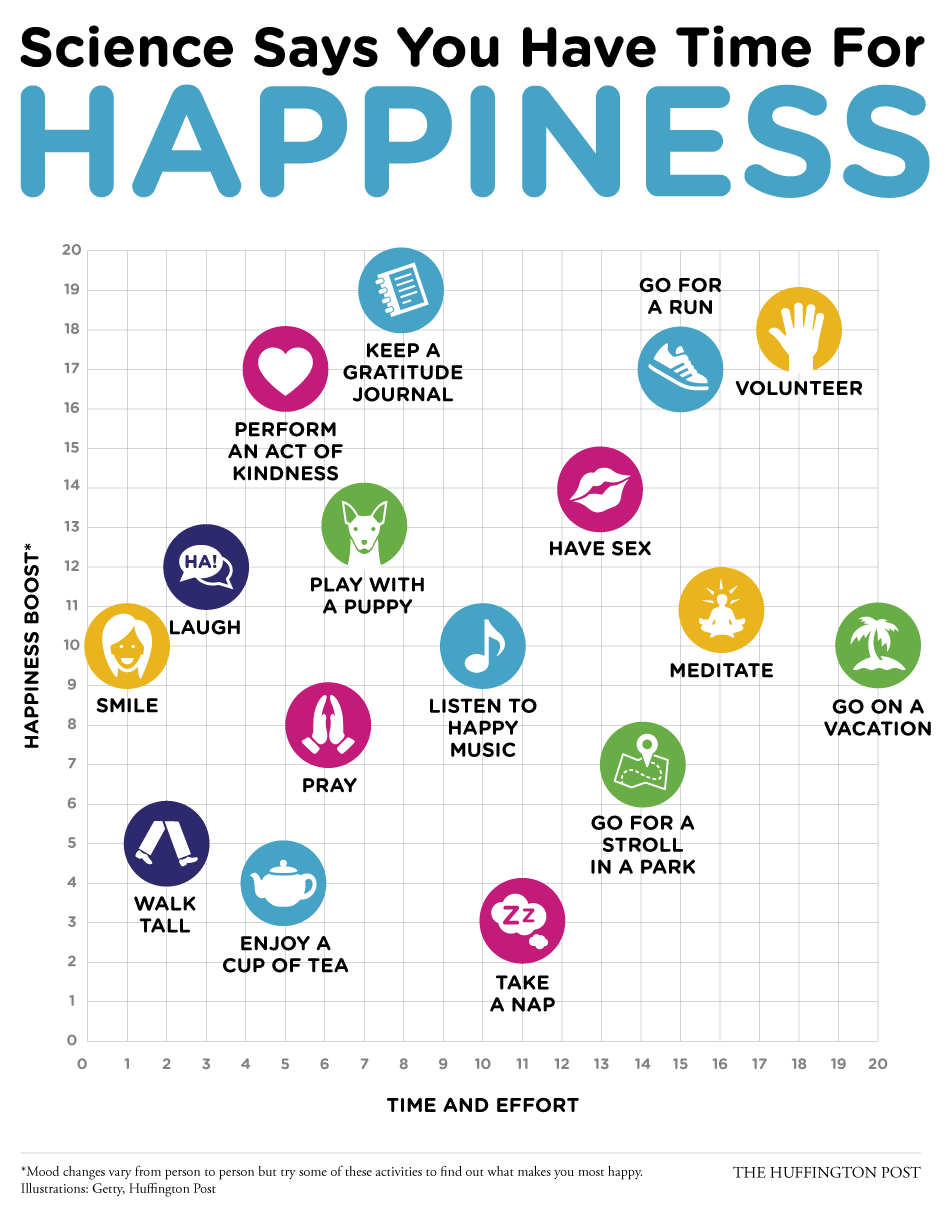
I’ve read a lot of books about happiness, but this little article on the Huffington Post really caught my attention with this simple and useful infographic. Click through on the link to the Huffington Post in that sentence to find the links to the studies backing the creation of this image.

2013_HappinessMatrix

Nice, huh?

Good to see how you can easily boost happiness simply by smiling (warning: the smiles have to be authentic – artificial smiles don’t work!) And I am really struck by the power of gratitude, and by performing acts of kindness.

So, how about just taking those three, and trying them out for the next few days. Start a gratitude journal and write in once a day, maybe preferably at night before bedtime……just list, and write a sentence or two about, whatever you experienced today that you feel grateful for, or write about who you are grateful to, and why. Set out each day to perform at least one act of kindness, or, even better, see if you can speak kindly and act kindly all day long. Finally, play some music which makes you smile, or look at some photos which make you smile, or delve into your memory banks for moments in your life which made you smile.

Read Full Post »

IMG_0656


Most days, most of us are focused on present needs and desires. We are good at knowing when we are hungry, thirsty or tired, and knowing what we’d like to do about that.

If we have children, our horizons are pushed out a bit – when we think about where to live, once we have children (or are considering having children), we think ahead to the next few years of their lives. What are the local schools like? What is there for them to do as they grow older? What kind of environment is this for children to grow up in?

That got me wondering about how many generations ahead we ever think.

Think about life from the perspective of a 25 year old this year, 2014. Let’s assume a reasonable life expectancy of 75 years. So when your horizon is yourself, at 25, you have about 50 years of living to consider, or till about 2064. Many of the decisions you take about how you are going to live now will affect how you will be living over the next 50 years. Now, what if you have children this year, when you are 25? If they have the same life expectancy as you, then they’ll live for the next 75 years, until 2089. You might well consider how the choices you make now may influence the kind of world which they will live in until 2089.

Take another step and think  about them also having children when they are 25 years old, (that would be in 2039) and life expectancy remaining at 75, then those grandchildren will live till 2114….a hundred years from now.

This is starting to get a little shocking, but let’s push it, a not unimaginable distance further and consider your grandchildren’s children. Sticking with the same pattern, your grandchildren’s children will be living in the world of 2139, and their children to the year 2164.

Yikes! Your grandchildren’s grandchildren will live in the world of 2164 (if you are 25 this year and having your first child).

That’s a hundred and fifty years from now.

Between 1850 and 2000 the world population increased from about 1 billion, to 7 billion people. The growth rate is not even – it’s exponential. In that same period we have consumed probably about 80% of the world’s non-renewable resources, and that consumption is increasing exponentially too.

WorldPop-7billion-102811

What kind of world will your grandchildren’s grandchildren be living in?

Does thinking about these increasingly distant family horizons influence any of the choices you might make this year?

Read Full Post »

Did you read “Stoner”, by John Williams last year? It’s been quite a phenomenon in the UK, having sold precious few copies in the author’s lifetime, then suddenly becoming a bestseller with rave reviews here this year.

I liked it. A lot. But let me just share with you a couple of wee passages which describe how the main character, Stoner, comes to think of love as he gets older. Firstly,

…he began to know it was neither a state of grace nor an illusion; he saw it as a human act of becoming, a condition that was invented and modified moment by moment and day by day, by the will and the intelligence and the heart

and, also

….that the person one loves at first is not the person one loves at last, and that love is not an end but a process through which one person attempts to know another.

Well, I’m sure if you’re a regular reader here, you’ll know why that first passage grabbed me – “a human act of becoming….” and I especially like the thought that love changes all the time, and that the will, the intelligence and the heart are all involved in creating that change.

Then, well, how wonderful….to describe love as a “process through which one person attempts to know another”. I do think that is so often forgotten….that love isn’t just a feeling or a state, but it is an ongoing act of trying to know another. Funnily enough, that makes me think of my verb of the week – attend, particularly, with regard to the latin origin of ‘attend’ being about a reaching or stretching out towards….

Read Full Post »

« Newer Posts - Older Posts »