Feeds:
Posts
Comments

Archive for the ‘life’ Category

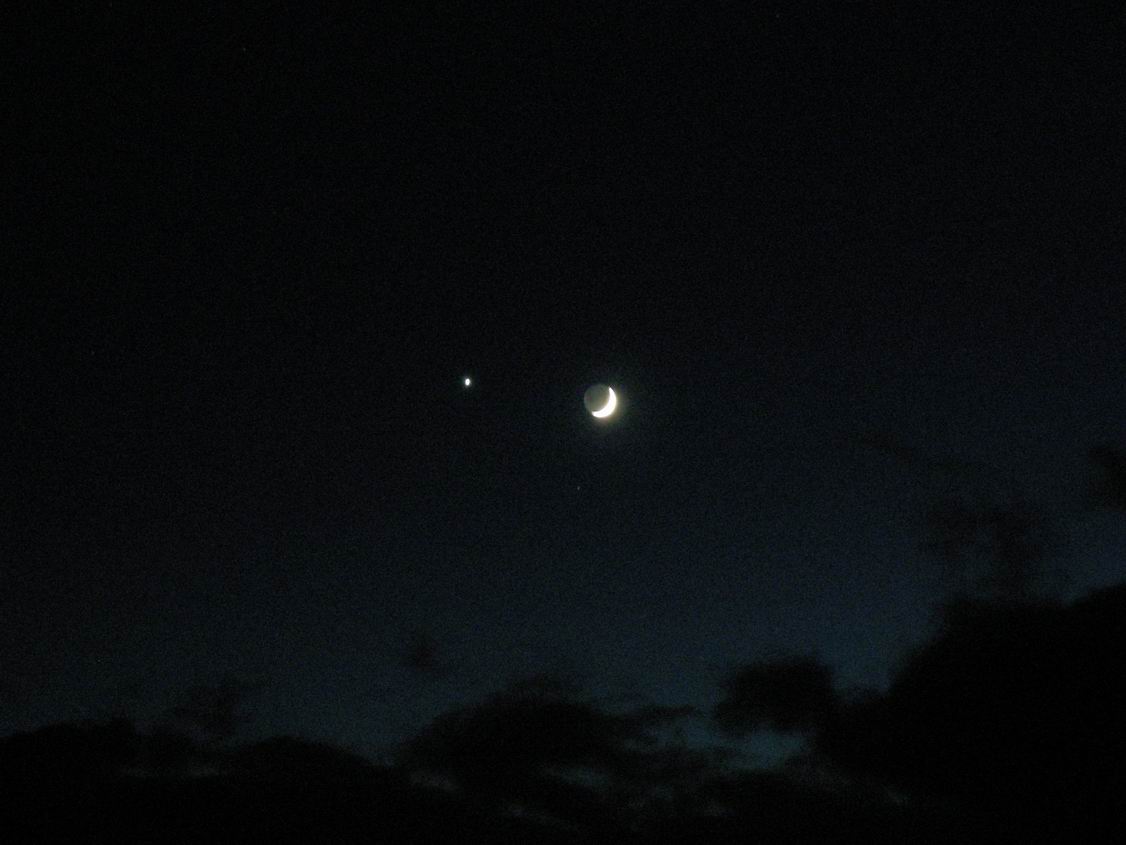
Saturday, 19th May was an usual night in the sky. Venus and the waxing moon were only about a degree apart just after sunset. I looked out of my window and took this photo.

moonvenus40.jpg

The following day I was browsing around Edinburgh and found myself outside the National Gallery on the Mound. On the spur of the moment I decide to have a look around. It’s a lovely building and I like many of the paintings there. Having browsed for a bit I went down to the gallery shop to see if they had any postcards of some of my favourite paintings there. Well, have a look and see what I found…….

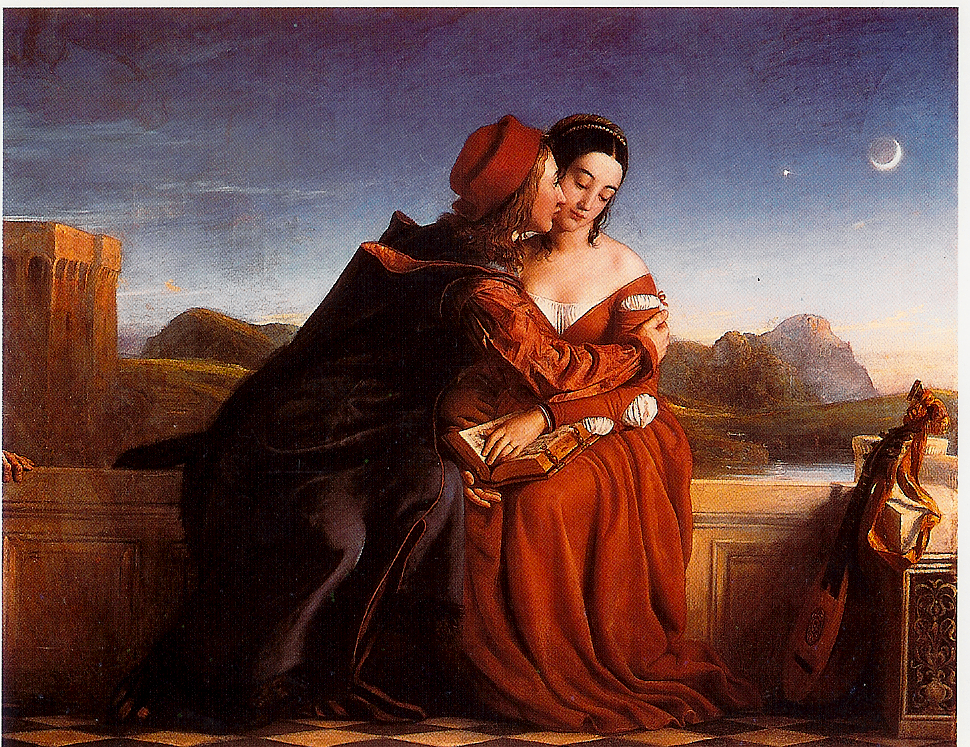
Francesca

This is “Francesca di Rimini” by Dyce. I don’t recall ever seeing this painting before but look at the sky! Yes! There it is! The exact same configuration of Venus and the Moon.

So what are the chances of that? I love these synchronicities in life. I can’t explain them but they do add to the pleasure and the wonder of life.

Read Full Post »

We all experience the world differently. Think of the last time you shared an experience with a friend or loved one then talked about if afterwards. Think of, say, a journey, or movie, or a meal in a restaurant. If you both talk to a third person about that shared experience, chances are you will both tell about different parts of the experience and will have felt differently about. One of you will probably have noticed very different aspects of the journey, or the movie or meal, than the other one. This is because we all interact with a shared world of places, people, and phenomena, but we do it from our own, unique, subjective viewpoint. No two of us share an identical experience because no two of us is the same.
What influences these different ways of experiencing a shared journey, or movie, or meal? I read a blog post recently which began with the statement “You are what you pay attention to”. A variation of this idea was a huge billboard I saw in Tokyo – “You are what you buy” – ok, so it’s a similar idea! The point is that what we notice and therefore what affects us most is fundamental to the creation of our individual world views.
I think there are three major foci of attention. Not three separate, distinct, world views, but three dynamically changing “attractors” which create our experience of the world.

  • Body-objective. The physical, the shared, external reality. The world of objects, things, facts. The measurable world. You have an experience of who you are within a particular body. The size of that body, for example, profoundly affects how you see the world and how you see yourself in the world. Think of the amount of concern many people have with body shape for example.
  • Mind-subjective. What you experience is always personal. Nobody can really know or share your subjective experience. If you have a pain, nobody else can feel that pain. You can try to communicate it, and others can try to empathise (to imagine what it might be like to be you), but they can’t actually experience it. Our subjective experience involves our minds. Without a mind, there is no subjectivity. Yes, there are many bodily sensations but they are all experienced with the mind. You feelings, your sensations, your emotions, your memories and your imagination are all subjective. None of this is measurable.
  • Spirit-meaning. We are meaning-seeking, meaning-creating creatures. We continuously try to make sense of our daily lives. For some people, this is the most important aspect of life. It’s a focus on purpose, values, ideas and the reasons to live.

None of these world views is complete and none of them are superior to the others. All are equally valid. If we try to squeeze others into our own personal world view, we’ll find they don’t quite fit and communication will fail. To communicate with, to connect with, to touch another, we have to understand what kind of world they live in and to what extent we can share that world.
My final point is that life is a dynamic process. We move around these foci or “attractors” with different ones exerting different degrees of pull all the time. We can see our lives as constantly moving, continuously evolving and growing as we shift and shade our world views, developing richer experiences as we become more flexible and less fixed in one particular view.

Read Full Post »

There’s an interview with David Lynch in this month’s AirFrance inflight magazine. In response the question “What kind of human being are you?” (I know, strange question!!), he replies

I’ve been practicing transcendental meditation for 33 years and it’s given me a profound love for the world and for life. It may sound slightly jarring, or seem a little out there to you, but I’m optimistic because I feel that humanity is growing more aware. I sense that a genuine dynamic for peace is emerging, and I’d like to convince people of the power that they have within themselves, of all the energy, the love, the fullness we have inside.

Well, David, what a delight to read that! That’s what this blog is all about. I hope some of these posts will contribute to that growing awareness that turns us from zombies into heroes.

He’s right you know, you DO have amazing powers of energy and love inside. Using them to grow, to connect and to create, is, I think, what life is about.

Read Full Post »

dsc_0039.jpg

Harry Eyres’ column in the Weekend FT this weekend was about colour vs black and white photography. He was making the point that he had always preferred to work with black and white, but when he printed some old colour slides of his father’s he found the colour made the photographs much more emotional. This is an interesting observation and I think it happened for him because the slides were about family, specifically about his last holiday with his grandfather. Our visual memories always seem to be in colour, don’t they? So colour photos, personal colour photos, can much more powerfully reconnect us to strong, emotional memories.

I think colour memories also begin to produce largely subconscious general responses to particular colours. I read this article while waiting for a connecting flight to Edinburgh in Charles de Gaulle airport this morning. The amazing thing for me is that the particular colour photos Harry Eyres was writing about were taken around Tain and Dornoch, exactly where I spent a few days with friends at the end of the previous week. My friends are South African and commented on how the colours of the north of Scotland were so reminiscent of the colours of Africa for them – until we came across the gorse in bloom. That incredible yellow is utterly Scotland for me, especially next to blues and browns. Later in the year when the heather comes into bloom it’ll be the shades of purple which will do exactly the same for me.

So that got me thinking (surprised?)……

  1. If memories are usually in colour, why do many people say they don’t usually dream in colour? (I always dream in colour!)
  2. Which colours create which emotions for you? (I know that psychologists have ascertained common colour influences but what about your personal responses?)
  3. Yet again, I am struck by synchronicity. What are the chances that first of all, Harry Eyres would have been to that particular part of Scotland and the photos from that very holiday were the ones which stimulated him to write this particular piece? And secondly, what are the chances I would read it? (I don’t buy the FT, just happened to be one in the airport lounge). And, thirdly, what are the chances that I would have just taken photos in that very same part of the world mentioned in the article?

Read Full Post »

footprint, originally uploaded by bobsee.

I took this photo last week up in the North of Scotland. I don’t know whose footprint it is but it reminded me why I started blogging. I think it’s important to remember that we don’t go through life without leaving footprints, without making impressions. But we don’t think about that as we live the average day. It’s not possible to live without making impacts on the world and on the other people who share it with us.

This is not a “carbon footprint” but it does make me think about that whole issue – how we change the world by just living in it.

You know, I think life is better when we raise our awareness of living, and that means noticing BOTH the way we are affected by the world AND the way the world is affected by us.
What kinds of footprints did you leave today? On the physical world? And on other people? Remember Yeats’ poem?

Tread softly because you tread on my dreams.

Read Full Post »

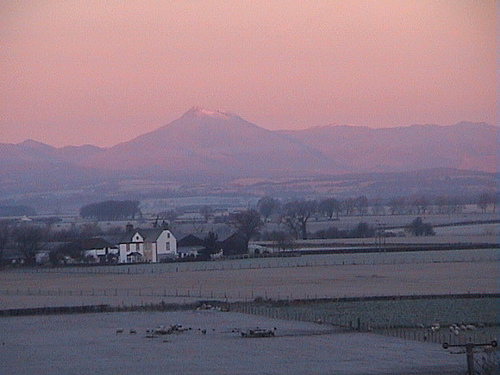
Ben Ledi

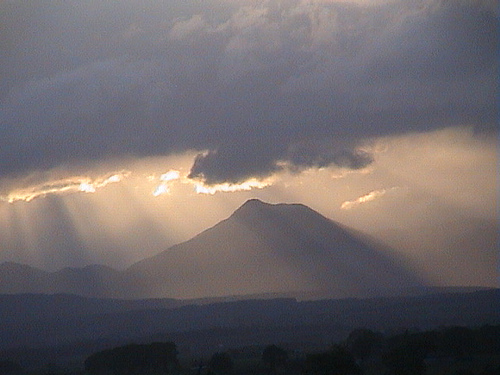
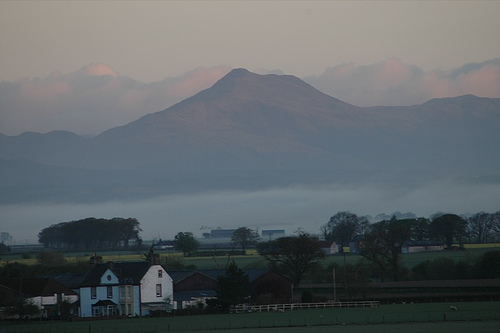
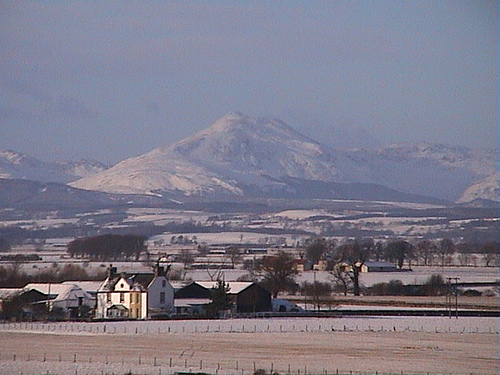
From the window of my apartment I can see across to the hills. One hill in particular stands above the others – Ben Ledi. I got to thinking the other day about how things change, how everything constantly changes, but how if something changes slowly we think its staying the same. You know what I mean. A plant changes quickly, growing from a seed to a seedling and blossoming under the sun’s rays to show its petals to the world, then developing its fruit or its seeds and withering away again, in endlessly repeating cycles. But mountains, now, they change so slowly they look the same for hundreds or even thousands of years. Don’t they? But then, as I gazed out of my window across the fields at the light and the shadow on the hillside, I thought to myself, actually, Ben Ledi looks different every day. OK, the rocks probably don’t change very much, but Ben Ledi is more than its rocks. The Ben Ledi I see from my window is not just the rocks, the slope, the shape of the peak. It’s foliage, the colours, the light and shadow. When I look at Ben Ledi I see something different every day. Here are four (of many!) photos of Ben Ledi all taken from my window.

Ben Ledi just after a storm.

benledistorm.jpg

Ben Ledi with morning mist.

benledimist.jpg

Ben Ledi covered in snow.

benlediwinter.jpg

Ben Ledi in a winter setting sun.

benledipinksnow.jpg

If you like these Ben Ledi photos you can find more on my Flickr page here.

Read Full Post »

There are a number of qualities in complex systems. Let’s have a look at a couple of them and see how they can help us to understand why sometimes we get stuck and why on other occasions we when we get through a certain difficult experience we feel that not only life, but we ourselves, have changed irrevocably.

Attractors

One quality is that of an “attractor”. The one attractor you’ll know something about is the kind that makes “Black Holes” – those whirlpools in space that suck everything, even light, deep into their swirling vortices. There are three kinds of attractor.

  1. Point attractors – these pull everything towards a single point.
  2. Loop attractors – these have two centres close together and anything which comes close gets swept back and forward between the two centres, flip-flopping between two alternating states.
  3. Chaos attractors – a focus of chaos, with everthing that comes near being pulled into a chaotic system.

What can these phenomena teach us about life? Well, a point attractor is the kind of thing that traps us. It might be a wound, a hurt, a bad experience. Or it might be a habit or stuck way of thinking. These are the well-worn paths that always, inevitably, end up at the same destination, producing the same outcome. It’s hard to move on, to grow or to develop when you keep going back or holding on to the same old thing. Point attractors are about stuckness. They produce routines that become ruts.

Loop attractors are those alternating states we often experience – a cycling back and forward between emotional highs and lows, between frantic activity and depression, between fear and anger. There is more variety in a loop than in a point, but they both entrap.

Chaos attractors are the most confusing of all. They hardly seem recognisable. They have no pattern, no rhythm and no predicability. Their only inevitably is chaos. These are the states we often find ourselves in when we are overwhelmed by something – bad news, loss, terror, grief. Like the points and the loops, the chaos attractors trap. At least points and loops have the comfort of the familiar, and, to some extent, the predictable. Chaos states are very hard to experience and can’t be sustained for long.

How can we break free of the pull of an attractor?

  1. Imagination. Developing your powers of imagination generates the potential for change and for movement. Without imagination it can be hard to believe that there is any possibility of breaking free from the entrapment of an attractor.
  2. Will. Determination and motivation. It’s one thing to imagine how life could be different but it takes a strong desire and determination to change to break free of the attractor.
  3. Relationships. Sometimes it takes an external influence to make the difference. This is where other people can make such a difference. It can be the attention, the love and the care of another which helps us to break free from our stuckness, our habits and ruts.
  4. Changes in circumstances. We all exist in constant interaction with our environments. As the environments change so do we. Changes in circumstances like new relationships, the ending of relationships (whether through break-up or death), loss of employment, new employment, moving house, and so on, can all exert huge power to knock us out of the old patterns and stuck places. This is why sometimes painful events can result in significant gains.

Bifurcators

Bifurcators are like crossroads. They are points where things change. With a bifurcator you usually have two possibilities – growing or shrinking. At a bifurcator the system changes and either develops, changes and grows stronger or more resilient, or it declines, shrinking or disintegrating, becoming weaker. The key thing about a bifurcator is that life is not going to be the same again. A good example is pregnancy. Once pregnant, a woman’s life will never be the same. She can never again have never been pregnant. Either the baby will grow and thrive and the woman will become a mother (and how different does THAT make a life!) or the pregnancy will not progress and the woman will experience an abortion, a miscarriage or a stillbirth. In none of these circumstances will she ever be the same again. Often there are no choices possible. Life develops one way, or it develops another. However, in many situations a bifurcator is all about making a choice. The challenges which come our way for example can be accepted or rejected. Accepting a challenge brings the potential for growth. Rejecting a challenge can leave you stuck in the arms of an attractor!

So, here is a key difference between a hero and a zombie – heroes break free of attractors, grasp the bifurcation points and grow; zombies stay stuck at the same points, in the same loops, engulfed in the same chaos, avoiding bifurcators and preventing growth.

Read Full Post »

The story so far……
I woke up on the morning of January 1st this year and this word popped into my head “storymapping”. I thought “what’s that?” The word came from a lot of thinking I’ve done about how we experience the world.
My basic premise is this……
We live in a real physical world – an objective shared three dimensional space – but we can only experience it subjectively. There’s no way for me to know how any other person experiences, say, the colour red, or the smell of coffee. But before I even get into thinking about relationships and how we communicate with others and understand each other, let me stay with the single person experiencing the world.
Let me start by saying that the phenomena of the real physical world impact on my sensory equipment. I can’t directly experience the phenomena of light or sound, but light waves or sound waves can impact on my eyes or ears and they translate these signals into electrical phenomena sent to my brain where they are somehow turned into what I “perceive” as red, or yellow, or hissing, or screaming, or whatever. I use my brain to make sense of this information, to interpret it so that I can react or not react to it. This is how I interact with the world. It’s how I find food, drink, shelter, how I connect to other people, cope with the weather…..everything.

Tools of perception and understanding
To make sense of the signals and stimuli I use a couple of really clever tools – maps and stories.
I make maps in my mind of the objective physical world. Maps contain information organised spatially and temporarily. Maps represent the shared space of physical reality. Maps, as the NLP practitioners say, are not the territory. They say that because we tend to get confused and think that the way we perceive things IS the way things are but it is isn’t, it’s only how we perceive things to be and that perception is not static. It is malleable. We can work with it, alter it, become actively involved in creating it. We can change the way we see things, change our focus, change what we give prominence to, change the feelings we have in association with certain perceptions. So maps are a useful way for making sense of the world and for acting in the world.
If I want to eat I need a map of locations for food and I need to orientate myself on that map to see where I am and figure out how to go get food. We use all kinds of maps all the time. In fact, we perceive everything through these maps. It’s almost as if they are filters between the external reality and internal subjective experience. This is all pretty much an unconscious process. We don’t need to think about our maps or make any big deal about it, but we CAN make them more conscious.
Maps help us to organise the mass of information that bombards us continuously – sights, sounds, smells and so on – and they do this by helping us to selectively notice some elements more than others.
The maps we use are created by ourselves but often on the templates, or bases of given maps. If we live life fairly unconsciously, by that I mean without a high level of awareness (a zombie way), then we are probably negotiating the world on through a largely given set of maps. We do still make every map our own however by factoring in our past experiences, preferences, qualities and so on.
This is an interesting question. It means that there is a creative component to every map we use, but we live on some kind of spectrum of passive/active or receptive/creative (zombie/hero) kinds. If we increase our awareness then we have an opportunity to increase the extent to which we can actively create the maps we use to perceive the world. In other words, we can change the way we perceive the world instead of just accepting how its been either given to us by others or how we’ve created a view of the world for ourselves from past experiences.

The second amazing tool we use is storytelling.
Stories are our way of making sense of our experience. We tell ourselves and others stories that help us to know what something means, to help us explain to ourselves and to others what we are experiencing. In fact, we even use stories to create a sense of self – this is who I am, this is how I came to be here, this is where I am going. Stories are the way I convey my subjective inner reality to another, or try to understand the subjective inner reality of another. They are also the way I work to achieve a better understanding of shared space, of external physical reality. I do this by seeing how my understanding fits with another’s understanding.

So what if we consciously combine map-making/map-reading with storytelling and create “storymapping”? Starting with our physical reality, the space and time in which we live, collecting information from our experiences as we move through that space, and marking this information on maps in a way that we note what that information means to us, how we make sense of it, in other words, by telling the stories of our experience and tagging them onto the map of the physical space we have travelled through over that period of time.

Well, I thought, I’ll try this out with my daily morning walk to the train station on my way to work. I actually did it by printing out a map of Stirling from google but since then I’ve discovered that google maps now lets you easily tag a map and add text – just the tools I needed! Here’s my example.

I think we could make all sorts of storymaps. Here are some I’m thinking of exploring so far –

The idea is that different maps can help us to understand different aspects of ourselves. We use multiple maps in our minds all the time. We can make these physical maps as an exercise in self-awareness, self-understanding so we can give ourselves an opportunity to more actively shape our lives the way we want to.
Here are some of the possible maps I’ve come up with so far.

Map of relationships
You need to choose the scales of maps for this exercise and to focus on a particular period. The period could be the present time, or you could chart it in real time by recording relationships over a defined period – day, week, month.
I suggest using different colours of pencil for each type of relationship – relatives, work colleagues, friends/social contacts, (for me also – patients and students)
What I mean by type of relationship is what’s the main nature of the current interactions you have with this person? Sometimes a person may be on your map largely as a work colleague, other times they might be largely there as a friend.
Who to put on the map? It’s always up to you but I suggest just the people you feel you are actively interacting with – in other words, not all your cousins and aunts and uncles but only the relatives who are “active” in your experience over the period under consideration.
Geotag them – by this I mean place a tag or flag or spot or something representing them on the map where they are when you interact with them. Each geotag needs a number which we’ll use later.
There are a number of other complexities you can add to this map – size of tag relating to importance to you of this person, or size of tag relating to the amount of time you are spending in interaction with this person…..whatever you think might be useful
The reference numbers of each geotag will be expanded with text around the map which is where you’ll write the stories which describe these interactions or what they mean to you or how they affected you.

Food map
Three colours – blue for where you buy the food, yellow for where it is prepared, red for where it is consumed.
Start with the red – where you eat – add the yellow if you eat where the food was prepared and add the blue if this is also where the food was purchased – so all three colours together represent eating out somewhere. If you’re not eating out draw lines from the red spot to where the food was prepared and also where it was bought (where the yellow and blue spots will be) – over a period of time this will show you your pattern of food gathering and consumption. Each red spot should be geotagged and referenced to a short story describing the situation of the meal and what it meant to you

Sensory map
Record for a period of time (say a day) the sensations you notice. This will obviously not be ALL the possible sensations, just record the ones that strike you, the ones you feel are “notable”. Sensations are visual, auditory, olfactory, gustatory or kinesthetic. Note these as they occur to you using one of the following capture methods –
the video function of your cameraphone – making audio notes as you describe the sensation
the video function of a digital camera
write them on 3×5 index cards
write them into a pocket diary
Once you get to the end of the period of the exercise place the sensations on the relevant map geotagging them with index numbers to the storied descriptions/explanations.

Feelings map
As with the Sensory map but focussing instead on the feelings you notice

Attention map
As with the Sensory map but focussing instead on whatever catches your attention.

Activity map
As with the Sensory map but noting what you are doing over the period

What do you think? Any of these ideas appeal to you? If you do make any geostorymaps, please put the links into the comments to this post.

Read Full Post »
Petrol on water, originally uploaded by bobsee.

A more conscious life is a more aware life. A great way to become more aware is to carry a digital camera – a small one – everywhere! It’s amazing what you’ll see when you know you have a camera with you. Look at the amazing colours and patterns of the oil on the water in this post hole in the road round the corner from the hotel where I stayed in Aix-en-Provence. The hotel was called “Aquabella” – beautiful water?

Read Full Post »

« Newer Posts