We’re all different. We cry for different reasons and in different circumstances. Sometimes it’s good to cry. A Scottish word for crying is “greeting” and there’s an old saying that “a good greet” will make you feel better. There are a lot of things that make me cry. I cry at movies, at songs, at the painful stories I’m told. I cry when I’m sad and I cry when I’m happy. I cry when I’m overwhelmed. It can feel good. Here’s a fanvid I found on youtube that made me cry. I find it very moving. Maybe if you’re not a Lord of the Rings fan like me, or you don’t like this kind of music, it won’t work for you, but maybe it will. Whether it does or not, what works for you? What do you watch or listen to or do to have “a good greet”?
Archive for the ‘life’ Category
What makes you cry?
Posted in from the music room, from the viewing room, life, music, video on June 27, 2007| 3 Comments »
The Witch of Portobello
Posted in books, from the reading room, life on June 25, 2007| 4 Comments »
The Witch of Portobello by Paulo Coelho. ISBN 978-0-00-725184-1
If you enjoy the work of Paulo Coelho, and I am someone who does, then you will enjoy his latest book. He has created a very distinct style for himself. As a reader you know what to expect and you’re not disappointed. Mind you, having worked as a General Practitioner in Portobello, Edinburgh until I took up my current post, I was disappointed that the book wasn’t set there! There’s plenty to enjoy and lots to think about in this novel. Let me focus on the idea of the witch because that is fundamental to the whole work. On page 13 he describes four archetypes of women –
- Virgin
- Martyr
- Saint
- Witch
What really got me thinking here was his description of the path to enlightenment characteristic of each of these archetypes –
- Virgin – Independence
- Martyr – Suffering
- Saint – Unconditional Love
- Witch – Pleasure
Do you recognise these archetypes? I don’t think they are exclusive to women. As with all archetypes of the psyche I think each of us resonate with them to greater and lesser extents. It’s unusual to find someone who can be fully described by a single archetype. So which of these do you resonate with? And how can you play to your strengths then?
Like all Paulo Coelho’s books, this is a story of self-discovery and how to find your own way in life.
Mind the gap
Posted in life, perception on June 25, 2007| Leave a Comment »
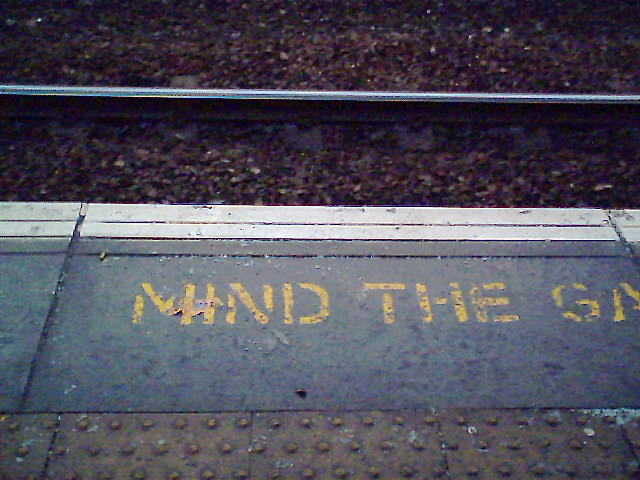
It is in the spaces in between that things happen
.……..The Conqueror. Jan Kjaerstad
In a study of how we hear silences in music, Elizabeth Margulis has shown that not all silences are heard the same. In fact she has shown that both the music which precedes the gap and the music expected to follow the gap influence how long the listener experiences the gap to be and alters the quality of what they perceive.
A photo, a quotation from a novel, a scientific study…………they bring to my mind the Tibetan concept of a “bardo” as described in the Book of Living and Dying. I read it years ago but the idea of becoming aware of the gaps (bardos) has stayed with me. Spaces interest me. Shadows, the patches of light within and around shadows, the brief moments between breathing in and breathing out, between one thought and another. So here’s your challenge for today. Notice some spaces. What are they like? See how they are all different? How does life change when you start to notice the spaces in between?
What would you like to win?
Posted in books, from the reading room, health, life, philosophy on June 14, 2007| 3 Comments »
Here’s a quote from The Conqueror by Jan Kjaerstad
Supposing one were a conqueror – what would one win? The world? A little peace of mind? A name? Immortality? Oneself? Power? Women? There were times in Jonas Wergeland’s life when he felt there was only one thing worth striving for: health. To be fit and well.
What do you think? Do you agree with Jonas? What do YOU think is worth striving for?
Cloudspotting
Posted in from the dark room, life, photography on June 11, 2007| 2 Comments »

anvil cloud, originally uploaded by bobsee.
I just looked out of my window and couldn’t resist snapping this.
What a wonderful anvil shape. You know there is a whole organisation and a book dedicated to noticing clouds. You can see why!
Sometimes the best place for my head is in the clouds…..
3 ways to think
Posted in education, from the living room, life, perception, philosophy on May 27, 2007| 13 Comments »
According to the French philosopher, Gilles Deleuze, wrote that there are three ways to think. I know, you’re already wondering how you can think three ways with one brain! Well, you probably use the three ways all the time. In fact, Deleuze claimed it was important to know about the three ways so you could both see things more clearly and communicate more effectively. You’ve probably come across arguments where one person is saying “But what are the facts? Just give me the facts!” while another says “But what is your heart telling you here?” and a third wants to know “But what does this all mean?”. These three questions arise from three different ways of thinking and whilst they are all trying to get at THE TRUTH, they are all actually dealing with entirely different aspects of reality.
So here they are –
- Science – thinking about function. A scientific way of thinking takes a focus on how something works. Understanding how something works is very useful. It gives us the chance to try and make it work better, or at least to improve our experience by figuring out how the world works.
- Philosophy – thinking about concepts. Science uses concepts to design experiments and observational studies which will throw light on how the world works. Without the concepts though we wouldn’t know where to start. Many scientists unfortunately confuse concepts with facts, thinking that both are THE TRUTH which leads to closed minds and arrogance. This causes a kind of blindness – “my view is THE correct view, yours is WRONG”. We have to be able to think conceptually if we want to better understand our world.
- Art – thinking about percepts and affects. What do we perceive? And what feelings are associated with our perceptions? This is not about the how of perception or the how of feelings, it is about using conscious engagement with our perceptions and feelings to understand an aspect of reality which science and philosophy cannot achieve.
I really like this idea. When I meet a patient it’s important that I am aware of my perceptions and of the feelings that arise in me during a consultation. It’s important that I have a developing conception of illness and of health and it’s important for me to understand what isn’t functioning well in this person’s body-mind.
I also like this idea when it comes to teaching. We learn better when our learning experience engages our three different ways of thinking. We need education which shows us how things work, which teaches us to to conceptualise and which engages our feelings. Remember “Gradgrind” in Dickens’ Hard Times? His view of education was that children were empty vessels waiting to be filled with facts. Ring a bell? Oh, for more enlightened educators!
Becoming not being….
Posted in creativity, from the living room, health, life on May 22, 2007| 2 Comments »
We have a real tendency to divide up our experience of the world, put the pieces into separate boxes and label them. Brian Broom talks about this in his excellent book, “Meaning-full Disease“. He says we discriminate, categorise and judge. It’s kind of how we make sense of the world. The human body is remarkable and is endowed with an incredible amount of sensory equipment to detect the world we live it – we sense light and colour, sounds, smells, textures and so on. In fact, our sensory systems are under constant bombardment. If we didn’t discriminate we wouldn’t be able to make sense of it all. We can only deal with so much at a time. We are pattern-seeking creatures, constantly trying to recognise and make sense of the sights, smells and sounds that surround us. Of course, we lose something in this process of discriminating. We ignore most of the signals coming our way and only pay attention to the ones that most interest us. As I said in an earlier post, “we are what we pay attention to“. If we want to grow, if we want to develop and change and not be stuck in deep ruts, then we need to shift our attention, to deliberately try to break our attention-habits and notice what else is in the world. I am a doctor specialising in homeopathic medicine. This is a method which is based on noticing difference. When a patient tells me their story, I don’t want to know just what symptoms they have in common with other patients I’ve known (so I can make a diagnosis), but I want to notice what is different, what makes this person unique. Picking out patterns is a good skill, but we just have to be wary that we don’t always only see the same old patterns. We also categorise everything. We love labels. Often a so-called diagnosis is nothing more than a label. I saw a little boy recently who had an itchy bottom. His mum said the paediatrician had diagnosed the problem as “pruritis ani”. That’s a latin label. You know what it means in English? Yep, “itchy bottom”. So how helpful is that label? Labels, categorising sadly tend to limit our vision. Once we place something in a box we tend to stop being aware of it, stop noticing how different it is from anything else in the same box. Finally, to judge those boxes, calling some “good” and some “bad”? I can’t remember who said it, but I remember once reading “Judgement stops thought”. How true. When we judge something and especially when we judge a person, we stop thinking, stop noticing and stop actually seeing.
Nothing stays the same. We are always constantly changing. We grow, we develop, we change. The processes of discriminating, categorising and judging create a false impression that the world is made up of fixed, separate things. It’s not true. Nothing exists except embedded in a web of connections, and nothing exists without changing. The world is not really so easy to pin down, and thank goodness for that. Life is dynamic. It flows, it moves and constantly changes. Too much pinning down, labelling and judging creates a false impression of a fixed, stagnant world. So, beware. Shift your attention, break your habits and try to see the connections between things, try to see how nothing just is anything, but instead how everything is in the process of developing and changing. Everything is becoming not being…….
Where do you relax? Part 2
Posted in from the dark room, health, life, photography on May 21, 2007| 2 Comments »

I think it’s good to know where you feel most relaxed, to know what helps you to feel good about life. We all need some time for ourselves. I often tell my patients that they should schedule into their busy diaries some time for themselves – not time to catch up on chores (well, you need that too probably!), not time to spend with your loved ones (yes, you DO need that too!), but time spent alone. It can be simply an hour one day a week (that’s better than no time at all) and it shouldn’t involve anything elaborate. A walk in the park, sitting watching the world go by for a wee while, listening to music, or reading, or just noticing your environment, really whatever works for you is good.
For each of us particular environments are most relaxing. Some of us prefer the seaside. For others, its a park.
This photo is taken in Princes Street Gardens, Edinburgh – plenty of seats there!
Go on, try it. Schedule some YOU time!
seats in park, originally uploaded by bobsee.
Where do you relax?
Posted in from the dark room, health, life, photography on May 21, 2007| 1 Comment »

We are all different and we all find different ways to relax or wind down. One of my colleagues always asks her patients to tell her what’s their idea of a great holiday. The answer can reveal a lot about a person’s coping strategies. I think it’s important to know what makes you feel good, where you feel good, when you feel good. We often get fixated on our problems and one way to not get stuck with problems is to focus on possible solutions. The solutions come from what works for us, the places, times and situations that help us to feel good.
This boat (for many people a boat is a symbol of freedom) and the blue, blue sky, at the seaside represents a way of relaxing for many people.
Where do you go to relax?
What’s your favourite holiday?
boat and the sky, originally uploaded by bobsee.
CCTV surveillance
Posted in from the dark room, from the living room, life, photography on May 21, 2007| 1 Comment »

There are 4 million CCTV surveillance cameras in the UK. But who is at the viewing end? This camera is at the Floral Clock in Princes Street Gardens, Edinburgh (no clock there! Long since gone! Just a patch of earth…)
This poor man looks like he’s bored stone rigid! No wonder, this camera’s video feed must be worse than watching paint dry!
But seriously, we live in a command and control society. Who’s in command? Who wants the control?
surveillance, originally uploaded by bobsee.
-

This work is licensed under a Creative Commons Attribution-Noncommercial-No Derivative Works 2.5 UK: Scotland License. -
Join 2,098 other subscribers
Top Posts
Categories
- art
- books
- creativity
- education
- from the consulting room
- from the dark room
- from the living room
- from the music room
- from the reading room
- from the viewing room
- health
- humour
- life
- movies
- music
- narrative
- neuroscience
- perception
- personal growth
- philosophy
- photography
- psychology
- science
- Uncategorized
- video
- writing
Pages
Meta
Category cloud
Commenting Policy
Archives
- October 2026
- July 2026
- June 2026
- May 2026
- April 2026
- March 2026
- February 2026
- December 2025
- November 2025
- October 2025
- September 2025
- July 2025
- June 2025
- May 2025
- April 2025
- March 2025
- February 2025
- January 2025
- December 2024
- November 2024
- October 2024
- September 2024
- August 2024
- July 2024
- June 2024
- May 2024
- April 2024
- March 2024
- February 2024
- January 2024
- May 2023
- April 2023
- March 2023
- February 2023
- January 2023
- December 2022
- November 2022
- October 2022
- September 2022
- August 2022
- July 2022
- June 2022
- May 2022
- April 2022
- March 2022
- February 2022
- January 2022
- December 2021
- November 2021
- October 2021
- September 2021
- August 2021
- July 2021
- June 2021
- May 2021
- April 2021
- March 2021
- February 2021
- January 2021
- December 2020
- November 2020
- October 2020
- September 2020
- August 2020
- July 2020
- June 2020
- May 2020
- April 2020
- March 2020
- February 2020
- January 2020
- December 2019
- November 2019
- October 2019
- September 2019
- August 2019
- July 2019
- June 2019
- May 2019
- April 2019
- March 2019
- February 2019
- January 2019
- January 2018
- June 2017
- May 2017
- April 2017
- March 2017
- February 2017
- January 2017
- December 2016
- November 2016
- October 2016
- September 2016
- August 2016
- July 2016
- June 2016
- May 2016
- April 2016
- March 2016
- February 2016
- January 2016
- December 2015
- November 2015
- October 2015
- September 2015
- August 2015
- July 2015
- June 2015
- May 2015
- April 2015
- March 2015
- February 2015
- January 2015
- December 2014
- November 2014
- October 2014
- September 2014
- August 2014
- July 2014
- June 2014
- May 2014
- April 2014
- March 2014
- February 2014
- January 2014
- December 2013
- November 2013
- October 2013
- September 2013
- August 2013
- July 2013
- June 2013
- May 2013
- April 2013
- March 2013
- February 2013
- January 2013
- December 2012
- November 2012
- October 2012
- September 2012
- August 2012
- July 2012
- June 2012
- May 2012
- April 2012
- March 2012
- February 2012
- January 2012
- December 2011
- November 2011
- October 2011
- September 2011
- August 2011
- July 2011
- June 2011
- May 2011
- April 2011
- March 2011
- February 2011
- January 2011
- December 2010
- November 2010
- October 2010
- September 2010
- August 2010
- July 2010
- June 2010
- May 2010
- April 2010
- March 2010
- February 2010
- January 2010
- December 2009
- November 2009
- October 2009
- September 2009
- August 2009
- July 2009
- June 2009
- May 2009
- April 2009
- March 2009
- February 2009
- January 2009
- December 2008
- November 2008
- October 2008
- September 2008
- August 2008
- July 2008
- June 2008
- May 2008
- April 2008
- March 2008
- February 2008
- January 2008
- December 2007
- November 2007
- October 2007
- September 2007
- August 2007
- July 2007
- June 2007
- May 2007
- April 2007
- March 2007

