Feeds:
Posts
Comments

Archive for the ‘perception’ Category

IMG_0571

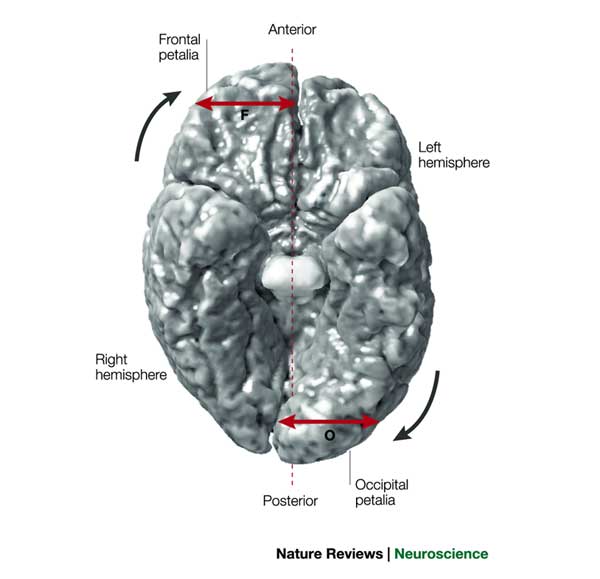
When I learned neuroanatomy at Medical School I was taught that the two cerebral hemispheres were symmetrical. There was no mention at all that they were in any way different. But look at this image above. (This is referred to as Yakovlevian Torque)

Clearly, the two hemispheres are NOT identical. In particular the right one is bigger at the front, and sits just a bit in front of the left, and the left one is bigger at the back, and sits just a little further back than the right.

Why might that be? Why the larger frontal area on the right, and occipital (back) area on the left?

Iain McGilchrist nicely summarises it by pointing out that how the left hemisphere approaches the world is by trying to grasp it. We try to make sense of the world by literally getting a hold of it – we want to understand it, to measure it, to predict what it going to happen by matching the patterns we see to those we have already learned from our experience, and we try to manipulate or control it. This is what the left hemisphere is really great at doing. Interestingly, the areas at the back of the brain are primarily for processing the outside world (our visual and auditory areas are toward the back, and the cerebellum which helps us to know whether we are standing up or falling over by orientating where we are in 3D space, is also to the back). The right hemisphere majors in making connections and maps. It has a significant role to play in all the skills we need to act as social animals.

So, one nice summary of why there might be this asymmetry in the brain, is to enable us to both grasp the world and to be social creatures. Amongst all the creatures on this planet we are probably the most able to manipulate our environment and the most developed as social animals.

There’s a huge amount more to this left brain/right brain understanding but I do think this is a fabulous starting point. Oh, and by the way, look at this
IMG_0349

Interesting, huh? And how come this has been pretty much completely ignored for so long?

Well, Iain McGilchrist’s theory, written up in full in The Master and His Emissary, or summarised in the Kindle Single, The Divided Mind, is that we have over developed the left hemisphere approach so much that we have developed the tendency to see only what we have already “learned” – so if we were taught that it was symmetrical, and we haven’t explored the differences between the two hemispheres, then we’ve become a bit blind. Time to start using our whole brains?


Read Full Post »

shadow of an empty seat

No straight lines are to be found in the natural world……..Leonard Shlain has pointed out that the only apparently straight line in the natural world is that of the horizon, but of course that too turns out to be a section of a curve……..Straight lines are prevalent wherever the left hemisphere predominates. Iain McGilchrist. The Master and his Emissary

playing under the moon

By contrast the shape that is suggested by the processing of the right hemisphere is that of the circle, and its movement is characteristically ‘in the round’, the phrase we use to describe something that is seen as a whole, and in depth. Iain McGilchrist. The Master and his Emissary

Circular rainbow


So, if the left hemisphere prefers straight lines, and straight lines don’t really occur in nature, and the right hemisphere prefers to see things in the round, then why not go out this weekend, and see how many round shapes you can see? Strengthen seeing with your right hemisphere!

lily pond

through the round window

Read Full Post »

This is NOT a post about diets!

We use the metaphor of weight as a measure of value. If we “give more weight” to one side of an argument than another, then we are saying we value that side more. What weight do we give to a certain piece of evidence for example?

Well, here’s a fascinating study by psychologists who were studying the embodied nature of metaphors. Here’s what they did, and what they found…

  • In the first study, European participants were asked to guess the value of various foreign currency in euros. Some were given a heavy clipboard on which to mark their estimates, and others a light clipboard. Those who held the light clipboard estimated, on average, lesser values.
  • In a second study, subjects were asked to estimate the importance of college students having a voice in a decision-making process involving grants to study abroad. Participants with the heavy clipboard felt that it was more important for students to have a voice.
  • In a third, subjects were asked to report whether they liked their city after reading a biography of the mayor and indicating how they felt about him. If they carried the heavy clipboard, there was a relationship between their estimation of the mayor and that of the city, but not if they carried a light clipboard. In this case, the importance of their feelings about the mayor weighed heavier on their evaluation of the city if the clipboard was heavy


Interesting, huh? Reminds me of a study I read years ago where the researcher gave the study subject a drink to hold while they went up in an elevator. The subjects were asked to give their opinion of the researcher at the end of the “test”. Those who had held a warm drink, rated the researchers as more friendly and warmer, than those who held a cold drink.

Still think the body and the mind are separate?

Read Full Post »

zen garden

pool of resonance


What’s the difference between these two kinds of waves?

Yes, the sand waves aren’t moving, they just look like ripples. But if you see timelapse photography of desert sand dunes you can see great waves of sand moving just like the waves which crash onto the beach.

Except, even there, there is a huge difference.

What’s the difference?

It’s a difference between matter and energy. The sand waves are made of particles which stick, or move, together. Waves in water, however, might look like lines of water molecules all moving forwards together…..but they aren’t. Waves in water are energy waves. As the energy passes through the water it pushes the water molecule up and down again (in a kind of cyclical motion). In other words, the wave which moves forward is continuously made up from one group of molecules after another.

A bit mind boggling, huh? But you can see what happens if you see some seaweed (or a rubber duck) on the surface of the sea…..as the wave arrives, the duck rises up, as it passes onwards, the duck sinks down again, waiting for the next wave to arrive…..same thing is happening with the water molecules.

What interests me about this is that I think WE are like the waves in the water much more than we are like the waves in the sand. We emerge out of everything which is, as the energy or life force of the universe surges through us, lifting us up into the world, then we disappear again, back into everything which is.

Read Full Post »

It’s Burns Night tonight, but I’d like to share the opening verse of a poem by another old Scottish poet, Thomas Campbell. From his, ‘The Pleasures of Hope’…..

At summer eve, when Heav’n’s ethereal bow
Spans with bright arch the glittering hills below,
Why to yon mountain turns the musing eye,
Whose sunbright summit mingles with the sky?
Why do those cliffs of shadowy tint appear
More sweet than all the landscape smiling near?—
‘Tis Distance lends enchantment to the view,
And robes the mountain in its azure hue.

first thing this morning


Although this turns around the French idea of the “view from on high“, in some ways, it’s the same idea. How often does it seem that it’s the distant mountains which catch our eye when we look at a landscape? I know that’s what catches my eye first. Every single day I look out of one of the windows of my flat and look for Ben Ledi. Unless there is mist, or the clouds have come down in front of it, it’s Ben Ledi I see first.

I like this idea of Campbell’s that the ‘distance lends enchantment to the view’, and I think our everyday often lacks enchantment, so maybe here’s an easy way to increase it…..look to hills, folks!

Read Full Post »

Rain lenses


Look carefully at these raindrops and see what you can see within them.

There are all kinds of theories about reality and how we experience it, but in this Age of Modernity, the object, what’s “outside”, what can be measured, what is “physical” has gained almost a monopoly over what is accepted as “real”.

What a patient’s tests or scans show are believed to represent what’s really wrong or right. What a patient reports, relates or describes of their experience – their symptoms, their personal narrative, is often dismissed by researchers as anecdote, or by clinicians as unimportant – “I’m happy to tell you your results are all normal” (“now go away and stop bothering me with your complaints!”). Somehow the lived experience of reality has become less relevant than the measurement of reality. The object trumps the subject.

Yet that objective, physical reality can only be experienced by, can only be measured by, the human subject.

So, in this dialectic, is there some way to grasp reality, to know what is REAL?

I’m not about to solve this one here, but one way of approaching this which appeals to me a lot, is to ask the question “what are these the two poles of?” “Inside and outside of what?” Or to put it another way……If the subject and the object are two sides of the coin, what’s the coin?

Is it the continuous process of becoming which we see everywhere in the universe? Is it the vital force, the Life force, the universal spirit from which all form emerges?

Can we take a perspective on reality which sees BOTH the inside and the outside as valid and important?

That’s why I don’t accept the proposed duality of mind and body, and any understanding of a patient is incomplete without exploring both.

Read Full Post »

waterfall

Is time linear? Is it like this waterfall? Does the future rush towards us, the present pour past us in a constant stream, and the past disappear into the far distance carrying the our daily experiences off into the vast oceans of memory?

Or is it more like a tree?

zen garden

Does time accumulate, like the growing sapwood just under the bark, laying down this year’s experiences on top of last years, each and every ring layered over the previous ones?

The forest becoming

Does the present grow out of the past which doesn’t disappear, but which perpetually lies beneath us, our daily experiences emerging from, growing from, all that has occurred before?

Read Full Post »

jupiter over ben ledi


When I looked out of the window this morning I saw a bright star shining over Ben Ledi.

My Starwalk app tells me that what I was looking at was Jupiter, and it was sitting smack in the middle of the constellation Gemini. It was too light to see any of the constellation but you can see how easy it was to see Jupiter.

There’s a saying in French about taking a view from on high (vue d’en haut). The meaning is pretty clear. When you think what it is like to look out over a land or seascape from a cliff or hilltop, you get the idea. In other words, its about taking an overview, seeing the bigger picture, seeing things in their context.

Iain McGilchrist describes how the left and right hemispheres approach the world differently. The left tends to focus in on things. It’s like using a telescope or microscope. It’s great for seeing the details and analysing them. It’s a kind of digital approach. The right however gets first claim on all the information flowing into the brain. It takes the overview, the more holistic, analogue approach. In some ways, you could say our right hemisphere is well designed to allow the view from on high.

The French take a variation of the view from on high, and include the concept in the expanded one of a “view from Sirius”. Sirius is the brightest star in the sky (the planets might look brighter but they aren’t actually stars).In 1752, Voltaire wrote a story entitled “Micromegas” about a giant from Sirius traveling across the universe and coming to Earth to have a look around. Not only does the view from Sirius include the idea of an overview, but it also captures the idea of everything being seen or experienced for the first time. When you travel to a new land, the everyday reality can seem strange and new, and stimulates your curiosity.

So, when I look out and I see the bright shining Jupiter over Ben Ledi, it sets off my thoughts about taking the “view from Sirius” and takes me into the day with a sense of wonder, of open-ness, and of being able to see the bigger pictures.

Taking a look from higher than Ben Ledi, but not as high as Jupiter or Sirius shows us just how thin the biosphere is…..its a pretty thin layer in the scheme of things!

biosphere


Read Full Post »

Where did 2013 go?
Where does the past go?
Does it go anywhere?
Is time like this long road?

DSC_0167.JPG

Was 2013 like a car, making its way along time’s highway? And disappearing into the far distance as we look?

That’s one way to look at it, but then look at this tree….

DSC_0062

The very shape of the tree tells a story, contains a history, reveals its past. Doesn’t it?

So what if time isn’t like a straight line, with the future speeding towards us, and the past soon behind us and out of sight?

What if time is cumulative? What if the past doesn’t go away anywhere, but instead continues to exist underneath the present?

Doesn’t the present emerge from an ongoing interaction between what’s possible, what’s happened already, and what else is happening now?

Think of 2013 as still here, underneath today, and out of which 2014 will grow. After all, if 2013 wasn’t still here, then what would 2014 emerge from? Nothingness?

Read Full Post »

light on earth


What I love about this photo is the way the light appears – it’s almost as if there must be multiple sources of the light, shining with different intensities on different parts of the landscape.

Read Full Post »

« Newer Posts - Older Posts »