Feeds:
Posts
Comments

Archive for the ‘personal growth’ Category

Move, move and be moved.

DSCN0496


DSCN0381


DSCN0905


DSCN0928

Move your body. If you wanted to do just one thing to improve your health then I’d suggest you move. Recent research has shown that rather than focus on certain types of exercise, or certain numbers of minutes exercising, what makes the most difference is the amount of time you spend sitting down in a day.

If you’re 60 and older, every additional hour a day you spend sitting is linked to doubling the risk of being disabled — regardless of how much exercise you get, reports a new study.

and

If there are two 65-year-old women, one sedentary for 12 hours a day and another sedentary for 13 hours a day, the second one is 50 percent more likely to be disabled, the study found.

Move from here to somewhere else. Travel, go trips, have a journey. Try something new. Try the 30 minute discovery challenge.

Be moved. Go to the movies. Listen to some music. Read a poem. Spend some time with someone who touches your heart. Stir your positive emotions.

Movement is Life.

Read Full Post »

IMG_0571

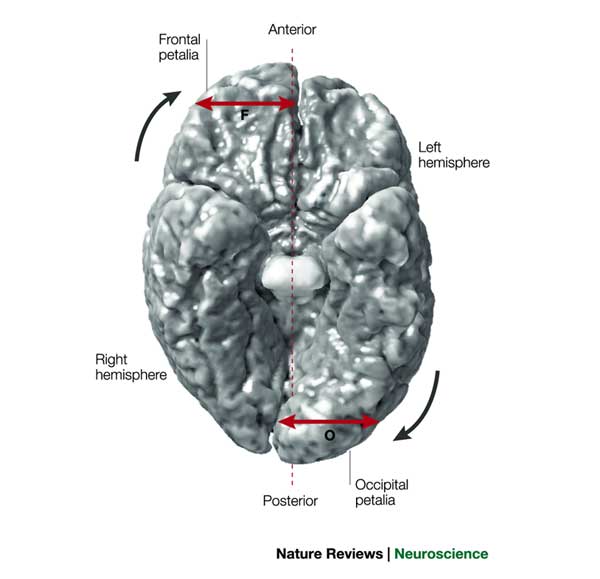
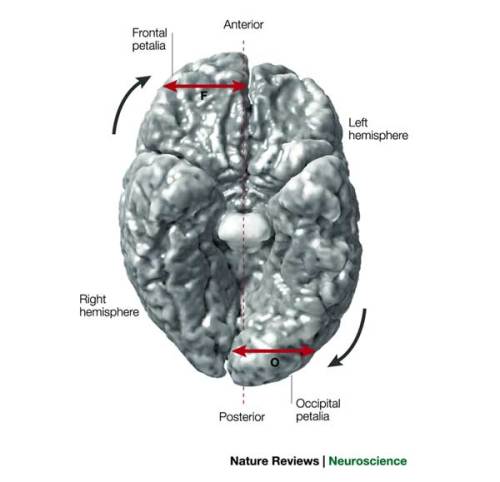
When I learned neuroanatomy at Medical School I was taught that the two cerebral hemispheres were symmetrical. There was no mention at all that they were in any way different. But look at this image above. (This is referred to as Yakovlevian Torque)

Clearly, the two hemispheres are NOT identical. In particular the right one is bigger at the front, and sits just a bit in front of the left, and the left one is bigger at the back, and sits just a little further back than the right.

Why might that be? Why the larger frontal area on the right, and occipital (back) area on the left?

Iain McGilchrist nicely summarises it by pointing out that how the left hemisphere approaches the world is by trying to grasp it. We try to make sense of the world by literally getting a hold of it – we want to understand it, to measure it, to predict what it going to happen by matching the patterns we see to those we have already learned from our experience, and we try to manipulate or control it. This is what the left hemisphere is really great at doing. Interestingly, the areas at the back of the brain are primarily for processing the outside world (our visual and auditory areas are toward the back, and the cerebellum which helps us to know whether we are standing up or falling over by orientating where we are in 3D space, is also to the back). The right hemisphere majors in making connections and maps. It has a significant role to play in all the skills we need to act as social animals.

So, one nice summary of why there might be this asymmetry in the brain, is to enable us to both grasp the world and to be social creatures. Amongst all the creatures on this planet we are probably the most able to manipulate our environment and the most developed as social animals.

There’s a huge amount more to this left brain/right brain understanding but I do think this is a fabulous starting point. Oh, and by the way, look at this
IMG_0349

Interesting, huh? And how come this has been pretty much completely ignored for so long?

Well, Iain McGilchrist’s theory, written up in full in The Master and His Emissary, or summarised in the Kindle Single, The Divided Mind, is that we have over developed the left hemisphere approach so much that we have developed the tendency to see only what we have already “learned” – so if we were taught that it was symmetrical, and we haven’t explored the differences between the two hemispheres, then we’ve become a bit blind. Time to start using our whole brains?


Read Full Post »

IMG_1536


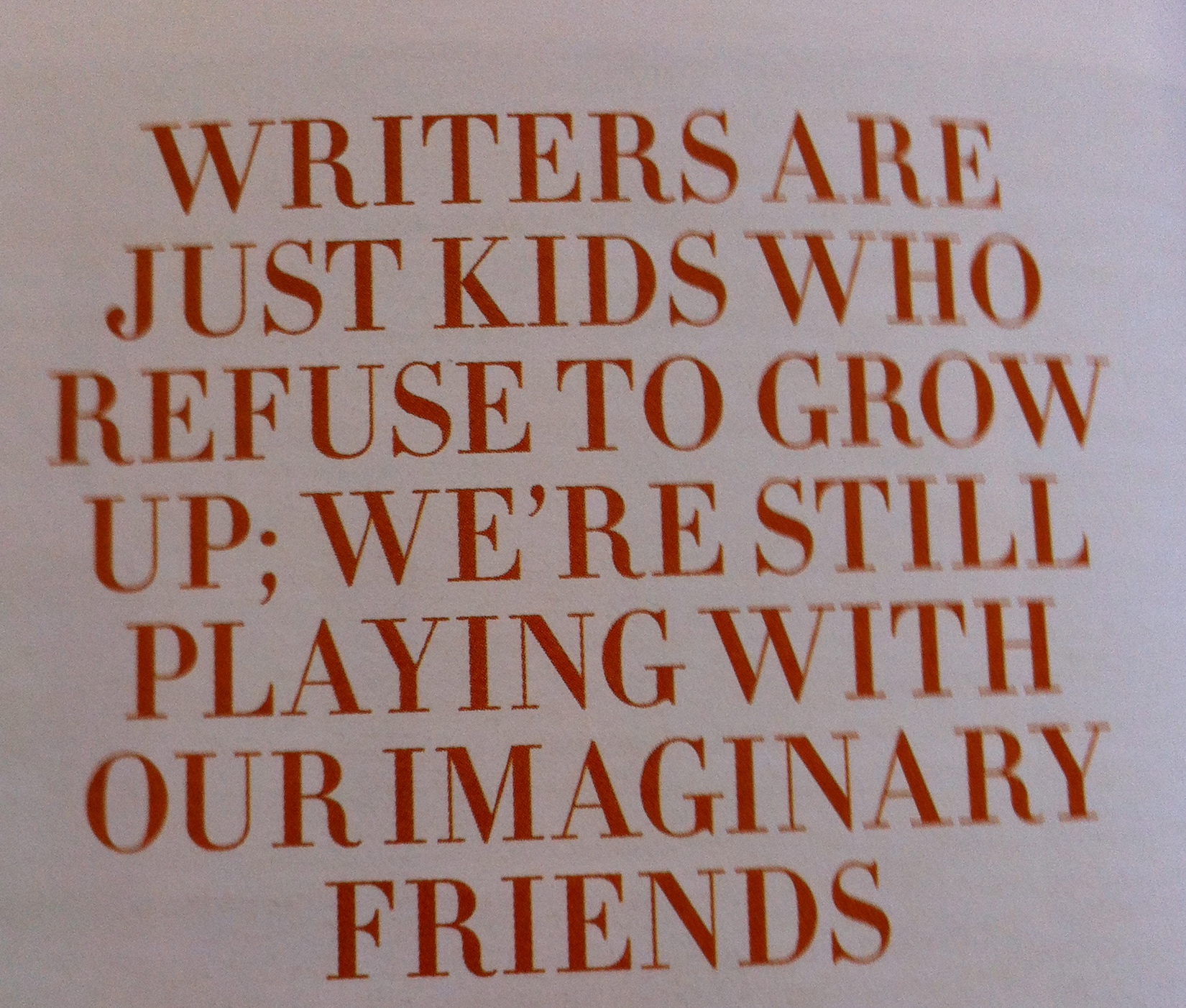
I came across the above quote in an interview with Ian Rankin, the author of the Rebus crime fiction books.

I think this is a such an important point about creativity. If we really want to let our imaginations flourish, don’t we need to stop being too serious, and setting it artificial limits. Have you seen how rich a life children create with their imaginations? It’s a constant inspiration!

So, with all the serious advice around about happiness, health, flourishing, etc, here’s an additional piece with quite a different flavour – play with your imaginary friends!

2866185000_27420d198a_o


2340960907_c7a7f1645e_o


2698797966_914511a3c7_o

Read Full Post »

Love.

5339374724_e660b26f93_o

Well, we could reflect on this subject for a long, long time! However, the point of the A to Z of Becoming series is to consider 26 verbs ie doing words which if you do them, you will experience the joy and deep satisfaction of becoming all you can be.

So, for this week, let’s do two things with love. Let’s start by either making a list, or reflectively meditating about who and what we love. This is love as it flows from you to the other. Who is included in your love world? When does your heart fill with love? It would be good to allow yourself to be honest and gentle with this. Don’t judge. Don’t judge the quality of the love or include who you think you should love but don’t! Instead get in touch with that loving feeling.

I remember years ago I used to listen to “pirate radio” stations – one in particular (Radio Caroline) used to talk all the time about “getting the LA habit” – by which they meant “loving awareness”. Maybe it became clichéd through repetition, so lost its power, but I still admired that they chose to put it out there (see the comments below). And that’s the second part of this week’s exercise….

Once you have become more aware of who you love, of when your heart fills with love, then ask yourself…when did you last vocalise this feeling? Yes, in other words, when did you last tell that person you love them. Maybe with some of the people on your list the answer to that will be a few minutes ago, but for some, I bet the answer might be a few days, or weeks, or months, or even years ago…..? Well, how about doing it this week? How about just telling the people you love that you love them? Raise the level of loving awareness in the world!


Read Full Post »

DSCN0921


Yesterday was the Spring Equinox, the day when there is an equal balance of day and night….for the next few months, there will be more light in every 24 hours.

I love seeing the appearance of the tree blossoms at this time of year. It feels like a time of new beginnings. So, maybe this isn’t a bad time to reflect on what you’d like to begin. What would you like to start? What journey would you like to begin?

It’s Nature’s time to blossom, and you are part of Nature, so how do you hope to blossom this Spring?


Read Full Post »

3514853663_ecefab90ef_z

An area of drug development is being referred to as “stratified” or “personalised” medicine – it’s about testing for biological markers which help to predict who will get benefit, and who will get side effects. Sounds a good idea? Any maybe it is, but I wonder if that’s all there is to knowing who is going to benefit from a particular drug and who will get side effects. However that works out, what struck me was the comment from the Professor in Glasgow

We’ve seen spectacular advances in the treatment of rheumatoid arthritis in the last 10 years,” he said. “But one of the greatest frustrations our patients face is that they’re given medicines which could potentially give them benefit or potentially add to the risk. They don’t know which is going to be their fate. What an easing of the mind if they had some degree of certainty about what their medicine was going to do for them.”

We have a great desire to predict the future and to be certain about what it will be like.

Every other day it seems we hear another round of “economic forecasts” suggesting what’s going to happen in the economy for the months ahead. Some economists are even prepared to predict what interest rates will be, growth rates, unemployment rates etc etc – since the financial crash of 2008, does anyone believe anything economists say any more? What exactly are these “forecasts” other than guesses? Is it possible to accurately predict the future of any complex system?

Certainty is the greatest of all illusions…….The only certainty, it seems to me, is that those who believe they are certainly right are certainly wrong. Iain McGilchrist. The Master and his Emissary

Prediction is impossible. We are complex adaptive creatures, living in a complex universe which co-evolves with us. Continuously, complex systems change so radically that the next phase is termed “emergence” – a phenomenon which by definition couldn’t be predicted from an analysis of the pre-existing parts.

So what to do?

Focus on becoming not being…….

For me, noticing patterns, being fully present during experiences and hearing and creating stories beats the illusions of prediction and certainty every time.


Read Full Post »

3408569363_bdc595e4a6_z

Kindle.

Since Amazon brought out their increasingly popular e-reader and probably transformed reading (how many people do you see on the train or the bus sitting reading something on a kindle reader?), the word “kindle” has become associated with their device.

That’s got something to say for us as we think of the verbs of becoming…..if this little device kindles a little more learning, if it kindles an enthusiasm for reading…..then we are on the right track.

But the kind of kindling I’m thinking of is that early nurturing of something. We start a project, begin to write  or read, embark on a new interest, and at first we have to gently nurture it into viable existence. It’s easy to start something…..for a moment, or an hour, or a day or two…..but a little harder to start something and see it through, to get it established.

I’m sure you’ve encountered the 30 day idea – the idea that if you want to change a habit, or to start a new one, then do the new behaviour (whether that be a change in your diet, or the amount you exercise, or starting to meditate, or whatever). That’s a good way to kindle something. Start today, and then do it again tomorrow, and keep kindling it for 30 days, and see what’s changed.

When I learned TM, both of my teachers were excellent, and they both repeatedly gave the instruction to “gently return to the mantra”. That constant “gently” returning is what made it easy and permanent for me. I think it was a genius instruction. Kindling has the feel of gentleness for me and whatever it is you want to nurture or change, I’d say “gently kindle it”.


Read Full Post »

shadow of an empty seat

No straight lines are to be found in the natural world……..Leonard Shlain has pointed out that the only apparently straight line in the natural world is that of the horizon, but of course that too turns out to be a section of a curve……..Straight lines are prevalent wherever the left hemisphere predominates. Iain McGilchrist. The Master and his Emissary

playing under the moon

By contrast the shape that is suggested by the processing of the right hemisphere is that of the circle, and its movement is characteristically ‘in the round’, the phrase we use to describe something that is seen as a whole, and in depth. Iain McGilchrist. The Master and his Emissary

Circular rainbow


So, if the left hemisphere prefers straight lines, and straight lines don’t really occur in nature, and the right hemisphere prefers to see things in the round, then why not go out this weekend, and see how many round shapes you can see? Strengthen seeing with your right hemisphere!

lily pond

through the round window

Read Full Post »

mitsudomo

Dan Siegel defines the mind as “an embodied process of regulation of energy and information flow”.

Flow is such an attractive and useful concept. If you’d like to read more about it start here.

I like Dan’s definition of the mind because he refuses to turn it into a measurable, objective entity. He describes it as a process – which seems so much more accurate to me. It is a continuous, dynamic, ever changing phenomenon. Not only is it a process however, it’s a process of regulation. He says it regulates energy and information flow.

I think this concept of the mind can be extrapolated to cover the whole organism. Whatever it is that self-regulates, self-defends, self-repairs (in my opinion we can usefully call it “the vital force”) is a process of regulation of energy, information AND materials. Because that’s how all our cells communicate and co-operate – by exchanging energy, information and materials.

So, let’s just consider another of Dan’s concepts. He defines a healthy flow of regulation as having five qualities which he remembers with the acronym FACES.

  • Flexible
  • Adaptive
  • Coherent
  • Energised
  • Stable

A healthy organism has flexibility. Rigidity is one of the two main patterns of dis-order and dis-ease. It uses that flexibility to be adaptive. In other words, as the world changes around it, the healthy organism can change with it in an adaptive way, a way of helping the organism to not only survive, but to grow, to thrive. Healthy organisms are also coherent – all their parts and systems are working synergistically, in harmony with each other. In the absence of energy, organisms become, literally, lifeless. Energised is a key characteristic of all living organisms – you might also use the word vitality to describe the degree to which an organism is energised. Finally, there is stability. Not the stability of stasis, but the stability of coherence. You are you. You were you when you were 10 years old, and you are you now. Almost everything about you has changed between then and now but you still have a stable sense of self – you still know you are you and not someone else! Stability comes hand in hand with identity.

Read Full Post »

february love

Marc Halévy says in his “Petit traité du sens de la vie” that a human being is not “un animal social. Par contre, il est un animal communautaire”. What he means by that is that we are social in a very particular kind of way. We create important and significant bonds between other human beings. That’s how we live….each one of us with our own unique world constructed from our own unique set of relationships with significant others. I’ve read various estimates of the maximum size of such functioning groups – from 50 to 150. Certainly several thousand twitter followers, or facebook friends don’t represent these kinds of real life relationship groups.

He goes on to say that our “communitarian human” is undermined by the “mass society human”. We have societies based on nation states which deal with whole populations as if they are a single mass. In this mass, not only is the individual lost, but so is the individual’s human world of relationships (each of which, remember, is unique in its own right)

I think this takes the understanding of uniqueness, and what it is to be human, to a different level.

Lewis Hyde, in the superb, “The Gift”, deals with this issue from the perspective of the ego…

I find it useful to think of the ego complex as a thing that keeps expanding, not as something to be overcome or done away with. An ego has formed and hardened by the time most of us reach adolescence, but it is small, an ego-of-one. Then, if we fall in love, for example, the constellation of identity expands and the ego-of-one becomes an ego-of-two. The young lover, often to his own amazement, finds himself saying ‘we’ instead of ‘me.’ Each of us identifies with a wider and wider community as we mature, coming eventually to think and act with a group-ego (or, in most of these gift stories, a tribal ego), which speaks with the ‘we’ of kings and wise old people. Of course the larger it becomes, the less it feels like what we usually mean by ego. Not entirely, though: whether an adolescent is thinking of himself or a nation of itself, it still feels like egotism to anyone who is not included. There is still a boundary.

He goes on to argue that the relaxation of that boundary is where we begin to experience the connectedness of everything….begin to lose that sense of duality and separateness from the other.

I think this is helpful. The truth is it isn’t easy to feel that ALL human being are your fellow men and women. But you DO live every day with a number of relationships which are fundamental to the creation of your world. I don’t think this means we should restrict our interest and our compassion to those outside of our personal community but if we approach these relationships from a positive perspective, and understand that every single human being cannot be understood in isolation but only in the context of their own unique web of relationships, then we might find an increase in both love and understanding.

Just a thought…..

Read Full Post »

« Newer Posts - Older Posts »