Feeds:
Posts
Comments

Archive for the ‘philosophy’ Category

Ok, so I’ve called this post “The hidden connectors”, but as you can see, there’s nothing hidden about this one! This is an astonishingly beautiful specimen from that Kingdom of Nature that we mostly don’t talk about and mostly aren’t even aware of – fungi.

Fungi are fascinating lifeforms. They aren’t animals, they aren’t plants and they aren’t minerals…..although this particular one looks awfully like a piece of agate. You can see examples of parts of them when they appear on the surfaces of trees, and the soil. The kind you will be most familiar with are the little toadstools and mushrooms which appear on the ground, especially in forests. But you also see them a lot growing on fallen logs in the forests.

Fungi play an important role in decomposition…..they are the essential, often invisible, link between what has lived and what is about to live. They are the recyclers, the processors, which break down the dead and dying cells of animals and plants and release nutrients to nourish emerging plants. They are the connection between the generations past and the generations to come. I’m sure you’ll have read that Nature doesn’t produce waste. There are no “land fill sites”, “incinerators” and “toxic dumps” in Nature – they are all human inventions. Nature transforms everything which has existed into everything which is about to exist. Fungi are one the key elements in those cycles of birth, death and re-birth.

But fungi are also the secret connectors which make the forests living, intercommunicating, interactive communities of individual trees. Every tree has vast root systems hidden underground, and fungi form astonishingly large and complex networks amongst and between the tree roots, carrying and exchanging nutrients, substances and information between the trees. It wouldn’t be unreasonable to compare them to the neural networks in our brains – totally different in structure and form of course – but vast threads of interconnection which create what some biologists have fairly recently termed “the Wood Wide Web” – which transforms a forest from a grouping of individual trees into a much larger, living being.

Isn’t it amazing how these creatures, these forms of life, fill that liminal space between – between trees, between life and death, between generations?

We live in a completely interconnected world. Maybe this pandemic has shown us that more clearly than ever before. But all our artificial boundaries and separations, all our arbitrary states, borders, our constant dividing of reality into “us and them”……it’s just not real. It fails to show us how inseparable we are from each other, how intertwined we are with each other and with all the other species and biosystems of Planet Earth.

Isn’t it time to insist on the importance of what we share? Isn’t it time to insist on our inter-dependence and inter-connectedness, instead of these false divisions and separations? Isn’t it time we understood that we ALL live on the same planet, with the same air, the same water, the same resources? Isn’t it time to remind ourselves how whatever we do, as individuals or as societies, has ramifications and impacts which spread way, way beyond what we can control?

I think we can all choose to become conscious connectors, building positive relationships, integrating our unique differences to create mutually beneficial bonds. I think that’s how we will change our world.
Read Full Post »

How do you grow a forest?

One seedling at time.

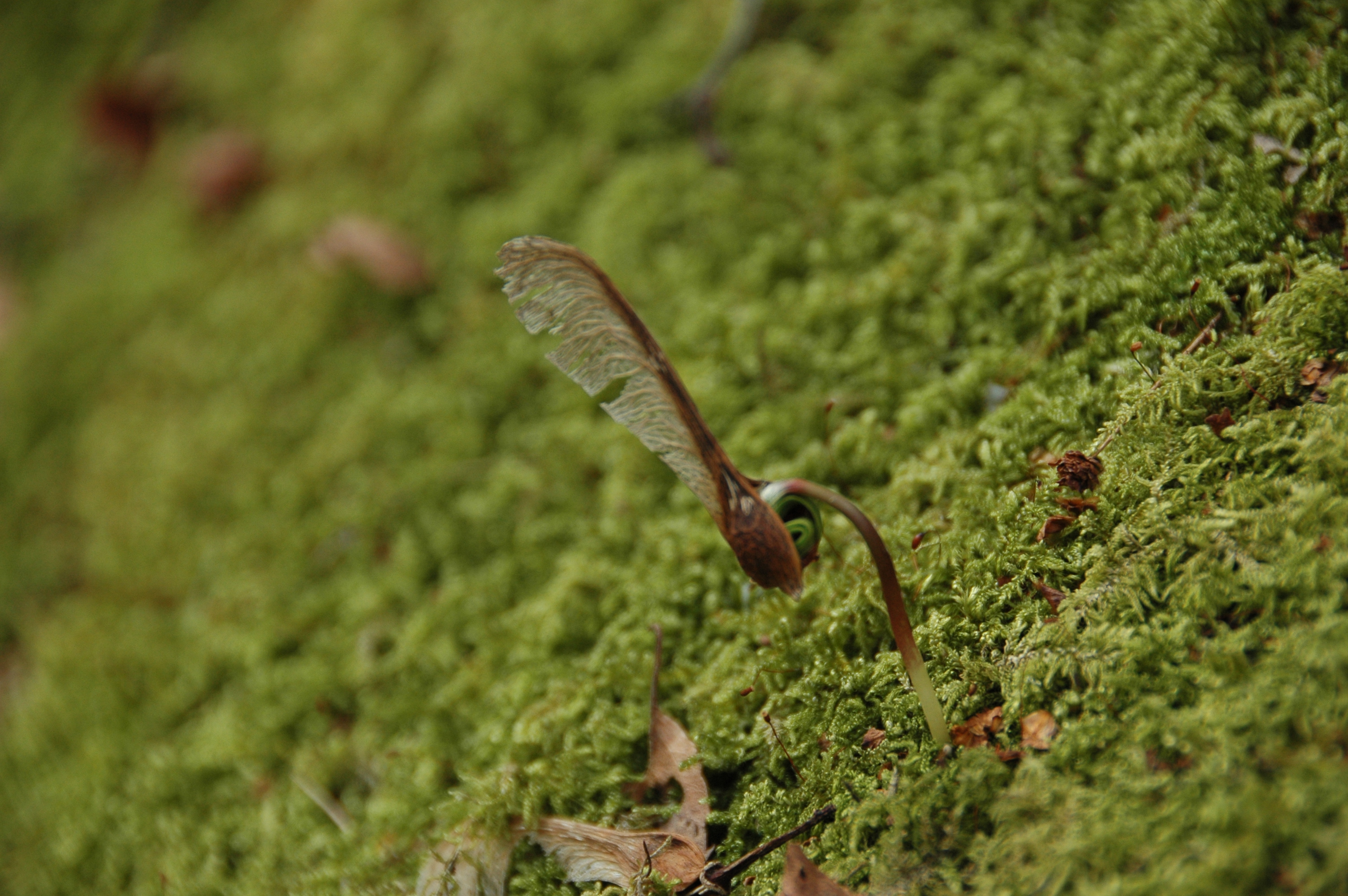
This beautiful little seedling is captivating. I spotted it growing from the moss covered forest floor, the seed casing with its wind driven system of flight and dispersal still intact, but the bright green of new growth clearly visible, and the beginnings of the spiral of unfolding showing us that this little seed has taken root, and is beginning the long journey to become a tree.

It makes me think about the relationship between the tree and the forest, between the particular and the general, between the individual and the group. A relationship I think we tend to get badly wrong. With the rise of statistically driven data collection and analysis, along with the development of algorithms, we reduce the unique person to a point in a set far too often. We pick one, or a handful, of observable, measurable characteristics, categorise them and use them as the be all and end all.

We define people according the group we’ve put them into. In so doing, we fail to see them as unique, individual, human beings. You just can’t know and understand a person from a data set. It’s not enough, and it’s often a fast track down the wrong cul-de-sac.

We make people invisible by reducing them to examples of a group.

All my working life I saw one person at a time…..whether that was in the GP surgery, with a rhythm of one patient every ten minutes or so, or in the specialist referral centre for people with long term intractable conditions, where we’d spend an hour to an hour and half for the first visit, then about twenty minutes for each follow up. In both these settings the rhythm of my day was determined by the scheduled appointments allowing me to give full attention focus to every single individual who came to consult me. I found that a great meditation practice, a great way of continuously coming back to the present moment…..not thinking ahead to who might come next, and not hanging on to the story of the person who has just left the room….but, rather, encountering the crowds, the queues, the “lists”, one person a time.

Of course I learned a lot from all these individuals which informed me about others. But the point is, it was a practice of focusing on the individual, and gleaning the general knowledge from there……not learning the general knowledge and trying to force each person into the right pigeon hole.

I learned from the work of Iain McGilchrist that this was the result of how we use the two hemispheres of our brain. The left hemisphere focuses in, abstracts information from its contexts, labels it and categorises it. It works with sets, groups, and generalities, continuously trying to fit new information into what we’ve learned already. The right hemisphere, on the other hand, focuses on the whole, seeking what is unique and particular in every context, every relationship, every circumstance, endlessly fascinated with what’s novel and what’s particular. As he says in his “Master and His Emissary”, we’ve let the left hemisphere become the dominant one, but evolution never intended that.

It’s time to re-balance, to prioritise the approach to life driven by the right hemisphere and to reap all the potential benefits of the analytic, labelling and classifying left hemisphere by handing those insights back to the right – in other words, by putting whatever we encounter, whatever we understand, back into the contexts and environments in which we found it.

We need to re-learn how to experience life, one seedling at a time. That’s how we’ll grow a healthy forest.

Read Full Post »

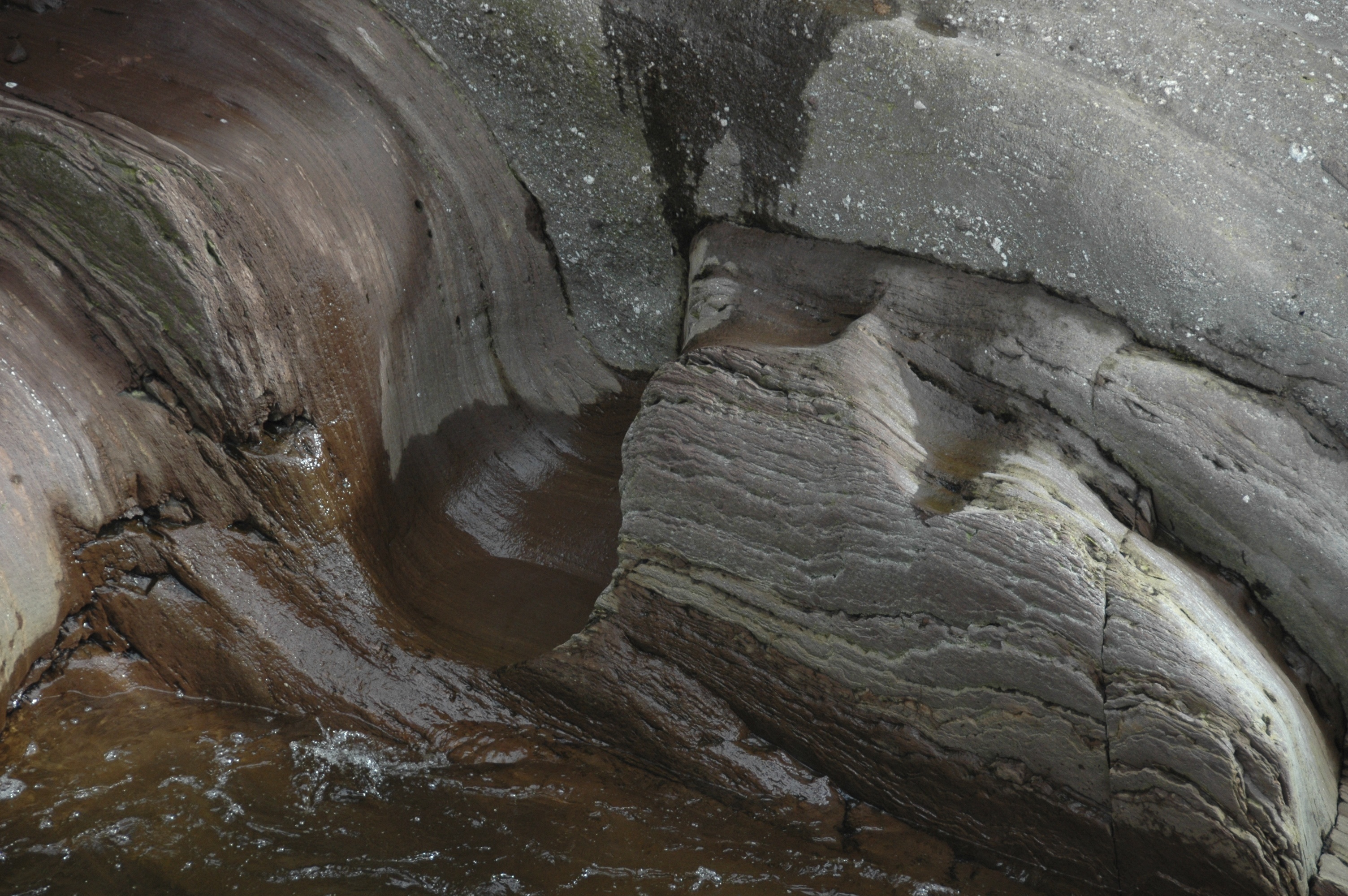
I took this photo many years ago at a waterfall in Scotland. I’ve long since been fascinated by the interplay between water and rocks in streams, rivers and, especially waterfalls. I suppose in waterfalls the power of the water to sculpt the rocks is at its greatest as the water roars down the hillside.

In this particular photo you can see how the water has smoothed the surface of some of the rocks to the extent that they actually look like water streaming over them. It’s as if the water has fashioned the rock in its own likeness.

One of the other rocks is revealing its multilayered structure in such a way that it, too, resembles, the flow of water, and reminds us of the often hidden depths that lie beneath the surfaces of what we see.

What shape is the water?

That’s a strange question, isn’t it? Because water always seems to assume the shape of whatever contains it. Certainly the rocks, whilst not permanent in their forms, create the boundaries or limits against which the water can flow. When there is no clear, solid container, water evaporates, disappearing into the air, rising upwards to form clouds, or staying close to the earth to make mists and fog. But even then it’s contained within the atmosphere. It doesn’t disappear away out to the rest of the universe (at least not in significant amounts, I don’t think).

So water is the shape of what contains it. But that statement doesn’t quite capture reality does it? It assumes that both the water and the container are passive…..that neither changes the other……but we can see, even in this photo, how the water constantly changes the rock and how the rock constantly changes the water. In fact, that interaction carries on at microscopic levels which we can’t see with the naked eye, as minerals and micro-organisms are exchanged between the water and the rock, changing the actual composition of each moment by moment, year by year, aeon by aeon.

That’s the nature of reality, isn’t it? A constant flow of co-creation. Nothing exists in isolation. Nothing lives outside of everything. Connections, interactions, relationships and co-creation are at the heart of universe. They are the fundamental, inescapable basis of reality.

And that’s both beautiful and wondrous, wouldn’t you agree?

Read Full Post »

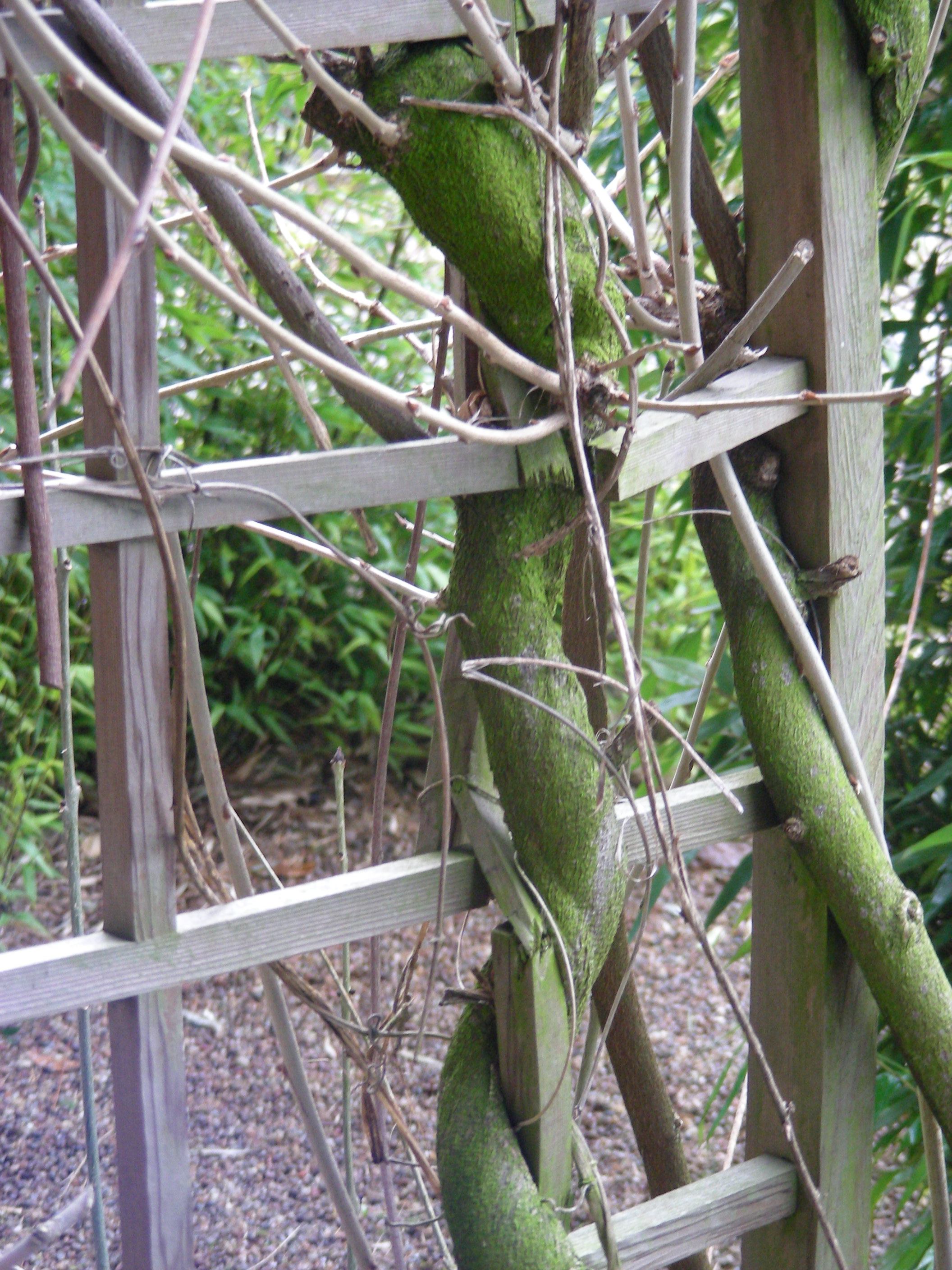
My consulting room at the Glasgow Homeopathic Hospital had a glass wall, half of which could slide open to let you step out onto wooden decking and from there into the garden. Each of the five consulting rooms in a row had that same design, and each of them were separated outside by a wooden trellis with clematis and wisteria growing up towards the upper level of the building.

A few years after the hospital opened and the gardens were laid, I noticed what this climber had done to the woodwork of the trellis as it wound its way upwards. I was astonished. I knew that climbers had great powers to reach out, connect, hang on even, but I hadn’t imagined that these plant stalks could become both so thick and so powerful. You can see this one has actually broken the wooden straps in several places.

Of course, I didn’t notice it happening. We’re not that great at noticing the reality of the present moment, are we? But I sure noticed it this day…..still don’t know why….don’t why it was this particular day and not one of surely many others which preceded it where I might have noticed. Oh well, you can see why I use “heroes not zombies” as my blog title, can’t you? We really do pass through life on autopilot, reacting to overt and covert stimuli which move us this way and that, allowing our attention to be grabbed by the loud, the dramatic, and the shocking. Living, but not fully.

It doesn’t have to be like that, does it. We can wake up, become more aware of the here and now, more mindful, more conscious of life and being alive. We can notice when our attention is caught, when our passions are stirred, and we can choose what we want to do with that knowledge. We can write a new story, our own, unique story, with ourselves as the main character……moving from a zombie existence to a hero one.

When I do that I find that the so called “ordinary” day is filled with what seems to me to be quite “extraordinary”. I mean, just look again at this photo. Think of the Life Force, of the drive to exist, to survive, to grow and to thrive which runs through every living being. And look how it overcomes every flimsy structure, every material object, which we humans fashion and build.

I’m sure you’ve noticed something similar in the surprising appearance of a wild flower, or “weed”, pushing its way up through a pavement, cracking apart the tarmac, or concrete.

Isn’t it astonishing, this “Life Force”?

Read Full Post »

This little ice crystal mesmerises me. It’s beautiful. Look at the intricate branching structure of each little bristle of ice. It’s almost like a tiny tree, or, at least a snowy leaf. Look at the way it catches the sunlight and sparkles like a jewel. But maybe the most astonishing thing about it is how it is attached to the iron bar from which it is hanging. Can you see? There is a single icy spike holding the entire structure onto the metal. In an instant you can see that this little piece of frozen water is not only incredibly strong, but that the entire crystal has grown from that single point. Isn’t that amazing?

What I love about something like this is that no matter how much you describe water and its behaviour in cold temperatures, the singular, the actual, the specific, particular ice crystal you encounter takes you beyond the limits of your expectations.

I find that everywhere in life, but, especially so in the practice of Medicine. No matter how much general knowledge I had of diseases, their origins, their life histories, and their likely consequences, I never had enough to know precisely what this individual patient today was experiencing, nor how this disease had arisen in their particular life, nor how their illness would progress. On top of that, no matter how much general knowledge I had of therapeutics, I could not predict, with 100% accuracy, what this individual patient would experience as a result of what I was going to prescribe today.

You might say that sounds like a lot of uncertainty, and I guess it is. A GP’s job, after all, has been described as dependent on his or her ability to cope with, and manage, uncertainty. But there was nothing to despair in there. It was a simple recognition that we have to be humble, because there is always more we don’t know, than there is that we know.

More than that…..it meant, and continues to mean, that the individual can never be encountered, understood and helped as a mere example of the recorded experience of groups. That’s another way of saying that statistics are never sufficient to replace stories. Only this unique, singular human being can tell you what they experiencing, what has happened in their life, what sense they have made of it, and only this unique, singular human being can tell you what effect your treatment has had.

The singular can never be replaced by the averages or “norms”.

Read Full Post »

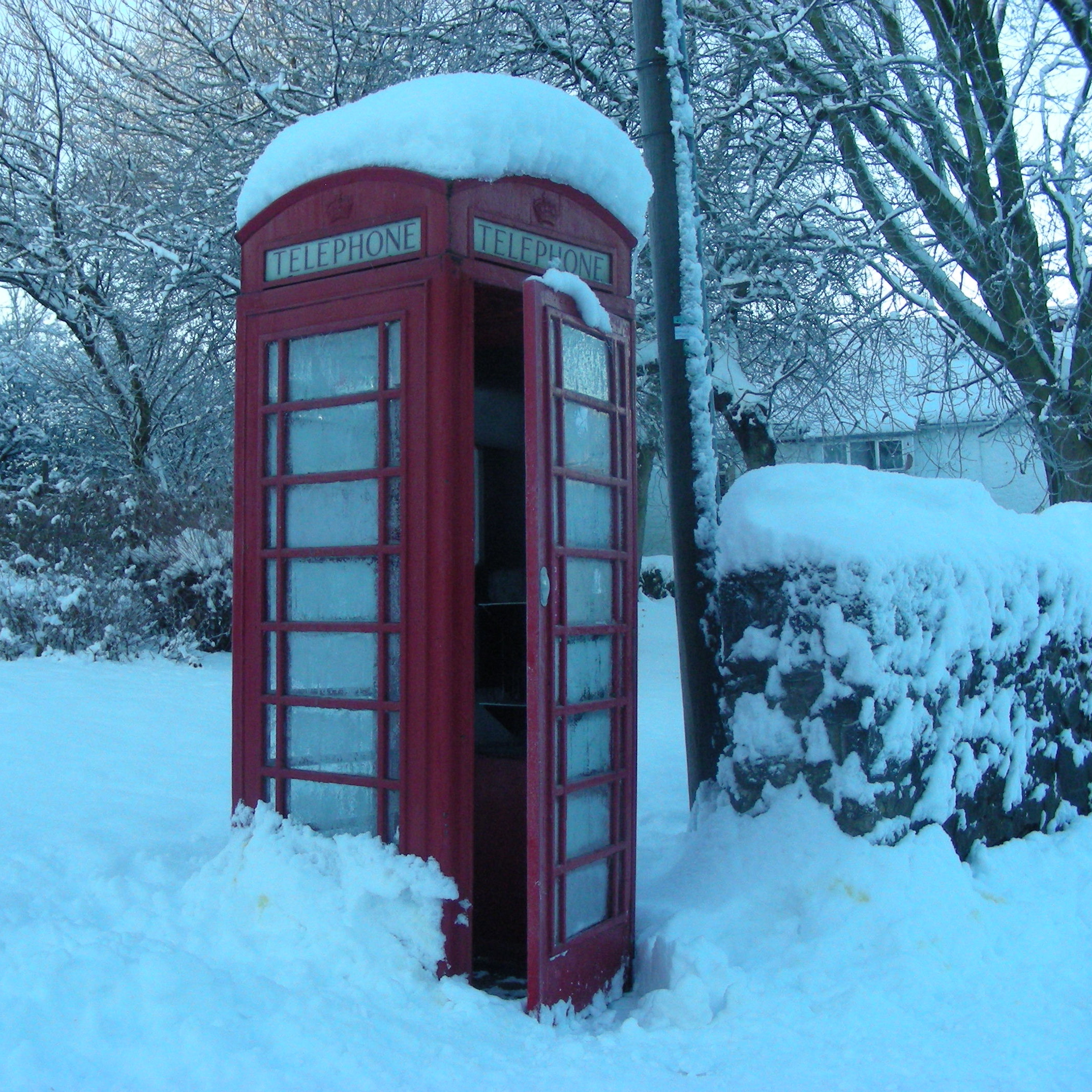
When was the last time you used one of these? Actually, if you don’t live in the UK and you’re half my age (I’m in my 60s), then chances are, you’ve never used one of these. I can’t remember the last time I saw a public phone in France, but there must have been some once upon a time. What were public, shared phones like in your country? Do they still exist?

This stimulates my thoughts on how we communicate. When I was a GP in Edinburgh, my partner, Sandy, and I were one of the first Practices to use mobile phones on call. We had a huge brick sized Motorola thing, and there was only one telecoms mast in Edinburgh so it only worked on one side of Arthurs Seat! How things changed…and how fast!

This pandemic has had an impact on how we communicate too….I don’t just mean what technologies we use, but who we communicate with and when. A lot of communication is now “asynchronous” – which you could have said was the case before the telephone was invented. But I don’t think that text-based or messenger-based asynchronous technologies have brought about a revival in letter writing skills! Of course, we aren’t just using asynchronous technologies, there has also been a huge growth in our use of Zoom, FaceTime, Skype and other video-calling platforms. Then there are social media platforms like Facebook and Instagram, which drive the growth of “one-to-many” communications, “public” communications over “one-to-one” and “private”. Obviously there are many many more, but what’s clear is that for most us, we don’t limit our communications to only one of these services. We are using combinations of them – messenger services, social media platforms, texts, email and video calls, and, hey, some of us still even use the telephone!

So, what do you think? With this vastly increased ease in our ability to communicate, are we communicating better?

Hmm…..I think I’ll take my time over that one.

The first thing that springs to mind is how many people I have reconnected with in the last twelve months. Without this expansion of services, combined with the extended, forced, physical distancing and isolation, then I don’t think that would have happened. But the second thing that springs to mind is the growth of “echo chambers” which feed conspiracy theories, fake news and social division. I suppose the answer to my question depends on how you define “better”. And isn’t that always the case? Isn’t life complex and interconnected? Nuanced and diverse?

Is anything ever reducible to a single label? Like “better” or “worse”? I don’t think so.

However, I still think it’s interesting to spend a little time reflecting on the following three questions –

  • Who do I communicate with?
  • How do I communicate with others? (I mean technologies)
  • and, finally, Does my communication build bridges?

I think that’s the important thing after all – how we use these technologies will always be determined by our intentions – and, hold me to account here, I want all my communications to be open, tolerant, kind, compassionate and understanding. When they aren’t, I want to address that, and improve.

Read Full Post »

This little flower caught my eye. She’s growing, and flourishing, in a small cavity on a rock face. I’ve zoomed right in to see the flower better, but, take it from me, this was a long way up! Frankly, I was astonished. I mean a seed must have blown in there, or been dropped by a bird, and, goodness knows there must have been precious little soil way up there on a rocky cliff face. And yet….not only did that seed germinate, but it grew right up to an adult stage of life, finding sufficient nutrients from who knows where, and has produced these beautiful yellow flowers at the top of the plant. Not only that, but it seems to have grown to a size which exactly fills the size of the cavity.

The first time I saw this, and every time I look at it, I get thinking about the incredible drive of the Life Force….how Life seeks to exist, express itself, and flourish, in a myriad of forms and in more than imaginable habitats across the surface of this planet. Then I marvel at the capacity of Life to be opportunistic….to make the most of whatever conditions it finds itself in and to thrive.

How often do we procrastinate? How often do we tell ourselves we’ll pursue our dreams, we’ll live the life we want to live, but just not until all the conditions are right? How many of us spend our lives waiting for those right conditions to appear?

I think this little flower teaches us a different lesson. Call it “seize the day” if you like. Call it “make the most of today”. It’s a teaching which says “you already live on this Earth with all the conditions you need to flourish”. It’s a teaching about abundance. A teaching about the underlying benevolent, supportive flow of the universe, which has enabled Life to exist, and continues to supply what it needs to grow and to flourish.

You don’t have to wait. Imagination truly has no limits, and loving attention nurtures growth…..starting with the loving attention of self-care, nurturing the desire to exist, to grow, to express your uniqueness, and to flourish.

Read Full Post »

Many years ago I did a road trip to Skye, and as I travelled up through the Highlands, around the island for a few days, then back down to the Central Belt again, I was stunned again and again by the beauty of the country. There’s no doubt that Scotland is a beautiful land. It isn’t best known for blue skies, sunshine and beaches, but, actually, on the right day, all of that is there. However, it’s always seemed to me it’s easier to find the darker, moodier, and I might even say, richer, atmosphere in Scotland. On that particular road trip I think it rained every day, and I got some of the most beautiful photographs I’ve ever taken.

This image captures so much that delights and inspires me. The first thing I notice is the bridge. It’s a traditional, old, stone, single arch bridge. There are dozens like it in the Highlands, and no two the same. I think it’s beautiful and I’m a big fan of bridges because I think they are the technology we humans invented to allow us to do two of the things closest to our natures – explore and connect.

We are insatiably curious creatures, we humans. Some of us more than other I’ll grant, but I still think the desire to explore and discover is as core to us as the Life Force. In fact, Jaak Paksepp, who is so important to an understanding the fairly new discipline of affective neuroscience – the neurological science of our emotions, identified seven core or “prototype” emotions, of which SEEKING is perhaps THE most basic and important. SEEKING is connected to the basic motivational arousal state of all forms of life, and we humans probably access it, and use it, more than any other other creatures on the planet.

Bridges speak to me of that SEEKING, that desire to discover what lies on the other bank of the river, what lies on the slopes of the opposite hillside.

They also inspire me to think of that equally strong drive which is central to our being – connecting. Iain McGilchrist, with his brilliant and detailed analysis of the human brain, shows us how the two halves of the cerebral hemisphere engage with the world in distinctly different ways. The right hemisphere is especially interested in making and exploring connections. Just stop to ponder for a moment – absolutely everything we encounter, everything we experience, everything we think, we connect to whatever else we know and imagine. It’s impossible for us to really consider anything at all as utterly and completely isolated from everything else. We are connection-driven creatures.

But there’s more than a bridge in this photo. There is a river too, which runs under the bridge, and this particular river has very stony banks. Stony banks with small shrubs and bushes growing in it. Rivers never stay the same. The water which flows down from the mountains doesn’t follow the exact same path every day. Some times the river will swell and all those stones will be hidden. Other times it will reduce to a trickling stream revealing vast stony banks. I love the river as a symbol of constant flow and constant change.

There are the mountains too. Tall peaks, so tall here, that the cloud base is hiding their higher regions. I love mountains. They inspire me to remember times I’ve climbed such hills in the past, struggling to get to the top, then finding myself utterly filled with delight at the views laid out before me once I get there (being careful not to go hill climbing on a day like that shown in this photo!) They inspire me too to think of the old philosophical practice of “the view from on high” – how helpful it is to stand back from the busy cluttered flow of the everyday, ascend to a height, and contemplate the bigger picture, change your perspective, and see how life changes as a result.

And then there are the clouds – clouds which hide tall mountains, clouds which dissolve into rain which then trickles down the hillsides to form the rivers which all run off to the sea again. Clouds which merge seemlessly with mists here – hiding trees, rocks and bushes, soaking them all as they pass on by. Mists which drift across the face of the glen like ghosts of clans from the distant past. Yes, I find that mists stimulate my imagination. They lead me to contemplate the invisible, and the traces of the past which still soak the present, the lives from the past which are still with us, carried by us in our genes, our memories and our stories.

Really, I can get a lot of enjoyment out of a scene like this. This is what I mean by “rich” experience, multi-layered, entangled, connected, inspiring……

Read Full Post »

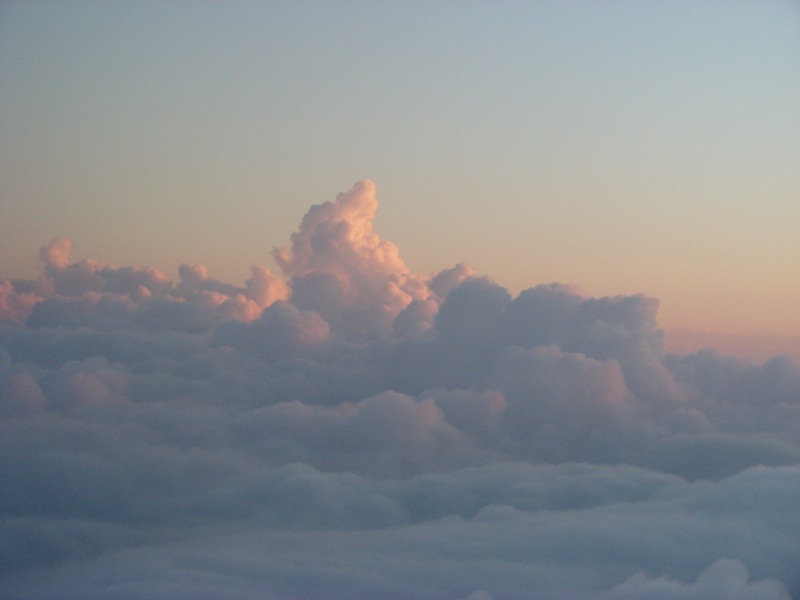
Whether you think of waves appearing and disappearing on the surface of the sea, or of the emergence and disappearance of beautiful forms within a cloud, you know that both the wave and the cloud formation are inextricably connected to either the sea, or the rest of the cloud. Neither exists apart from the environment in which they appear.

We humans are like that too, even if we’ve been pretending to ourselves for hundreds of years that we aren’t. Whether we take on board a religious or a scientific concept that we humans are apart from Nature, we are wrong. Nature isn’t a thing, and doesn’t exist outside of us. We cannot relate to Nature by “dominating it”, or “controlling it”. Partly because Nature is not an “it”, but more so because we are as much Nature as the cloud form is the cloud, as the wave is the sea.

We emerge within Nature, never leaving Nature, never living outside Nature or separate from Nature. Nature isn’t a part of the country to go and visit. But we can definitely understand that the “natural environment” is different from the “built environment” or the “urban environment” – not separate from, or detached from, but different.

There is an enormous amount of evidence that spending time in “natural environments” is good for us. A recent study of 20,000 people showed that two hours a week could be a threshold. Researchers found significant differences in mental and physical health of those who spent more than two hours a week in natural environments, from those who spent less than that. They also found that people who lived in streets with more trees in them seemed to need less prescriptions for antidepressants. Of course, that doesn’t mean we can just replace antidepressants with trees! There are many other factors affecting the environments which people live in. Still, the finding of the benefit of trees, persisted even when the researchers controlled for other social factors.

Of course, we are never really outside of “natural environments”, any more than we can ever be outside of Nature. It’s a matter of degree, isn’t it? We know when there is a lot of life around us – trees, flowers, shrubs, birds and other creatures. What these studies confirm are that we need to be aware of that connection with the rest of Life on this planet. That when we feel cut off from the living world, our health declines.

As we move forward through this pandemic we’re going to have to reconsider how we live, both as individuals and collectively. Some of that change might be best informed by a change of mindset – one which considers that we are “a part” of Nature, not “apart” from Nature.

Read Full Post »

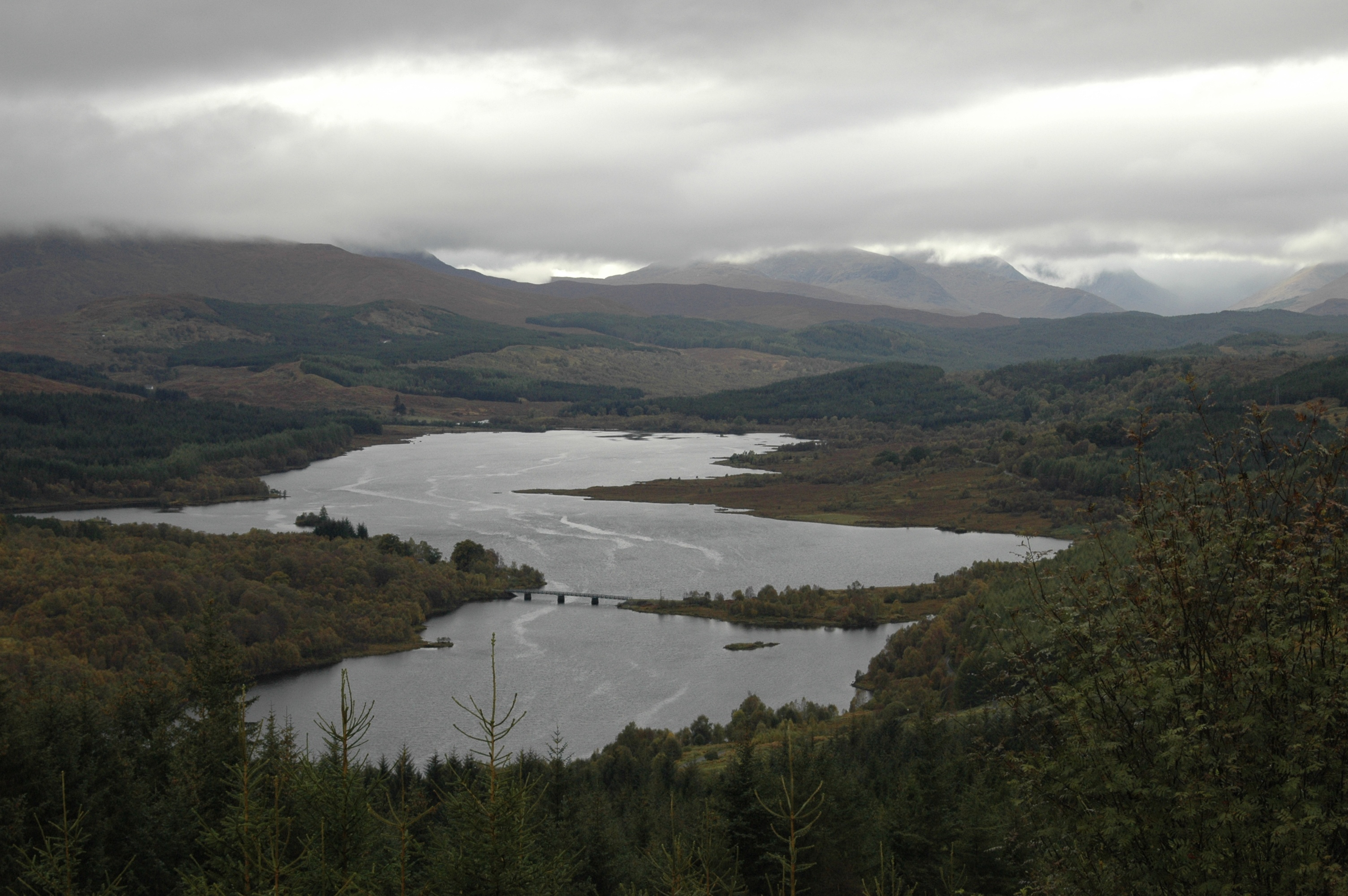
This is Loch Gary. When I stopped at the side of the road to take this photo many years ago, I was struck by how the shape of the loch so closely mimics the shape of the Scotland. It’s almost good enough to be a map!

If you do look at this as a map of Scotland, then one of the interesting little extra things is that the bridge you see could represent the connection between Edinburgh and Glasgow across the “Central Belt”.

I was born in Stirling, a town which is almost equidistant between Scotland’s two cities of Edinburgh and Glasgow. I studied Medicine in Edinburgh, worked there for most of the first two decades of my career then changed to work in Glasgow for the second two decades. There’s a long, long rivalry between these two cities. Each has a very distinct culture, and each is home to remarkably different accents. Maybe because I came from Stirling, people in Edinburgh often guessed that I’d come from Glasgow, and people in Glasgow often guessed I’d come from Edinburgh. I never subscribed to the rivalry between the two cities, liking them both for their very different cultures.

Maybe all of that has contributed to my love of connections, of seeing, accepting and even relishing difference, and my distaste for rivalry and competition.

I wonder how much the geography of our lives affects our values and our beliefs?

What do you think? What comes up for you if you reflect on that?

Read Full Post »

« Newer Posts - Older Posts »