Feeds:
Posts
Comments

Archive for the ‘psychology’ Category

“Don’t draw attention to yourself!” “Keep your head down!” “Don’t stick out like a sore thumb!”

Social pressure to conform.

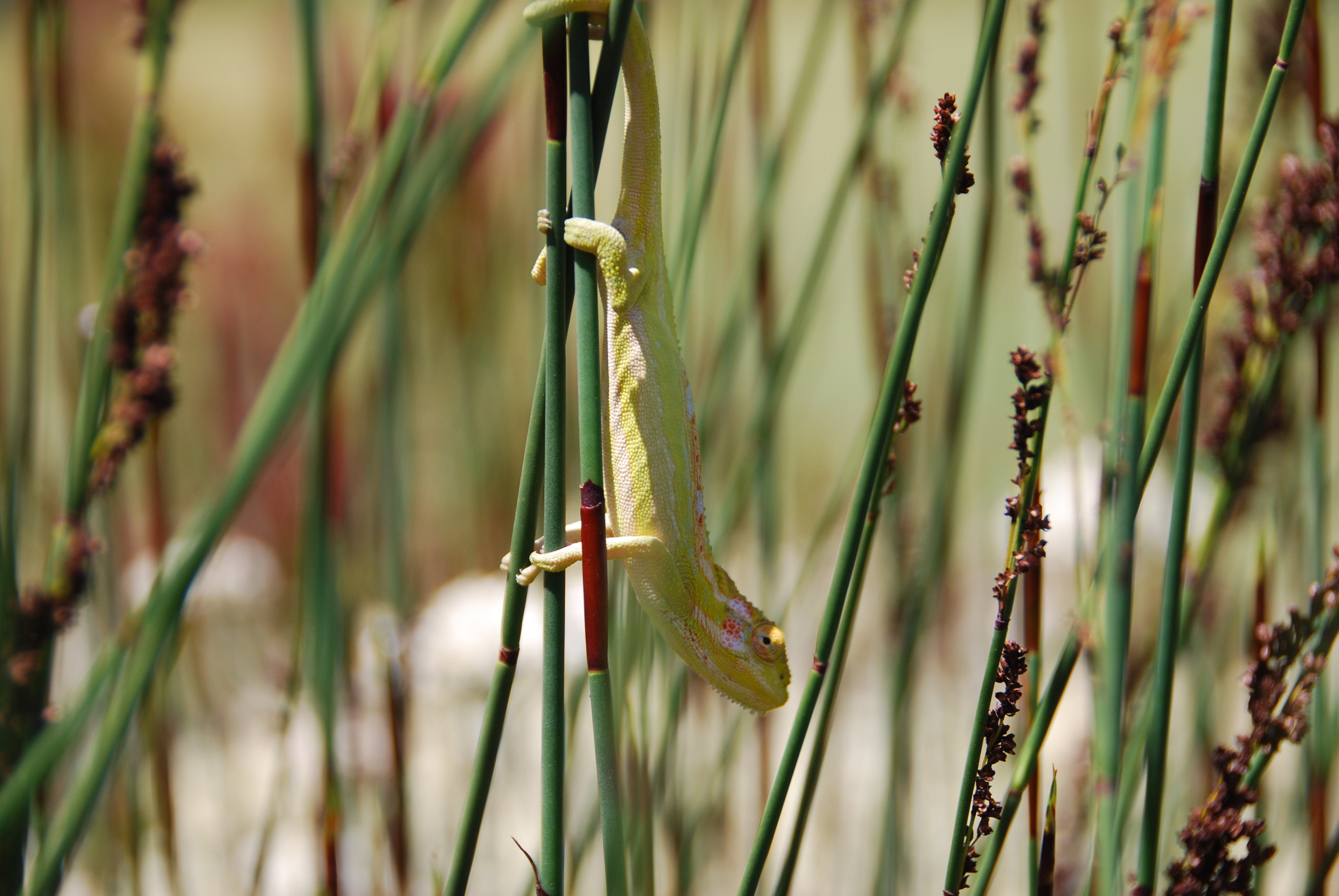
I bet you’ve heard a few of those instructions before. Or others which say pretty much the same thing. The basic idea is that to be safe you need to hide yourself away. Isn’t it a common experience at school that the kid who is really different gets picked on? You can see where all this advice comes from…..as this chameleon demonstrates, disappearing into your environment is a good way to avoid predators, and so stay alive!

But we aren’t chameleons. While there are real advantages to “fitting in” and conforming, every single one of us has a strong sense of Self, and deep feelings of uniqueness. There is, after all, nobody who is “just like you”. The truth is we need to do both – we need to function well socially, which means building healthy mutually beneficial relationships with others, and we also need to develop our autonomy and our self-expression.

The social powers of human beings are incredible, and, as a species, they are responsible for a lot of our survival and development….our success, if you like. But, equally, is there any greater diversity possible between members of the same species as their is between two humans? I’m not sure there is. We’ve evolved such complex nervous systems, such sophisticated bodies and brains. We have consciousness, imagination, language. We just can’t stop ourselves from co-creating and from expressing our uniqueness.

I wrote a book based on “and not or” because I think this is perhaps the most important characteristic we have – the ability to handle paradoxes. It’s built in. The cortex of the human brain is divided into two almost equal parts, with each part (hemisphere) engaging with the world in its own distinct way……the right seeking connections, the new, relationships and an understanding of the raw whole, whilst the left focuses, analyses, labels and categorises. One half giving priority to living relationships, the other most at home with objects and machines which can be measured and controlled.

It’s the same then with conformity and uniqueness. We do actually need both, because we need to be aware of our uniqueness and self-fulfillment involves fully expressing that uniqueness, and we equally need to form mutually beneficial relationships with others, which involves finding points of connection, shared values and desires, tolerance and respect.
Read Full Post »

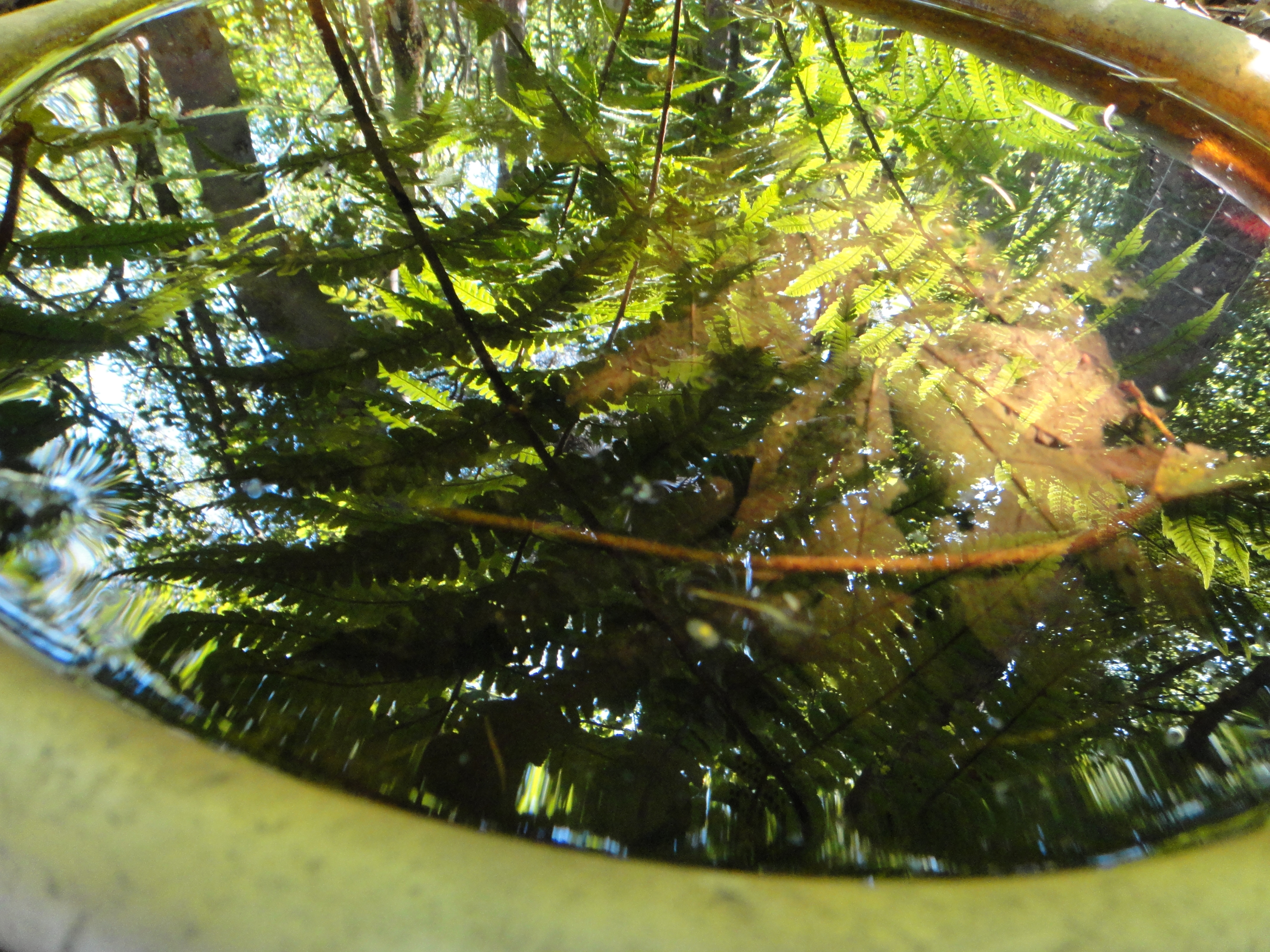
I have a fascination for reflections. I love to gaze into pools, ponds and fountains where the water is fairly still and you can see the world around you reflected on the surface. So, this is one of my favourite photos. I found this old stone basin full of water just sitting abandoned in a forest. I don’t know if the forest makes the image more magical for you, but it does for me.

As I gaze at this simple bowl of water I see the reflections of the trees and ferns which surround it, but I also immediately see fallen leaves lying below the surface….in other words I can both the living leaves and the dead leaves at the same time. That superposition strikes me as both interesting and beautiful. It’s as if I can see a snapshot of the past and the present in exactly the same moment, as if time itself collapses. Then I also notice the ripples on the surface of the water…..the water’s surface has its own shape. It’s not the same as a sheet of mirror glass. It’s moving, changing, dynamic. I’m sure if I had a microscope and sampled some of the water I’d find whole families of creatures in here, but with the naked eye, I see only the plant life and the water itself.

An image of Galadriel in Lord of the Rings gazing into her magical pool comes to my mind, and that layer of fantasy, of fiction, of story, just enriches the experience of the encounter.

I see green life everywhere and stand amazed at the abundance and diversity. I see the water itself as filled with life, filled with history and filled with potential……a memory bank, a lens and a crystal ball all rolled into one.

You know, I think one of the best ways to enrich our daily experiences is to see the connections, the threads, the traces, the reflections, echos, and to follow them for a bit. That way I don’t see a simple “object” but I encounter another aspect of manifest reality, a changing, particular, and unique aspect which involves me, the “subject” who is having the encounter. But that old “object”/”subject” split doesn’t satisfy me any more. It now seems that there really isn’t a clear division between objects and subjects in this universe. Rather that there are an infinite number of layers of connection, some of which appear as “objects” and others of which appear as “subjects”.

There really is nothing which exists in isolation.

Prove it to yourself by exploring some connections for yourself. Notice the threads, the roots, the knots, the intersections, the reflections……..I bet you find it an enriching, enchanting experience.

Read Full Post »

My word for 2021 is a French word – épanouissement. Translated into English it has various connotations but basically it means “blossoming” or “opening up”. It’s also used in psychology to refer to the development of the personality, or the self – it means “fulfilment”, or, more specifically, “self-fulfilment”. It can also be used in the description of someone’s face, as when their face “lightens up”. You get the idea?

This peony which I saw in Ueno gardens in Tokyo many years ago captures this notion for me by somehow conveying motion within a still image. Because the beautiful petals are unfolding and opening up in a spiral manner, this looks a bit like one of those little windmills you might have played with as a child. As a physical pattern this spiralling, whether in an opening up, or a closing up, speaks to us of movement. It’s not as static as some other geometric patterns appear.

That element of motion conveyed by this flower’s petals is, I think, an essential part of the whole concept of “épanouissement” – in other words, it’s always a work in progress. It’s not a goal, at least not as an end point, or an “outcome”. It’s a ongoing, growing, developing, evolving, ever-changing phenomenon. And that’s exactly what I think the development of the Self is like.

We are not fixed entities with identities held in aspic. We are not separate, not unconnected, not static. Rather we emerge from within the vast web of Life, never leaving that web, but developing a coherent sense of Self within it, a sense of Self which never stands still, and which, ultimately ebbs back into the great web itself.

Here’s the exciting extra part that you and I can access – consciousness. We have Will and we can make choices. We are “agents”. We are the “co-creators” of reality. We can do that consciously, and deliberately, or we can drift, reacting rather than responding to every change and signal which comes our way. When we wake up, become more aware, then we can choose how to respond, moment by moment, day by day, year by year.

So, here we are, still in the throws of this pandemic, but we have not stopped changing. The thing is – we are now more aware of our inter-connectedness, our inter-dependence, not just with other human beings across the entire planet with all of Life, all of Nature, all of The Earth, as active, living members of Gaia.

So what does that mean for our “épanouissement”? For our “unfolding”, our “self-fulfilment”, our “flourishing”? How are we going to blossom now?

Those are some of the questions that float around in my head these days. These feel to me to be some of the most important questions for me to answer now. This pandemic has challenged our values, our aspirations and our modes of living. How do we want to evolve all three of those? Our values; our aspirations; our modes of living.

Read Full Post »

This pandemic with its lockdowns (or “confinement” as we call it in France) has been, and continues to be, tough for a lot of people for many reasons. It’s the biggest global disruption of our way of life that most of us have ever experienced. So many “normal”, “everyday” and “routine” activities and experiences disappeared over an incredibly short period of time. Apart from the disruptions of work, family and social life, we’ve seen an end to “mass” everything – no crowds of spectators at sporting events, no theatre or cinema audiences, no music concerts, no festivals…..well, I’m sure you can add to that list.

However, there have been two positive developments which I’ve read that many people have experienced – one inner, and one outer which enhances the inner. Pardon? Let me explain.

With the shrinking of our horizons, physical and social, many of us have been spending more time in contemplation – yes, maybe deliberate meditation or other such exercise, but, also a more general reflection. A kind of reassessment and revaluing. It’s given us the time and space to become more aware of our habits and routines and ask if we want to re-establish them when the time comes (when the pandemic is over).

What patterns of behaviour, what modes of living, what activities have been disrupted that I don’t want to re-establish? That I want to let go off.

What new patterns, rituals, activities do I want to create instead? What new ways of living do I want to begin?

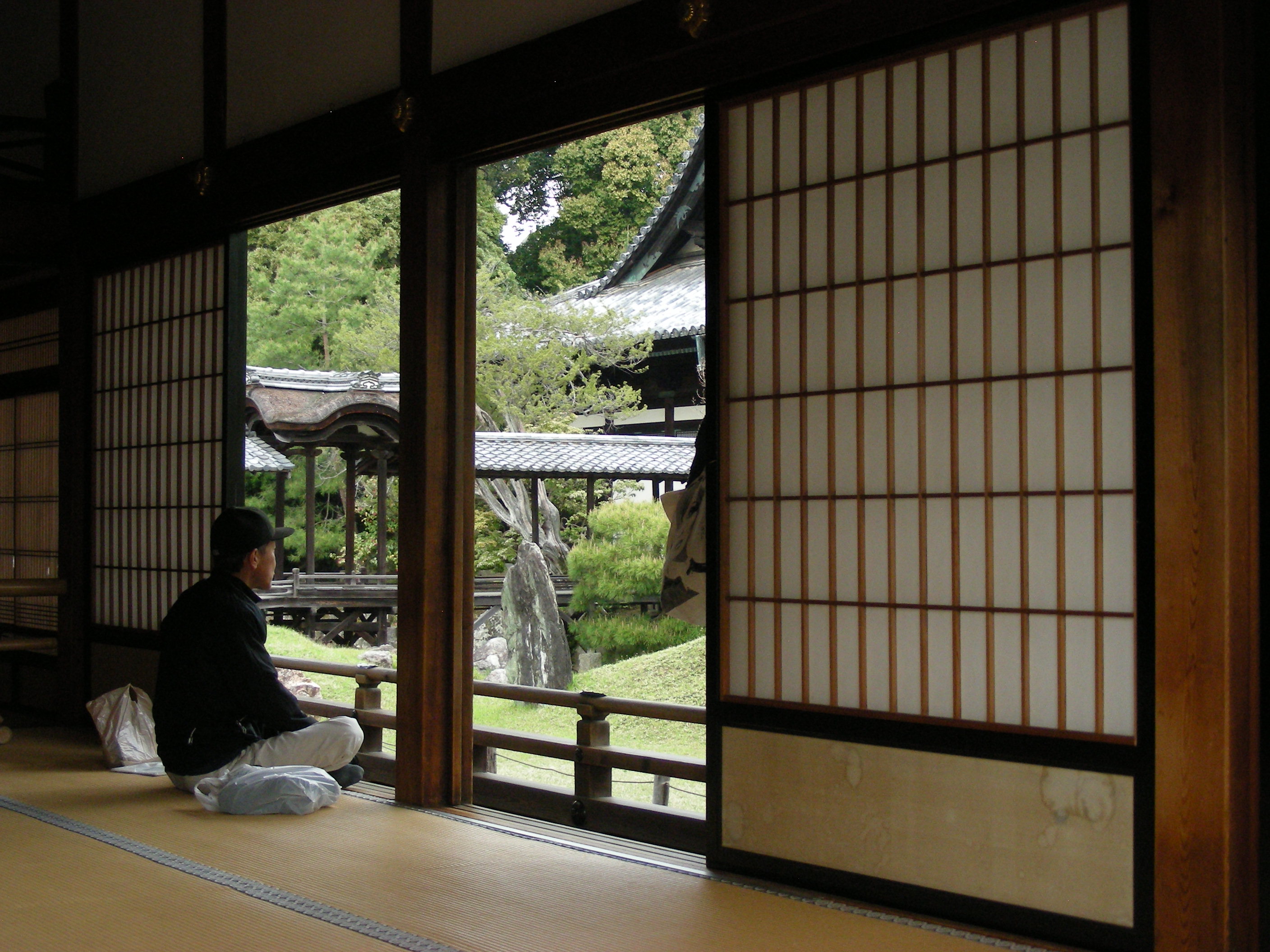
This un-asked for, and, frankly, pretty unwelcome, pause, is a real opportunity for both awareness and change. You don’t need to have a meditation space, like the man in this photo, to do that, but maybe there’s something inspiring in this image anyway? Maybe it would be good to create, if possible, a place, a space, which we find is conducive to contemplation and reflection? Or maybe we can do that wherever we are?

That’s the inner – this is an opportunity to develop our inner selves – to pay some more attention to our physical and mental health and our lifestyles. To become aware of our habits of thought and feeling and ask ourselves if we want to develop along different paths now.

The second is about what we call “Nature”. You know, I’m a bit uncomfortable about talking about “Nature” as if Nature is a thing, and more than that, as if “it” is a “thing” “out there”. We are part of Nature, not apart from Nature. But then, we’ve sort of forgotten that, as a species, and maybe that’s one of the problems which has brought us to this pandemic. So, maybe this is a great time to reconnect, to re-engage, to re-orientate ourselves with regard to the “natural world”.

I’ve found that noticing the cycles of the flowers, the vegetables, and the trees, has become something I am much more aware of now. I’ve found that I’ve noticed many more species of birds in the garden. I’ve noticed that when I’ve had the chance a walk in vineyards, in amongst some trees, or along a sandy beach on the Atlantic coast, then I feel a huge boost. That shouldn’t be a surprise. I’ve written before about the recognised benefits of spending time in the natural world – to the extent that some people now talk about “Nature Therapy“.

There is something truly life enhancing about becoming more aware and more engaged with “the natural world” and from “forest bathing” to spending time in open spaces we know that such activities boost the chemicals in our bodies and minds which influence our immune system, our moods and our thought patterns.

So, connecting better to the “outer” enhances the “inner”.

Again, you don’t need a beautiful Japanese garden like the one in this photo, (although, isn’t that gorgeous?) – but I recommend taking advantage of this time and space to develop your inner self, and your connected self, by grabbing or creating every opportunity you can get to do so.

Contemplation and Engagement with the Natural World.

Read Full Post »

I took this photo of a path in a Japanese garden because I’d never seen wavy tiles like this before. In fact, having seen this one, I then came across several more. Although, many years on, I’ve never seen paving tiles, or stones, like this, for sale anywhere in Europe.

Maybe some of you will look at this and feel a bit unsteady, or dizzy, because they give the impression of flowing water, and you know how it is when you stand at the edge of the ocean and after crashing onto the sand, the water runs back between your feet, back to where it came from. It can feel quite destabilising. So, I think these wave forms have the power to communicate the sensation of movement, of flow, of change, and, yes, even of direction.

But I didn’t find them at all destabilising when I walked on them, rather I felt like I was walking/surfing/skiing/sailing over the surface of the Earth…..or maybe, rather, over the surface of the oceans. I love how this simple shape laid out in this repeating pattern captures the sense of life and movement. It felt completely different from walking over a pretty featureless tarmac, or over square, right angled, hard edged, separate slabs.

The other thing I thought of as I walked along this path was the story that Susan Jeffers tells in her famous “Feel the Fear” book, where she describes how a plane traveling from A to B spends only a tiny percentage of its time actually heading in the exact direction which would be a straight line between the two points. Rather the pilot is constantly adjusting the direction of the flight of the plane, a little bit to the right, then a “correction”, to the left, then back again, and so on. It’s a lovely metaphor for the need to be flexible and adaptable. It shows us how we need to proceed by going a little bit this way, then a little bit that way, all the time. It’s a counsel against so called “perfection” – as if there is “only one right way”. There never is.

Read Full Post »

In many ways this is a very simple photograph. What do you see?

Having ignored the “rule of thirds” in my composition, I’ve put the cherry blossom bang, smack in the centre of the image. It’s literally right in front of your eyes. It’d be pretty hard to respond to the question “what do you see?” without referring to the cherry blossom, don’t you think.

But I’ve long since had a fascination for appreciating the whole over the parts, and in this photo, I think it’s equally difficult to ignore the presence of the “background” – the bamboo – even though I’ve blurred that background for the purposes of contrast.

When I look at this I definitely see “cherry blossom in front of a bamboo forest” – well, I was there at the time, and I remember that. You might not be aware that the bamboo is part of a whole bamboo forest, but you can certainly see bamboo stretching in all four directions to every edge of the image.

This insistence on seeing both the foreground AND the background to have full appreciation of the scene, is consistent with my desire to always take into consideration contexts and environment when I encounter anything. For example, in my work as a doctor, a patient would “present” to me their symptoms, and with my knowledge, plus any relevant physical examination, and, if necessary imaging or tests, then I would make a diagnosis – probably the diagnosis of a “disease”. A “pathology”. But that was never enough. I had to see the presence of this foregrounded disease in the context of the backgrounded personal life story. I had to “situate” the disease into the time, place and meaning of this individual’s life. If I wanted to understand, not just the “illness” as the whole experience of the patient, but how it came about, what impact it is having, and how it might change this person’s perception of themselves and their life, then I had to see them “whole”, not limit my focus to the the “presenting” parts.

I think this same principle applies throughout the whole of life. If I want to understand anything about my life, about others, about this planet we all live on, then I need to see the “whole”. It’s not good enough to reduce reality to a data set, a package of characteristics and elements. I always need to consider the connections, the relationships, the contexts and the multiple layers of environment and meaning. I know that doesn’t sound as quick and easy as focusing just on a part or two, but, hey, who said reality could ever be reduced to what was quick and simple without losing all understanding? Not me.

Read Full Post »

Apparently we are the only creatures on the planet to create works of art. I know, you’ll have seen some painting done by a chimpanzee or an elephant, but they aren’t exactly spontaneous acts of self expression or interpretation are they? No, Art is something unique to being human. There are many examples of “wall art” or “cave art” in France, discovered in recent years but painted some tens of thousands of years ago. It seems that even way back when our ancestors were nomadic hunter gatherers supposedly spending most of their days on the survival needs of food, water and shelter, they still had time to create astonishingly complex art, and, for some reason, often carried them out in the most difficult locations deep underground.

I’m using the term “art” here as broadly as I can, but I mean the kind of art which included drawing and painting. I’m not excluding the fabulous arts of sculpture, of music, of storytelling, poetry, dance, and so on, but, for today, I’m focused on visual art.

For me, Art is an experience. I don’t regard Art as an object, or a collection of objects. It’s an event. It’s an engagement. It’s a moment where we connect to what is greater than ourselves. It stirs our emotions, sparks our imaginations, and stimulates our empathy……we connect to the artist and/or the world as experienced by that artist.

Every work of art was created in a particular place at a particular time, and I mean that not just in the externals of geography and history, but in the internals of a personal life story, an individual, subjective, lived experience. So when we encounter that work of art at some other time, in some other place, we experience a (sometimes) powerful connection with the artist, with the life of the artist. I put “sometimes” in brackets there because it’s certainly not the case that all art has a powerful effect, and I’m not even clear about what it is that makes the difference. I do know, however, that the power of art is dependant on both the person creating the art, and the person experiencing it.

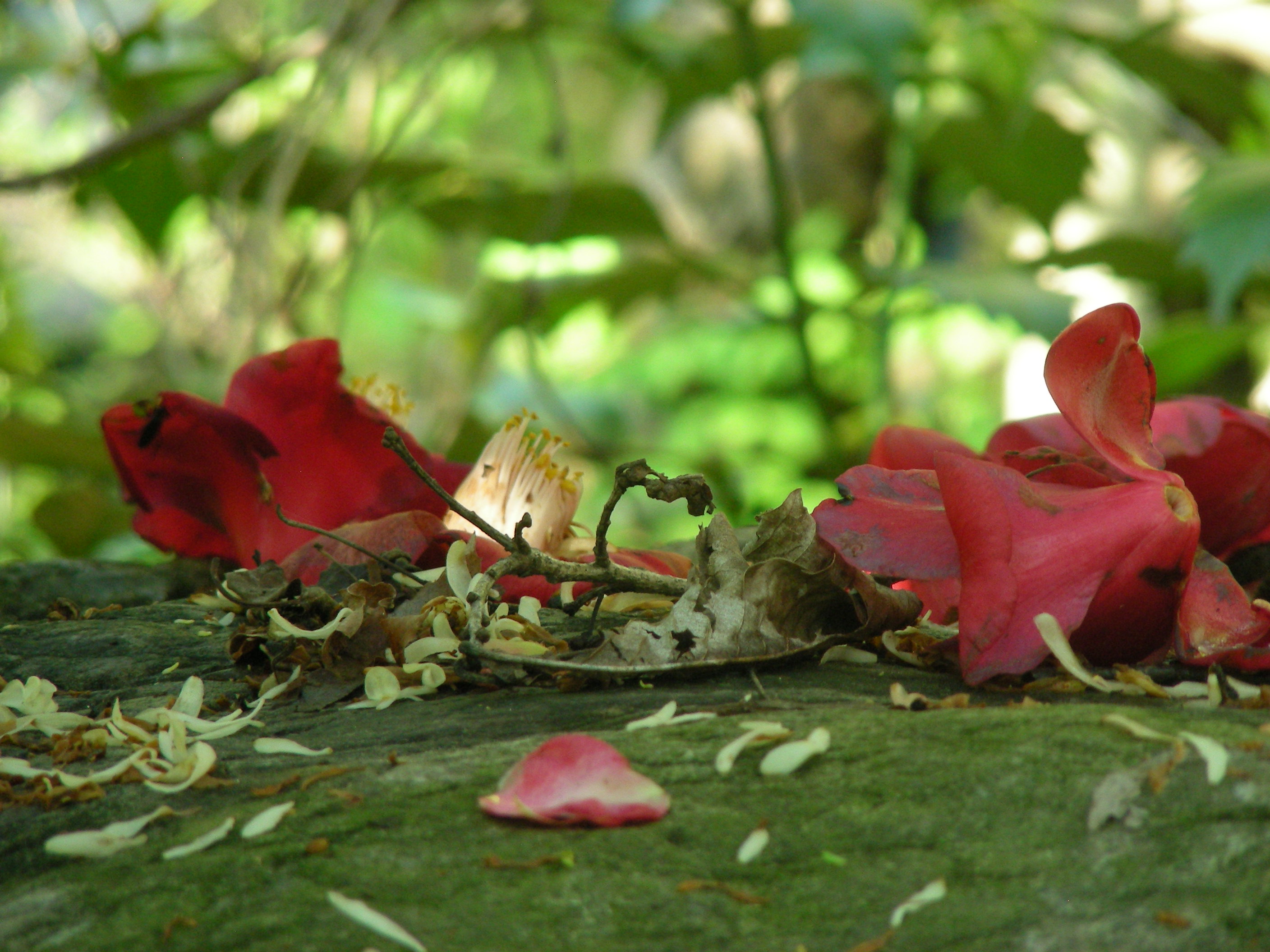
All this came to mind when I looked at this old photo I took in Japan many years ago. It just looks like a work of art to me. It reminds me of the classic traditions of “Still Life” (which I find such an odd term because no life is still), or, as it is called in French “Nature Morte” (which translates as “Dead Nature” – nope, can’t say I like that any better!). The twig, the leaf, the petals and the stone all look as if they have been arranged in the most beautiful way.

But here’s the thing….I don’t think this was created by human hands. I just stumbled upon some fallen parts of plants, lying on a stone in a garden, crouched down, framed it, and took this shot. OK, so maybe I’m the artist. Maybe the work of art is the photograph. But what I mean is that so much of everyday Nature looks like a work of Art. Creation, the cycles of birth and death, the seasons and the weather, the light, the water and the air, the myriad of diverse lifeforms everywhere, all adds up to an infinite number of opportunities to encounter deeply moving Art.

Because this moves me, this image. Yes, I know, I have a set of memories connected the to event of taking the photograph, which you don’t have, but there’s something about the colours, shapes and nature of the elements in this arrangement which I find deeply moving……which stir in me, memory, imagination and wonder, which provokes joy and delight, which makes me amazed to be alive in this, this most astonishing, small blue planet, we call Earth.

In an image like this, the artist I connect to is Planet Earth.

Read Full Post »

It’s interesting how we use the verb to light in English. This photo is of a full moon, but what it shows best is the foliage of the tree through which I took the photo. I like the effect very much.

The Moon has no light of its own. It’s not like the Sun. It doesn’t generate any physical light, but, rather reflects the light of the Sun. That makes the light of the moon a completely different kind of light than that from the Sun. For a start we can gaze directly at the Moon for as long as we want, but we daren’t even stare directly at the Sun for a second without running the risk of damaging our eyes. I suppose that makes it easier to contemplate the Moon than it does the Sun.

The Moon’s light is a softer, gentler light, but on a clear night with a Full Moon you can still find your way around in the dark. It’s enough to give us a hint about what is around us in the world. But the colours aren’t there, and neither is the clarity which daylight brings. So, it almost demands that we use our powers of imagination and creativity more. After all, vision is a creative process. You know that, right? Our brain doesn’t contain something like a movie screen for us to watch the moving images. In fact, light itself doesn’t even get into our heads. Instead our eyes convert the light to electrical signals which are passed along a vast network of nerve cells in the brain and the brain does the job of analysing all the signals, and somehow creating clear images for us to perceive – images without any gaps in them, despite the fact that the back of the eye has a “blind spot” where no light can be detected. We literally create the images we see moment by moment.

Creativity involves an interplay of memory and imagination with the current information being received by the sensory system. It’s a true, continuous blending of the present, the past and the possible futures.

I think that by moonlight, without the clarity of colour and forms, we demand more of the imagination and our creative powers to enable us to see our way in the world.

Moonlight also works through symbolism and story – is it possible to contemplate the Moon without thinking of Venus, of Love, of Romance, of the Divine Feminine? It is, but it’s not nearly as rich an experience when we ignore all that. We associate the Moon with the unconscious, with feelings and with rhythms of tides and hormones. We associate the Moon with a certain wildness of thought – the word “lunacy” meaning madness has the word for “moon” right in there – “luna”. I’m not going to get into a detailed description of the history of madness and psychiatry here, but let’s just say our understanding of the psyche and of “mental illness” is ever changing and we still don’t really understand the more severe forms of disturbance, the “psychoses” which come with “hallucinations” and “delusions”.

So, when I see a Full Moon, or even one of the phases of the Moon, I don’t just see the physical, reflected light of the Sun, but I see a whole world of imagination and enchantment.

Read Full Post »

How do you grow a forest?

One seedling at time.

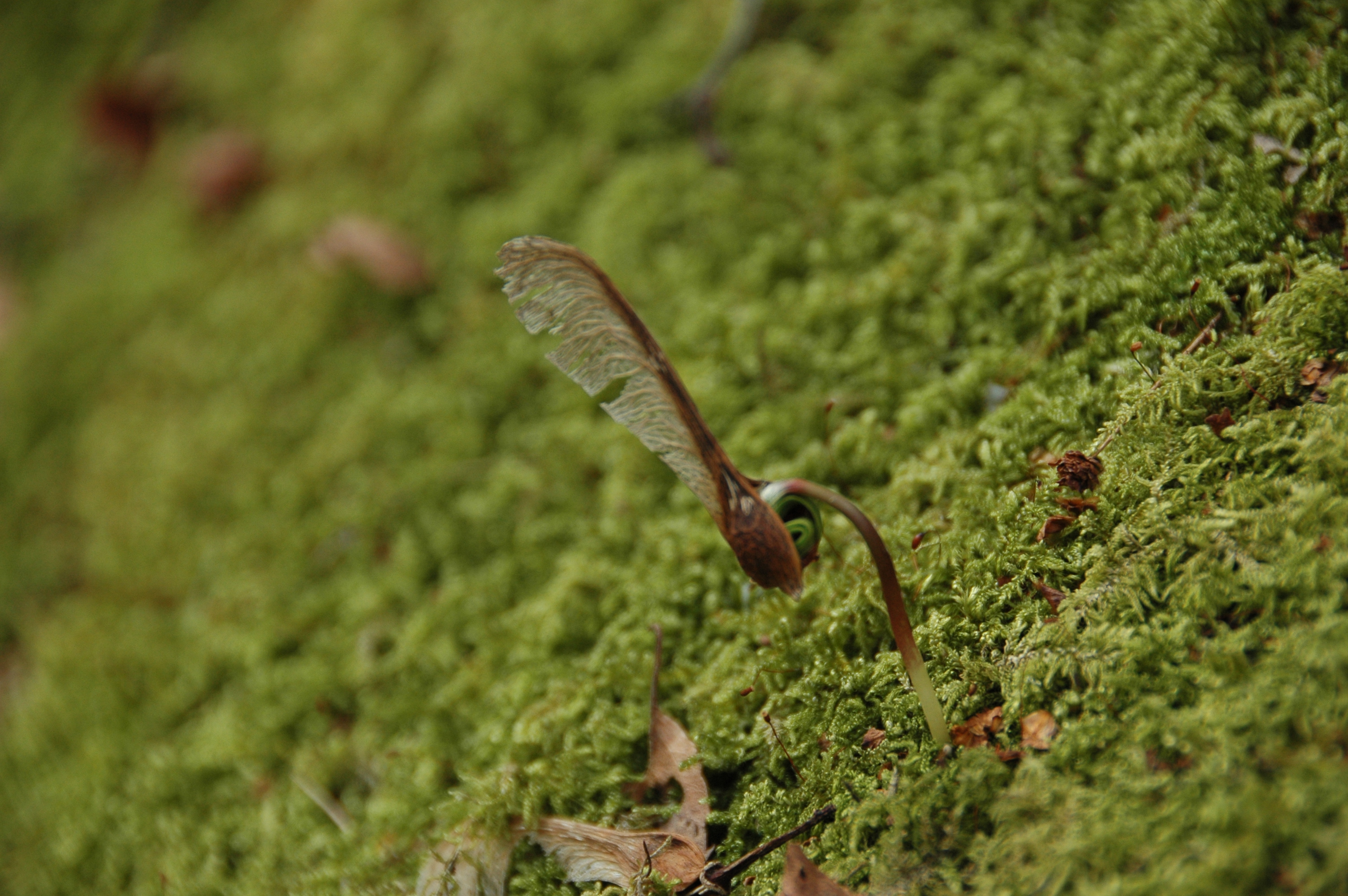
This beautiful little seedling is captivating. I spotted it growing from the moss covered forest floor, the seed casing with its wind driven system of flight and dispersal still intact, but the bright green of new growth clearly visible, and the beginnings of the spiral of unfolding showing us that this little seed has taken root, and is beginning the long journey to become a tree.

It makes me think about the relationship between the tree and the forest, between the particular and the general, between the individual and the group. A relationship I think we tend to get badly wrong. With the rise of statistically driven data collection and analysis, along with the development of algorithms, we reduce the unique person to a point in a set far too often. We pick one, or a handful, of observable, measurable characteristics, categorise them and use them as the be all and end all.

We define people according the group we’ve put them into. In so doing, we fail to see them as unique, individual, human beings. You just can’t know and understand a person from a data set. It’s not enough, and it’s often a fast track down the wrong cul-de-sac.

We make people invisible by reducing them to examples of a group.

All my working life I saw one person at a time…..whether that was in the GP surgery, with a rhythm of one patient every ten minutes or so, or in the specialist referral centre for people with long term intractable conditions, where we’d spend an hour to an hour and half for the first visit, then about twenty minutes for each follow up. In both these settings the rhythm of my day was determined by the scheduled appointments allowing me to give full attention focus to every single individual who came to consult me. I found that a great meditation practice, a great way of continuously coming back to the present moment…..not thinking ahead to who might come next, and not hanging on to the story of the person who has just left the room….but, rather, encountering the crowds, the queues, the “lists”, one person a time.

Of course I learned a lot from all these individuals which informed me about others. But the point is, it was a practice of focusing on the individual, and gleaning the general knowledge from there……not learning the general knowledge and trying to force each person into the right pigeon hole.

I learned from the work of Iain McGilchrist that this was the result of how we use the two hemispheres of our brain. The left hemisphere focuses in, abstracts information from its contexts, labels it and categorises it. It works with sets, groups, and generalities, continuously trying to fit new information into what we’ve learned already. The right hemisphere, on the other hand, focuses on the whole, seeking what is unique and particular in every context, every relationship, every circumstance, endlessly fascinated with what’s novel and what’s particular. As he says in his “Master and His Emissary”, we’ve let the left hemisphere become the dominant one, but evolution never intended that.

It’s time to re-balance, to prioritise the approach to life driven by the right hemisphere and to reap all the potential benefits of the analytic, labelling and classifying left hemisphere by handing those insights back to the right – in other words, by putting whatever we encounter, whatever we understand, back into the contexts and environments in which we found it.

We need to re-learn how to experience life, one seedling at a time. That’s how we’ll grow a healthy forest.

Read Full Post »

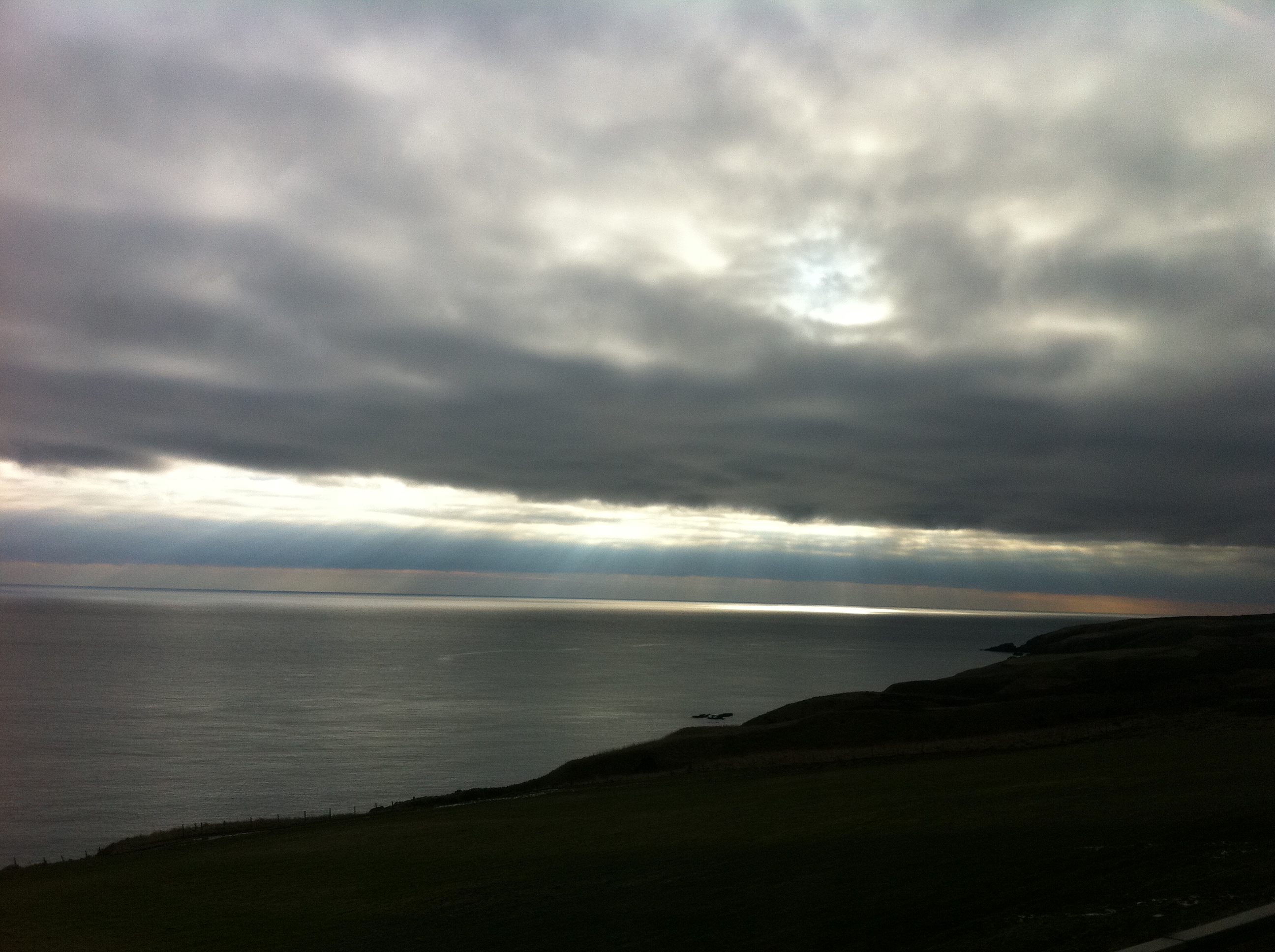
I love to photograph light….sunbeams, dawn, sunsets, moonlight, you name it. But I am especially drawn to scenes where there is a lot of contrast. I just love an image like this with the dark land before me, the grey clouds above, the grey sea below, and then, there on the horizon, at the far edge of the scene, is a display of sunbeams stretching down to the make the sea shine, and turn the grey clouds, blue.

Maybe it’s the yin and yang thing that attracts me. That’s been my favourite symbol for most of my life, and I have worn a rose gold/yellow gold version of it around my neck for decades. I love that statement of reality which isn’t just that there are always opposites, but that neither can exist without the other. I also love what that symbol says about the constancy of change.

Or maybe we are all drawn to images of sunlight on far horizons. Maybe they spark our imaginings and our longings for what might lie ahead, and give us hope as we journey towards it.

What do you think?

Are you also drawn to both the light….and the dark?

Read Full Post »

« Newer Posts - Older Posts »