Feeds:
Posts
Comments

Archive for the ‘Uncategorized’ Category

Wide open

Yesterday I wrote about the exercise of taking the “view from on high“. Today, I’m returning to another of my favourite themes and activities……the wide open.

Maybe it’s because I was born and brought up in Scotland, or maybe it’s something many of us share, wherever we live, or wherever we come from, but a view like this opens me up to the world. An expanse like this, including a clear view of distant, snow covered mountains, reflected on the surface of a body of water makes me want to take a big deep breath in, slowing empty my lungs, and just take it all in.

This simple action of slow, large in-breath, followed by an even slower, longer out-breath, activates the parasympathetic nervous system, and it’s this response in the body which slows the heart, lowers the blood pressure, and relaxes our muscles.

The wide open natural environment opens the heart and the mind. In one and the same moment, I feel calm, feel my consciousness expand, and my heart open to this one, amazing, beautiful planet. I feel gratitude, contentment, and peace.

As the boundaries between my individual self, and the whole of the planet, of the universe even, dissolve, I experience awe, and know, in my heart and my mind, that I am inextricably connected to what is greater than me.

I am quite a fan of forest bathing, of the influence of trees on our health and wellbeing. I’m also a fan of being in the garden, listening to the birdsong, feeling the warmth of the sun (not in the midst of winter however!), and wandering around to discover what new plants and creatures I can find sharing this little space with me. But the experience of standing in the “wide open” is something else. It has a power. I recommend it.

Read Full Post »

There’s what some people call a spiritual practice taught by the Classical Greek philosophers. It’s called “The view from on high”. I thought of that when I looked, again, at this photo which I took from the train crossing the Alps last year.

The idea of the view from on high, is about taking an overview. It’s about seeing the context of something, seeing the “bigger picture”. We can be too close to something, so close in fact that we can’t “see the wood for the trees”. The answer is to go higher for a more comprehensive perspective.

Although the Greeks didn’t know it, this is advice to access your right hemisphere. The left hemisphere of the brain has a very narrow focus. It enables us to zoom in, separate out elements, and grasp what we are looking at. But the right hemisphere takes in the context, sees the connections, enables a more holistic understanding.

Of course, it’s best when we use our whole brain, not just half, but, sadly, we’ve developed the habit in our cultures of thinking the left hemisphere knows best. It doesn’t. It only helps us when we take its “re-presentation” of reality back into the right hemisphere, to situate it in the whole.

Reality is not made up of pieces which are assembled. Reality is a whole, in constant flow and change. Stepping up a level and taking “the view from on high”, can help us to appreciate that.

Read Full Post »

Living on the edge

I imagine that the first thing you notice when you look at this image is the sea. In fact, it was the sea which caught my attention, and triggered my camera release. But when I review it now, my eye is drawn from the water, to the rocks, and then to the houses perched on the top of the cliff. Strangely, I didn’t notice them when I was taking the photo.

How would you like to live there? Right on the edge?

You’d certainly have a fabulous view of the sea every day, for as long as you wanted to. As best I know house prices on the coast, with a sea view, are pretty much higher than house prices inland, so, perhaps most people are keen to live on the edge.

Others find it a bit scary. They’re not so secure perched on the top of a cliff, and open to the winds and storms which sweep in from the sea from time to time.

We’re all different.

The philosopher, Gilles Deleuze, writes about the “far from equilibrium” zone. It’s where change occurs. It’s the closest area to chaos, to phase changes, to producing emergent phenomena which we couldn’t predict. He says that when we follow a “line of flight” towards the edge, things can become clearer. In the middle, in a balanced, and relatively static place, the mix of streams of information and energies can make it hard to distinguish characteristics and themes, but as you stretch out towards the edge, it’s a bit like unravelling a ball of threads, each colour becomes easier to see.

But there’s something else about living on the edge which occurs to me. I’ve noticed the word “extreme” is used a lot these days, especially in politics, and always with an intention of shutting people down. Some views are described as “extreme right”, others “extreme left” (sometimes the word “extreme” is replaced with the word “hard”) but what does it tell us about the person to whom we are attaching this label? It’s a judgement, not an observation. The label is applied differently in different contexts of course. As I understand it, something like “universal health care” is described as an “extreme” view by some (much more so in the USA than in Europe). Here in France, that’s definitely not labelled “extreme”.

I’m wary of labels at all times, but I’m especially wary of this “extreme” label. It doesn’t tell me anything. I want to hear what the person has to say. I want to understand their world view and their beliefs. I want to explore their values. Labelling them doesn’t let me do that.

By the way, understanding a point a view, doesn’t mean you have to adopt it. It can, however, open up some points of common ground, and shift the discourse away from the harmful polarised quality which seems dominant at this time.

Read Full Post »

Transient pathways

Even on a calm day, the sea is neither still, nor flat. Looking out over the Med from Sicily I noticed these pathways on the surface of the water. I’ve seen this phenomenon pretty frequently and every time it captures my attention.

Firstly, it’s beautiful. Life is better when we look out for the beauty which surrounds us.

Secondly, it’s curious. Life is better when we wonder, when we are aware of the truly amazing phenomena of nature.

Thirdly, it’s inspiring. When I look at a scene like this I realise how little I understand about this world. I am in awe.

Truly, this is an awesome planet. We should really be careful about how we change it, how we live on it, every single day. Because we do change it, every one of us, just by making our daily choices, just by where we focus our attention. We leave our marks. We leave our traces.

Read Full Post »

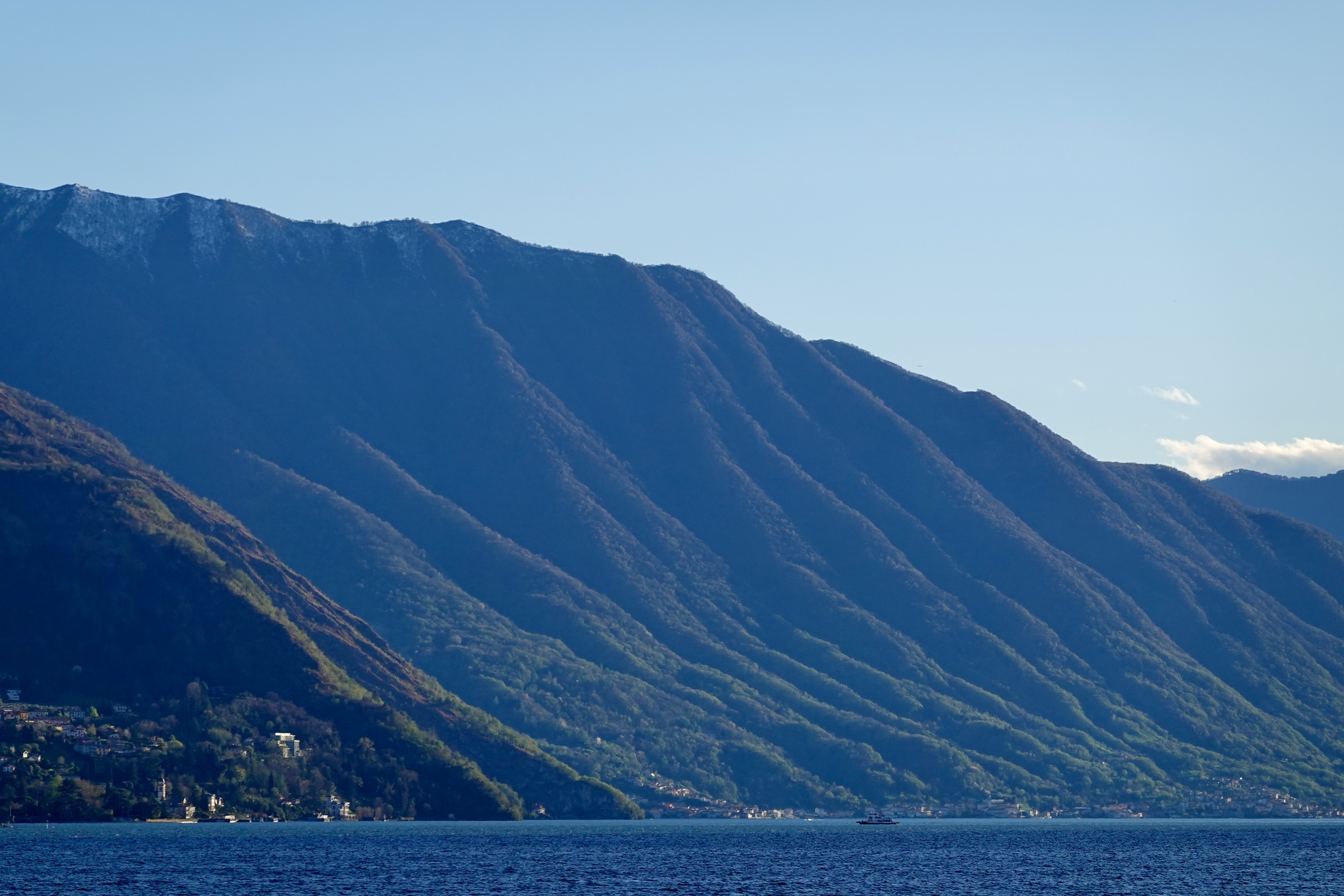
When I look at a mountain, my first thought, my first impression, is how unchanging it is. You can’t imagine a mountain changing. Can you? I used to look out across to Ben Ledi in Central Scotland, and what I saw every day was different. It was different because the light and the weather were different. So sometimes it would glow red with a setting sun, sometimes seem painted white with snow, other times hidden by low clouds and mists, but the mountain, itself, looked the same size and the same shape every single day. I couldn’t imagine a time when it wasn’t there, or when it was just created.

But look at this mountain beside Lake Annecy. It looks pleated. It has so many folds that it looks as if it is draped in a giant cloth. And when I look at that I can easily imagine that this mountain emerged…that it was created by massive forces, stronger than I’ve ever seen.

I can imagine a time when this mountain didn’t exist, and so I can imagine a time when it might disappear.

And I know, that if I was a scientist studying mountains, I’d be aware of just how the mountain changes, little by little, every single day.

Nothing is fixed in this universe. There are no fundamental, unchanging particles, the “building blocks” of all that exists.

The Universe is flow. Reality is always in the process of creation. Every changing.

Read Full Post »

Darwin identified two drivers of evolution – collaboration and competition. It’s the latter behaviour which has dominated the development of our societies, almost to the complete exclusion of understanding the importance of the former.

We need both in order to survive, and if we get the balance wrong, we all suffer. Wherever you look in Nature you see the importance of relationships between creatures, and, much less understood, the importance of positive, mutually beneficial bonds between different species – between plants and insects, insects and birds, fungi and plants….and so on.

Nothing really survives or thrives in isolation.

We need each other.

Read Full Post »

One of the commonest forms you’ll see in the plant world is the spiral. Pretty much any plant which sends out creepers to latch onto something so the plant can grow higher towards the sunlight, uses this form. It doesn’t go for a straight line….what we were taught is the shortest distance between two parts. Why not? There just aren’t that many really straight lines in Nature. It seems there’s a great preference for meandering, changing direction, spiralling around…..not what a machine would do.

Machines, and the industrialised types of management which dominate our lives now, are said to be best when they are most “efficient”. But Nature has a different idea. “Efficiency” seems, these days, to be about expending the least possible amount of effort and money to achieve a standardised outcome. It’s not natural, and it squeezing out beauty and life.

Complex, natural, living forms are not like machines. A plant doesn’t produce the least number of seeds required to produce a second plant. It produces thousands and thousands of them, using a huge number of different methods to have those seeds carried far and wide, relying on the weather and other creatures to do the scattering. Have you ever watched a bee or a butterfly collect pollen? They don’t start top left and work their way “methodically” flower by flower until they’ve harvested the most possible. There’s an inherent, apparent randomness to their flight. You just can’t predict which flower they are going to explore next.

The spiral is a favourite form of exploration in many plants. It’s a way of discovering.

It’s also extremely beautiful. One that artists replicate again and again. Here’s an example from the sculpture park near where I live……

Beautiful, dynamic, attractive, pleasing, and even in a stone carving, bursting with “life”.

I reckon we’ve taken a life destroying path through industrialisation, and I’d love to see us grow whatever we find life enhancing instead. We can do that by paying attention to, and learning from, plants and other creatures. We can privilege beauty, joy and Life instead of consumption, “efficiency” and “profit”. That would lead us to a very different kind of “growth”, and a very different society.

Read Full Post »

I bought this novel by the French/Sengalese author, David Diop, because I thought it was the story of a plant hunter, but really it’s a tale about colonialism and slavery in Senegal.

I loved it.

You know how some books are a real delight to hold in your hands? Well this is one of them. The publisher is Pushkin Press. I don’t know if all their books are printed on such lovely paper and with such delightful covers but I’ll be keeping an eye out for them now.

I lost myself in this story. It was completely engaging. An 18th century tale of discovery, encounter with another culture and language, as well as a challenging, powerful narrative about the inhumanity of slavery.

There are people we encounter in this life, who stay in our hearts forever even if we don’t pass all that many days with them. The actual door of no return hits hard even though you know it’s going to come at some point.

Highly recommended

Read Full Post »

One of my favourite French words is “Emerveillement” – it’s one of those words where you can’t just give a single English word equivalent when you try to translate it. It’s a bit like “wonder”, but also “amazement”, and “awe”. It’s not just a word for me, but, as it is in a French phrase “l’emerveillement du quotidien”, it’s a kind of life philosophy. That phrase means something like “the wonder of the everyday”. It’s about finding the extraordinary in the ordinary. It’s about noticing. It’s about paying attention with an open mind, a non-judging mind.

I find that the more I practice this the more it becomes an everyday way of living. I expect to encounter sights, sounds, smells, textures, sensations which make me stop, delight in them, and be amazed. I expect to have experiences where I find myself wondering….asking questions, becoming more curious.

I highly recommend it as a life practice – allow yourself to encounter the amazing everyday, to relish it, to be curious about it and to wonder……

Read Full Post »

We are stars wrapped in skin. The light you are seeking has always been within.

Rumi

I read these lines by Rumi this morning, and I thought of the many photographs I’ve taken of plants backlit by the Sun. I know, of course, that the light you see in these photos is coming from the Sun, but it’s infusing these leaves with its brightness making them appear to glow. It looks as if the light is coming from the leaves themselves.

Everything we encounter is an instance of complex interactions….in this moment, the Sun is illuminating the leaves which I’ve noticed as I wander through the garden. This light has caught my attention and stirred my senses of beauty and wonder. It’s taken the Sun, the plant, and me, my consciousness, to have this experience. And now, there’s you, too. As you look at this photo, read these words, you bring your own memories, your own experiences, your own preferences and values to bear.

Enjoy this moment. Savour the beauty. Allow yourself to bathe in the river of wonder.

Read Full Post »

« Newer Posts - Older Posts »