Feeds:
Posts
Comments

Archive for the ‘Uncategorized’ Category

Out of the box

I’m pretty sure this wee plant seeded itself on top of this metal plate but it looks as if the iron frame has been an attempt to fence the plant in.

But look! This plant isn’t going to be constrained so easily. It’s made it’s way out through a little gap and is already discovering a second exit.

Many years ago on my morning commute I sat next to a student on the train. The student was revising for a science exam and the definition of science which she was rehearsing really struck me at the time.

It had the following steps –

  • Observation
  • Description
  • Explanation
  • Prediction
  • Control

So I was with this for the first three steps – observation, description and explanation. This is completely consistent with what I love about science. It’s about noticing, looking carefully, describing what you see and trying to explain it by way of trying to understand what you’re looking at. All of that fits with a science of wonder. A science which is humble and curious.

So the next two steps were the ones I found, and still find, controversial, and frankly a bit misguided – prediction and control.

Wow! Prediction! Good luck with that! Hasn’t this pandemic shown us how often our predictions are wrong? Hasn’t the emergence of more and more extreme weather events shown us how difficult it is to predict rainfall, floods, forest fires, hurricanes? Not to mention volcanic eruptions and earthquakes.

The truth is prediction quickly becomes inaccurate the less focused and limited it is. The further ahead we look the less accurate our predictions. But more than this, all of Life, all of Nature, all individual human existence is a complex, open system. What happens in this real world cannot be reduced and abstracted without being falsified. All is interconnected and the webs of connections allow the open flow of particles, energy and information unceasingly. Prediction in detail over time isn’t possible.

That’s why the shift towards industrialised Medicine is so wrong. Nobody can predict the life path or future health of any individual with accuracy and nobody can be sure about the outcomes of treatments at an individual level either.

Which brings me to the last point – control.

We live in a society obsessed with power and control. We do not control NATURE. We do not control LIFE. It’s an illusion.

So it’s refreshing to see that complexity science is leading to a resurgence of a science of wonder and hopefully that shift will begin to let us put the control myth back in its box and replace it with a determination to care instead.

Read Full Post »

Back home

It’s been a long day, folks. I left Segovia in Spain about half seven this morning and drove to Saint Jean de Luz in the south western corner of France to see some relatives and have lunch.

Then late in the afternoon I headed north. I got snarled up in very, very slow stop and start traffic around Bordeaux. It’s really unusual to be able to drive round Bordeaux without hitting traffic jams. It’s been like this as long as I can remember but today the amount of traffic heading north was unprecedented. I began to wonder if the rest of the world knew something I didn’t. Was there a mass exodus underway? And if so, where to??

So by the time I pulled into the driveway the sun had set. There was a gorgeous tobacco glow just over the horizon and a crescent moon was sitting there in the pink.

It’s good to travel. It’s good to spend some time in another culture and try a different language. But it’s good to come home again.

Well I almost missed posting today and I know that some of you are already wondering where I’ve got to. So this is me, back home, marvelling at the astonishingly different, deeply familiar last few minutes of the last light.

Read Full Post »

A sense of place

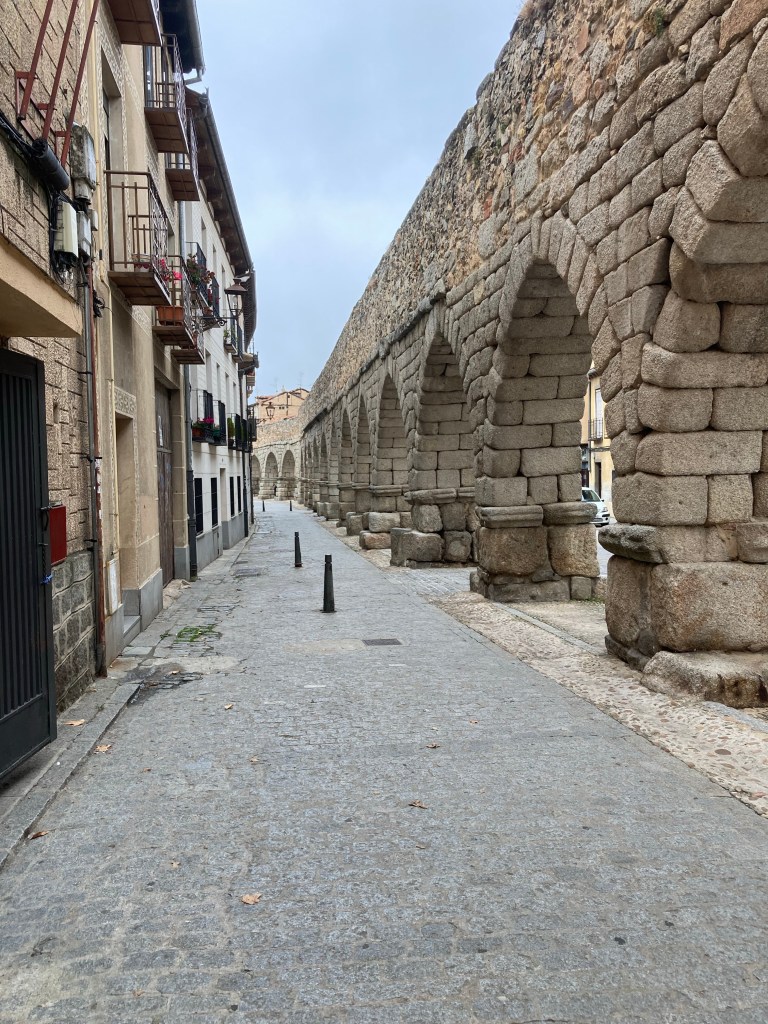
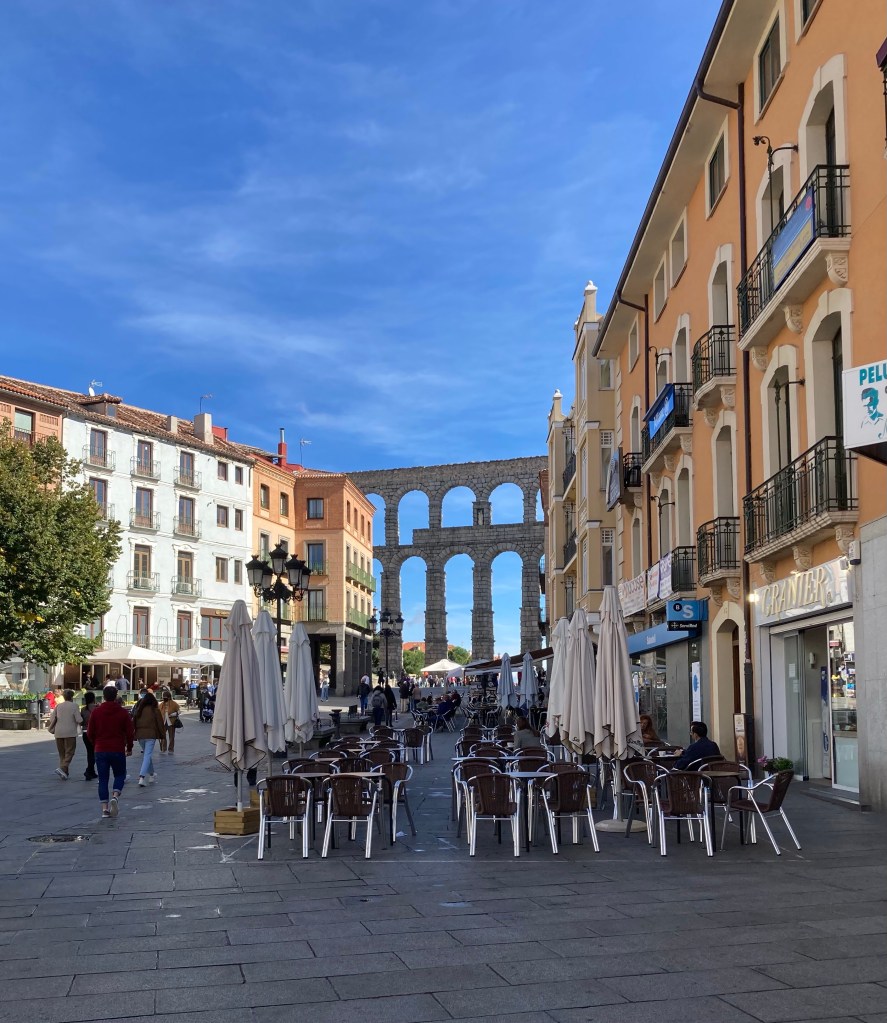
I’m visiting Segovia in Spain again for a few days. Ever since I first came here I’ve had a sense that it’s a special place.

I’m sure you’ve had that kind of experience where within minutes, maybe even seconds, of arriving somewhere new to you, you might have a strong feeling about it. That strong feeling might be a sort of belonging. I had that in Marrakesh which completely surprised me. I’d never had a strong desire to go there but I deeply felt that I belonged, or more that I had lived there before. Weird.

It might be a bad feeling. I once visited a small town in France which had been a centre for tanneries. I don’t think I knew that before I got out of the car and within minutes we all decided we didn’t want to be there and left. It was only after that, that we read about the history of the town and learned about the stinking tanneries.

But then other places instantly feel just right. For me, Segovia is one such place.

There’s no doubting the power of the Roman aqueduct here. I mean you really couldn’t miss it, could you? It’s astonishing in its size, construction, beauty. Gradually, metre by metre, it allows water to flow naturally downwards from the countryside to the town, and it worked for centuries. A testament to human creativity, to Will, determination and strength.

I think it’s the main influence for me in making this town such a special, attractive place.

What towns have had the biggest instant effects on you? Which villages, towns or cities feel special to you?

Read Full Post »

A different palette

As you’re probably aware, I’m a fan of the gorgeous greens we see around us in so many healthy natural environments. I also love the bright reds, yellows and purples of many flowers and adore the goldens, yellows and browns of autumn.

So this photo, taken in Scotland a few years ago, is startlingly different. Just look at the greys, whites, and so, so pale shades of any other colours. It almost looks monochrome.

But it draws me in and I find the subtlety of the palette soothes me and makes me want to linger.

Spend a while contemplating it today by yourself. I hope it brings you the same delight.

Read Full Post »

Imperfection

There are times and places where it’s good to aim for perfection. Mainly in the manufacture of machines and technologies, especially where precision makes a big difference to performance.

But in the natural world, in Life, in living as a human, perfection isn’t such an easy concept to define or achieve.

What’s a perfect tree? A perfect person? A perfect day?

In Japanese aesthetic, captured in the concept of wabi sabi, what might be termed imperfection is seen as beautiful.

Think of pottery made by human hand. It tends to look different from that mass produced by machines in a factory.

This photo is of a “dry stane dyke”, a common sight in Scotland, and almost always beautiful. The stones are carefully placed on top each other but they are all different shapes and the wind can blow through the spaces between them. There is no cement or mortar. They often get covered in moss which makes them somewhat more beautiful but you can’t manufacture that.

They are even beautiful many years later when they fall down.

Read Full Post »

Sacred

There are places in the world which we experience as special. Places where we feel connected to, and at one with, what is greater than ourselves.

Some people describe these as “thin” places, where the boundary between the visible and invisible dissolve.

Some people describe them as sacred places, others as the places where we experience a “re-enchantment” with the world, with Life even.

For many people these places are buildings – constructed by others as “places of worship”. For others they are “holy places” in the midst of wildernesses, forests or deserts.

Where do you find yours?

Read Full Post »

This is one of my all time favourite photos.

I’ve taken lots of photos of seed heads over the years. I’m repeatedly drawn to them. The earliest ones I remember would be dandelions in the garden. I expect as a child you too played the game of blowing a dandelion seed head and counting how many puffs it took to send every single seed flying.

We called them “dandelion clocks” and the idea was that the number of puffs told you what time it was. I always thought that completely odd. I mean it was so easy to manipulate by varying the strengths of your puffs. You could prove the “dandelion clock” right or wrong depending on what you believed.

I know there are other traditions associated with the dandelions but, actually, I just preferred to look at them, and as I got older, photograph some of them.

This particular photo stands out from the rest because I was lucky enough to catch the moment that a single seed set off on its journey.

This still makes me of think of both the time in my life where I left home to go to university, and the times where my children left home to set up their own homes.

So it’s a poignant photo. It stirs in me that mix of emotions common to most parents – when their child reaches the time to leave home and step into adulthood. It’s a moment that, at best, feels right, feels natural, feels like the witnessing of maturation. I’m reminded of the passages in Kahlil Gibran’s “The Prophet”

You are the bows from which your children
As living arrows are sent forth
The archer sees the mark upon the path of the infinite
And he bends you with his mightThat his arrows may go swift and far
Let your bending in the archer’s hand be for gladness
For even as he loves the arrow that flies
So he loves also the bow that is stable

It’s also a moment of anxiety and trepidation. Are they going to be ok? How am I going to protect them?

And a moment of sadness and loss, a realisation that their childhood is over, the little birds have flown.

Fundamentally however, this image stirs a sense of awe and wonder in me. I am yet again astonished and delighted by the beauty of Life.

Read Full Post »

I know this tree doesn’t have a mouth and I know it’s not shouting, either to me or to the other trees, but it definitely makes me think of that.

For a long time we’ve seen trees as separate beings and forests as collections of trees which are in competition with each other for sunlight, nutrients and space. But that’s all changing thanks to the scientists who study the connections between things and the relationships which living creatures have with each other.

The work of Suzanne Simard, published for a wider readership in “Finding the Mother Tree”, is perhaps the most convincing of this kind of research. She’s shown that trees in a forest are in constant communication with each other, sharing nutrients and sugars, warning each other of predators and threats and basically working together for mutual benefit.

This kind of work shows us that the dominant belief in Nature as constant competition between individuals is simplistic and wrong. I think it’s harmful actually – it feeds into politics and economics. It creates cultures of “us and them” and stokes self interest and division.

So it comes as a breath of fresh air to find scientists now demonstrating the importance of a model based on cooperation instead. Well, not simply cooperation but more complex interplay between competition and cooperation than we’ve been led to believe.

Richard Powers, whose brilliant “Overstory” novel changed the way many people understood trees, forests and the world, has a new novel out, “Bewildered”. I listened to him being interviewed by Ezra Klein this week. He quotes Suzanne Simard and talks about his own development of thought, from traditional scientist focused on control and power to his current way of thinking which he terms “humbling science”.

Great phrase. He’s referring to the science which increases wonder, awe and understanding. He’s referring to the shift towards seeing complexity and studying both inter-relatedness and inter-being.

He also said in the interview that he thought the largely negative 20th attitude to our human tendency to anthropomorphising other living creatures has had a downside of increasing the distance between ourselves and other beings, which has allowed as to treat the rest of Nature as a mere resource to be plundered. He said it had diminished our ability to see other living beings as sacred, and even other human beings as sacred.

Isn’t this what we need? The ability to see our interdependencies and our interbeing? The need for more empathy? The need to reconnect to a sense of the sacred.

Read Full Post »

Thriving

I love the colours in this photo.

Colours? It’s all green!

Yes, but look at the shades of green! Look at the intensity of the green!

I look at this and I see vitality. I see life in abundance. Life thriving.

Isn’t health more than survival? Isn’t it also about developing, growing, and thriving? Isn’t it expansive, energised and engaged?

Sometimes I think we aim too low in health care. We have got better at saving lives in extremis. We have got better at rescuing people at the point of death. We are better at helping people to survive serious injuries and illnesses.

And all of that is good. Remarkable even. But is it enough? Is it enough to suppress symptoms and slow the progress of disease? I mean those are good achievements too. Who wouldn’t celebrate the relief of suffering.

But we’re not good at cures. More people are living with several chronic illnesses now than ever before.

And we’re not good at prevention either.

I wonder if that’s because we don’t try hard enough to create the environments and the societies which naturally promote health.

If we don’t address poverty, poor, inadequate housing, inequality, poor quality industrial over processed food, chemically flooded agriculture, pollution, the destruction of forests, the loss of species, the consumption of carbon…..

If we don’t address hatred, fear and prejudice, greed and narcissism……

Then we will continue to fail. To fail to create the circumstances which enable and promote thriving.

Because that’s what we humans need….more care, attention and love…..to each other, to Life and to the world we live all in together.

That’s how we create a thriving planet. Is that beyond our imagination? Is that beyond our creative abilities? Is that beyond our hearts’ desire?

Read Full Post »

In good shape

This is such a common sight for me. There must be thousands of such streams, or “burns” tumbling down through the hills in Scotland. This combination of lively, gurgling water, centuries-smoothed rocks and green moss and grasses twisting this way and that is just so beautiful, so pleasing. The sound the water makes as it hurries downhill is like a magnet. When you’re out walking in the hills or in a forest this special noise draws you towards it. It’s a sort of compulsion. Once you hear it, you feel magnetically drawn towards it, to go and see it, to stand or kneel beside it, to slide your hand into the cool, clear waters.

I often wonder about the shape of streams and rivers – thinking of how it’s the relationship between the water and the earth, the rocks and soil, which creates their shape and path.

The exact shape of any stream or river is constantly changing. It emerges as the co-creation of day by day, moment by moment, interactions as the rocks contain the water and the water shapes the rocks.

Mostly the daily changes aren’t obvious but then there will be a downpour or a storm and both the size and shape of the river can change dramatically.

You can feel that power as you stand beside it. You can sense it’s potential.

When I started to think about this image the phrase, “in good shape” or “good form” came to my mind.

We say that when we mean someone is healthy don’t we? “They are in good shape” or “they are on good form”. We aren’t usually referring to their bodily statistics when we say these things. We’re thinking more of their vitality, their energy, their that slippery overused word, well-being. In short, we’re commenting on their state of health and/or their mood.

Many years ago I read a collection of essays by Hans Gadamer, “The Enigma of Health”. They made a huge impression on me. One of the points he made about health was that it involved are certain kind of fitness – not so much in the sporting sense but in the way we say something is “a good fit”. This captures the idea of comfort, ease, and something “just right”.

Hard to pin that down really but we know it easily. We know it intuitively. We sense it with our whole being.

Gadamer’s essays in that collection are all about how difficult it is to pin down that state we call “healthy”. He comments how we notice our thumb when we trap it in a door but we don’t really notice it when it’s healthy, when it’s in good shape. Strange that, isn’t it? How it’s trauma or disease which draws our attention to parts of our body, and how health, by contrast, is pretty invisible.

Thinking then of the phrase “in good shape” and looking at this photo, I get to wondering how our lives take the shape they do. That too is a constant interplay of forces and flows, of resistances and movements.

It’s both beautiful and strange.

Read Full Post »

« Newer Posts - Older Posts »