As you’re probably aware, I’m a fan of the gorgeous greens we see around us in so many healthy natural environments. I also love the bright reds, yellows and purples of many flowers and adore the goldens, yellows and browns of autumn.
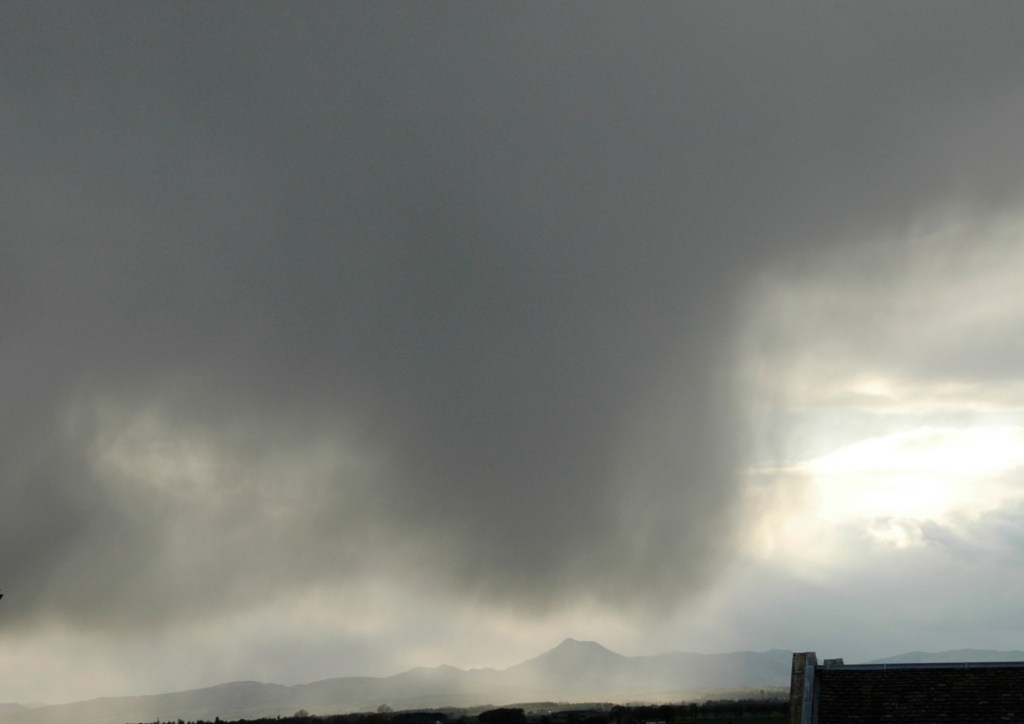
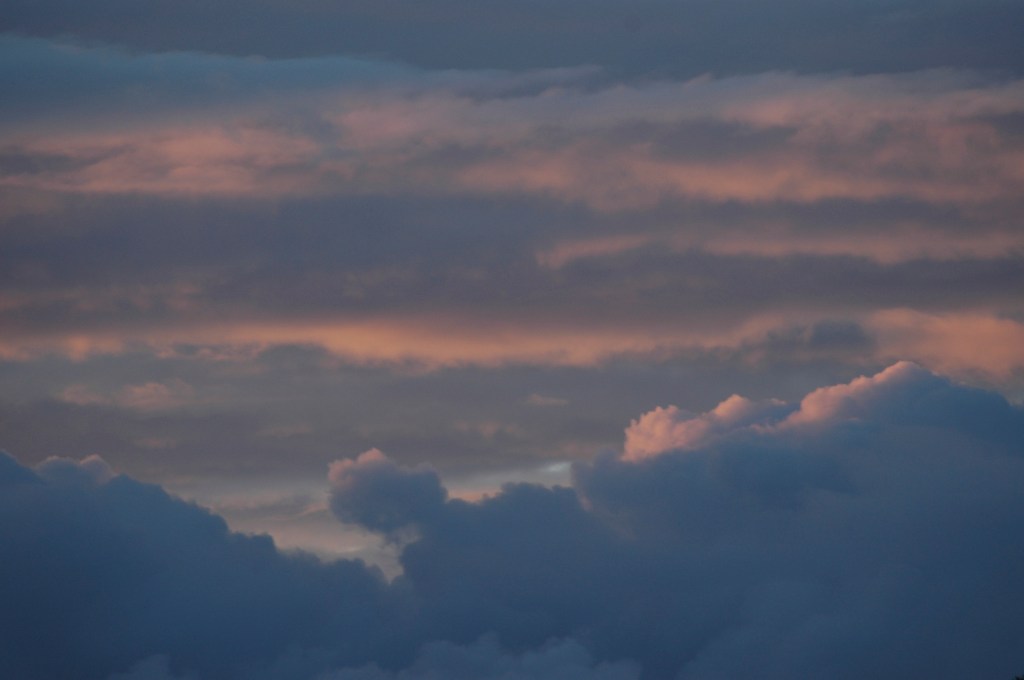
So this photo, taken in Scotland a few years ago, is startlingly different. Just look at the greys, whites, and so, so pale shades of any other colours. It almost looks monochrome.
But it draws me in and I find the subtlety of the palette soothes me and makes me want to linger.
Spend a while contemplating it today by yourself. I hope it brings you the same delight.
There are times and places where it’s good to aim for perfection. Mainly in the manufacture of machines and technologies, especially where precision makes a big difference to performance.
But in the natural world, in Life, in living as a human, perfection isn’t such an easy concept to define or achieve.
What’s a perfect tree? A perfect person? A perfect day?
In Japanese aesthetic, captured in the concept of wabi sabi, what might be termed imperfection is seen as beautiful.
Think of pottery made by human hand. It tends to look different from that mass produced by machines in a factory.
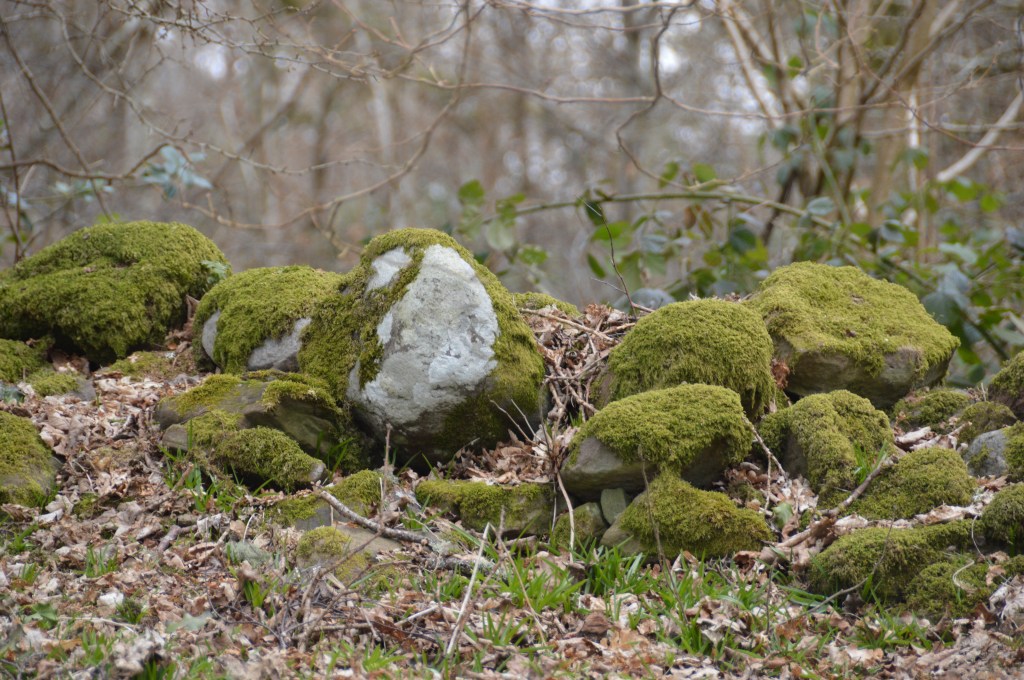
This photo is of a “dry stane dyke”, a common sight in Scotland, and almost always beautiful. The stones are carefully placed on top each other but they are all different shapes and the wind can blow through the spaces between them. There is no cement or mortar. They often get covered in moss which makes them somewhat more beautiful but you can’t manufacture that.
They are even beautiful many years later when they fall down.
There are places in the world which we experience as special. Places where we feel connected to, and at one with, what is greater than ourselves.
Some people describe these as “thin” places, where the boundary between the visible and invisible dissolve.
Some people describe them as sacred places, others as the places where we experience a “re-enchantment” with the world, with Life even.
For many people these places are buildings – constructed by others as “places of worship”. For others they are “holy places” in the midst of wildernesses, forests or deserts.
I’ve taken lots of photos of seed heads over the years. I’m repeatedly drawn to them. The earliest ones I remember would be dandelions in the garden. I expect as a child you too played the game of blowing a dandelion seed head and counting how many puffs it took to send every single seed flying.
We called them “dandelion clocks” and the idea was that the number of puffs told you what time it was. I always thought that completely odd. I mean it was so easy to manipulate by varying the strengths of your puffs. You could prove the “dandelion clock” right or wrong depending on what you believed.
I know there are other traditions associated with the dandelions but, actually, I just preferred to look at them, and as I got older, photograph some of them.
This particular photo stands out from the rest because I was lucky enough to catch the moment that a single seed set off on its journey.
This still makes me of think of both the time in my life where I left home to go to university, and the times where my children left home to set up their own homes.
So it’s a poignant photo. It stirs in me that mix of emotions common to most parents – when their child reaches the time to leave home and step into adulthood. It’s a moment that, at best, feels right, feels natural, feels like the witnessing of maturation. I’m reminded of the passages in Kahlil Gibran’s “The Prophet”
You are the bows from which your children As living arrows are sent forth The archer sees the mark upon the path of the infinite And he bends you with his mightThat his arrows may go swift and far Let your bending in the archer’s hand be for gladness For even as he loves the arrow that flies So he loves also the bow that is stable
It’s also a moment of anxiety and trepidation. Are they going to be ok? How am I going to protect them?
And a moment of sadness and loss, a realisation that their childhood is over, the little birds have flown.
Fundamentally however, this image stirs a sense of awe and wonder in me. I am yet again astonished and delighted by the beauty of Life.
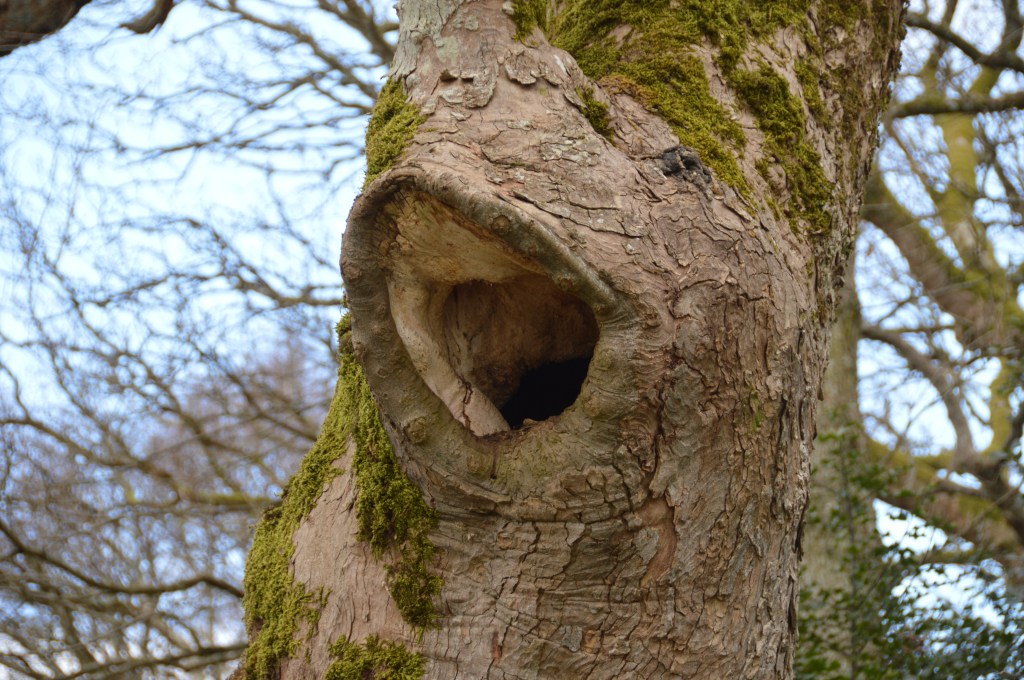
I know this tree doesn’t have a mouth and I know it’s not shouting, either to me or to the other trees, but it definitely makes me think of that.
For a long time we’ve seen trees as separate beings and forests as collections of trees which are in competition with each other for sunlight, nutrients and space. But that’s all changing thanks to the scientists who study the connections between things and the relationships which living creatures have with each other.
The work of Suzanne Simard, published for a wider readership in “Finding the Mother Tree”, is perhaps the most convincing of this kind of research. She’s shown that trees in a forest are in constant communication with each other, sharing nutrients and sugars, warning each other of predators and threats and basically working together for mutual benefit.
This kind of work shows us that the dominant belief in Nature as constant competition between individuals is simplistic and wrong. I think it’s harmful actually – it feeds into politics and economics. It creates cultures of “us and them” and stokes self interest and division.
So it comes as a breath of fresh air to find scientists now demonstrating the importance of a model based on cooperation instead. Well, not simply cooperation but more complex interplay between competition and cooperation than we’ve been led to believe.
Richard Powers, whose brilliant “Overstory” novel changed the way many people understood trees, forests and the world, has a new novel out, “Bewildered”. I listened to him being interviewed by Ezra Klein this week. He quotes Suzanne Simard and talks about his own development of thought, from traditional scientist focused on control and power to his current way of thinking which he terms “humbling science”.
Great phrase. He’s referring to the science which increases wonder, awe and understanding. He’s referring to the shift towards seeing complexity and studying both inter-relatedness and inter-being.
He also said in the interview that he thought the largely negative 20th attitude to our human tendency to anthropomorphising other living creatures has had a downside of increasing the distance between ourselves and other beings, which has allowed as to treat the rest of Nature as a mere resource to be plundered. He said it had diminished our ability to see other living beings as sacred, and even other human beings as sacred.
Isn’t this what we need? The ability to see our interdependencies and our interbeing? The need for more empathy? The need to reconnect to a sense of the sacred.
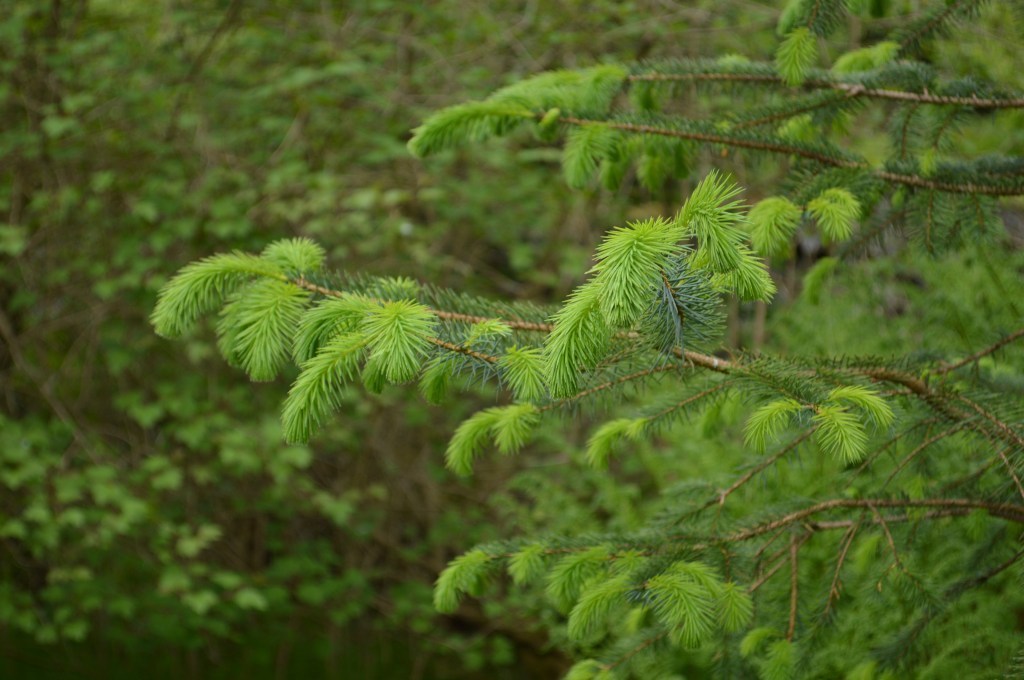
Yes, but look at the shades of green! Look at the intensity of the green!
I look at this and I see vitality. I see life in abundance. Life thriving.
Isn’t health more than survival? Isn’t it also about developing, growing, and thriving? Isn’t it expansive, energised and engaged?
Sometimes I think we aim too low in health care. We have got better at saving lives in extremis. We have got better at rescuing people at the point of death. We are better at helping people to survive serious injuries and illnesses.
And all of that is good. Remarkable even. But is it enough? Is it enough to suppress symptoms and slow the progress of disease? I mean those are good achievements too. Who wouldn’t celebrate the relief of suffering.
But we’re not good at cures. More people are living with several chronic illnesses now than ever before.
And we’re not good at prevention either.
I wonder if that’s because we don’t try hard enough to create the environments and the societies which naturally promote health.
If we don’t address poverty, poor, inadequate housing, inequality, poor quality industrial over processed food, chemically flooded agriculture, pollution, the destruction of forests, the loss of species, the consumption of carbon…..
If we don’t address hatred, fear and prejudice, greed and narcissism……
Then we will continue to fail. To fail to create the circumstances which enable and promote thriving.
Because that’s what we humans need….more care, attention and love…..to each other, to Life and to the world we live all in together.
That’s how we create a thriving planet. Is that beyond our imagination? Is that beyond our creative abilities? Is that beyond our hearts’ desire?
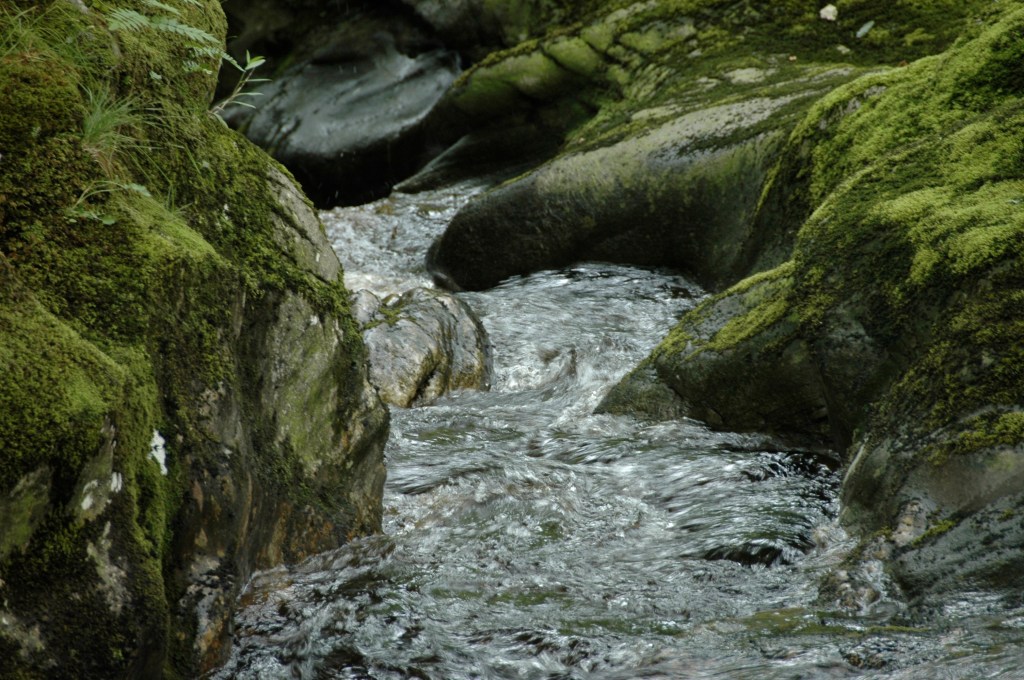
This is such a common sight for me. There must be thousands of such streams, or “burns” tumbling down through the hills in Scotland. This combination of lively, gurgling water, centuries-smoothed rocks and green moss and grasses twisting this way and that is just so beautiful, so pleasing. The sound the water makes as it hurries downhill is like a magnet. When you’re out walking in the hills or in a forest this special noise draws you towards it. It’s a sort of compulsion. Once you hear it, you feel magnetically drawn towards it, to go and see it, to stand or kneel beside it, to slide your hand into the cool, clear waters.
I often wonder about the shape of streams and rivers – thinking of how it’s the relationship between the water and the earth, the rocks and soil, which creates their shape and path.
The exact shape of any stream or river is constantly changing. It emerges as the co-creation of day by day, moment by moment, interactions as the rocks contain the water and the water shapes the rocks.
Mostly the daily changes aren’t obvious but then there will be a downpour or a storm and both the size and shape of the river can change dramatically.
You can feel that power as you stand beside it. You can sense it’s potential.
When I started to think about this image the phrase, “in good shape” or “good form” came to my mind.
We say that when we mean someone is healthy don’t we? “They are in good shape” or “they are on good form”. We aren’t usually referring to their bodily statistics when we say these things. We’re thinking more of their vitality, their energy, their that slippery overused word, well-being. In short, we’re commenting on their state of health and/or their mood.
Many years ago I read a collection of essays by Hans Gadamer, “The Enigma of Health”. They made a huge impression on me. One of the points he made about health was that it involved are certain kind of fitness – not so much in the sporting sense but in the way we say something is “a good fit”. This captures the idea of comfort, ease, and something “just right”.
Hard to pin that down really but we know it easily. We know it intuitively. We sense it with our whole being.
Gadamer’s essays in that collection are all about how difficult it is to pin down that state we call “healthy”. He comments how we notice our thumb when we trap it in a door but we don’t really notice it when it’s healthy, when it’s in good shape. Strange that, isn’t it? How it’s trauma or disease which draws our attention to parts of our body, and how health, by contrast, is pretty invisible.
Thinking then of the phrase “in good shape” and looking at this photo, I get to wondering how our lives take the shape they do. That too is a constant interplay of forces and flows, of resistances and movements.
Once upon a time a king commanded the poets to write a phrase which could be inscribed on his ring and which he could use appropriately in all circumstances…..
You know how these stories go. After several failures resulting in a few poets having their heads chopped off, one finally succeeded.
These were his words…..
This too shall pass
I thought of that when I saw this rain cloud passing over Ben Ledi. I’ve had the experience of seeing a rain cloud approaching and knowing the rain will arrive soon. I’ve even had the weird experience of walking from the front garden where it was raining round the house to the back where it wasn’t. But I’ve rarely seen such a distinct edge to a rain cloud dropping its rain onto the earth below.
It’s not that easy to see change coming.
Here we are still in the midst of a pandemic and it’s hard to see when, how, or even if Covid is going to disappear. Will there be more waves, will it trundle on with flare ups here and there, will it bed in and become endemic or will it weaken to nothing more than a common cold? We don’t know and we sure don’t know when.
We can’t see the edge of change.
I’ve often thought about how difficult it is to see the edge of change. Think of any city on the planet. Can you imagine London not being there any more? Can you imagine Paris, New York or Tokyo not being there any more? Yet we find the scattered ruins of great cities around the world, some shadows of their former selves, some reduced to mere traces.
Once thriving and powerful empires have gone but it would have been impossible to imagine them disappearing if you were living in them.
It’s only when we look back through history that we can see the edges of change. Only then do we trace the beginnings and the endings. But we have the superpowers of imagination, hope, determination and creativity. We should be able to see a different path ahead.
The big cities, the powerful states, the current economic systems, structural inequality, the political and social elites…..none of them will last forever.
That gives me hope.
Perhaps we can’t see the edge of change but we can imagine a better world, and that’s a start.
As Greta Thunberg said yesterday at #youth4climate in Milan….
We can no longer let the people in power decide what hope is. Hope is not passive. Hope is not blah blah blah. Hope is telling the truth. Hope is taking action.
Perhaps we can’t see the edge of change but we can choose a different future.
Let me set this in context. I was born in 1954 in a small town in the middle of Scotland. I say the middle because Stirling is pretty much equidistant from Glasgow on the west coast and Edinburgh on East. But it’s known as “The Gateway to the Highlands” because, historically, THE crossing point between the south and the north was over Stirling Bridge which spans the River Forth.
When I was 10 years old my family moved from the house where I was born (yes, I was born at home), to a development of brand new houses. I can’t remember how many houses were built there but I think it was a couple of hundred or so. I spent my teenage years with a group of a couple of dozen friends, most of whom lived in those houses.
I’m thinking about the music which is still so important to me. I can’t remember a time when there wasn’t music in my life. I listen to it every day and have done for most of my life.
I’ve read a number of articles about the influence which music has on our well being, our moods, and even our cognitive abilities. Those articles don’t really tell me anything I don’t already know from personal experience and intuition but they reinforce the significance of music in my life.
So I saw this photo in my collection this morning and I heard a line from a song in my head. I’ll tell you which song at the end of this piece. The experience of that song popping into my head got me thinking of some of the musical landmarks in my life…the songs, records and concerts which created my personal landscape through which my story unfolds.
The first singles I bought were by The Beatles….I Want to Hold Your Hand, She Loves You, Twist and Shout and Can’t Buy Me Love.
The first time I heard stereo (yes, folks, that happened in my lifetime!) was when my friend Tom played Simon and Garfunkel’s Bookends on his dad’s “stereogram”. Wow! I still remember the thrill!
A bit later we all bought stereo record players and the first album I bought and played on it was “Stand Up” by Jethro Tull.
We formed a record buying club. We each put a pound into the kitty every week and we grouped ourselves into threes or fours. Each week one of the groups would go to one of the record shops and buy as many albums as they could afford. Each member of the group could have one of those albums for up to a week then would pass it to another group member. Once the whole group had had their turn they’d pass it to the next group and once all the groups had had their weeks we auctioned the albums amongst us all and put the proceeds into the kitty.
As you might imagine this gave us all a fairly wide exposure to different styles and artists but there were definitely favourites we almost all shared.
So from those years I developed my own favourites….Genesis, Jethro Tull, Van de Graaf Generator, Pink Floyd, Soft Machine, Frank Zappa, Jimi Hendrix, Elton John, Wishbone Ash, Colosseum, Caravan…..oh, I could go on! Do any of those names resonate with you? Probably you’ll have a completely different list.
We went to fabulous concerts…..Pink Floyd at the Refectory in Stirling University where they used a joystick to send the music round the whole audience, Genesis with Peter Gabriel at the Usher Hall performing The Lamb Lies Down on Broadway, the Eurythmics at their peak in the SEC in Glasgow…..again I could go on. Which concerts made the most lasting impressions on you?
Radio was also important to me. I listened to a lot of John Peel and recorded some of my favourite sessions from his programme on a portable cassette recorder. I listened to Radio Luxembourg whose signal would regularly fade away to almost silence before surging back again, and the pirate station, Radio Caroline. Later I’d become a regular listener to whispering Bob Harris and I’d record his late night show on a minidisc which I’d listen to as I walked to the railway station each morning.
Nowadays I listen to Spotify – I have a playlist I’ve called “A lot more than good” which is a collection of tracks I totally love. Many of them go right back to those early Stirling years. I read that playing music from your youth keeps your brain young. Does it? Do I care? I also read that playing new music keeps your brain young because your brain loves novelty. Does it? I’m not sure. However, you know me and my “and not or”! I listen to favourites and I explore new music too.
I’ve recently found Radio Paradise online and I love it. Usually I select the “mellow mix” which plays me a brilliant selection of favourites and new songs. It’s as if they know me! By the way the best way to experience Radio Paradise is on a large screen TV – the hand crafted slideshows are breathtaking.
So, let me tell you which song popped into my head when I looked at today’s photo (have you guessed?)
Look at these beautiful berries. The rain is making them sparkle. They are like precious stones, a small cluster hanging like an earring, adorning the plant. They are some kind of celebration, an achievement, a kind of destiny almost.
They are the manifestation of fruition.
It’s easy to think of fruition as the stage in a plant’s life when it reaches an apex. They seem to represent a plan come good, a success, an achievement after a year of effort and growth.
This is the plant saying “I survived this year. More than that, I flourished”.
But can you look at this stage in a plant’s life without being aware of the fact that this isn’t an ending, it’s a season. It’s a flourishing which will take the plant on to a new level. It’s a phase where the plant holds her potential to expand beyond the immediate ground on which she is growing. These berries contain the possibility of new growth on new territory.
I love what the seasons of plant life teach us. They shift us beyond the simplistic, disconnected, cause and effect, goal oriented processes, procedures and concepts of industrialised living.
They show us instead that all of life is connected and cyclical.
They remind us that life is about more than survival. It’s about maturing and flourishing. It’s about manifesting our potential, expressing our uniqueness and sharing the fruits of our efforts.
They remind us that a healthy life is an open hearted and generous one, a creative path looping around, season by season, taking us to places we discover are both new and familiar.
Each season stirs memories of similar seasons gone by. Each season reminds us that life is cyclical, not a straight line from A to B, but a constant flow studded with sparkling moments.
Fruition is not a dying, it’s a call to celebrate, a time to enjoy and to share.
I welcome constructive criticism and suggestions. I will not, however, tolerate abuse, rudeness or negativity, whether it is directed at me or other people. It has no place here. ANYONE making nasty comments will be banned.