Feeds:
Posts
Comments

Celestial rhythms

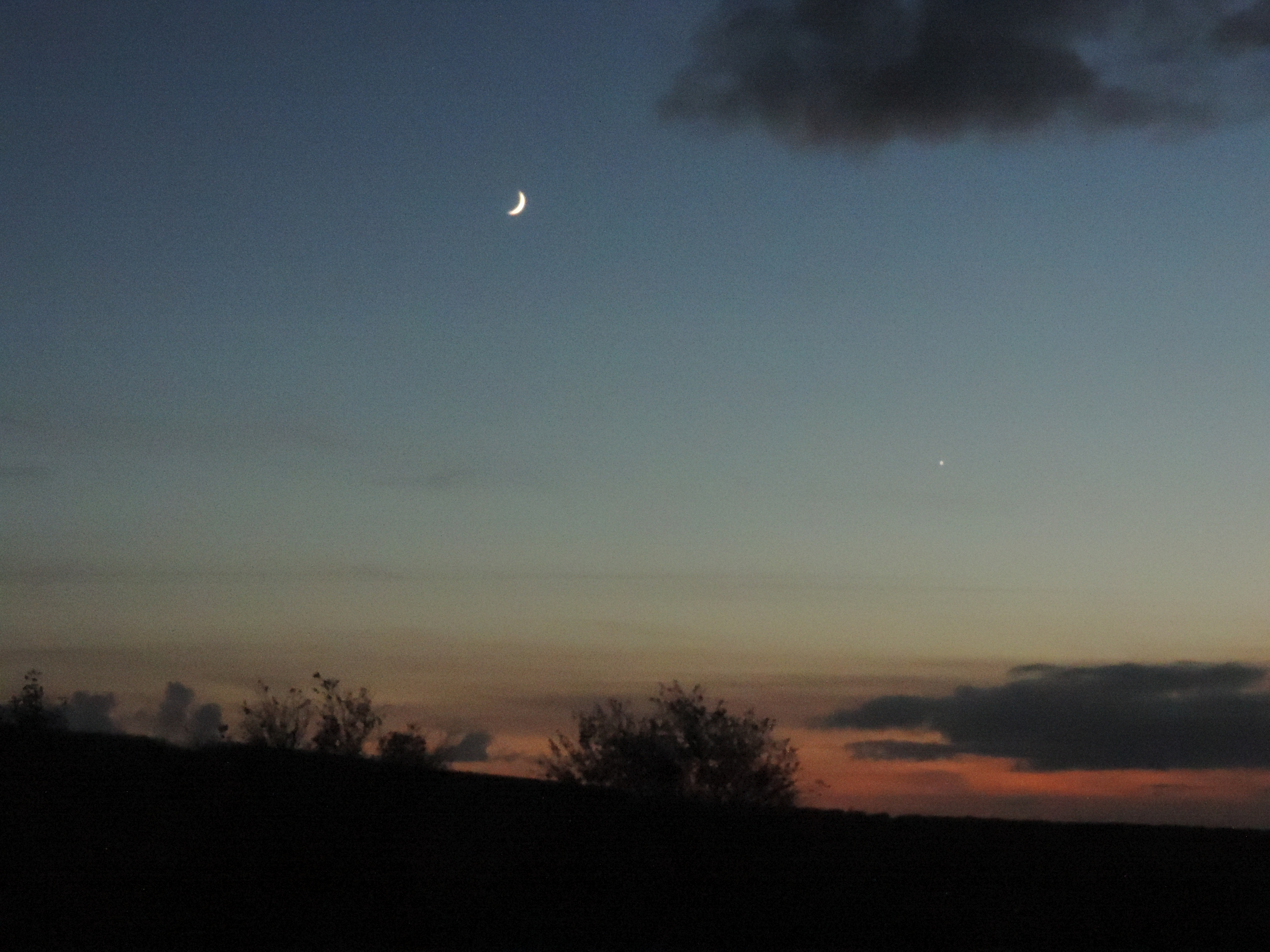
I wonder how much the sky influences our lives. I don’t just mean how a blue sky lifts our spirits, and a heavy grey cloud cover can dampen them. I’m not only thinking of the reds, tobacco browns, and goldens of a setting sun. I’m thinking about the evening sky, like this one, and the night sky which you know, looking at this, is only a few minutes away.

I don’t share this photo because it’s a great photo of the Moon and Venus in a twilight sky. I share it because it sets off a train of thought in my mind. It gets me thinking about the rhythms of our planet, and how, for millennia, we humans have learned to understand some of those rhythms by looking at the night sky. I know there are stories of how ancient peoples navigated by the stars and worked the Earth by the progress of the constellations. I know that even now, there are farmers and gardeners who plant, cultivate and harvest according to the phases of the Moon. I know I get a lift in my heart when I see Orion appear for the first time on the Eastern horizon, knowing that I’ll be able to see him make his journey to the West every night until Spring comes again, knowing that Orion is a winter companion in this part of the world.

But I also look at a sky like this and am struck by both the Moon and Venus, and, instantly I’m thinking of the Divine Feminine, as both the Moon and Venus are associated with goddesses. I wonder if they evoke the anima in me. I wonder if they start me thinking about intuition and beauty.

Actually, I don’t wonder that at all. They do. For sure. I look at this scene and I am entranced, I am enchanted, I am absorbed in feelings, thoughts and images of intuition and beauty.

Have you ever wondered how much the sky influences your life?

Peering into the mist

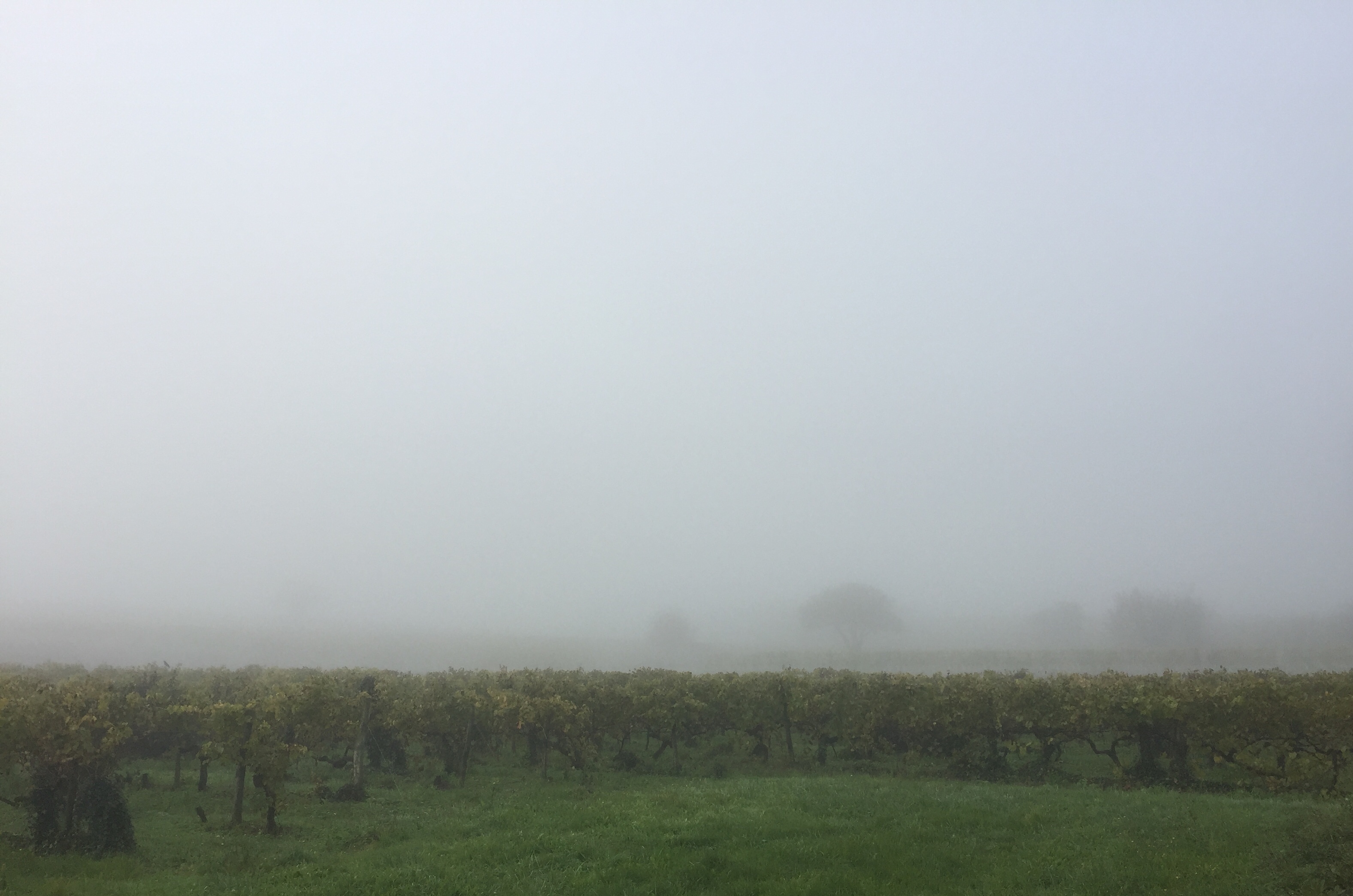
This time of year it’s not uncommon to wake up and find that the vineyards have disappeared. They are hidden in dense morning mist. Just like in this photo here.

I can almost see some of the trees. I can see the nearest vineyard but I know there are several others beyond this one. I can’t see the next village.

The fog brings the horizon much closer. I can only see what is close to me. I’m reminded of a passage by the late, great John O’Donohue –

Today the light is very low so the fog is covering the mountains. When the fog is there, half of them are missing. But, in some sense, that is the duty of the imagination: to help us connect with that which is invisible but is actually very close.

What a great reminder that we need our imagination to “help us connect with that which is invisible but is actually very close”.

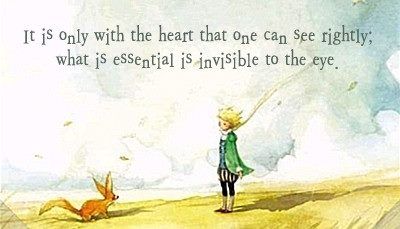
How do we see the invisible? Well, Saint-Exupery told us

No clear edges

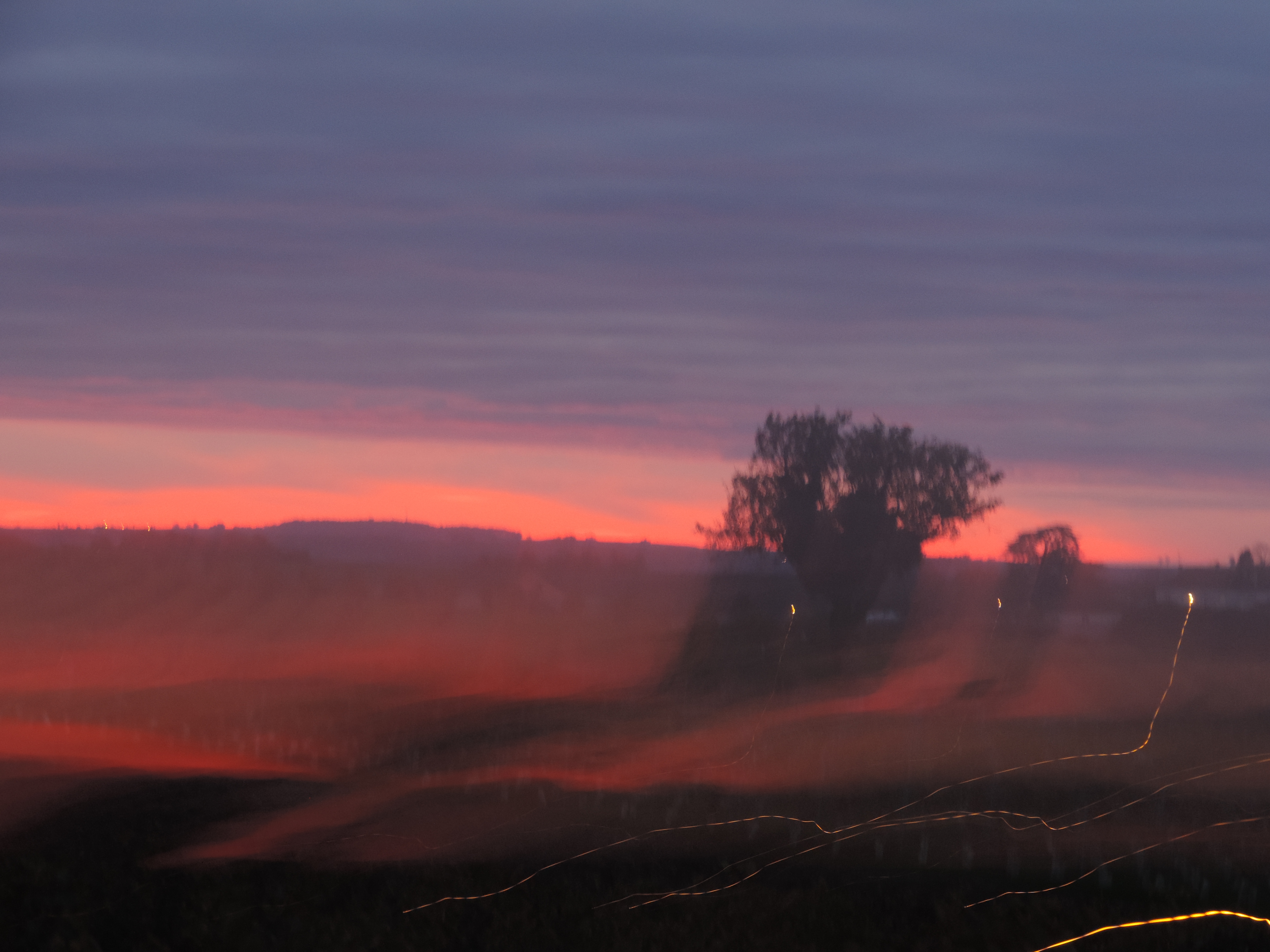
I took this photo of a sunset with a long exposure time and my hand moved a bit but when I looked at the result I really liked it.

OK, it’s obviously not exactly what I saw as I looked out over the vineyards that evening. In fact, it’s almost more like a water colour painting than an exact representation of what I could see with my eyes. But don’t you think that makes it, somehow, all the more appealing?

We have a tendency to prefer clear boundaries, to be able to pick out an object or an individual as separate from all the others, in order to recognise them, to name them. This recognition and categorisation skill takes us a long way. Such a long way that we tend to forget the power of fuzziness, the reality of uncertainty, and the unavoidable fact of dynamic change.

Nothing exists in isolation. Everything changes all the time. The future is unpredictable with any accuracy when we pay attention to the details, to the unique and to the individual.

Seeing how everything flows into everything else, how there are streams of substances, energies and information flowing through us and everything else constantly, streams which form us, which we process, which flow through us on into the future and into other beings and other objects.

We need that skill too. That ability to shift our perspective away from labelling and categorising to flows, to connections, relationships and uniqueness.

Maybe that’s why I find this image so beautiful. Because reality can’t be fully understood as made up of separate “bits”.

Two ways of seeing

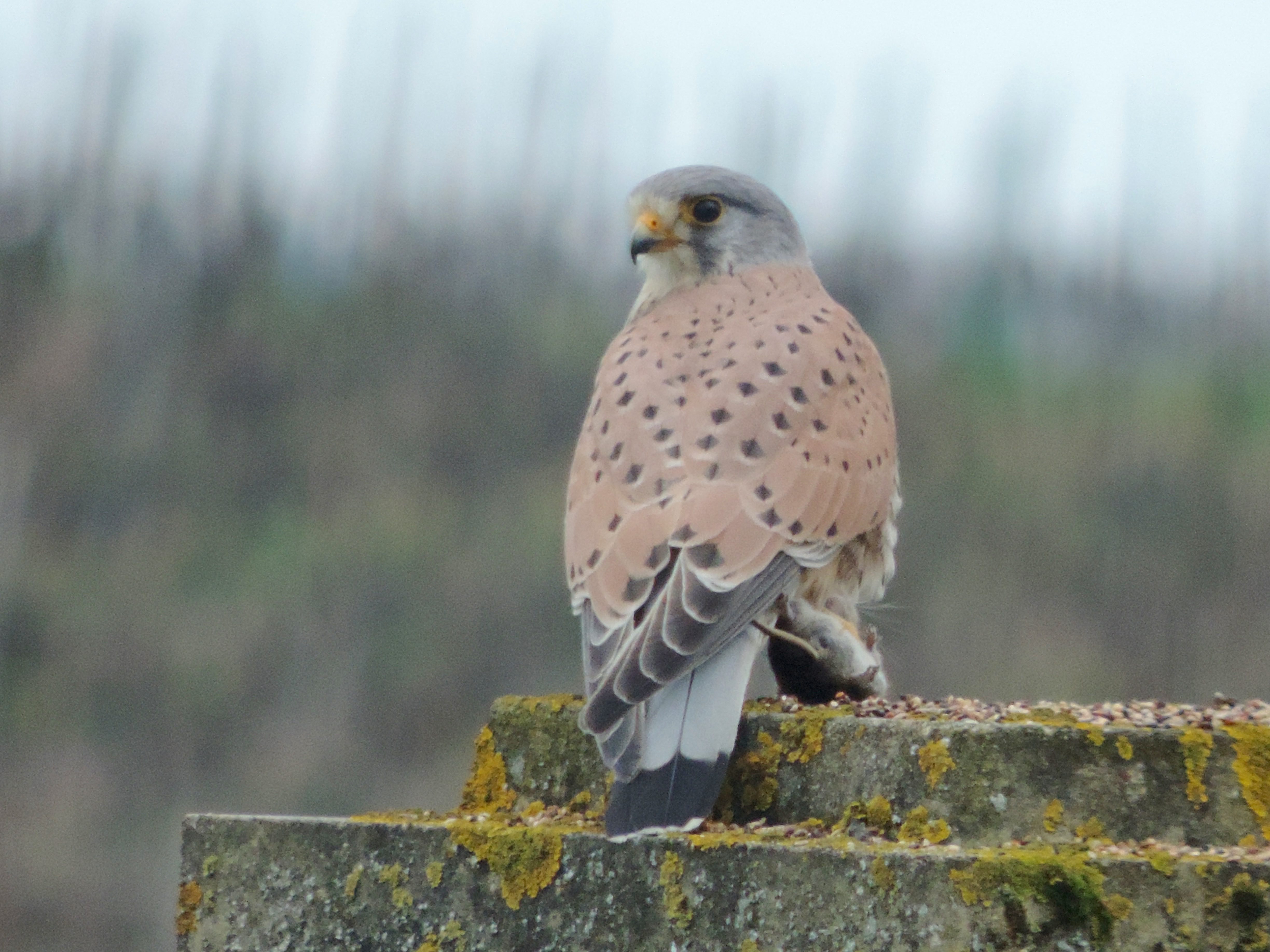
There are three common predator species of birds which I see around where I live, pretty much on a daily basis. There are the buzzards which circle on invisible airstreams way high up in the sky. I hear one call with a distinct but also distant cry and look up at the blue sky which I then have to scan till I spot what is often just a small dot against the blue. Then there are the owls, both the “barn owls” and the “little owls” which live in neighbouring outbuildings. On of the “little owls” sat up on my neighbour’s TV aerial last night calmly watching me while I closed all the shutters on our windows. Finally, there are the kestrels, like this one in the photo above.

The kestrel hovers, often at a height about that of a two or three storey house, whilst the buzzards circle rather than hover, and do so at much higher levels. I never see a kestrel sitting on a roof or an aerial, but I’ve spotted them in trees sometimes. Mostly, however, I see them like this. They are hovering silently, then, all of a sudden they fall like a stone onto some prey they have spotted.

Iain McGilchrist’s majestic “The Master and His Emissary” changed the way I understood the brain, and also changed the way I understood human, and other animal behaviours. He describes how birds share the phenomenon we humans have of a brain divided into two halves. You might know this already, but there is a crossover thing that happens between brains and bodies – our left hemisphere controls the right side of our body, and the right controls the left side. In birds the left hemisphere processes the information from the right eye and the right processes the information from the left eye. They choose to use each eye for different purposes.

The bird’s left eye and right hemisphere combination specialise in broad attention – they use this to be aware of potential predators around them, and to make social connections with other birds. They use the right eye and left hemisphere combination to focus in on details. The right eye, left hemisphere lets them spot prey, or find grain. They enable it catch and grasp.

As Iain points out in his book this split and asymmetry of the brain brings great evolutionary advantage – it allows the creature to be broadly aware, socially connected, and to be narrowly focused to grasp objects all at the same time. Both halves of the brain function all the time. We don’t selectively switch one off while we use the other one. But we can develop habits which prioritise the one half over the other – and that’s the key thesis of his book – that we have prioritised the attention the left hemisphere pays to the world over the broad, connecting attention the right hemisphere gives us.

I think of all that when I gaze in wonder at the kestrel. I marvel not just at its ability to hang there in the sky, but its ability to see a broad sweep of territory below, and to pick out, from such great heights, the prey it needs, exactly where it is moving in the field below.

Only once in the last six years have I been able to see a kestrel hover above me, dive down into the hedgerow and return with its catch.

Astonishing. Amazing. Wonderful.

Diversity and order

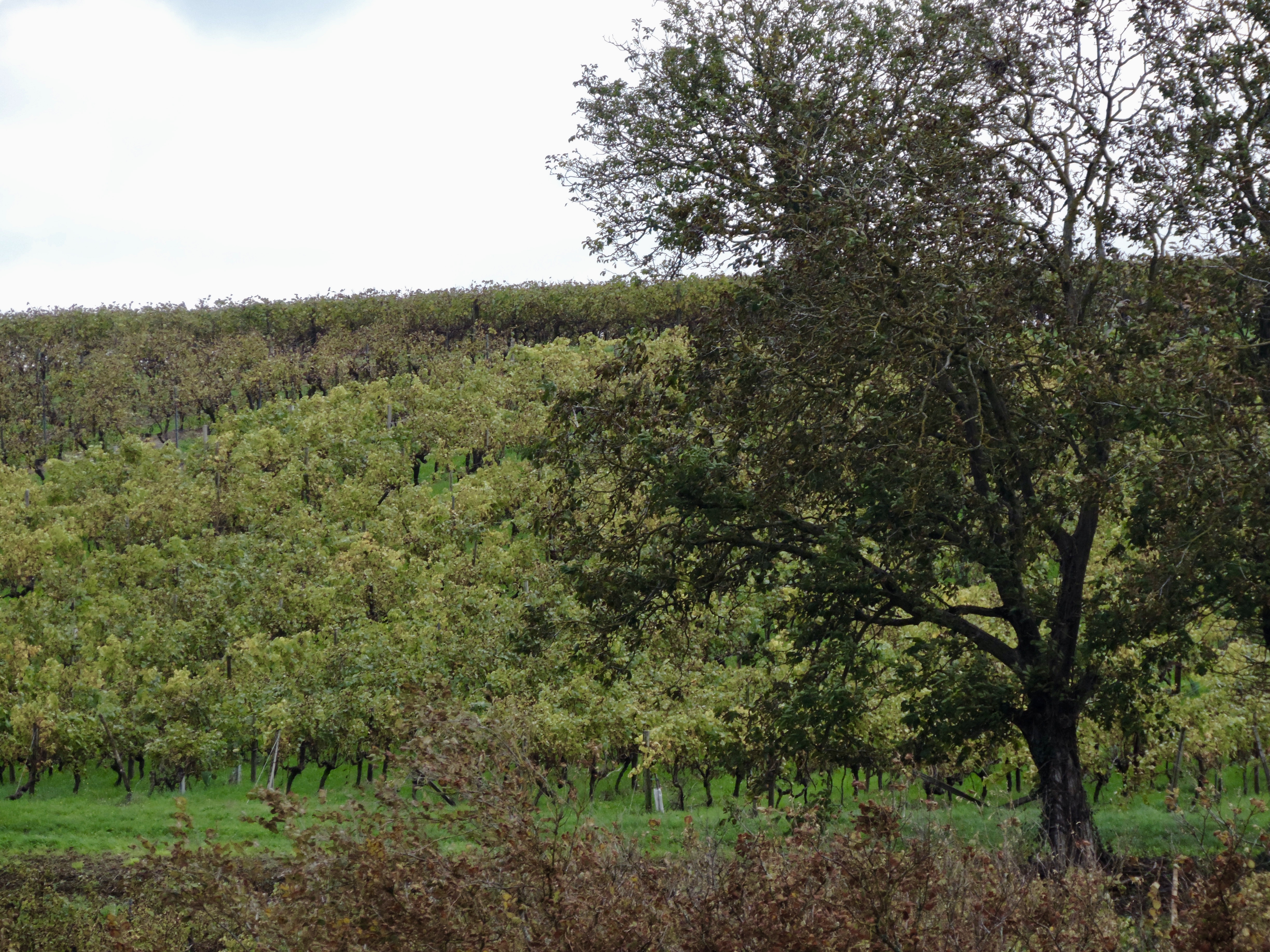
Since I retired six years ago and emigrated from Scotland to France I’ve lived in a house surrounded by vineyards. Watching the changes across the seasons and seeing how the workers tend to the vines has been an education for me. There’s something very comforting about watching the sweep of the seasons through the year. It helps me to feel more in tune with Nature’s harmonies and cycles.

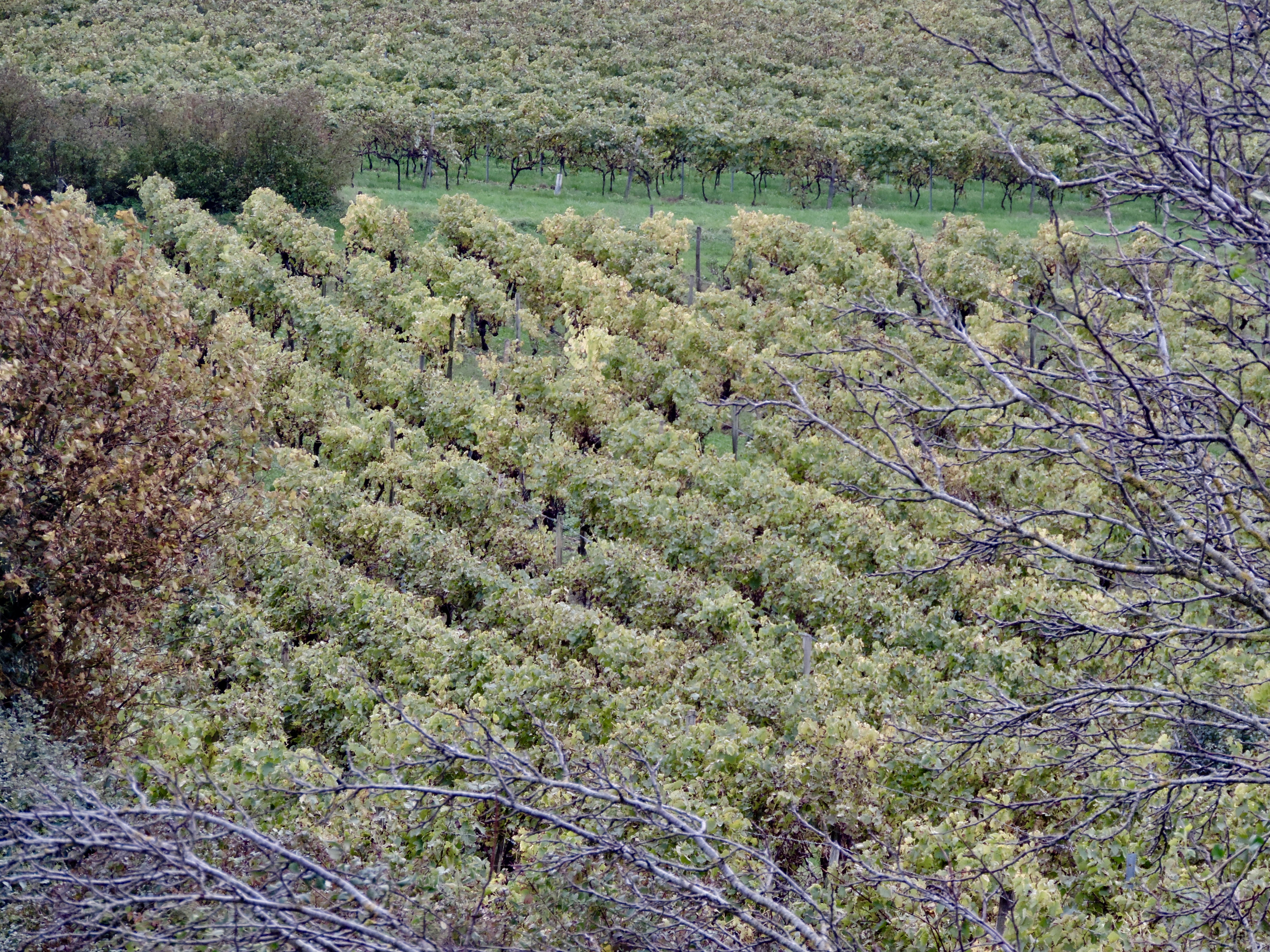
I think these two photos capture two concepts which vineyards can convey – diversity and order.

You can see as you look at these images that the vineyards are not uniform. Although the individual “wires” run parallel to each other within any single vineyard, each yard runs in a different direction. Some run north to south, some east to west, and yet others seem to be on a diagonal. This brings a real sense of diversity to whole landscape, despite the fact that as far as the eye can see there are vines everywhere.

What you can’t really see in these images is that each vineyard is a different age. Each year, some old vines are removed and new ones are planted. As I look out of my window just now I can see one whole vineyard which is row after row of seedlings, each in a bright green protective plastic tube. All the other vineyards are golden or brown. Some still seem to have all their leaves, and others have hardly any left at all.

That diversity strikes me as really important because its in so many dimensions – place, direction of the “wires”, age of the plantation – and so on.

Yet at the same time there is an incredible amount of order. At the time of the pruning the workers move from plant to plant trimming each one back to only two branches, and tying them onto the wires. The row after row of vines is the most ordered, planned and maintained landscape I think I’ve ever seen. Farmland in Scotland is not at all like this. OK, maybe if you see a field with all one crop, be it rapeseed or wheat, it looks pretty uniform, but these vines seem to take order and control to a whole other level.

You might think that diversity and order are opposites, and in some way, they are. So what we have here is that key phenomenon of “integration” – two apparent opposites existing together in synthesis, in harmony, in a way where neither negates the other.

We need diversity in our lives. We need some order too. But most of all we need “integration” – bringing everything together to work in harmony.

I haven’t taken a flight for almost exactly a year now. I suppose that’s a good thing for the planet. The sky above where I live in South West France is so empty of plane trails now that yesterday I was chatting with my landlord, Jacques, in the garden and he suddenly stopped speaking and pointed up to the blue sky and said “Regarde! Un avion!” (Look, a plane!). Well, there’s something that wouldn’t have happened before.

This photo was one I took the last time I was flying to Scotland and if you look carefully you can see all three bridges over the River Forth. First there is the famous red iron railway bridge, then next to it, the first road bridge, (I remember seeing its construction), and then the newest one, “The Queensferry Crossing”. One bridge built in each century for three centuries in a row.

Looking at this again I get thinking about the what bridges do – they connect. In this pandemic year we have been distanced and disconnected. Disconnected from our routines, our habits, our families, friends, and for many, our work. Jacques said yesterday how sad and strange it is now that when he saw his little grandchild the wee one held up his hand and told him to keep his distance in case he caught the virus. It’s little gestures, behaviours and episodes like that which deepen the strangeness and awkward disconnectedness of this year.

Maybe you’ve been making new connections this year, though. Maybe you’ve connected to family or old friends over video calls or meetings. Maybe you’ve been Whatsapping and texting more than you used to. Maybe you’ve reconnected to some people you might not have had so much contact with in recent years.

Maybe you’ve connected more to Nature, hearing more birdsong in the space opened up by the disappearance of noisy machines.

Maybe you’ve connected more to the seasons, the new growth in the Spring, the fruit trees in the Summer, the leaves turning red and golden in the Autumn, the first frost of Winter.

Maybe you’ve connected more to the here and now. Becoming more aware of colours, sounds, scents and tastes of the everyday.

Maybe you’ve re-connected to what’s important in your life, re-assessed your values, made decisions to change where you focus your attention and spend your energy.

One thing is for sure, as we come out of this pandemic, we are going to have to build new bridges, make more connections, make new connections, find different ways of living according to our most important beliefs and values.

Difference

There’s something very beautiful about this cloud pattern. I prefer a sky like this to a homogenous grey one where an apparently solid cloud stretches from one horizon to the other.

I like its “granularity”, the fact it is made of many different smaller clouds, not one of them floating in the sky alone.

When you think about our theory of the origins of the universe – that Big Bang theory – maybe it’s not right but it’s an impressive image isn’t it….the idea that in the beginning was a tiny dense energy which all of a sudden exploded out in all directions to create the universe as we know it. When you think about that, if it is true, then why did these waves of energy start to condense and form clusters, groups and objects? Why when we look at the night sky, even when we look at our own galaxy, The Milky Way, do we not see either just darkness in all directions, or a homogenous grey film stretching from one horizon to the next?

What we see in the night sky are millions and millions of stars, galaxies, and even groups of galaxies. Maybe what lies between them is dark material, and dark energy. But so far we haven’t been able to find it.

The universe is granular. It isn’t homogenous. It’s made of stuff gathered together into clusters and objects. Or, at least, that’s how it seems. So what we see is difference. We see each object as different from it’s surroundings.

We see each object as different from all other other objects, in terms of spatial and temporal co-ordinates, but also in terms of the exact amounts and proportions of elements of which it is made.

We see each object as having a different life story, a different origin in time and space, a different set of environmental influences. We see each object as having a uniqueness which we can only understand by following the multitude of it’s connections – in time, in space, in relationships and in experience.

Beginnings, endings, events and experiences. Edges and boundaries. Connections and relationships. None of this would exist if the universe weren’t full of difference.

Maybe that’s why I find this cloud pattern so beautiful…..because it reveals a fundamental principle of all existence.

Networks

I’ve got lots of photos of spider webs. When there has been a heavy dew and the sun is just up in the morning they look absolutely bejewelled. Mesmerising and gorgeous. Most webs have that classic spiral appearance with a clear centre, and strands all spreading outwards from that centre, then concentric rings of web woven around and around that centre point.

But this one is different, and maybe you’ll look at it and think it’s not as beautiful because it has neither a clear centre, nor any lovely symmetries. But this structure is one of the most fundamental shapes in Nature.

It’s a network. It’s made up of two simple components – nodes and connections. There is no single clear centre, no branching or hierarchical structure. Some nodes are multiply connected, others only connected to two other nodes.

The cells and organs of our bodies are like this – they are multiply connected and once change takes place somewhere it spreads quickly through the entire network. There is no single commanding point. This is an incredibly flexible, adaptive structure and it is exactly what every “complex adaptive system” looks like – either literally, or functionally.

I find it utterly beautiful and wondrous. I love how I can understand human biology through this lens. I love how I can understand the brain through this lens. I love how I can understand ecosystems through this lens.

Every single one of us exists within, and emerges within, these vast complex webs or networks of Life. We don’t function like machines. The connections are not linear – instead they are “non-linear” – so effects can accelerate as they cascade through the system, and changes can occur which are utterly unpredictable from the starting state.

This reminds me of the importance of seeing each of us, not as separate disconnected individuals, but instead as unique instances of change within the entire web of Life.

Finding a way through

Do you see the rock just beyond the harbour wall? The white foam of the sea catches your eye, doesn’t it? At first, you think it’s water splashing against the rock, because, that’s something you’ve seen many, many times before. But if you keep looking the foam disappears and you can see this –

Click on the photo to get a closer look. Can you see the gap in the rock where the white foam was? If you look very carefully you can still see some water falling down the front of the rock from that gap.

This rock has a gap in it. A long narrow gap. The waves crash against the other side of the rock, the side you can’t see from the land (the dark side of the rock??) and some of the water flows through that gap and cascades down the front.

I don’t know how this began, and I’ve no idea when it began, but it’s quite mesmerising to watch. There’s a rhythm to it, as there always is when you are watching waves breaking on a shore line.

However it began, I know that every time some water forces its way through this gap it widens it just a little bit more. I can’t help but think about that power of water and what it can teach us.

Little by little, probably imperceptibly at first, constant, repeated, pressure of the water against the rock opens, and widens, a hole right through the middle of the rock. It would be tempting to think of the rock as solid and unchanging, and the water as soft and constantly changing, but this reveals that’s not quite right. It’s true that the presence of the rock changes the shape of the water – influences the speed and direction of the waves. But the water actually constantly changes the rock.

Gentle, constant persistence.

I’ve always been a fan of that. The ability to be present, and to pay attention, to sustain that attention, is a powerful skill. I’m pretty sure that’s one of the reasons why so many patients told me the same thing – that they had just told me something they had never told another human being. It always amazed me to hear that. Sometimes it would be an important, even a key, part of their story which made it possible to make a diagnosis. Sometimes it brought about a sudden revelation which allowed the person to make sense of what they were experiencing. One small part of a life story might be like that gap in the rock and as the water of insight flowed through it, suddenly we both understood.

I suppose it’s a bit like that famous line from Leonard Cohen –

There is a crack in everything
That’s how the light gets in

How do we heal?

I’ve just finished reading Madeline Miller’s superb “Circe”. I can’t tell you just how much I enjoyed it. I found it a great read. I am a bit familiar with some of the Greek myths and legends, including the story of Odysseus, but this way of telling Circe’s story let’s Madeline Miller tell you some of those myths from a new perspective. I just loved it.

Last night I read a passage which made me think “Yes! I must share this!” Here it is –

When I was young, I overheard our palace surgeon. He said that the medicines he gave out were only for show. Most hurts heal by themselves, he said, if you give them time. It was the kind of secret I loved to discover, for it made me feel cynical and wise.

I have long believed exactly that. I used to say to patients something like “If you break a leg, the surgeon will apply a plaster to your leg to hold it still. The plaster doesn’t repair the fracture. It just holds the ends together while your body gets on with doing what it does – healing – or, in this case, repairing the fracture.” Or I’d tell someone “This antibiotic isn’t going to cure your bladder infection. What antibiotics do is to kill bugs. That’s a good thing. But your bladder wall is all inflamed because of the infection, and it’s that inflammation which is causing your symptoms. The antibiotic will have no direct effect on your inflammation. But it will reduce the number of harmful bugs in your bladder to allow your body to get on with doing what it does – healing.”

Does that seem unnecessarily pedantic? I don’t think so. I think it reinforces the patient’s belief that their body can self-heal – which is exactly what all “Complex Adaptive Systems” do – all living creatures have these abilities to self-regulate, self-defend, and self-repair. It’s what they do.

That’s the wisdom part.

But in Circe’s telling this knowledge also brings a certain cynicism, and for me, that’s always been about the place of drugs in health care. There isn’t a drug on the market which is designed to directly promote and/or stimulate self-healing and self-repair. Each drug attempts to redress an imbalance, or to suppress some symptoms or pathologies. The business of the body doing what the body does – self-healing and self-repair is left to be a hopeful sort of side-benefit at best.

There are ways to work more in harmony with the body’s natural powers, but, in my opinion, those ways aren’t taken seriously enough. Targeting pathology/disease and/or symptoms remains the dominant model. But I do dream of a time when the balance tips towards targeting health/healing and/or powers of self-repair, and self-healing. The present types of drugs and treatments will then be seen as the potentially useful adjuvants that they really can be. They will no longer be seen as enough by themselves.

Oh, by the way, “Circe” isn’t a book about health or disease. It’s a telling of some of the Greek myths. It’s just that passage really resonated with me so I thought I’d share it. And, on reflection, don’t those myths have something to tell us about disease and illness, and how we cope, heal and grow?