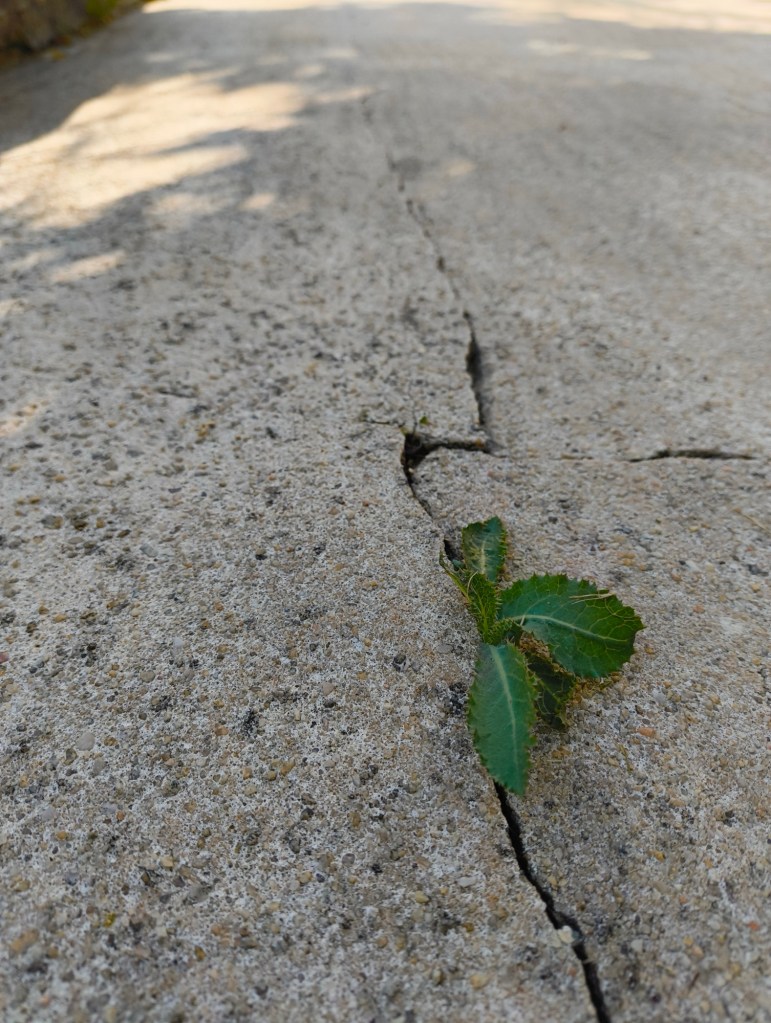
We are a bit obsessed with “outcomes” and determining “cause and effect”. But look at this photo. Do you think this shows cause and effect? Do you think this little plant has split open the concrete path?
I don’t think so. Of course, I know the crack was there long before this little weed popped up. I don’t know why the concrete is cracked or when it happened. It was like this when we moved here over two years ago. But I do know that from time to time a weed will turn up here or hereabouts.
Plants are brilliant opportunists. Give them the conditions which they need and they will thrive (even if you don’t want them to!)
I think it’s the same with all forms of life. Create the right, supportive, environment and life will thrive. All living organisms are adaptive and opportunistic. All are utterly unpredictable.
The best way to create health is by providing the environment and opportunities for life to thrive.
A recent report in the U.K. focused on prevention rather than cure. It proposes a “pre-NHS Service” to deliver mass vaccination programmes coupled with blood tests including cholesterol levels and genetic testing to get “at risk” people to start taking lifetime drugs and changing their eating and exercise habits.
Although this is promoted as innovative, visionary and “personalised”, I can’t help feeling such an approach ignores the importance of the environmental and socio-political factors which underpin population health and well-being.
There’s something about a lifetime of drugs just doesn’t feel right to me – this is really a definition of “health”? You’re not healthy, you’re just not sick yet. You’re pre-sick and that needs drug treatment.
There’s another thread to this approach – the underplaying of the importance of emotions. We are not simply “rational” creatures. We are emotional and social creatures with rational capabilities. We process the world, first, emotionally and socially…then we try to rationalise our experiences.
Fear and despair lie at the core of much chronic illness and poor health. They charge up inflammation, damage immunity and can contribute to both ageing and cancer.
At a population level, poverty, job insecurity, poor housing, pollution, industrialised highly processed foods and climate change all contribute to massive insecurity which feeds both fear and despair.
So, if we really want to invest in prevention, it’s not a “pre-NHS” we need, it’s political and social action to reduce poverty and inequality. It’s work to improve the daily workplaces, and the job contracts which most people live with. It’s better housing, better insulation and less polluted air and water. It’s more respect for others, more kindness and care, more autonomy and acceptance. And, and, and……
In other words I think we need to put in the energy and resources to create better societies, and healthier environments. That way we create the conditions which can benefit everyone, not just those who sign up for a lifetime of drugs.
I detest the xenophobic politics sprouting up everywhere these days.
Nature thrives on diversity and all areas of society do too.
If you work in a team you don’t want everyone to think the same way. Well you don’t if you want to promote creativity, innovation and resilience. You do if you want to impose conformity and control.
If you want an institution, whether a school, university, health service or company, diversity is essential for adaptation and survival.
Discrimination against people on the basis of where they were born, or where their parents or grandparents were born is simply wrong – morally and rationally.
Immigration is not a problem – integration is. We should be putting our energies and resources into integration – building mutually beneficial relationships between well differentiated parts – between people who are different from each other, between people and the rest of Nature.
This story – https://www.bbc.com/news/articles/ckkkgvl59x3o.amp – is a good example – a PhD student from Romania studying at Imperial College in London and working with the University of Edinburgh and Cancer Research Horizons to develop a home test which could replace uncomfortable, unpleasant smear tests. If successful this could make a big contribution to reducing the numbers of women who will die from cervical cancer.
It’s really not hard to find other great examples of integrated diversity.
Shame on those politicians who promote hatred and fear of “the other”.
Love is a word we can use too easily (“I love chocolate”) and/or not enough (how often do you tell your loved ones that you love them?)
But I reckon it’s at the foundation and the core of a good life, of a good society, of a good relationship.
I’m thinking of the love we feel and give without any expectation of return. I don’t mean desire. Desire might be coloured by love, but it might not. I mean the love that directs and maintains our attention. The love that enables us to notice, to care. The love that doesn’t judge, the love that opens our heart to “the other”, not to possess, or own, or control, or to make them the same as we are. But the love that stirs curiosity, makes us want to know the other better, more deeply, more fully.
Is my action loving? Are my words loving? Am I thinking loving thoughts?
I wish we could all put love at the heart, at the core, in the foundations of all we do, say and think…..as much as we possibly can.
In a world riven with divisions, hatred and fear, the answer, surely, is love.
Here’s my challenge, to myself, and to you….this week, just notice each day every time you feel love in your heart. (and maybe note it down somewhere, in a journal, a notebook, on your phone). Then let’s reflect in a week’s time, and set an intention to love a little bit more.
I find it pretty depressing how immigration is presented as a problem in so many countries. It seems every far right political group on the planet wants to build walls around their own country and keep any foreigners out. Why? Because people who aren’t born in the country where they now live are a problem to be solved?
Personally, as an immigrant myself, I think everyone who live in the same street, the same village, town, or city, the same country even, should be treated equally. I’m not a problem because of my genealogy or my genes. We are all inhabitants, we who live together, sharing the same roads, the same shops, the same activities. I prefer the concept of “inhabitant” or “resident” over that of “citizen” if, by the latter term, we mean people who have passed whatever administrative and/or economic rules a country applies to people who weren’t born in that particular part of the world.
In fact, more than anything geographical, I feel I am a member of the human race, and a unique expression of Life, just like all the other human beings who I share this planet with, just like all the other astonishing forms of life I share this planet with.
I don’t think immigration is a problem to be solved. The problem to be solved is “integration”. Here’s the definition of integration I work with – “the creation of mutually beneficial bonds between diverse and well differentiated parts”. In other words, how do I live with my fellow “residents”, fellow “inhabitants”, fellow “citizens” in the part of the planet which I call home?
When we don’t create healthy, positive, creative, and caring bonds between each other, we all suffer. We humans have always moved around the Earth, and we always will. Yet, most people who live in a particular part of the world would prefer to stay there – it’s war, violence, and utter poverty that drives out those who would rather stay.
I think we should put our energies and our resources into living well together – that would include treating people in the same place equally no matter where they were born, actively helping immigrants to integrate by teaching them the language, customs and laws of the country, and encouraging their full participation in society. And we need to develop mutually beneficial, caring, creative relationships between countries, instead of hostility, hatred, fear, competition and violence.
We humans are superbly adaptive creatures and we’ve evolved to be able to inhabit almost every corner of this little planet. But we’re going to have to adapt better if we all want to survive….or at least, if we want our grandchildren and their grandchildren to survive. We’ll do that through integration – by the creation of mutually beneficial bonds between ourselves and others.
So, I reject the dominant narrative that immigration is a problem, and I say, loud and clear, that what we should address and “solve” rather, is integration – integration in our streets, our villages, our cities, our countries, and our planet.
All my working life I practised Medicine as holistically as I could. I never made sense to me to split a human being into parts, particularly into a “mental” part and a “body” part. I was trained to practice holistically, even if my teachers rarely used that word. They taught me to listen to a person’s story, to listen with empathy and without judgement, in order to understand their illness, to make a good diagnosis and to plan what investigations and treatments should be considered. We started with the person, and drilled down to clarify what was happening in certain systems or parts, with the help of investigations.
This way of working emphasised that every single human being was unique, and that there were no one size fits all treatments. It taught us to remain ever alert, to follow up patients ourselves and to adjust our diagnoses, treatments and prognoses, as life continued to flow.
But was it holistic enough?
My chronic doubt, which, I confess, has grown over the years, was that it wasn’t. The reason for saying that is that whilst I knew everyone lived within a complex, layered web of relationships and environments, my interventions were almost exclusively individualistic.
But I know that our health is affected by traumas, by relationships, by work, by poverty, by housing, by pollution.
The Covid pandemic made all that clearer than ever, but still, we went for an individualised approach, focusing on vaccinations and personal hygiene. But we saw that the vulnerabilities and problems lay in insecure employment, poverty, racism, overcrowded and inadequate housing etc.
Sometimes I buy the idea that we can all be healthier if we exercise enough, eat a balanced nutritious diet, and manage our emotions, but then I see children in Gaza, people picking through the rubble of their houses in Ukraine, whole towns swept away in historic floods, and I realise, this individualistic holism just isn’t enough.
Let me clarify – I’m not knocking holistic medical practice – it’s far superior to reductionist, materialist, industrialised models. But we need to be much more aware of the circumstances of our lives, and, in particular, of the shared circumstances of our lives. If we can’t do anything about climate change, plastic pollution of the oceans, chemical pollution of the soil, the waterways and air; if we can’d do anything about poverty, social exclusion, hatred and prejudice; then we’re going to be fire fighting, and applying bandaids, when we could be creating a better world for all of us to live in.
How do we do that?
Ah, that’s the big question, and it’s not an easy one to answer. But we have to start somewhere, and awareness might be a good place to start. We need to talk to each other, to express our desire for more justice, more care, more understanding of how we all share this one, massively connected world.
I’ve read that we live in an attention economy. Marketers, producers, companies and individuals are all competing for our attention. They pay the social media companies to promote themselves to us using attention grabbing, and attention holding tools and techniques. “Influencers” can only influence if they attract attention, so they do whatever they need to do in order to achieve that goal.
I was pretty shocked on a recent trip to Milan to discover how “instagrammable” has become a major force. Certain buildings, certain viewpoints, or “attractions” were surrounded by dozens of, mostly young female, photographers, either taking pictures of themselves in front of whatever it was that had become “instagrammable”, or having someone else take their portraits there. Some even used portable reflectors, to “get the light right”, and had changes of clothing to model. I joked that my wife and I, standing in front of the Duomo, were the only people in the crowd actually facing the building. Most were trying to make it more beautiful, or more interesting, by putting it in the background, and themselves in the foreground.
That’s not a new phenomenon. A few years ago on a visit to the Alhambra in Grenada, I was surprised to find that most people who were taking photos of the amazing art and architecture, were only doings so by putting themselves into the foreground of each frame.
But attention is important. It’s how we see and experience the world we live in, and it influences our moment to moment moods, thoughts, and actions.
Ellen Langer, who studies “mindfulness”, describes it, simply as, “actively noticing things”.
I love that.
This “heroes not zombies” blog is all about living a more mindful life, and, I believe, that requires two things, both created out of attention. The first is, “noticing”, or as Ellen Langer says, “actively noticing”. When we pay attention, when we set out with an intention to notice – to notice the world around us, to notice others, to notice our thoughts and feelings – then we move into a more active, more conscious mode of existence. We reduce the chances of blindly following the influences and powers of others who try to shape our lives. The second is, to pay “loving attention”. I think whatever we pay attention gets magnified. If we focus on problems, we fill our lives with problems. If we focus on joys, of moments of awe and wonder, then we fill our lives with amazement and delight. But when we pay attention from a loving position – from a position of care, of empathy, of genuine interest, and love – then our attention changes, not only our own lives for the better, that of others…..whether they be other people, animals, plants, the environment, or the planet.
So, I’m all for paying attention – do it actively and do it lovingly – not mindlessly.
“Informed consent” is a fundamental principle of good, ethical, medical practice. In the UK, the General Medical Council has specific guidance about informed consent in its guide to shared decision making, which begins –
This guidance explains that the exchange of information between doctor and patient is essential to good decision making. Serious harm can result if patients are not listened to, or if they are not given the information they need – and time and support to understand it – so they can make informed decisions about their care.
They specify what information should be shared –
You must give patients the information they want or need to make a decision.
This will usually include:
diagnosis and prognosis
uncertainties about the diagnosis or prognosis, including options for further investigation*
options for treating or managing the condition, including the option to take no action
the nature of each option, what would be involved, and the desired outcome
the potential benefits, risks of harm, uncertainties about and likelihood of success for each option, including the option to take no action. By ‘harm’ we mean any potential negative outcome, including a side effect or complication.*
When did you last receive a treatment from a doctor? Before you received it, did they gain your “informed consent”?
In my personal experience, informed consent before surgery has always been present, but over the years the information given has improved considerably. When I saw a urologist last year he offered me different options for treatment, discussed the potential benefits and harms, and included a discussion about the option of doing nothing. He then gave me a pack of literature to read and insisted I didn’t decide which treatment to take until I’d read the information and reflected on it before my next appointment with him.
That’s not my experience when it comes to drugs. I have never been given options, nor had the potential benefits and harms discussed, before receiving a prescription, and, in fact, I’m not sure I’ve ever heard of any patient who hasn’t shared exactly that same experience. It’s far more likely that a doctor will write a prescription, and say, take this and come back and see me in x days/weeks. Once the patient picks up the drug from the Pharmacy, inside the pack is an information sheet, which is usually a longer piece of paper than you’d find anywhere else, but where there is a lot of information about what the drug is, the precautions you should take, potential side effects and harms, and exactly how to take it. I’ve never seen any “other options” described on such an information sheet (unlike the information pack I was given before surgery).
I just don’t think this is good enough.
It’s not good practice, as defined by the GMC, and it doesn’t fit with the “Evidence Based Medicine” approach, and it certainly doesn’t meet with the constantly repeated claim to provide “person centred” or “patient centred” Medicine.
If you are a prescriber, maybe you will say, but this just isn’t feasible. There isn’t sufficient time available in each consultation to obtain “informed consent”. I think there are ways to address that. Firstly, there should be enough time, and if there isn’t, then the system is not working. Consultations which are routinely too brief to make a good diagnosis and obtain informed consent are inadequate, and fail to meet the standards of good practice. Secondly, if surgeons can produce comprehensive information about their procedures and the potential benefits and harms, then so can physicians and generalists. Thirdly, as the GMC points out, informed consent is a dialogue and not a single event. Continuity of care has a wealth of benefits, and one of them is enabling an ongoing dialogue between doctor and patient. Many clinics are not designed to facilitate continuity of care, but they could be if we all agreed it was important.
I just don’t think it’s good enough in this day and age to have a doctor write a prescription and say “take this”, without giving any information about potential benefits, harms or other treatment options. And without facilitating a discussion/dialogue with the patient to obtain truly “informed consent”.
I guess war has always been mass murder. After all, every war involves at least one group of human beings killing another group of human beings. In fact, if the killing was one way, just one group being slaughtered by another, then we’d call it “genocide”, but in war, both groups kill others who belong to the other group. Who wins? The group who kills the most? I don’t know. Maybe a historian could tell me, but, my hunch is, it’s either the group who murders most members of the other group, or the group which carries out such a horrifying mass murder that the other group says, “Stop” and “gives up”.
I was thinking about this in relation to two current conflicts – Russia/Ukraine and Israel/Gaza. In the former case, as best I know (and it’s hard to know the truth about any war), most of the killing has been of “combatants”. Is that true? Do the number of “combatant” deaths exceed the number of “civilian” ones? Even if it is true, “combatants” are human beings too.
In relation to Israel/Gaza, this latest round of “war”, or shall we just call it “killing”, was sparked by the mass murder of “civilians”…….young people enjoying a music festival, families in their own homes, and so on. Since then, we are told, somewhere around 30,000 Palestinians have been killed by Israelis. A huge number of those killed in Gaza, are reportedly, children and adult “civilians”. How many “combatants” have the Israelis killed?
This is what set off my recent thought that war is mass murder, because, we now get reports that Israel identifies certain individuals as “combatants”, or, more likely, they call them “terrorists”, and then they either bomb their houses, or use a drone, to kill them, and, often several members of their family at the same time. There is no judicial process involved, as there isn’t usually in a war. I read that there are over 30,000 people on the Israeli database who have been selected to be killed in this way. They are named, found, and killed.
Will the Palestinians or Israelis ever “give up” and stop killing each other? In other words, will this war ever end? We don’t know. But, sadly, at this point, it seems unlikely.
In World War II both sides targeted civilian populations, carpet bombing and/or fire bombing whole cities. Did the “big bombs”, dropped on Hiroshima and Nagasaki, bring the whole conflict to an end? In other words, did the “Allies” win by killing more people who lived in countries controlled by the “Axis” than the other way around? I don’t think all historians agree that the nuclear bombs ended the war, but they certainly horrified the whole world.
However you look at his, it’s pretty clear that war is mass murder. Will we humans ever evolve to the point where we stop doing that to each other? What are the chances?
Last year I found a walnut under the earth when I was weeding. It had a small pale green root (or stalk? Who knows?) sticking out of one end so I took it and planted it in a pot. A few weeks later I had a tiny tree with a few delicate leaves on the top, so I transplanted it into the forest area of the garden and put a little fence around it.
Along came autumn and the leaves dropped off and all winter it’s looked like just a stick. I thought it was dead, but I’ve learned to wait (gardening teaches you patience), and over the last few days, look! It’s producing leaves again!
It still astonishes me that we humans have no way of telling if a particular seed is dead or alive. We just have to plant it, care for it, and nourish it. We can’t force it and can’t predict it.
Similarly, it amazes me how dead so many little trees appear in the winter. You have no idea which of them are still alive. Again it’s best to wait, to care for them, and watch out for signs of life in the Spring.
I think there’s a lesson here for when we think about how to recover from an illness, or even how to stay as healthy as possible – it’s about creating the right environment.
For we humans, we need to create the best conditions for people to recover and thrive, and that includes a healthy physical environment (as free from pollutants as possible), clean water, nourishing natural food, and social conditions such as dealing with poverty, poor housing and insecure employment.
I welcome constructive criticism and suggestions. I will not, however, tolerate abuse, rudeness or negativity, whether it is directed at me or other people. It has no place here. ANYONE making nasty comments will be banned.