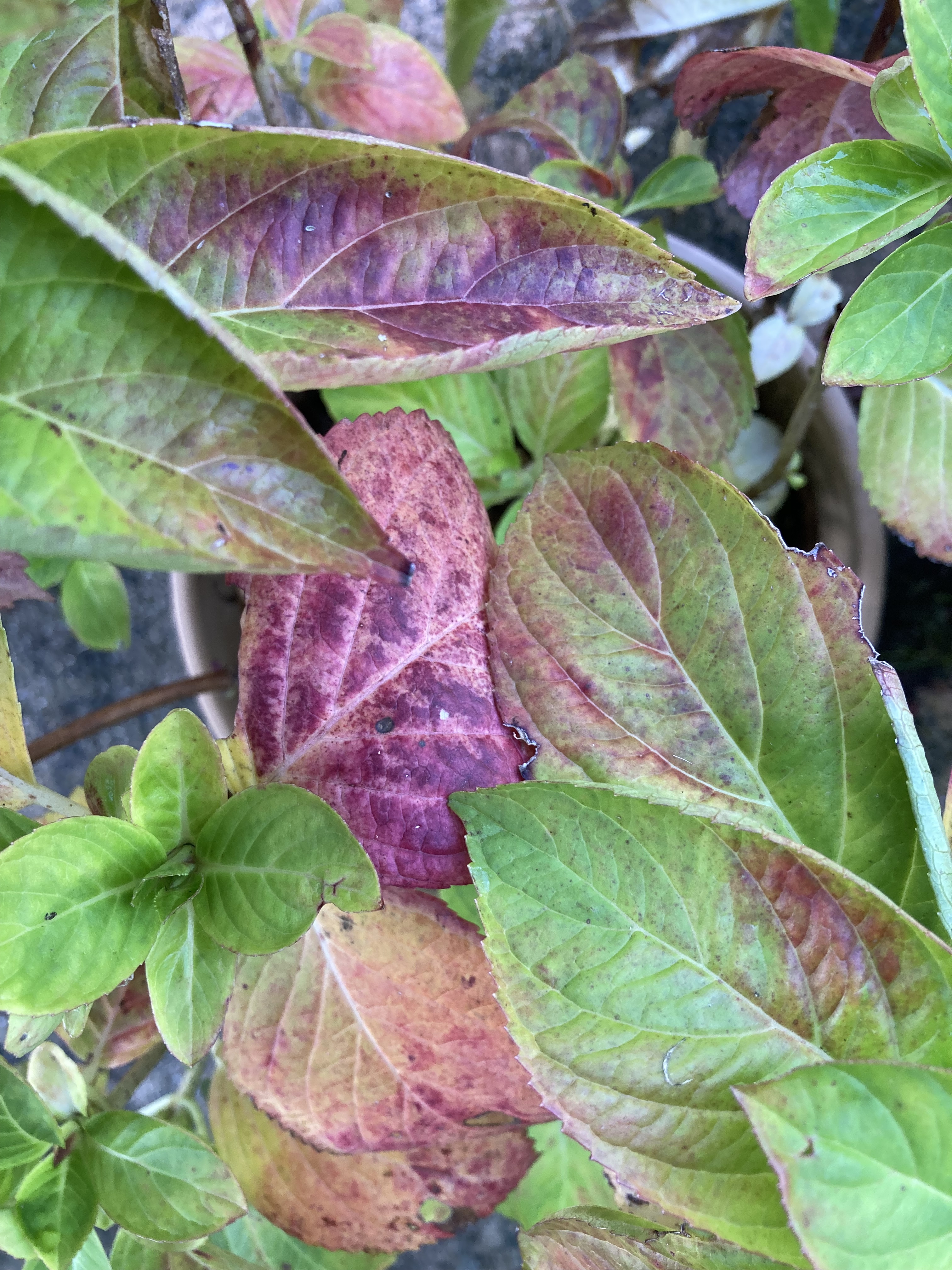
Spring and autumn are the two seasons where I notice change happening right before my eyes. Right now, in October, here in France, we are beginning to see leaves change colour. I love to gaze for a few moments at a plant like this, where some of the leaves are still bright green, some have patches of red or brown appearing, and some have gone fully deep red or even purple.
This reminds me of two things – the first is that change never stops. Everything in the world is constantly undergoing change. We are not the same today as we were a few weeks ago, and we are very different from what we were a few years ago (just browse through your photo albums to see how you’ve changed since you were a baby). The reality is that we change moment by moment. That’s why the advice to “be present”, or to “be here now”, is so relevant. Every single moment is unique, and if we breeze past it without noticing, it will be gone forever (except, of course, in the background of our subconscious the changes never cease to play their part).
The second is that change is so variable. It is heterogenous, not homogenous. You and I are unique. Our daily lives are unique. Our moment to moment experiences are unique and become even more unique over time, as nobody shares with us an exact personal history, an identical string of experiences. Just looking at this one plant and seeing the huge variation in colour as the leaves begin to change makes me even more aware of this uniqueness, of diversity.
So awareness of change slows me down, inspiring me to savour this moment, to live today as fully as I can. It inspires me to pay attention to the flow of Nature, to be aware of the fact that there are no fixed objects in this world, only different rates of change.
And awareness of change does something else for me – heightens my appreciation of uniqueness, of difference, and of diversity. Reducing life to abstractions, selecting single characteristics and bundling everyone who shares them into a single category is such a deluded way of living. We need to stop putting people into little boxes, labelling them and judging them, because when we do that, we just stop seeing them as they really are.
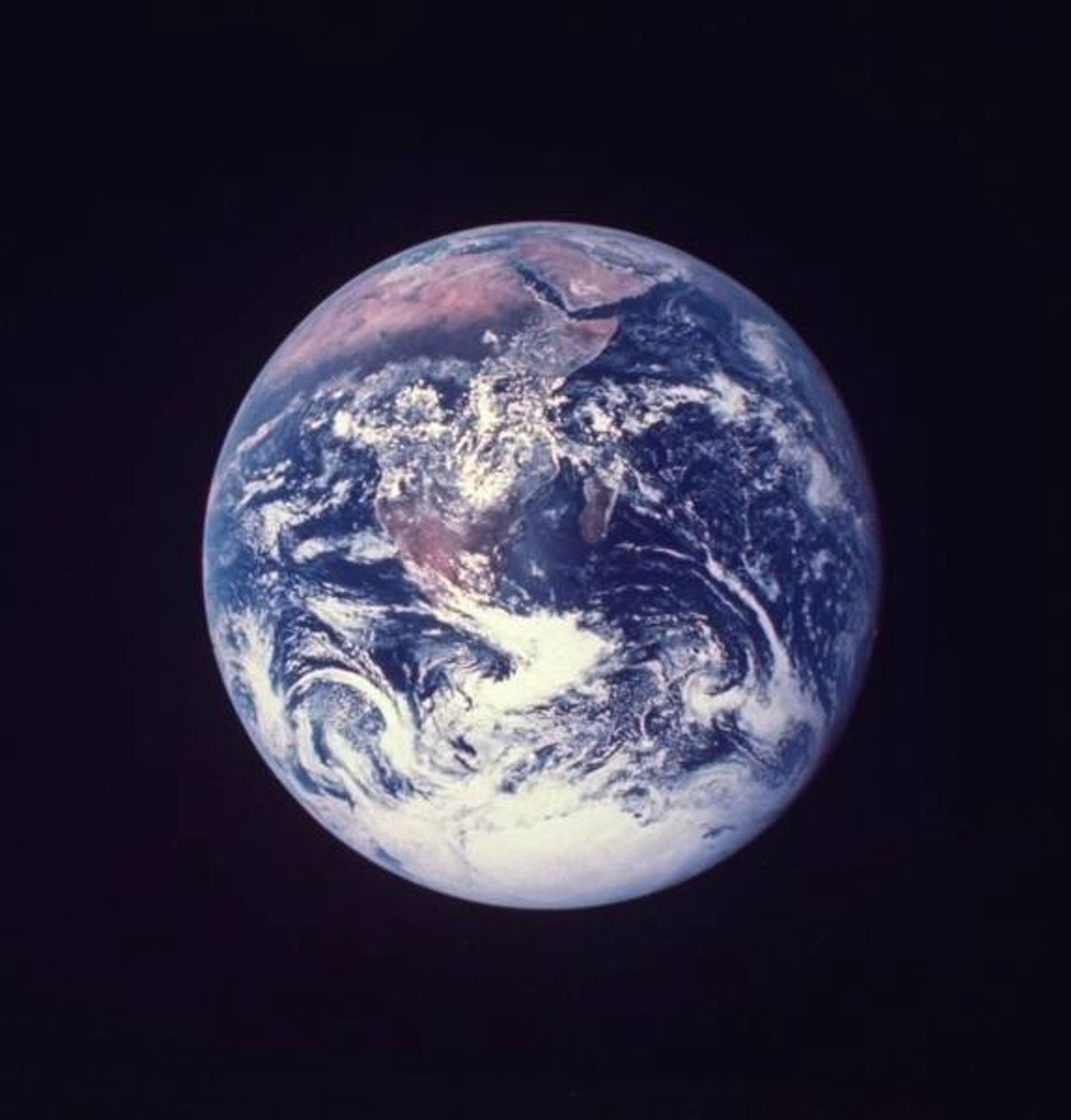
Just a few more beautiful words from the book, “Orbital” (and photo I didn’t take!) –
“Before they came here there used to be a sense of the other side of the world, a far-away-and-out-of-reach. Now they see how the continents run onto each other like overgrown gardens – that Asia and Australia are not separate at all but are made continuous by the islands that trail between….. Continents and countries come one after the other and the earth feels – not small but endlessly connected, an epic poem of flowing verses.”
This isn’t a small world. It’s huge. But there really is just a constant ever changing flow of Life on this planet, manifesting through diversity, relationships and an infinity of connections. We belong here. Together. We become here. Together.
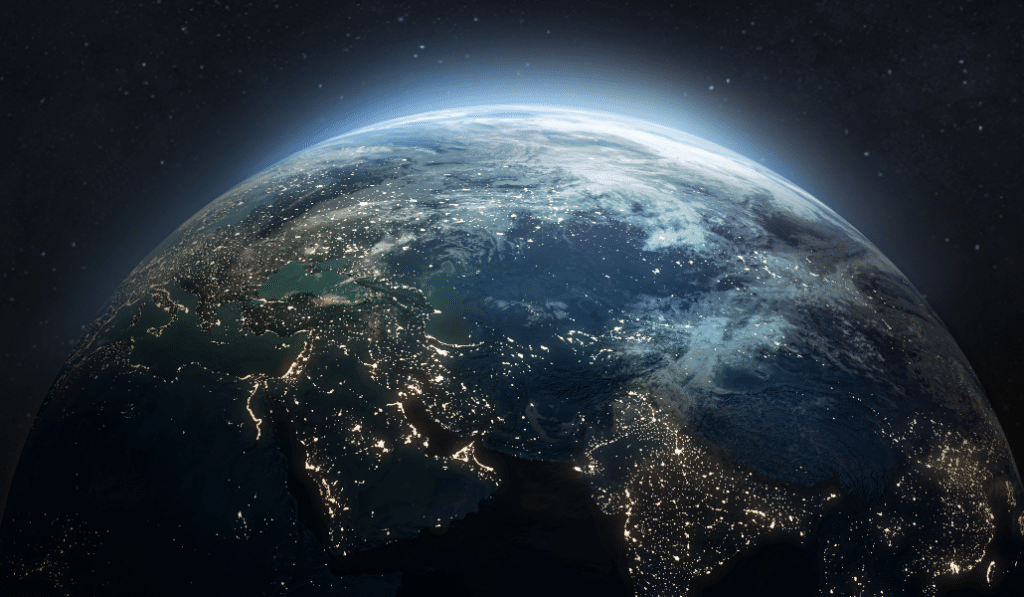
In “Orbital”, by Samantha Harvey, she describes how the astronauts aboard the International Space Station are first entranced by the Earth at night. It’s when night falls over the surface of the planet that the presence of human beings becomes most obvious….the networks of streets, buildings, roads sparkling and shining so brightly you can easily see them from Space. Then as daylight comes they see the Earth as a planet where humans beings are invisible, see it as a living, whole organism with its oceans, clouds, weather systems, forests and deserts. But then they come to realise just how much of the Earth is the way it is exactly because of human choices and actions.
We change the planet just by living here. How it changes comes down to our collective choices and those of the corporations and individuals with the greatest power and wealth.
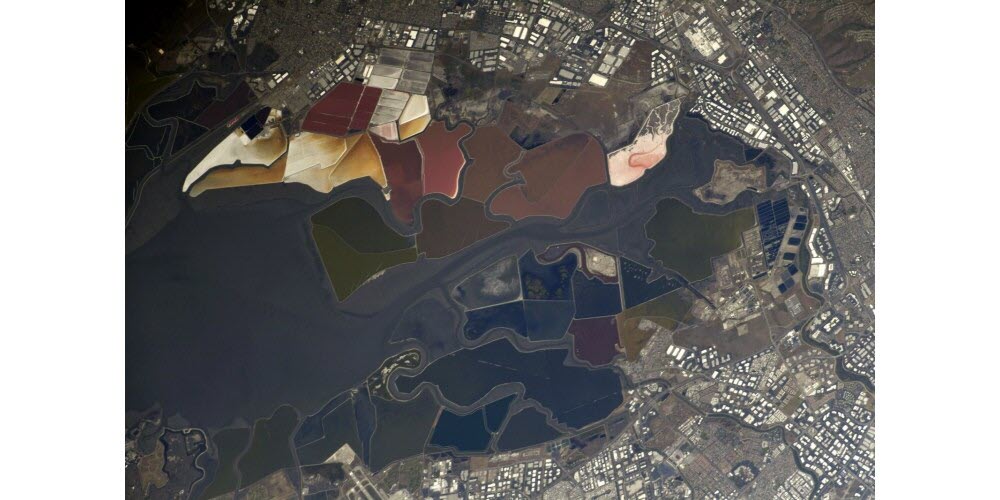
Normally I use my own photos to illustrate my posts but, having never been to the International Space Station, this time, I’m borrowing a couple of photos from the French astronaut and photographer, Thomas Pesquet. Look him up. Check out his photos. They are simply astonishing.
“They come to see the politics of want. The politics of growing and getting, a billion extrapolations of the urge for more……The planet is shaped by the sheer amazing force of human want, which has changed everything, the forests, the poles, the reservoirs, the glaciers, the rivers, the seas, the mountains, the coastlines, the skies, a planet contoured and landscaped by want.” – from “Orbital” by Samantha Harvey.
This is the modern version of a very old philosophical exercise – taking the view from on high – to stand apart, above, and look out over the greater whole.
“The earth, from here, is like heaven. It flows with colour. A burst of hopeful colour. When we’re on that planet we look up and think heaven is elsewhere, but here is what the astronauts and cosmonauts sometimes think: maybe all of us born to it have already died and are in an afterlife. If we must go to an improbable, hard-to-believe-in place when we die, that glassy, distant orb with its beautiful lonely light shows could well be it.” – from “Orbital” by Samantha Harvey.
The mental capacities we humans have developed allow us to do incredible things, not least the ability to create a distance, and the ability to change our perspective. The ability to put a space, or a pause, between all the signals and stimuli entering our bodies, and carrying out an action, is the difference between reacting and responding. You know about the famous “knee jerk”, where a doctor hits a tendon in your knee and your legs jumps forward….this is an instant reaction carried out at the level of the spinal cord. It doesn’t require any thought, and it’s not possible to suppress or enhance it consciously. But when we act in life, we have the chance to put a gap into the stimulus-response loops which pass through our brains. We don’t need to act only on auto-pilot. We can “stand back”, consider, or reflect, and then choose what actions we want to take. This is responding instead of reacting…..an important skill in managing anxiety and learned loops of behaviour.
It’s this same “necessary distance” which enables us to have a sense of self, separate from the world in which we are living. Of course, that separation is a sort of delusion because we never step outwith the flow of all that exists. But it’s a useful skill.
The other skill, to change perspective, is a different way of creating a distance, of stepping off the treadmill, switching off the autopilot. We can do it by altering, or disrupting a habit. Walking a different route, shopping in a different store, visiting a different town or country. It’s a big part of why I decided to emigrate from Scotland to France when I retired….to force myself to experience a whole gamut of different perspectives….physical, cultural, social…..to learn to communicate and think in a different language.
In her book, Orbital, Samantha Harvey describes in detail these experiences of distance and perspective. In this passage I quoted above she prompts us to think about heaven and earth by flipping the normal perspective. Instead of standing on the surface of the earth gazing “towards the heavens”, she describes the astronauts on the International Space Station, gazing down towards the surface of the earth and finding it “heavenly”.
I often think this life, this planet, is heavenly. It is so improbable, so incredible, so amazing…..how did it come to be? How did Life come to exist, and the myriad of species evolve? How, despite all our seeking, and all our statistical beliefs, this planet we call Earth, we call Home, remains singular, unique, quite unlike any other in the entire universe.
When you stop to experience this planet, and take time to reflect, and to wonder, it’s not hard to experience it as heaven. There is so much beauty in this world. We should protect that, nourish that, care for that, value that, make it a goal to enable all human beings to experience this planet as heaven on earth.
“The Earth is a mother waiting for her children to return, full of stories and rapture and longing.”
“Orbital”, by Samantha Harvey, describes the experiences of six astronauts aboard the International Space Station. It’s a beautiful little book, which reads as a poetic meditation on The Earth, Nature, Life and Space exploration. One of the lines which struck me, early in the book, was the one above.
The idea of Earth as a mother is an ancient one, but one we’ve become distanced from. The truth is we are born on this planet, emerging from millions of years of flows and interactions between energies, molecules and information. We have evolved as a part of Nature, with the planet’s resources of air, water, and nutrients, supporting us, enabling us, and with the Earth’s atmosphere protecting us from harmful solar and cosmic rays. We couldn’t exist without her. Mother Earth. We only exist because of her. Mother Earth.
But our direction of travel over the last few hundred years has been to distance ourselves from her, to objectify her, to treat her as a resource to be plundered, a wildness to be tamed. We talk of Nature as if “it” is something not human, as if “it” is something “out there”, separate from us, apart from us. And I think we’ve lost a lot along the way.
In this sentence, Samantha Harvey describes the mother as “waiting for her children to return”. Shall we return? We should. We really should.
And we’ll find her waiting for us with our “stories and rapture and longing”. That’s what we humans excel at – stories – telling the stories which enable us to make sense of ourselves, of our lives, of others and of our universe.
What kinds of stories are we telling these days? I think we need more stories of “rapture and longing”. I love the French phrase, “l’emerveillement du quotidien”, the wonder of the everyday. That’s where rapture lies….if we slow down, pay attention and allow ourselves to be filled with the wonder and beauty of the everyday. If we pay a particular kind of attention….the attention of longing and loving. Not a longing to possess, to control, to hold onto. But a heart’s longing, a soul’s longing, of deep resonance with “the other”, a harmony, a connection, a loving, caring attention.
Shall we do that now? Shall we return to Mother Earth filled with our stories of rapture and longing? It would take a change of direction….and a healthy one, I believe. But let’s start today.
It seems like, however the government want to label it, the UK is about to enter into another phase of austerity…..because, apparently, they’ve “found a black hole” in the finances. This is such a common narrative. The one where governments say they need to “balance the budget”, match the government’s income to its expenditure, or vice versa. There’s talk everywhere about “deficits”, “the gap in the budget” and “cuts’. Yet all this comes at time of wage stagnation, deteriorating Public Services, schools, hospitals, hospices, care homes, GP Practices struggling to deliver the basics.
Well, I’m not an economist. I trained as a doctor, graduating in 1978, with no debt, because the State paid for my education. My generation experienced job security, were able to purchase their own houses or afford rented accommodation, had access to local libraries, sports facilities and so on, in ways which are no longer the case for my grandchildren. I can’t help but wonder why. Why could the country afford better services, a better NHS, free education and decent jobs back in the sixties and the seventies, but can’t afford them now? Has the country become so much poorer over the last fifty years? If not, where has the money gone?
But my first thought is “what is money anyway”? I understand that centuries ago the Knights Templar developed an early banking system, allowing someone to deposit gold in an abbey in one country, receive written confirmation of that deposit, then travel to an abbey in a completely different country, present that note and receive the same amount of gold. There was a link between the paper and the gold. As best I know that remained at the heart of finance for centuries. The paper notes in my wallet, and the coins in my purse, represented something physical stored somewhere else…..gold, or other “assets”. But that’s not the case any more. Now money, for me, is a number on a screen on my banking app. A transaction involves somebody’s account increasing by the same number as mine reduces. We don’t actually send each other anything. It’s a sort of balancing act. Money is no longer tied to gold, or to anything else.
I could understand that in the past, more gold could be mined, refined and stored, and that notes could be issued relative to how much gold there was, but maybe that was always a sort of fairy tale. However, nowadays, for any country which has its own sovereign currency, it’s the government who “issues”, or “makes” the money. I know they talk all the time about increasing the government bank balance by taxation – taking it from other peoples’ bank accounts – but how did it get into other peoples’ bank accounts in the first place? Actually, it was the government which issued orders to change the numbers in the Central bank upwards. Money doesn’t grow on trees. It’s created in spreadsheets.
During the pandemic governments suddenly “found” or “issued” billions more pounds, dollars, or whatever. They lent this “new money” to individuals and companies, and, apparently, billions have been “lost”, loans not paid back, and money “disappeared”. They spent “new money” on purchases of vaccines, protective clothing and testing materials. They didn’t have to say, “sorry, we haven’t got any money in our bank account”. As has been said before, in times of war, governments always find the money. It’s at other times that they choose to say there isn’t any.
Over the last decade or so, the number of millionaires and billionaires has increased, while average earnings have stagnated, or fallen. The profits of energy firms, pharmaceutical firms, and global corporations have soared. Money, what money there is, has moved….away from workers and families and Public services to private individuals and corporations.
It turns out the country isn’t poorer now than it was when I was at university. It’s just redistributed the money into the hands of fewer and fewer people, away from Public services to private companies.
So, when the government talks about black holes, and needing to balance budgets, it is choosing not to do at least two things….one, redistribute money away from those who have the most, and, two, create the money needed to fix what needs fixed.
It’s the system which is failing millions of ordinary people. It’s the system which needs to change, and the system won’t change until the values change. The covid pandemic showed us that we need each other, that our shared environments affect our chances of getting sick, that poverty, poor housing and chronic ill health are the biggest determinants of who gets sick and who dies.
It’s not a lack of money which is hindering our ability to create a better society.
Maybe it’s time to try kindness instead, to draw upon the wells of compassion we saw in the early days of the pandemic. Most human beings will act to try to help others when they can. We’ve seen that time and again, during the pandemic, during floods, earthquakes and forest fires. We need to nurture that basic quality, instead of promoting selfishness, greed, and hyper-individualism.
What do you think? Does this make sense to you? If it doesn’t, tell me why. I’m always keen to improve my knowledge and understanding. I just don’t think it’s necessary to make peoples’ lives harder.
I don’t understand xenophobia. Why fear, and/or hate, someone because of some way in which they are different from you?
The rise of political “populism” seems to be fed by, and feeds, xenophobia. Whether the targets are immigrants, asylum seekers, or those who adhere to a particular religion, those who promote “send them back home”, or “take back control”, or “secure our borders” always focus on a “them” who are not “us” and “shouldn’t be here”.
I don’t get it.
Every one of us is different. Every day of my working life patients told me stories I’d never heard before. No two of us share the same story. No two of us have the exact same history or experience. No two of us share the exact same face, the exact same voice, think in exactly the same way or respond to life’s challenges in exactly the same way.
It’s our differences which make us unique. I find that fascinating, and, an essential part of treating someone when they are ill.
And yet, despite our differences, we all share a lot. We have many, many points of connection. We share the same air, drink the same water, live on the same planet. People live in the same city together, they live in the same street together, they might buy their food and clothes in the same shops. Many of us enjoy the same music, participate in the same sports, work in the same offices, shops, factories, hospitals, or schools.
Our points of connection are infinite. How often have you had a conversation with someone and explored your shared tastes, experiences, similar memories, discovered shared contacts?
It’s our connections which make us unique.
Yes, it’s both our differences, and that unique set of relationships, experiences and connections which we have, which combine to show us, simultaneously, that we are different, and that we have much in common.
If we are to thrive together, we humans, we’re going to have to reject the poison of xenophobia, and replace it with kindness, curiosity, and compassion. Is that so hard?
It’s impossible to really know someone if you don’t take into consideration their relationships.
None of us exist in isolation.
The human baby wouldn’t survive if it wasn’t for the care and attention of others.
We have evolved as social creatures and both the quantity and quality of relationships we create influences who we become.
There’s a theory of development which highlights the default patterns which we all share and which become apparent in the earliest years, even days, of our lives. When the umbilical cord is cut, suddenly the child “knows” (not consciously) that they’ll die if they don’t take their first breath, then another and another. In those first moments we each experience a mix of fear, anger and separation anxiety. Which of these emotions becomes the strongest manifests itself throughout the rest of our life. How we respond to and cope with those emotions shapes who we become.
There’s a danger that our society has become hyper individualistic which drives division, separation and disconnection. None of that is conducive to good mental health, to a healthy immune system or to positive levels of inflammation. What emerges is dysfunction and disintegration at multiple levels, from cellular, to systemic, to social.
We all need a healthy level of belonging. We all need to love and be loved. We all need to care and be cared for.
The healthiest bonds are “integrative” bonds – relationships between well differentiated parts, or people, which are mutually beneficial.
What’s good for “us”, is good for “you” and “me”.
Forming integrative relationships is good for everyone and good for the planet, as we create caring, loving, mutually beneficial relationships with others, with other creatures, with the rest of Nature, with the planet.
If I want to understand someone I ask them about the most significant events in their lives…the traumas which left wounds, the bereavements, injuries, separations and losses, but also any event which made an impact on them. Anything which made a lasting impression.
As doctors we often focus exclusively on the traumas. On the events which have left wounds. How someone copes with a death, with an injury or a loss, shapes the person they have become. But I think it’s as important to understand the, what we might term, positive events, too. The births of children, the first kiss, the achievements, and, pretty much anything which creates a feeling of awe. Because those experiences of awe, and how we respond to them, also shape the person we have become.
Dacher Keltner, in his book, simply titled, “Awe”, and subtitled, “The Transformative Power of Everyday Wonder”, explores this latter phenomenon in detail. He describes eight types of awe, as described in the narratives of over two thousand people from around the world. The top one is “moral beauty” which we encounter when we witness an “exceptional virtue, character or ability” in someone. This is something I experienced frequently when listening to my patients. Time and time again I was in awe of someone who was telling me what had happened in their life and how they had coped. The second is “collective effervescence” which I’ve experienced frequently at concerts, or when witnessing a sports spectacle. It’s that feeling we get when we feel connected to what is more than ourselves, and which we share with others. I expect “Swifties” get this a lot! The third is “nature”, and that’s my source of daily wonder. I am constantly amazed, and in awe of, the plants, trees, birds, butterflies, hummingbird moths, bats and so on, which I encounter every day. The fourth is “music” and this is also an everyday source for me. I listen to music every day. I listen a lot, and I share my greatest pleasures with four old school friends who were all part of the same “record club” when we were younger. Fifth is “visual design” which includes architecture, sculpture and painting. Sixth is “stories of spiritual or religious awe” (honestly, that’s not my most common one!), and seventh is “stories of life and death”, again, one I experienced most, and most deeply, as a working doctor. Finally, is “epiphanies”, those sudden profound, and life changing insights. I find these in science, in art, in philosophy, as well as in other people’s stories.
How about you? What kinds of awe have you experienced? How do you think those experiences have contributed to you becoming the person you are today?
I welcome constructive criticism and suggestions. I will not, however, tolerate abuse, rudeness or negativity, whether it is directed at me or other people. It has no place here. ANYONE making nasty comments will be banned.