Feeds:
Posts
Comments

The Resilience Alliance give this description of resilience, using forests as an example of a complex adaptive system which exhibit resilience.

Natural systems are inherently resilient but just as their capacity to cope with disturbance can be degraded, so can it be enhanced. The key to resilience in social-ecological systems is diversity. Biodiversity plays a crucial role by providing functional redundancy. For example, in a grassland ecosystem, several different species will commonly perform nitrogen fixation, but each species may respond differently to climatic events, thus ensuring that even though some species may be lost, the process of nitrogen fixation within the grassland ecosystem will continue. Similarly, when the management of a resource is shared by a diverse group of stakeholders (e.g., local resource users, research scientists, community members with traditional knowledge, government representatives, etc.), decision-making is better informed and more options exist for testing policies.Active adaptive management whereby management actions are designed as experiments encourages learning and novelty, thus increasing resilience in social-ecological systems.

The main point made here is the importance of diversity. They mention “socio-ecological” systems, but in fact organisations can also be considered as complex systems. This is one of the ways we are going wrong with the way we deliver health are these days. Due to the vast diversity of human beings, and the reality that large organisations behave as complex systems, we need diversity in our organisations and in our practices.

There just is no one size fits all when it comes to health care and a health service managed by protocols, rules and tight controls, will ultimately fail.

Half a brain…..

Take 20 minutes to watch this brilliant TED talk by Iain McGilchrist.


I agree with everything he says in this, but I was especially struck by his mention of the gene which codes for eyes. It’s the same gene which codes for a fly’s eye, a frog’s eye and a human eye. What makes the difference? The context of the other cells in the separate creatures. We are not just our genes, and our genes only express themselves in the contexts of the cells in which they exist.

I also really like what he says towards the end of the talk about protocols and the practice of medicine. How on earth can a protocol devised by a committee somewhere tell a doctor how to treat this particular, unique, individual patient today? It’s nonsense.

Rain lenses


Look carefully at these raindrops and see what you can see within them.

There are all kinds of theories about reality and how we experience it, but in this Age of Modernity, the object, what’s “outside”, what can be measured, what is “physical” has gained almost a monopoly over what is accepted as “real”.

What a patient’s tests or scans show are believed to represent what’s really wrong or right. What a patient reports, relates or describes of their experience – their symptoms, their personal narrative, is often dismissed by researchers as anecdote, or by clinicians as unimportant – “I’m happy to tell you your results are all normal” (“now go away and stop bothering me with your complaints!”). Somehow the lived experience of reality has become less relevant than the measurement of reality. The object trumps the subject.

Yet that objective, physical reality can only be experienced by, can only be measured by, the human subject.

So, in this dialectic, is there some way to grasp reality, to know what is REAL?

I’m not about to solve this one here, but one way of approaching this which appeals to me a lot, is to ask the question “what are these the two poles of?” “Inside and outside of what?” Or to put it another way……If the subject and the object are two sides of the coin, what’s the coin?

Is it the continuous process of becoming which we see everywhere in the universe? Is it the vital force, the Life force, the universal spirit from which all form emerges?

Can we take a perspective on reality which sees BOTH the inside and the outside as valid and important?

That’s why I don’t accept the proposed duality of mind and body, and any understanding of a patient is incomplete without exploring both.

waterfall

Is time linear? Is it like this waterfall? Does the future rush towards us, the present pour past us in a constant stream, and the past disappear into the far distance carrying the our daily experiences off into the vast oceans of memory?

Or is it more like a tree?

zen garden

Does time accumulate, like the growing sapwood just under the bark, laying down this year’s experiences on top of last years, each and every ring layered over the previous ones?

The forest becoming

Does the present grow out of the past which doesn’t disappear, but which perpetually lies beneath us, our daily experiences emerging from, growing from, all that has occurred before?

Health in health care

Steven Charlap tells the story of the failure of his MDPrevent business which he had to close down last month. It’s an honest and thought provoking reflective piece. His idea was to have a medical practice which focused on health instead of disease, which advised patients and supported them in making lifestyle changes instead of prescribing for them. It didn’t work out. For a number of reasons……he didn’t get enough referrals from other health care providers, had many problems with health insurance companies, and, he says, the patients weren’t really up for it.

Based on our review of the credible research, our model mostly excluded dietary supplements and multivitamins because the science mostly did not support their use. When it came to pharmaceuticals, we didn’t rush to prescribe if there were a non-drug alternative. This approach was a turn-off to many patients who expected a prescription or emphatically clung to beliefs in supplements. And the no-cost, no-deductible, no co-payment provisions in Medicare’s preventive benefits may have had an adverse effect on people’s sense of its value. How much would you appreciate something that has no cost to you? For many patients, it seemed easier to take supplements than to be more attentive to food labels and exercise habits.

I have a lot of sympathy for this doctor. I think the present system of health care is not about health, and is not sustainable. I’m not so sure about the emphasis on prevention however…..let me explain – to prevent something has a negative tone for me, and I think health is a positive attribute. I prefer a focus on positively creating health, rather than negatively trying to prevent, or avoid disease.

His conclusion is particularly striking –

Patients loved my practice because I was willing to spend up to two full hours with them, most of it not reimbursed by insurance. The extra time often meant successfully making a diagnosis that had eluded other doctors for many years. It takes a very long time to get a thorough history and do a good exam and almost no time to prescribe a medication for a presumed illness. I chose the former. Insurance pays for the latter. Unfortunately, we still have a healthcare system that makes money by treating disease, rather than by preventing it.

and that last sentence is the real indictment in this story “we still have a healthcare system that makes money by treating disease, rather than by preventing it.”

What do you think? Do you think we need health care which helps people to create health? Would you like a service like that?

Getting neutral

Mostly we react, but its better when we respond.

What’s the difference?

Reacting is automatic and rapid. Somebody presses one of our buttons and BUZZ out comes the response – anger, indignation, anxiety, hurt, sadness…..you name it. One of the problems with this reaction mode is that we get the feeling other people are constantly pulling all our strings.

It would be great if we felt more in the driving seat, wouldn’t it? To do that, we need to practice responding instead of reacting. What happens in response mode is that somebody presses one of our buttons, we notice it and think, ‘oh, there’s that button getting pressed again’, then in the short pause, we get to choose. What am I going to do about it?

It’s a bit like when the telephone rings. You don’t HAVE to answer it. You have a choice. The experience of exercising that choice, in fact, even the experience of having time to choose, is hugely empowering.

Here’s a simple little technique which lets you begin to change from reactive mode to responsive mode. It’s called “getting neutral” by the “Heartmath” people.

First deliberately move your attention to your heart area. Say, for example, you are speaking to someone on the phone, maybe someone who repeatedly winds you up. They hit one of your buttons but instead of automatically reacting, you say ‘hold on a moment’, put your hand over the receiver, turn your attention to your heart area, and now, take three deep, diaphragmatic breaths. One, two, three. Now return to the conversation.

This is called ‘getting neutral’ because its like when you are driving a car and the brakes fail. You can slip the gear into neutral, breaking the connection between the engine and the car’s wheels, stopping it from speeding out of control.

I’ve taught this method to people who experience panic attacks. Instead of spinning out of control, they turn their attention to their heart area, take three diaphragmatic breaths, and the panic stops.

It might not work every time, but one of the great things about it, apart from its simplicity and easiness, is that it gets more powerful and useful the more it is practised.


In the A to Z of Becoming, the second verb is “breathe”.

You might think, ‘well that’s easy, I do that all the time!’ But I don’t mean automatic, unaware breathing. I mean the kind of breathing we choose to do.

Think of these two different kinds of breathing – primarily using the muscles of your chest, or primarily using your diaphragm. It’s this latter form of breathing which I’m going to focus on this week. Diaphragmatic breaths tend to slower, deeper and fuller than the more automatic chest muscle form. These deeper, fuller breaths change the balance of oxygen, and carbon dioxide in our lungs, and so affects the balance of chemicals in the blood. This has far ranging effects on your body, and your mind.

Here are two simple suggestions.

First, awareness of the breath. At any moment, in any place, turn your attention to your breathing. Without trying to change anything, see if you can just notice how you are breathing. How fast is your breathing? How regular? How deep?

Secondly, take three diaphragmatic breaths. Fill your lungs by breathing in as much as you can breathe in. Now breathe out, slowly, evenly, and as completely as you can. Once you have completed this out breath, breathe in again, again completely filling your lungs. Breathe out, slowly, evenly and completely a second time. And now do the same again a third time, once more filling your lungs to the top, and slowly, evenly breathing out to empty them.

Notice how you feel. How does your body feel? How does your mind feel?

I’m often asked what I and my colleagues actually do at the NHS Centre for Integrative Care.

Here’s a 20 minute video where I explain what Integrative Medicine is. This is based on a talk I’m giving to GPs next week so the intended audience is health care professionals but I thought anybody might find it interesting or thought provoking…..I hope it is!

In essence I think Integrative Medicine is a holistic approach to health making, and my understanding of health and illness is framed by the lens of complexity science, or, specifically, through the lens of the Complex Adaptive System.


View from on high

jupiter over ben ledi


When I looked out of the window this morning I saw a bright star shining over Ben Ledi.

My Starwalk app tells me that what I was looking at was Jupiter, and it was sitting smack in the middle of the constellation Gemini. It was too light to see any of the constellation but you can see how easy it was to see Jupiter.

There’s a saying in French about taking a view from on high (vue d’en haut). The meaning is pretty clear. When you think what it is like to look out over a land or seascape from a cliff or hilltop, you get the idea. In other words, its about taking an overview, seeing the bigger picture, seeing things in their context.

Iain McGilchrist describes how the left and right hemispheres approach the world differently. The left tends to focus in on things. It’s like using a telescope or microscope. It’s great for seeing the details and analysing them. It’s a kind of digital approach. The right however gets first claim on all the information flowing into the brain. It takes the overview, the more holistic, analogue approach. In some ways, you could say our right hemisphere is well designed to allow the view from on high.

The French take a variation of the view from on high, and include the concept in the expanded one of a “view from Sirius”. Sirius is the brightest star in the sky (the planets might look brighter but they aren’t actually stars).In 1752, Voltaire wrote a story entitled “Micromegas” about a giant from Sirius traveling across the universe and coming to Earth to have a look around. Not only does the view from Sirius include the idea of an overview, but it also captures the idea of everything being seen or experienced for the first time. When you travel to a new land, the everyday reality can seem strange and new, and stimulates your curiosity.

So, when I look out and I see the bright shining Jupiter over Ben Ledi, it sets off my thoughts about taking the “view from Sirius” and takes me into the day with a sense of wonder, of open-ness, and of being able to see the bigger pictures.

Taking a look from higher than Ben Ledi, but not as high as Jupiter or Sirius shows us just how thin the biosphere is…..its a pretty thin layer in the scheme of things!

biosphere


Happiness

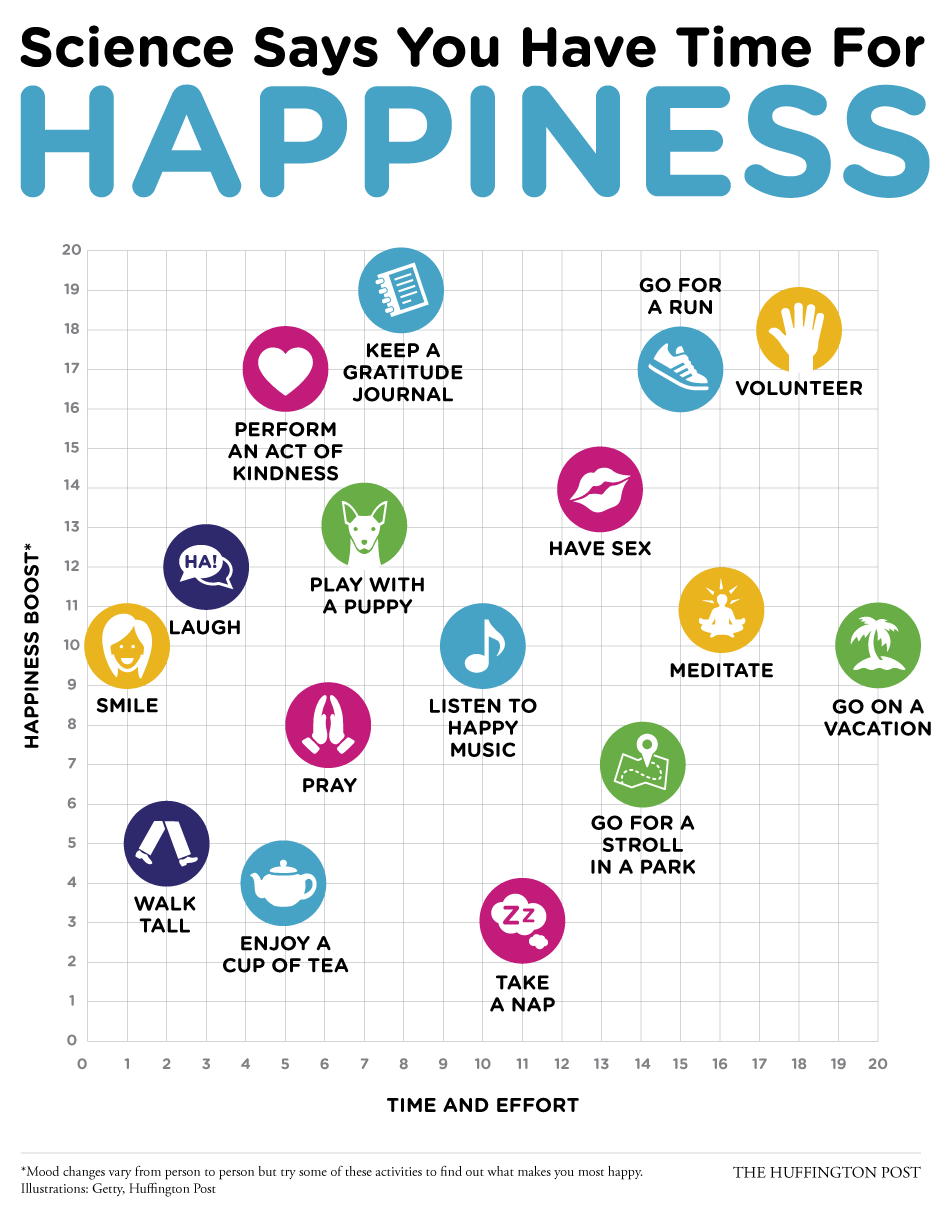
I’ve read a lot of books about happiness, but this little article on the Huffington Post really caught my attention with this simple and useful infographic. Click through on the link to the Huffington Post in that sentence to find the links to the studies backing the creation of this image.

2013_HappinessMatrix

Nice, huh?

Good to see how you can easily boost happiness simply by smiling (warning: the smiles have to be authentic – artificial smiles don’t work!) And I am really struck by the power of gratitude, and by performing acts of kindness.

So, how about just taking those three, and trying them out for the next few days. Start a gratitude journal and write in once a day, maybe preferably at night before bedtime……just list, and write a sentence or two about, whatever you experienced today that you feel grateful for, or write about who you are grateful to, and why. Set out each day to perform at least one act of kindness, or, even better, see if you can speak kindly and act kindly all day long. Finally, play some music which makes you smile, or look at some photos which make you smile, or delve into your memory banks for moments in your life which made you smile.