
cherry blossom, and the shadows of cherry blossom
cherry blossom, and the shadows of cherry blossom
Posted in from the dark room, photography | 3 Comments »
I started today outside Physio in the garden of hospital where I work


then I saw this gorgeous orange tulip

and a natural bouquet outside one of the consulting rooms

Next my walk stumbled into the dark


Have you ever seen a tulip like this?

Posted in from the dark room, photography | Leave a Comment »
For a while I was quite taken by the idea of “mind body medicine”. I was even impressed by how, in the US and in Japan, I could find “Mind Body Medicine clinics”. However, for me, the idea has worn off. It just doesn’t work for me any more. Here’s why.
The good intention behind the “mind body medicine” idea is to stitch back together what the advocates claim Descartes separated. It signalled the intention to address the subjective experience of the patient, and not just the objective body. All well and good.
However, what I don’t like is that it continues the delusion of two separate entities – a body, and, a mind – as if these are two different “things” which are linked in some way. But I don’t think it’s like that. I’ve never met a mind without a body, and I’ve only met a body without a mind in the mortuary. Is it ever sensible to focus exclusively on the body, or on the mind, if your job is to provide health care to human beings? I don’t think so.
Worse than that, many people seem to associate “mind” with psychological issues (or in terms of mental health, with psychiatric ones). Yet there is a lot more to the mind than cognition – particularly once you start to understand the mind as “an embodied, relational, process of regulation of energy and information flow“. Or if you begin to understand both the embodied and the extended nature of mind. Discovering the phenomenon of neural networks around the hollow organs of the body, particularly the heart and the gut, made sense for me of those phrases which up to that point seemed mere metaphors – “heart felt”, “heart broken”, “gut feeling”. The mind can’t be corralled into the skull!
The other experience I encounter frequently is one where someone has pain, or dizziness, or nausea, or fatigue, or something, and “all the tests are normal”, so they are told, “Good news. There’s nothing wrong with you”. But they’re still debilitated by their symptoms…..so, what now? “It’s in your head” – which means, either “you’re making it up”, or, “you’re mentally ill”. I think that’s a lousy way to make a diagnosis. If someone has a mental illness, it should be properly diagnosed and understood. And, more importantly, why assume a person is “making it up” if you can’t find any abnormal blood tests? Isn’t trust a foundation of successful medical practice?
The understanding of the concept of “complex adaptive systems” helps us to see that people are whole organisms, that health cannot be reduced to the sum of component parts, and that any disturbance within the organism is likely to produce changes throughout that organism and not be confined to single organs – not even the brain!
I do hope the medicine of the future will start from this perspective – holistic and patient-centred, based on trust and the ability to avoid subdividing people into the delusional idea of two entities – a body, and a mind.
Posted in from the consulting room, health | 3 Comments »
Excellent post on the School of Life site by Christopher Hamilton about scepticism. He starts by mentioning how Socrates doubted everything but how these days all kinds of people assume they’re cleverer than that –
Politicians know how to get the economy growing again (which we all know to be a good thing) and the economists know why it all went wrong in the first place; the health experts know what we have to eat to stay healthy, and the gym instructors know just the right amount of exercise we need; the Church knows what’s gone wrong with modern morality, and the atheists know that religion was a con anyway; evolutionary scientists know that we’re driven by our genes, and philosophers know it’s all much more complicated than that.
but of course……they really don’t know, do they?
the history of thought shows that equally sensitive, reflective, intelligent people come to radically different views about – well, about pretty much everything. Human beings claim to know because it’s frightening not to know…
Interesting how the contemporary so called “skeptics” (I’m thinking “Pub Skeptics” and their like), seem to be characterised by their complete sense of certainty……busy telling everyone that their views on anything and everything are absolutely right, and claiming that they know they are right because “science” tells them so.
How did “scepticism” morph from doubting everything to claiming to know things for sure?
Posted in from the reading room, philosophy | 1 Comment »
Health is a state of being of a whole organism. It isn’t reducible to either single elements, or to a cumulative total of elements. The whole is more than the sum of the parts.
A number of years ago, I read Hans-Georg Gadamer’s stimulating collection of essays, “The Enigma of Health“. He wondered about the strange invisibility of health. For example, at the moment I’m not particularly aware of having a left foot, but if something heavy were to fall on it, injuring it, I’d certainly be aware of it! I’m reminded of the Roger McGough poem, “Bits of Me”, where he refers to the bits of him which are making their presence know, when normally, they don’t! (a great, thought provoking, and funny poem)
I’m also very aware of how little “health” is discussed, taught or researched, what with both training and service delivery in health care being focused on disease discovery and management. But don’t we need to have some useful concept of “health” if we’re seeking to support and/or create it?
I recently came across some writings by the biologist, Brian Goodwin. He captures the issue beautifully here –
I take the position that there is a property of health of the whole organism that cannot be described in terms of the functioning and interactions of the constituent organs or tissues or molecules—whatever level of parts one wishes to consider. Furthermore, this property of the whole influences the functioning of the parts in identifiable ways; that is, it has causal efficacy. The absence of such a conception from mainstream biology and medicine is evident from the fact that there is no theory and practice of health taught to medical students that develops systematically such an emergent property of the whole organism with which one can work methodically. Health in the medical model is absence of disease, not presence of a coherent state that can be recognized and facilitated by an appropriate therapeutic relationship.
Wonderful. This is the understanding we need if we’re ever going to develop a science of health and a practice of health care.
Posted in from the consulting room, from the reading room, health | Leave a Comment »
I work in the NHS – the National Health Service. I was just wondering the other day……..why isn’t the NHS primarily about delivering services which are intended to improve health?
Pardon?
Well, think about it for a moment. Almost all of the services in the NHS are organised around diseases or body systems. Next door to where I work is the “Cancer Centre”. Around the rest of Gartnavel site there are departments of Infectious Disease, Dermatology, Rheumatology, Gastroenterology etc – all with a clear focus on delivering care to people with specific diseases and administering treatments designed to modify or manage disease processes.
That’s what health care does. It conceptualises illness as disease, usually by identifying objectively measurable changes in the body, then uses either surgery to cut out diseased tissue, or administer drugs “proven” to modify defined physical parameters (blood pressure, blood sugar levels, inflammatory markers etc). The hope, I’m sure, is that in doing this, health will emerge or improve.
My point is, that very little of organised health care seems to be structured explicitly, or directly, to stimulate or create a condition called health.
In fact, when I ask groups of doctors or nurses to give me their definition of health without referring to either illness or disease, they frequently struggle. Health doesn’t even get an entry in standard textbooks of Medicine, and the stated goal of Undergraduate Medicine is to teach doctors how to make a diagnosis (of disease). Despite that, I’m pretty sure most doctors and nurses would say they go to work each day to try to improve the health of their patients. The odd thing is that by focusing on disease and it’s management, health improvement is left to Nature, or chance, or hope. It’s kind of a side effect of the interventions delivered. A hoped for side effect.
Wouldn’t it be a good idea to have some of the Health Service focused directly on health? Might not a focus on health produce some useful impacts on the presence or progress of disease? Wouldn’t it be a good idea, in other words, to have another approach which directly intends to stimulate and increase health, and which hopes for a side effect of reducing disease?
But here’s the main idea – what about an integrated health service – where, with the focus centred on the patient, care is delivered which impacts on disease AND care is delivered which impacts on health – in each case, directly.
We’re well placed on the Gartnavel site in Glasgow. We’ve got the services focused on disease, but we’ve also got the Centre for Integrative Care, Glasgow Homeopathic Hospital, (where I work) which is focused on health. Here’s a photo of the site
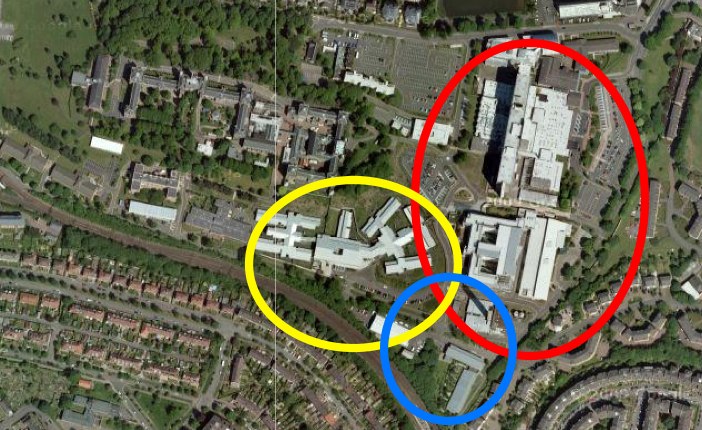
The red circle is around Gartnavel General, the physical disease hospital, the yellow is around Gartnavel Royal, the psychiatric disease hospital, and the blue is around the Centre for Integrative Care, the health-focused hospital.
Posted in from the consulting room, health | Leave a Comment »
Sometimes it’s the smallest things which look so exquisitely perfect……

Posted in from the dark room, photography | Leave a Comment »
I don’t know about you but it seems to me that there are some people around who seem to think that science can explain EVERYTHING. Personally, I think there’s a lot more to human endeavour and thought than the scientific method, but that’s another story….perhaps.
Here’s an article from Scientific American where they are posing the question “Too hard for science?” – a question which is actually wondering if there’s anything which can’t be explained by science. They put the question mark at the end because they clearly feel it’s unlikely that that sentence could be a statement. This particular article is by a sleep scientist who talks about how his subjects often want to tell him their dreams (I might be wrong, but I got the feeling he wasn’t that keen on hearing them!).
Dreams often feel profoundly meaningful, bizarre experiences often interpreted over the centuries as messages from the gods or as windows into the unconscious. However, maybe our brains are just randomly stringing experiences together during sleep and investing the result with a feeling of profundity.
Those last three words caught my attention – “feeling of profundity” – is meaningfulness a feeling? Would that make understanding also a feeling? Or insight? Are scientific insights feelings?
He goes on to scope out the “problem” as he sees it….
The problem: The difficulty in exploring this idea is that how meaningful something is might be too hard to measure. “It’s a bit like beauty — it’s in the mind of the beholder,” Stickgold says. “It’s not like heart rate or the level of electrical conductivity of the skin, which you have outside evidence of. If a person says something is meaningful, you’re not sure how to measure that, and you’re not sure how, if at all, that applies to others. One has to come up with a meaningful definition of meaningful.”
That’s the “problem” with the scientific method, isn’t it? It’s all about measurement. Meaningfulness, beauty (go on, add your own list) aren’t measurable. They’re a subjective expression. Not only that, but one person’s subjective expression is often not at all like another’s. What are we to do with that?
Ken Wilber would point out, I’m sure, that only surfaces are measurable, but depth requires interpretation. I deal with the subjective experience of health and illness all day. It’s only through the telling of their story that an individual can communicate that to me, and it requires me to listen, non-judgementally and compassionately so that I can interpret what they tell me. It wouldn’t be helpful to reduce people to what’s measurable in my opinion. Brian Goodwin, the biologist, also used to point out that objective, “measurable” scientifically described phenomena are only the result of intersubjective consensus anyway, and I think that’s also true.
This distinction between what is “objective” and “measurable” and subjective experience isn’t as helpful as it first appears. Whether we are observing, measuring or interpreting, we need reach a consensus about our subjective experiences. That’s the bottom line for me with patients – it’s their experience, as told by them, which is most important and reliable if I’m going to help them to find greater health.
I guess what I’m saying here is that I don’t think science is “the way, the truth and the light” – it’s an appropriate way to increase understanding in some circumstances, and not so appropriate in others. Or is that just too narrow a view of science?
Posted in from the reading room, science | 1 Comment »
The Edge recently had an issue on predictability. You can predict why! From the financial collapse of 2008, to the earthquakes, tsunamis and hurricanes which have devastated so many parts of the world in the last three years, certainty seems increasingly misguided. The first main article in the piece is from Bruce Parker, an oceanographer. He starts with this –
Prediction is the very essence of science. We judge the correctness a scientifictheory by its ability to predict specific events. And from a more real-world practical point of view, the primary purpose of science itself is to achieve a prediction capability which will give us some control over our lives and some protection from the environment around us.
Oh, that bothered me. It’s bothered me since I first read it, and it’s continued to bother me since. You see, I like science. I love those scientific stories of exploration and discovery. But I don’t like the kind of science described in this opening paragraph. “Prediction is the very essence of science”….really? I know what he means, but isn’t there a lot more to science than prediction? I went back to Richard Holmes, “Age of Wonder“. No, it’s not a tale of prediction, it’s a tale of wonder and discovery. And what about this aim of science – “give us some control over our lives and some protection from the environment around us”. Again, I understand why he says this, but isn’t this too narrow a view of science? Doesn’t complexity science itself show how unlikely it is that we’ll be able to predict and control ourselves or the natural environment of which we are a part (not “apart from”)?
So, it was with great interest that I read and article from the biologist, Brian Goodwin, entitled “Towards a Science of Qualities….”
Reductionist science is essentially a strategy of divide and conquer: dividing the world into constituent systems whose parts are simple enough to allow prediction of their behaviour, and hence to exert control over their activity. This has worked remarkably well in many physical systems and even, to some extent, in biology. The approach exemplifies the principle that can be described metaphorically as linear thinking, which regards a whole as no more than the sum of its parts. Manipulation of the parts then results in control over the whole.
He goes on in the article to describe characteristics of complex systems and to argue (convincingly in my opinion) that we cannot hope to predict and control such systems. What we need to focus in instead is to further our understanding of complex systems and to learn how to increase things like “fitness” and “resilience”.
I think that’s the right approach. There’s too much “command and control” in our world – and it’s flawed. Let’s restore a sense of wonder, a desire to discover and understand, and to develop a good, scientific understanding of how to adapt, how to be flexible and how to increase our resilience and our creativity.
Posted in from the reading room, science | Leave a Comment »


